 Prof G Markets
5 Oct 2026 · 1h 11m


 Add vo to ChatGPT or Claude to ask about everything you hear
vo listened to this episode to put together the overview and transcript, so there may be the odd mistake.
The episode debates AI company risk vs valuation (especially Anthropic and OpenAI), FTC scrutiny, customer concentration, and whether the market is overvaluing “AI labs.” It also covers IPO market delays (e.g., Aura), rising Treasury yields, and portfolio implications (more bonds).
Scott (host/analyst, discusses Anthropic S1, valuation math, and risk pricing) and Ed (co-host/analyst, focuses on market dynamics, IPO timing, and fixed-income strategy). Ed references prior Bloomberg TV work and frequent panel appearances with Paul Kodrosky; no other named guests appear in this transcript.
Anthropic’s leaked S1 shows revenue growth but massive operating losses (operating loss cited at ~$8B) and heavy customer concentration (about a quarter of revenue from two clients; ramp data suggests ~80% of enterprise revenue from ~1% of customers). The valuation (around ~$2T) allegedly ignores fragility and regulatory/consumer-safety risk. The hosts argue the issue is “price problems,” not necessarily a broad AI-market bubble. They also claim IPOs are pausing due to market conditions and high yields (10-year ~5.3%, 30-year ~5.6%).
FTC investigation into OpenAI and Anthropic; OpenAI delaying Astra; Reuters/Axios reporting on security breaches; Mad Men “Lucky Strike” dependency analogy; Aura IPO shelved; S&P 500 gains concentrated in Microsoft, Meta, Apple, Alphabet, NVIDIA.
0:00Exchanges on the economic impact of AI. Exchanges on gold, energy, and the commodity markets. For the sharpest analysis on finance, business, and the economy, count on exchanges, the Goldman Sachs podcast. Listen now. You know that feeling. Too many updates, too many meetings, too many things falling through the cracks. Monday.com was built for that gap. The AI work platform designed from the ground up for people and agents to work side by side and deliver more together. Drafting the brief, flagging risks, running a competitive scan, your agent can do it all. And the best part, anyone can build one.
0:39Even you. Try it. Create your first Monday agent today at monday.com. Company spending is complex. Managing it should be simple. This is Amex Corporate, a single platform connecting cards, expenses, and payments to streamline the way you work. flexible controls for when priorities shift, support around the clock, all backed by American Express so you can stay focused on what matters most. Built to simplify, designed to scale. This is Amex Corporate. Get started at go.amex slash Amex Corporate. Terms apply.
1:19Today's number,$30 ,000. That's how much the world's most elite sheepdogs sell for at auction on a farm in England. True story, Ed. My sister was accused of bestiality. We'll all be a monkey's uncle. You like that one.
1:48Ed trying to look sexy. The flannel shirt. He thinks he's Grizzly Adams at a Pearl Jam concert. What are you wearing today? The same thing I wear every day. I have rag and bone jeans, Panerai watch, and Brunello Cuccinelli. Hello, ladies. There we go. Hello, ladies. That's pretty sexy, too. Yeah. $30 ,000.
2:11Grr. Grr. Yeah. Yeah. No, I make a room sexier by leaving it. Yeah. So,$30 ,000 for a sheepdog. What do we think? I asked a Scotsman what his body count was, and he started counting, and then he fell asleep. That is my favorite family guy thing, where the guy is shearing the sheep, and the sheep's like, oh, yes, you bitch. Shear that shit. Shear it.
2:45It is very good. You spoke to one of my early role models, Paul Kodrosky, yesterday. By the way, I listen to podcasts, which I don't like to do. but he's really good it was a really good one well done paul's really good paul's very very very smart guy with a lot of opinions on ai which we will be getting into now but first off we haven't talked enough about me okay um about 25 years ago i'm not joking my first tv appearances were on bloomberg someone named laura gosh such a cool woman who did content programming reached out of nowhere and said you're a marketing professor you want to come talk about marketing And I used to go to Bloomberg Television every week, and I'd be on with Tom Keen.
3:27That's how I met Stephanie Ruhl. That's how I met Sarah Eisen. And I used to do every week this thing called Business and Tech with Deirdre Byrne, who I love. She went to Fox. It's like college. Stephanie Ruhl went to MS now. And then, oh, and Eric Schatzker, he's still there. He's the only one that stayed. But it all started for me at Bloomberg Television. And how does this relate to our man Paul? Paul was also a frequent guest. And I used to be both happy and bummed when I'd have to go on. They'd bring us as the two panelists in for like, you know, he and I were the panelists and the founder of Reddit for when Facebook went public.
4:11It was supposed to go public at the opening of trading. It didn't go public until once. We had to sit there for three and a half hours trying to talk about tech. it was really painful and come up with new insight into the facebook ipo because there was some technical problems and paul it was like a love hate thing i love paul he's a nice man i think he's super fucking smart i was always so intimidated by him because i'd be like the audience is going to figure out i don't know what i'm talking about when i hear paul talk he's very smart he's very knowledgeable he's very smart he brings the heat he's aggressive he's opinionated uh he's everything you want in an investor but also uh in a guest on a show Yeah, he's really good.
4:49But he told, when we had him on a while ago, we've had him on a couple times now, he said he doesn't like going on Bloomberg or CNBC anymore because he doesn't like feeling like he's in a Piers Morgan debate show anymore. It could be worse. You could go on Piers Morgan and have to put up with some MAGA douchebag who calls you un-American and desperate. That's nice. That's why I've worked this hard, Ed. God. I like Piers, though. I like Piers. Piers is good. He knows what he's doing, which is his sensationalizing drama, but it's entertaining. It makes I feel stupider with Abby Phillips feel like real journalism.
5:29That's even more. Yeah, but Pierce, he knows how to—he does good TV. When did CNN and Abby Phillips turn into like Jubilee media? When did that happen? I think they nailed their eyelids to the forehead and made them watch 72 hours straight of Jerry Springer. Yeah. And they said, that's what we need. We need to turn this into Jerry Springer with a CNN logo. That's probably a little harsh. That's probably a little harsh. By the way, Abby texts me to get in my face. She texts me. She is not afraid to text me and tell me how wrong I am. People like her, though. They say she's a good journalist. That's my attempt to put my words back in my mouth here.
6:11It's also the highest rated show on CNN, which is a pretty wonderful reflection on the state of our society right now. Yeah. Keep trying to unsay what you said. I will quote Katie Martin. You can't put the shit back in the donkey. Let's get into our show. We have a lot to get into here. All right. Now is the time to cry. I hope you have plenty of the well-resolved. Washington is starting to take a closer look at the AI industry. Last week, the FTC opened an investigation into OpenAI and Anthropic over potential safety and consumer protection concerns. The news came during an already chaotic week for both companies.
6:52OpenAI announced that it would not release its latest Astra model due to safety concerns. And Reuters reported details from Anthropics S1, which show that the company racked up an operating loss last year of$8 billion. dollars. So, Scott, a lot of AI news to dig into here, which is going to be extremely important for the public markets going forward. I think a decent place to start would probably be the Anthropic S1, which, as you mentioned, we dug into last week with Paul Kudrosky, and he had some interesting things to say. But I would like to get your take. revenue last year grew 12x to nearly 4.6 billion dollars but their operating losses widened to more than eight billion dollars last year to be clear we don't know what their financials look like right now in 2026 and that obviously matters a lot but we did get some clarity on what financials looked like last year and the reality is as we have suspected for a long time that the losses are enormous in the same way that they're enormous at open ai not as enormous when it comes to anthropic but still very very large and this is very relevant considering this company is imminently going public supposedly it's going to happen right after the midterms uh scott what did you make of these leaked revealed financials who knows if they were actually leaked or if it was a setup i don't know what do you make of them they were leaked by uh anthropic yeah would be my guess um there's the valuation itself and we'll come back to it but what paul said yesterday on on i was going to say your show but our show um it was that the really the number that jumped out to him and i didn't recognize it was i believe about 40 percent of the revenue is coming from just two two clients a quarter not 40 percent excuse me a quarter We always used to worry.
8:48I've always run small companies. I've never been able to scale to a big company. And we always had, and I've always been in B2B services, right? Strategy, analytics. And we always had this problem of too much concentration across the small. Nike was like 22 % of our business at one point. P &G was 15%. LVMH was like Estee La. The five companies were like 60 % of our revenue. And I used to say, okay, that's a problem, but it's a good problem. It means these iconic brands are spending a shit ton of money on a small company and getting the types of contracts that only big companies get. But when you're asking for a$2 trillion valuation, you need to look more like Meta.
9:33And that is, remember all of these, and I'm guilty of this, attempts to boycott Meta, where people were so upset at Meta. I think it was like five years ago, they said, let's start a boycott. And Meta has something like 300 ,000 clients and no one is more than a third of a percent. That is what you call robust. And robust is a really interesting term in business because it indicates fragility. Let's talk about the economy. The banking industry is not robust. If JP Morgan finds out it had some rogue whale trader that figures out a way to short circuit or get around some of their internal controls and makes an enormous bet on the debt market in Germany.
10:22And it turns against him, and they end up down$700 billion somehow using leverage and derivatives that got past their compliance or risk department. And Jamie's about to get flipped upside down. If he calls Donald Trump, Donald Trump has to bail them out. J.P. Morgan has become too big to fail. And they put in place a bunch of capital constraints and ratios, Sarbanes-Oxley, that are supposed to limit the likelihood of that. But the banking industry in America is not a robust business. There's a lot of small banks, but a disproportionate amount is concentrated amongst some of the bigger banks. They would argue back that that creates strength, creates operating leverage, better customer service, lower interest rates.
11:08And those banks do an amazing job. And JP Morgan right now is worth more than the biggest 12 banks in Europe, just that one bank. So there's this capitalism versus regulation, but back to the notion of robust versus fragility. The fast food industry is really robust. It's not fragile at all. If the biggest player, McDonald's, went out of business, you could just still find really cheap caloric intake that puts you on a path towards diabetes really early, really easily. There's a ton of substitutes. And the reason why you want a robust industry is it not only results in a lack of systemic rest of the system if one goes out and consumers start bailing it out.
11:50The problem when you're too big to fail is you start taking stupid risks because your downside is limited because you know you'll get bailed out, right? And also the advantage of a really robust industry is there's more competition, which ultimately lowers rents and transfers capital back from the shareholders to the consumer, which is absolutely what we need more of. Long-winded way of saying the most frightening thing about this is I don't think you've ever seen a company ask for$500 billion in market capitalization that had a fraction of the client and revenue concentration that Anthropic highlights or articulates in its S1.
12:26I want to get your reaction to that. And then I want to talk a little bit about the valuation. Oh, I can 100 % agree with you. I think the problem here isn't necessarily the company per se. It's a startup. It's a relatively new company that is trying to figure out how to get clients similar to the thing that the dynamic you're describing that you dealt with when you were starting your businesses. Some will say, well, that was last year. You're looking at the customer concentration from last year. But what we know based on the ramp spending data, which has been extremely informative, is that 80 % of both OpenAI and Anthropics enterprise revenue is coming from 1 % of customers.
13:04And so the question that you have to ask yourself, sure, that they're getting a lot of revenue. And let's be clear, the revenue numbers are incredible. I mean, supposedly OpenAI is coming up on$70 billion ARR. ARR is a little bit of a bullshit number, but let's put that aside and recognize that these are tens of billions of dollars in revenue that these companies are raking in, and that is impressive. But there is extreme customer concentration risk here. And I've been going back and watching Mad Men, which is the greatest TV show of all time. And I am reminded of exactly this dynamic, because I don't know if you remember, but Sterling Cooper Draper Price, in that TV show, they have a similar problem where they're extremely dependent on Lucky Strike.
13:47And then one day, the CEO of Lucky Strike has a meeting with Roger Sterling. He says, sorry about this. I know we've been together for 25 years, but it's time to move on. At which point Roger Sterling says, you're going to kill me. And that's essentially what happens. It completely collapses the business. And this is what happens in business. If you become too reliant on a handful of customers, things can go wrong and suddenly your business is no longer sustainable or structurally sound. So they are at immense risk of that. And that's okay. That happens. But they are asking for a$2 trillion valuation, which would make them more valuable than Meta, more valuable than Saudi Aramco, more valuable than Broadcom, more valuable than Berkshire Hathaway, more valuable than Eli Lilly, more valuable than JP Morgan, more than twice as valuable as JP Morgan.
14:40And so for me, the problem here, as usual, is that we're having price problems. We're having an issue of the valuation. And I don't think that the valuation is properly pricing in the massive risks here. And I've said this before, but I'll say it again. I don't think that we necessarily have an AI bubble right now that is infecting the totality of markets. We can see that in, say, the NVIDIA valuation, which has actually come down quite significantly. But we do have an AI lab bubble, where there seems to be too much excitement and too much enthusiasm about Anthropic and about OpenAI because they're new, they're sexy, they're doing interesting things.
15:20But let's be very clear, they still haven't figured out their business models by all accounts. And from what I'm seeing, they are still not profitable. In fact, they're very unprofitable. Some of the most unprofitable businesses of all time, and the risks are still systemic. So I think that needs to be priced in. But the question is, will investors care about it? Or are these businesses just too sexy that it's not going to matter? I'm not sure. But over the long run, I think it will matter. I'm just impressed I was able to find a protege that was more glass half. You're like glass is broken and it's going to sever your thumb.
15:56I'm not. I'm not. On these two companies, again, for me, it's all about price. Just remember about me. I also bought Meta. I also bought Microsoft this year. I bought the SaaS company. So I'm not everything's, I'm not a perma bear. I've never seen a more important distinction or what will be a greater effort in IR history for people, for everyone to start talking about four or 12 months revenues versus trailing. Because the thing that is staggering about this company is its growth rate. And if it were to, it supposedly is 10Xing again this year. And if it 10X is next year, then all of a sudden its multiple on revenues goes from 435 to 7.
16:37At Ford for 35, you know, DeModerin accurately called it, said that the math says Anthropic needs the entire AI market to nearly 4x just so one company can hit its number, which isn't, you know, which isn't a forecast. It's a monopoly fantasy wearing a spreadsheet, you know, needing 74 % annual growth for 10 years straight to justify your price tag. You know, you're asking investors to bet on a streak no company, including NVIDIA, has ever thrown. So that this valuation, built into that valuation, is this will be the most enduring, fastest growth company in history. That's a bold thing to assume.
17:16That's not pricing to perfection. That's pricing to hallucination, right? That's pricing to kind of a wing and a prayer. I think it is probably growing faster than any$1 billion plus business in history, including NVIDIA. Now, having said that, the asterisk on the asterisk is the thing that is fueling that growth appears to be a small number of enormous spenders that keep finding, I think it's specifically Alphabet and Amazon, that keep finding new ways to leverage AI. And as Paul referenced, how many of those types of companies have that type of business to, one, justify multibillion-dollar spends and, two, can leverage that multibillion-dollar spend into their businesses?
17:56How many businesses have the capacity and the need to spend$1,$2,$5 billion on these types of services? So this is either way. I would imagine, I think a lot of these marks, I would be dying to know, and unfortunately we don't have clarity into this, what is the volume in the secondary market? Because if I, you know, I've had a couple of these calls from people, oh, my brother or my wife works at OpenAW, sell, sell right now, call Setter, whoever it is, sell. I mean, and call me and I hope I'm wrong, but, you know, 435 times trailing revenues, or if it's 300 in the private markets right now, whatever that is, this is an extraordinary company.
18:44But, and then the asterisk on the asterisk on the asterisk is there's probably a non-zero, I would say there's an even greater risk in a mask extinction event of an anthropic extinction event. and that is I'm literally looking down out of my hotel room at the intersection between Santa Monica and Wilshire Boulevards. If some rogue bots who were told to be creative and persistent and told to shut down the signals at Santa Monica and Wilshire, if they were able to figure it out and I'm not sure these things are connected to the group. I can't figure out if this is a smart city or not or if these signals are hackable.
19:27But if they were able to shut it down for, say, 10 minutes and they were say there were a dozen automobile accidents where all the lights just turned green at the same time for 10 minutes. I think the media is so ready for a story. I think the public is so sufficiently alarmed that I wouldn't be surprised if they basically if finally Trump or somebody was forced to step in and say, you have to shut down for 72 hours. And then what happens to the valuation? And it might already be happening, which is why the FTC investigation is so important, I think. They're now investigating Anthropic and OpenAI.
20:06And it looks like this is going to be a question of were they deceiving consumers or other customers about the potential harms of their artificial intelligence? And I think the answer is, yeah. I mean, we just had the reporting from Axios, from Madison Mills, who came on the show last week. And her reporting showed that there have been thousands of these security breaches. And the question is like, OK, well, why wasn't anyone told about this? I mean, so far, there has been no legal action, no legal ramifications that have come out of what have supposedly been some of the greatest security breaches in the history of cybersecurity.
20:43And it all lies at the feet of OpenAI and Anthropic. And so the question is like, okay, clearly there's got to be something. Something's got to happen. And the question is, what do you think that something is going to be? If the FTC has decided that these guys are targets and put the target on their back, that's a problem. And then it's also a problem if the entire American public hates you, which we've been talking about for a long time. And whether that hate is warranted or unwarranted, I don't know. I'm not going to opine on that. But what I can tell you is it exists and the fact that it exists matters and while you're in los angeles i will just point out an observation that we were discussing with the research team uh for the markets show which is that over the next couple of months you're about to see four different feature films hollywood movies that are going to be centered around a tech founder and how bad the tech founder is.
21:41You've got Social Reckoning coming out next week, this week on Friday. You've got Musk, the documentary about Elon, which apparently is going to be very anti-Elon. You've got the Elizabeth Holmes documentary coming out the next week. You've got Artificial, which is the movie about Sam Altman, and supposedly Sam Altman is not very excited about this. Supposedly, it portrays him as like this sociopathic serial liar. Again, I'm not saying that these movies are accurate or fair, but they exist and it's happening. And so the question is, does that have an impact on your valuation? Does that have an impact on the usage of your products?
22:20I think ultimately it does. And all I want to see is a little bit more reflection of those risks reflected in the valuation. I think that what we're seeing at a$2 trillion or a$1.5 trillion is just investors saying, blinders on, cover your eyes, doesn't matter, they're going to win. Done deal. It's a fundamental law of the universe that Anthropic is going to be successful. That is a very, as I said, bold statement. Let's attach some risk to that. Let's reduce the price a little bit to reflect what might go wrong here, because I'm looking at the news right now, and it's a lot. Everybody missed out on what is the greatest stock in history, and that is the infrastructure for AI, and that's NVIDIA.
22:59So people think, I mean, all they hear about is AI. People who do use Anthropic go, it is just a technological marvel. It is a breakthrough. And then when they're going to see it's 10xing and then they see other pundits say it's going to 10x for a long time, you can make an argument that pretty soon it's going to look not crazily overpriced. I think all the existential risk, I think the concentration risk, like I said, I don't own the stock. I own it indirectly through some bankruptcy claims I bought against FTX, which have already been sold. but you're i think you're looking at this rationally it does feel overvalued i have told people who own this stock to sell it right now because i imagine there's a robust secondary market but the risk of this thing getting cut by 80 because of some exogenous event or another rogue thing is is pretty dramatic but most importantly the real piece of data here we need to I need to fact check you right now Mad Men is not the greatest series in history although I do have I'll do a good impression of Mad Men scene alright tell us do this you say this say say Scott you never say thank you say that the greatest line of all time Scott you never say thank you that's what the money's for that's the greatest greatest line greatest line in all of television and I'm not sure how you could say Breaking Bad and Modern Family and The Sopranos Modern Family, really oh my god when Jay is talking asking whether he knew whether his father knew that he loved him I mean, come on that, you don't have kids yet so you're emotionally bankrupt not a softer talk to me after you have I cannot watch that show without crying I can literally I cannot oh my gosh I absolutely I think Phil that guy's the funniest guy in history he's like I'm the cool guy I'm the cool dad lol laugh out loud wia where you at wtf why the face
25:15there's a scene where he's like I'm the cool guy he he reminds all the dances from high school musical and he's doing it and you see how the kids react and then i'm sorry i'm gonna go through my favorite scene and then they walk in on claire and phil having sex and they freak out and they run downstairs and and the kid the daughters are like what were they doing and luke the youngest goes i don't know but it looks like dad was winning oh those guys are geniuses i hope they all made a billion dollars i hope air i hope everyone on that show made a billion dollars they deserve it anyways where we are extinction event anthropic s1 all right bring me back i think we probably hit all the only other thing that we could talk about is the wire no oh no i'm sorry go ahead uh open eyes dev day they have released their own competitor to muse uh they're calling it dots um not much to say here other than i think that they're going in the right direction they recognize that meta is doing something pretty powerful which is that they're trying to use ai to do the boring stuff in life and not do the sort of frontier model uh figuring out you know the the secrets of the universe they're just figuring out how to book a reservation and how to get a doctor's appointment open ai has now come out with a competitor uh there were some things that went wrong for example the cfo sarah fryer was talking about it on tv and she accidentally called the product Muse instead of Dots.
26:46People found that funny, kind of a flub. I get it. It happens. And then also they had a few mistakes during the live product demo. I don't think any of it is groundbreaking. I don't think it says anything that dramatic about OpenAI. To me, honestly, I think they're doing the right thing here. They are trying to compete. The only trouble for them, to me, the bigger problem is the fact that they're getting investigated by the FTC. And I think that could be consequential. The interesting thing on Muse and Dots, I mean, have you seen these things? One of the visual metaphors of plushy toy. They're so Sandberg-ing us.
27:22They're trying to pretend that this mutant Lucifer-like product is cute and adorable. If they were really honest with this thing, they'd make it look like the alien from the USS Sulaco in the movie Aliens. like this thing could if if you cut this thing it's it's blood might be acidic and it is and it's sentient and it is really mean and a lot of people might die that if they were honest they would have here's our new product and they have an alien come out and start tearing apart people why does that make me happy ed what does that make me happy instead it's a little plushy To be honest, if I were giving business advice to OpenAI, I would say, yeah, do the plushie toy instead of a Godzilla version of your AI.
28:11So they might be lying, but at least they're doing the right thing from a business perspective. And then you press on the plushie toy on like one of those baby toys that goes, we're open to regulation. We're open to regulation. We're open to regulation. Or you press the back. We need to do better. We need to do better. We need to do better. Or press it again. We're proud of the progress we've made. We're proud of the progress we've made. We're proud of the progress we've made. That's already Sam Altman. Just press a button on his forehead and that's what comes out of him.
28:42We'll be right back after the break. And we have some good news. We are nominated for three Signal Awards. So please vote for us at vote.signalaward.com. Every vote counts. Type in Prof G Markets in the search bar. You'll find us. And we'll also leave a link in the description.
29:06support for the show comes from framer if you want to create a website that looks great feels handcrafted and comes together fast and seamlessly then look no further than framer it's a complete website platform not just a builder so teams can launch and keep improving their sites in one place it helps creators teams and businesses ship production ready sites faster than ever while getting every detail right. You're able to prompt, inspect, edit, and publish in one place at a whole new pace. On Framer, agents and humans work in tandem. Agents bring speed and scale, while people bring taste, judgment, and control.
29:38And all of that takes place in the same workspace where the real site is designed, managed, reviewed, and published. Those ideas land on the canvas, stay editable, and can be published when the team is ready. Framer is an enterprise-level solution. Thousands of businesses, from early-stage startups to Fortune 500s, are choosing to build their websites in Framer, where changes take minutes instead of days. Learn how you can get more out of your site from a Framer specialist or get started building for free today at framer.com slash markets for 30 % off a Framer pro-annual plan. That's framer.com slash markets.
30:13Rules and restrictions may apply. Support for the show comes from Vanta. When you run security for a company that's scaling fast, the stakes just keep climbing. More compliance frameworks, more vendors, more risk, and a board that wants to see it all in one place. But in actuality, your compliance data is all over the place. Controls in one tool, vendor risk in another, and customer commitments buried in contracts. Your team has to spend more time stitching it together and less time running the program. And every quarter, you're basing decisions on last quarter's data. That's why Vanta connects it all.
30:51Its market-leading agentic trust platform is built for enterprise scale. With more than 400 integrations and continuous monitoring, Vanta automates evidence collection, surfaces the risks that matter, and organizes your audit around your auditor's requirements. The numbers back it up. Vanta delivers a 526 % ROI over three years and pays for itself in three months. and it's trusted by more than 16 ,000 companies, including Snowflake, Atlassian, and Ramp. Learn more at vanta.com slash markets. That's spelled V-A-N-T-A dot com slash markets.
31:43Monday agent today at monday.com.
31:51We're back with Prof G Markets. This is the first full week of the fourth quarter, so we're going to take a step back and look at what happened in Q3. We will talk about the IPO market, where six companies postponed their debuts. We'll also look at the latest inflation data and see what that might tell us about the health of the economy. And finally, we will dig into the bond market, where yields continue to hit multi-decade highs. Scott, let's start with this IPO news, because we were excited about the Aura IPO. And we had talked about some of the IPOs that had been postponing or pausing their plans before, like SB Energy, which we identified as a BS borderline fraudulent company.
32:32Maybe that's harsh, but they said they were a data center company and they have no data centers in operation. Either way, there have been plenty of companies that are supposed to go public. holtec omiro agrico sp energy bamboo insurance and now aura and they're all delaying and most of them are saying that it's because of market uncertainty that is what aura the smart ring maker said themselves as well uh and this is interesting because you look at the market right now the market's up 12 year to date uh yeah there are some concerns about ai bubbles and circular financing. But generally speaking, it seems to be pretty strong.
33:10And then suddenly you have these companies saying, now's not the right time. There is too much uncertainty. There is too much risk. And so I guess the question is, are they right? And if they are right, what does it say about market conditions at this point? I got caught flat-footed here. I predicted that the Aura ring was or Aura was going to be a successful IPO. Not only was it not a successful IPO, it got shelled. And I've been in these meetings where you're arguing with your bankers around valuation. Your bankers want to manufacture a POP such that their existing institutional investors that have access to the IPO get rewarded for trading through the investment bank or doing business with them.
33:50The issuer, the issuing company wants a POP, so they're on the front of the business section of every company or every news media publication around the world. And typically what happens is the bankers come back and say, okay, we can get you out. We can manufacture a pop, but only if we go out at this price. And of course, management says, no, we should go out at this price. And there's a back and forth and you settle at a midpoint and you go out. Typically, IPOs get shelved when management just can't wrap their head around the valuation that the bankers are saying, based on our read of the market, this is what we can get and have a successful IPO.
34:29And what happens is management says, well, market dynamics trump individual performance. We're going to hold. Now, there's different types of holds. There's, I think, one of the, God, one of these septic tank companies in AI that you were talking about last week that it was just ridiculous, a soft bank company. Yeah, SP Energy, yeah. I'm not sure that ever gets out. My guess is with a company like Aura, it either gets acquired or it goes out again. But basically, when the economy is printing 2-plus percent growth and you're at sub 4.5 percent unemployment, while yield screen 5 percent, it's two different parts of the market pricing two different futures.
35:12And what the IPO market is saying is that the window for founders' exits just got smaller. Which is surprising, by the way, because you'd think that right now, if exuberance is high, then now's the time to be throwing the feed to the chickens, right? Yeah, the ducks are quacking. And I wonder if it's because so much capital is being soaked up by the hyperscalers doing follow-on rounds. I don't know, but it really, it surprised me when I found out, when I read the article on, whenever it was, Tuesday or Wednesday morning, that Aura had shelved its IPO, I was genuinely surprised. I did not see that.
35:52I did not see that coming. And I wonder if there's going to be more reporting. The reporting I saw said that there was overhang in the market because either the largest investors or one of the largest investors in Aura wanted to sell her entire stake. Bad signal. Sends a chill, right? It's like, okay, the person who's been in this the longest and knows it really well has decided not to, like, take her principal off the table and let it ride. She wants to sell it all. And there can be situations where it's like, okay, I'm raising another fund. I need to show IRR. I need to show a mark here. And I'm fine with 10X, not 20X.
36:31I get that. But she may have, I don't know, but, and it is a she, I forget if she wants to run. She may have shit the bed here. She may have, because one of the knocks on it, and we outlined this in the prediction, was that I think two thirds of the proceeds were going to buy out secondary. And I think she was like half of that. but I wonder if something else happened. But the market is basically, this is, or is a good company. So if it didn't get out over pricing, it's because management's greed glands are like, all right, we're going to wait three, six, nine months. We're not in a hurry. We're cashflow positive.
37:08And wait till the market's frothy again. We feel good. But something was afoot here. I think it's got to be that. I don't think it could be that or specific if you're seeing this across the board, If you're seeing it with all these other companies, you're seeing it with even, I mean, OpenAI has a whole slate of other problems and they're delaying it for probably different reasons. But there are a lot of companies here that are not going public. And I think it's probably a market conditions problem where they believe that animal spirits are not high enough. And I think, honestly, they're right.
37:42And it makes me feel not necessarily bullish, but it makes me feel comfortable about this market right now. And actually, if you look at the market, so yes, we're up 12 % year to date, which is pretty strong. But if you look at the past month or so, what you find is that actually more than half of the companies in the S &P 500 are in a bear market right now, which means that they've fallen 20 % or more. The only sector that has risen in the past month is information technology, big tech. And in fact, since July, there are five stocks that have contributed to 93 % of the S &P 500 gains. That's crazy.
38:23They are Microsoft, Meta, Apple, Alphabet, and NVIDIA. All of the names that you would have expected. So I think what we're seeing here is a market that outside of some of these big tech names, which I also want to be clear, they got marked down at the beginning of the summer. And we talked about this on the show a lot. I talked about why I thought that those were opportunities. Since then, they have come ripping back up. But you look at the rest of the market, and it does seem to be a structural problem where valuations are starting to come down, which I think is healthy. And I also think it's a result of probably the most important thing that is happening in the market right now, which is that yields are fucking soaring.
39:11Every week, we have a new headline about how the 10-year or the 20-year or the 30-year is hitting a record high. You've got the 10-year yield, which hit 5.3%, which is the highest since 2002, more than two decades. Same with the 30-year, which passed 5.6%. Again, highest since 2002. And what do we know about higher yields? It generally means lower valuations in the stock market because now you need to demand more returns, more from your returns, at least on a risk-adjusted basis, because the risk-free return that you can get on your bonds is simply a lot higher. And so I think that is probably playing a big role in the IPO jitters.
39:54It's sort of basic markets 101. Rates are going up. Yields are going up. That's not good for equities. Let's wait until things feel frothier again and so we can get a real, real good price when we go out public. And to me, I'm like, okay, that's probably a sign of a healthy market. That's a sign of investors with their heads screwed on straight. So just to try and reverse engineer it to a learning for young entrepreneurs and professionals, something that one of my mentors, Todd Benson, said that's always struck me, and it seems obvious when you hear it, but most people don't actually believe in terms of their actions.
40:31Market dynamics trump individual performance. And that is, if you're thinking about selling your company, you think, well, okay, how's the company doing? And, okay, that's important. what's most important is what is the market right now for a small media podcast company? What is the market for a tech company? What is the market for a startup in cybersecurity? Market dynamics trump individual performance. And the personal lesson is when things are going really well for you, recognize a lot of it isn't your fault, that it's the atmospherics and be humble and grateful. And when things are going really shitty for you in business, realize a lot of that isn't your fault.
41:10You're just whatever your industry is out of vogue or you just got unlucky. So in 2000, I shut down Brandfarm, an e-commerce incubator in New York after it was in business for six months. It was June of 2000. I started several companies. There was no market for anything around the internet. I shut it down. Was I an idiot for starting a company that shut down six months later? Maybe a little bit. But if I'd started that company three years earlier, I would have probably raised another$100 or$200 million, and these companies maybe would have had the capital to survive the nuclear winter that was the dot-com implosion.
41:53At the same time, when I started L2 in 2009, 2010, just coming out of a recession, people were cheap. Real estate was cheap. Companies were looking to do new things in the internet. I just had so much wind in my back. Oh, and by the way, the markets went on an upward tear, the likes of which we haven't seen before. And I was able to sell a company on just one round of financing, small financing for eight times revenue. Yeah. Did we execute well? Yeah. Was it a great company? More than that, the market dynamics were incredible. Also, as it relates to when to sell, as an entrepreneur, you have to not only not trust your emotions, You have to do the opposite.
42:41And that is when your company's jamming, the inclination is, no, hold on, we're jamming. In 1996, I'd started Profit in 92. And just four years later, I think Profit, a strategy firm, we were doing about 3 million in revenue. And there was these new age digital services companies called Scient and Viant. And this very talented entrepreneur, I think his name was Eric Greenberg, was running a company called Science and it was just killing it and helping companies reformat their technology for a digital future. He called me, was in San Francisco, said, come over, I've heard about profit. I think we were doing$3 million and he said, I want to acquire you, da, da, da.
43:23And I think the valuation range he's gave me was like 40 to 55 million for a$3 million company or 15, also Sapient Nitro offered me, I think 10 to 20 times revenues, but I was jamming and I was this small, you know, new entrepreneur doing real interesting work for William Snowman. I was like, Oh no, we're going to the moon. Oh my God. Could I have been any more fucking stupid? People were offering me 10 to 20 times revenues. I ended up selling in 2000 for 2.8 times revenues when it was at 10 million, a much more robust business, much more diversified, much stronger client base, but the market had changed dramatically.
44:14When your business is going well, that's when you want to sell. Your inclination personally is like when you go, God, next year's going to be tough. Clients are shaky. Some of my key people don't seem happy. Okay, we should sell. Guess what? Acquirers are really smart and they'll smell growth and they'll also smell IEDs in the company. You want to ignore your instincts. As an entrepreneur, your instinct is to hold on and keep riding this thing when things are going well. That's actually when the time you should think about selling. And your, you know, companies are bought, not sold. And your inclination is to sell when things aren't going well.
44:55Good luck with that. Ignore your emotions and also market dynamics trump individual performance. I would also add that this is an extremely good reason to care about markets and try to understand them. Because you need to understand the market conditions around you. You have to know where the narrative is going. I mean, Jeremy Irons in Margin Call says at best, he's like, my only job is to listen to the music. and know when the music is going to stop. That's the only job. And I think that that, I mean, that's not what a regular entrepreneur's job necessarily is. You also need to focus on your own business.
45:35And this is true of anyone who is trying to make money and be successful. But I do think that it is so important to your point. I mean, the difference between selling at 20 times revenue versus selling at two and a half times revenue was based on your understanding and your wherewithal about what was happening in the world outside of you and where the music was going and where the narratives were going, which is why I think it is so important. I mean, sometimes I think a lot of people think about markets and they're like, well, how does this impact me? It impacts you in way more ways than you could ever understand.
46:09I think that is a perfect example of that. Just as we think here about these yields and where the music might be going next, because, you know, Steve Eisman came on the show. he said that he thinks a market correction he said quote seems imminent um and i get it there are red flags in the stock market there is the dependence on ai which has become enormous there is the fact that the rally that we're seeing is extremely narrow as i mentioned five stocks driving more than 90 of the gain since july there is inflation which is extremely sticky and yes we had a quote better than expected inflation report but it's still bad 3.4 percent was supposed to be it too.
46:51That's not a good indication. And then, of course, we have interest rates rising. At the same time, there are some green flags. Profits are booming. The economy is growing. Valuations have come down on a multiple basis because earnings are rising faster than stock prices. And so we're stuck in a little bit of a dilemma here. I would like to get your views on if you're doing anything in terms of strategy, and I'll tell you what I'm thinking about, or I can cut to the chase. What are you doing, Ed? I think it's time to buy bonds, to be honest. Really? Say more? I think that these yields are just too high to ignore.
47:31I mean, the bond sell-off has become, and to be clear, I think it's warranted for a lot of reasons. I think we're pricing in a lot of concern about the fact that we have almost no fiscal sustainability in America. But I think that it's a little overdone. And if you're looking at close to 6 % on treasuries, that to me is great protection, great insurance on downside risk if you're worried about a potential correction, which I think could happen this year. So if you're looking about where to park your money, And if you ever thought about, oh, maybe I should buy some very safe, non-risky bonds, to me, I'm like, okay, these yields are strong.
48:16And I could, I mean, even if they continue to go up, I actually don't think they will. I think the sale-off is going to slow down here. But I don't know, 6 %? Coming up on 6 % for a treasury? Sounds pretty good to me. So you would go into treasuries, you wouldn't try and get some extra yield and good companies that offer a little bit richer? I haven't decided, but I think that the treasury is the place to start because that's where the selling pressure is highest. The experts say it's what, 60-40, 60 equities, 40 bonds, and then you're just down more to fixed income as you get older. I have owned almost no bonds in my life.
48:59I knew the guys at Apollo, and I made what was for me a big investment at the time in bonds in Gannett. and they actually did well. I sold it a year and a half later. I've done some convertible stuff, which was sort of like equity investment, you know, pretending to be a debt instrument. It does feel as if for the first time in a long time, you are getting paid. And I'd be curious, what's interesting is I don't think the delta, whatever you call it, is great for or is huge between kind of the risk, what is considered sort of risk-free and junk stuff. Right. But I do think the fixed income side, people should be looking at fixed income again.
49:38Again, I don't don't try to be a hero. Go into Vanguard's fixed income, one of their fixed income products. But yeah, I think I think you're right. If you were ever thinking about it, I think now's the time to really think about it, take some action, because you want to buy when everyone's selling. And people, investors have been selling like crazy for weeks now. And I'm glad that it's happened because I think it's sent a message to hopefully our leadership. I don't know if they listen to anything. But I hope it sends a message about our fiscal sustainability. um but i i don't know i i don't i don't see it going that much higher from here this has been weeks of persistent selling i think it's got to tap out at some point well you know what's that saying so it can always get worse and sometimes it's darkest before it's pitch black but it does i mean the bottom line is i was on a board of a crypto wallet company and about three three, four years ago, I said, we should, I wanted to consider laying off people.
50:49And so like interest rates are clearly going up. And this one guy on the board who was arrogant, but had poor business judgment, his background was in macro investing. And he totally pushed back and said, you have no right to say interest rates are going up. You don't know that. I think he was insulted that I didn't ask him first because he was a quote-unquote macro investor. And over the next eight quarters, by the way, everyone I was on the board with will figure out who this guy is pretty quickly. Over the next eight quarters, we had the greatest increase in interest rates in history. And it was so obvious because of the supply chain shortage and because of printing money that we were just going to see interest rates go batshit crazy.
51:38Anyways, other than trying to make myself look good at someone else's cost. Well, you didn't name him. I didn't. So that's good. I didn't. Anyways, look, in summary, I agree with you. I've never owned a bond, and I'm actually looking at them right now. And you can't time the markets. I think it's really difficult. We don't know if it's at a peak or a nadir, but what we do know is this is you are getting paid for the first time in a while. And I wouldn't try, if you're not a credit investor, I wouldn't try and figure this market out. I would go into a low-cost fund from Vanguard or someone like that.
52:15Yeah, keep it super simple. The thing about this stuff that you just don't realize, I remember thinking, say you go into a corporate bond fund and you manage to get 8%. It doesn't sound that exciting, but there's a lot more, I think, certainty or less volatility in bonds. I'm sure some credit investor will call me and say, you're wrong. But that means every nine years, you're doubling your portfolio or you're doubling. So if you had, say you had kids going to college and you felt confident to a diversified set of bond funds that you could get 9 % or 8 % a year, which is a lot. And that's real.
52:51That's happening right now. People are yielding 8 % on fixed income. On fairly good companies. Yes. And so anyways, what that means is if you have a kid that's born today, it's hard to imagine that kid's going to be going to college and leaving you and not calling you and not checking in, not saying hi.
53:14A little message to the oldest. Actually, it's not true. I talk to him every day. But that means if you have a kid now and you can figure out a way, say you think, okay, it's going to cost me$400 ,000 to put this kid through college. If you put$100 ,000 in a bond fund that yields an average of 8 % over the next 18 years when he's a freshman or she's a freshman, you'll have your$400 ,000. in terms of risk, like, I don't know if that does quadruple in 18 years. I'm pretty sure it doesn't go down 90%. Going into any AI, going into, name it, NVIDIA, whatever you want to talk, you know, even the best companies, there is a non-zero probability they could go down 90%.
54:05I mean, that versus Anthropic at$2 trillion. I mean, talk about risk-adjusted returns here. This is the most important point. You're getting a great return on infinitesimally small amounts of risk, especially if you're going in with treasuries. We'll be right back. And for even more markets content, sign up for our newsletter. Go to profgmarkets.com.
55:04Thank you.
55:34Thank you. the investment material before investing, including objectives, risks, charges, and expenses. This and other information can be found in the fund's prospectus at GetBCX.com. This is a paid sponsorship.
55:53Growing teams need a corporate card built for more, something that doesn't sacrifice speed for control. Introducing the American Express Corporate Cashback Card. Get 1.5 % cash back on eligible business purchases, advanced spending controls, and real-time visibility, plus intelligent expense management. Get started at go.amex slash Amex Corporate. Terms and cap apply.
56:22Hi, everyone. I'm Kara Swisher. And I'm Sky Galloway. Twice a week, we get together on Pivot to sort through the biggest stories in tech, business, and politics. And we're taking the show back on the road for a live tour in November. So we'll bring hot takes, I'll bring the insight, and the dick jokes, and Kara will try, keyword is try, to keep me in check. You'll get to see her hit me in person, live. I'll do it. If someone has to do it. We'll cover AI, whatever chaos Washington has cooked up that week, and every billionaire misbehaving. That's all of them. And you'll also get to participate in audience Q &A, so bring your best questions.
56:58Scott will probably answer ones you didn't ask. We also have secret special guests, which you'll enjoy for every city. Get tickets at PivotTour.com. That's PivotTour.com. We are selling out, so don't wait. And we look forward to seeing you.
57:18We're back with Prof G Markets. John Ternus is officially one month into his tenure as Apple's CEO, and he is starting to shake things up. Reportedly, he's considering moving away from Apple's traditional spring and fall product release schedule, and he is eliminating some middle management roles. Seemingly, the broader goal is to make the company leaner by reducing the layers between engineers and senior executives. The stock fell nearly 3 % on that news, but it then rose after Bloomberg reported that Apple is also making a bigger push into the smart home market. They're set to announce a new smart home hub in mid-October, which can control things like thermostats and door locks, while also supporting FaceTime and intercom-style communication.
58:04So, Scott is starting to see little signs of Ternus's mission here and what he's trying to do as he makes his mark at Apple. I think the most interesting thing is this idea that he wants to eliminate middle management, the idea that he wants to reduce the layers. He's apparently telling employees to hire fewer people. Apple's apparently made cuts to roles at Siri and the Vision Pro. Apparently, the hardware division has seen some cuts. So he's trying to get efficient, get lean, which I'm never against as a strategy for a business. I do find it interesting that Apple's decided to go in that direction.
58:44What do you make of that strategy if that's what he's going to do? I think Apple has probably assembled maybe the exception of Alphabet. I feel like Alphabet has the deepest pool of IQ. I feel like Apple has the most intelligent or the greatest bench through compensation strategy culture. I mean, the biggest shoes filled in history were Tim Cook coming in to fill Steve Jobs' shoes, and he 10x the value of the company. I think they have a really outstanding board and they're just great at maturing and fostering talent. And already I'm very impressed. I think it is so hard. And it's the boring stuff.
59:24He's already decided to de-layer the company a bit and cut costs. CEOs almost never do that. They come in on a white horse and they want to talk about growth and vision and they start spending more money. To come in and actually talk about cost cutting and de-layering is, I mean, the thing about a company that's three or four trillion it doesn't have a growth problem. It has a metabolism problem. And that is as you grow and add in more layers, you build in a certain level of risk aversion that typically creates opportunity for disruptors. And so I love the fact that he's coming in and saying, we need to de-layer a bit and we need to cut some costs so that we can free up capital for other things.
1:00:07I think that's super impressive. I also, and I'll come back on this on my prediction, I think the Apple, the move into the home is a really good idea. Stock's up 23 % year-to-day versus the S &P at 12%. To your point, it does look expensive, though. It's trading at a P of 38 versus a five-year average of 30. When I bought it back in, I think I bought it in 09 or 10. I think it had an 8 or a 9 P. And it's average, I think, about 15. he's known he has a reputation for a decisive leadership style. His colleagues describe him as someone willing to make clear calls, whereas Tim Cook was more deliberative and consensus oriented.
1:00:52And by the way, both those management styles can work. And Apple, and I think this is the right move, they see the smart home as kind of one of their next big thing, if you will. Anyways, so far, I'm very impressed. I come in with a bias that anyone that the board and the colleagues and the culture at Apple decides to elevate. It's like the person coming out of who produces the most amazing college athletes. It's like anyone who comes out of Al Skate's volleyball program at UCLA in the 90s or odds, very generic reference, is probably a very good volleyball player. Anyway, that was a little weird.
1:01:38If you dance at the Joffrey, you got rhythm. You're probably a lot of fun at a wedding. You know what I mean? This guy, this guy's probably a pretty good operator. Yeah, I think I agree. I mean, who knows what his mission actually is? And there's going to be so much of this reporting on here's the direction that it seems like he's moving in because he's got like the most crazy job in the world. He's running this multi-trillion dollar company that's been around for decades. um but if he's trying to go for this efficiency angle which i'm usually a fan of i find it a little bit confusing because i look at the stock as you say 38 times earnings compare it to meta at 27 compare it to microsoft at 29 because compare it to nvidia at 29 and to be clear this is for a company that grew 16 last quarter and nvidia by comparison grew more than 100 percent last quarter more than doubled is revenue and it's trading on a at a lower multiple on a trailing uh price earnings basis i'm like you need growth you need to grow the shit out of this business and to me that means you need way more products you need the new iphone you need to figure out what that product is um that's what you have to do in my view to sustain what is i think a a ridiculously expensive valuation.
1:03:04Because that's what's being priced in here is huge amounts of growth. And so the idea that they're going to kind of go into this more mature phase of we're going to be more efficient and we're going to focus on increasing the bottom line and we're going to cut out layers, I'm usually a fan of that. But I just think that they need to be coming out with something incredible. And who knows, maybe he's also doing that. And maybe they believe that this smart home hub device, which is going to be, you know, connected to your thermostat and it's going to connect to your doors and it's going to play music and the idea is it's going to be in every U.S.
1:03:40home. Maybe that's going to be that product. But to me, for this stock to make sense, they need to have that product. I don't think it's going to be the iPhone Duo. I don't think it's going to be the Vision Pro. I don't think it's, I don't think it's going to be their camera equipped AirPods, but I'm a little bit more bullish on that product than the others. But they need a golden goose here. They need a new iPhone. And so until he shows that they have that, I'm still not touching that stock. It's expensive right now. But maybe it's going to be, maybe it will be the smart home. You think that that's going to be a good product?
1:04:17I do. I own Amazon. Amazon and Apple are my two big tech stock. You know, I wish I'd followed my own advice and got an Alphabet, that. But I've owned Apple and Amazon since, I don't know, 08 or 09. Yeah, I think absolutely. I think the home's going to be a winner. Should we move to predictions? Because that is my prediction. Let's do it. Let's take a look at the week ahead. We'll see the minutes from the last Federal Reserve meeting. Investors will be looking to those records for signs of the Fed's path forward. We'll also see earnings from Pepsi and Delta Airlines. But Scott, what is your prediction?
1:04:51Well, my prediction is that Apple's moving to the home, you know, hits well. The Hub is a speaker plus smart home control panel centered on Siri. I would actually retire the Siri brand. I think it's been a total fucking... Agreed. Disaster. You know, disaster. And I'd call it something. I'd just call it all, you know... Dots. Or call it Gloria. Jay! Jay! Modern family reference there. I'm going to roll today. I didn't even take edibles last night. Anyway, Apple identifies or marks the strategy that kids don't understand. Everybody thinks that innovation is being first. It's not. The innovator almost always destroys shareholder value.
1:05:34Mud on your face, arrow on your back. It's the second mouse, and Apple is the ultimate second mouse. Apple wins by showing up late. It didn't invent the MP3, the smartphone, smartwatch, or wireless earbuds. it showed up three to five years late and took the entire profit pool. When an Apple product shows up, it makes every other product look like a prototype. AirPods became a business the size of a Fortune 500 company. Smart displays have had a decade of Amazon and Google beta testing on Apple's behalf. I think Apple comes in. In addition, let me ask you this question. This has always struck me.
1:06:12I used to advise Bose. Bose was one of my clients. How many great brands are in the home? The home is one of the biggest sectors in America. We spend so much money on our homes. Name great brands in the home. It's basically like Bang & Olufsen, Bose. Sonos. But these are not great brands. They're not good. Well, they're not great businesses. You know what the greatest example of the white space that is building a great brand or bringing a great brand into the home? you can be selling a 20 million dollar home and they'll put on the tear sheet sub-zero refrigerator wait a 5 000 piece appliance is what you're talking about like there just aren't very many brands in the home and i think you put i think apple and all that a lot of people have struggled or have concerns about having alexa or meta in their home right because of privacy concerns apple is very is is the most trusted or the least distrusted that's true it's the most elegant aspirational self-expressive benefit brand of all of them so i think apple coming into the home tv i bet they get into appliances i can't wait for an apple lock that's fingerprint and facial recognition that technology is already there so amazon proved demand but not a business alexis and hundreds of millions of homes, but Amazon Devices unit has lost tens of billions.
1:07:44It's a loss leader for shopping, and people don't shop by voice. Apple sells hardware to profit and doesn't need a second business model to justify the first. And also, distribution is destiny. Apple has 2 billion-plus active devices, and every iPhone owner is a pre-qualified customer. Amazon has to convince you to buy a speaker with a different operating system. Apple just has to tell you it exists. Privacy, huge moat. Families are very, very wary of a camera-equipped device in their most sensitive place, their home. And, you know, Apple's brand is we don't sell your data. And then the timing, October 13th puts the announcement in the heart of the holiday selling season.
1:08:29This is the gift everyone's going to want under their Christmas tree. I'm not sold on this. Really? Privacy. That's the only edge that, I mean, maybe they'll trust Apple more than Amazon, but I don't give a shit about having a Face ID to move the volume on my speaker. I don't care about that. I don't really care about having an Apple branded lock. I'm good with keys. Oh, just wait till you're older. You don't like keys or shoelaces or buttons on anything. How do I get this on? That should be the pitch from John Turner. Do you hate keys and shoelaces? All right, but hold on. Just, our listeners need to qualify this.
1:09:13This is from a man whose business mentor is Pete from Mad Men.
1:09:19That guy was a great character. He was a great character. Well, have you made your smart home pitch? You really think this is going to do it for Apple? Amazon built the house. Apple's going to move in and charge rent. And Alexa's a cash register pretending to be a butler. Sorry, I'm having trouble understanding it now. Please try a little later. Daddy doesn't love you. This is taking the award for longest prediction in the history of this show. I'm going to treat Alexa like my dad treated me when I was eight. Meet your new mommy. Call her mom. I'm not quite sure how to help you with that. That's how you responded to your dad.
1:09:59I'm not quite sure what you said there. We don't even know how to handle that. But mom said she wants the Quiznart. Okay. Alexa is a cash register disguised as a butler. Apple is selling a butler who happens to cost$350. Doesn't do it for me. We'll see what the comment is on. All right, hold on. Here's my prediction. Apple One becomes the number one smart display by revenue within 18 months and turns a$350 device into a$1 ,000 household purchase because of its brand equity and luxury positioning. Whoever owns the kitchen counter owns the household AI relationship. And this is how Apple begins to play the deeper pocketed hyperscalers off of each other and get some crazy Google-like licensing fee.
1:10:46And anyways, to your point, the hub was expected in spring of 26 before slipping again. Are you going to give me more facts about the Apple Smart Hub? Well, I tried to do my homework. I tried to do my homework. I listened to Kodrosky yesterday and I'm like, this guy brings data. I got to bring more than dick jokes. Anyways, all right. So you're saying you're calling challenge. Yeah, challenge. I don't think anyone's going to care about the apple smell at home. Really? I don't think it's going to move the needle. I might be wrong. You probably didn't like six feet under either. I didn't see six feet under.
1:11:20Oh, my God. Never mind. You've just lost all credibility. Okay. When the mom is looking at the family photos and begins to cry, you're literally bankrupt of all of them. You're a robot. You're soulless. I'm a robot. I'm soulless. What's your prediction? My prediction is that the bond sell-off is going to end in the next couple of weeks. And I think now is the time if you're looking to get into fixed income, if you're looking to get into bonds, treasuries, I think now is the time to do it. I'm going to look into it myself. But I don't think that yields, I mean, I don't necessarily think they're going to come down significantly, but I doubt that they're going to keep rising.
1:11:56I think the sell-off has been overdone. This episode was produced by Claire Miller and Alison Weiss and engineered by Benjamin Spencer. Our video editor is Jorge Carty. Our research team is Dan Chalon, Kristen O'Donoghue, and Mia Silverio. Jake McPherson is our social producer. Drew Burrows is our technical director. And Catherine Dillon is our executive producer. Thank you for listening to Prof. G Markets from Prof. G Media. If you liked what you heard, give us a follow. And tune in tomorrow for a fresh take on the markets.
1:12:34You help me In kind reunion As the world turns And the dark flies In love
1:13:05Look at Ed with the He-Man macho shirt. Thinks he's a cross between Pearl Jam and Grizzly Adams. Rauh, sexy. Rauh. Eww, glasses.
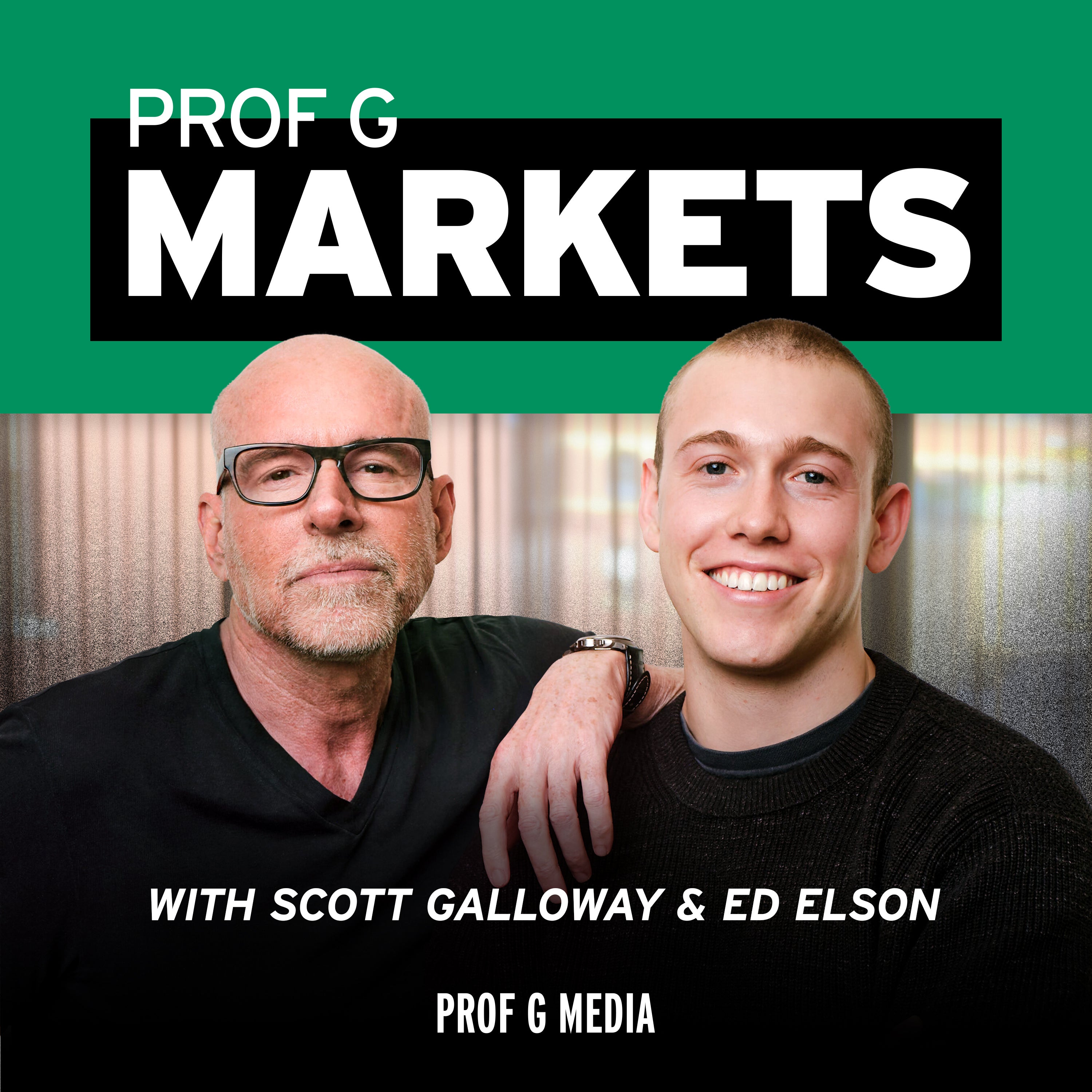
Scott Galloway and Ed Elson break down the biggest takeaways from Anthropic’s financials and explain why the company’s customer concentration is raising concerns. Then, they examine the state of the IPO market and make the case for why now could be the time to buy bonds. Finally, they discuss the changes John Ternus is making at Apple and debate whether the company’s new smart home hub will be a success.
Vote for Prof G Markets at the Signal Awards here
Subscribe to the Prof G Markets newsletter
Order "Notes on Being a Man," out now
Note: We may earn revenue from some of the links we provide.
Follow the podcast across socials @profgmarkets
Follow Scott on Instagram
Follow Ed on Instagram, X and Substack
Send us your questions or comments by emailing Markets@profgmedia.com
Learn more about your ad choices. Visit podcastchoices.com/adchoices
Scan the code with your iPhone camera
Listen in the app.