
- Podcasts
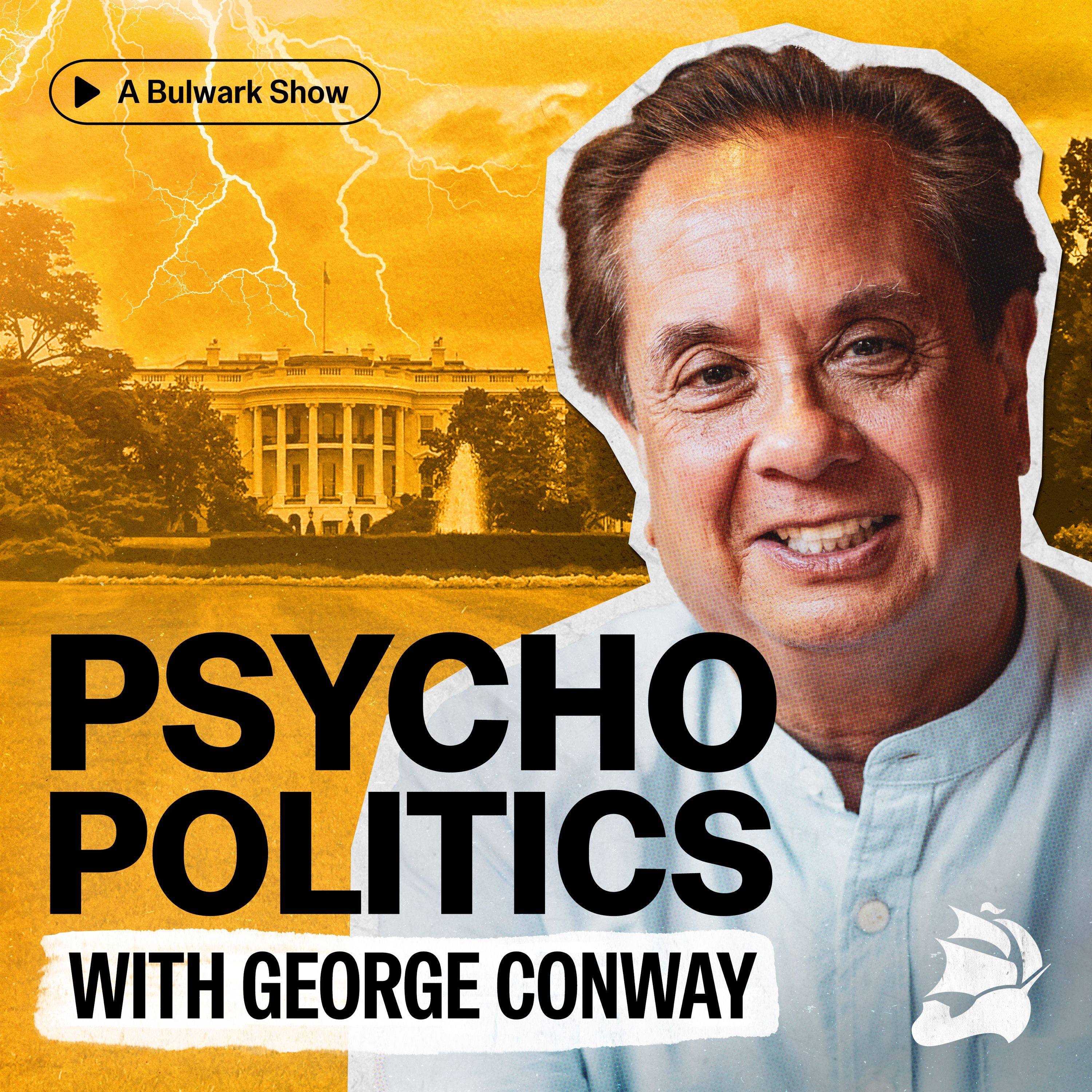
- Psycho Politics with George Conway
- 9: Psychologist Sees Alarming Signs of Trump’s Decline (w/ John Gartner)
Psycho Politics with George Conway23 Nov 2026 · 57m
9: Psychologist Sees Alarming Signs of Trump’s Decline (w/ John Gartner)

 Add vo to ChatGPT or Claude to ask about everything you hear
vo listened to this episode to put together the overview and transcript, so there may be the odd mistake.
In short
Psychopolitics episode arguing that Donald Trump’s psychological profile—especially “malignant narcissism” plus antisocial/psychopathic traits and possible frontotemporal dementia—makes him uniquely dangerous, particularly as he becomes more disinhibited and detached from reality. The episode uses the “Downfall” bunker scene (Hitler’s “Nero Decree” to destroy Germany) as an analogy for leaders who punish others when losing.
Guests
John Gartner, clinical psychologist (PhD), clinician treating disorders including borderline personality disorder; taught at Johns Hopkins; mental-health activist since 2017–2018; co-founded Duty Judy DeWarn; appeared in the documentary Unfit; co-launched the Anti-Psychopath Pack (2024) and served as chief advisor/expert.
Key claims
Trump meets DSM-5 narcissistic personality disorder criteria (grandiosity, entitlement, exploitation, lack of empathy, arrogance) and antisocial personality disorder criteria (lying, deceit, impulsivity, aggression, lack of remorse). Gartner suggests worsening disinhibition and aggression could be consistent with frontotemporal dementia. He argues Trump may use nuclear authority without effective guardrails.
Notable examples
Trump praising “strong ones,” comparing himself to historical conquerors (including claims of being more powerful than Alexander/Hitler, etc.), stories about empathy-free reactions (e.g., fainting/bleeding incident focused on his floor), “NBC you suck” Oval Office exchange, and references to January 6 and the “person carrying the football” nuclear chain of command.
Transcript
0:00Like clockwork each year, Friendsgiving rolls around and everyone says, I'll bring something. And somehow it turns into five charcuterie boards and zero drinks. Don't let your group chat down. Roll up with Smirnoff Ice and be the friend who actually understood the assignment. It's cold, crisp, perfectly mixed, and basically does all the heavy lifting while everyone argues over who makes the best mac and cheese. So next time someone asks, what are you bringing? Easy. Stock up for your next Friendsgiving now and order Smirnoff Ice now for delivery. And hey, if you're looking to shake up the party, check out Smirnoff Ice Zero Sugar.
0:33Same flavors you love with zero sugar and 100 calories. Game changer. Please enjoy responsibly. Must be 21+. All right, all right, turn it up. This next track by Crown Royal, it's got a way of getting everybody together. So grab your people, grab a glass, and play this one loud. You got gold.
0:55George Conway: So bring it, bring it, bring it. I said you got gold, so just bring it, bring it, bring it in. This track is brought to you by Crown Royal. Please drink responsibly. I said you got gold, so just bring it, bring it in. This is why we are in so much danger, okay? We're not just dealing with a Hitler on the way to the bunker. We're dealing with a demented Hitler on the way to the bunker. Yeah, Hitler was only in his 50s when he was in the bunker.
1:32George Conway: Welcome to this week's edition of Psychopolitics. When we thought about naming this podcast, we didn't immediately come up with the name Psychopolitics. But when somebody suggested it, I thought, you know, it's perfect for a bunch of reasons. One is our politics have gone completely psycho. You know, this is this day where we have the president of the United States causing the reinstatement of Jensen Huang. because he likes Jensen, even though Jensen Huang and Vidya and in conjunction with some of his own people seem to have been turning a blind eye at a minimum to violations of the law. But we'll get that aside.
2:08George Conway: I mean, it's all very crazy and psycho. But I really did want, as one of the objects of this podcast, is to keep talking about something that I educated myself about starting in 2017 and 2018 and have talked about so much, which is the psychology of Donald Trump, the perverted, the deranged psychology of Donald Trump. And it really started with me when my ex-wife was in the Trump administration. I thought about going into the Trump administration and I was thinking, there was something deeply wrong with this guy, something seriously wrong. And I tried to, you know, I wanted to figure it out. So I started reading and I ultimately wrote an article in The Atlantic that was like 11 ,000 words where I combined my legal expertise with what I had learned reading psychological literature.
2:54George Conway: And it's not that hard. I mean, it's just a small fraction of what the psychiatric and psychological world knows. But I put it all together and I got involved with this guy. He was our guest today, John Gartner, who is a clinical psychologist. He, you know, treats patients. He studies things like borderline personality or treats borderline personality disorder and all sorts of other depression and all sorts of things. And he knows a lot about this stuff, obviously, because he's a clinician and he has a PhD and he's taught at Hopkins for many years. And he became something of an activist in 2017 and 2018.
3:31George Conway: He was among the very few number of mental health experts who wanted to talk about Donald Trump's, who weren't afraid to talk about Donald Trump's psychological condition. And he formed a group called Duty Judy DeWarn. And you played a starring role in a movie, what was it called? Unfit, a documentary. Hashtag unfit. Yeah. Hashtag unfit. And I played a little cameo in there and we got to know each other. And then ultimately in 2024, John and I teamed up to launch the Anti-Psychopath Pack because I thought, you know, at this point, I was kind of so pissed off that the media just won't talk about it for reasons that we may have time to talk about.
4:11George Conway: And they still haven't really talked about Trump's psychological disorders. And we started Super PAC, and John was the chief advisor, expert advisor to our group. And so we're going to talk about, we're going to have a little seminar today about Trump's psychology. And the reason why, I mean, everybody knows he's nuts. If you talk to anybody in Washington press, politicians, Republicans, Democrats, deep down, they know he's nuts. Okay. Now they don't, they can't tell you chapter inverted. They can't tell you he's a narcissist, but they, you know, and everybody's like, okay, so he's nuts. We're all used to it.
4:46George Conway: The problem with it is, is you really need to know just a little bit more than he's nuts to understand why it is he has this destructive arc and why it is he's going down, but why it is also, and this is the button, this is why we're doing this now. It's not just for kicks, he's more dangerous than ever. And as the centerpiece for our discussion, it's a clip from the movie Downfall. The Downfall movie was a German language movie from a few years ago that characterizes, that tells the story of the last 10 days in the Fuhrer bunker. And one of the things that Hitler did, and this is historical fact, is he issued something called the Nero Decree, where he basically said, you know, as the allies, the Western allies and the Russians were closing in on Germany and Germany was facing its ultimate defeat.
5:35George Conway: Hitler ordered the destruction of all infrastructure in the nation. And he ordered his minister of armaments, Albert Speer, to do that. And Speer actually ended up defying the order. But one of the reasons why Hitler did it, there was no military necessity, they were going to lose the war, was because he wanted to punish the people he led because he felt they let him down. And that is the essence of the psychological disorder of malignant narcissism and megalomania that we see, have seen in so many other leaders. And this is, this piece just, this is why we need to pay attention to Donald Trump's psyche today.
6:15George Conway: Let's play that clip. And this briefing is broken. I could not cry about it. It would have nothing else to do. They get what they deserve. Speer is coming in to see Hitler for the last time. And Hitler is justifying his order. Basically, if I go down, everyone goes down with me. My people, the people of Germany let me down. So they deserve what they're going to get. They have to be destroyed as well. It's that sickness that characterizes a malignantly narcissistic leader. And that's what we're going to talk about today. This is something we've been talking about for a while. When we did the Psycho PAC in 2024, the anti-Psycho PAC, we tried to explain this is why he's dangerous.
7:05George Conway: This is why he shouldn't be elected president. To understand Donald Trump, why he's unfit for office and why he's a danger to the republic, you have to understand his psychological disorders. Trump's malignant narcissism explains everything about him. His authoritarianism, his love for dictators. We worked together on that ad and we worked together on a bunch of different ads. And one of the things we would do is we ran them as audience of one ads where we would play them at Mar-a-Lago for cheap or we play them at the White House. You know, because for five thousand dollars, you can just you can narrow cast these ads.
7:39George Conway: And he saw them. I'm convinced he saw them. And let's play the next clip, which I think is evidence that he saw these ads and that he agrees with us about his psychological disorders. And they asked the head of the prime minister of Hungary, very tough man, strong man, very, you know, somebody that I always got along. I get along with the strong ones. I don't get along with the weak ones. Isn't that sad? That's a personality defect. He said personality defect. And we had been dumping these ads on him, talking about his personality disorders. He knows this. He saw that. And he wasn't upset about it.
8:19George Conway: He thought it was a good thing. He likes the fact that he's a malignant narcissist. And here's more evidence on the point. If those of you who have read Maggie Haberman's and Jonathan Swan's recent book, toward the end, there's a description of when they came in to interview Trump at Mar-a-Lago. And one of the things that Trump started talking about, because he just wants to talk about himself, no other president could do some of the shit I'm doing. And then he tells a story about how Gary Player has a friend who's a historian. Turns out he's not really a historian. He's just a friend of Gary Player's who read a book.
8:57George Conway: And the guy wrote Trump a letter where he basically said Trump was more powerful than Alexander the Great, Caesar, William the Conqueror, Genghis Khan, Attila the Hun, Napoleon, Hitler, and Stalin. And he loved that. He said he told the reporters, these leaders maintain power through fear, he said. Who would ever do a thing like that, right? I never thought about it in terms of that. It's very interesting. But when I read it, I said he's right. Trump loved that. He wants, he considers himself to be, you know, as powerful, more powerful, because his view was like, you know, Attila was just a local thing.
9:41George Conway: Khan was just a local thing. Even Hitler, he was just Europe. Okay. And, you know, it's really not funny. Mao was just China. Stalin, you know, you know, he was just Russia, a little bit of Eastern Europe. But I am the entire world. He loves that. That's what we saw just over the past few days with the he's glorying in his summit in China with President Xi and President Putin. And then he comes back to the United States and saying we need to take care of Canada, those bad people in Canada. But he loves Xi and Putin. And this is really goes to his malignant narcissism. And that's what we're going to talk about today.
10:22George Conway: What is malignant narcissism? First of all, what is narcissism? Well, you know, I think one of the I think most people do have an understanding of what narcissism is. I think the distinction that many people don't get that you've been trying to tell people about is the difference between narcissism and malignant narcissism. And I like to say it's like the difference between a benign cancer cell and a malignant cancer cell. One is giving you a scare and might annoy you. The other will kill you. It's a big distinction. It's not a small distinction. And so, yes, many people have narcissistic tendencies, including Bill Clinton, who I wrote a very admiring biography of.
11:01But I think Bill Clinton helped the country. And I could if we had time, I could argue with you and show you the economic statistics and show you the other reasons to believe that Bill Clinton was a very benign figure. He, Trump, is a malign figure. I'm really glad that you started with Hitler. Usually when I do these interviews, you know, I have to work my way up to Hitler. But since you and I have a shorthand now, we've worked on this together, you pointed to the very thing that I try now to point to in all my interviews, the Nero Decree. Because the Nero Decree truly shows the psychology of the wounded, malignant narcissist when they are losing.
11:41They would prefer to take everybody down with them.
11:45George Conway: Let's stop here because we're going to, you're going to get into that. I just want to start with understanding basic narcissism. Let's talk about basic narcissists. Sure. There's a grandiosity. There's a sense of entitlement. There's a sense that you only want to hang out with other people who are very, very special. There's a hunger for recognition and a rage at people when you don't get it. And there can be a tendency to basically run over people who aren't basically worshiping you or stroking your ego. everything is about their dominance, their fame, their power, their glory, their admiration.
12:29And that's their primary orientation.
12:33George Conway: Yeah. And I think it's also helpful to point out and tell me whether you agree. And this is something that my friend Craig Malkin, who wrote some books on narcissism, and he's also a clinical psychologist, narcissism is actually kind of a spectrum. You can go from people who are basically, you know, are the opposite of narcissistic. They don't feel confident that they can do anything. And then you get to the mid-range of narcissism, which is actually, there is healthy narcissism. Like we are not afraid to go on this podcast and make asses of ourselves, right? Because we think we're great. You know, people who accomplish things, people who accomplish things and do things, oftentimes it takes narcissism to put yourself out there and do things.
13:22George Conway: And the question is, do you carry it so far that you run over other people, as you say, that you trample over their rights, that you don't care, you don't have any empathy for what they feel? And there are times where we get so carried away with ourselves, Sometimes we do that, but we know deep down we have consciences and it restrains us. And so there's a spectrum of, you know, if you're slightly narcissistic, that's actually a good thing. And, you know, politicians, they're all narcissistic. You have to be narcissistic to be a politician. OK, but it doesn't mean you can't do a good thing. I mean, you know, Winston Churchill was a narcissist.
14:02OK, he was so he was so full of himself, but he inspired people to do the right thing.
14:08George Conway: and he did the right thing and he led the right thing because he so believed in himself, but he also believed in higher values and he put those together. And so, so there's a, yeah, but then there's a point where you just don't care about anybody else, where you don't care about their feelings. You don't care about their rights. You don't feel guilt. You're really to tell any lie. And that, that's, that's when it becomes pathological. And also you've just gone through the diagnostic criteria for psychopathy, for antisocial personality disorder. First thing we're going to do is slide one. Slide one.
14:43George Conway: This is, you're about to talk about the diagnostic criteria. And what we see here is the cover to the Diagnostic and Statistical Manual of Mental Disorders. It's really designed in part to, so when you go see a psychologist or a psychiatrist, they will write down the diagnostic code and then the diagnostic code will go to the insurance company. It was actually also designed to create some kind of standardization in the way that mental health professionals look at diseases and talk about diseases. And it was actually, ironically, in part, a reaction to the incident in 1964 where Goldwater sued a bunch of psychologists and psychiatrists who basically said he was absolutely nuts.
15:24George Conway: And the American Psychiatric Organization realized that, okay, this was all gibberish, what these psychologists and psychiatrists. We need to do two things. One is we need to get shrinks to stop talking about public officials because it gets us into trouble. And that's something I have a problem with. And the second was let's make a little more – let's create some structure in how we define things and call things. But anyway, the DSM-5 has a lot about everything under the sun, but it also has a discussion of what are called personality disorders. Everybody has their personality traits, but these are the ones that cause people distress and cause harm.
16:02George Conway: And there are three boxes of personality disorders, and they're called cluster A, cluster B, and cluster C. Cluster A is just kind of like kind of weirdness, if you will, people who are paranoid and people who are a little schizoid. And we're not really concerned about them, except a little on the panel. We'll talk a little about paranoia in a bit. Cluster B is the one that we really want to talk about. And you do work with, you know, there's borderline personality disorder. There's narcissistic personality disorder. There's antisocial personality disorder. There's histrionic personality disorders.
16:34George Conway: And the one, the two that we are going to be concerned with today is narcissistic personality disorder, which is not quite malignant narcissism, but it is pathological. I mean, the way to look at it is there's normal narcissism, pathological narcissism, which is defined in the DSM, and then malignant narcissism, which is off the charts, where you're so narcissistic that you are also sociopathic, and that's the bad place. But let's put up slide two. Okay, we have here the diagnostic criteria for narcissistic personality disorder. And I once posted that in 2019 on Twitter and said, which one of these does Trump not meet?
17:15George Conway: And Jimmy Kimmel did a whole skit on it. And if you go through them, let's go through them. Yeah, I think we should. Grandiose self of self-importance. Oh, no, that's not Donald Trump. Right. No, he's not grandiose. Preoccupied with fantasies of unlimited success, power, brilliance, beauty or ideal love. You know, and I just want to stop at this one for a second to say that people don't realize, but that the things that Donald Trump posts are in and of themselves diagnostic, right? Because he has posted a picture of himself as every great person who ever lived, Right. He's Jesus. He's the pope.
17:52He's George Washington. He's Rambo. He's on he's Lincoln. He's on Mount Rushmore. In other words, it's not just enough to be one of the great conquerors. And I want to get back to that because that's so dangerous is comparing himself to all of those, you know, people like Napoleon and Genghis Khan and Hitler. But he has to be every great person, every great person who ever lived. He even posted pictures of Jesus washing his feet, meaning that he was above Jesus. So when you talk about preoccupied fantasies of power, brilliance or beauty, he's so preoccupied, he's posting from five in the evening to five in the morning.
18:31That's pretty preoccupied.
18:33George Conway: A lot of skin care makes big promises, but often undelivers. One skin is different. And that's why I love using their products. I have here the cleanser and I have here the facial moisturizer and I have here the eye moisturizer. One Skin never set out to be a skincare company founded by four PhD longevity scientists. They focused on one thing, skin aging. Quick fixes or marketing trends were never the point. They tested the best-selling anti-aging products on the market and found the same hard truth over and over. Most of them weren't working on the actual cause of aging. They were just working on the surface signs of aging.
19:16George Conway: And it turns out some didn't work at all. After years of research and testing over 900 novel peptides, they developed OS1, which is the key ingredient to each of these products. Their proprietary peptide, OS1, has proven to address a leading driver of visible skin aging. It's the foundation of every product they make. So over time, you'll see smoother skin, even more tone and radiance and visibly fewer lines. Skin that both looks and acts younger. And I can attest to this. I've been using it for some time and I'm in my 60s and my skin is better now than it was a few years ago because I did the Bulwark podcast and one of the sponsors was OneSkin and I became a big fan of their products.
20:01George Conway: But it's not just my experience. OneSkin's results are backed by four peer-reviewed clinical studies, over 10 ,000 five-star reviews, and they've been recognized by Bloomberg and Fast Company as a leader in skin longevity. And it took 10 years of longevity research. It's going to help you unlock your healthiest skin now and as you age. So for a limited time, we have an offer for you. You can try OneSkin with 15 % off using the code psycho for psycho politics, psycho, P-S-Y-C-H-O at oneskin.co slash psycho. That's 15 % off oneskin.co with the code psycho. After you purchase, they'll ask you where you heard about them and please support our show and tell them that we sent you.
20:52George Conway: Let's keep going through these criteria. Okay. There are nine criteria. We've just gone through a couple of them. If you have any five, you have narcissistic personality disorder. Okay. Let's go through it. Believes that he or she is special and unique and can only be understood with and should associate with other special or high status people. Tiger Woods, Xi, Putin, you name it. And only I can fix it, right? Only I can fix it. Three for three. Requires excessive admiration. Okay. We're going to put ourselves on the currency. We're going to build a statue to ourselves that looks like Kim Jong-un in the ballroom there.
21:37George Conway: All right. Five. Okay. So we're four for four so far. Five has a sense of entitlement, unreasonable expectations of especially favorable. Oh my God. Okay. Well, he feels entitled to Venezuela. Yes. He feels entitled to a lot of things. He feels entitled to Greenland. I would say that's a pretty big entitlement. That's pretty good. Okay. Yeah, yeah, yeah. We got thousands of each one of these. So we're five for fives. Is interpersonally exploitative, takes advantage of others to achieve his or her ends. What do you think? That's all he does is exploit other people. That's he's made an art and a science of it.
22:12I mean, he's a crime man about his sexual abuse and his his conning people. Yeah. So that's that's what he does. It's his race.
22:20George Conway: Six of six. We're six of six so far. So he's he's a malignant narcissist. But I'm not a malignant narcissist. He has narcissistic personality disorder. So let's see what the other seven lacks. Empathy is unwilling to recognize or identify with the feelings and needs of others. Oh, come on. He's so empathetic, right? Right. Like if somebody passed out in his like somebody passed out in his office, he wouldn't, you know, just get himself a bottle of water, would he? Right. No, there was referring to that incident. There was also an incident at Mar-a-Lago where some guy fainted and started bleeding out on his floor.
22:50George Conway: And all he could think about was, oh, my God, my beautiful parquet floor. And and and and he actually tells the story like I couldn't believe the floor. And then remember 9-11, when they interview him and say, well, what's it like? As somebody who owns buildings, what do you feel like? Well, I have the biggest building in New York now. Like thousands of people have just died. OK. He's often envious of others and believes that others are envious of him or her. Oh, my God. He's so jealous. He thinks everyone's jealous of him and he's jealous of everyone else. Yeah. And, you know, he he practically declared war on Norway when he didn't get the Nobel Peace Prize.
23:29George Conway: Yes, very bad. All right. Nine shows arrogant, haughty behaviors or attitudes. OK, I mean, look, he's nine for nine. There is. Right. If you can't see that he's at least five, there's something wrong with you. OK, let's go to let's go to sociopathy. What is sociopathy, by the way? Yeah. So it's gone under different names. I call it the criminal personality disorder. We've called it psychopathy. The more recent name is antisocial personality disorder. But these are bad people. These are people who break laws and norms, who lie. Why are they bad? They harm other people. They exploit other people.
24:05They have – they're very good at it. They have no sense of guilt or remorse about it, no sense of anxiety about it. They violate laws and norms. They violate – they lie and they steal. and cheat. These are the kind of people who are predators.
24:23George Conway: Huh. Sounds kind of familiar. There have been different terms that kind of overlap. Sociopathy, antisocial, the antisocial personality disorder, which is how the DSM characterizes it in its diagnostic criteria. And then there are people who talk about psychopathy, and there's actually a checklist, which is actually pretty easy to use called the hair psychopathy checklist. And if you look that up online, hair psychopathy checklist, and you basically get zero, one, or two points, I think, for each of the questions. And if you get above a certain number, you're a psychopath. The Brits have a slightly lower number, 25 or something, 30 is the American standard.
25:01George Conway: I don't remember. But it's actually a fun exercise to do on your own. And you do Trump. And there's no reason. It's important to remember. We all can see Donald Trump. There's this whole thing about whether you can diagnose. We're not really doing this to diagnose people, whether you can diagnose somebody from afar. But this is a guy we know really well because we have been watching him for years. We know him as well as anybody now, all of us who have been paying any form of attention. Well, we can diagnose him from afar. I really feel the need to assert that. OK, I understand that there's an ethical prohibition against it and we can talk about that.
25:39Most of that is basically a cover your ass thing for the American Psychiatric Association that doesn't want to get in trouble with powerful people. Public figures are the only figures we're prohibited from commenting on because they get this special protection. But you mentioned the change in our diagnostic system. This was in the 1980s. In 1987, I believe, when we adopted the DSM-3, Robert Spitzer, a leader in our field, said we needed objective, observable criteria for all of our diagnoses so that 100 doctors who see the same patient come up with the same diagnosis. And the beauty of these criteria, and George, you did more than anybody to sort of educate the public about this.
26:17People have some idea that diagnosis is some very obscure, specialized, rarefied, we've got to look under a microscope, we've got to run tests. These criteria, and I think you probably have the one for antisocial, if we read them, they're plain English language sentences. Guess what? he's the most documented liar in all of recorded human history. In all of recorded human history, you cannot show me anyone who has told more lies than Donald Trump. The Washington Post stopped counting at 30 ,000. So I don't need permission of the American Psychiatric Association or an interview with Donald Trump to assert with 100 % certainty he is a frequent liar.
26:59I can stake the lives of my children on that fact, okay? And each of these diagnostic criteria are the same.
27:05George Conway: Yeah. And one of the things I liked about these diagnostic criteria coming to this as somebody who has legal training was it's sort of like the elements of a claim and elements of a crime. What you have to prove when you go to court and you're making a certain claim, you have to go, there's a checklist for most things. One, two, three. Fraud, you have to claim, you have to prove a lie. You have to prove the intent to lie. You have to prove the damages from the live. All right, all right, turn it up. This next track by Crown Royal, it's got a way of getting everybody together. So grab your people, grab a glass, and play this one loud.
27:41You got gold. So bring it, bring it, bring it.
27:45George Conway: I said you got gold. So just bring it, bring it, bring it. Give me more, baby. This track is brought to you by Crown Royal. Please drink responsibly. I said you got gold. So just bring it, bring it in.
28:27Ketchup on a dog. Yeah, we've got thoughts. Too loud? In Chicago, you're gonna hear it. Because nothing here gets built without conversation. Nothing moves without connection. So if you think you know AT &T, it might be time to rethink that. Because their network has improved, like, a lot. So Chicago can keep speaking its mind with AT &T Wireless and AT &T Fiber. Chicago won't stop talking. Our improved network backs it up. AT &T, connecting changes everything. AT &T Fiber, limited availability in select areas.
29:00George Conway: And so here we have the criteria for antisocial personality disorder or sociopathy. And there are seven criteria and you only need three. Only three here, okay? Failure to conform to social norms with respect to lawful behaviors. I mean, this guy. This guy, you know, he's a convicted felon. We know that. Right. Start there. You can start there. Check the box. Check the box. He got away with so many other things. Two is what you're talking about. Deceitfulness as indicated by repeated lying use of aliases or conning others for personal profit or pleasure. I mean, this guy actually did use aliases when he was in business.
29:45George Conway: He would call up the New York Post and say, hey, I'm John Barron. Hey, I'm John. Remember that? So like, I mean, he. Okay. So we're two for two. Two, impulsivity or failure to plan ahead. Oh my Lord, let's bomb Iraq. Let's bomb Iran. Let's not bomb Iran. Let's do this. Let's do that. He's totally, completely impulsive. Yes, he's completely impulsive. I mean, they used to say that even back in 2016 or 2017, before we got to know him so well, that the last person who talked to him is often the one who has the most influence. Irritability and aggressiveness. Okay. Yeah. He can be kind of cranky sometimes.
30:22The other diagnosis that I think he has that is making all of this 10 or even 100 times worse is his advancing what I believe is frontotemporal dementia. And the number one diagnostic criteria for frontotemporal dementia is disinhibition of aggression because the frontal lobe, which is our break in our filter, is deteriorating. So even though he has always been irritable and aggressive, he's getting dramatically worse and worse and worse. So now we have what I call the quiet piggy phenomenon, right? Where he's just cursing and yelling like a madman at the press. And just yesterday, I was looking at this clip where even that is getting worse.
31:06He had an encounter in the Oval Office just yesterday where a reporter wanted to ask a question. She hadn't even asked a question, much less a challenging question. He says, well, where are you from? She goes, NBC. He goes, oh, NBC, you suck. And you know what? You're bad too. And it just starts going off on this person who hasn't even asked a question. He says, you don't even have a right to be in the front row. You should be in the back row. So I guess some kind of prejudice against her for being a woman. But in other words, this is why we are in so much danger. We're not just dealing with a Hitler on the way to the bunker.
31:42We're dealing with a demented Hitler on the way to the bunker.
31:45George Conway: Yeah. Hitler was only in his 50s when he was in the bunker. Right. He has no judgment. He has no comprehension. And he has absolutely no impulse control, no remorse, no concern for how his actions would affect other people. Some of those are characterological. And now we know when people get dementia, whatever personality disorder they have gets 10 times worse. So we have someone with the most severely destructive and evil and dangerous personality disorder that a human being can have in charge of our country. And now he's losing his faculties and losing whatever internal restraint, the little he had over his judgment and behavior is now completely disappearing.
32:25And of course, we know he has no external guardrails. So, you know, basically this guy could just decide to nuke Iran at four in the morning and no one can stop him.
32:36George Conway: Yeah. And that's the whole thesis of what we're talking about today. And it really is true how the press has really mishandled all of this. I mean, they started talking about, obviously, there was some cognitive deterioration in Joe Biden. I mean, we talked about this in 2024, but it's like, okay, fine. But he's not a malignant narcissist. Right. Okay. What we were facing then is like, okay, we got this guy who's old and declining, but he spaces out. And this guy who is becoming more disinhibited and who is fundamentally disinhibited, you know, his evil is becoming more disinhibited. Right. And that is a very, very scary thing.
33:18George Conway: And those of us who have dealt with elderly people in our families, you know, people get crankier as they get older, right? Because they are more prone to say shit that they wouldn't have said 20 years before. But again, they don't have nuclear weapons. And again, the fact that we can watch him and the New York Times, you know, Peter Baker, I actually was going to put the clip up here, talk about how Trump is talking, you know, the whole thing about Trump talking about people's asses and using more swear words. You know, this is all the disinhibition. I mean, we use this word. That's disinhibition.
33:52George Conway: Those are clear examples. Yes, it's disinhibition. And it's particularly dangerous. Let's go back to the diagnostic criteria just to go really fast through the sociopathy to move on. Five, reckless disregard for safety, self of others. Well, you know, let all the people with the guns in on January 6th. Remember that? Great example. Six, constant irresponsibility, like repeated failure to work behavior or honor financial obligations. Financial obligations? You never paid. And work obligations? This is a guy who never read his briefing books. Seven, and number seven is the biggie, right? Lack of remorse, as indicated by being indifferent to or rationalizing having hurt, mistreated, or stolen from another.
34:38George Conway: That is the most because he has no conscience, no morality. I'll up you from there because this is the other two components of malignant narcissism, which are paranoia and sadism. It's not only that he doesn't have remorse, it's that he gets off on it. He loves the smell of napalm in the morning, so to speak. He loves the experience of torturing, killing, hurting, humiliating and degrading other human beings. And that's why it's a sexual pleasure. It's an ego pleasure. It's hard for a normal person to get their heads around how evil a sadist can be. But that's why he loves Putin. He loves Stalin, Mao, all that list of people.
35:24But Putin is his friend, he said this week, because Putin has no compunction.
35:30George Conway: And he doesn't want to have any compunction. Putin to him is strong. He represents all that Trump wants to be. So he's always looked up to Putin. So let's talk about malignant narcissism. And I want to take a, I want to talk about Eric Fromm. Eric Fromm was the guy who basically came up with the idea of malignant narcissism, right? Malignant narcissism, it's not a thing in the DSM. Right. It's not a, it's not something you diagnose someone with. It's a concept that's used to describe certain kinds of personalities and certain kinds of historic personalities. Yeah. And to me, look, to go back to the diagnosis thing, this isn't diagnostic, but it doesn't really matter.
36:08George Conway: We're not talking about diagnosing. We are not seeking to treat Donald Trump. We are simply asking the question of, is he fit to be president? And is he dangerous as president? And the bottom line is, you don't have to buy into the whole, all the psychology. All you have to do is look at those behavioral characteristics that we listed. The nine for narcissism, the seven for sociopathy. And do you want anybody with a significant number of those characteristics to have control over any aspect of your life, let alone to be controlling the country, to control its foreign policy, to control its nuclear weapons?
36:49George Conway: The answer is no. Look at all those historic figures that he compared himself to after whatever his memo from the golf caddy. But, you know, what do all of those strong men have in common? Well, two things. One, they built monuments to themselves. And two, they started world wars. That's one of the reasons that I'm saying I think there's a 50 percent chance that Trump will drop a nuclear weapon on Iran. Or he'll try to. I don't know what the Pentagon will do. George, George, you know the Constitution as well as I do. Who can stop him? Well, somebody could say, I mean, I think somebody could say it's a war crime, but that's a separate one.
37:29George Conway: Well, who's, okay, but the person carrying the football - I'm not arguing with you. I'm not arguing. The person, well, I just, but no, I think people need to understand this. People need to, it's important. No, you're right. You're right. The person carrying the football - The fact that we are talking about this is horrible. Well, the fact that we're talking about it is horrifying. This is not a remote fear. I'm saying this is like a flip of a coin. Correct. The person carrying that football has been trained to obey the president, and constitutionally he has the unilateral power to order that strike.
37:58Who is going to intervene between the time he tells the guy with the football to launch the strike and the time the strike is initiated? Who in the chain of command is going to stop him?
38:09George Conway: You know who figured this out back in 2020 and 2021? General Milley. They had special, they put in special procedures where let's put a pause on any crazy shit that comes out of the White House. It's an important point Because in this administration, as you well know, there are no guardrails. They're only, you know, the worst kind of sycophants and true believers and psychopaths. So do you think that anyone in his administration now is going to stop him? We don't have a General Milley. We don't have a General Milley anymore. We have Pete Hegseth, who would probably love to do it. All right, all right, turn it up.
38:47This next track by Crown Royal, it's got a way of getting everybody together. So grab your people, grab a glass and play this one loud.
39:05This track is brought to you by Crown Royal. Please drink responsibly.
39:16Hi everyone, this is James and Anna. We are two folks of the Hit UK podcast. No Such Thing as a Fish. Yep, No Such Thing as a Fish is where four of us get together every week to discuss our favourite, weirdest, funniest, maddest, most interesting facts we found that week. Anna, did you know that there is an island in Peru where the ultimate masculine gesture is to knit a bobble hat so well that you can carry water in it? That's why you're wearing ten bobble hats today, is it, James? Because I'm so masculine. Good on you. All right, go to No Such Thing as a Fish wherever you get your podcasts.
39:52George Conway: Okay, let's go back to Fromm. Fromm, Eric Fromm was a German Jew who escaped Germany in the pre-war times. And he became, he was a brilliant psychologist, a brilliant writer, a brilliant social psychologist. And he wrote books about human nature. and he wrote books about, he really puzzled over what made the Hitlers and the Stalins of the world and what made people follow them. And he wrote a book called, one of his books called The Heart of Man. And it really goes into, it's the first book that really talks about malignant narcissism. And it talks about how these people are on the edge of insanity.
40:41George Conway: They're on this sort of cusp of sand between sanity and insanity. They want to be all powerful. And the problem is they may be all powerful for a while, but you can't always stay all powerful. And then there are things that have even small things that happen to them that make them feel less than all powerful. They get mad at and they get offended at and they try to fight and they develop their own reality. They become, he said, psychotic. Yes. And one of the things we've been seeing is, you know, he's becoming more and more detached from reality. And I think, for example, I've talked about this in the past.
41:18George Conway: Natalie Harp is enabling this because she hands him all the stuff. But let me read a passage from The Heart of Man. This is from. A particular instance of narcissism which lies on the borderline between sanity and insanity can be found in some men who have reached an extraordinary degree of power. The Egyptian pharaohs, the Roman Caesars, the Borgias, Hitler, Stalin, Trujillo all show certain features. They have attained absolute power. Their word is the ultimate judgment of everything, including life or death. There seems to be no limit to their capacity to do what they want. They are gods limited only by illness, age, and death.
41:56George Conway: They try to find a solution to the problem of human existence by a desperate attempt to transcend the limitation of human existence. They try to pretend there was no limit to their lust and to their power, so they sleep with countless women. They kill numberless men. They build castles everywhere. They want the moon. They want the impossible. This is madness, even though it is an attempt to solve the problem of existence by pretending that one is not human. Here's a key sentence, which tends to grow in the lifetime of the afflicted person. The more he tries to be God, the more he isolates himself from the human race.
42:32George Conway: This isolation makes him more frightened. Everybody becomes his enemy. And in order to stand the resulting fright, he has to increase his power, his ruthlessness, and his narcissism. This cesarean madness would be nothing but plain insanity if it were not by one factor that by his power, Caesar has bent reality to his narcissistic fantasies. He has forced everybody to agree that he is God, blah, blah, blah, and it goes on. Hence, his own megalomania seems to be a reasonable feeling. Comment. Well, I'm glad you, thank you for reading that. I mean, Fromm was such an articulate writer, and we don't always go to the original sources.
43:09No, that's exactly what's happened. And you know, this idea that, there's two important ideas there. One, that he's on the boundary between psychosis and reality. His fantasies about his own greatness have become more and more psychotic. He thinks he ended eight wars. He thinks he should be elected pope. He thinks he's going to become the president of Israel. He thinks he's going to become the president of Venezuela. These are things he said. And so this idea that these monuments he's building to himself as a kind of God are actually reflections of how he feels. And it's been getting worse. What is psychosis?
43:48Well, psychosis is an unshakable belief in something that has no basis in reality. And the person cannot be dissuaded from it, no matter how much reality they're exposed to. Like the 2020 election was stolen, perhaps? That would be a great example. Yeah, exactly. And so with some of these things, and this is where people often ask me this question, George, when I'm on a show, they'll say, but how can we tell whether he's just lying or whether he's crazy and really believes this stuff? And this has actually been one of the mysteries going back to 2017. Oh, yeah.
44:27George Conway: I have my own answer to that. My own answer to that is it's both. It's both, right? It's both. It's two. He's both. Two breath minutes in one. He's both psychopathic and sociopath. He's a sociopath and a psychopath because he lies with impunity. OK? Right. But he's also – he's become more and more psychotic as he has convinced himself of his lies. Right. So on a good day, he's a psychopath. Yes. And he's just lying to you. That's the best it gets. OK? On a bad day, he's psychotic and he actually believes the bullshit that he's selling. Yes. Another quote from Fromm. Psychosis is a state of absolute narcissism, one in which the person has broken all connection with reality outside and has made his own person the substitute for reality.
45:20George Conway: He is entirely filled with himself. He has become God in the world to himself. Yeah. That's exactly where he is. I think that's a very, very good description. And then the dark side of that gets back to this neuro decree, which is that if he is the world, right, then what happens to him is the only thing that matters. And so he doesn't care about the well-being of the rest of the world. In fact, because he's a sadist and a malignant narcissist, he actually gets more pleasure from harming and dominating people than, you know, either he wants to be worshipped or he wants to destroy. Those are the only two modalities that he has.
46:05George Conway: And the way I've put it is that basically malignant narcissists seek to destroy what they cannot control or use for their own glory. And this is the thing that struck me is what I was trying to explain. Remember there was this period of time a few weeks ago during the campaign when he started talking about nukes being dropped on Los Angeles? He's not seeking to drop nukes on Los Angeles. OK, that's not what he's thinking. What he's thinking is only he can prevent nukes from being dropped on Los Angeles. And if people don't do what he says, nukes will be dropped on Los Angeles. And it will be because you failed to appreciate my greatness.
46:46George Conway: What do you think? You know, it might even be worse than that. That's the thing. It's like it's always worse than you think. I can always I can always I can always top almost anybody. It's worse. It's even worse. But what's even worse, okay, going back to the Nero decree, he wanted to destroy Germany once Germany had failed him. He did want to destroy Germany. And that's something I think people really need to understand how deep this malevolence goes. One of the analogies I've been using is we're kind of like an abused woman, okay? And when an abused woman throws the abuser out of the house and gets a protective order, sometimes that's when she's in the maximum danger.
47:31Absolutely. Because the really sick abuser says, well, if I can't have her, nobody can. Nobody can.
47:36George Conway: No, that's exactly right. Well, guess what? America is that woman. And if he can't have us, he wants to make sure that nobody can. Yeah. And actually, you know who actually had insight into this of all people in 2021? Mitch McConnell. When Mitch McConnell gave his speech on the Senate floor after the acquittal of Donald Trump on the insurrection charges, he basically said that what Donald Trump had done was probably criminal. And he also said that what Donald Trump had tried to do is try to destroy everything as he left town. And he wanted, he wanted that destruction. When that day on January 6th, if he couldn't be president again, he wanted to go up to the hill.
48:21George Conway: wanted these people to go up there. And that's why he jumped on that secret service agent, tried to strangle them. That's right. He wanted to go down there and glory in it. He wanted to glory in it. Absolutely. I got more quotes from Fromm. When his narcissism is wounded, he feels threatened in his whole existence. And then Fromm goes on to say, and this is again from the heart of man, only the destruction of the critic or oneself can save one from the threat to one's narcissistic security. This is what we're talking about here. Right. And now that the country is turning against him, right, the whole country now is, in some ways, an object of his scorn.
49:05You know, hell hath no fury like a malignant narcissist scorned. You know, I feel like a party pooper when my fellow Democrats are, you know, in ecstasy right now after the election. And, you know, what I keep trying to say is, you're right, boy, we've got Donald Trump right where we want him, cornered and wounded. No, that's not where you want a monster. That's not where you want a monster cornered and wounded. The point is, he's cornered, he's wounded, and he still has immense power, and he will use that power our destruction. And there was a syndrome or process that Fromm described, and he called it
49:49George Conway: the syndrome, or it has been called the syndrome of decay. The syndrome of decay prompts men to destroy for the sake of destruction and to hate for the sake of hate. That is how we go full circle back to the Nero decree scene. And that is why he is so profoundly dangerous at this moment, even though in some ways he's at his weakest. He's becoming more detached from reality, more resentful, and more spiteful. And he's going to become even more so as these investigations get ramped up over the next year, as his power begins to dissipate, as Republicans begin to try to figure out what kind of party are they going to have without him.
50:34George Conway: And he's not going to, you know, he doesn't want anybody to take over the Republican party. He wants to destroy all these people. Of course. Because they, you know, he can't cede power. He can't do that. That's, that makes him feel lesser and weaker. If you think he's done damage to the Republican party, let's leave apart the country for the moment. You haven't seen anything yet. But again, the worst part of this is exactly as you say. I think that people think we are on the downswing, and we are in an overall sense, but this is the most dangerous period of time. Right. Like clockwork each year, Friendsgiving rolls around and everyone says, I'll bring something.
51:16And somehow it turns into five charcuterie boards and zero drinks. Don't let your group chat down. Roll up with Smirnoff Ice and be the friend who actually understood the assignment. It's cold, crisp, perfectly mixed, and basically does all the heavy lifting while everyone argues over who makes the best mac and cheese. So next time someone asks, what are you bringing? Easy. Stock up for your next Friendsgiving now and order Smirnoff Ice now for delivery. And hey, if you're looking to shake up the party, check out Smirnoff Ice Zero Sugar, Same flavors you love with zero sugar and 100 calories. Game changer.
51:50Please enjoy responsibly. Must be 21 plus. All right, all right, turn it up. This next track by Crown Royal, it's got a way of getting everybody together. So grab your people, grab a glass, and play this one loud. You got gold.
52:06George Conway: So bring it, bring it, bring it. I said you got gold. So just bring it, bring it, bring it. Give me more, baby. This track is brought to you by Crown Royal. Please drink responsibly.
52:23This is the part in the conversation, George, when people usually say to me, so what can we do? So what can we do? I don't have a great answer. In fact, I don't have an answer at all. I don't have an answer.
52:35George Conway: Well, here's my answer. Yes, what's your answer, please? I have been, this has been my answer for quite some time because I always felt this day, these days would pass. Our object in 2024 is to accelerate the end. The faster you get to breaking him down and having him fall apart, the less damage he can do. The longer you prolong it, the more you try to assuage him, appease him, get to the next month, get to the next year, get to 2029, the more damage he can do. And that's why I talk a lot about – I've been talking a lot about impeachment. Not just because I think it's the right answer from a legal standpoint and a moral standpoint.
53:18I think it's the necessary answer for purely our survival.
53:23George Conway: I think that the sooner people figure out that he has to go, including Republicans, and I think they're starting to figure that out, the better off we are, the less danger. I mean, we can't let this fester. We can't. We have to figure out a way to get to the end faster, to fast forward to the end. And I think he's going to force everybody's hand. The question is how much destruction is he going to cause in the interim? It's the way I used to put it, what I have been putting it for the last couple of years is, you know, there's no question this man is going to destroy himself. And the question is the blast radius.
53:59George Conway: It's like the bomb squads, right? They try to blow up the bomb before or defuse it first before it goes off. But here's the problem, and here's why I see us as being in what I call a death spiral, which is the more we investigate him, attack him, expose him, weaken him, humiliate him, make him lose followers politically or in the country, the more viciously he's going to act out in response. So, you know, as long as this cycle continues, everything you're saying, yes, we should do all the things that you said, but I don't believe it's going to bring about the result that you're hoping it will.
54:42Maybe it will. I hope it will. But it also is, I think, equally likely to bring about an unintended negative consequence, which is the more threatened and wounded the monster feels, the more violently he will act out.
54:55George Conway: Yeah, but the problem is, and here, this is the conundrum. Again, the problem is he can't be assuaged. You cannot, when you give in to him, you can see the examples with the Europeans. And, you know, I was thinking about this the other day with about, you know. That's why there's no right answer. Right. Senator El-Sayed is saying, well, we'll give you your ballroom or name something after you. We'll name Trumpcare after you. It's like. Yeah, smart strategy, actually. You know, I kind of, you know, I think it's funny and cute. And I think, you know, using, manipulating him is, I like the idea of manipulating Trump and using his narcissism to accomplish.
55:32George Conway: It's like, I'm not against that. But it's never going to be enough. That's the problem with these characters. It's never going to work. I mean, it's like Mary Trump's book. The title of Mary Trump's book about her uncle was Too Much, Never Enough. And that's the never enough is a descriptor of the malignant narcissism. No amount of glory, no amount of praise, no amount of power is ever enough. And I think of Rick Wilson's book, Everything Trump Touches Dies. Yes, my friend Rick Wilson. The more you try to assuage him, he also gets worse because he wants more. Yes, because it's the Floresheim shoe phenomenon.
56:11He bought those shoes that were two sizes too big, and Marco Rubio wore them anyway, like a little pisher beta male that he is. Okay, so he humiliated him, right? He showed what a flunky he was, where Pence used to grab the water bottle every time he grabbed the water bottle. So the thing is, is that if you become an acolyte, he still wants to humiliate you, right? Like a mob boss, right? To show his dominance. To show his dominance. So that nobody gets confused as to who is the powerful person here.
56:41George Conway: Correct. Who's in charge. Yeah, he used to do that. He used to denigrate Lindsey Graham when he was campaigning with him in South Carolina. Right. He has to put people in their place and everybody to him is not even on his plane. He's the only one that matters. He's the one who can fix it all. Right. So we can compliment him or we can fight him. But the one thing that's for sure is he will use his power destructively. All right. I hate to leave everybody on that sour note. Well, I have one positive note. Okay. What's the positive note? Okay. It's also a plug. I have a book coming out in April, A Dose of Enlightenment, The Psilocybin Therapy Revolution in Mental Health Care.
57:23I'm really mentioning it to plug the book, but it does, there is a segue here, which is the nature of -
57:29George Conway: That we could all use philocybin to deal with what's about to come? Not only that, but psilocybin therapy actually changes people. They experience what we call ego dissolution, where they become more identified with all humanity and not just their self or their tribe, which is very egocentric. But when the ego dissolves, they become identified with we are the world. They become more less materialistic. They become more altruistic. Their relationships improve. They become more loving, more forgiving, more compassionate, more empathic. If we could get millions and billions of people to change in this way, I think it might counteract the tribalism that is actually pushing us towards total self-destruction.
58:18We have to have a more fundamental change because Trump, after all, is the worst of something that is actually endemic to human nature. Right. This tribalism has been with us since before we had recorded human history. It's just that now the tribes have gotten bigger, the weapons have gotten deadlier, and so the stakes have gotten higher. So unless we evolve as a people, as a race, we're heading towards self-destruction.
58:45George Conway: So drugs are the answer. Yes. Well, actually, it's not just drugs. This is an important point. Psilocybin therapy, I'm not against recreational use of psychedelics, and a lot of people listening probably tried psychedelics and maybe had a profound experience. Psilocybin therapy is completely different than just taking psilocybin. It's done with a doctor or a therapist. It takes place over a series of days or weeks. There's preparation. There's people who are with you during the experience, and there are people who help you integrate it and interpret it afterwards. And the experience that people have is much deeper, much deeper than people have in recreational.
59:23You're wearing headphones, eye shades, you're lying down, and you're listening to a very select soundtrack and taking a deep, deep inner journey.
59:32George Conway: I read something recently about veterans with PTSD undergoing some kind of, is this the same kind of thing? Yes, yes, yes. Well, psilocybin is one drug they're using. They're also using another drug, which I have not been writing about MDMA. Both of them have been showing amazing results. But you're right, the veterans are one of the groups that have been pushing for FDA approval because they see how transformational this treatment can be and how life-saving it can be for people with PTSD. I mean, we have amazing clinical trial data now, just absolutely mind-blowing. So if we could get some psychedelic gummies to Natalie Harp, we could save the world.
1:00:13There you go. It's like the electric Kool-Aid acid test, remember? In the 70s, if we could just spike enough people with LSD, we could save the world, except that's not what I'm advocating.
1:00:23George Conway: All right. Even though we talked about some horrible things, one of the things I like about talking about these things with you is you see the irony and you see the danger, but you also see the irony and we can talk about this with some dark humor. But it's the only psychologically healthy way to deal with this. Denial is the worst. And that's what I think a lot of people have been doing. Anyway, thank you, doctor. Really great. We'll have to do this again. Thank you. And thank what you did for educating the public. I just have to mention that I'll never forget the image of you running through the streets of Washington with a giant blowup of narcissistic personality disorders criteria in one hand and a giant blowup of antisocial personality disorder on the other hand.
1:01:11You look like Charlton Heston coming down from Mount Sinai. I think that was in Milwaukee, actually.
1:01:16George Conway: I think that was in Milwaukee during the convention, the 2024 convention. Okay. I've been trying to get people to internalize this stuff. I know you have. Once you look at it and read this stuff, it doesn't take much. You realize, oh, yeah, this is it. This is exactly what we've been saying. And that was like a revelation to me back in 2018. And I've been pounding the drum ever since. Yes, you have. All right, great. All right, so be sure to subscribe to Psychopolitics. We'll be back next week wherever you get your podcasts, whether that be on YouTube or through Substack or Apple Podcasts or Spotify, you know, just keep subscribing and keep listening.
1:01:53George Conway: Appreciate it.
1:02:24This track is brought to you by Crown Royal. Please drink responsibly.
1:02:35Hi everyone, this is James and Anna. We are two folks off the hit UK podcast, No Such Thing As A Fish. Yep, No Such Thing As A Fish is where four of us get together every week to discuss our favourite, weirdest, funniest, maddest, most interesting facts we found that week. Anna, did you know that there is an island in Peru where the ultimate masculine gesture is to knit a bobble hat so well that you can carry water in it? That's why you're wearing 10 bobble hats today, is it, James? Because I'm so masculine. Good on you. All right, go to No Such Thing As A Fish wherever you get your podcasts.
From the publisher
George Conway is joined by clinical psychologist John Gartner to examine the psychology behind Donald Trump’s chaotic behavior. They discuss how Trump’s observed traits compare with diagnostic criteria associated with narcissistic and antisocial personality disorders, and why Gartner argues that a wounded narcissist may become more dangerous as he loses power. Conway and Gartner also explore the broader risks they associate with Trump’s psychological profile, particularly as he has authority over the country’s nuclear weapons.
Get 15% off OneSkin with the code PSYCHO at https://www.oneskin.co/PSYCHO #oneskinpod #sponsored
Get John Gartner's book, "A Dose of Enlightenment: The Psilocybin Therapy Revolution in Mental Health Treatment":
More from Psycho Politics with George Conway
All episodesWe use cookies.They keep vo running smoothly and help us improve it. Privacy policy
Scan the code with your iPhone camera
Listen in the app.
- Play everything vo finds for you
- vo remembers everything you hear
Go to the App StoreFree on iPhone