
 Ask ChatGPT


- Podcasts
- Real Vision: Finance & Investing
- How Much Longer Can This Cycle Run? w/ Andreas & Mikkel
Real Vision: Finance & Investing5 Oct 2026 · 33m · 14 chapters
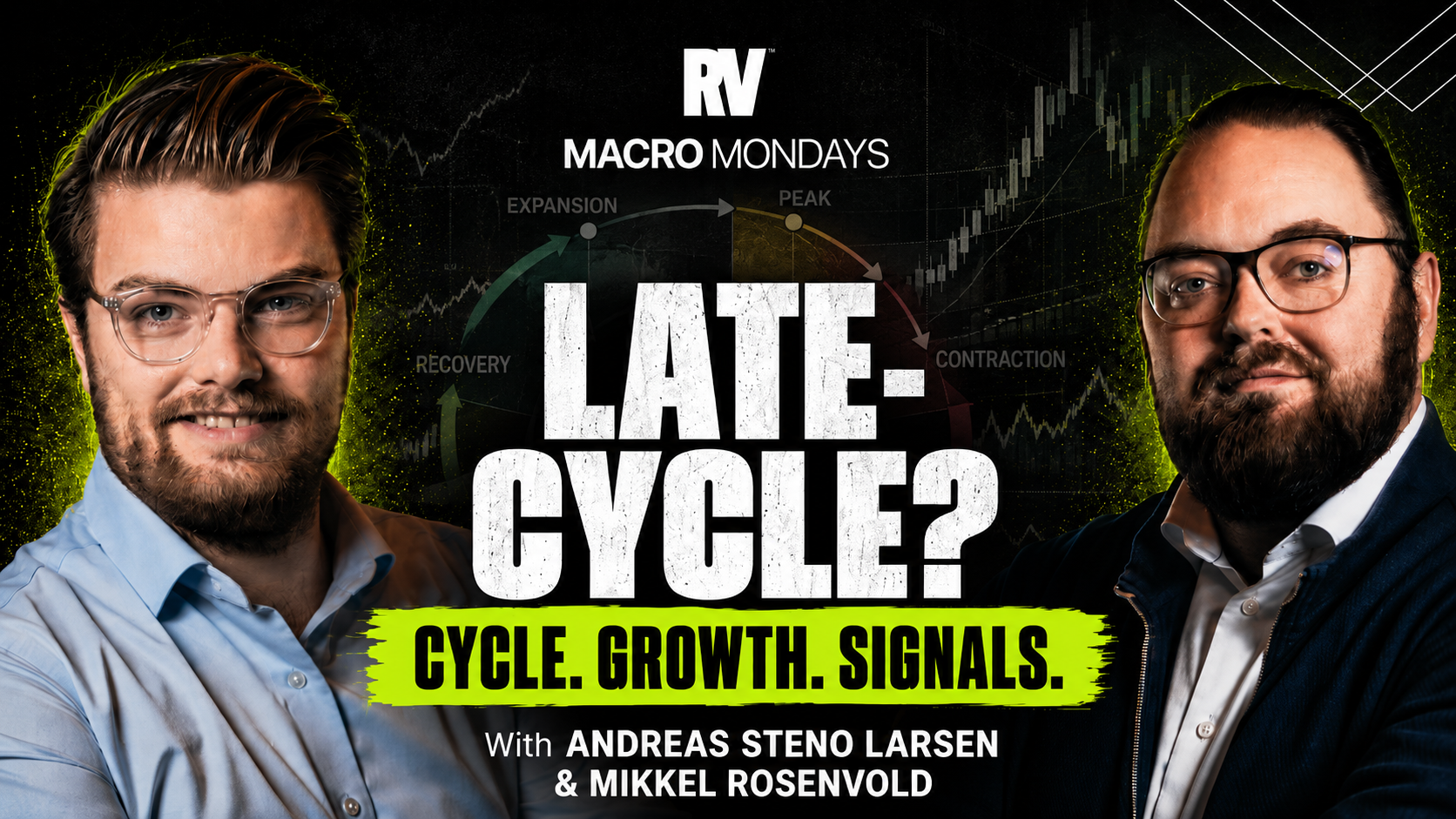
How Much Longer Can This Cycle Run? w/ Andreas & Mikkel | with Macro Mondays Oct. 5, 2026
In short
Macro outlook after Trump–Xi and Trump–She summits; whether rising long-bond yields and hot inflation prints signal the end of “good times”; potential rate-hike path under Kevin Walsh; and whether Iran de-escalation (sanctions relief/negotiations) could cool oil and inflation. They also discuss semiconductors (take-profit timing) and proposed US AI data-center moratorium legislation.
Guests
Andreas Steno (co-host; macro investor/editor; writes Steno Signals; discusses yield-curve regime shifts and Japan/Nikkei evidence). Mikkel Rosenvold (co-host; geopolitical piece “The Drill”; focuses on Iran negotiations and macro implications).
Key claims
Yield-curve lessons from 1900–2020 may not hold in a rising-yield regime; Japan’s Nikkei rose even as long yields climbed. Inflation “hot prints” may be partly technical (shelter survey timing) and energy-driven; resolution in Strait of Hormuz could prevent hikes. Oil can stay near ~100 if US–China cooperate and Iran risk de-escalates. Semiconductors: don’t take profits until South Korea demand/export data shows a slowdown. AI data-center moratorium reflects “not-in-my-backyard” politics.
Notable examples
2021–2022 yield-curve inversion/un-inversion didn’t trigger the expected recession; Japan long yields rising from near zero to >3% alongside strong Nikkei; Ed Yardini calling for June tightening and July 25 bps hike; South Korea export data for first 10–20 days; >50 US protests against data centers; Japan/Nikkei as empirical counterexample.
Written by AI. May contain mistakes.
Chapters
0:45
Upcoming Topics Preview
Preview of the topics to be discussed today, including Trump-She summits and inflation reports.
“And we're entering the part of the year where we have public holidays left, right, and center.”
1:50
Public Holidays and Content Schedule
Discussion about upcoming public holidays in Denmark and future content plans for Real Vision.
“Remember, this is our free weekly sneak peek into the world of macro and the publications that we publish on Real Vision.”
2:45
Andrew Tate's Life Hack Controversy
Exploration of Andrew Tate's controversial life hack regarding bond investments.
“I'm very, very fascinated by the following he has, Andres.”
4:11
Analysis of Bond Yields and Market Impact
In-depth analysis of long bond yields and their significance for risk assets.
“So we had a lot of focus on that last week, right?”
8:09
Inflation Trends and Economic Signals
Discussion on recent inflation trends and the potential for future rate hikes.
“on a trend basis, maybe those conclusions do not hold anymore.”
13:20
Negotiations and Potential Market Impacts
Discussion about US sanctions and potential negotiations to ease inflation pressures.
“Having said that, I still hold the view that we need to see a resolution in the Strait of Hamosi over the next couple of months to avoid interest rate hikes everywhere.”
14:01
Inflation and Geopolitical Influences
An overview of the current inflation situation and its links to geopolitical events.
“the hope is that there is still a window to remedy the inflation situation by pulling out the driver of this inflation wave, essentially.”
14:47
Impact of Settlements on Market Rally
Discussion on how a potential settlement might impact market rallies and economic sentiment.
“And while that is admittedly true on the surface, everything that we see in relation to the growth momentum quite frankly across the board globally is much better than feared.”
16:12
Oil Market Dynamics Amidst U.S.-China Relations
Analysis of the oil market's stability in the context of U.S.-China cooperation.
“And it's actually been a surprise to me.”
18:13
Interest Rates and Political Pressures
Exploration of how political pressures might influence interest rates and economic policy.
“at least from the bond yield side we're starting to see the kind of pressure that is needed to force the US into making a deal as well.”
Show all 14 chapters
24:13
AI Legislation and Economic Implications
Discussion on the implications of proposed AI legislation on the economy and political landscape.
“And Andreas, that just leaves us with a few minutes to open up a complete Pandora's box.”
28:06
Political Movements and Investor Implications
Discussion on how upcoming political movements may affect investors.
“The reason being that I think you can rest assured that Dario Amate and his friends, they're starting to figure out who to pay ahead of the 2028 election to avoid this.”
28:40
Factors Affecting the Long End of the Yield Curve
Analysis of key factors influencing the yield curve, including inflation and geopolitical risks.
“We've seen, I think, three themes wreaking havoc on the long end of the yield curve over the past seven days.”
29:59
Political Stability and Economic Growth
Examination of political stability in the UK and its relation to economic growth.
“We've seen it in France over and over, right?”

Ask about this episode
Get the gist, explore an idea or ask about something said.
 Claude
On Real Vision: Finance & Investing, what are the key points of this episode?
Searching your listeningTranscript
Automatic transcript. May contain errors.
0:00Macro Mondays, level up your week, oh yeah.
0:05Mikkel Rosenvold: Hello out there, welcome to Real Vision, welcome to Macro Mondays. My name is Mikkel Rosenvold, I'm joined as usual by my co-host Andreas Steno. And we have a jam-packed show for you today once more. We are looking back at the Trump-She summits, we're looking a little bit at interest rates, and then we're obviously looking at the inflation reports we got last week. But do we need to worry? Is this the end of the good times? We'll take a look at it. And, of course, we'll cover the latest dose of Iran popium that we just got over the morning here. So lots of stuff to talk about. Andreas, how are you feeling?
0:44Mikkel Rosenvold: We had an extended weekend in Denmark. We are Europers, after all. And we're entering the part of the year where we have public holidays left, right, and center. So how was your weekend, Andreas?
0:55Andreas Steno: Well, you're absolutely right. You should expect us to be off three, four days a week on average from now on until the end of June. So I guess it could be worse. End of August, really? Yeah, sure. Yeah, we're off all of July. So, I mean, I just took that for granted.
1:14Mikkel Rosenvold: Absolutely. Now, even though we have a lot of public holidays, we still have lots of great content here in Real Vision. We do have collaborators outside of Europe, thankfully, both Australia and the States. So remember, on Wednesday, that's the big one this week, on 4 p.m. Eastern, for all pro members, we have a roundtable discussion. So that's going to be you and Andres, Jamie, and Raul talking everything macro, crypto, AI, just shooting shit. So it's going to be really, really fun. Really looking forward to that show, getting all the good guys together. So really looking forward to that one.
1:50Mikkel Rosenvold: Remember, this is our free weekly sneak peek into the world of macro and the publications that we publish on Real Vision. To get full access, you need pro access for Real Vision. That gives you access to our three weekly articles. That includes the Steno Signals, that is Andreas' flagship editorial, my geopolitical piece, The Drill, and then our Friday portfolio update where we take a look at what's happened on the thematics that we cover in our macro model portfolio at Real Vision. So do check out the approach here for more on that. at realvision.com. And as usual, a little reminder here, Andres.
2:26Mikkel Rosenvold: We are trying to be as actionable and concrete as possible, but our recommendations might be... Sometimes it may be good, sometimes it may be shit. That's the way it is, Andres. And speaking of sometimes maybe good, sometimes maybe shit, I'm an avid, I don't know if it's right to say follower, but at least observer of Andrew Tate. I'm very, very fascinated by the following he has, Andres. And he has obviously been a very, very big Bitcoin guy. He has slipped his toes in finance once in a while. Now he has essentially killed our program, I'm afraid, Andres. I want your take on it. He published his life hack.
3:04Mikkel Rosenvold: Since the US government is now selling 30-year bonds at 5%, you should simply take$50 million in cash and just buy bonds. That will pay you$2.5 million a year for zero work,$208 ,000 a month. and that's enough to cover basic expenses like a security team in Cigar. I don't know what your monthly budget is for Cigars and security team address. That's probably one of the good things of not living in Romania. But what's your take here? Is this the life hack we all waited for?
3:34Andreas Steno: Well, I guess this classic example of the old discussion on how to get rich, right? The easiest way to get rich is to inherit the money or get 50 million in gas from out of the blue, apparently here, right? Because, of course, it's easy to earn money if you have 50 million. So I don't really see the hack here, to be honest. But it could be seen as a sentiment indicator related to long bond yields, in a sense, right? That all of a sudden, Andrew Tate is now aware that the 30-year treasury yield is above five, which is the first time for a while, right? So we had a lot of focus on that last week, right?
4:16Bond deals, they've trended in a nasty direction.
4:20Andreas Steno: The big question is whether it's an issue.
4:22Mikkel Rosenvold: And that's the point, Andreas, to get serious about this. When even Andrew Tate is posting about bond deals being high, was that what caused the sell-off we saw on Friday and into Monday here? Or how much impact does that have on investors in your opinion?
4:38Andreas Steno: You know, the trillion dollar question right now is whether long bond yields carry the same significance for risk assets as they've typically had for decades. And I've spent a lot of time digesting that topic over the course of the weekend since we had this very nasty price action in bonds towards the end of last week. But I'd like to start with just a very simple observation on page 10, Mikkel, because I've actually had this dialogue with quite a few of our professional investor counterparts, but also with various accounts on X, various people in my inbox, etc. So is it fair to assume that all of the conclusions that we've typically learned from the yield curve between, say, 1900 and 80 until 2020 still hold, now that we have a very different yield environment?
5:47Andreas Steno: I think the simple answer to that question is no. That you cannot just assume that all of the lessons that we learned over the past four decades still hold true now that the overall regime is pointing in the other direction for bond yields. And to take one but very important recent example of it on page 11. we had the so-called inverted yield curve back in 2021 2022 you know we had inflation spike central banks started hiking interest rates aggressively so they brought short-term yields above long-term yields and historically once we've seen the so-called un-inversion of the yield curve where short-term bond yields drop relative to long-term bond yields, it has been sort of a precursor of something nasty.
6:48Andreas Steno: We've typically seen recessions, say a year, year and a half after that. A couple of good examples of it, right after year 2000, just ahead of the great financial crisis, we had similar uninversions of the yield curve. Those are the red vertical lines here in the chart. And we had nasty developments in markets. We had nasty developments in the economy after that. And I remember how everyone called for the same kind of development back in 2022 into 2023, where we had this on inversion, stating that, okay, now we have 12, 18 months left, and then the US economy will be in ruins, basically. None of it happened.
7:30Andreas Steno: And so this otherwise very strong hit ratio signal of the yield curve simply didn't materialize. And maybe that's a very strong hint that you cannot just conclude that everything we've learned about how the yield curve impacts various assets, how the yield curve impacts the economy. is the same as it was during those four decades of falling bond yields on a trend basis. Now that we, as I said, probably have increasing bond yields on a trend basis, maybe those conclusions do not hold anymore. And currently, we have a tremendous empirical study of this in Japan. We've obviously seen long bond yields going from close to zero to more than 3 % in Japan.
8:29Andreas Steno: And it's probably been the best era for Nikkei in decades, despite long bond yields going up and up and up and up and up. So why is that? Could it be that allowing yield curve to re-steepen is a kind of normalization of the price discovery that is actually positive for markets? I hold sympathy for that thesis and I have a load of evidence of why that could be the case in my editorial today
8:58Mikkel Rosenvold: Very interesting stuff so check that out and read why this may be not the canary in the coal mine Andreas but if this isn't the signal we should be looking for how about inflation Andreas we had a couple of quite hot prints last week what do you make of them and how worried should we be about inflation right now
9:19Andreas Steno: You know, initially I found the trend to be pretty worrying, especially since we also, I mean, one thing was the hot consumer inflation report. Was it on Wednesday? And then we had the producer price inflation the day after, which was probably even nastier. Typically, you see, you know, the input cost inflation ahead of consumers actually feeling the heat. And we're starting to see some signs of inflation pressures that are pretty reminiscent of what happened in 21. So, I mean, we obviously should not discard that. Earlier today, and I actually think this carries a bit of significance because it's the first research house I've seen calling for this.
10:08Andreas Steno: Remember Ed Yardini? He wrote that, I quote him now, we expect the FOMC to signal a tightening bias at the June meeting of the Monetary Policy Setting Committee, followed by a 25 basis points hike at the July meeting. We cannot rule out more rate hikes over the rest of the year. I don't think I've seen anyone else calling for rate hikes in the US especially given the backdrop that we just got the official confirmation of Kevin Walsh taking the job last week so we now have allegedly a dove in place in the chairman's seat and now a couple of research shops are starting to cite the risk of hikes coming up in two or three months from now, would be quite the ironic backdrop if Kevin Walsh entered the FOMC just as a hiking cycle was starting.
11:07Andreas Steno: I don't agree with the view, by the way, of Yardini here for a couple of reasons. I typically hate charts that strip out parts of the inflation basket. And, you know, it's very easy to always say, okay, if you leave this and this and this and this out, inflation is nowhere to be seen.
11:29Mikkel Rosenvold: No inflation in used cars, always good.
11:33Andreas Steno: But if you look at the consumer inflation report we got last week, I just think it's easy to isolate the issue. Because if you leave out energy and buy products seen in food, you basically don't have a lot of inflation in that report. Especially if you leave out shelter as well, the so-called homeless basket, right? because shelter was sort of a technical one-off last week. Remember that the shelter category is a survey-based inflation measure. So they survey a panel biannually, so twice a year, about their rent development. And back in October of 2025, they didn't have the staff at work due to the government shutdown, so they couldn't collect the survey.
12:27Andreas Steno: So in the inflation report from October of last year, everything related to shelter costs was basically a zero because they didn't survey this panel. Therefore, six months later, April 2026, they surveyed them twice, in a sense. They doubled up the monthly contribution to account for that zero back in October. So that is obviously a technicality that led to more inflation than what is actually the case in April of 26. And therefore, if you strip that out, if you leave that out of the equation, and if you leave energy out of the equation, for obvious reasons related to the Strait of Hormuz, you could still find excuses to stay soft on interest rates, in my opinion.
13:16Andreas Steno: and I think Kevin Walsh will jump on that opportunity. Having said that, I still hold the view that we need to see a resolution in the Strait of Hamosi over the next couple of months to avoid interest rate hikes everywhere. Maybe that's the perfect bridge to allow you to talk a little bit about the hope that we actually got from the Iranian side for once today, Michael.
13:40Mikkel Rosenvold: Yeah, yeah, we're getting reports. Admittedly, I've been in recordings for the past two hours So I haven't read into details on most of it. But we do have reports that the US side is looking to relieve some sanctions. We're hearing positive signs about negotiations, a new deal from being brokered by Pakistan. So, Andreas, the hope is that there is still a window to remedy the inflation situation by pulling out the driver of this inflation wave, essentially. And yeah, I still think there's a good chance. I think we all accepted that last week was about the Trump-She meeting. Now Trump is, I mean, even though he's doing 50 things at once, he usually focuses on one thing per week.
14:24Mikkel Rosenvold: And now hopefully we're back to the Iran war to get that settled, because that is essentially what we're all looking for. So a quick break in your regular programming. If you're serious about your future, grab my free report called Prepare for 2030. I think you've got five years to make as much money as possible. and this guide will help you navigate what's coming the link is in the description download it now so the big question here is obviously andreas if we do get a settlement within a few weeks uh will that sort of restart the rally uh how much of an impact can impact can that have
14:59Andreas Steno: um at least i kind of sense the same fear now from from quite a few of the research houses and And the PMs out there, as I sensed towards the middle of March or thereabout, I constantly hear this notion that, oh, the tech rally cannot really go on since we don't have a lot of positives to take away from the global economy. And while that is admittedly true on the surface, everything that we see in relation to the growth momentum quite frankly across the board globally is much better than feared. For now, the reason why we're staying alive, to put it that way, is that China is on a clear bias strike in oil markets.
15:49Andreas Steno: They import more than 5 million barrels a day, less than what we typically see in the Chinese economy. On top of that, we obviously see these record export numbers and record fillings in U.S. harbots. So we certainly still have a couple of months left of decent momentum if the Chinese and U.S. cooperation on this topic is as solid as it is right now. And it's actually been a surprise to me. And a big kudos to you to read the tea leaves right ahead of this Trump-Xi meeting. At least sort of from a big picture perspective, that war, if you allow me to call it that, the war between the US and China is basically off the table for now.
16:36And it seems like both parties agree on, at least on the major things related to the Strait of Hormuz and to the oil market overall.
16:49Andreas Steno: So when the biggest consumer of oil and the biggest producer of oil cooperates in that way, I actually think that we can keep the oil market in balance for longer than what most of the doomster energy pundits had expected. given everything that's ongoing in Iran. If you had told these energy pundits and energy hedge fund managers a couple of months ago that we're still trading around 100, they would have told you no, absolute no way, given that the trade-off move is closed. But I don't really see a strong sense of urgency in the oil market to strike a deal here, which is admittedly slightly worrying.
17:35The good news is that, and I've actually had a look at that earlier today, it seems like bond yields also matter a lot to the reaction function of the Trump administration.
17:47Andreas Steno: we've seen how Scott Besant has added pressure to alleviate some of the concerns surrounding Trump's very aggressive or hostile policy makes for markets once bond yields have gotten extreme and we're probably at that point again where he'll start to sound the alarm internally so I think we're seeing at least from the bond yield side we're starting to see the kind of pressure that is needed to force the US into making a deal as well.
18:20Mikkel Rosenvold: The question is, Andreas, because we're talking a little bit about Kevin Walsh. The whole idea was that when he entered office, there would be this huge political pressure to cut interest rates. We haven't really heard a lot about that, probably because Trump knows that he has essentially killed that plan with the Iran war, at least for now. But once he ends the Iran war, could that move back to center stage? Because the way I see it, it's the one thing he's lacking from this whole agenda. I mean, the terrorist war is more or less done. I don't know. He has some kind of truth with China. If he can end the Iran war, why shouldn't he move back to focus on cutting interest rates?
19:02Mikkel Rosenvold: Because that would be great ahead of the midterms, admittedly. Do you think there's any chance of that?
19:09Andreas Steno: You know, at least as long as the decomposition of inflation looks, the way it does, we can very easily go back to discussing rate cuts if we get a resolution to the straight of a moose. So take the example of last week again. If we get sequential negative contributions in nominal terms from energy to month in and month out from August and until the midterms, then inflation will not really end up being a worry, right? So it all depends on the straight of the moves and whether you can get energy prices down in time for the midterms. I still think you can. And that is one of the, you know, I've had plenty of discussions on this exact topic with many of the energy experts out there.
20:05Andreas Steno: and what they what i think they struggle with is you know i fully understand that for example the oil market or any other commodity market for that sake is a physical market by the end of the day right so you you cannot really manipulate the the dated market right because you you obviously need the fuel right so it's not like it's a paper market that you can manipulate uh to some extent You can manipulate a futures market. But what I keep telling them is that as soon as the root cause of the initial worry is gone, the market will move on. And the best example of that is late March, early April, where we got that move towards ceasefire in Iran.
21:02Andreas Steno: we certainly didn't have accelerating concerns around geopolitical risks sort of on a weekly basis instead we have we had the opposite right it was kind of a de-escalation without of course getting at the the ultimate deal in place and that was also the exact point where we started to see entity worries recede. We started to see NASDAQ rebounding. And here we are, I don't know, 35 % later with one of the fiercest rallies in modern history amidst the war, right? So I've lost count of the amount of insults I received when I said that the rate of change is what matters, also in oil markets, but it does.
21:54Andreas Steno: And the best empirical evidence of that has basically been the way the market has behaved over the past six to seven weeks.
22:02Mikkel Rosenvold: So Andreas, a question here from a user called or a viewer called Kavi79, which sums things up very beautifully. That's all very often the beauty of listening questions here. Good afternoon, gents. Could you comment on whether it's time to take some profits in semiconductors? That's a good way of wrapping up your view on the immediate situation, Andreas?
22:24Andreas Steno: Let me put it like this. Obviously, we shouldn't rule it out. But I think it's an even more popular view to say that it's time to take profits in semiconductors than it is to be long semiconductors. I don't think anyone is willing to say no to that question outside of me. Everyone is saying that you should take profit in semiconductors. But I have this very simple rule that I'm not going to take profit in that trade until I see an issue in the economic data from Korea. Because that's essentially the best real-time gauge you have of demand in the semiconductor space. And it will be very interesting to see the first 20 days of the month.
23:12It will be released, I think, on Wednesday morning, right?
23:15Andreas Steno: the export data from the first 20 days of the month, but we received the data from the first 10 days of the month, which looked incredible. So I think it's as simple as that. I mean, if there's still an accelerating demand side on this, then why? I don't know when this ends, but I know what to watch, and South Korean data is basically what I watch.
23:44Mikkel Rosenvold: Yeah, you know, sometimes I think I'm blessed. I'm a political science major. The only economics I had at university was a course on supply and demand. That's it. It ended there. I had decent rates on that, but the demand is there. That's all I understand. The demand is there. The demand is accelerating. We saw that in all the earnings reports. So I don't really see a reason for this unless you're extremely short-sighted and you need to buy a car this fall or whatever. I mean, yeah. And Andreas, that just leaves us with a few minutes to open up a complete Pandora's box. But one that I've been wanting to open for a while and that I'm very, very eager also to get the discussion going on on the Real Vision platform with all the great users in there.
24:29Mikkel Rosenvold: Because you sent me this. I don't know if you went to the congress.gov website and looked. That's something I usually do. look at the bill proposals from the U.S. Senate Committee on Commerce, Science, and Transportation. But Bernie Sanders, Bernard Sanders, the senator from Vermont, introduced a bill on Artificial Intelligence Data Center Moratorium Act. And we're not going to go into the depth of this address, but what you spotted exactly right was that this is probably the first example of what we could call, It's probably harsh to call it anti-AI legislation, but the beginnings of perhaps a more nuanced view, Bernie Sanders would say, on AI.
25:13Mikkel Rosenvold: He was also quoted for the opinion that anthropic and open AI have stolen the knowledge of the masses and the population.
25:23Andreas Steno: That's the Jon Stewart argument as well, right? In my opinion, Andreas, I've always said that if AI is working as we think it is, we're going to have unemployment.
25:36Mikkel Rosenvold: It might be good unemployment because we're all getting richer. We don't have to work. But it's still a political issue. It's a huge political issue potentially already for 2028. So how much should you as an AI investor be on the lookout for this? And does this change the way you understand the stakes of the midterm elections as an AI investor?
26:00We should obviously look into the political side of this trade because some trades related to infrastructure are incredibly sensitive to whether it's a red
26:15Andreas Steno: or a blue administration. take the example of wind turbines this is actually the same kind of issue that faces solar parks, wind turbines all those infrastructure projects because one thing is that Bernie Sanders has got sort of a more academic reason to put this bill forward but it is ultimately in my opinion a response to the, you know, to the grassroots opposition against not having data centers in your backyard. We've seen, I think, more than 50 protests this year in the U.S. directly related to data centers. It is a very classic not-in-my-backyard issue, this with added layers here because it's not like a wind turbine will make you jobless right so and and uh but but but to me i i still think the most tangible part of data centers is still this whole issue of you know um yeah the whole not in my backyard issue with high energy prices um the ramifications for the temperatures for the people living close to data centers and all of that more than this second order effect of how it impacts the job market etc i don't really think anyone's really on top of what's going to happen there yet um not at all yeah so we'll have to see ultimately i don't think the democrats will turn into anti-data center politicians uh the very The reason being that I think you can rest assured that Dario Amate and his friends, they're starting to figure out who to pay ahead of the 2028 election to avoid this.
28:19Mikkel Rosenvold: Yeah, that's absolutely true and absolutely fair. I think we will see movements in the Democratic Party. But again, yeah, we'll get back to unpacking the entire midterms. I think it's being overplayed as an investor theme, to be perfectly honest. But we'll get back to that. In later shows as well, Andreas, we are past our time. Any final remarks for the listeners on how to behave this week?
28:47Andreas Steno: No, maybe one final remark. We've seen, I think, three themes wreaking havoc on the long end of the yield curve over the past seven days. One is the inflation wave. that's an obvious one given the energy crisis the second is probably this whole worry that international investors will flee western bond markets due to geopolitical risks etc that was again sort of center of attention with the trump she meeting but you can probably put that to bed for a while again with with the with the truce that was found between the u.s and china and then And the final thing is probably these fiscal slash political worries currently mostly present in the UK with the risk of Keir Starmer having to step down.
29:43Andreas Steno: We've seen very volatile decision-making and very volatile environments for politicians in many countries, right, where they struggle to even stay in power for their whole election period. and Kirstenmer is the latest example. We've seen it in France over and over, right? So, you know, maybe that should be my final remark. I also think those risks are kind of overstated, especially in the UK now, since the economy is actually on an accelerating path and that is typically comforting for those in power. And therefore, if you overall get positive, growth surprises during the second half of the year compared to consensus um it probably points in the direction of the more stable political second half of the year than what is priced in
30:40Mikkel Rosenvold: depending on inflation i'd say because i mean today it's uh it's not weak growth that kills governments it's inflation but uh we'll have to see and raise a lot hinges still on the the situation the whole moves that we are obviously covering on an ongoing basis that's all we had for you this week, folks. Remember to tune in for our roundtable discussion with Raul and Jamie and everyone on Wednesday at 4 p.m. Eastern for Real Vision Troll members. Thanks to all of you for tuning in. We'll be back next Monday. You obviously enjoyed the episode because you're here with me at the end. But listen, don't forget to go to realvision.com forward slash join and grab a free membership.
31:19Mikkel Rosenvold: It's an incredible community packed with alpha, great investment ideas and the research that you need to help you unfuck your future. So get started now. Go to realvision.com forward slash join.
From the publisher
Andreas Steno and Mikkel Rosenvold are back to tackle the question that matters most for markets right now: are we still mid-cycle, or are the warning signs of a late-cycle economy starting to pile up? They also head to Europe, where surging French bond yields, political uncertainty, and renewed concerns over the country’s finances are putting pressure on French assets. Is the turmoil a genuine warning for investors — or exactly the kind of dislocation you should be buying? Plus, Andreas and Mikkel revisit purchasing power parity and ask how useful PPP really is when trying to figure out where currencies should trade.The markets are wide open right now. Crypto, AI, entire sectors repricing. You don't need a finance degree to play anymore. You just need someone to hand you the map.That's Real Vision. The place where the best minds in macro and crypto break down what's moving, with the research, tools and community to help you make your own calls.🏆 The Real Vision Trading is now open! The best trade ideas on the platform compete for $80,000 in cash. Register before October 15 to secure your spot.📈 Trading League: https://realvision.com/your-futureTimestamps:00:00 - Macro Mondays October 5, 202600:22 - Mid-Cycle or Late-Cycle? The Big Macro Question 02:14 - GDP vs PPP: Is Russia’s Economy Really Smaller Than the UK’s?05:15 - Why Energy and Food Self-Sufficiency Matter More in a Crisis07:21 - Iran War Update: Why Oil Flows Are Better Than Before the War10:56 - Can a Democratic Midterm Sweep Derail the AI Buildout?14:32 - ISM Services Miss: Is the US Economy Starting to Slow?17:55 - France in Turmoil: Are Markets Pricing in Too Much Political Risk?20:39 - Marine Le Pen, French Bonds, and Why France Could Be a Buy26:09 - Mid-Cycle vs Late-Cycle: Will Central Banks Kill the Expansion?29:01 - Dollar Strength, Hormuz, and the April-Style Setup Returning#macromondays #macro #mikkelrosenvold #andreassteno #stenoresearch
🔥 Get 𝗙𝗥𝗘𝗘 𝗔𝗖𝗖𝗘𝗦𝗦 to Real Vision https://rvtv.io/3YOZZUe
Connect with Real Vision™ Online:YouTube: youtube.com/@RealVisionFinanceTwitter: https://rvtv.io/twitterInstagram: https://rvtv.io/instagramWebsite: https://rvtv.io/3Y4t5PwDisclaimer: https://media.realvision.com/wp/20231004185303/Disclaimer-1.pdf
Learn more about your ad choices. Visit podcastchoices.com/adchoices
More from Real Vision: Finance & Investing
All episodesWe use cookies.They keep VO running smoothly and help us improve it. Privacy policy