
In short
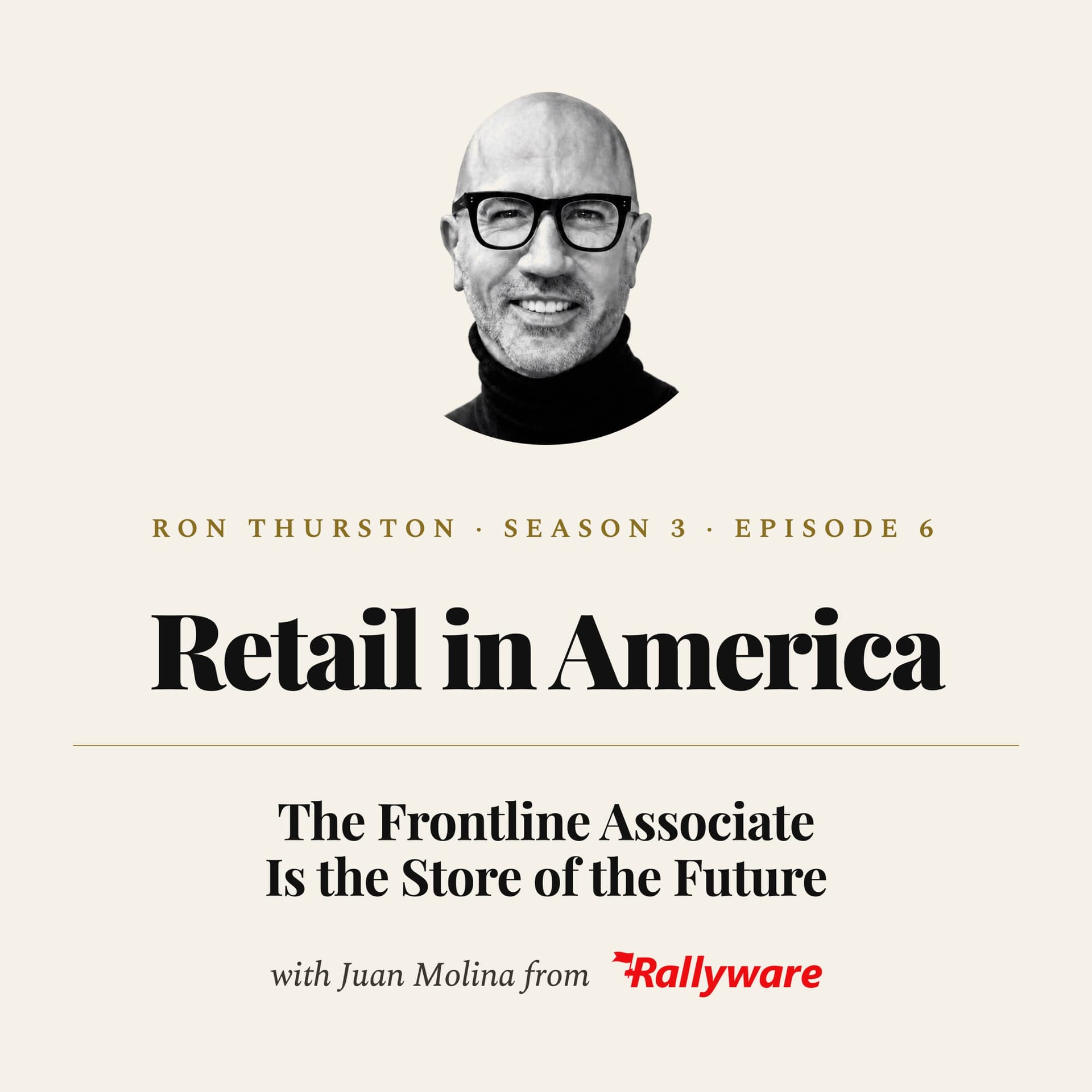
The episode argues that retail’s “AI” focus misses the biggest conversion lever: the in-aisle decision moment where a frontline associate must respond in milliseconds to a customer’s intent. It claims 50–70% (possibly more) of shoppers leave without buying, and many arrive with AI-generated answers, creating a high-stakes gap the store currently fails to own.
Guest backgrounds
Juan Molina is Senior Director of Retail at Rallyware. He previously spent about a decade selling retail/commercial tech, including 3D product visualization at Chaos, focused on the pre-purchase moment.
Key claims
Traditional training is “homework” that most associates don’t retain (under 15% engage with voluntary training). Rallyware shifts training to real-time sales assist at the point of decision, optimizing for sell-through and revenue.
Notable examples
Scanning a product box/QR code (or using image recognition) to surface brand info and retailer selling guidance; “revenue per device” pricing to quantify ROI; aisle-level performance tracking and device usage linked to basket size and incremental sell-through.
Written by AI. May contain mistakes. Listen to the episode to check what was said.
Chapters
Tap a time to open that second in VOThe Importance of Frontline Associates
0:46 to 2:08
Discussion on the role of frontline associates in retail and the challenges they face.
“My guest today is Juan Molina, Senior Director of Retail at Rallyware.”
In-Aisle Decision Moment
2:09 to 3:45
Exploration of the 'in-aisle decision moment' and its significance in retail.
“Yeah, you and I met actually relatively recently, and you started telling me about Rallyware and the very specific problem that you're solving.”
Optimizing Sales and Training
3:46 to 6:41
Understanding how to optimize training for frontline associates to improve sales.
“It's one fell swoop, if you will, where the brand wins or loses, the retailer wins or loses, the customer wins or loses, and that frontline associate wins or loses.”
Rallyware's Role in Retail
6:42 to 11:28
Insights into how Rallyware supports frontline associates through technology and training.
“If whatever, if your foot counter says that your walkout rate is 75, what if it was 73?”
Components of Rallyware's Platform
11:29 to 14:00
Overview of the key components of Rallyware's platform for frontline associates.
“and we haven't optimized it for the frontline associate who lives in this chaotic world, we're stopping and looking into a library for a video or that doesn't work, right?”
Platform Components for Retail Success
14:00 to 15:00
Learn about the three key components of a retail platform designed to enhance frontline associate performance.
“What that means is we have sort of three components to the platform.”
The Importance of Frontline Engagement
15:00 to 15:55
Discover how frontline engagement influences customer satisfaction and sales outcomes.
“And you are different than some of the bigger just communication platforms, because you like a UBIC or a retail Zipline, because you're focused exclusively on frontline selling.”
Challenges in Retail Sales Dynamics
15:55 to 17:45
Understand the unique challenges faced by retail associates and the impact of high turnover.
“I love that you say, like, don't go to your company website.”
Investing in Frontline Associates
17:45 to 20:18
Explore the need for investment in training and resources for frontline associates to improve conversion rates.
“And the things that you just sparked in my mind are two things.”
The Consumer Experience and Its Impact
20:18 to 22:34
Learn how the experience of consumers is intertwined with the effectiveness of frontline associates in retail.
“And therefore, maybe there's spiffs, maybe there's commission rates, maybe like what happens to the conversion of the store when all the data then shows you the investment was worthwhile.”
Show all 16 chapters
Leveraging Technology for Sales Improvement
22:34 to 26:48
Discuss how technology can enhance the performance of retail associates and drive sales.
“And you don't, therefore, gain that sale on your website instead.”
Creating an Integrated Retail Ecosystem
26:48 to 28:00
Consider the potential of integrating various retail technologies for enhanced performance and decision-making.
“The brand voice is always going to be in the aisle driving that consistency.”
Transforming the Retail Ecosystem
28:00 to 30:54
Explore the integration of technology and frontline associates in retail.
“on the floor and how many people and how many footsteps did we have?”
Rallyware's Role in Retail
30:54 to 33:55
Learn how Rallyware supports brands with retail ecosystems and device strategies.
“And it's just a matter of, so the kind of last couple of questions, one, like who is Rallyware for and who is it not for?”
Mindset Shift for Retail Success
33:55 to 35:59
Understand the importance of devices as revenue drivers in retail.
“And if you can do that, that will then unlock a significant source of funding for you to be able to access this paradigm shift that we've been talking about.”
Closing Thoughts and Future Insights
35:59 to 37:20
Reflect on the significance of frontline teams in the retail industry.
“And what we're trying to do right now is just tell a story.”
Transcript
Automatic transcript. May contain errors.0:00Juan Molina:Welcome to season three of Retail in America and a limited series this fall dedicated to the road to the NRF big show. And I'm Ron Thurston. Every January, our industry fills the Javits Center in New York City. The keynotes are always about AI. The booths are about inventory and margin and omni-channel solutions and the supply chain. And the list goes on and we all love it. But walk the floor and count the conversations about the person who actually sells. Not the platform that roots the order. Not the model that sets the price. The person who closes the sale. They are the foundation of our business.
0:42Juan Molina:And they have never been the headline. But I'm going to change that. So let's get into it. My guest today is Juan Molina, Senior Director of Retail at Rallyware. Juan spent the better part of a decade selling technology into retail and commerce. 3D product visualization at chaos, helping brands make a product look convincing on the screen. All of it aimed at the moment before someone decides to buy. Now he's at Rallyware, working the moment after. The 10 seconds when a real person standing in front of a customer either closes the sale or doesn't. And here's what we're going to get into. Because somewhere between 50 and 70 % potentially higher of people who walk into a store, leave without buying anything.
1:30Juan Molina:80 % of them walked in with an AI generated answer already in their pocket. And somewhere in that gap is a moment. A customer standing in the aisle, an associate who either steps in with the right thing to say or doesn't. This is where the sale is won or lost. And nobody actually owns that moment. not the brand whose product it is, not the retailer whose floor it's on, not the systems already running in the store. And Juan and Rallyware spend their days fixing that gap. So, Juan, welcome to Retail in America. Thank you for having me, Ron. I'm excited for this. Of course. Pleasure. Yeah, you and I met actually relatively recently, and you started telling me about Rallyware and the very specific problem that you're solving.
2:23Juan Molina:And the more I learned and kind of understood the point of view of Rallyware and what you're doing, I was like, we have to speak more about this because it's a huge opportunity that I think is really an unlock to the success of our industry in retail. So I wanted to start with this because, as I mentioned in the opening, you know customers are walking in the door more educated than they've ever been before they have done you know very easy homework these days we can all type something into chat gpt and claude and get endless information so where do you see that point where an educated customer is in the aisle trying to make a decision yeah thanks for that ron so um the the way that we think about it um and if folks sort of are familiar with google zero moment of truth right if you think about sort of the digital world.
3:17We think that there's a very similar moment in the store. We're calling that the in-aisle decision moment. That is the moment where a product from a brand, right, the aisle from the retailer, as you mentioned, and then that frontline associate are all interacting. And in milliseconds, that frontline associate needs to meet the intent of that consumer as they're walking in into the aisle. And I'm sure we'll get into a lot more detail around sort of context of it. But if I just focus on that in our decision moment, what we found in our engagements with the hundreds of brands that we work with and our rich sort of retail network that those brands drive billions of dollars worth of revenue through is that that moment of decision is where everybody wins or loses, right?
4:07It's one fell swoop, if you will, where the brand wins or loses, the retailer wins or loses, the customer wins or loses, and that frontline associate wins or loses. And I know you mentioned a little part of my career, but the first part of my career, I spent at Experian Marketing Services for seven years, right? And I'm sure you remember that world where it was all about 360-degree view of the customer and attribution and all of this great stuff. And 20 years later, the store continues to be a black box. And we believe at RallyWare that it continues to be a black box because there hasn't been enough focus on not only that in-out decision moment, but that frontline worker that is the difference between the win or the loss for all of those parties that I mentioned in that moment.
5:01Juan Molina:Yeah. And you're exactly right because we can speak about 360 degree view of a customer, but the customer is only a customer if we know who they are. And the only way we know who they are is if they make a purchase. So this is where I think we spin ourselves out, like that we have all this knowledge. But the reality is 80 % of people didn't actually buy anything in the store. So we have no idea who they are. And that's a really interesting point, like a very specific point of view around conversion, which every brand talks about. You either need traffic, more traffic and equal or higher conversion, or you need, if the traffic's not there, you need a higher conversion.
5:42Juan Molina:There's only one answer to the question, and it's the frontline associate. Absolutely. Absolutely. And, you know, to put it in sort of very simple terms, I think you mentioned 50 to 70 percent of everybody that walks into a store today walks out without buying something. And so there's two things that sort of really scream at us from that is number one, it's not like when I was growing up where you go to the mall to hang out with your friends, right? Like if you get up today, you get dressed, you get in a car and you go to a store to us, that is a massive, massive signal of intent. And so how are you then capturing that intent?
6:20And in retail, right? One of my mentors says this a lot to me, right? A dollar spent in retail isn't a dollar spent. to the dollar times whatever your scale is, right? And by the same token, a dollar made in retail isn't a dollar made, it's a dollar times whatever scale. And so when we think about taking small percentage chunks out of that 50 to 70%, right? If whatever, if your foot counter says that your walkout rate is 75, what if it was 73? What if it was 72, right? We're not talking about, you know, a thousand percent ROI And like, nope, but we just need to optimize that moment to squeeze a percent or 2 % out of it.
7:01And if we can do that, that then ultimately means a lot more happy customers, happy brands, happy retailers, and happy frontline associates. Totally agree.
7:13Juan Molina:Well, and you had shared this data with me that less than 15 % of associates engage with voluntary training. And most of it's forgotten within a matter of days. And so, yeah, but see, and you think about the landscape of frontline associates, a lot of part-time, a lot of second jobs, third jobs. We, I've talked extensively about turnover rates and the impact that has on this business. So you, you take this kind of mix of people full-time, you know, really like masters of, of their, of their roles and their skills all the way through. It's my first day. and I had an hour to watch a video and learn a little bit about product knowledge and all of a sudden I'm standing in front of a customer.
7:58Juan Molina:And so like, where does RallyWare play in that game and what's the impact when you think about training? Yeah, so look, we have over a decade in a separate part of the business where we've been training frontline associates. And the thing that we learned over 10 years and 100 plus brands, some of the bigger brands that you can think of in the world is that the day in the life of a frontline associate is not conducive to doing homework. And that's ultimately what we were saying. We were calling it training, but it was actually homework. And I think that one of the things that you mentioned there is just like human biology.
8:44I mean, just think about it. In your normal life, your partner says, hey, I need you to do this. half the time while forgetting it, right? Or it's just, it's just, it's the way our biology works, right? So, so it's not conducive to doing homework, because they're not in school, right? And it's not sort of the primary focus. It's not conducive to doing homework, because the biology and what we forget. And I think lastly, and most importantly, is it's not, it's not, it's not conducive to doing homework, because the store in and of itself is chaotic, their day is chaotic, right? The delivery didn't make it.
9:19Someone called out, now I need to cover for this person. There is so much craziness that's happening throughout the day that there's just a paradigm shift that is required. And my CEO, our CEO, George, when I got here, he said something very, very powerful to me, which is, look, man, we've been around for 10 years and we have a lot of pride in what we do. Our customers love us and we love our customers. But every time I walk into a retail store, we're nowhere to be found. That has to change. We must be able to do this better for brands, retailers, and most importantly, that frontline associate.
9:58Because what he knew is we were the ones tasking them and we were the system they were using. And we were reporting on all sorts of great analytics, right? Generally, your most engaged person from a training perspective is going to be one of your best sellers. And that's totally fine, right? But if you're only getting across 20 % max, what's happening with the other 80 % of those frontline associates? And most importantly, what are you optimizing for? Are you optimizing for good grades, right? And completion rates and saying that, you know, giving yourself a pat on the back because that piece of content was really engaging and a lot of people downloaded it.
10:38Or are you optimizing it for unlocking value when they need it most, which is when that customer comes in, picks up a product, and it's a new product launch, or I'm a seasonal worker. I talked to a company recently. They give their seasonal workers sometimes less than seven days from training to hitting the floor and selling them. This is a relatively complex product. It's in jewelry. So, you know, it's, again, it's just what are you optimizing for? And in our world, we full and wholeheartedly believe that what we need to optimize for and what we're trying to drag all of our brand customers and therefore then all the retail networks that they sell through is towards this paradigm shift.
11:21Where it's not that the training data is bad or training of itself is bad. It's that we haven't optimized it for what it's meant for, which is selling. and we haven't optimized it for the frontline associate who lives in this chaotic world, we're stopping and looking into a library for a video or that doesn't work, right? And think about it from a consumer's perspective. I mean, I get angry when someone goes on their company's website. Now, I'm biased, right? I live in this world where I think there's a better way of doing things. We're not going to sit around as consumers and wait for you to go and look for the thing, right?
11:59So let me sort of pause there, but that's really it. It's what are you optimizing for? Are you optimizing for school and homework, or are you optimizing for that moment of decision to unlock maximum value for that customer through that frontline associate to ultimately drive max sell through?
12:18Juan Molina:Yeah. And so give us just kind of the nuts and bolts of how Rallyware works. just kind of give us the like, how does it show up to the, to that frontline associate that you're describing, like give us a little bit more insight on the product. The first thing you need is sort of a gas tank, a sort of a rich area where you have all of the brand information that you need about all of the products. And the good news is that mechanism already exists, right? Every brand that produces a product that's sold on a retail floor is going to produce a lot of PDFs and technical documentation and videos and blah, blah, blah.
12:56So that's sort of step number one is you need that. And then what you need to do is connect that to a platform that allows that associate to access all of that information in milliseconds during the moment of decision with that consumer. And what you then need to do is transform that rich foundation. This is where the retailer now comes in. You marry that with the ethos, with the spirit, the selling sort of guidelines, if you will, that every retailer has. And I've been in those rooms. I'm sure you've led some of these sessions on how when you can marry those two things together and expose it on that pane of glass through something as simple and ubiquitous as scanning the box, if it's a box of shoes, scanning the QR code.
13:45There's also image recognition for bigger pieces of things that don't have a barcode on them, that's when you can start to really pull this thing together. So you asked me how this shows up. So Ron, at Rallyware, we like to think of ourselves as the retail execution platform for the frontline associate. What that means is we have sort of three components to the platform. Component number one is we will house and store all of the information on any product in that retail location. Component number two is we We provide lots of gamification and sales contests and things that you need to motivate the frontline associate of today.
14:24And then component number three, which I would say is our secret sauce, is what we term sales assist or in-isle sales execution. And that is the thing that unlocks all of the value. It puts all of the information at the fingertips of that associate to be accessed in real time, in a moment of decision, so that they can unlock that incremental sell-through, that additional value for the customer, et cetera, et cetera. The ultimate outcome then is a significant increase in sell-through, customer satisfaction, et cetera, et cetera. Excellent.
14:59Juan Molina:Excellent. And you are different than some of the bigger just communication platforms, because you like a UBIC or a retail Zipline, because you're focused exclusively on frontline selling. Correct. Correct. Yeah. So we would partner with the task management folks or the communications folks, right? Like we don't see them as competitive at all. And even some of the traditional sort of training companies we really don't see as as competitive. We have lots of retailers, actually lots of customers that use something else for for a training platform, because those are big and hairy and they don't want to rip them out.
15:42That's okay, right? What we care about is that frontline associate, the moment of decision and how are we then utilizing the information regardless of where it's stored to unlock that moment right then and there.
15:54Juan Molina:And that makes a lot of sense because it's the journey of discovery and the information availability that leads to conversion in a very efficient manner. I love that you say, like, don't go to your company website. And you have seconds here. I think this is where the customer's frustration point comes in of like, yeah, there were people on the floor, but they weren't either engaged or interested. and they really didn't know how to sell. And I think selling is a combination of both tools and resources that you need and human behavior. It's the combination and the willingness and the desire and the drive to actually merge those two worlds together.
16:42Juan Molina:Because selling isn't just a behavior. It's not empathy and curiosity. It is, but you need tools and resources. And if you work for a retailer, that say it's a multi-brand retailer that has hundreds of different brands, all the product knowledge that happens because of that, you know, the daily new deliveries, like the bar that we have set for people creating customer experiences that lead to conversion require information at rapid speed. And we all have it at our fingertips until you get to the sales floor. And this is my frustration of like, Like all of a sudden it's like we've taken 10 years of a step back often.
17:27Juan Molina:Yeah. Oh, I need to call another store. What do you mean you need to call another store? Like those kinds of things, like we can't operate in a world of not reality. And when we have things like this that are available to us, does that ring true for you? No, absolutely. And the things that you just sparked in my mind are two things. Number one is I think we've sort of gotten into this false sort of cost of doing business, right? Where people use, well, it's a 70 % turnover rate, so there's nothing we can do about it. Like we fundamentally disagree with that, right? And I think that that plays a lot into sort of that lack of embracing of that frontline associate, right?
18:09Lots of businesses probably have much smarter people than I that have thought of strategies and ways of doing things better. but the immovable object is that sort of turnover rate, right? And I actually would take it one step further, is that not only is there a turnover rate, but there's a huge disparity in the good sense of the word, right? I'm thinking like a bell curve of the type of frontline associate, right? Because it's a different experience if you're a mom and pop shop where I'm the owner and you're talking to me, as opposed to when you get up to the big box retailers where you're talking to maybe someone taking a weekend shift Maybe it's a seasonal worker.
18:47Maybe it's someone home from school. And I guess I would just say that I don't think it's appropriate or fair to frontline associates to say that because there's such a huge turnover historically, we're limited in what we can do. You know, I think as I shared a little earlier, the tools are now there. The paradigm shift is upon us. It's now a matter of who wants to go down that road. Right.
19:17Juan Molina:Well, and this is off topic of Rallyware specifically, but like associates that know that the company has already given up on them because like that message comes through of like, Yeah. Hey, we'd love to do something, but we can't afford it. We've cut that budget. We decided not to invest. You know, when you talk about turnover, it's so self-inflicted often. Yeah. And it's not because no one chooses to leave jobs and keep joining new companies because it's fun. Nobody enjoys job interviews. Nobody enjoys getting ghosted during the process. Nobody enjoys like signing up for their benefits and then their benefits change six months later.
19:59Juan Molina:Like no one's choosing to do this. And so I think instead there's this mindset of like, well, yeah, since they're going to turn anyway, we're not going to invest. And you and I very much agree on this of like, but what happens if you did? What happens if you said, you know what? We're going to give you the best training and resources available to do your job. And therefore, maybe there's spiffs, maybe there's commission rates, maybe like what happens to the conversion of the store when all the data then shows you the investment was worthwhile. All you want to do then is invest more. Exactly. This idea of like, how do you get better every day?
20:37Juan Molina:How does your business get better? and then you're on the hunt for the tools to do that well. Yeah, yeah, exactly. I was going to say the other thing that sort of came to mind is the other person that suffers in that equation is the consumer, right? I'm sure everybody that'll listen to this and hopefully it's a ton of people, everybody that'll listen to this can identify with, sometimes you walk into a retail store and you're like, get me out of here. Like it stinks, right? Like not that it stinks like the smell, But like, just no one's engaging with you. It's it's and I think that that's what you were just referring to, right?
21:16Like these employees aren't going to tell you in their employee survey that they feel like you've given up on them, right? That's not going to happen. None of us do that. What they will do, though, is show it, right? All of us, when we're not having a good day, it comes out in one way, shape or form. And if they're spending eight hours in your store, it's going to come out in the store. And the way that, you know, that other person that suffers is that consumer. And when I leave a store like that, right, and again, I'm going to be, again, I'm biased. So I will say, because I believe there's a better way of doing this.
21:48But like every time I see a frontline associate not know the answer and have to go on their website, that to me leaves a lasting impression of that company, right? Which is just kind of like, I mean, come on, man, right? Like it's just not, yeah, we can just do better. I'll leave it at that. And the people that suffer, yes, are the frontline associate, the brand and the retailer, but that consumer. And if you suffer, right, we human beings make beliefs and beliefs are the hardest thing to break in us. And if I believe that your store is not a good place for me to be or I don't enjoy it or I don't think your people enjoy it.
22:27Right. You know, do they come back? Maybe. But it's not it's this no it's not where we want to be. I'll just put that.
22:33Juan Molina:It's not where you want to be. And you don't, therefore, gain that sale on your website instead. There's a trade that happens. So you don't lose the sale from the store because you don't like the people. You lose the sale as a brand. And so then all the, you know, I talk a lot about all the marketing money that you've spent, all the resources that you've poured into every part of your business. You have one chance to do it right. and it's when the customer and the associate the frontline associate are face-to-face that's your chance and if you mess that up then all of a sudden you're you've you didn't convert in store they may not be a promoter or detractor for the brand they really don't care at that point they're not going to shop on your website and so like it there's it's just this um emotional pain point that it doesn't have to be painful.
23:28Juan Molina:I just look at it and say, what else could we do? And I think where you and Rallyware have really played into this is we can now track performance by aisle. We can look and say, well, how are the screens used? The associate in your world is the protagonist. It's the winner of the, it's the star of the show here. And so that's a top-down approach. Yeah. And look, I think it goes a couple of other axes as well. I think that if I'm a big box sort of retailer in sporting goods, my category strategy can probably be influenced by something like this. And here's the example that I'll give you. If I go into one of these big box sporting goods stores and I want to buy sneakers, probably anybody in that store could sell me the sneakers.
24:16But if I go in there, I want to buy a golf club. Now your population gets smaller and smaller right and i had a conversation recently with a brand and they sell sort of like recovery stuff uh just to to keep it uh vague but a lot of their stuff is like big and bulky and it's technical and they struggle in in in the the frontline associates even picking up their product because it's scary right it's something that's on the on the sort of the the other side of the bell curve in terms of complexity. And the other thing we know about humans is we don't like to say, I don't know, or look stupid. So instead of doing that, we just don't engage, ignore the customer, pretend like we have something else to do.
25:01Tell them, I don't know. Right. As opposed to having the, the, the retailer, give me something that in real time is an easy button, regardless of the product that's picked up. And I have right then in there, here are the top three things you need to say about this product. Oh, by the way, here are the combos or the upsells or whatever, right? Because they have reams of data. I mean, retailers have umpteen reams of data of when someone puts product X in the cart, we offer them this other product that converts X percent of the time. And that means X more money to us, right? These are the types of things that you can start to unlock for that frontline associate.
25:42And, you know, I hope that people don't walk away from this wrong thinking that we're being altruistic, right? If we are being altruistic in terms of that frontline associate has been abandoned, but at the end of the day, it's about increasing sell-through and revenue. And just to get back to the device for a second, where lots of retailers, and you would know more about this than I, it's difficult to purchase devices because it's a capital expenditure. You generally have to pay for these things all upfront. There's no way to quantify the value, right? You know, you need to have it, but how do I, well, we're actually shifting some of our retailers over to a revenue per device model where you can quantify down to the set exactly how much value in monetary terms that device is unlocking.
Read the full transcript
26:27And if we can get to that world where a device is no longer the constraint, the spend, right? Because of the turnover or whatever we want to, we want to attribute it to is no longer the constraint. And that actually turns into a revenue driver. Now we've found the funding mechanism for the paradigm shift, right? That funds the ability to now create the context of regardless of whether you're a seasonal worker, you're one of my gurus, you're the business owner, you're a student, it doesn't matter, right? The brand voice is always going to be in the aisle driving that consistency. The technology is providing and filling in the gap of the, I don't know, let me go on a company website.
27:13Let me ignore you because I have no idea about that product. That now begins to fill that void and we can move to the same place together. So this can't be a cost center. The retail, the margins are too slim for that. But I think that is where that moment of decision provides the opportunity where you're letting 70 % of people leave that moment without converting. Right? And so if you can layer all these things on top of each other, everybody links. Yeah. Yeah.
27:45Juan Molina:Well, and you're exactly right because that KPI of say like revenue per device linked then to staffing, like revenue per head, like linked then to how many devices were on the floor and how many people and how many footsteps did we have? What did we convert? The numbers just exponentially get more interesting as you play this out. And so instead, we would say, we're going to cut payroll. We're going to have fewer heads and no device. And we're frustrated by the conversion. So I know we keep coming back to this, but like the investment in time and energy and tools is only there for the taking done well.
28:33Juan Molina:It's right in a retailer's hands. Absolutely. And I'll take it maybe one step further. And hopefully this isn't too sort of out there. But we can start to turn this into an ecosystem play, right? Where if you think about it, now we're integrating your device strategy with your point of sale, right? Potentially some task management, right? The sell-through and the performance and the revenue per device and the revenue per head. And then let's say you work with an analytics provider that can look at heat maps and dwell time and foot traffic. And what I know about most of those is today, they all exclude the frontline associate.
29:15There's literally like a button in there that says, exclude my associates, right? What if, again, this paradigm shift means that you don't have to exclude those associates. You can start to really try and understand in that whole flow of the chaos of the store, not just how customers are moving and interacting with those products, but now add that third you know the protagonist certainly for our movie is then what what are my associates doing how are they engaging right and then when you link the the foot traffic and the dwell time and maybe it's the moment of decision dwell time maybe i'm making something up there right no and you link that then to device usage what what information was being accessed were they able to increment the basket size and then link it to have they done the homework and like now you can start to really create the data lake or the foundational sort of data layer that you need to make very strategic decisions.
30:20And I know we're not going to get into it in too much detail, but certainly when you think about sort of the AI enabled store of the future, I also believe you can't actually access that reality unless you put this foundation in place. Yeah, completely agree.
30:36Juan Molina:Because you don't have the mindset of the combination, again, as kind of the human behavior and technology and resources. You can't just jump, you know, fast forward to the future without kind of taking the steps that are honestly, they're all quite available now. Yeah, absolutely. And it's just a matter of, so the kind of last couple of questions, one, like who is Rallyware for and who is it not for? Yeah, that's a great question. So who Rallyware is for are brands on the larger side, right, that have significant retail ecosystems. Because for those brands, oftentimes, as you know, they will have very strategic partnerships with their retailers.
31:22And one of the other things that brands do is they have significant trade marketing budgets for a lot of these retailers. And so what we're actually finding is that one of the major sort of funding mechanisms and sort of one of the major impetuses or sort of momentum drivers into some of our customers or new customers that we're bringing on are these brands, where they will be willing to seed a pilot of the first 10 stores. We've got a bunch of them going live here for the holiday season. And then off the back of that, either the brand will have all the data they need to justify continuing to to to sponsor that on behalf of the retailer or what we really are seeing is that these retailers are saying okay it works for one brand in one category i can bring this in and start to really be strategic about how i start to to scale this out so um it would be on the brand side with larger um um retail distribution footprints and then i would say a retailer with you know 25 stores and above to be honest um we of customers is as small as 25 stores and above and as high as, you know, a thousand stores, you know, some of the big boys out there.
32:31Juan Molina:So, yeah. Great. That's helpful. And on the retailer side, it could be multi-brand, could be vertical. You can integrate with knowledge from any resource. Absolutely. Absolutely. Because again, the beauty of it is whoever's manufacturing that product is already as a normal course of business, manufacturing all the data you need to sell that product. Yeah. And last question, if you are speaking to retailers and brands today, what's one thing going into, you're thinking about the fall season, the holiday season, NRF, what's one thing you would share like a mindset shift? Yeah, that's a really good question.
33:19I'm seeing a couple of trends. Um, I'm seeing the first trend is that, um, devices are starting to become more ubiquitous. Um, so that is something that we are really seeing, right. Where before there was, there was like, we don't have devices. We don't, now it's less, right. Like we have some devices, I guess is the way I put it. So definitely think about what your device strategy is, what it looks like. Um, there are now, um, providers out there that are doing a device as a service model, right. So this revenue per device thing, I guess that's the main one is think about how you turn devices into a revenue driver.
33:55And if you can do that, that will then unlock a significant source of funding for you to be able to access this paradigm shift that we've been talking about. And if you can do that, that's where the incremental sell through will come.
34:08Juan Molina:And when you say that, because I think often device has gone to mobile POS or slash clienteling. and in clienteling, it is harder to draw a straight line to revenue. And mobile POS potentially, again, you talk about conversion, you talk about NPS scores, there are things you could do. But if you said we could actually drive significant revenue per associate, per device, per aisle, per brand, then you're winning. And you're not just like, well, I think it would be great if we had mobile POS. No, actually, we use the device in order to accomplish this. This generates revenue. This isn't just like a nice to do.
34:51Juan Molina:It would be fun to like line break on Black Friday. No, we need a revenue strategy here. Yeah, yeah, exactly. Makes sense. Juan, where can people find you and learn more about Rallyware? Yeah, so they can find me on LinkedIn. and they'll actually, we're going to provide you a link, Ron, that you can put in the show notes, ideally, for folks to go ahead and find out a whole bunch more. There'll also be additional information about what we're getting up to at NRF. We're really, really excited about what we have planned there. So hopefully we'll be seeing you and many of your listeners there. Great, can't wait to see you there.
35:28And we'll be trying to put on, you know, lots of sort of engaging social type of events to just meet with folks. You know, I'd say I'm lucky. I've been doing this for a long time. And my passion historically had been commercial sort of go to market sales. You know, I thought I was sort of I was a student of that. And that has truly morphed into I am now sort of an acolyte of the front line associate moment of decision. And what we're trying to do right now is just tell a story. Right. This doesn't really feel like we're selling anything. it uh it feels like we're just talking about something that we've observed that we've got 10 years worth of data on in terms of it being a problem um and we've been lucky enough to through our experimentation and our hypotheses in the past and a great you know product engineering team i have to say thank you to everybody at rallyware it's great it's great and and as i started the
36:26Juan Molina:show it's a great place to have a conversation about frontline teams yeah very much so thank Thank you, Juan. This was a lot of fun. And I will make sure all the links to what you described are in the show notes. So that is another episode of Retail in America. Between now and January, this industry is going to spend a lot of time talking about what's next. AI agents, margin, supply chain, and all of it matters for the health of our industry. And when you come to the big show in January, bring someone from your field team to speak to people like Juan. not a director, someone who's actually standing on the sales floor speaking to customers.
37:08Juan Molina:Because frontline teams have never been the headline in this industry, and this year we're going to make them one. I'm Ron Thurston, and I will see you on the road to NRF and another episode soon. Thank you.
From the publisher
Somewhere between 50 and 70% of people who walk into a store leave without buying anything. Eighty percent of them walked in with an AI-generated answer already in their pocket.
Juan Molina built his career on the moment before that — 3D product visualization at Cylindo and Chaos, making a product look convincing on a screen. Now, at Rallyware, he works the moment after: the ten seconds when a real person, standing in front of a customer, either closes the sale or doesn't.
Twenty years after "360-degree view of the customer" became a boardroom phrase, the store is still a black box. Juan calls the gap the in-aisle decision moment — Google's Zero Moment of Truth, for the sales floor.
The number that should worry every retail leader: under 15% of associates engage with voluntary training, and most of what lands is forgotten within days. Not laziness — the day in the life of a frontline associate isn't built for homework. Juan's CEO put it simply: "Every time I walk into a retail store, we're nowhere to be found."
From there: the real math behind "false" turnover, why associates avoid products they don't understand, and Juan's case for treating the device in an associate's hand as a revenue driver, not a cost center. It closes on something Juan didn't plan to say — that his own career has quietly made him an acolyte of the frontline associate's moment of decision.
In this episode:
- Why 80% of shoppers now walk in more informed than the associate helping them
- The in-aisle decision moment, and why the store is still a black box
- The real reason training doesn't stick
- What actually separates an associate who converts from one who doesn't
- Turning device spend into revenue per device
- Who Rallyware is built for, and who it's not
- One mindset shift for NRF and the holiday season
Learn more about Rallyware here
Find Ron: ronthurston.com


