
In short
“The Human Edge in the Job Market” on-ramp episode arguing that, amid skills-based hiring, candidates already have three advantages: judgment, relationships, and story—assets no algorithm or restructure can take away.
Guest backgrounds
No guests. Host is Ron Thurston (Miami), speaking directly to listeners.
Key claims
LinkedIn “open to work” is up (28M, +19%); LinkedIn applications up 45% while job postings down ~10%; 85% of employers (2026) say the biggest gap is industry experience/judgment; nearly 9/10 bad hires lack critical soft skills. Referrals outperform job boards (4–10x more likely to be hired; referrals 7% of applicants but 30–50% of hires). Strong LinkedIn headlines/profiles increase views/messages.
Notable examples
Judgment stories are “moments” where the gut overrode the easy path; relationships come from people who’ve seen you deliver; story is a single through-line sentence (“Across every role… the thing I’ve consistently done is…”).
Written by AI. May contain mistakes. Listen to the episode to check what was said.
Chapters
Tap a time to open that second in VOUnderstanding the Job Market Shift
0:45 to 2:25
Ron discusses the current state of the job market and the rise of skilled-based hiring.
“And those are just the ones who told us.”
The Importance of Judgment
2:25 to 5:23
Ron explains how judgment and decision-making skills are valued in today's hiring landscape.
“Now, before I give you the three edges, I want to tell you what I'm seeing, because a lot of what you're reading right now is really designed to scare you, and that's not why I'm here.”
Leveraging Relationships for Success
5:23 to 8:14
Ron highlights the power of personal relationships and referrals in job searching.
“for this year are analytical thinking, adaptability, and problem solving.”
Crafting Your Personal Story
8:14 to 13:21
Ron emphasizes the need to articulate your unique career story for better job prospects.
“That's a different universe of outcomes.”
Three Edges You Possess
13:21 to 14:01
Ron wraps up by summarizing the three key edges: judgment, relationships, and story.
“So let me wrap this up and bring it home.”
Introduction to the Series
14:01 to 14:35
Learn about the upcoming series focused on uncovering your inherent strengths.
“And that's what the next five episodes I'm going to help you do.”
Recognizing Your Value
14:35 to 15:10
Explore the concept of inherent value and how to recognize it amidst changes.
“You get to start from right here, right now, with everything you've built.”
Closing Thoughts and Resources
15:10 to 15:35
Discover additional resources and encouragement to own your narrative.
“and every one of them is carrying three edges that they may have forgotten they even had.”
Transcript
Automatic transcript. May contain errors.0:07Welcome back to Retail in America. I'm Ron Thurston, recording from my studio here in Miami. And I need to tell you up front that this episode's going to be a little different. In fact, the next six of them are. Because if you've been listening to the show for a while, you know it's been about what's really happening inside retail. The space between the strategy and the person expected to execute it. And this series is still that. But it's not just for retail, because something has shifted that is really on my mind. That right now, on LinkedIn alone, more than 28 million people have the open to work banner on their profile.
0:51And that's up 19 % in the last year. 28 million people. And those are just the ones who told us. And if you're one of them, or if you're sitting there thinking about whether to turn that banner on, this series, it's for you. It's for anyone who's built something, lost a role, and maybe now trying to figure out what's next. Maybe you saw it coming. Maybe you didn't. Maybe you're six months in and wondering why this feels so much harder than you expected. Maybe you're one weekend and you haven't really even told anyone yet. And maybe this is for someone who's close like a friend or family. And wherever you are, you're in the right place.
1:37And this isn't tactical. I'm not going to tell you how to fix your resume or how to beat the applicant tracking system or how to optimize your LinkedIn headline for the algorithm. There are plenty of tools for that. This is something bigger. It's about what you carry with you into whatever's next and why that's more valuable right now than it's ever been. And I'm calling this series, The Human Edge in the Job Market. And over the next six episodes, I'm going to walk you through the edges that you already have, the advantages that didn't end when the role did, the things no algorithm can see, no title can capture, and no restructure can take away from you.
2:25Today's episode is the on-ramp. Three edges, all yours, already in you. So let's go. Now, before I give you the three edges, I want to tell you what I'm seeing, because a lot of what you're reading right now is really designed to scare you, and that's not why I'm here. Here's what's actually true. In the last year, applications on LinkedIn went up 45%. of jobs posted went down about 10%. And that's the tightness you're feeling when you apply to something and hear nothing back and are ghosted. That is real. But here's the other side of that equation, that 85 % of employers in 2026 are now using what's called skills-based hiring.
3:17They're looking at what you can do, not what degree you have, not what your last title was, not how linear your path looked on paper. That's a massive shift from where we were even three years ago. And here's the one that stopped me when I read. Thirds of hiring managers now say the biggest gap they see in their recent hires isn't technical skills. It's industry experience. It's judgment. It's the stuff you accumulate over years of doing the work. And think about what that means for you. The thing you've been told that doesn't matter anymore, the years you've put in, the patterns you've learned, the instincts you've built, that's the exact thing employers are telling us they can't find.
4:08Now, you are not obsolete in this market. You are incredibly special. And that's the frame for this whole series. And it's the frame for the three edges I'm about to walk you through. And just a reminder that every stat I quote in every episode is always linked in the show notes. It's something lands with you and you want to dig deeper. It's all there. Now, the first edge is your judgment. And I want to be specific about what I mean, because judgment's one of those words like culture that gets thrown around and starts to lose its meaning. Your judgment is the pattern recognition you've built from doing the work.
4:52It's knowing which customer complaint is actually a loyalty moment in disguise. It's knowing which team member needs a push and which one just needs space. It's knowing when a number on a dashboard is telling you the real story and when it's actually lying to you. You didn't learn that in a training module. You earned it. So let me give you some more proof. LinkedIn owned 2026 data shows that the top skills employers are hiring for this year are analytical thinking, adaptability, and problem solving. All three of those are judgment skills. All three are the kinds of things you cannot learn from a book.
5:37They can only be built by doing the reps. And 89 % of bad hires, according to LinkedIn, lack what they call critical soft skills, regardless of technical proficiency. So let's read that again. Nearly nine out of 10 hires that didn't work out failed not because of what the person couldn't do technically, but because of what they couldn't do as a human. Your judgment is the asset most employers are now willing to pay a premium for. But most of you, I can tell you, aren't leading with that. Because I've sat across from hundreds of candidates over the years. And one of the patterns I saw over and over again was this, that people who were the strongest performers on the job were often the weakest at telling me about themselves in the interview.
6:31They lived this life of service and they struggle to tell their story. They'd list responsibilities, they'd list outcomes, but what they wouldn't do was tell me about the moment they made a call that nobody else saw coming and ultimately it was the right call. Those stories are the missing piece. So here's what I want you to do. Open a blank page, write down three decisions you've made in your career that you're proud of. Not the accomplishments or the promotions or the decisions. The moment where the easy path said one thing and your gut said another. And you followed your gut and you were right.
7:12Those decisions are your judgment. And those stories are what you should now be telling in every interview from now on. Not what you did, but what you decided. That's your first edge. Your second edge is your relationships. And I know the word networking makes all of us nervous and want to close our laptop and go for a walk. But I'm not talking about networking. I'm talking about the people who have worked with you, who have watched you deliver, and who know in their bones how good you are. Those people are your second edge. And right now, in this moment, they are worth more than any overly polished resume.
7:57And here's the data to back that up. Referred candidates are four times, four to ten times more likely to be hired than candidates who apply through job boards. Now, that's not a small edge. That's not a rounding error. That's a different universe of outcomes. Referrals make up only 7 % of applicants, but they account for 30 to 50 % of all hires. And the one that really tells you what's going on in the market is that company career pages get about 13 % of applicants, but 26 % of hires. That means that candidates who come in through the company's own front door, often because someone on the inside told them to, are four times more likely to get hired than someone who applied through a job board.
8:49So let's translate that into something you can actually do right now. I want you to sit down and write a list of 20 people, not 200, but 20 people who have seen you work, former managers, peers, customers, vendors, team members, anyone who knows what you bring. And I want you to reach out to five of them this week. not with a job ask, with something better. I want you to write a message that says, I'm thinking about what comes next in my career. And I realized that you're one of the people who's seen me at my best. I'd love just 20 minutes to catch up and tell you what I'm exploring. That's it.
9:36No pitch, no resume attached, no ask for a job or a referral. Just the start of a conversation with someone who already knows you're worth talking to. Because here's what the data doesn't capture, but anyone who's ever gotten a job through a referral will tell you. The job you're likely to get next is probably not going to come from the one you applied to. It's going to come from a conversation with someone you already know. And that turns into to a conversation with someone they know, that your relationships are your second edge, and they're already built. You just have to take advantage of it and pick up the phone.
10:20Your third edge is your story. And this is the one that I really care about the most, because I think it's the one that is underestimated the most. And here's something that I believe and is something I've written about extensively, that you are more than a resume. Your story, your experiences, your determination, they transcend keywords and algorithms, and you bring a voice and a presence that no machine can ever replicate. And I believe that because I've sat across from too many extraordinary people who couldn't tell me in a simple human sentence what they had actually built. They could list their jobs, they could name their titles, they could recite their accomplishments, but they couldn't tell me the through line, the pattern, the thing that was true about them, regardless of the role or regardless of the company.
11:20That through line is your story. And it's the single most persuasive thing you own. And here's why it matters more than ever. LinkedIn profiles with a strong headline, not a job title, and a real headline that says something about who you are get 30 % more views. Complete profiles get 21 times more views and 36 times more messages. Now, those aren't just vanity numbers. They're telling you something fundamental. The people who get found, who get hired and get interviewed are the people whose story is clear before you ever click into the experience section.
12:08Here's your assignment for this one. I want you to write one sentence, just one, that finishes this prompt. So here it is. across every role I've had, the thing I've consistently done is, and then fill in the blank. Don't overthink it. Write it fast. Write it five or six times if you have to. What's the common thread in your career? Maybe it's, I've turned underperforming teams into the best in the region. Maybe it's, I've taken chaotic operations and made them calm. Maybe it's, I've built trust with customers that outlasted my time with the company. That sentence is your story. And once you have it, everything else gets easier.
12:56Your LinkedIn headline writes itself. Your interview answers stop sounding like a list. And your cover letter has this center of gravity that you build around it. Your story is your third edge. and nobody, no algorithm, no recruiter, no hiring manager can write it for you. Only you know what's the true story across every chapter of your career. And I want you to start telling it. So let me wrap this up and bring it home. You have three edges right now. Your judgment, which is the pattern recognition you've earned from doing the work and the reps. Your relationships, which are the people who already know how good you are and your story, the through line that makes all of it make sense.
13:46These are not things you need to acquire. They're not skills you need to build. And they're not courses you need to take. They are already yours. The work of this next chapter is not going to invent a new version of yourself. It's to see what's already there more clearly and to bring it forward. And that's what the next five episodes I'm going to help you do. We're going to talk about what you won't compromise on. I'm going to walk you through what you've actually built and how to see it. We're going to talk about choosing your next manager more carefully than you've ever chosen a company. And we're going to talk about what makes you irreplaceable in an AI driven market.
14:29And we're going to talk about how to future proof the things that make you, you. But today is the foundation. Three edges, all yours, already in you. You don't have to start over. You get to start from right here, right now, with everything you've built. The role might have ended, but your value certainly didn't. I'm Ron Thurston. This is Retail in America. If this episode made you think differently, or you want to share it with someone who needs it, I really appreciate it. 28 million people have told LinkedIn that they're open to work and every one of them is carrying three edges that they may have forgotten they even had.
15:16And this is the first of six of this little series that I'm doing. So if you want to go deeper, both of my books, Retail Pride and Human Pride, are linked in the show notes. Until next time, know your worth, own your story, and don't let a restructure right the ending.
From the publisher
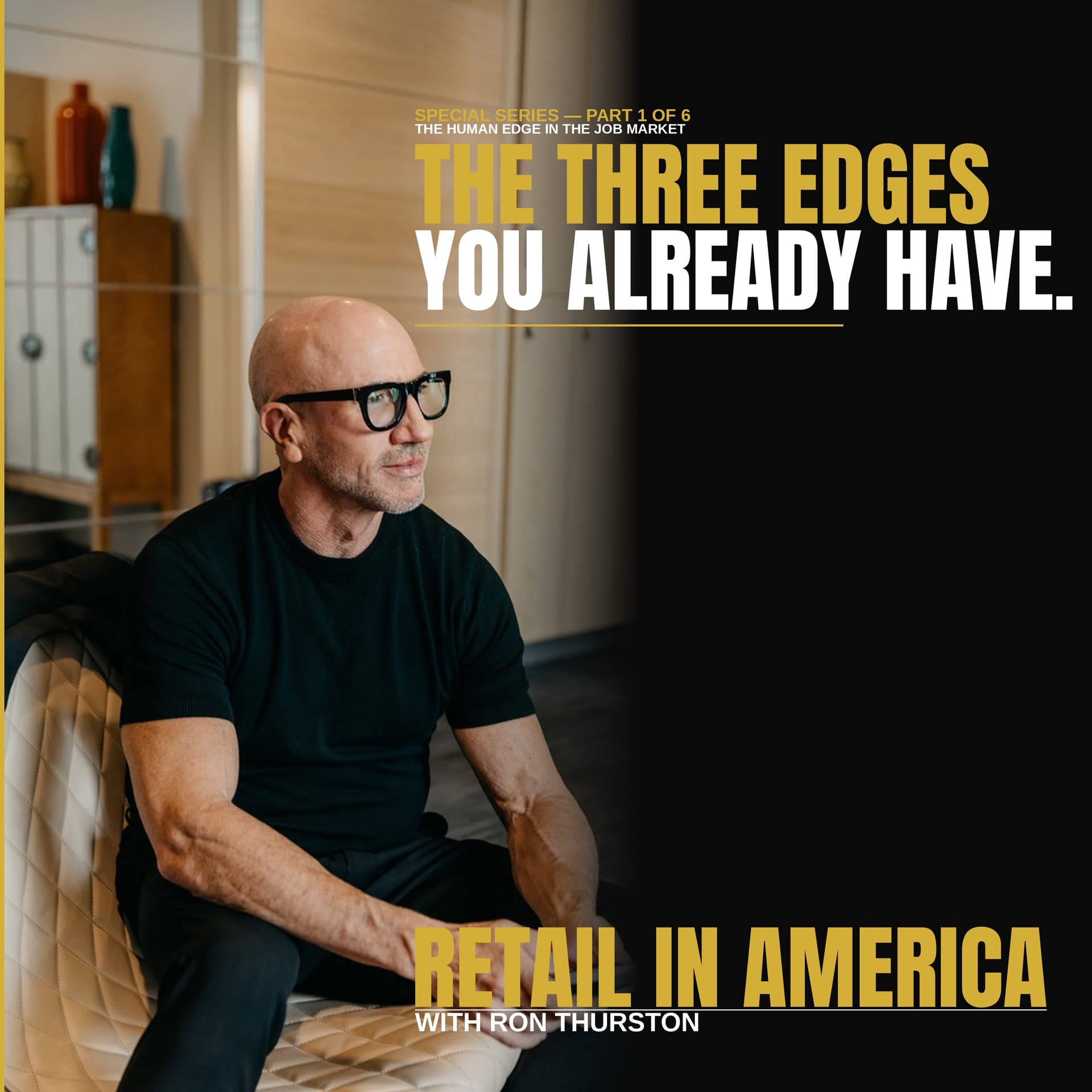
Special Series: The Human Edge in the Job Market (Part 1 of 6)
Right now, more than 28 million people have the Open to Work banner on LinkedIn. If you're one of them — or you're thinking about turning it on — this episode is for you.
Over the next six episodes, Ron walks through the edges you already have in a job market being rebuilt around technology. Not tactical job-search tips. Not resume hacks. The advantages that didn't end when the role did — the things no algorithm can see, no title can capture, and no restructure can take from you.
In Part 1, the foundation: three Human Edges you already carry.
Edge #1 — Your Judgment. The pattern-recognition you've earned from doing the work. Analytical thinking, adaptability, and problem-solving are the top skills employers are hiring for in 2026 — and the #1 reason hires fail isn't technical ability. It's judgment.
Edge #2 — Your Relationships. Referred candidates are 4 to 10 times more likely to be hired than candidates who apply through job boards. Referrals make up only 7% of applicants — but 30–50% of hires. The job you get next is probably going to come from a conversation, not an application.
Edge #3 — Your Story. The through-line that makes every chapter of your career make sense. The single most persuasive thing you own — and the thing most candidates leave out.
Three edges. All yours. All already in you.
"The role ended. Your value didn't."
🎧 Subscribe for new episodes weekly
📚 Ron's Books
Retail Pride: https://www.amazon.com/dp/1544509456 Human Pride: https://geni.us/humanpride
🔗 Sources & Stats Referenced
- 28 million+ Open to Work profiles on LinkedIn — LinkedIn member data, cited in LinkedIn stats roundups (2026): https://writefulcopy.com/blog/linkedin-stats-handy-reference-b2b-marketers
- Applications up 45.5% / job postings down 10.6% — LinkedIn Recruitment Trends Report, Q3 2024: https://copilot.recruitaisuite.com/blog/linkedin-recruiting-statistics-2026/
- 85% of employers using skills-based hiring in 2026 — TestGorilla State of Skills-Based Hiring Report: https://www.testgorilla.com/skills-based-hiring/state-of-skills-based-hiring-2024/
- Two-thirds of hiring managers cite industry experience as the biggest gap — LinkedIn Future of Recruiting Report: https://business.linkedin.com/talent-solutions/resources/future-of-recruiting
- Top skills for 2026: analytical thinking, adaptability, problem-solving — LinkedIn Skills on the Rise 2026: https://www.linkedin.com/business/talent/blog/talent-acquisition/linkedin-skills-on-the-rise
- 89% of bad hires lack critical soft skills — LinkedIn Global Talent Trends: https://business.linkedin.com/talent-solutions/global-talent-trends
- Referrals = 7% of applicants, 30–50% of hires — Zippia Employee Referral Statistics: https://www.zippia.com/advice/employee-referral-statistics/
- Referred candidates 4x more likely to be hired — Boon / Jobvite data: https://www.goboon.co/post/referral-hiring-the-solution-to-high-turnover-rates
- Company career pages: 13% of applicants, 26% of hires — SilkRoad Sources of Hire Report: https://www.shrm.org/topics-tools/news/talent-acquisition/employee-referrals-remain-top-source-hires
- LinkedIn profile photos: 21x more views, 36x more messages — LinkedIn profile optimization data: https://www.linkedin.com/business/sales/blog/profile-best-practices/17-steps-to-a-better-linkedin-profile-in-2017
Follow Ron
LinkedIn: https://www.linkedin.com/in/ron-thurston/ Instagram: @retailpride Website: https://www.ronthurston.com/
Listening to the whole series? Episodes 18–23 are built for anyone in career transition — retail or otherwise. If you built something, lost a role, and you're figuring out what's next, this series is for you.
Next up — Episode 19: Know What You Won't Compromise.