In short
Rich Habits Podcast Summary
Episode Title
Q&A: Austin & Robert's Worst-Ever Investments, War Time Investing, and Solo 401(k)s
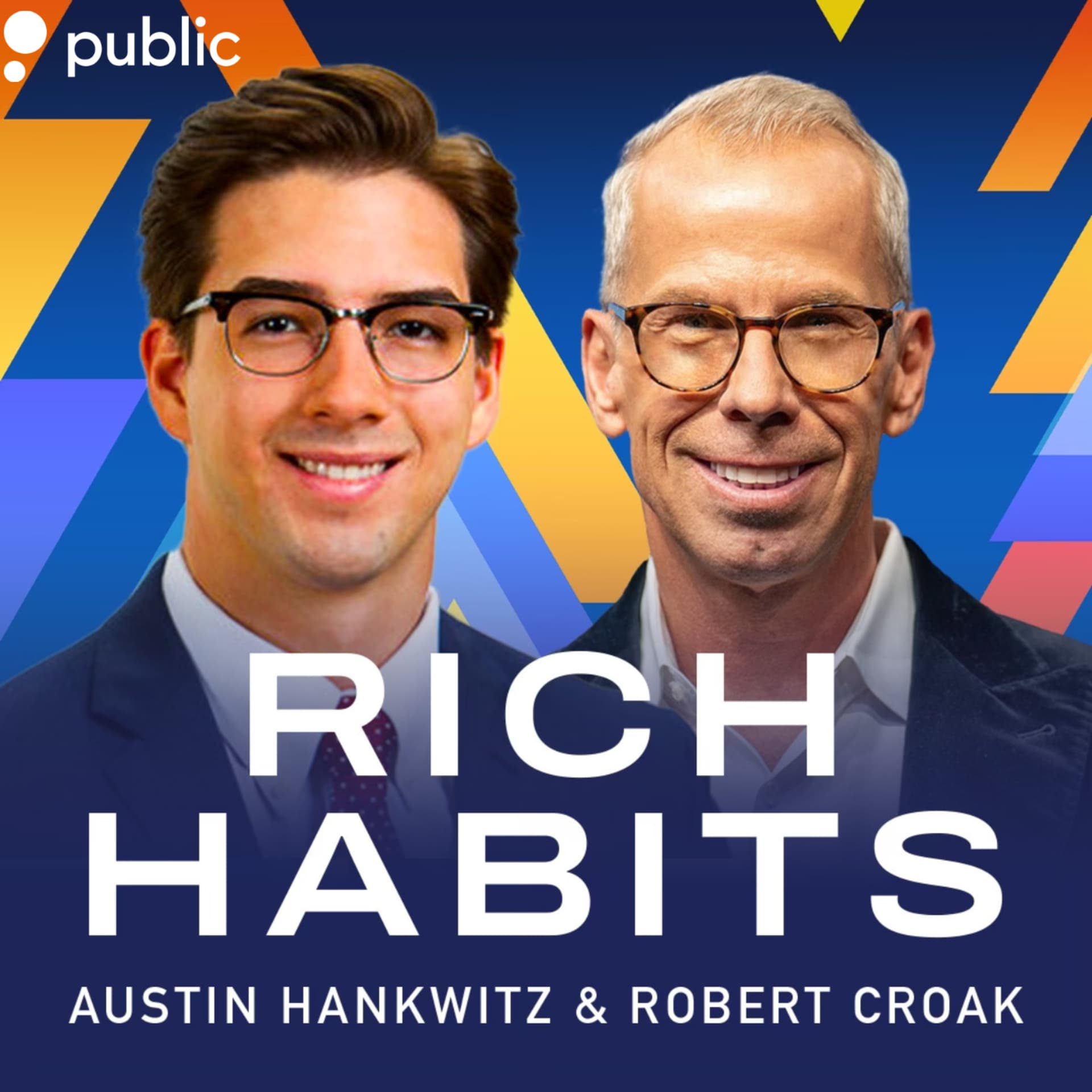
Podcast Overview The Rich Habits Podcast aims to provide financial literacy and new habits to help listeners take control of their finances. Hosted by Robert Croak, a seasoned entrepreneur with extensive business experience, and Austin Hankwitz, a younger entrepreneur eager to learn, the podcast discusses the financial habits of the wealthy, shares personal experiences, and provides a roadmap for financial success.
Episode Highlights In this Q&A session, Robert and Austin tackle various listener questions, ranging from investment strategies during wartime to personal finance decisions.
Key Questions Discussed
- Investing During War:
- Listener Question: Should you withdraw investments during wartime?
- Key Points:
- Robert suggests "hunkering down" and diversifying assets rather than panic selling stocks.
- Austin emphasizes the importance of holding investments in quality companies, as they are unlikely to go under during crises.
- Cryptocurrency Investments:
- Listener Question: What cryptocurrencies should I invest in 2024?
- Key Points:
- Austin recommends focusing on Bitcoin (BTC), Ethereum (ETH), and Chainlink (LINK) for a balanced portfolio.
- Robert suggests a more diversified approach, including allocations to AI and gaming cryptocurrencies.
- Worst Ever Investments:
- Listener Question: What were your worst investments?
- Key Points:
- Robert shares a missed opportunity with Uber pre-IPO and highlights the lesson of investing in strong founders rather than just ideas.
- Austin recounts a $75,000 investment that went to zero, stressing the need for thorough due diligence in venture investing.
- Investing Strategies:
- Listener Question: Should I liquidate my Roth IRA to pay off credit card debt?
- Key Points:
- Both hosts strongly advise against liquidating retirement accounts, emphasizing long-term growth potential over immediate debt relief.
- Instead, they recommend aggressive budgeting, side hustles, and possibly debt consolidation loans to manage credit debt.
- Buying a New Car:
- Listener Question: Should I use an auto loan or personal loan for a new car?
- Key Points:
- Robert advises waiting for better deals in the current car market and recommends buying used cars to avoid depreciation losses.
- He emphasizes the benefits of auto loans over personal loans due to lower interest rates and collateral.
Key Takeaways
- Market Reactions: Avoid panic selling during uncertain times; long-term investments typically rebound.
- Cryptocurrency Portfolio: Consider a mix of established cryptocurrencies and newer projects for a balanced approach.
- Investment Diligence: Conduct thorough research and due diligence before making significant investments.
- Debt Management: Prioritize eliminating high-interest debt before considering retirement account withdrawals.
- Smart Car Buying: Wait for the best time to buy a car, and consider used vehicles to save money.
Conclusion The hosts wrap up the episode by encouraging listeners to take control of their financial futures and engage with the podcast community through social media and upcoming events. They continue to offer valuable tips and insights for building wealth and navigating personal finance challenges.
---
Additional Resources
- [Public.com for options trading](https://public.com/richhabits)
- [Carry Money for Solo 401(k) solutions](https://carrymoney.com/?via=austin)
- [Download FREE Budgeting Template](https://stan.store/robertjcroak/p/get-my-budgeting-template-now)
---
Podcast Links
- Follow on Instagram: [@richhabitspodcast](https://instagram.com/richhabitspodcast)
- YouTube Channel: Rich Habits Podcast
- Join the Newsletter: Upcoming updates and resources
Acknowledgments
- Special mention of the sponsors and resources discussed throughout the episode, including the importance of choosing the right financial products and services.
Overall, this episode of the Rich Habits Podcast provides a wealth of knowledge on personal finance, investment strategies, and the importance of strategic decision-making in uncertain times.
Written by AI. May contain mistakes. Listen to the episode to check what was said.
Transcript
Automatic transcript. May contain errors.0:28What's going on? I'm Arch Manning, Viore athlete and college quarterback. and get 20 % off your first order. Exclusions apply. Visit the website for full terms and conditions. Not only will you receive 20 % off your first purchase, but enjoy free shipping on any U.S. orders over$75 and free returns. Have a great day. Hablas Espanol. Spreys to Deutsch. Condénosque. If you used Babbel, you would. Babbel's conversation-based techniques teaches you useful words and phrases to get you speaking quickly about the things you actually talk about in the real world With lessons handcrafted by over 200 language experts and voiced by real native speakers, Babbel is like having a private tutor in your pocket.
1:04Start speaking with Babbel today. Get up to 55 % off your Babbel subscription right now at babbel.com slash Spotify. Spelled B-A-B-B-E-L dot com slash Spotify. Rules and restrictions may apply. Hey everyone, and welcome back to the Rich Habits Podcast, a top 10 business podcast on Spotify. This is our question and answer edition, which means we take your questions via Instagram DMs at richhabitspodcast or email richhabitspodcast at gmail.com and we answer them. We give you our unfiltered perspectives and guidance and everything that we think you should probably consider doing. But of course, this is not financial advice.
1:40We're just a couple of financial educators on the internet sharing our own perspectives and experiences. But before we jump into the episode, Robert, I do want to remind everyone that we are hosting a webinar on May 8 at 4 p.m. Eastern Time. We're going to be talking about the tax loss harvesting that comes with direct indexing. Very, very important. A way for anyone to save literally thousands, if not tens of thousands of dollars on their investment gains when they're ready. Be sure to save your spot. It's completely free. There's a link in the show notes below. And I also want all my options traders to listen up because I want to tell you just a little bit about public.com.
2:18But first, I want you to ask yourself, have you actually ever thought about all the fees that you're paying to trade options? Probably not, right? Aside from the regulatory fees, there are commissions and most platforms charge per contract fees as well. That's what makes today's sponsor, public.com, so interesting. Public doesn't charge commissions or per contract fees. And in an industry first, they offer a rebate of up to 18 cents per option contract traded, which is so, so cool. So check it out. If you trade a thousand option contracts on public, you'll get up to$180 in rebates. And if you trade 10 ,000 contracts, you could almost make 2000 bucks.
2:56So it's really, really cool. So more importantly is the rebate means you can maximize your profits and minimize your losses. So to recap, there's no commissions. There's no per-contract fees, and you get up to$0.18 on every contract traded. See why NerdWallet recently awarded Public 5 stars for options trading. And to start earning up to$0.18 per contract traded, go to Public.com. This was paid for by Public Investing. Options are not suitable for all investors and do carry significant risk. There is the full disclosures in the podcast description below. Be sure to check those out. And this is for U.S.
3:30members only. Now, Robert, are you ready for our first question? I am so, so ready. I love these episodes and the questions just keep getting better and better. So let's go. All right. So our first question comes from Rob D. Rob says, I love the podcast. I just followed you guys on Instagram. I hope you all answer my question. I feel like there might be a war coming, a big one. My question is this. Is it ideal to withdraw the money you've invested into stocks if a war is declared? How does the rich man approach wartime? Robert, this question is a sad one, right? No one wants war, but it's hard to ignore what's going on around the world.
4:05And I think our followers should be prepared. So do you want to kick this one off? Yeah, I'll kick it off. And I think it really just comes down, Rob. Great question. And yes, sad topic. But we have to be honest with our situation and what we're staring at when these types of things arise in the markets and in the world. And so for me, it's really all about hunkering down. Maybe it's not time to take that new job. Maybe it's not time to go start that new company and really just look at weathering the storm. but secondarily it's all about understanding what could happen in the markets if they become shaky and then really just looking at it of how can i diversify while still earning gains in a bumpy market so the ways to look at that are high yield savings treasury bills tangible assets like real estate and also gold right now gold is really soaring it's still a store of value you know i prefer crypto but gold is great so i think it's just really hunkering down understanding how to diversify and play it a little safer when we get into these down markets.
5:03But I don't think we're there yet. We're seeing some bumps in the road right now, but I still think we have some strong things to happen in 2024. But those are my takes, Austin. I'd love to have your thoughts. Yeah, certainly not there yet. But Rob, to answer your question specifically, should you sell your stocks? No. There's no reason to panic or have a knee-jerk reaction. Of course, COVID was a great example of like the worst case scenario of what could happen to the stock market. I mean, everything was down by 20, 30, 40 percent in only a couple weeks time. It was a terrible time to be an investor.
5:39But the smart investors use that as an opportunity to build wealth in the future. And so, you know, when you sell your stocks, one, you might be selling them for a loss. Don't want to do that. And if it's a quality company, let's say like Costco or Procter & Gamble, there's no reason to think that Costco or Procter & Gamble will go out of business because if you sell a stock, that means you think the company is going to go under, right? There's no reason to think those things are going to happen to those names and those companies during a war. So I just want to encourage you, just like we kind of talked about on Monday's episode, Black Swan events do happen.
6:11And we are certainly in a weird time right now with the stock market. It's up and down. It's left and right. Some folks think it might go down to 4 ,700 talking about the S &P. Others think we're going to keep going higher. Who knows? But the last thing you want to do is have a knee-jerk reaction and sell and do bad things because of your emotional response. Yeah, Austin, that's a great point when you think about what just happened to COVID. And you're not old enough to remember like when 9-11 happened and other things in the past, the Gulf War, things like that. You just really get to a point where everyone is uneasy and there's all of this unrest because of wars and what's happening with COVID and those types of things.
6:49And it's really just difficult to know what to do. I've lived through so many of these and I understand the turmoil that can happen seemingly overnight in a market. And that's why we're always telling you to make sure that you keep your eye on the prize. You're actively watching your money and you're diversifying because if you have all your eggs in one basket, it could be bad for you if the market's sour. So it's just really important to just keep your head up, keep an eye on things and understand where the markets could go given these situations. So over the decades for me investing, I'm just a buy and hold kind of guy.
7:21And I know that over time, the S &P 500 and the QQQs, the Nasdaqs of the world are going to go up into the right. We might have a bad year or two here and there, but over time, the math just is in our favor. And so that's why you really want to consider just holding tight, hunkering down, and just really just stick to it. Because those knee-jerk reactions could really hurt you. Because if you sell and you panic sell and have that knee-jerk reaction, and then the market's correct in a week, two, or month, or a couple months, then all of a sudden you might miss a big run and then sit on the sidelines because you fear you're too late.
7:56So I think it's just really important to always understand the macro information that's presented to you and know what to do. because you just can't always try to time the market and have a knee-jerk reaction. What a great question, Rob D. Our next question comes from Nick M. Nick says, I love the podcast and I look forward to listening every Monday morning on Spotify. Thanks, Nick. We appreciate it. Nick's question is this. What are the best cryptocurrencies to invest into right now? I'm building a small portfolio from scratch and I want to know exactly what to buy and how much waiting. So Robert loves crypto and he's been in crypto longer than myself.
8:31So he's kind of a nerd when it comes to crypto. I'm a little bit more of like the layman. It's like, you know, I want to have it, but I don't want to like really, really like do so much analytical research on crypto like I do with stocks. I love analyzing stocks, but crypto for me is like kind of a weird concept to wrap my brain around sometimes. So to answer your question, Nick, I keep it really simple myself. Again, as a layman, I've got three cryptocurrencies, Bitcoin, Ethereum, and Chainlink. BTC, ETH, and LINK. If I was building a crypto portfolio from scratch, I'd put 50 % into Bitcoin, maybe even 60 or 70%.
9:09And then whatever is left, I would divide it in half between Ethereum and Chainlink. That's what I would do, again, as a guy who's just trying to have a little bit of crypto in his portfolio and is not so passionate about it as I am with single stock investing. But Robert is the other side of the aisle there. He loves his crypto. So Robert, what's your perspective here? Yes, Nick, I love this question. And I actually took some notes for you because I want to make sure to really spell out my thoughts and the weighting, as you asked, for each sector. And for me, crypto, I try to look at it as having three to five of the best in class in each sector that I believe are the ones that are going to perform the best in this bull market.
9:48So how I would look at it is if I were building a portfolio right now, I would be right alongside with Austin on Bitcoin, Ethereum, Chainlink, and XRP. And I would do 40 to 50 % in those four of that portfolio. Then after that, I would have AI. I would have 15 % probably in AI, 15 % in gaming, and then another 5 % in decentralized science. And then I would hold 20 % that would be for new coins that I would be adding on a regular basis. And there are dozens of those that are really good and just have the overall portfolio be maybe no more than 20 total coins. And that's how I would break it down.
10:29There's the weighting. And, you know, some of my favorites, if you go to gaming, would be Nakamoto Games, Beam, Immutable X. But then AI is such an important sector right now. And I love Veracity, AGIX, Fetch, Ocean Protocol, and BitTensor. Those are great. And then look for new coins. A couple of my favorites are PAL, P-A-A-L, Aegis, which is A-E-G-I-S, and Syncas, S-Y-N-C. So that's the breakdown. That's what I would do if I were building a portfolio right now is to have some of that leverage across all of these top sectors and three to five coins at each, but make sure you're always holding, you know, the stables.
11:10And that's Bitcoin, Ethereum, Chainlink, and XRP, in my opinion. I appreciate it. Okay, good question, Nick. Our next question comes from Justin V. Justin says, hey, Robert and Austin, I love the show and I can't wait to attend the new webinar you're hosting. I love the open Q &A you all do at the end of each one. Justin, we look forward to having you there. Justin says, they say billionaires lose millions to make billions. What was the worst investment you two have ever made and how did you overcome the loss? Oh, what a question. It was a good question because I feel like Robert and myself have both made pretty terrible investments in our lives.
11:48Robert, you want to kick this one off? Yeah. And I want to put a little wrinkle to this because a terrible investment can be one that you didn't make. I was ready to write a check for Uber pre-IPO as they were doing one of their last rounds before the initial public offering. And my check was going to be$25 ,000. There were three of us that were investing and me and one of the other guys backed out And then post IPO, my$25 ,000 would have been worth$7 million roughly. So sometimes it's the ones you didn't make. And I've got countless ones that I did invest. And the biggest lesson I learned from that is invest in founders, not in ideas.
12:28Because a really good founder that's strong and intelligent will pivot and figure it out. and a shitty founder will spend the money, go through the money, worry about themselves and not find a way to win. So if you're doing venture investing or startup investing, find the founders, bet on the quarterback, not the concept. But I will say too, back to the founder idea here, right? I invested into a founder who was on the younger side. I think I wrote him a check for$15 ,000. It was a wonderful idea. It was essentially a debit card that would build your credits as well, right? So it's like a credit building debit card.
13:03It was like first of its kind back in like 2020, 2021. Really, really cool stuff. And the founder just, he had it all, but he couldn't connect the dots. And what I can appreciate about what you said about investing into the founder and not the idea or the product is this guy straight up said, listen, investors, I'm not going to waste any more of your money. I've realized I cannot get product market fit. I cannot hire the right person. Whatever the excuse was, he's like, listen, I can't do it. So instead of pretending that I'm going to pivot and do this and do that and try and win, try and get this and try that and waste your money, I'm stopping now.
13:38I'm going to swallow my pride and I'm going to return to you 60 % of your original investment. So that did happen. I got 60 % of my money back, which was better than nothing, which has also happened in the past. But it's like, I respect that guy. I respect the fact that he can swallow his pride and say, like, I just can't do it. And here's your money back. I'm sorry I wasted your time. Now, the worst investment I ever made was I invested$75 ,000 into a startup back in 2020 or 2021, early 21, late 2020. And it went completely to zero. I got none of that money back and it just all went kaput. And I think the biggest lesson I learned from that, Robert, additionally, on top of your investing into the founders, not the idea, is that you too, as an investor, need to do so much diligence on what you're investing into, right?
14:27I think when we see people make investments like into Uber or into ABC XYZ company that get them really excited, they're like, yeah, I'm a venture investor. I invest into startups. That's what I do. I'm cool. I'm, you know, David Sachs. Look at me. When in actuality, it's like, you know, like take a deep breath, dude. It's not that deep. Like this is really, really risky of an idea. And you should make sure like, you know, the numbers, the data, everything like the back of your hand before you actually do it. And I think that was a big mistake I made in the beginning was like, I trusted the people and I trusted their word and what they said they had and what they said they were doing without opening up what was called the data room and looking into the specifics.
15:09I just took their word for it. And that was a big mistake and something I've certainly learned from now. Robert and I, we recently invested into a company. I think we both wrote checks for 20 or 25 ,000. I don't know how much you wrote for. I wrote a check for 20 ,000. about a month ago, Robert and I did into this incredible company out of Austin, Texas, and really excited about it. But we made sure we did our diligence beforehand. We made sure we met the CEO, of course. It was part of something called a special purpose vehicle and SPV, a sort of a way to pool investor money together. But it was an awesome experience and we did everything right.
15:41So not only did we invest into the founder, but we also invested into the idea and all the proven data they had on that idea as well. And one thing just to cap this off, and this is a really great question, is to understand that if you are at a point where it's time to start venture investing and you're diversifying, look at it this way. When you're making this investment, the biggest mistake I made early on, let's say post Silly Bands days, is I wrote checks that were too big. Austin should have never written a$75 ,000 check to that company that he lost it all. He should have written a 10 or$25 ,000 check because it's better to take more shots over more deals than it is two or three deals with bigger shots because you really want to look at it that if you do five venture investments, you're hoping one is a home run, one maybe breaks even and you make a little money back or get your money back and you assume two or three are going to go to zero.
16:32So it is a game of trying to figure out how can you capitalize on the big ones, but you have to look at it this way. If something goes meteoric and it becomes a unicorn, there's not really going to be much difference as far as because the return is going to be so incredible for you and probably life changing. So if you wrote the$25 ,000 check versus the 75, it's still going to be incredible for you. But the downside risk is obviously a third of the damage that it can do by writing the smaller check. So learn from me, write the smaller checks, diversify over more deals because you can always put more money into the winners when they raise the next round.
17:10And beyond, let's just take venture investing out of the equation. Let's talk about single stock investing. A lot of people listening right now probably have made a bad single stock investment. I sure have. The first single stock I ever invested into was a penny stock. I was 15 or 16 years old and me and my buddies thought we figured out the Chinese manufacturer that was creating the iPhone 5. And we thought we knew it. We thought we got it figured out. You thought Foxconn was the penny stock? No, no, no. It wasn't Foxconn. They were making the LCD digitizers for the... That's one component part, but they're like, yeah, we're going to get this contract.
17:46We're going to get it, whatever. They never got the contract. I lost all my money. Obviously, it was a couple hundred bucks. But what I'm trying to say is I have lost thousands of dollars investing in a single stocks. Robert, I'm sure you've lost thousands, if not more, investing in a single stocks as well, just considering the size of your portfolio. And I think the biggest piece of advice I can give to Justin and anyone else listening that's trying to get over the loss, the hump of like, oh my God, I lost this money. What was I thinking? Every day that you don't sell your loser costs you what you would have made if you had that money elsewhere, right?
18:17Opportunity cost is something we talk about all the time here on the podcast. And it is the most important thing to consider when it's a losing investment. For example, let's say you invested$10 ,000 into Tesla on January 2nd of this year. You're now down 40 % on that. So your 10 ,000 is now only worth 6 ,000, whereas the S &P 500 is up about 4%. So you're closer to about 10 ,500, 2 ,400 there. But by holding on to Tesla stock, because for whatever reason, maybe you are really bullish or whatever, maybe you like me and you own Tesla, no matter what the company is, but by holding on to it, that's money, not only that you're losing on the way down, but money you could have made with another investment on the way up.
18:57So just think about now as you look at these losers in your portfolio, because it's this theory, right, Robert? We're like, oh, it's down 80%, whatever. Like it can always go back. It can always go back up. It can always just go back up to where it was. Stocks can go to zero, dude. I've seen it happen a hundred times. Stocks can go to zero. I don't care if it's a recent IPO. I don't care if Jim Cramer's talking about it. I don't care if you read it on the internet. Stocks can go to zero. They can always go down more. I don't care if you're down 90%. It can always go down more. And that is the big hump that I had to get over when I started single stock investing was like, okay, I made this mistake, but I'm not going to hold on to this for the rest of my life, hoping that it's going to do something else.
19:39I'm going to learn from that mistake and take that money and invest it into the next best thing. Yeah, it's such a mindset shift to be able to get away from the losers and understand the opportunity cost rather than riding it for years and years and saying, it's going to come back and I hate to lose. Don't invest with emotion. If it's a loser and you feel like the time has come to get rid of it, get rid of it. Get that money somewhere else where it's making money and you'll be fine. Earlier in the show, you heard us talk about the investing platform public.com. That's where you can trade options with no commissions or per contract fees.
20:11And you get a rebate of up to 18 cents per contract traded. NerdWallet recently gave public five out of five stars for options trading. If you want to see why, go to public.com and start getting a rebate of up to 18 cents per contract trade. Paid for by public investing, options not suitable for all investors, and carry significant risk. Full disclosure and podcast description and U.S. members only. Major shout out to public.com. We love you. We use you. I've been a user since 2020. I got Robert on the public train in 2023, and we never look back. And they are one of our favorite sponsors of the show.
20:47They're a partner. Shout out to Catherine. I hope you're listening. Thank you so much for being awesome. And go check out public.com, guys. All right. Our next question comes from Margaret P. Margaret says, hey, all small business owner here. Love listening to the show because I feel like you two not only help me with my personal finances, but also growing my business. So here's my question. I've been using a SEP IRA for my retirement investing for the last 10 years. However, I just discovered the solo 401k. I learned that you can also do a mega backdoor Roth with your solo 401k. One, do you know what the heck this is?
21:21And two, should I do it instead of my SEP IRA? Robert, I'm gonna kick this one off because I actually do this, weirdly enough. So let's start at the beginning, right? What is a SEP IRA? A SEP IRA is a simplified employee pension IRA. It's a tax-deferred retirement account that a self-employed person can make and contribute toward. It's very similar to your traditional IRA in the sense that you can deduct from your taxes what you've contributed to this account. a way for anyone that's a solopreneur, a small business owner to invest toward their, call it, retirement accounts that are not just the IRAs, like the Roth IRA that we talk about.
21:57Now, the solo 401k is very similar. It's a retirement account that self-employed individuals like Robert and I can also use. What's cool about the solo 401k to Margaret's call out here is that mega backdoor Roth component. It's really complicated, and I'm not going to pretend like I'm a tax expert or any type of retirement CPA, right? I'm just a guy on the internet who listens to his own CPA. But the website I use that taught me a lot about the Mega Backdoor Roth Solo 401k and the platform that allows me to max out and contribute toward this Mega Backdoor Roth Solo 401k is called carrymoney.com.
22:36C-A-R-R-Y-M-O-N-E-Y.com. I'll have a link for them in the description below, but I invested$66 ,000 toward my mega backdoor Roth solo 401k in 2023. And you can invest up to$69 ,000 in 2024. And why that's important, Robert, is because on top of my backdoor Roth IRA in 2023 of what was it 6 ,500 bucks, I think I was also able to contribute $66 ,000 after taxes to my retirement through this solo 401k. It's unbelievable stuff here. So if you are a small business owner or solopreneur and you are not yet contributing to a solo 401k, Roth rather, solo 401k, you certainly should learn more about it. And again, carry money is a great resource to do that.
23:24So find a good CPA, find a good advisor, and really make sure you implement these strategies because Austin and I both use it. It's very beneficial, especially with the$66 ,000 amount per year. So yeah, it's a great one. And I love this question, very complex. So Austin, you crushed the breakdown. I love it. All right, our next question comes from Thomas D. Thomas says, hey guys, love the podcast. I recently totaled my car and now I'm on the prowl to buy a new one. I'm trying to figure out though, which is better. Should I use an auto loan to buy a car or a personal loan? It seems like auto loans have better interest rates.
23:58Additionally, do you have any recommendations on where I should go to borrow the money? Robert, I'm going to let you answer this. Yes, Thomas. Great question. First and foremost, don't you dare go buy a new car. If you've got your sights set on a new car, you have to wait at least another 30 to 60 days and here's why. Volkswagen was the first of its kind to offer cash back to dealers to get them to take inventory. That's where the car market's at right now. So that's going to keep happening elsewhere as well. And so what you're going to see is the ripple effect in the coming weeks and months of more and more rebates and deeper discounts because the car market is in a really tough spot right now.
24:38So to answer your question directly, if you have to buy a new car, please wait a little bit longer. You'll save a few thousand dollars. I'd prefer you stop looking at new cars. The way to look at it is this. If you're going to get new, you want to lease. and if you're gonna buy, you wanna buy used. So that's it. That's the end all be all. It's the truth. The car is the biggest depreciating asset you're ever gonna buy besides a boat. So why would you buy a new one? Within three years, you're gonna lose 40 % of its value and you're gonna be upside down on the loan. So to tackle the loan part, it's definitely better to use an auto loan over a personal loan because you're right.
25:15The interest rates are lower, but also the credit criteria is lower as well. So keep that in mind. You have the advantages. So use the auto loan for the auto. It's just going to be better for you, better terms, and it's going to be an easier situation. But please look at buying used. Find a two-year-old car that's got a good Carfax, three-year-old car. Save yourself the 30 % that's already depreciated and drive it till the wheels fall off. And the reason, Thomas, why Robert is suggesting the auto loan over the personal loan and why the bank gives you a lower interest rate on an auto loan versus a personal loan is because of the collateral, right?
Read the full transcript
25:55If you want to go get a personal loan and it was uncollateralized and there was just, you know, hey, let me go borrow 20, 30,$40 ,000. The bank's going to be like, how do I know you're going to pay this money back to me? Where if you're like, hey, I'm going to go buy this car that's worth something and I'm going to use your money to buy it. They're going to be like, okay, so here's your interest rate. And if you don't pay us, we're just going to repossess the car and then we'll sell the car to make money back on our loan. Where again, personal loans, there's no collateral. It's just, you know, borrowing money.
26:26Thomas, I'm doing you a favor here, man. I've looked up the interest rates on auto loans, depending on the credit scores, according to NerdWallet. If your credit score is between 600 and 660, you're going to look at about 14%, which is, oh my gosh, dude, really, really high. If it's between 660 and 780, which is prime, which is where most people are going to be, you're looking at about 9.5%, which is still pretty high. I mean, it's high, it's high interest debt. And then super prime even, let's call it 780 to 850, you're looking at about 7%, which is still pretty high. So Robert, what did we learn about this?
27:03We learned that used cars and auto loans at the moment are considered high interest debt. So Thomas, you should borrow as least amount of money as possible. So you're not going into high interest debt and you should want to pay this off as fast as possible. Because if you're stuck with an 11, 12, 13, 14 % interest rate, building wealth is going to get really, really hard. And Robert and I say this all the time. You cannot out invest your high interest debt. The stock market is up, let's call it three or 4 % this year. This would be a 14%. I mean, y 'all seeing the difference there, right? So it's just, please, please heed our advice here.
27:35Yeah. And a little pro tip for those of you that might know a car dealer, if you know someone that has a car lot or a used car dealership, go ask them if they're a friend or a family member or a cousin or whatever and say, hey, can I go to the next auction with you and give you$250 to let me buy a car there? Because you could get pre-approved and I recommend go to a credit union because you might get better rates and terms there. You get pre-approved, go to an auction and save a couple more thousand dollars if you're buying it along someone that buys at auction. That's what I've done over the years and it's worked really well for me.
28:09So that's a little pro tip for those of you that have that option. I also want to encourage you to do your homework and don't settle just because you don't have a car right now, right? You mentioned total your car, super happy that you're safe. Don't be afraid to rent a car just a little bit longer as you are looking on CarGurus, Facebook Marketplace, AutoTrader, Craigslist even, for people who are selling their cars, for example, and it's so funny, my friend did this. He was looking for a car between eight and 10 ,000, 11-ish thousand dollars. And he found like a 2014, 2015 Hyundai Elantra with like 80, 90, 100 ,000 miles on it.
28:48And it was only like nine or 10 grand because some rich people in a neighborhood in South Carolina, you know, didn't want the car anymore. It's their family car. All the kids went to college and they all got new cars. They're like, oh, I just don't want this car. It's a payment, blah, blah, blah, like insurance. Like we just want to have the garage, like someone can get it. And he found it on Facebook and he bought it for like nine grand. It was worth like 15 or 16 ,000. So like those things happen and don't be afraid to hold out a little bit longer and look for those opportunities. Love that.
29:15Love it. Now, our last question comes from Juan R. Juan says, good morning, gentlemen. I need help paying off my credit card debt. I just recently started learning about personal finance and I'm ready to become debt-free and begin building wealth. I've got$30 ,000 in credit card debt and$30 ,000 in my Roth IRA. Do I liquidate and sell everything in my Roth IRA to pay off the credit card debt or should I do something else? Robert, I see you're snickering, so I'm just going to let you take No way. This is you as much as any question on earth is you. I want you to go first. All right, one, I'm going to be very candid whenever someone says, oh, I'm just going to, you know, borrow against my 401k or I'm going to sell my 401k or my Roth IRA.
30:01I'm going to sell these things so I can get out of debt. Listen, listen, listen, you are literally taking whatever chunk of money that you would have had when you were, let's call it 65 or 70 years old, and you're just throwing it away. You're just getting rid of it. Because what you don't realize is this$30 ,000, let's say you're 35 years old, this$30 ,000 over the next 30 years, if you don't touch it, is worth over$1.3 million, one. That's what you're saying. You're saying, I would rather pay off$30 ,000 than let my retirement grow into over a million, right? We don't want to do that. Never borrow from your future for today's pleasures, right?
30:42We always want to make sure our money is always working for us in retirement. First and foremost, we can maybe pause investing for retirement. Like you probably should considering you have$30 ,000 of high interest credit card debt. Like let's get laser focused on paying that off before maybe we start investing more money because you can't out invest high interest credit card debt. But if the money's already in there, there's no reason to take pre-withdrawal penalties and taxes and left and right all this other stuff like there's no reason to do that all you have to do is go to the description below download our honest budget create one and stick to it find the margin in your monthly budget get aggressive get the side hustle start driving uber deliver the door dash you know start working at that third job or second job whatever you can do for a small season of your life like i'm talking six nine months here to get an extra kind of lift against this 30 000 attack Hack it like it is a virus in your household.
31:38Get rid of it and never go back into high interest credit card debt. That's just a mic drop. I was going to close it out by saying, Juan, get the side hustle. Make$1 ,000 a month. Pretend it doesn't exist. Put it towards the credit card debt. Knock out the credit card debt as fast as possible. Do not touch the Roth. Absolutely not. Austin, great breakdown. Love it. And what an incredible episode. And Juan, actually, too, Robert and I have an affiliate link for LendingTree. below. So if you want to get a debt consolidation loan on LendingTree, go check that out. We will obviously get some sort of commission here, but it's really important.
32:12You can use it or not. Definitely go check out a debt consolidation loan because what that's going to do is it's going to consolidate all your credit card debt into one monthly payment. And the interest rate nine times out of 10 is about half of what it would be for your credit card debt there. So let's say credit card is 30%. The debt consolidation loan might be between 12 and 15%. So it's going to allow you to attack that credit card debt much faster. I love it. What a great episode. And for those of you following along today, don't forget you have one day left to get tickets to the Money Mindset Wealth Building Summit that we're holding in St.
32:45Petersburg this weekend. Austin and I will be there on stage and just a ton of other great guests and speakers. And we look forward to having you there. And if you do buy the virtual ticket, please remember that it is recorded. So if you don't have time to watch it during the event, you can watch it whenever you'd like. There's a link in the show notes for the event. And just a quick reminder, if you've not yet left us a five-star review on Spotify, please go do that. We also have clips that we share on Instagram at Rich Habits Podcast, TikTok as well. I think we just hit a thousand followers over there.
33:19That's pretty cool. That's Rich Habits Podcast as well. We have our YouTube channel where we post not just clips, but also kind of breakdowns of specific episodes and answering questions. So go check out our YouTube channel as well. We're all over the internet and we are doubling down on the Rich Habits podcast this summer. We cannot wait. We're launching a newsletter. We're doing the webinars. We're doing a community. It's going to be a big, big deal. So we are really, really excited for you all to come along on this journey with us. And we just can't wait to deliver immense value to each and every one of you.
33:49And with that being said, everyone have a great rest of your week.
From the publisher
In this episode of the Rich Habits Podcast, Robert Croak and Austin Hankwitz answer your questions!
- How do the rich invest during wars?
- What cryptocurrencies should I own in 2024?
- What is the worst investment you've ever made?
- Should I do a Mega Backdoor Roth Solo 401(k)?
- How should I approach buying a new car?
- Should I liquidate my Roth IRA to pay off credit card debt?
---
Public has finally introduced options trading! To learn more about trading options on Public, click here.
---
Save your seat for our Direct Indexing webinar (taking place May 8th at 4pm EST). You won't want to miss it!
---
Austin's Solo 401(k) solution, Carry Money.
---
⭐ Download our FREE Budgeting Template – click here
⭐ Earn 5.1% on your savings with a High-Yield Cash Account – click here
⭐ Automatically buy stock where you shop with Grifin – click here
⭐ Protect your family with term life insurance from Suriance – click here
⭐ Use code “Spotify” for 15% off our 4-module video course – click here
⭐ Optimize your portfolio with Seeking Alpha – click here
---
👤 Explore everything Austin does – click here
👤 Explore everything Robert does – click here
❓ Ask us questions for our Q&A episodes – @richhabitspodcast on Instagram
📬 Inquire about working together – christian@witz.vc
---
Disclosures:
Options are not suitable for all investors and carry significant risk. Certain complex options strategies carry additional risk. Options can be risky and are not suitable for all investors. See the Characteristics and Risks of Standardized Options to learn more.
For each options transaction, Public Investing shares 50% of their order flow revenue as a rebate to help reduce your trading costs. This rebate will be displayed as a negative number in the “Additional Fees” column of your Trade Confirmation Statement and will be immediately reflected in the total dollars paid or received for the transaction. Order flow rebates are only issued for options trades and not for transactions involving other assets, including equities. For more information, refer to the Fee Schedule.
All investing involves the risk of loss, including loss of principal. Brokerage services for US-listed, registered securities, options and bonds in a self-directed account are offered by Open to the Public Investing, Inc., member FINRA & SIPC. See public.com/#disclosures-main for more information.
Hankwitz Group LLC has an existing business relationship with NEOS Investment Management LLC. The opinions expressed are those of the author, and the author owns several NEOS ETFs.