In short
Rich Habits Podcast Episode Summary
Podcast Overview
- Title: Rich Habits Podcast
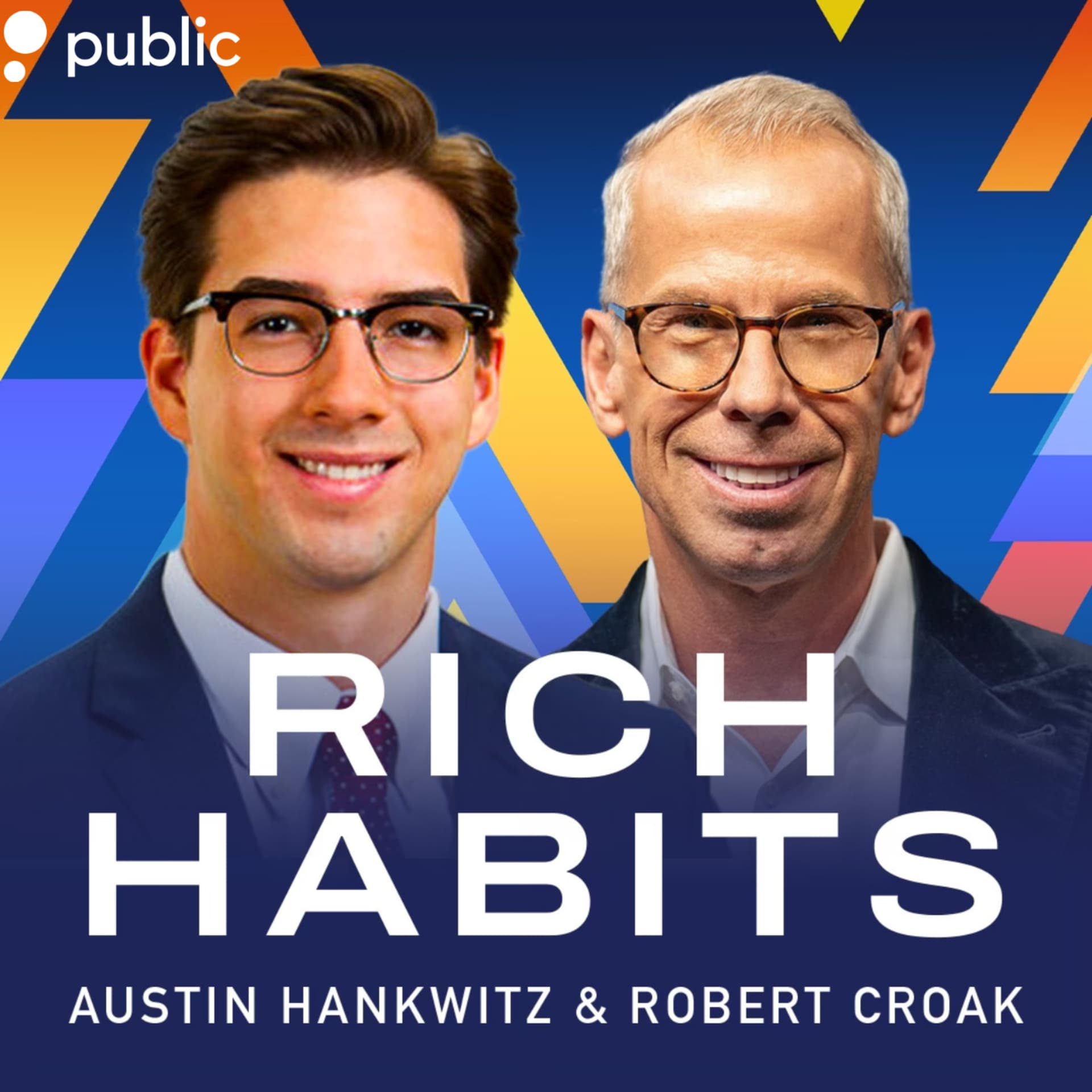
- Hosts: Robert Croak and Austin Hankwitz
- Description: A financial literacy podcast aimed at helping individuals take control of their finances through new habits. The hosts share insights from their own experiences, mistakes, and the habits of wealthy individuals.
Episode Details
- Episode Title: Q&A: How to Take Bitcoin Profits, Becoming a Full-Time Entrepreneur, & ETFs for the Roth IRA
- Episode Description: In this episode, the hosts answer various listener questions, discussing profit-taking strategies, optimizing financial accounts, and investment in ETFs for retirement.
Key Concepts and Discussions
- Profit-Taking Strategies
- Listener Question: Sylvia inquired about taking profits from her investments in stocks and cryptocurrencies, particularly during the current market bull run.
- Hosts' Insights:
- The importance of having a clear profit-taking strategy as investments rise.
- Recommended profit-taking strategy:
- Sell a portion (e.g., 25%) when up by 50%.
- Repeat this until original investment is recovered, allowing for growth with "house money."
- Differentiation between core (65-80% in ETFs and blue-chip stocks) and satellite (20-35% in riskier investments) parts of a portfolio.
- Interest-Generating Checking Accounts
- Listener Question: Maria questioned the necessity of keeping large balances in a no-interest checking account.
- Hosts' Advice:
- Suggested maintaining one month's expenses in checking, but exploring high-yield checking accounts (e.g., banks offering up to 4% interest).
- Emphasized opportunity cost—time spent managing small returns may not yield significant benefits.
- Investment in Gold vs. Cryptocurrency
- Listener Question: AXA asked whether to sell gold (GLD) to invest in cryptocurrency.
- Hosts' Perspective:
- Advocated for diversification—both gold and cryptocurrencies have valid roles in a portfolio.
- Recommended against chasing returns by frequently shifting investments; instead, adhere to a long-term investment thesis.
- Roth IRA Strategies
- Listener Question: Brian was curious about the optimal number of ETFs to hold within a Roth IRA.
- Hosts' Recommendations:
- Recommended 3-5 ETFs for simplicity and diversification at the early investment stage.
- Caution against having more than 10 ETFs due to overlap.
- Transitioning to Full-Time Entrepreneurship
- Listener Question: Ben sought advice on transitioning his side hustle into a full-time business.
- Hosts' Recommendations:
- Suggested ensuring side hustle income matches or exceeds current job income before quitting.
- Encouraged maintaining both jobs for as long as possible to build a financial cushion.
- Discussed importance of discipline and planning in entrepreneurship.
Key Takeaways
- Profit-Taking: Establish clear rules for when to take profits based on investment performance.
- Account Management: Explore high-yield options for cash management, but assess time investment vs. return.
- Diversification: Maintain a balanced approach to asset allocation across different sectors.
- Roth IRA Investments: Start with a manageable number of ETFs to build a diversified portfolio.
- Entrepreneurship: Prepare thoroughly before leaving a stable job; consider the potential for increased income and growth.
Conclusion This episode of the Rich Habits Podcast provided valuable insights into various financial strategies, focusing on practical approaches to profit-taking, managing investment accounts, and navigating the journey toward full-time entrepreneurship. The hosts emphasized the importance of informed decision-making and the need for a solid foundation in financial habits.
> For listeners seeking to delve deeper into these concepts, subscribing to the Rich Habits Network is recommended for exclusive content and community support.
Written by AI. May contain mistakes. Listen to the episode to check what was said.
Transcript
Automatic transcript. May contain errors.0:00When it comes to what your family eats and drinks, you know your choices matter. You're the expert because you know what fits your life. And getting it right starts with good information. That's why America's beverage companies are sharing more information about our ingredients at GoodToKnowFacts.org. No spin, no judgments, just the facts straight from the experts for more than 140 beverage ingredients. Visit GoodToKnowFacts.org. abercrombie kids knows how to make outfitting easy mix and match sets are their ultimate outfit hack for fall their sweatshirts and sweatpants are super cozy and they always have the cutest colors and patterns shop falls easiest outfit at abercrombie kids in the app online and in stores
0:57Hey everyone and welcome back to the Rich Habits Podcast question and answer edition. If you have a question to ask us for these Thursday episodes you can do so in three separate ways. You can email us at richhabitspodcast at gmail.com with your question. We're answering a couple of those in this episode. You can send us an Instagram DM at richhabitspodcast. We get tons of those every day Or you can join the Rich Habits Network, which is our sort of private community where we host live streams and have hours of video coursework and a lot of DMs and things like that inside of that and ask us questions that way.
1:29We've got a mix of the bunch here in today's episode, and we have a ton of really cool questions to answer specifically about how to take profits during this bull run, how to optimize with maybe a high yield interest paying checking account. some questions about gold and gold prices, as well as how to structure a Roth IRA with more than five ETFs inside of it, and a ton of other awesome questions. So stick around, and we can't wait to dig in. Yes, and a quick heads up, folks. Interest rates are falling, but you can still lock in a 6 % or higher yield with a bond account at public.com. That's a pretty big deal because when rates drop, so can the interest you earn on your investment.
2:08A bond account allows you to lock in a 6 % or higher yield with a diversified portfolio of high yield and investment grade corporate bonds. So while other people are watching their returns shrink in their high yield savings accounts, you can sit back and enjoy these regular interest payments with a public.com bond account. Yes, but you might want to act fast because your yield is not locked in until you invest. The good news is it only takes a couple minutes to sign up at public.com and lock in that 6 % or higher yield with a bond account. Again, that's only at public.com forward slash rich habits.
2:45Public.com forward slash rich habits is where you can learn more about their bond account. This was brought to you by Public Investing. They're a member of FINRA and the SIPC. These rates are as of November 13, 2024. the average annualized yield to worst across the bond account is greater than 6%. Yield to worst is not guaranteed. This is not an investment recommendation. All investing involves risk. Please visit public.com slash disclosures slash bond dash account for more information about those. Now, Robert, our first question here comes from Sylvia R. from Inside the Rich Habits Network, and it hits home with me.
3:19I love this question because I think a lot of people are beginning to take notice. So let's read the question and then have a quick discourse about it. Now that we are in this big historic bull run, I have a question on taking profits. I slowly started investing into single stocks in cryptocurrency earlier this year. Robert and Austin have been talking about your profit-taking strategy, but my question is, if I'm putting in $200 to$300 a month and I'm dollar-cost averaging into some of the most popular stocks in cryptocurrencies, when do I take a portion out? Do I hold the full shares? Do I take off fractional shares?
3:51Do I keep it in my bridge account for the next 8 to 10 years? How do I think about this? So Robert, before we dig into our profit-taking strategies, which by the way, we've been sharing inside the Rich Habits Network for quite some time now, let's just take a moment to say, oh my gosh, Bitcoin as we're recording this is at$91 ,000. Palantir as we record this is at$60 plus a share. Tesla is at over$350 a share. You know, the S &P hit 6 ,000 points for the first time in history. All these things that we've been talking about and trying to just shake people's shoulders and say, be an investor, be an investor, be an investor, put money in the markets.
4:31We are not in a bear market, right? Bears sound smart. Bulls make money. I like to make money. I don't care how smart or dumb I sound if I'm making money. So at the end of the day, Robert, I just want to have a quick round of applause. Congratulations to everyone who's been sticking with us now since February of 2023 and dollar cost averaging into these markets, into these asset classes, into Bitcoin specifically, right? It's up 110 % just this year. It's just so cool to see all of this awesome green in our portfolios for the first time since really we started making this podcast. Like, don't get me wrong, we've had a bull market, but I mean, geez louise, dude, it has been a ton of fun.
5:07It's great for us as well, because we've been out here shouting from the mountaintops of what we think is going to happen, giving people all of our best stuff. You know, we're here to educate and hopefully guide and nudge people in the right direction. So these are fun times because everyone is put in the work. We hope that they've been taking notes and taking action. They've been dollar cost averaging along the way. And that gets us to this point. We've all been accumulating and now we get to the fun part, going into this bull run and really starting to build our portfolios and see all the hard work pay off.
5:40So this is what it's all about right now as we film this episode. And so now to answer Sylvia R's question specifically. To give you all a little bit more context as to how I approach investing, I like to use this sort of core satellite strategy. So the core of my portfolio, right, let's call it 65 to 80 % of my portfolio's value are ETFs and blue chip stocks. Because I want to make sure that I'm vastly invested into companies and indices that have a long track record of growth, profitability, and trending up and to the right, right? That is a great way to invest your money is have a lot of it in things that tend to go up.
6:20That's just point blank period. Now the other, let's call it 20 to 35%, I consider my satellite portion of my portfolio, which is the more riskier ideas, right? These are ideas, these are opportunistic, you know, single stocks, cryptocurrencies, alternative asset classes, things that I think can have outsized returns than just the S &P 500 and other blue chip stocks. Think about this as your on running. Think about this as your Palantir, your, I would maybe even say Nvidia, although they are pretty blue chip at this point, right? But think of this as the Bitcoins of the world, the Solanas, the Ethereums, the Chainlinks, right?
6:56The idea is that, okay, risk adjusted returns seem very favorable to have some allocation into these specific names. My entire investment strategy and thesis here is to have a bunch of money in these blue chips, have a sizable amount of money in these really cool opportunistic names, make money opportunistically in those names, sell those names, roll them down into the blue chips and the other indices, and then as I deploy that new capital, put that opportunistically where I want. What that means for Sylvia R here is that as you continue to build up your portfolio, you have a lot of it to your point in some of these popular stocks and these blue chip names, but you also opportunistically have some in this Bitcoin and Ethereum and, you know, a little bit of these other names that you mentioned.
7:43And so if I were you, I would say, okay, I have my$100 ,000 base. I'm up X amount of money on Bitcoin. I'm up X amount of money on Ethereum. I have these very specific price targets that I give myself to begin to sell and realize some of those profits. And then as I realize the profits, I pay my taxes. And then I take that whatever amount of money it is for you and roll it into the S &P 500, roll it into the Magnificent 7, roll it into VGT and VTI and these other great sort of core pillars that make up a profitable long-term portfolio. So definitely that was a mic drop moment, Austin, and I'm gonna add a little bit more to it.
8:20We definitely wanna make sure everyone understands what Austin spoke of. He's not out there selling his S &P 500 and some of the blue chip things that he has talked about, these vehicles that are always in our portfolios. he is kind of doing a rollover strategy where he's taking this net new capital, adding into some of these, you know, high flyer stocks like you have and how we've mentioned in the past. And then what he's doing is taking some of those profits and rolling it into those blue chips, like our retirement accounts is what he means. And so the other day in the Rich Habits Network private live, I discussed my profit taking strategy.
8:57And it's just really simple for me. And it's adjustable for everyone. Everyone's numbers can be different, but how I try to look at it is once I'm up 50%, I take 25 % off the top. Then I let the rest roll. Then once I'm up 50 % again, I take 25 % off the top. And I will do that depending on the company because each investment is different. I will do that over and over again until I get to a point where I have my original investment out of the investment and I'm playing with strictly house money. Or sometimes I might might stop it at one or two draw outs from this investment because I feel so good about it still moving forward in the growth like I feel about NVIDIA, Palantir, On Running and some of the other stocks we talk about.
9:42So everyone's risk tolerance is different. So adjust your profit-taking strategy to where you feel the most comfortable. You might put it in a situation where when you get up 20%, you take 10 % off. Everyone's is different, but I hope this illustration helps you understand what I do in this instance and what Austin does, because then that way you can build a thesis around your investment style and stick to it, because that's one of the key things is making sure you stick to a plan and then also being consistent. So I love this question, Sylvia, and I hope this helps. I love that, Robert. Our next question comes from Maria N.
10:20Maria says, every month I have money sitting in a no interest checking account at Chase to cover my monthly bills. Is there a better way to do this? because I regularly need to move money out of my public.com high yield cash account into my checking account to pay these bills. Is there a checking account out there that pays interest? Is there a better way to pay the bills than from no interest checking accounts? Marie, this is a great question. And I'm sure there are checking accounts out there that have two, three, maybe 4 % interest inside of them that will pay that to you as a consumer. I'll find a couple for you here right now that I'll share, but I want to make sure we're on the same page about this, Marie.
10:54I believe that having about one month's worth of expenses is how much people should keep in their checking account, right? Just kind of willy-nilly there. So for me, I keep about$5 ,000,$6 ,000, maybe$7 ,000 in my checking account at any time because that is one month's of expenses for me. Now, with that being said, Marie, if you're keeping$5 ,000,$4 ,000 in a checking account and it's paying you 4 % interest, we're talking about a$200 annual bump in interest payments to you. $200 a year. Now,$200 a year could be a lot of money for a lot of people, and I'm not saying that it's not. But what I am saying is you might be overanalyzing the situation, right?
11:30I think there might be better ways that you can use this brainpower to try and earn another$200 a year than trying to move all this money around and find the right accounts and chase it all down. I guess what I'm saying is just take a step back and think about, like, how much time, energy, and focus are you using on all of this juggling just to make$200 a year? I'm not saying that$200 is a small amount, but I'm not saying that you're going to become a millionaire by finding$200 a year for arbitraging all these different accounts. Yeah, I agree. It really comes down to opportunity cost of your time.
12:01And I'll tell a story. Back when I used to run the restaurant with my mother, she would drive. It was like seven and a half miles each way to go to the bakery to buy the bread to save 20 cents a loaf, even though that bakery would deliver to our restaurant anytime we wanted. And I would always say to her mother, what are you doing? She's like, well, we're saving 20 cents a loaf and we're getting this, you know, 14 loaves a week of this bread. And I was like, are you doing the math of what you're spending the time on, the gas and the insurance and the wear and tear on the car and your time? So I think this story really relates to that.
12:37To save yourself$20 a month, let's call it, is it really worth it to be doing all of this extra activity, moving money around for very little gains? I just don't think it is. I wish there was a way and a strategy we could tell you that made sense for your time. But if you value your time and put a reasonable amount of ROI on your time per hour, I just don't see a way that it's worth it. And I would just get rid of that, stop it, get rid of the stress of doing this and moving the money around all the time, and just keep that amount in your checking account, like Austin said, so you can make the transactions every month without the stress of forgetting or moving the money or any of those things.
13:16Now I did just do a quick Google search and bank rate, which is a really cool resource for people that are trying to find more information about specific fintech platforms and banks and stuff. They've got some top high yield checking account picks to share. I'll give you the top three on their website here. I'm seeing presidential bank, they pay up to 4.6%, but you have to deposit at least$500. Axos Bank, they are paying 3.3 % and there's no minimum deposit. And then there's Lake Michigan Credit Union that pays 3 % with no minimum deposit. So those are just quick three checking accounts out there that will pay you some interest to keep it in there, which is really cool.
13:52But again, Marie, we're talking about 15 to 20 bucks a month. I guarantee you your time, energy, effort, brain power is much better used somewhere else. So our next question comes from AXA A. AXA says, I have a question on gold. Based on the outlook and how the market's performing, is anyone still putting their funds in GLD, which is the gold ETF? Alternatively, is it now recommended to sell gold and maybe roll some of that into cryptocurrency? Of course, for me, the crypto investment for my personal risk tolerance is that 5 % to 15 % profile target, and I continue to dollar cost average. But what's everyone's perspective on gold?
14:25Robert, you want to kick this one off? Sure. I love precious metals. I own gold. I own silver. I've always been in it, at least for the last 15 years. For me, though, I don't know that you ever want to be all in in one sector. So if you're looking at it as a hedge against inflation or as a diversification tactic, then I think you should own gold. I have no problem with that. The way I look at it is, do I believe that cryptocurrency is going to outperform gold in the coming years? Absolutely. But that doesn't mean you should be all in in one sector or one investment. You want to make sure you keep your diversity and I think gold and silver is a good way to do that.
15:03But I even believe silver will outperform gold over the next two or three years. That's just my opinion. But if you look at gold right now, the price of it as we film is$2 ,621 an ounce. I think we'll see a$3 ,000 gold ounce price in the next two years. So there is a decent amount of return there. But I don't know if I would sell it and get all in on crypto. Just make sure you keep it where we talk about where you have the right amount of allocation in every sector. That would be my opinion. Yeah, I think this is a great segue, Robert. And I want us to talk about this for a little bit of this idea of chasing the next best thing, right?
15:41So AXA A says, hey, I've got this GLD. And GLD, by the way, is up 35 % over the last year. It's up 26 % this year. I mean, it's kept up with S &P 500. It's done very well. Gold has done very well this year. So he's saying, hey, I've got this gold. Do I keep the gold for a long time, which is like part of his original investment thesis is I wanted to have some gold in my portfolio or do I now sell gold for this shiny new thing over here like Bitcoin? So do I sell this to go chase this? There's always gonna be a shiny new thing that's going to outperform whatever your existing investments have, right?
16:14We cannot always perfectly buy, perfectly sell, perfectly move. I mean, it just, it doesn't exist. The quicker every single one of you realize that you are not ever going to perfectly predict and optimize your portfolio at the most perfect times in the world to make the most money possible, the more wealthy you're gonna be because that means you're gonna stop trying to do that. Now, let's say, for example, Robert, that AXA took his gold investment of$10 ,000, which is up 25 % this year, and he took that, he sold it today, and he put it in Bitcoin. And then let's say something happened and gold went up another 10 % over the next month while Bitcoin chopped sideways.
16:51Well, dang, that's an opportunity cost of 10%. Maybe we should move it back into gold, right? So then he pays the 3 % trading fee on Bitcoin and then moves it back into gold. And then Bitcoin skyrockets and then gold's flat again. Then he moves it back again. That's what you don't want to do. We don't want to see anyone juggling trading back and forth, trying to time the market one side or another. If you're bullish on gold, like Robert and I are over the long term, have some gold. If you're bullish on Bitcoin, like Robert and I are over the long term, have some Bitcoin. Don't try and do this time the market stuff because it's only going to leave you chasing, paying high trading fees and underperforming if you just had an idea and stuck with it for a long time.
17:32I love that. And, you know, the way I look at it right now for myself, if I have a thousand dollars and I want to invest it and I'm choosing between gold and Bitcoin, I'm probably going to do seven hundred dollars in Bitcoin and three hundred dollars in gold or precious metals. But I'm never going to chase because if I were chasing, then it would be a recipe for disaster. Because contrary to what a lot of the fake gurus say, you want to have your safe blue chip investments. The VOOs, the QQQs of the world that we know year in and year out, decade in and decade out are going to make that 10, 11, 12 percent a year.
18:09And then you have your other buckets, which maybe can be a little more risk on and in the cryptos and in the precious metals and some of these other investment sectors. So just be careful. Don't chase the shiny ball, because at the end of the day, you have to have your different buckets of investments and have that diversity to make sure you have a well-rounded portfolio. It just goes back to this idea that Robert and I really try and drill into everyone here, which is before you invest any amount of money into anything, have an investment thesis. Why are you investing in this asset? Is it because you think their earnings are going to go up?
18:44Is it because you believe in AI? Is it because you think their cash flow is going up? Right? Have a thesis as to why you're going to invest in this. And then say, as the price moves up or down, how is my thesis doing? Right? We're up 30%. Oh, cool. Seems like my thesis is still playing out. or hmm, we're down. Am I doing something wrong? Right, just like have a good thesis as to why you buy and allocate capital into something. And the only reason you should sell that is to one, rebalance your portfolio, which happens a lot. I do that quarterly, semi-annually, but also two, if your investment thesis is broken, if you invested in gold and the reason you invested in gold was because you thought ABCXYZ is gonna happen, but something else happened instead and the price is not doing what you want, then yeah, sell your gold investment.
19:25That's totally fine. But if you bought it and then you're over here seeing, oh, something else goes up more, I should go put like, that's not investing. That's gambling. That's timing the market. And historically speaking and statistically speaking, that's how you lose money. Robert, as we are filming this episode, Bitcoin just hit$92 ,000. I have the biggest smile on my face right now for everyone that's like, Austin, why are you buying Bitcoin back in February at 23 at$24 ,000? We all know it's in a bear market. It's not going up. Here we are at 92. It's so cool, Robert. $92 ,000 per Bitcoin.
19:55Cannot wait to see this trend higher over time. I'm so, so thrilled that we've been talking about this as a way for people to diversify their portfolios now for several months. And I hope everyone actually did it and bought some Bitcoin. I remember vividly after I had just bought 100 Bitcoin at$7 each. Let's go back. $7 each. I was pacing my front yard, trying to be a good friend to all of my wealthy friends, telling them again about Bitcoin and that they should put five grand in Bitcoin and thank me later. And I remember saying to two or three of them, look, you don't owe me anything. Just when you make a million dollars off of Bitcoin, buy me a new jet ski.
20:36That was the joke. Not one of them bought. And then as years went by and Bitcoin at$5 ,000 and$10 ,020, I remember my friends are like, I can't believe you're investing in that. It's fool's gold. It's not going to go anywhere, et cetera, et cetera. And I just kept rolling and rolling and rolling. And here we are,$92 ,000. This is a magical day. And we could hit$100 ,000 this week. This is magical internet money. And I love it. Yeah. And just, again, here for the people that say, is it too late? I don't think so. I don't think it's too late at all, especially for this like market cycle, right? I think we're going much higher over the next, call it six to 12 months.
21:12But certainly if you have a long-term view, call it five plus years, it's not too late. So let's take our next question from Brian I. Brian says, Hey Austin and Robert, I just discovered the podcast and I'm loving the transparency and the direct approach y 'all provide in your answers to each question. It's very refreshing to hear. I have a question about a Roth IRA. I'm 40 years old and I just started maxing my and my wife's Roths out this year. I've started moving the investments into the ETFs you all talk about, but how many different ETFs should I be putting money into? I see the benefit of having two to three ETFs in the Roth, but I also see the benefit of having 10 to 12 different ETFs which could help me guard against big dips in my main ETFs.
21:52What do you think is the sweet spot for the number of ETFs that you should have in a Roth IRA? For some additional context, we make$125 ,000 a year combined. I also have a 403B that's worth about$30 ,000 with a 4 % match for my employer, and I just started adding to my bridge account this year. Brian, first and foremost, congratulations. Welcome to the investor class. We're so excited to have you. Max out that Roth IRA. Keep going with that 403B. You guys are making so much money. You're going to retire multimillionaires. I am so pumped. Thanks for listening to the show. Robert, you want to kick off this question?
22:21I do, and I love this question because I see it every single day when I do the one-on-one consulting calls where people just have way too many products. They have some investment advisor that's telling them you need 23 ETFs and you need all of these and bonds and mutual funds and index funds or whatever it is. And at the end of the day, in my opinion, when you're starting out for that first hundred thousand, two hundred thousand dollars, I think you need three to five index funds in these ETFs that we talk about to make sure you have a good blend across all sectors. And then as you get more complex and as you build more wealth then i think you could get up to that seven eight nine ten but anything above ten to me is just unnecessary because you're going to have so much overlap in these funds and so for me personally in two of my biggest accounts i just checked with austin in one of them i have nine funds and in the other one i have seven so that's me i'm a very advanced investor.
23:21I've been doing this for decades and I only have nine in one of my biggest accounts. So for me, I think you're on the right track, but keep it simple. Don't get talked to having every little thing because again, I feel like you're chasing and you don't need to chase. You want to cover all the major sectors so you have diversification without having so much overlap and too many different types. Right there with you, Robert, happily pulling up my account right now to read you what I have. So I've got 32 % of my retirement here in VGT, which is, you know, the big tech mag seven, big technology focus, because I think technology is going to rule the world, especially throughout my lifetime.
24:00I've got 22 % in VOO. So let's call it over VGT and VOO is more than half of my retirement here. I've got 7 % in VTI. I have 17 % in QQQ. I have 7 % in SPYI and I have 15 % in IBIT, which is Bitcoin. So of my big basket here, I've got about 15 % exposed to Bitcoin and the other 85 % is exposed with the majority of that being the S &P 500 and a little bit of the NASDAQ, just these big blue chip stocks. So that's six ETFs in mine. I think Robert Soti had six, seven or eight in his own. You know, two or three works too, right? VOO, QQQ and VTI. I mean, there's definitely a world where you can have these awesome index funds and ETFs in your account.
24:45You can continue to keep up with the markets, outperform the markets, depending on some of the ETFs that you might include, and give yourself the best chance to retire a millionaire. You're doing everything right, Brian. Great question to ask. And we hope you're able to take some of these ideas and maybe rebalance your own portfolio to your own liking. Yeah, I love it. I think it's just really good to focus and optimize, but keep it simple. And then you can get more complexity along the way. Yeah, totally. as you get older and you want to begin to preserve wealth versus grow your wealth, you know, there's definitely a world where you can add some fixed income.
Read the full transcript
25:16There's a world where you can have a little bit less volatility, some, you know, dividend focused ETFs and maybe some REITs as well. I totally agree, Robert, but I'm in the phase where I want to grow my wealth. Therefore, I've got so much in VGT. I've got a lot in VOO and QQQ, some Bitcoin, right? Like that's what I'm focused on at a younger age. And I think that's how I'll outperform the markets over time. So listen up, folks. Time could be running out to lock in a 6 % or higher yield at public.com. You can lock in a 6 % or higher yield with a bond account. But remember, your yield is not locked in until the time of purchase, so you might want to act fast.
25:51Lock in your 6 % or higher yield with a diversified portfolio of high-yield investment-grade corporate bonds only at public.com forward slash rich habits. Robert, the Fed cut interest rates last week. We're now down to 4.75 % as the short-term federal funds rate here. Bonds over 6%, right? So your high-yield savings account's coming down. Lock in that 6 % or higher yield with a bond account on public if you want those regular interest payments as yields drop. I love it. Yeah, get the free money, and we're always going to keep you updated on what the best products are and what we like and what we're doing with our money so you can just get as much of that free money as you can.
26:29So our final question comes from Ben S. Ben says, hey, Robert Nasson, you transformed my personal finance journey, and I first want to thank you. My question is about transitioning my side hustle to a full time business. First, here's some insight into my financial situation. I've got$30 ,000 in my emergency fund. I've got$5 ,000 into cryptocurrency,$7 ,000 in my Roth IRA,$6 ,000 in my 401k, and$1 ,000 in a bridge account. I've got$35 ,000 in student loans at a 4.5 % interest rate, and I lease my car at$275 a month. I started a paid media agency earlier this year, and I've scaled it faster than expected.
27:05My agency runs ads for entrepreneurs who sell products online. I plan to continue to scale it rapidly, but working full-time hinders me from putting my full effort into the business. I make$80 ,000 per year in my 9-to-5 job, and I work remote. At what amount of monthly income would it make sense for me to go all in on this side hustle and build it into a real business? My fiance and I's monthly expenses land anywhere between$5 ,000 and$6 ,000. She works full-time as a nurse and makes$70 ,000 as well, bringing our combined income to$150 ,000. I'm trying to think of some of the implications of making the transition from a retirement and a healthcare perspective as well, so please talk about that.
27:41Okay, I'll kick this off because this is me like three or four years ago. So I was making$65 ,000 a year at my full-time job working in corporate finance. And after taxes and stuff, that's like$4 ,000 a month. I finally quit my job when I was making about$20 ,000 a month with my side hustle entrepreneurship stuff on the internet. Now, I'm not saying you have to wait that long. I waited longer than I should have. But I waited so long because I had a mortgage, because I had student loans, because I had a car payment, because I had ABCXYZ. and I want to make sure if I'm quitting my job, I'm not going to foreclose on my house.
28:16I know this is going to be a good thing for me and I'm going to go all in on it and I'm going to be very, very certain of that before I quit. To your point, I also had an emergency fund. At about$15 ,000, you've got$30 ,000, which is great. $30 ,000 is about six months of monthly expenses for you guys, which is incredible. Now, here's my perspective, Ben. I think if your agency starts making the same amount of money as you make with your full-time job, so let's call that $6 ,000 to$7 ,000 a month pre-tax, if your agency is making$6 ,000 to$7 ,000 a month pre-tax profit, then I think it could be a good idea to start saying, okay, really sit down and think, if I spent an extra six, seven, eight, nine hours a day working on this, how much could this actually scale?
28:59Have a plan. How do I get new clients? How would I use this time? How would I be able to really double or triple my monthly income by going all in on this side hustle and making it a real business? And is that a feasible solution, right? Can I actually achieve these ideas if I had more time? Because for me, time was the hindrance. I was working eight to eight every day at my job. And then from like nine or 10 o 'clock at night till three in the morning, I was building my business and I wasn't sleeping. I was doing that for a year. It was terrible. It was the worst year of my life, honestly, but it worked, right?
29:28It's how I found the extra time. And I was like, okay, if I actually had 12 hours a day that I could focus on this beyond the now five, I'm building my business, I could really, really build this into something special, which is what I was able to do. And so Ben, I love this idea. I think you should really, really give yourself a good old college try and do this. Another really cool thing is you have a fiance that is also making 70 ,000 a year, which when you break that up, pretty much covers your monthly expenses, right? So there's, if she's okay with it, right, guys go get married first. But I think there's a world where if you have the opportunity to quit your full-time job after you're making six or 7 ,000 a month in profit, pre-tax profit with your side hustle and say, okay, we're going to live off of my wife's income while I do everything I can to build this side hustle into a full-blown business that can make hundreds of thousands of dollars every single year for me.
30:17I would think she's probably okay with that. You also have$30 ,000 in a high yield savings account as well, which is great. Now let's talk about the healthcare component and let's talk about the retirement component. I didn't have healthcare for the first two and a half or three years of being a small business owner. It just didn't make sense for me. I'm very healthy. I just, I don't know. I thought it was also pretty irresponsible, which is why I have it now. But what I have now is very different than what I had before. What I had before when I was working my corporate job was I could go and co-pays and I could go do all this stuff anytime I want.
30:45I had dental, I'd vision, I had all this stuff. As an entrepreneur, I have one type of healthcare plan and that is catastrophe healthcare, right? I pay $117 a month for it. I have up to a million dollars in coverage, which means if I get hit by a bus and I have to get airlifted to Vanderbilt and it costs$900 ,000, my health insurance will pay for that. That's the type of healthcare I need as a 28-year-old healthy individual. Every six months, I go to the dentist and I pay$182 out of pocket. Every year, I go to the optometrist and I pay$250 out of pocket to get my eyes looked at, right? If I get sick, I go to urgent care and I pay$142 out of pocket.
31:20If I need medicine, prescriptions and stuff, I just go pay that out of pocket. That's just been what's worked for me and I think that's how I'll keep it for the foreseeable future. But when it comes to retirement too, go check out carry.com, C-A-R-R-Y.com. They offer solo 401ks for you and your spouse so you can start investing toward a retirement account that is not just, I think you mentioned your, yeah, you have an employer 401k. This will allow you to invest even as a sort of solopreneur entrepreneur, which is really important. And then, of course, the Roth IRA is really important as well.
31:49I love that breakdown. I really think you covered it well. The only thing I would say is from the other side of the fence is you're young, you're healthy, you're crushing it. I would try to do both for as long as you can. There's 168 hours in a week. Let's assume for your stay-at-home remote job that's paying you well, you're working 35 to 40 hours a week. Well, that leaves you a ton of time if you were to put 30 or 40 hours a week into your side hustle to build it, build it, and build it. Here's why I don't wanna see you quit too soon because right now you're essentially printing money by double dipping.
32:27and if you quit too soon and the side hustle dies off, let's say AI comes in and changes the game in what works for what you're doing for paid media and it happens all the time with Facebook, the pixel changes, this paint changes, all of that, you could find yourself going backwards and then you're on your own, you're with your own income, you don't have the job and it just, so for me, I would do it as long as possible, maybe a year or two years, scale it, Make sure you have stability with the side hustle and you can migrate that into a longstanding company and job and then consider quitting the full time job.
33:05Because I love the fact that you have both. And even though it's going to put some wear and tear on you and it's going to really, really be difficult. Well, guess what? Building wealth can be difficult. And you right now have the tiger by the tail having this opportunity to do both. and you just have to have the conversation with your fiance and say, look, I want to crush this. I want to feel good about it, but I don't want to give up the hard-earned money that I'm making at my job. So I'm going to do both. Give me a year and let's see where we're at. That's what I would do. Robert, I love that.
33:36Do both. I did both. I did both for a year. It was a terrible year, but I did both and it allowed me to stay investing. It allowed me to keep my mortgage paid and do these things as I was experimenting and figuring out what worked, figuring out what did not work figuring out how do I now take this from a couple hundred bucks a month to a couple thousand to tens of thousands to hundreds of thousands a month which it is today right it's like how do I build this business and you know Robert one of my favorite mantras or quotes is like there's nothing more dangerous than someone who has their back against the wall the only thing they can do is succeed right and by quitting my job I was put in that position I succeeded and now I love this idea that Ben is going to do both but Ben there is something really powerful that comes with like, okay, it's all on me.
34:20I now have to go do this. And it just, it gives me chills thinking about that as an entrepreneur. And Ben, I'm rooting for you, man. We really are. It's gonna be great. I love it. But for every Ben that's killing it and every Austin Hankwitz that killed it and made the transition, there's tens of thousands of others that didn't. And then all of a sudden, they're not focusing on building their business. They're focusing on eating and paying their sell bill. So I just want to make sure Ben is fully ready financially to make the migration to being totally out on his own. and also Ben what taught me a lot here entrepreneurship wise is if you are not a disciplined person this is not a good idea if you're someone who likes to be told like what to do with your work and like hey go do this like and you do it right you don't really have to worry about you know oh my okay I'm an entrepreneur now work for myself do I have to go sit down the computer for I'm gonna watch some tv I'm gonna go do that I'm gonna go pretend to be an entrepreneur like obviously you're making great money now which is cool so that's probably not you but if someone out there is listening that is in a situation where they have this cool full-time job and then they want to go quit and build their side hustle into a real business.
35:22If you are not a disciplined human being, it's going to be really hard. Time blocking is really important. There's a really cool notebook that I bought on Amazon that helps with time blocking, Ben. Just make sure you have discipline before you do this. And if that's not you, then keep the job and just invest like the rest of us and retire millionaires anyway. I love it. Everyone, thank you so much for tuning into this week's episode of the Rich Habits Podcast Question and Answer Edition. If you learned something this week, if this episode inspired you, if this episode was the one that finally put you over the edge to start investing and being a part of the investor class, give us a five-star review.
35:55Give us a thumbs up on YouTube. Share the episode with a friend. I think we dropped some pretty cool gems in this one. So if you learned something, definitely share this with a friend that you think would also learn something as well. And definitely go check out public.com's bond account. We cannot say enough how important it is to have high yields in your diversified portfolio as the Federal Reserve is cutting rates. It's very, very important. And don't forget to check out the Rich Habits Network and read the Rich Habits newsletter every Thursday morning. And because all of you, we are a top 10 business podcast on Spotify among tens of thousands of other podcasts.
36:29And we appreciate each and every one of you every single week voting for us, giving us those five-star views, keeping us at the top of the charts, because we are here to provide as much value to all of you as we can. So I just want to make sure you understand from the bottom of our hearts how thankful we are for all of you each and every week. So keep crushing, go Bitcoin, and this is awesome. Thanks everyone and have a great...
37:10With OfferWatch. Wanna have CarMax pick it up from your driveway?
37:18So, wanna drive? CarMax. Pickup not available everywhere. Restrictions and fee may apply. Great rest of your week.
From the publisher
In this week's episode of the Rich Habits Podcast, Robert and Austin answer your questions!
---
⭐️ Open a Bond Account on Public to lock in your 6% or higher yield today, Click Here!
---
🚀 Sign up for the Rich Habits Network so you don't miss out on the next big investment opportunity, click here!
---
⭐ Download our FREE Budgeting Template – click here
⭐ Earn 5.1% on your savings with a High-Yield Cash Account – click here
⭐ Trade stocks, options, music royalties and crypto on Public – click here
⭐ Automatically buy stock where you shop with Grifin – click here
⭐ Protect your family with term life insurance from Suriance – click here
⭐ Use code “Spotify” for 15% off our 4-module video course – click here
⭐ Optimize your portfolio with Seeking Alpha – click here
---
👤 Explore everything Austin does – click here
👤 Explore everything Robert does – click here
❓ Ask us questions for our Q&A episodes – @richhabitspodcast on Instagram
📬 Inquire about working together – christian@witz.vc
---
Disclosure: A Bond Account is a self-directed brokerage account with Public Investing, member FINRA/SIPC. Deposits into this account are used to purchase 10 investment-grade and high-yield bonds. As of 11/13/24, the average, annualized yield to worst (YTW) across the Bond Account is greater than 6%. A bond’s yield is a function of its market price, which can fluctuate; therefore, a bond’s YTW is not “locked in” until the bond is purchased, and your yield at time of purchase may be different from the yield shown here. The “locked in” YTW is not guaranteed; you may receive less than the YTW of the bonds in the Bond Account if you sell any of the bonds before maturity or if the issuer defaults on the bond. Public Investing charges a markup on each bond trade. See our Fee Schedule. Bond Accounts are not recommendations of individual bonds or default allocations. The bonds in the Bond Account have not been selected based on your needs or risk profile. See https://public.com/disclosures/bond-account to learn more.