
In short
Podcast Summary: Right About Now - Legendary Business Advice with Alyssa Campbell
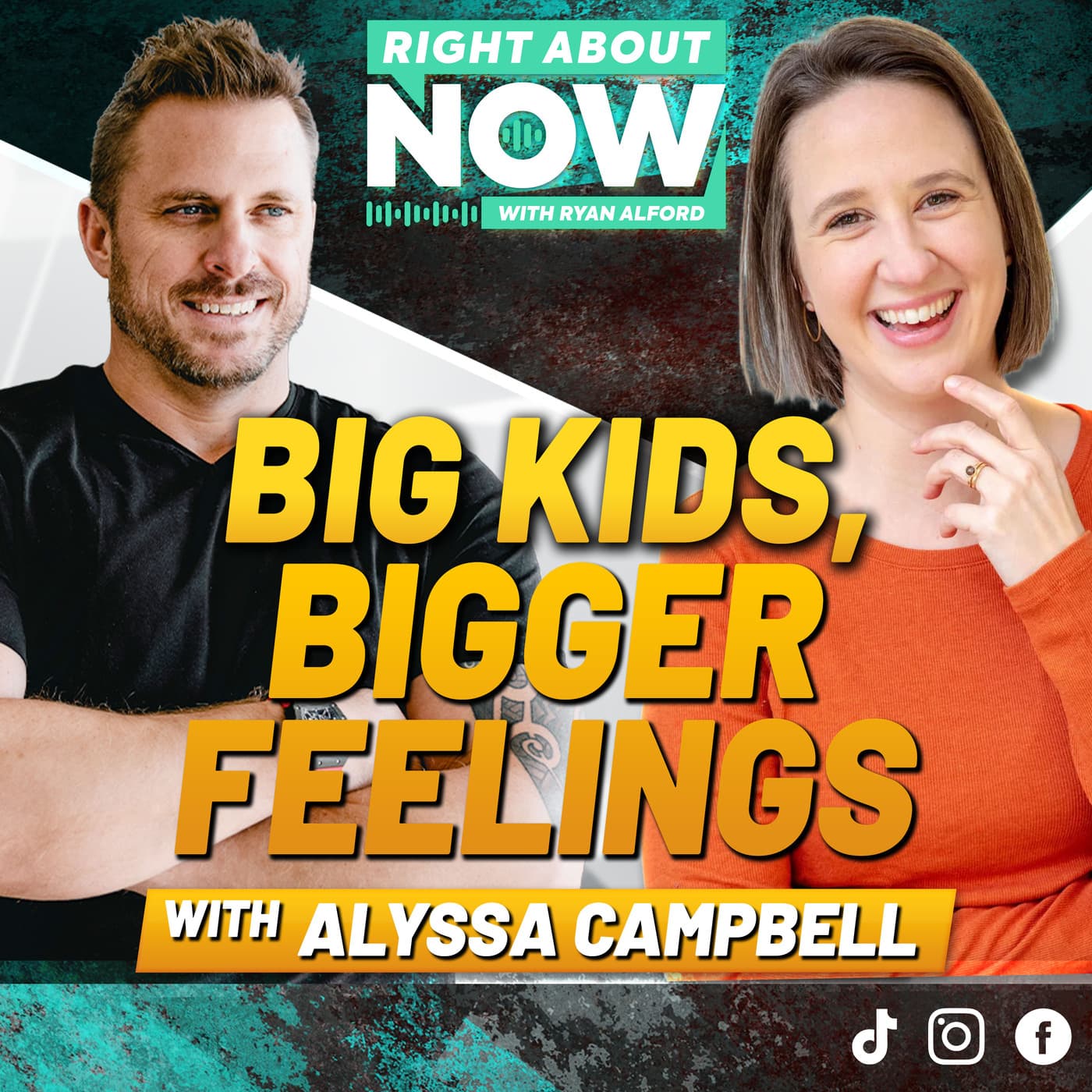
Episode Overview In this episode, host Ryan Alford interviews Alyssa Campbell, author of *Big Kids Bigger Feelings* and CEO of Seed and Sew Collaborative. The discussion focuses on emotional regulation and resilience in children aged 5 to 12, offering practical insights for parents and educators in understanding and addressing children's emotional needs.
Key Concepts and Discussions
Emotional Development in Children
- Target Group: The episode primarily focuses on children aged 5 to 12, emphasizing the importance of emotional understanding during this developmental stage.
- Alyssa's Books:
- *Tiny Humans, Big Emotions* (New York Times bestseller)
- *Big Kids Bigger Feelings*
- Purpose of the Books: To help parents and educators grasp the emotional and nervous system development of children.
Strategies for Emotional Regulation
- Proactive Support: Emphasis on proactive behavior support in schools rather than reactive measures to manage misbehavior.
- Nervous System Understanding: Alyssa discusses the nine senses beyond the traditional five (sight, sound, taste, touch, smell) that influence emotional regulation:
- Vestibular Sense: Movement and balance.
- Proprioceptive Sense: Awareness of body position.
- Interoceptive Sense: Internal cues related to feelings (hunger, anxiety).
- Neuroceptive Sense: Reading the energy of the room.
Building Resilience
- Teaching through Challenges: Rather than removing obstacles, the focus is on teaching children how to process and navigate hard feelings, thereby building resilience.
- Calm and Regulating Environments: Importance of creating spaces in homes and schools that promote calmness and emotional regulation.
Impact of Societal Factors
- Influence of Poverty and Trauma: Discussion about how social factors can affect children's emotional health and behavior in school settings.
Examples and Practical Applications
- Behavior Support Plans: Alyssa shares a case study where understanding a child's sensory needs led to significant reductions in behavior incidents by making small adjustments (e.g., allowing a child to listen to music during lunch).
- Multi-Tiered Systems of Support: Explanation of tiered support systems in schools that provide varying levels of customization while still being manageable for educators.
Key Takeaways
- Understanding Children’s Emotions: It’s crucial for adults to help children navigate their emotional experiences rather than simply shielding them from discomfort.
- Resilience Cultivation: Building resilience is about preparing children to face challenges rather than making life easier for them.
- Tailoring Approaches: Each child is unique, and understanding their individual needs is essential for effective emotional support.
Conclusion This episode of *Right About Now* highlights the significance of emotional education and proactive support for children's emotional needs, aligning with the broader conversation about mental health and resilience in today's society. Listeners are encouraged to consider how they can integrate these insights into their parenting or teaching practices.
Resources
- Alyssa Campbell's Work: [Seed and Sew Collaborative](http://seedandsow.org)
- Books: Available wherever books are sold, including audios for both titles.
- Podcast Links: [Right About Now Newsletter](https://bit.ly/4eztNcv) | [Free Podcast Monetization Course](https://bit.ly/3BhJzKK) | [Join The Network](https://bit.ly/4doxmRH) | [Follow Us On Instagram](https://www.instagram.com/ryanalford) | [YouTube Channel](https://www.youtube.com/@RightAboutNowwithRyanAlford) | [Vibe Science Media](https://vibescience.media)
Listeners are invited to dive deeper into the topic by exploring Alyssa's books and the practical strategies mentioned in the episode.
Written by AI. May contain mistakes. Listen to the episode to check what was said.
Transcript
Automatic transcript. May contain errors.0:00On today's episode of Right About Now, a little bit of a different episode. I talked to Alyssa Campbell. She's the author of Tiny Humans, Big Emotions. It's a New York Times bestseller. She just released Big Kids, Bigger Emotions. We talked about releasing the book, everything that goes into raising kids today and some of the insights that we can use to better train our kids to adapt and deal with today's challenges. And some of the triggers that happen were all different. I think this is important in today's society as we talk about raising good human beings, good people, good people that go on to be good business people.
0:31I also brought in perspective of my wife, who is a principal at a middle school. It's a fascinating discussion with Alyssa Campbell about all of these things. Enjoyed this talk, and I know you will too, right now. We're not saying that we're going to snowplow obstacles out of their way. We're saying, how do we teach them what it really looks like to cultivate resilience, to know what it feels to be in a hard feeling, to experience something hard, and move through it and process it and come out on the other side instead of just burying it down or building resentment. This is Right About Now with Ryan Alford, a Radcast Network production.
1:07We are the number one business show on the planet with over 1 million downloads a month. Taking the BS out of business for over 6 years and over 400 episodes. You ready to start snapping next and cashing checks? Well, it starts right about now. Hey guys, what's up? Welcome to Right About Now. We're always talking about what's right, what's now, what's here today. And it is here today, folks. I'm telling you, literally here today, a new release. We've got Alyssa Campbell. She's author of Big Kids, Bigger Feelings. And the book just came out. So here we are. What's up, Alyssa? Hey, I'm excited to get to hang with you today.
1:44Thanks for having me. I know. You're on the book tour. It just came out yesterday. I know we're recording. This will be a few weeks from now, so it won't officially be one day. We'll ground this in a little bit of reality of your reality today. Yeah, for sure. Yeah, it's a whirlwind today. That's for sure. I started press and media yesterday at 530 in the morning and ended the day at 11 p.m. We're in it. CEO of Seed and Sew Collarative Emotion Processing Method. That's a mouthful, but it's an important one. That's right. We call it the SEP method for short. Talk to me about Seed and Sew, and then we'll get into the book.
2:18Yeah, for sure. Seed is the company that I created, and we work with schools and child care programs and teachers and then organizations on how to understand how to actually create spaces that are calm and regulating. And we use it. I mean, we're a team of 12 at this point, and we use it in our workspace every day to know how do you work best? How do you function? How does it work within teams and the mismatches of teams and being able to navigate really just being a human on planet earth is the work that we do. Ah, how to be a human. We need more of that sometimes. It sounds It's basic, but like sometimes I do worry that we've lost our humanity, especially with AI and everything else.
2:57A little worrisome and just overall development. I'm a father of four boys and it's not lost on me the role that I play in bringing them up. But as parents, it's you don't feel like you always know every answer. And I don't know this about being perfect, but we do want to raise good human beings. That's it. And there's so much information out there right now. It can be hard to know like what actually to pay attention to. So we're just here to distill, basically get nerdy with you, but make it make sense. Yeah. Talk to me. It's your second book? It's my second book. Tiny Humans, Big Emotions was a New York Times bestseller and hoping to bring this one to the list as well.
3:32I know. Who's our target for the book? Obviously, I go to parents and all that, but something tells me it's a little deeper than that. Yeah. This one is for the five to 12 year old age range, those elementary school kids. And it's parents, it's teachers. The bulk of what we do at Seed as a business is working with schools. That's our biggest revenue driver. It's really coming in and working with schools and through schools, also working with families. So the book's designed to be able to serve families and schools and teachers. In fact, one of the coolest things we've seen so far in this pre-order season for books was schools doing like bulk orders for families to have access to it or for their teachers to have access to it, to dive into work look like to do in tandem with each other.
4:11It's interesting you say that. My wife is a principal at a middle school. Oh, we should chat. She just had a chat. So she's a progressive. My wife called the book. I obviously talked with a lot of authors and we have them on the show. She's used to that. But maybe the topic per se. The title, Big Kids, Bigger Feelings, playing into your first book. You can kind of work your way there. But let's set the stage. What are we talking about? And what are the big takeaways? Yeah. So what we do that's different than what's happening is that we look at your nervous system as a whole. And this is the part of being a human on planet Earth.
4:41You know, we have your five senses. Sight, sound, taste, touch, smell. There are four other senses that we don't talk about a lot that really factor into how you show up in the world and if you can be regulated, if you can access your whole brain, whether it's for things at work or it's for teaching or it's for learning for kids. And so we have our vestibular sense, which is located in your inner ear. It's responsible for your movement and balance. We have our proprioceptive sense that lets you know where your body ends and something else begins. if you are like walking by the table and you bump into it, your perceptive senses, it's having a hard time letting you know, oh, there's a table there.
5:17You should move over a little bit. And we have our interceptive sense that lets us know if we're hungry, if we're tired, if our heart's beating fast, if we're like anxious, any of those internal cues. And then we have our neuroceptive sense, which is like the energy reader of the room. If you come into a room and two people have been arguing and they stop arguing, but you feel it in the room, you know, this is awkward. That's a neuroceptive sense at work. And so we look at all nine of these senses and help you understand where you fall or where a kid falls in terms of whether they're sensitive to it, it drains them or they're seeking it, it regulates them.
5:49The things I'm sound sensitive, when my kids are like loud and annoying and like making all the noise and all the sound is happening in my house, it adds up for me and I can lose my cool if I'm not mindful of it and paying attention to it and supporting myself through it. Just the other day, they were like bickering in the car on the way to school and driving each other nuts. And I was, I'm going to pop in my AirPods and I'm going to listen to one song so that I can control the sound and not lose my cool on them. And so we're looking at these nine senses and helping you understand like, how does your nervous system work?
6:21What's going to drain you? What's going to recharge you so that you know when you're getting drained, oh, here's what I have to do to recharge because it's not one size fits all, you know, this is a dad of four. And this is stuff that's so overlooked. When we have a school that we work with, it's high needs. Most of their kids are high poverty. A lot of them have at least one incarcerated parent, a number of homelessness situations going on. And we came into that school last year. And from Q1 to Q2, all we focused on was this nervous system, understanding each kid, putting systems in place for those needs to be met proactively throughout the day.
6:55Not just the kid is losing it and is dysregulated and then they're pulled out of a classroom and there's disciplinary action. Not that reactive cycle, but proactively supporting it. And we saw a 60, 6-0 percent reduction in behavior support calls from Q1 to Q2 just by doing that. When we're looking at this, we're looking first and foremost at how do we really set you up for success throughout the day? That's interesting. I've been sitting here thinking about my wife. She comes home and has the stories to tell. And she deals with a lot of that poverty and other things. There's a lot of variables that play into maybe the misbehavior, but it doesn't change the fact that it's happening.
7:29And it blows my mind, Alyssa, along the same lines. I don't want to get the education system. There's so many advancements. There's smart people like you, companies like yours. We have so much information now that's changed. And arming our teachers, arming our parents, and getting knowledge and turning knowledge into action, into change that then has an impact on our children. Is there anything more important? It's huge. I don't think there is. No, and it's so huge. We look at the mental health crisis today and I'm like, yeah, no one knows how their brain and body work. We're just like shooting in the dark.
8:01Pause and take deep breaths. I don't even know what it feels for these kids. They don't know what it feels when it's building. My son calls this the volcano where it's like building inside before you explode. And then afterwards, these kids can tell us what they should do, what they shouldn't do. They might know the rules, but they can't put it into action because they don't know the precursors for what's coming before it. They don't know what that kind of volcano as it's building feels like. And you're right. There are so many factors that are also coming into play, the homelessness or poverty and how that's factoring into even how they're showing up at school or in everyday life.
8:32And so we get to come in and be the detectives and help create that. And one of the things we as a business created was a lot of schools have like a behavior tracker where they kind of track kids behaviors. And really, we use it predominantly for disciplinary action to see like, oh, this kid's had X number of behavior support calls. They're going to get whatever the disciplinary action is in correlation to the policy. And we came in and said, how about we actually use that information to change behavior? We pair it up with the kids. We have everyone's nervous system regulation questionnaire information that lets us know how their brain and body work.
9:06And say Jackson gets a behavior support call three times in a week. We get pinged and it says on our end, we have to create a behavior support plan for this kid to meet their need. And it pulls in Jackson's information. and makes a customized behavior support plan to actually meet the need that's driving the behavior. So we're not just focusing like whack-a-mole, getting these behaviors over and over and over on the surface. Interesting. Let me play the other side of the coin, play my wife's role or the teacher's. I'm sure you hear this. It all sounds cheers from the back. All that makes sense.
9:37If I could work one-to-one and if every kid at that level, boy, that would be a wonderful day. That might be an excuse. We'll give up precedence to reality and to reality. Probably some truth and some false to that. How do you balance that? I'm sure you probably hear that. All this is great, but if I had four children in my classroom, this is manageable. How do we make it manageable? We are not doing individual support for almost any of our kids. In the school systems, we often use what's called multi-tiered systems of support. You look at the baseline is called tier one, and that's like universal supports that everybody gets.
10:11Tier two is like maybe a couple of customized things for some kids, some specific tools in place. tier three, they have special meetings, they're getting certain services provided, all that jazz. We do the bulk of our work in tier one and tier two. For us, when we're creating a behavior support plan, that doesn't mean it's individualized and this kid's getting one-to-one support. What it means is that they're getting the tools in place and the things that they need to not see this behavior happen. Let me give you an example. We got a kid who every time they're at lunch, we're seeing these huge behaviors.
10:41They're getting in trouble in the lunchroom every day. And it flagged in our system. Yeah, about the same time every day, this kid's getting a behavior support call and it turns out it's at lunchtime. What we know about this kid from their profile is that they're sensory sensitive. What that means is that they are the kids that notice the details in the space. My husband's like this. If I put something down on the counter, he's like, don't put it down, put it away. The clutter is annoying for him. If there's a bunch of sounds in the space for these kids, it can also be the feeling of certain clothes.
11:09I want to be comfy and cozy in my clothes. And if it's too tight or too itchy or there's a tag, that starts to get a little bit of a little bit. to drain them. All these things start to add up for their nervous system. So you put them in a lunchroom where it's loud and it's busy and all this is going on and they're losing their cool. The schools that we work with, we accessed some grant funding. They got access to little kind of essentially mini iPod things that connected to the Bluetooth in the cafeteria and kids can just pop it on and listen to some music and then they're in control of the sound.
11:35And this kid didn't have another lunchroom behavior support call for three months. And all we did was say, like, yeah, his nervous system needs some help during lunch. And he would wear headphones and listen to music instead of like being in the crazy loud lunchroom. That was too overwhelming for him. Yes. You and my wife have a call. I was validating that if nothing else. Starting with Alyssa Gamble, all of her big kids, bigger feelings. Alyssa, as we start to close out here, walk me through, I always like to ask this with like kind of books. I'm someone that's about to read your book and I walk in thinking something and I'm going to walk out thinking something different.
12:11What's the biggest change that I would get from reading your book? There's so much talk about kids and their feelings these days. And I think a lot of people think that it means that it's permissive and kids are going to be soft and they're not going to be able to like handle real life stuff that we're going to step in and make sure that they're not feeling hard things. And what we're doing is actually kind of the opposite. I'm not putting hard things in their way, but I'm helping you know, how do you actually support them through the hard things that we aren't stepping in. We had, for instance, a mom reach out the other day and she was like, the friends are doing these TikTok dances.
12:43Her daughter was not included or invited. She's like, do I step in? Do I help? Whatever. Do I reach out to these parents? No. Your daughter's learning what it feels to be left out and not be included. And that's going to happen for the rest of her life sometimes in different spaces. You get to create a space where she can talk to you about that, where she has a place to talk to. Because in the past, so many of us grew up in spaces where we felt the hard thing, but we didn't know what to do with that. And we see this huge mental health crisis where kids are drowning in adults who don't know what to do with their emotions and they're just losing their cool and they can't have conversations with each other because they don't know what to do when they're in the hard space.
13:18And when we're navigating this, we're not saying that we're going to snowplow obstacles out of their way. We're saying, how do we teach them what it really looks like to cultivate resilience, to know what it feels to be in a hard feeling, to experience something hard and move through it and process it and come out on the other side instead of just like bearing it down or building resentment. That's a big one. Or boys. I mean, my nine year old, who's the youngest, who's the baby, he is an anxious kid. He's like a very normal kid. He builds up anxiety over big things and small things sometimes. And when you were talking about that, I was going to say, we don't get it out of it.
13:54I grew up with a military father. My wife and I both played teams. He won team sports. We're go-getters. We're not easy parents. And trying to figure out exactly what's going on. When I was hearing you talk, what's being processed right now that's causing that? Even as adults, we know these are children. But we always think of ourselves first, how we react to things or how we do things. Everybody's makeup is different. It's a hard reality, but that's why we have books like yours to help us figure it out. That's right. It's not a one size fits all. And you know that as a dad of four, all these kids are different.
14:26And so much of our work is really helping you understand who's the kid in front of you and what's actually going on in their brain and how do you help them? I also, I grew up in a family of five, all athletes and high achievers, and it was also definitely not a soft household. And when I look at things from my childhood that I want to pass on. Respect was really important in my household. And I want to carry that on. I want my kids to have respect for themselves, for everyone around them. And also there are things in my childhood that I'm like, yeah, I'm going to leave that to the wayside because this piece doesn't carry on into this next part.
15:02And one of those for me is that my kids will be able to share their emotions. It doesn't mean I'm going to make it go away. It doesn't mean the boundary changes, but that they get to be disappointed about a boundary or ask why. That it's not in my household a because I said so culture. It's, yeah, you get to ask why and be curious. And I'll let you know why. Again, it doesn't mean the boundary changes, but we can have a dialogue in this. And so when we're looking at these things, there isn't one right way to do it. And if we don't get to the root of what's going on with kids and really respond to that, we're just going to keep seeing behaviors over and over and over.
15:38Yeah. I keep doing the same thing. You get the same results. So that's what Mark told me. That's right. Including my own tests. It tends to be the same. Where can I find the book and learn more about what you're doing with Seed and Sew? Yeah. We're at seedandsow.org is kind of our mothership. And the book is wherever books are sold. It's published with HarperCollins. Anywhere you get a book. And I read the audio book for big kids and then for tiny humans as well. Go snag that bad boy. It's an important topic, and I appreciate the work that you're doing. It makes a difference. Thanks for shining the light on it.
16:10You know where to find us, ryanisright.com. We're going to sign up that meeting with Alyssa and my wife, if nothing else. But look, get out there, get big kids, bigger feelings. It's an important topic if you have children. It's important to just understand how everyone works a little different and that we've got the opportunity to mold the world that we want through our children. We'll see you next time, right about now. this has been right about now with ryan alford a radcast network production visit ryanisright.com for full audio and video versions of the show or to inquire about sponsorship opportunities thanks for listening
From the publisher
Right About Now with Ryan Alford
Join media personality and marketing expert Ryan Alford as he dives into dynamic conversations with top entrepreneurs, marketers, and influencers. "Right About Now" brings you actionable insights on business, marketing, and personal branding, helping you stay ahead in today's fast-paced digital world. Whether it's exploring how character and charisma can make millions or unveiling the strategies behind viral success, Ryan delivers a fresh perspective with every episode. Perfect for anyone looking to elevate their business game and unlock their full potential.
Resources:
Right About Now Newsletter | Free Podcast Monetization Course | Join The Network |Follow Us On Instagram | Subscribe To Our Youtube Channel | Vibe Science Media
SUMMARY
In this episode of "Right About Now," host Ryan Alford interviews Alyssa Campbell, author of "Big Kids Bigger Feelings" and CEO of Seed and Sew Collaborative. Alyssa discusses her new book, which helps parents and educators understand and support the emotional and nervous system development of children aged 5 to 12. The conversation explores practical strategies for managing kids’ emotions, the importance of proactive support in schools, and the need to address the root causes of behavior. Alyssa emphasizes building resilience, not removing challenges, and offers actionable insights for families and teachers.
TAKEAWAYS
- Emotional development in children aged 5 to 12
- Strategies for parents and educators to support children's emotional management
- Overview of the books "Tiny Humans Big Emotions" and "Big Kids Bigger Feelings"
- The importance of understanding children's nervous system and sensory processing
- The role of schools and educators in addressing emotional challenges
- Proactive vs. reactive approaches to behavior management in educational settings
- The significance of creating calm and regulating environments for children
- Customizing behavior support plans based on individual children's needs
- Building resilience in children through emotional awareness and processing
- The impact of societal factors, such as poverty and trauma, on children's behavior and emotional health