
In short
Podcast Summary: Right About Now - Innercise with John Assaraf
Podcast Overview
- Title: Right About Now
- Host: Ryan Alford
- Description: A candid marketing and business podcast that offers real insights from experienced entrepreneurs and thought leaders. The show focuses on actionable advice, mindset, character, and the tools necessary for business success.
Episode Details
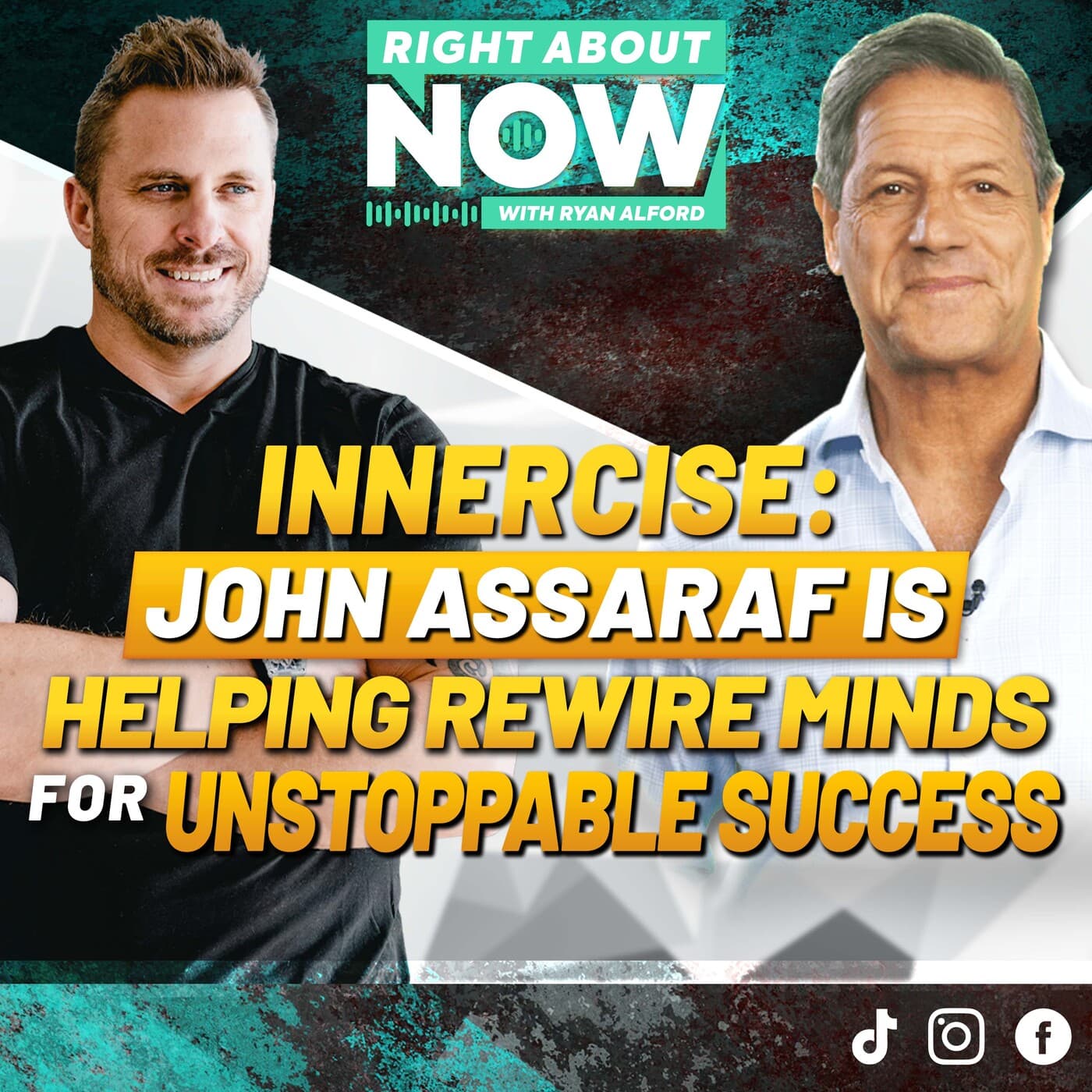
- Title: Innercise: John Assaraf is Helping Rewire Minds for Unstoppable Success
- Guest: John Assaraf
- Background: John Assaraf is a renowned mindset and business growth expert, author of multiple bestsellers, and a prominent figure in personal development.
Key Themes The Importance of Mindset
- Mastery of one's inner game (mindset, habits, emotional resilience) is essential for success in business and life.
- Emphasizes self-acceptance and understanding one's identity as a foundation for growth.
Concepts Discussed
- Neuro Mechanics: Understanding how the brain functions helps to navigate personal and professional challenges.
- Self-Mastery: The journey of self-discovery and mastering one’s thoughts and actions.
- Growth vs. Fixed Mindset: Differentiating between those who are open to growth and those who are not.
- Rewiring the Brain: Techniques to create new empowering beliefs and habits through consistent practice.
Innercise Method
- Introduces the Innercise app, designed to help people overcome limitations and achieve their goals by rewiring their neural pathways.
The Role of AI in Today's Business
- AI represents a massive shift that entrepreneurs must embrace.
- Discussion about how AI tools can enhance productivity, but also the need for human management and understanding of these technologies.
Key Takeaways
- Mindset Matters: Embrace a growth mindset and accept oneself to move forward.
- Neuroscience in Business: Understanding brain mechanics can enhance performance and decision-making.
- Empowering Beliefs: Focus on creating new beliefs that align with desired outcomes.
- Consistency is Key: Achieving long-term success requires consistent action over time.
- AI Adaptation: Embrace AI as a tool for growth, while recognizing the need for personal adaptation and learning.
Conclusion
- The episode underscores that achieving success starts with the inner game, emphasizing continuous learning, curiosity, and personal development as key drivers in an ever-evolving business landscape.
Resources
- [Right About Now Newsletter](https://bit.ly/4eztNcv)
- [Free Podcast Monetization Course](https://bit.ly/3BhJzKK)
- [Join The Network](https://bit.ly/4doxmRH)
- [Follow on Instagram](https://www.instagram.com/ryanalford)
- [Subscribe on YouTube](https://www.youtube.com/@RightAboutNowwithRyanAlford)
- [Vibe Science Media](https://vibescience.media)
For further insights, listeners are encouraged to explore the Innercise app and John Assaraf's various resources aimed at improving mindset and business strategies.
Written by AI. May contain mistakes. Listen to the episode to check what was said.
Transcript
Automatic transcript. May contain errors.0:00Show me your daily practice of how you are expanding your mindset, self-talk, and emotional regulation for the level you want to play at. This is Right About Now with Ryan Alford, a Radcast Network production. We are the number one business show on the planet with over 1 million downloads a month. Taking the BS out of business for over 6 years and over 400 episodes. You ready to start snapping necks and cashing checks? Well, it starts right about now. What's up guys? Welcome to Right About Now. We're always helping you get right now. What does that mean? We can talk about last year. We can talk about five years now, which we might venture a little bit.
0:49I will say that. But that's just because of who the guests we have. But it's about making action, taking action, and making it happen right now for you through business and life, because that's where we're headed today. It really starts with the brain. It starts with the mind. It's all there. No matter what we want to do, we can get purposeful. But if you don't have your head right, you can't get there. That's where we go to the expert. He is the master of the mind. He is John Assaraf. What's up, John? Hey, Ryan, great to be with you and your wonderful guests and audience. Appreciate it, John.
1:21He is an expert in mindset and coaching and teaching actionable steps to help get businesses scale because it does start in the mind, John. This crosses a lot of boundaries for me that I like. I host another show called Vibe Science, and I might have to get you on that show as well because it is about mind, body and energy to get us where we need to go. It seems to be what you live, breathe and coach every day. Am I right? You are 100 % right. I like understanding what I call the neuromechanics, what's going on in my own head so that I can understand why am I doing what I do? Why am I not doing what I want to do, know I should do and can do and combining neuroscience and neuropsychology into trying to perform at the highest level I can and teaching what I learned to others.
2:08They called that self-mastery. When I hear you say those things, and not that we ever, I try to be honest and not pretend that we master anything to perfection because it's always an evolution, but it really is like to know thyself. Didn't a famous philosopher say that? Yep, absolutely. You know, the idea of self-mastery, I think first should start with self-acceptance. And not a lot of people invest any time on, you know, this is who I am right now. And before we start getting into I'm not good at this and I could be doing more of that and I should this. And, you know, as Tony Robbins said many ago, should have all over yourself.
2:48What about self-acceptance first? Saying, hey, I was born with, you know, a genetic predisposition for certain things and character traits. I've been given some things that are easy for me to do or not do. And then there's other things that are harder. and require some effort. And the whole idea first is to not judge, not blame, not shame, not feel guilty for who you are right now because every moment is perfect. And if we come at life from the perspective of every moment is perfect, some things may not be to my taste. And where I'd like to grow and develop or I'd like to do, have, be, achieve and feel are all little journeys that we could take and, you know, get on the path to achieve whatever it is that we're looking for, whether it's a mental achievement, emotional achievement, a financial, physical, spiritual achievement.
3:46One of my beliefs is especially now, how to fill in the blank, anything, how to have deeper spiritual connectedness. We know how to do that. How to 3x my income in my business. We know how. How to get 500 more leads today or this week. We know how. So the issue isn't that we don't know how. A person may not know how, but in general, how to is the easiest part of the equation. The real question is, why am I not doing what I could easily find out how to do. Now we're dealing with what's going on inside, you know, my brain or, you know, my heart, you know, my gut, et cetera. And we know a lot more about that today that we can tap into.
4:35I love that because that's getting into what the first thing you said, John, when we were doing the pre-episode talk a little bit is, you know, you go, you were quick to go, So I'm a mindset, you know, a master mindset. I understand the mind, but I make it actionable. And I think that's the key. So you often speak about the inner game for success. How can, you know, people listening sort of that are, you know, we have a lot of high level executives. How do you coach people like balancing profit, people and pressure to sort of master that inner game?
5:16Sure. And it's a lot more complex than people think. Carol Dweck wrote a great book called Mindset. And in the book, the synopsis of the book is that we either have a growth mindset or a fixed mindset. Most entrepreneurs, I think, would have a growth mindset, meaning they're willing to grow and learn and stop stuff and start stuff. But when we're looking at profits, people, pressure, let's talk about pressure first. because pressure is a form of stress, right? And so if we ask ourselves this question, does the same pressure activate the stress circuit in every human's brain under that pressure?
6:00And the answer is no. So the stress circuit or the amount of pressure required to trip you up may be totally different than to trip me up. So the question should be, How do I increase my capacity to deal with the pressure of my current, let's say, business, my current life? And how do I expand my ability to handle the pressure at the next one or two or three stages? And so when we're talking about stress and pressure, there's circuits in the brain. And what activates, for example, your fear circuit may not activate mind. So when we talk about mindset, it's a much more intricate discussion than one size fits all.
6:46And you may not have the identity right now and the beliefs required to reach your next level of business success. And so we ask ourselves, well, what is identity? Identity is your feeling of certainty about who you are and what you deserve to have and achieve. So think about this. Is it possible to generate$50 million a year in business for most of the people that are listening in their niche? It's possible, but not likely. Well, hold on a second. Well, let's first deal with it's possible. Because if we ask ourselves if it's possible, then how do we make it likely? So in my business, you know, I'm in the coaching business, right?
7:31And there are people in our industry, coaching industry that make, you know,$50 ,000 a year. And there's people like Tony Robbins in the coaching industry making$180 million a year. What's the difference? And the first part is Tony is looking at the game at a much different level. International game, multiple languages, a totally different infrastructure that began with him wanting to build something of that stature and then building the identity, the beliefs, the habits, the strategies to achieve that goal. And most people get stuck at their current level of achievement. And when they set their goals for that next level, they set goals based on what they think they can achieve versus what is possible to achieve.
8:17And they don't like to think about what's possible to achieve because either A, they don't believe they're smart enough, good enough or worthy enough to achieve it. B, they don't believe it's possible for them or it's not possible in their niche. C, it would be fears, fear of failing, fear of being embarrassed, ashamed, ridiculed, judged, rejected, disappointed. And that's what stops them from actually going after the biggest version of the success that they may want to achieve. And right now I'm just sticking to business. Yeah, that's really interesting. And it makes me, John, I'm thinking like two things, two words are bubbling to the top of my head.
8:53One of them is potential and one of them is headroom. And I feel like it's like in you're increasing both, like when you've mastered this inner game, like, you know, because, you know, like anyone listening, I've got a my hand over my head, like where you hit your head, because I think John just said a lot more eloquently than my diagram. but you know like you've set these limits that are there and i think when you you both extend the limit but it's one thing to extend the limit john but we have to also and this is where the inner work i think that you focus on which is the potential because i have to become different than i am today yes to reach that head of course right of course yeah let's maybe back up for one second And let's just understand a couple of things most people don't know about the human brain.
9:48Number one, just like almost every electric car in the world runs the same way and every gas powered car runs the same way. Every brain functions exactly the same. So the fear circuit in your brain works just like the fear circuit in my brain. And what triggers it is different. But how it works is the same. How your habits were developed are the same. but the habits you develop, the beliefs you develop, the self-image you develop, the things that cause you stress and may not cause me stress, how they were developed are the same. So when we're looking at increasing capacity, now we're entering the domain of neuroscience and asking ourselves this.
10:34Let's say you're in Hollywood for just a moment and let's say you're sitting at a coffee shop or tea shop in Hollywood and one of your favorite actors, male or female, you know, taps you on the shoulder and says, hey, I've been looking at you from the corner over there and you look like you would be amazing at this role that we're filming in six months. You're about 6 '6", 250, 60 pounds. Like this role would be amazing for you. If we pay you a million dollars and we coach you on this role, would you be willing to work with our coaches to learn how to add this role to who you already are. And then we'll film in six months.
11:14Ryan, what would you say? I'm in. You're in. They give you a check for$100 ,000. Now they give you a script. You've never seen the script. There's just a bunch of writing on the script that said, here is your role. What would you do to become this new role? Got to memorize that script, baby. How would you do it? Reading it over and over again. How many times? I have a photographic memory, so probably at least three times. So you do it three times. Would you take your mobile phone and record it so you can listen to it? Yes, I would. Yeah, I have my AI, actually, my little recorder on my phone that does all of that.
11:57I'd give myself footnotes and all of that. So I would, you know. So every time you would read it, would you add emotion to it as if you are playing the role so you can practice it? until it becomes permanently known to you? Yes. So you would practice. Option A and B, like the role that they gave me. And then, hey, this is a little spin I put on it if you like it. Great. So you would practice. And what would happen during these practice sessions? You're basically firing the neurons in your brain. They're creating connections. The neurons that fire and wire in a repetitive pattern become more permanent, otherwise known as an expansion of your capacity and capabilities.
12:40So we talk about, you know, an entrepreneur. And here's something that I ask, you know, a lot of a lot of people. Show me your daily practice of how you are expanding your mindset, self-talk and emotional regulation for the level you want to play at. there'd be a lot of quiet it's always a lot of quiet i coined the practicing of that inner size right so just like we can strengthen our bicep or shoulders or chest or quads or legs through cardiovascular work or weight training or yoga or pilates or or hiking or hockey or whatever we can train the different parts of our brain the neuro muscles i call them to expand my identity no differently we expand our identity to be able to play this role why not imprint create the beliefs you need to create in order to affect how your brain sees the world what most people don't know orion is this we don't see the world as it is our brain creates okay what we see based on the internal beliefs and identity and map that it already has yes you know what i call that john What?
14:02What you just described is you got to believe it before you see it. Most people need to see it before they believe it. And that's why it doesn't work. That's exactly right. So here's the question in the brain. Right. What is a belief? That's a norm, I guess. Unfortunately, with any beliefs, you've got four boys. Were you born? Were they born with any beliefs? No. Zero. Were they born with any fear? No. Were they born with a self-image? I'm smart enough. good enough. I'm confident. I'm not. No, it's all the world that's conditioned them. So you condition them, your spouse, partner, condition them, their school, each other condition them.
14:41So think about this from a pure brain perspective. You know, we have about 85 billion brain cells like marbles. Those marbles activate and connect to other marbles, brain cells. The connections that are reinforced become dominant patterns. The dominant patterns around our self-talk become the norm. The dominant patterns around how we react or respond to stuff becomes the norm. The dominant patterns of what we expect becomes the norm. The dominant habits become the norm. And then we just reinforce patterns from the age of literally 13, 14 till we die. So most people watching or listening to this podcast are not 13 or 14.
15:24They're probably 25, 35, 45, 55, probably in that range. Now, we already have our map. We already have these patterns that have been reinforced that our brain is just playing the game based on the patterns that are already ingrained and reinforced in condition like software. So what I've gotten fairly good at doing is helping people re-fire to rewire for whatever the next levels of success is. and understanding how to do that, you know, based on neuromechanics of the brain. And that's why people have a very, very hard time with hyper growth. And they usually go from, you know, X to 100 ,000 to 250 to 500 to a million.
16:07But how often do you see someone go from a million to 10 or 20 or 50 or 100 million? Rare, but it's possible. So if it's possible, why not possible for me? And now we have our story that we're going to say. Now we're going to get into the story that justifies our current set of results. Can you talk about the intersection between visionary thinking and sort of the neural part here that you're talking about? Like how do leaders expand what they believe is possible for their companies? You know, because of what you said earlier, I'm going to dive into the world of, you know, spirituality for just a moment without going off the rails too much.
16:48That's fine. We have a brain, right? Electromagnetic switching station that receives and sends out energy in formation, right? So we've been given a faculty called imagination. And our imagination is part of our brain that can imagine what's possible or what we would like to achieve. And for anything that we want to achieve, the vision is part one of this. We want to get into what I call resonance, coherence and flow. So we want to align the vision, the idea, right, with the emotion, the energy in motion of my hundred trillion cells. Now, when I have a vision for, you know, an outcome that I want to achieve for my company and I am like emotionally like, yeah, let's do this.
17:40And I engage my team. All right. And they buy into the vision and the mission and the why that we want to do this. When you create a vision that is strong, big, it's energetically like charging you and you get team involved in that, you're increasing the amplitude of your energy of what you and I and everybody else is. Now, part one. So we get that alignment, right? And that is called sympathetic resonance in quantum physics. But there's also something called destructive interference. So destructive interference is, let's say I say, Ryan, let's start this business and let's you and I build this thing and help a lot of people.
18:24And let's grow and let's make a difference in the world and have impact and influence. And let's make a ton of money and give a bunch of charity. And then you have another partner or somebody on your team that goes, well, that can't be done. Destructive interference. When beliefs do not match vision, destructive interference. When habits do not match vision, destructive interference. When fear runs the show, destructive interference. In the world of manifestation and growth, we want to create sympathetic resonance around the vision, the goals, the why, part one, and then the strategies, the tactics, the timelines, and the tools and resources.
19:03Now we have an entire sequence, no different than what they do to put a human on the moon and bring them back home safely. All systems go. So we have to have the mindset, we have to have the emotions, and then we have to have the right strategies in the right order done at the right time. Now we have coherence, harmony and flow. Most entrepreneurs do not take the time to create the sympathetic resonance that is required, even though we know exactly how to do it. Why? Well, for some. It's hard? Or is it too fast? Yes, it's hard. If it was easy, everybody would do it. So let's understand why do some people not do it?
19:48Their story, they tell themselves a story. It's not the right time. I don't have the money. I don't have the knowledge. I don't have the skills. I don't have the team. I don't have, I don't have, I don't have, or I don't know how, or I don't deserve it, or I'm not worthy of it. So there's a self-image and story disconnect, part one. Part two is they have beliefs that limit them, right? We either have empowering, constructive, positive beliefs that build us up, constructive, or we have disempowering, destructive beliefs that tear us down. But a belief is nothing more than a neural pattern that's been created and reinforced in the brain.
20:25And ask ourselves this question, what has to happen in order for me to create and reinforce an empowering belief that would allow me to achieve that goal? And then if I discover what would have to happen, then if I ask myself this question, how long does it take to create a new identity, to create a new habit and to create these new beliefs that would actually affect positively my behavior? And here's the answer most people don't want to hear. based on some research done the university of toronto 66 days to 365 days of spaced repetition now when you tell most people 66 days three months 100 days uh they're like nah i want the shortcut i go okay um good luck i'm gonna give you the science uh you wanna you wanna do it a little bit differently.
21:20Keep trying your way. Now, can you have somebody take action today based on motivation? Of course you can. But the key is not about motivation today. It's about consistency of a new pattern that overrides the old habit, pattern, etc. And it just takes a little bit of action, in the right order, at the right time, consistently will not achieve their health, wealth, relationships, career, business, financial goals. There's just no way. It's impossible. The biggest eye opener for me that I want the audience to get, you've got to get past the motivation. Motivation today isn't enough. It's the consistency over time.
22:11That's right. And, you know, as entrepreneurs, we don't like to wait. But if you're going to build it and make the change, like you said, like, especially inside your own brain, it's, it's that repetition. So if people would get into their heads, if I, if I do for a hundred days, what most people are not willing to do, I will live the life of my dreams. And this is why it's not the smartest, the fastest. It's the ones that are willing to delay gratification. They're willing to delay the graph. It's not that you can't have success immediately, right? Like, listen, if I go, you know, for example, on social media right now, and I do a live session, and I know how to create a call to action, and I have something that's a really good offer, sure, I can make money today.
23:00But if I don't do it again tomorrow, and the next day, and the next day, and the next day, if I don't do this podcast consistently, and then market it and get, I'm not going to grow the audience and achieve the potential for it. So instead of thinking, you know, what am I going going to do today or this weekend. I like to teach people to think in 100 day blocks. What can I accomplish with extreme, you know, focus and deliberate planning over 100 days? And then can I develop myself enough to build the habit that controls 95 to 98 % of what I think, feel and do every day? Yeah, the parallels with building a brand.
23:42And what you're talking about, like, Like everybody, performance marketing has become all the rage, right? Because they want to sell today. I want to sell today. I want to sell today. But you got to build the brand over time. That's right. And like I coach brands, like this is what I do. I help brands build brand over time, which is playing the long game and doing what you need to do that to build your reputation, build your foundation, all these things. But we're so hyper obsessed on the results today. If we ask of the reason, like why are we so hyper focused on the results today? it's usually because we're not achieving the results we want today but the results today are not because of what's happened today the results today are because of what you didn't do a hundred days ago or 60 or 30 days ago whether people like it or not we live in a world of effects and for every effect there is a cause or more causes and the inner game is the cause of all of your effects.
24:41So just like you wouldn't go to a mirror, you know, and scratch out your hair in a mirror, hoping that it would move off of the image that you're seeing, you know, you shouldn't focus on the effects too much. Focus on the cause. Effect will take care of itself. And the cause of my behavior is everything to do with my self-image, my beliefs, my habits, and my emotions. Inner game stuff. Inner game. It is. I have a show on ours. It's about the empowerment, but empowerment. You got to empower yourself with the right habits, techniques, and working with people like John Assaraf. Hey, John, I know you coach a lot of executives, other people pivoting a bit, as we must do.
25:31Sure. Because we have the value of your input, so I'm going to leverage it. Let's do it. You talk AI. It's the buzzword in business these days and in everything. There can be a lot of inner games with that, too, because reframing your identity in a lot of ways. So two parts to kind of kick you off a little bit, John. How should be people thinking about this? What are you seeing? What are the trends? Where are things headed? And then we can kind of get on the inner game of all of that. It's been coming fast for two and a half years, but most people have just gotten on the bandwagon now. AI in general is the greatest shift in humanity's history since the first human walked on Earth.
26:16There's been 110 billion humans that have walked on Earth. This is greater than the Renaissance era, agricultural revolution, industrial revolution, computer age, internet age, electricity, and fire. This is bigger than all of them. So what does that mean? It means that we have to learn how to reinvent ourselves. There are now AI tools. There's 177 large language models and over 40 ,000 tools as of last week. so first and foremost we're in a in a sea of overwhelm and confusion and a brain that's an overwhelm and confused confusion by the way just means new concepts getting fused but when new concepts are getting fused we're in a state of stress and when we're in a state of stress we either fight it, we fight it, we flee, run away, or we freeze.
27:12So a lot of people have gone on, gotten on to the initial bandwagon of generative AI, you know, use a chat GPT to create this word document for me, or to analyze this or write a poem for me or create a business plan for me, or a marketing plan for me. The next generation is agentic AI, is actually having agents who are doing the work for you. The challenge we have for most people is when the change is so big and requires a lot of cognitive capital, most people don't know how to break it down into bite-sized chunks to be able to say, okay, for the next 30 days, I'm focusing on this, this problem, these agents these workflows these sequences this testing and then i'm going to move to the next one and the next one and the next one so we've moved from generative ai only to agentic ai which is agents that'll do the work for you to general ai which will actually see you just talk to it and it'll go and do it and execute it for you and analyze itself and give you the results that you want.
28:24That's where it's all going. And that's going to be, you know, within the next six to 12 months. So there's a massive learning curve right now that requires cognitive capital, we call it, brain power, thinking power. And the good news is we can all do it. The challenging news is this. The brain's number one priority is safety and security, to protect what I have, to stay safe. Number two, it's to avoid any pain or discomfort. Well, this change is painful and this is uncomfortable. And then number three priority of the brain is conserve glucose, energy. So now I need more cognitive capabilities.
29:06I need to go through this change pain that what we call is to transition from what is to what will be. And our brain considers that painful and uncomfortable. It doesn't want to do that. It requires energy to get to the fourth priority of the brain is the benefit and the win. So I have to challenge myself to override my brain's natural propensity through this overwhelming, confusing, rapidly changing time. And most people don't have the skill set or the habit to manage change effectively. And that's why they're drowning in watching some other people doing it. And then the other problem we have is there are people on social media showing these graphs of this AI agent connects to this AI agent.
29:57And all you need to do is drag and drop and this and that. And that's just a bunch of bullshit right now that they're making these promises, but they don't understand all the underlying work that actually really has to happen in order for it to work. So people are being sold a bunch of blue skies that can be done, but it's a lot more work than they're laying out the foundation for. Yeah. We're building agents as well. And I can attest to that. It's a lot of work. It's not plug and play. It's going to be plug and play, but right now it's not. Yeah. I mean, what does this mean? We talked a little bit pre-episode.
30:35It's going to replace a lot of jobs. Hundreds of millions. Yeah. And so when knowledge is cheap and no longer a value source, and now we're moving, like you said, into this agentic world where it's not just the knowledge is cheap, the knowledge and ability to use it. How do people make money and how do they have self-identity? Yeah. So I think we have to shift how we're getting our rewards. So we shift how we're getting our rewards. A lot of us entrepreneurs, I have this identity like this is my business. This is what I do. Therefore, this is the value that that I derive from being this. and I like to suggest that the way you derive your value right now is this understand that in in times of change this is a Eric Hoffer quote in times of change he said the learned find themselves beautifully equipped to deal with the world that no longer exists while the learners inherit the earth.
Read the full transcript
31:42So for those of us who are willing to learn, to change, to let go of what was, to get used to understand how to take advantage of what is, 95 % of people will not make the shift right now. You know, the early majority is going to be slower than ever. There's the early adopters whenever there's change and you ryan are one of them i'm one of them but then there's the early majority the early majority is taking way longer time right now because it's much more complex and if you don't know how to use technology for example then even using you know lindy make pably or zapier is like what what am i supposed to do with this right so it's it's going going to be, you know, for those who are willing to make the shift and be comfortable in this highly uncomfortable stage of our development, A, we'll make a lot more money to be able to help a lot more people.
32:47But B, somebody is still going to have to, for the time being, for the foreseeable short future, one, two, three years, manage what is happening with the AI. We don't yet have the systems of AI being able to manage themselves and have supervisor AI agents, even though we already have them. We have to have people who are managing the supervisor, managing the agents, which is like, if you think about it, like, what the hell is he even talking about? Supervisor agents, managing agents like managing little robots is what I'm managing that are going to be humanoid, you know, in the next five to 10 years.
33:25and it's like, get your head around this because this is a change of biblical seismic proportions that I'm not going to fight. I'm going to learn how to ride this wave versus being crushed by it. And so the first thing from a mindset perspective is I'm going to learn how to surf this wave. Yeah. And in order to surf this wave, the first thing you learn in surfing is the first thing you have to do. Yes, you paddle out there, And you have to point your surfboard towards the beach. So everybody, where is the beach? Where is this all going? You need to know. And then you got to pick your surfboard, your tools, so that you can use it for your personal life, whether it's chat GPT, Lama, Mistralwood, whichever LLM or two or three you're going to use, whichever tools you're going to use.
34:19None of us needs 50 tools. We need five to 10 tools like like your tool chest for your in your garage. You don't need 150 tools. Most of us use five tools, a hammer, a wrench, a couple of different screwdrivers. And we're pretty good to go. You need to choose which are the tools that I need to master now. So then I can master five more down the road and reduce it back down to the ridiculous. And think about, you know, how do you fix any of the problems you have in your company using AI? and then how do you accelerate what you're doing using AI? Because it's faster, cheaper, easier, and better.
35:00Even before this call, Ryan, I created this brochure for an event that I'm going to have in September and I sent it to my lead neuroscience expert. His name is Mark Waldman. He's also written books like I have and he read, he goes, John, this is like scientifically perfect. He says, how long did it take you to write it? I said, 15 minutes is what? What do you mean 15 minutes? I said, yeah, it took me another 15 minutes to get the images in there. It was like 15 page brochure. His jaw just dropped. When I would pay him to write this kind of stuff, it was literally$500 an hour. And he would take five to seven hours to create what I sent him that created in less than 30 minutes this past weekend.
35:42It's powerful, man. I did the same thing. I uh this show notes like everything we do with podcasting everything to do with growing like social media and everything else like if you aren't using these technologies it's like you're just I don't know what to tell them but I but I will say you know you know entrepreneurs generally speaking are it's people ask me all the time okay what are the keys to success and I think you would agree with this one John highly curious and the willing that learner thing really hit with me because I think about myself over the years and what differentiated me from my friends.
36:17And look, some of them are more successful than me. Not many, but some. But it's not because I'm not the smartest guy in the world, but I'm a learner, man. I'm a learner. Me too. I love learning. I'm curious as hell. Yeah. I got to fucking know. I want to know. And I'm a practitioner. There's something about those attributes, isn't it? Yeah, it's interesting. Many years ago, I was on Larry King about seven, eight times. One of the episodes, I actually got a chance to interview him. A video of me with Larry King glasses and his straps. And I was interviewing him for one of our shows that he came down to San Diego for.
36:57And I said, Larry, because I met him. He was just like an ordinary guy. And I said, like, what do you think has made you so successful? And I forget his answer. He said, John, I'm just more curious, you know, than the average person on what, why, how. And I really, I'm just curious. He said, I'm just a voracious learner. And he says, and that has helped me become really good at what I do. And so I think that's one of the greatest skills. The other thing that it does, Ryan, is when we're curious, there's something in the brain called the neuroplasticity switch. So remember earlier we talked about growth mindset versus fixed mindset and a fixed mindset is this is the way things are This is how I am.
37:41This is why this is that's a closed mindset And we're basically not open to growth when we're born this Neuroplasticity switch the brains are late to create new patterns Reinforced patterns is 100 % on the reason babies are sleeping 20 hours a day 22 hours a day is their brain is creating, you know, through the sight, the sound, the tactile, the smelling, the eating and all this stuff. It's creating these patterns, a map of reality. By the time we're 13, this neuroplasticity switch turns off and then we're reinforcing these patterns. But for those of us who remain curious, it flips on the switch again.
38:21So anytime you're reading, watching this podcast, taking notes, implementing, talking about it with your friends, going to AI and say, how can I use this? And you get curious, you're activating and reinforcing this success pattern of curiosity. And if you're asking the right questions, now your brain starts to say, okay, I've just learned this. I've discovered this. I could do this. I could do that. Now, how do I implement this? Now you're growing. You're back into this growth mindset. And for those of us who don't just passively listen, but we listen, we take notes, we make plans for what we're going to do.
38:58We learn from what we've done. How do we change it? We're deliberately and consciously evolving ourselves. And that is where the prize is. I have taken about 15 personal notes from this, John, and I already have like action in my brain, like spinning. I know our audience does. John, we could talk for hours, man. I really appreciate your wisdom. Where can everybody learn more about what you're doing, how they might could work with you, etc? Sure. You can hop on to johnassereff.com. And I've got a lot of free stuff on there. And there's audios, videos, blogs that I write on social media. My Instagram page, I'm on there every day.
39:35Obviously, YouTube videos. And then myneurogym.com is my company name. And then any of my, I've got a few New York Times bestselling books, Having It All, The Answer, and Inner Size. And then the final one is my InnerSize app. If you want to get, you know, to be a better entrepreneur, there's brain training inner sizes using the best methods. You just go to InnerSize.com. It's like a hundred bucks for a year to get access to 600 brain training inner sizes and videos on really mastering your mindset and your emotions and your habits. We'll have all of that in the show notes, all of those links.
40:14and let me tell you, I spent some time on a few of these things and there's times where I go to things and I feel like because I am curious, I go down the rabbit hole sometimes. It's a lot of value you provide, John. Thank you, my friend. I appreciate you. You're doing a lot for the world. I really appreciate all that you do and for coming on the show. Thank you, Ryan. Great being on your show. Hey, guys, you're going to find us. Ryan is right.com. Hey, I'm right because I know guys like John who are providing value, insights, and telling you like it is because you've got to work on the inside to get what you want on the outside.
40:49We'll see you next time on Right About Now.
40:54This has been Right About Now with Ryan Alford, a Radcast Network production. Visit ryanisright.com for full audio and video versions of the show or to inquire about sponsorship opportunities. Thanks for listening.
41:12you
From the publisher
Right About Now with Ryan Alford
Join media personality and marketing expert Ryan Alford as he dives into dynamic conversations with top entrepreneurs, marketers, and influencers. "Right About Now" brings you actionable insights on business, marketing, and personal branding, helping you stay ahead in today's fast-paced digital world. Whether it's exploring how character and charisma can make millions or unveiling the strategies behind viral success, Ryan delivers a fresh perspective with every episode. Perfect for anyone looking to elevate their business game and unlock their full potential.
Resources:
Right About Now NewsletterFree Podcast Monetization Course
Join The Network
Follow Us On Instagram
Subscribe To Our Youtube Channel
Vibe Science Media
SUMMARY
In this episode of Right About Now, Ryan Alford sits down with John Assaraf, a world-renowned mindset and business growth expert who has built five multimillion-dollar companies, authored 14 books—including two New York Times bestsellers—and starred in The Secret and Quest for Success with the Dalai Lama and Richard Branson. Known for his appearances on Larry King Live and The Ellen DeGeneres Show, John shares how mastering your inner game—mindset, habits, and emotional resilience—is the key to thriving in business and life. He also dives into how his Innercise app and myNeuroGym.com platform help people rewire their brains, overcome limitations, and achieve their biggest goals—especially in today’s fast-paced, AI-driven world.
TAKEAWAYS
- Importance of mindset in achieving success in business and life.
- The role of self-talk and emotional regulation in peak performance.
- Understanding the neuro mechanics of the brain and its impact on behavior.
- The concept of self-mastery and the necessity of self-acceptance.
- The distinction between growth and fixed mindsets in handling pressure.
- The significance of expanding personal limits (headroom) and potential.
- The process of rewiring the brain to create new empowering beliefs.
- The impact of consistency and delayed gratification on long-term success.
- Navigating the challenges and opportunities presented by artificial intelligence.
- The importance of curiosity and lifelong learning in adapting to change.