In short
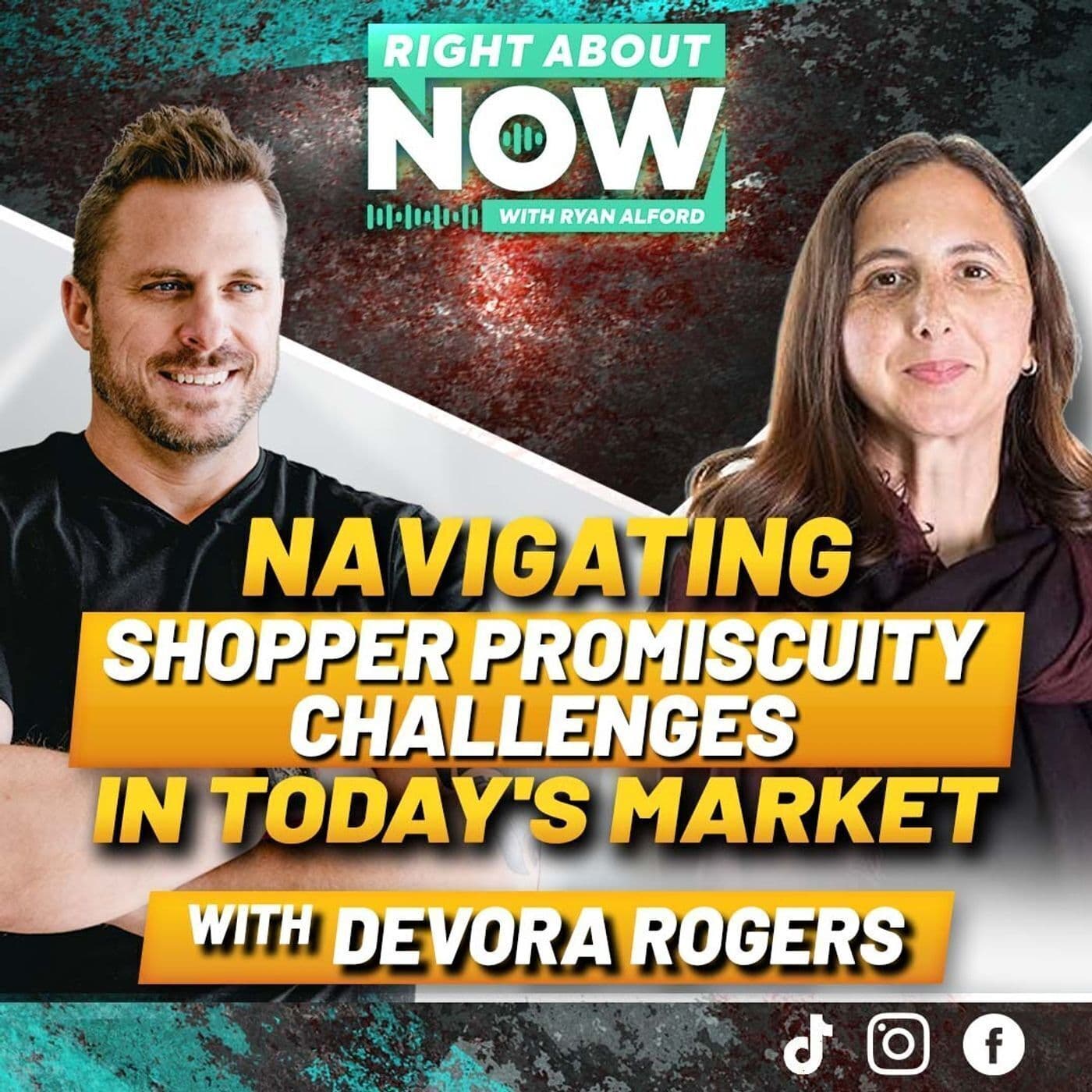
Podcast Episode Notes: Navigating Shopper Promiscuity Challenges in Today's Market with Devora Rogers
Podcast Details
- Title: Right About Now - Legendary Business Advice
- Host: Ryan Alford
- Guest: Devora Rogers, Chief Strategy Officer at Alter Agents
- Description: A deep dive into consumer behavior and marketing strategies, focusing on "shopper promiscuity" and modern research techniques.
Episode Summary In this episode, host Ryan Alford engages with Devora Rogers to explore the complexities of modern consumer behavior and the strategies brands must adopt to stay relevant. They discuss the concept of "shopper promiscuity" and the challenges brands face in maintaining loyalty in a market flooded with options. The conversation highlights the evolution of research methods from traditional focus groups to innovative approaches that include mobile ethnographies. Devora emphasizes the importance of understanding consumer behavior to build effective marketing strategies that balance performance and brand building.
---
Key Concepts and Discussions
Understanding Shopper Promiscuity
- Definition: Shopper promiscuity refers to the tendency of consumers to switch between brands, driven by the vast array of choices available.
- Brand Loyalty Trends: Loyalty decreases as younger generations, particularly Millennials and Gen Z, show reduced commitment to brands compared to Baby Boomers.
Evolution of Research Methods
- Focus Groups: Traditional focus groups are increasingly being replaced by virtual formats and mobile ethnographies, allowing for better participation and insights.
- Real-World Insights: Engaging directly with consumers in their environments provides richer, more relevant insights compared to conventional methods.
Balancing Performance Marketing and Brand Building
- Performance Marketing: Focuses on immediate results and sales but risks sacrificing long-term brand loyalty.
- Brand Building: Essential for awareness and connection with consumers, requiring a nuanced approach that informs them about product benefits and brand values.
Attribution Challenges
- Understanding Impact: Brands struggle with determining which marketing channels are effective. Research methodologies can help identify consumer sources of influence before making purchases.
- Attribution Models: Combining qualitative insights with quantitative data can provide a clearer picture of what drives consumer decisions.
The Role of Podcasts and New Media
- Growing Influence: Podcasts are emerging as a significant avenue for consumer engagement, demonstrating strong influence despite concerns about brand safety.
- Consumer Engagement: Listeners often appreciate advertisement as part of their content experience, making podcasts a valuable marketing channel.
---
Key Takeaways
- Consumer Behavior is Complex: Brands must understand the nuances of consumer preferences and behaviors to tailor their strategies effectively.
- Innovative Research is Crucial: Transitioning to modern research methods can yield more actionable insights that reflect current consumer sentiment.
- Balance is Key: Successful marketing strategies require a balance between driving immediate sales (performance) and fostering long-term relationships (brand building).
- Stay Adaptable: The market is constantly evolving, and brands must be willing to adapt and innovate their approaches.
---
Resources
- Right About Now Newsletter: [Subscribe Here](https://ryanalford.com/newsletter/)
- Podcast Monetization Course: [Free Course](https://bit.ly/4doxmRH)
- Follow on Instagram: [@ryanalford](https://www.instagram.com/ryanalford)
- YouTube Channel: [Right About Now](https://www.youtube.com/@RightAboutNowwithRyanAlford)
Conclusion In this episode, Ryan Alford and Devora Rogers shed light on the intricacies of consumer engagement in today's fast-paced market. They emphasize the need for brands to adapt their marketing strategies to the evolving landscape, leveraging innovative research methodologies and understanding the significance of shopper behavior. The insights provided serve as a valuable resource for marketers looking to enhance their approach and connect more effectively with their audiences.
Written by AI. May contain mistakes. Listen to the episode to check what was said.
Transcript
Automatic transcript. May contain errors.0:28This is the story of the one. Nothing reveals opportunities and challenges in the way that talking to humans does. It just doesn't. We feel that brands have to put in the work and ultimately get answers from real people dealing with real challenges that either your company can or cannot solve. This is Right About Now with Ryan Alford, a Radcast Network production. We are the number one business show on the planet with over 1 million downloads a month. Taking the BS out of business for over 6 years and over 400 episodes. You ready to start snapping next and cashing checks? Well, it starts right about now.
1:12Hey guys, what's up? Welcome to Right About Now. We're always talking about what you need to know now in business. Hey, even life sometimes. I'll give you some life advice. But I'm probably more the marketing and business guy. And that's why I like to bring the best, the brightest, and some of the smartest people in the industry on the show. And sometimes we venture back into the things that I always had my hands in in the agency world. Less today with the podcast network, but definitely keeping a pulse of what's happening in marketing and research and what brands are thinking about. And ultimately, I've got to go to the source.
1:52That's why we got, we've got the research poet. We have the chief strategy officer of Alter Agents. It is Devorah. What's up, Devorah? Hey, how's it going, Ryan? Good to be with you. Yes. Appreciate you coming on. I get to get, I don't always get to get my nerdy marketing hat on, but I kind of want to get it on today. Let's do it. In the beautiful LA, Santa Monica area, correct? Yeah. Yep. Yep. So what is it? Is Alter Agents, I mean, is it look, feel, act like an ad agency? I know you're not involved maybe in the marketing campaigns, but in many ways, is my mind in the right place? Yeah, we're a full service research shop.
2:37So research shops tend to be a little bit different than ad agencies. Our offices aren't as cool. We got rid of our office during the pandemic, which has been great. We're fully remote and the team loves it. and it's given us access to amazing talent all over the U.S. But yeah, we have a little, I came from the ad agency world, so we have a little ad agency in us, you know? Okay. We give off one day a month just because, I feel like that's an ad agency thing. Yeah, exactly. It's also, it brings me flashbacks of focus groups in New York, sitting there talking to people about Test Man and Can You Hear Me Now, which was one of the first campaigns I worked on back in the day for Verizon.
3:17If you worked in New York and you didn't work on Verizon at some point, then, you know, you just didn't like cut your teeth right. But do we still – are focus groups still a thing? I'm going to give you the German answer, which is jaen. Yes and no. Look, if you enjoy traveling and going and having shitty food in a back room while people talk about things for days on end, then you might do focus groups. And some people still do that. But honestly, we have moved to virtual focus groups because you get better respondents. You know, people just don't want to leave their houses right now. So it's like if we do a focus group in L.A., getting people on time in four o 'clock in the afternoon, traffic's bad.
4:03It's really hard. So we do them, but I would say judiciously and more and more we're moving to something we call mobile ethnographies. They've also been called selfnographies, which is really freaking cool. we the agency research we always call it with the best names of shit it's like it just sounds important but it is important and that's why i was so thrilled you know when your your people reached out and it's for our audience it's important for people to kind of know what the sentiment of today is like you know what's motivating shoppers and and consumers uh what how does one learn what's doing those things?
4:50What are the techniques today? What should we listen? And sometimes when I have brilliant people like you on the show, it's like almost what you don't do and what you don't listen to sometimes. Because I feel like the inputs can be so confusing now because the channels are... That's the thing that just blows my mind with you doing what you do. I think about what I did 12 years ago. Then the inputs felt complex, but they worked, you know, now it's just like so many, how do you balance all of it? Yeah. Yeah. No, I mean, I feel like that I have that same feeling that you have when I look at my clients who handle, let's say CPG brand marketing in a space where you've got to compete on Amazon.
5:38You've got to figure out TikTok. You've got, I mean, like to me, that's now brain science. And so we actually literally do brain science to understand because the amount of channels that people can be in, the importance of being offline, online, you know, a mix of both, you know, dealing with private label, like it is rough. And so it's our job to help clients focus on what's really going to matter for them, you know, when they bring something new to market or when they're trying to compete with their competitors. Yeah. And that's the thing that's interesting. I really want to dig under. I've watched these worlds with, I came up in what I feel like was a great mecca of brand marketing.
6:24You know, like the importance of that, of building brand over time and the resonance of that and reaching frequency and all of these things. And then, you know, kind of in my in-between land, the last 10 years of owning an agency, but kind of being on our own planet, you know, and doing podcasting and all that. Performance marketing, the savior of all things came in, right? Which I rolled my eyes a little bit, drove me crazy. I'm like, you know, you can't drive a sale until someone's aware of you. And last time I checked, you have to play that game too. But what's been your perspective the last 10 years?
7:06I want to turn to more specifically some of the nuances that you work in. But I just wanted to pick your brain a little bit as someone that's in it with the consumer. The performance versus brand thing and the last 10 years of, hey, let's just scoop up all of the bottom of the funnel. But have we just completely lost our mind that we still have to build somewhere along the way, the awareness and the consideration. Yeah, I agree. I'll start with the bad news for brands. The bad news for brands is that consumers have more options than ever before. We call it shopper promiscuity. Think about it. I'm married.
7:48I don't know about you, but if I had four amazing suitors outside every single day, standing outside my house being like, you know what though? I'm pretty great. Like I'm an amazing chef. Like I'm really, you know, I'm really good in bed. Like, like it'd be hard to stay loyal. Don't let's just be honest. Right. And that's what brands are facing. There are consumers have so, so many choices. They could go anywhere. They could at any time of day. Um, and so that access that, uh, that the choice that they have creates this promiscuity. And so the difficult news is that brands continue to be brands and what brands often do as brands, both in marketing and in research, is they do something we call brand narcissism.
8:32And a lot of research is built on this idea that if you just track people's relationship to your brand, then you'll know enough and then you'll know what to do. It's called brand tracking. It underpins all of research and marketing. And many people hate it, including the people that use it because, you know, things don't shift that much. It's hard to really make sense out of it doesn't and and again it's it's narcissistic it's like do you i mean imagine imagine ryan if you and i went out let's just say for like a little friend hang yeah and the whole time i was like hey ryan what do you think what do you think about my hair what do you think about my cashmere sweater what do you what do you think about my friends did you look at my friends do you think that they're am i more innovative than my friend you'd be like get out of here you wouldn't want to talk to me and that's what brands do with their precious research So we have really drawn a line in the sand.
9:26Our CEO, Rebecca Brooks wrote in our, in our book, Shopper Promiscuity. Sorry, we didn't end up getting to name it that because we had a British editor and they didn't want the word promiscuity in there. I know it's too bad. It ended up being influencing shopper behavior. The original name was Shopper Promiscuity. I know the Brits, sorry. She was like, Oh, let's not, we can't. But in, in, in a chapter in that book, She wrote what I call her Jerry Maguire letter, basically, to the research and marketing industry saying, we're missing the boat here. Like brand tracking isn't delivering the answers that you want.
10:01And to add to that, insult to injury, and then I'll tell you the good part. The challenge is that when we survey shoppers by generation, brand loyalty basically stair steps down. So if you're a boomer, then you're pretty likely to keep buying, let's say 60 % of boomers are going to keep buying products that they've been buying. By the time you get to millennials and Gen Z, it's like 17 % of them express that same brand loyalty. So that's the bad news. Yikes. But I would agree with you that performance marketing has shown us that the answer is not just the race to the bottom. Yeah, you can get people to buy things if you do enough coupons and promotions and whatever.
10:52Way of a buy one, give one free. Yeah, you can. But you may not have a lasting voice or presence in the space that ultimately means that brands still do have to do the hard work. What's interesting, though, I think, and I think where the opportunity for brands is, is that brands have this idea that it's either all or nothing. I'm going to put my brand out there, show you my brand logo again and again and again. I'm going to have my, my, you know, billboards up that you won't even know what my website is or what I'm selling. I get so mad at those. I love those. They think they're like fooling somebody.
11:28Like, like they think they could do something like, cause we're just so wrecking. It's just so distinguished, you know, that it will, people will get there. I get mad. I like, my husband has to listen to me for 20 minutes being like, who did that? He's like, okay, the ivory tower of the creative department. Right. Or they say, okay, so either we're going to go the all in, it's just our brand name, brand recognition, build brand, or we're going to go all the way to the bottom and give you all these little details. But actually the center space is where we really see the opportunity for brands. Tell them about your products and what they do and why they're better and why people should believe in you as a brand.
12:11So essentially what we've seen is consumers and shoppers becoming really, really smart. And every piece of research that we've done over the last decade shows that people consume more information than ever before about everything, but also all of their purchases. Hmm. So more sources than ever before, more knowledge than ever before. And I'm going to put, I think, implied words in your mouth. They know they're being marketed to. 100 right and they're okay with it too like that's the thing too is that brands don't have to pretend like they're not we've actually seen an increase in people accepting advertisement as a useful source of information they get the exchange yeah but do better tell me more i have a one of the few people i would call mentor christopher lockhead uh in marketing i don't if you know Chris.
13:14He's a category pirates is his brand. He doesn't believe in brands. He just believes in category creation to where you carve out exactly what you are. You market the problem and you become the solution. I think that's a little bit of what you're saying with telling people about what you are. I agree with about 75 % of it. I choose to believe that brand isn't dead. Yeah, I would agree with you. You know, at the end of the day, people are the way our brains work, right? So we, we, we do neuroscience, right? And I don't know if you know this, but it turns out half the reason we like our spouses is because we see their face every day.
14:00Familiarity. It's, it's a, it's a brain thing. So the next time you get in a fight with your spouse, just be like, am I with you just because I see you every day or And that's the same for like, so for brands, right? So brands, you wouldn't want to give that up. Yeah. Yeah. It's, it's a name. It's a, it's a logo. Your brain recognizes it's a logo or, or a, um, a service that you associate with something good. So if that goes away, it, I do think it makes it harder for consumers. They'd have to do more work. It's not to say you couldn't. And I do think category matters a lot. And if everybody could do what he's suggesting can be done, cool.
14:45But I don't know that everybody has that benefit. I know. That's always my argument, too. I'm like, not everybody's going to be the category king. You know, like even if they want to, they don't have. There's a lot of money. And I think, you know, Chris devised the line, well, you know, because he gets to work with the companies that he chooses to, to help them carve out the category when they've decided they want to do that. but there's a lot of money to be made as the uh you know second person second best in the category and no i know as somebody that's very competitive that doesn't like to play for second in much of anything uh but at the same time i do like to be successful and there's not all it's first isn't always the goal second i'll play for second yeah honestly like i'm pretty competitive that's pretty get a second right or even like five percent like you yeah being top five percent pays the bills yeah so exactly but the brand thing is interesting the familiarity and i just always think and you talk about in a lot of your studies and like a lot of the writings i've read from you it's just like that and the promiscuity is like the biggest thing is like does it matter its single moment of truth you know if that performance bug comes in and i'm going to the yeah i'm keeping it simple here like the store but whether it's a luxury thing or not luxury is a whole other category i mean a whole other thing but you go in and i buy arm and ham a toothpaste but if there is a half price deal on colgate and that's a flavor thing So I'm probably going down a whole nother road, but I think, you know, where I'm headed with this.
16:25It's like, am I cheating? You know, like, well, I mean, think about all the places in our lives where we make left turns. Yeah. You know? Yeah, it depends. Right. It depends. Mustard is a category that I like talking about. Ah, yes. It's good. And the reason I like talking about mustard is that there are people that don't care at all. They're like, I just give me the gravy pond or give me the cheapest that I don't care. Is it mustard? Fine. Right. My father-in-law is like that. Doesn't care. You know, maybe if there's like a flavor, he might splurge, but otherwise it's just like yellow mustard is sufficient.
17:03And then there are mustard aficionados like, you know, mustard sommeliers, you know, and they're going to know every little thing. They're going to do little tastings. Right. Right. So there are in every category mustard aficionados. You you may not be an aficionado in one category in your life, but randomly in another you might be. And even among people who consistently choose value over. I'm somebody that chooses like I'm like, oh, is there a more expensive price that I can pay? I'll do that. You know, it's great. You are that person, right? Do you want to charge me more? Do you want to charge me more, please?
17:48Yeah, please do. But there are people that are the opposite who are, and it doesn't matter if they're wealthy or not, right? That they're going to consistently choose the value option. Yeah. We tend to leave out a lot of the people that are choosing the value option in our research because they tend to not be very interesting. But I guarantee you, whoever they are, one thing in their life, most likely, unless they're just like a total weirdo. They have something that they really want to be higher quality premium. And for that, they're willing to do the research. They're willing to do the looking and they might be harder or easier to move.
18:22So that's the other thing is that this promiscuity means that there are a whole group of people who are just promiscuous and they might be amazing to initially grow your brand. Cause like, let's say they become obsessed with, I don't know, let's say like, I feel like there was, you know, like an underwear, a direct to consumer underwear brand, right? Like me undies or whatever. And people become obsessed early on and they're, they're like the look, they're the explorers. They're the ones finding new things. They're evangelizing and they are the ones that you can lose very easily. So you kind of have to know at every stage of building your business.
18:55And cause you, the idea that you could just have loyal people that'll stay with you and that's everyone is just no longer true. So you have to sort of plan for, okay, I'm going to have these people that are going to come in. They might help me build my brand early on, But then they're going to defect because that's what they do. And then I've got to get the other people, you know, to to to fill up the back. Right. So that we don't completely lose when the explorers and promiscuous folks go away. you you have a lot of job security because you know why you know what i just heard devora is and it's very true it the the it depends word is it it's so unique to every different brand and every different category and i know this instinctively but i almost forget it too because think we all like to paint with broad brushes and make statements like TV is dead or Facebook is dead.
19:51You know, I've been hearing Facebook's been written those trends. I've written those trends reports, by the way. But the answer to the truth is, but it depends because depending on your product and depending on the category, the categories of consumers that buy that product, They can be very promiscuous in one, but brand loyal in another. Listen, years ago, I did a call with someone who was very senior at the milk board. OK, the call went very poorly. She had seen the work that we did with Google, the zero moment of truth work. And she's like, I want that. But I don't believe that people are doing a lot of different searching and researching and sources using a lot of different sources for milk.
20:34Milk is an everyday household item. Nobody. And I tried to convince her on the call. I was like, listen, I know you think that. And for a lot of people it is. But even if for 15, 20 % of people, it starts to shift. What's that going to look like? She didn't believe me. The call went poor. I didn't win. Didn't win. Never heard from her again. It was like really a bad call. Look at where we are now. Go into the milk aisle and tell me that that wasn't completely disrupted. There is pea milk. Yes. There is goat milk. My doctor, my child's doctor told me to get camel milk at one point. Oh, my God. Okay.
21:16Yeah. Yeah. So. A lot of inputs. We're in a different world. And anyone who thinks that a category is never going to shift or be disrupted is in for some surprises. And once it does, you either are ready or you lose your share. Yeah. And that's why you got to get underneath it, like to know within your own product and your own category, what the mindset, what are the media, what are the mind thought process, what are the problems that you're solving or not solving? and it's hard it's frustrating because we want and we've been chasing especially which is before i want to go next door is attribution ultimately that's right you know like the old pepsi saying or i forget who says it you know i know that 50 of my marketing works great i just don't know what 50 and we've been chasing that attribution game but there you and how do you where do you fall them that?
22:22Like, cause again, you know, I get, you know, the hand raisers on Google, SEO is important. They're searching for you and it gets a lot of credit, but did my friend down the street were all good old fashioned word of mouth, put it in my brain. And so who gets credit and how do I know what to do more of? Yeah. Well, you know, there were folks who built, you know, these tech stacks and they said, we'll just, we'll be able to answer it all and we'll know everything. You know, it didn't really play out that way. And certainly now some of the changes that have occurred in tech and, you know, some of the questions calling into, you know, a question, you know, whether cookies are, you know, privacy, all kinds of different things, I think has shown us that there isn't an easy fix for attribution.
23:18There's no special key that just unlocks it permanently. You have to do the work and you have to do the work among humans. Now, working in research, we have, I don't want to call them colleagues, but we have people who are trying to use synthetic respondents, which by the way, that means not a real human, in case anybody didn't know. Artificial. Artificial, not real, fake, to essentially answer research surveys. And I look at that and I go, why would you do that? You could use big data to do that. You could use any number of things. Nothing, nothing reveals opportunities and challenges in the way that talking to humans does.
24:05It just doesn't. And so I think that attribution is worthwhile. And certainly, if you're doing a lot of media spend, you've got to do it. But we feel that brands have to put in the work and ultimately get answers from real people dealing with real challenges that either your company can or cannot solve. How to small brands, you know, I know that the techniques and online have probably brought the scale. I mean, I just remember what it costs. You know, I haven't been in a focus group in 12 years, but like it was, it's expensive, you know, like research and stuff. So, but how to, I mean, I guess the online equations probably made it more attainable, but it has.
24:55Yeah. Yeah. So a couple, a couple of thoughts on that. So my mentor, you mentioned yours, my mentor was a guy named John Ross, who was, had been the CMO at Home Depot and he oversaw Home Depot's growth, you know, the biggest growth, um, you know, of its development. Right. Um, and I learned a lot from him around how I think about research and retail and shopping. We wrote a book together, um, called fire in the zoo, which is all about the difficulty of selling at retail and, um, and all that kind of stuff. And, you know, he used to do, so they had, you know, every imagine, you know, they had Deloitte, they had all every consultant in the world was working for Home Depot at the time.
25:36Every single one, they had any amount of data or research they wanted. And guess what, as the CMO, he felt like he still didn't know why people were making choices. And so he would go down and, you know, put on an apron, stand in the paint aisle, and he would ask people a series of very, very simple questions. What made you decide to come in today? Where'd you go for information? What of that information was most influential? What of that information specifically, was it price? Was it what we told you about the product? Had you ultimately decided that you wanted to come in and make a purchase?
26:13And he would go do those conversations. And, you know, small business owners can do that. Yeah. You don't need a research agency to do that. So if you're really on the no budget side, I would say small business owners need to at least be having those conversations. They won't be at scale. And you got to be aware of that. Did you tell him to take it with a grain of salt what he learned in those conversations? Or do you think they were meaningful? We turned it into a quantitative methodology. Okay. Yeah. And today clients do that methodology at scale when they're trying to figure out where is everyone going for information?
26:48Where should I be? I don't have billions of dollars. I have to choose between TikTok and Google or podcasts and, you know, Google search. What should I do? So, you know, and then now you can do these self-nographies. We use a company called D-Scout, which I'll give them a shout out. I think they've built something really cool. There's another one called Recollective. And, you know, for a relatively small sum,$20 ,000,$30 ,000, you can send out real people into the real world and find out how they're responding to your product or service or stores. And, you know, OK, 30 people, that's not the same as a thousand.
27:30But you know what? If you work in research, the truth is after about 12 or 18, you start hearing a lot of the same things. Yeah, I remember that. Is a random question. You're doing a lot of research, different clients, different things. And I'm sitting here saying we can't paint with a broad brush, but I'm going to ask you a broad brush question. Mm hmm. What's a medium or a tactic or something that might surprise people listening that is popping up over and over again in the influence or magnitude that it has? Is there something? As a marketing tactic. Yeah, just marketing, you know, maybe it's a channel.
28:18And I mean, so what might it be? I mean, honestly, podcasts are pretty amazing. We've been tracking podcasts for 15 years. And for a long time, it was like they were down there with the dust bunnies. Nobody used them. They weren't driving influence. And now we see that they are widely used, I would say, by about 30 % to 40 % of the population. So there's people that don't use them. Fine. But, you know, there's a decent audience that is really listening and really attuned and they really love the hosts. And so that can be a very powerful channel for brands. And a lot of brands have worried that podcasts are not brand safe because you can't control everything that happens.
29:03But consumers tell us that they do not penalize brands if something I mean, it's different if it's like a bigoted show. But if it's just like bad language, consumers don't care. It hasn't hurt our numbers and I have a potty mouth. Yeah, same, especially on Fridays. Oh, talking with Devorah. She is the research poet. Devorah, back to this attribution game, who does get the credit? I mean, like, how do we answer that what 50 % is working or not working? Yeah. Yeah. I mean, I think there's some really great, you know, speaking about podcasts, right? There's a lot of podcasters that use codes and that kind of thing that gives you an opportunity to know what's working.
29:49We're seeing creators do that. Creators are certainly having a moment. I'm a little bit worried about creators with the growth of AI because I worry that it could kind of turn things into slop. And that's not going to be good for consumers or brands, but that's an aside. I think you have to live with some level of uncertainty. You're never going to know everything. You just never will. But you can find out a lot. Let's say you're, you know, throwing money at TV and radio and podcasts and 10 other things. We do a study where we then ask people, what sources did you use before making a purchase?
30:28And we only talk to people who actually made the purchase. So these aren't intenders. These aren't random consumers. They actually bought the thing that our brand is selling. And if we see that TV is just really low, not a lot of people are using it, but it's really influential, we take note. Or like another one that we see a lot, like people kind of make fun of catalogs. Do you know catalogs are like actually not so bad? Not a lot of people use them, but the people that do, they buy shit. Really influential. So we're looking at things through the lens of how many people are using it. And we can find that out through research and how influential is it.
Read the full transcript
31:07And we can find that out through research. And then like we can hook that together with other attribution models to say, you know what, let's plus up the catalogs or the TV isn't showing up in some of our other stuff. But let's plus it up because consumers, a thousand of them, 80 percent are saying it worked. And that's what it's just applying the percentage of the scale. Like, right. And so then it's like, okay, we know that this has impact at some level, which research that you could help them with would, would tell. And some portion of that makes up, I don't know, a hundred percent of the impact in our 90%.
31:42It's probably always that ambiguous 10 % that we don't know. Cousin Eddie that told him about it or influenced them in the projection. And Cousin Eddie, you know, people like to write that off. Cousin Eddie matters. If Cousin Eddie bought from you and demonstrated any aspect of being an evangelist or somebody who's really excited about the product, give Cousin Eddie some codes. Do you know? Give him some ways to get other people on board. Cousin Eddie is great. We'll take him. What's the biggest problem you've solved? like and like when you think about it every client's your baby i know so we don't have to call but you know let's divorce is a big deal i'm telling the audience this and so she's worked with a lot of big brands um she's smart as hell i want her to to brag a little bit but also to you know the types of problems that you've solved and the scale and maybe what your research drove as a change.
32:50Yeah. Oh gosh, it is. It's like choosing among my children or my favorite poems. It's really tough, Ryan. Um, but the one that's been most enduring and I think for me is, is a really good, um, B2B case study that, that brands can continue to, to learn from is, uh, about in 2012, um, Google came to us. I was working at the time at the IPG, uh, media lab and, And Google was having trouble convincing brands that people would buy things online. It's hard to believe that was like 13 years ago. 13 years ago, clients did not believe people would buy things online. Okay, so let's just how quickly things have moved.
33:35And, you know, Google, who's, you know, however many trillion dollar company right now, you know, I don't think that most of their sales guys are making decks anymore, slide decks that they have to, like, you know, get themselves a meeting. the client. Like people are like, yeah, generally Google delivers results. But at that time, the sales guys had to go in, they had to look sharp, they had to have nice shoes, and they had to go in in person. And they had to say, you know, we have this offering called search. And we're starting to see that people are interested in buying things online. And they're doing research.
34:09And even if they don't buy it online, attribution, they appear to be looking And we think that they are then buying it later elsewhere. And clients are like, nah, what are you talking about? Nobody's going to buy laundry detergent online. They're just not going to do it. Well, our research proved that they were. And it became a study that was called ZMOT. And it went global. People started for a while were hiring directors of ZMOT. And they turned it into a case study, a major thought leadership initiative. And what that taught me is, first of all, never be too certain about what the future looks like.
34:49Because if, you know, 12 years ago, people were like, nobody's going to buy laundry detergent online. Look where we are. I mean, I haven't bought laundry detergent in a store, in a store myself. Pick it up off the shelf. I don't, why would I do that? It's heavy. It's pain in the ass. Why would I go in there? Right. So it taught me to be humble about what the future holds. And also that if you, whether you're a big company or a midsize company, you've got to do the work to show up with the thought leadership, the data that says, here's what we're seeing. Will you take, will you take a risk on me?
35:26And then if it works, turn it into a massive thought leadership thing that you take around and give out. And I speak a lot about thought leadership. And I think that brands are wise to do the research and then where they can figure out how to tell that story publicly in a way that makes them look great. How much of the zero moment of truth, that's what we're talking about with ZMOT. And if you go Google that, if you have it, it's a big one of the most widely read research studies of all time. How much of that still is in play? A lot. Feels like it. A lot because so we've been doing it for 12, 13 years and we have norms and stuff.
36:12Right. So we have watched the fortunes rise and fall of various media types. You know, like we saw where radio was increasing and then falling and going over to streaming and then, you know, newspaper, you know, that have watched that decline, have watched podcasting grow. And we have about 50 sources that we've been tracking since that time, whether they're increasing, decreasing, you know, growing influence, that kind of thing. And what has happened is just that consumers are using more information than ever before. There are categories where they might use less. Fine. But on the whole, if they're going to go buy an expensive workout machine or plan a trip to Italy, they're going to they're going to spend a lot of time because now here's the thing is that now searching and being online as you research is like a form of entertainment.
37:07it. It's just an activity. You could listen to a podcast, you could read a book, or you could plan your next purchase that you get excited about. Depending how research-oriented you are or neurotic, you might read hundreds of minutes of things. Did I answer your question? You did. You did. It made me think when you're saying that, I tell people all the time that TV and all the radio because I don't know that people aren't watching it, but their head's down on their phone. So they're hearing ambient the messages that are there. So it has an impact. Well, and to that point, a lot of, you know, we talked about attribution.
37:47Attention's another one that has been a real topic of interest, right? So everyone said, okay, fine, fine, fine. We don't know all the attribution answers, but we're going to figure out attention. We're going to see where they're looking. And so they did a whole bunch of stuff with eye tracking and are they looking, whatever. Well, it turns out that you can be attending something without looking at it. You can be attending something and looking at it and your brain can still be thinking about something else entirely. And that does brands no good. And so what we want to look at is how emotionally engaged are folks.
38:20And so we do that through using Scosche devices or essentially like Apple watches, sport watches. And we can tell somebody's heart rate variability that tells us their oxytocin is spiking in their body and sending them signals that makes them more likely to do something in the future. And I think that's incredibly powerful. That is powerful. I was just thinking we're doing a little segment on sports trading cards because they're so huge in our news segment. And I've been opening packs on the episode. I think about what's going through my head. It's like legal gambling. You know, you're looking, opening.
38:57I bet your immersion, that's the, that's the measure. I bet it's through the roof. It's usually on a scale of zero to a hundred and anything over 50 starts to get our attention. Yeah. You're probably, I mean, cause money's on the line, your emotions are on the line. I would love, you can download the app. It's called, um, immersion, uh, Tuesday. Uh, they, and they have another consumer one too. And you could just track and see what's the number that your brain, which puts your brain on, on sports cards. Yeah. And my kids, I've gotten into it, back into it because my four boys and they're all into it.
39:34So I'm teaching them business through this lens. You know, they didn't care about anything I did. So I'm going to, I'm creating, helping them create a business out of it. I love it. My daughter sometimes does that for me. She'll put on like a fake little focus group and she's only 10, but she's been, and she knows, and she always serves snacks. So that's like, okay. She knows what she's doing. Last thing before I let you go, Devorah. I mean, all this has me kind of in this mind of the, the is the purchase funnel dad. I mean, we have the purchase funnel on the purchase cycle, like whatever you want to call it.
40:13It's still there. Right. I mean, you still have to get awareness and then intent and consideration and like in some way, shape or fashion, even if it's always moving. I'm very ornery about the purchase cycle. I got to tell you. And the reason I'm ornery is because yeah, it still exists. You still have to get from A to B to C to D, but it doesn't happen in this neat, tidy little order. So when we do path to purchase studies and we do quite a number of them. I have to, I try to break it to clients. I'm like, I'm not going to give you your nice little neat little thing. And oftentimes they're like, but I want the, I want the, I want the graphic that shows the one thing to the next.
40:54So, you know, sometimes I give in and I'll give them their little path to purchase, purchase funnel. But what you have to know is that whole huge other things, galaxies of things are happening outside of that. And so the way that we like to kind of envision it is almost like as if there's a room full of balloons. And that is everyone's sort of attention and engagement. And some of those balloons rise and fall. Some of them are bigger, some of them. And that's kind of how I like to think about it rather than like a neat little tidy thing, because our research shows that less than 5 % and it's actually less than 1 % ever do things in the same order in the same way.
41:33It's just, there's too many things. there's trillions of combinations. I like that crystallized something for me, thinking about the influence. A certain stage or a certain tactic might be considered a consideration tactic, but its influence might be greater depending on the person. Am I hearing that right? Yeah, absolutely.
42:00Devorah, you're a smart lady. Thank you. Thank you. It's been fun to be with you. Hey, it's fun. Fire in the zoo. Influencing shopper decisions and her TEDx's are blowing up. You got to go check them out. She's smart. She's teaching brands what they need to do and more importantly, what not to do. But it's complex at the end of the day. That's what I think we need to take away. But it's unique. It's attainable to know, but you have to kind of clear your mind. I have to even do this myself. I consider myself a bastion of willingness to change, but it's just there's a lot of complexity, a lot of different influence, but it doesn't have to be overwhelming.
42:40And I feel like that's what you crystallize today, either with your brilliance or just at least crystallizing it in my head. So I really appreciate it, Devorah. Thanks so much, Ryan. Great to be here. where can everybody keep up with you what you're doing books etc yeah we've got a sub stack uh alter agents uh you can find us on sub stack uh that's kind of where we're writing right now we shared a little bit about um what it was like because we're here in los angeles after the fires and uh you know we're not super consistent but there's a fair bit on there and actually there's some really great research we did in august and then repeated in after the inauguration on consumer sentiment.
43:20And so I'll just leave you with a quarter of Americans are like insanely depressed and down in the dumps right now. And so not a super happy topic, but I think very interesting to look at in terms of sentiment right now. And it did not change. It just flipped a little bit. Conservatives are a little happier now and liberals are a little less happy, but essentially the same number of people are pretty, pretty darn sad. Hmm. That's not positive, but, but, but we need to be aware of it. You know, you can't put your head in the sand. And I think brands and companies can go a long way by avoiding the divisiveness and maybe just being a little more positive.
44:04Yeah. I mean, and we actually give some recommendations for that. It's like, yeah, maybe do, you know, visuals and maybe partner with, you know, brand with, um, publications that are a little more positive, maybe host a 5k or a puppy adoption thing. I don't know. Yeah. Well, people do love dogs and their animals or their, whatever they are. If I was a brand with money to spend, I'd be hosting puppy parties right now. Ah, I like it. Okay. Puppy parties it is. Puppy parties for the win. Devorah, thank you so much for coming on. Thanks so much. Take care. Hey, guys, you know where to find us, RyanIsRight.com.
44:40You'll find highlight clips, all of the episodes and our YouTube links. And of course, where to find our guests, her amazing books and information on everything that they're up to. We appreciate you for making us number one. We'll see you next time on Right About Now. this has been right about now with ryan alford a radcast network production visit ryanisright.com for full audio and video versions of the show or to inquire about sponsorship opportunities thanks for listening
From the publisher
Join media personality and marketing expert Ryan Alford as he dives into dynamic conversations with top entrepreneurs, marketers, and influencers. "Right About Now" brings you actionable insights on business, marketing, and personal branding, helping you stay ahead in today's fast-paced digital world. Whether it's exploring how character and charisma can make millions or unveiling the strategies behind viral success, Ryan delivers a fresh perspective with every episode. Perfect for anyone looking to elevate their business game and unlock their full potential.
Resources:
Right About Now Newsletter
Free Podcast Monetization Course
Subscribe To Our Youtube Channel
Vibe Science Media
In this episode of Right About Now, host Ryan Alford sits down with Devora Rogers, Chief Strategy Officer at Alter Agents, to explore the ever-evolving world of marketing and consumer behavior. They dive into the challenges brands face in truly understanding their audiences, the transition from traditional focus groups to cutting-edge research methods, and the delicate balance between performance marketing and brand building. Devora introduces the concept of shopper promiscuity, explains how familiarity drives brand loyalty, and examines the rising influence of podcasts in shaping consumer decisions. This insightful conversation highlights the urgency for brands to adapt to shifting consumer preferences and craft compelling value propositions in a competitive marketplace.
TAKEAWAYS- Understanding the significance of consumer behavior in marketing.
- The concept of "shopper promiscuity" and its impact on brand loyalty.
- The transition from traditional focus groups to modern research methods, including virtual formats and mobile ethnographies.
- The tension between performance marketing and brand building, and the need for long-term consumer relationships.
- The complexity of modern marketing strategies across various channels.
- The role of familiarity in fostering brand loyalty among consumers.
- The challenges of attribution in marketing and the difficulty in determining effective channels.
- The importance of engaging with real consumers for genuine insights.
- The potential of podcasts as a growing marketing channel.
- The necessity for brands to adapt to changing consumer preferences and market dynamics.
If you enjoyed this episode and want to learn more, join Ryan’s newsletter https://ryanalford.com/newsletter/ to get Ferrari level advice daily for FREE.
Learn how to build a 7 figure business from your personal brand by signing up for a FREE introduction to personal branding https://ryanalford.com/personalbranding.
Learn more by visiting our website at www.ryanisright.com
Subscribe to our YouTube channel www.youtube.com/@RightAboutNowwithRyanAlford.
See Privacy Policy at https://art19.com/privacy and California Privacy Notice at https://art19.com/privacy#do-not-sell-my-info.