In short
Right About Now - Legendary Business Advice
Episode Title
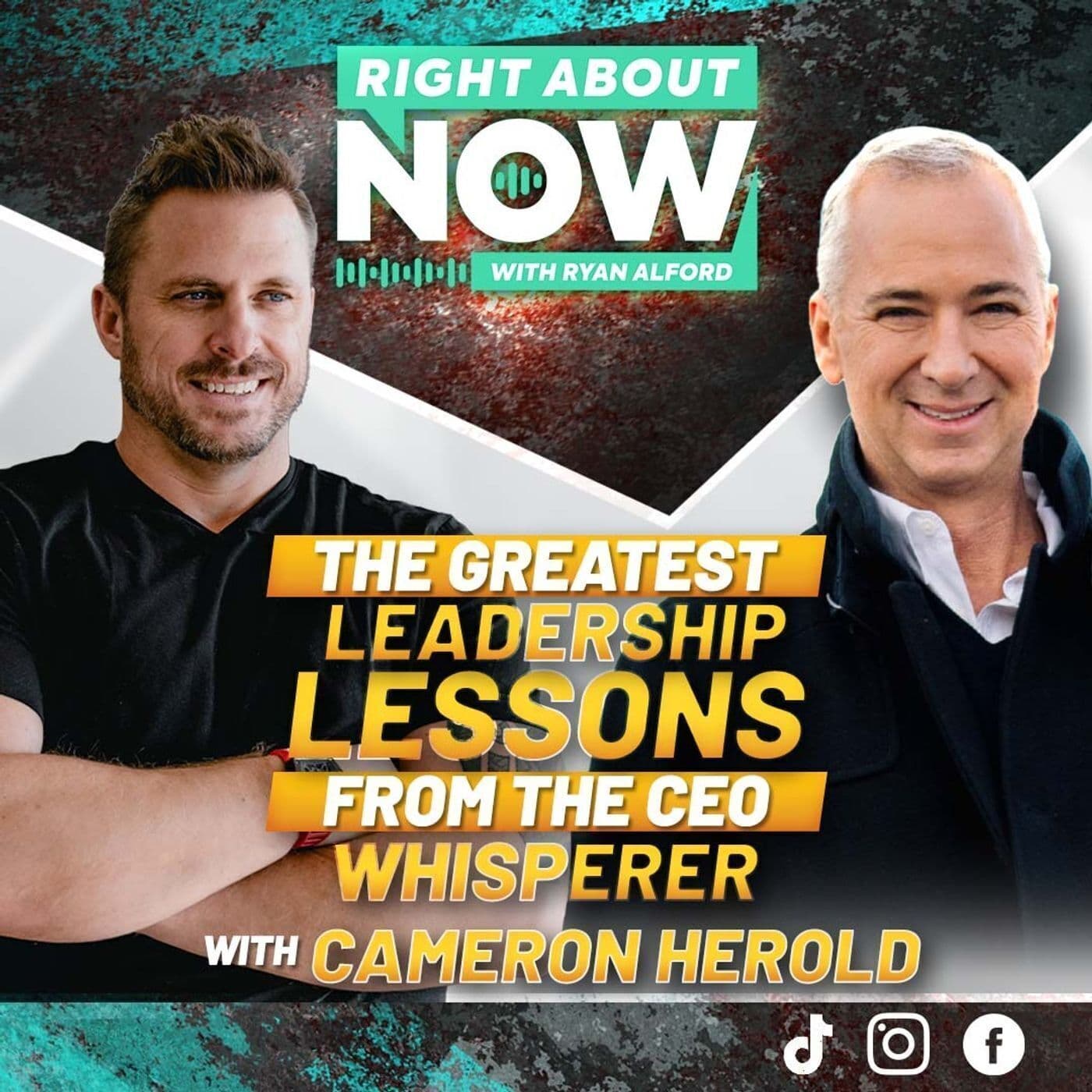
The Greatest Leadership Lessons from the CEO Whisperer
Episode Overview In this episode, host Ryan Alford interviews Cameron Herold, known as the "CEO Whisperer." The discussion centers around leadership dynamics, particularly between CEOs and their second-in-commands (COOs). Cameron shares his wealth of experience in coaching leaders and emphasizes the balance between visionary leadership and effective execution. The episode also covers the creation of the CEO Alliance, a network for COOs, and offers practical advice on fostering a positive company culture and maintaining work-life balance.
---
Key Takeaways
- Leadership Dynamics
- The importance of the relationship between CEOs and their second-in-commands.
- Essential qualities for successful leadership, including humility, delegation, and self-awareness.
- CEO Alliance
- Introduction to this network dedicated to supporting second-in-commands.
- Provides resources for personal development and leadership growth.
- Company Culture
- Strategies for fostering a growth-oriented culture within organizations.
- The role of strong company values in shaping a positive workplace.
- Work-Life Balance
- The significance of maintaining a healthy balance to enhance leadership effectiveness.
- Practical Leadership Advice
- Insights for aspiring leaders on delegation and team development.
- The necessity of investing in leadership training and employee development.
---
Detailed Summary
Opening Remarks
- Ryan Alford introduces the podcast, emphasizing its focus on practical and uncensored business insights.
- Cameron Herold introduces himself, sharing his journey and lifestyle changes, including pursuing bucket list experiences.
Becoming the CEO Whisperer
- Cameron discusses how he earned the title "CEO Whisperer," mainly through coaching and advising various CEOs, including high-profile clients like Sprint.
- Emphasizes the balance between visionary goals and operational execution, quoting Thomas Edison: "Vision without execution is hallucination."
The Importance of Second-in-Command
- Cameron highlights the critical role of COOs in executing the vision set by CEOs.
- Effective partnerships between CEOs and their second-in-commands are essential for company success.
The CEO Alliance
- Cameron explains the purpose of the CEO Alliance, a network designed for COOs to connect and grow.
- Acknowledges the lack of resources for second-in-commands compared to entrepreneurs.
Characteristics of Successful CEOs
- Successful CEOs often possess humility and a willingness to delegate.
- They need to focus on vision and strategy while allowing their COO to manage day-to-day operations.
Cultivating Company Culture
- Cameron details four key elements that contribute to a thriving company culture:
- Core Values: Companies should have well-defined values that guide behavior and decisions.
- Core Purpose: The “why” behind a company’s existence.
- BHAG (Big Hairy Audacious Goal): Long-term ambitious goals that drive the organization.
- People Systems: Effective recruitment, onboarding, and leadership development processes.
Work-Life Balance and Personal Growth
- Cameron discusses the importance of personal well-being and balance as a leader.
- Encourages leaders to prioritize hobbies and family time.
Lessons from Failure
- Shares a personal story about nearly bankrupting 1-800-GOT-JUNK due to ignoring financial warnings.
- Emphasizes the importance of listening to team members and being receptive to feedback.
Closing Thoughts
- Cameron encourages leaders to focus on growing their teams and to maintain a mindset of learning and development.
- Stresses the importance of empathy and understanding in leadership.
---
Notable Quotes
- “Our job as leaders is to grow people, their skills, their confidence, and their connections.”
- “You need both visionary and operational roles for success.”
- “Culture comes from alignment with core values, core purpose, BHAG, and effective people systems.”
---
Timestamps
- Role of Leaders (00:00:00)
- Introduction to Podcast (00:00:11)
- Cameron Herold Introduction (00:00:33)
- Vision vs. Execution (00:03:39)
- CEO Alliance Introduction (00:06:29)
- Creating a Growth Budget (00:19:52)
- Importance of Work-Life Balance (00:21:45)
- Building a Strong Company Culture (00:26:42)
- Learning from Failure (00:29:51)
---
Resources
- Cameron Herold's Website: [CameronHerold.com](https://cameronherold.com)
- CEO Alliance: [COOAlliance.com](https://cooalliance.com)
- Invest in Your Leaders Course: [InvestInYourLeaders.com](https://investinyourleaders.com)
For more insights and detailed discussions, subscribe to the podcast and follow the platforms mentioned in the episode.
Written by AI. May contain mistakes. Listen to the episode to check what was said.
Transcript
Automatic transcript. May contain errors.0:00Our job as leaders, whether we're managers, directors, VPs, or C-level, is to grow people, to grow their skills, to grow their confidence, to grow their connections, very similar to being a parent. This is Right About Now with Ryan Alford, a Radcast Network production. We are the number one business show on the planet with over 1 million downloads a month. Taking the BS out of business for over 6 years and over 400 episodes. You ready to start snapping necks and cashing checks? Well, it starts right about now. Hello and welcome to Right About Now. You know, I don't whisper much myself. My voice kind of booms and carries, but we have a whisperer today of a different kind.
0:46He is the CEO whisperer. He is Cameron Harreld. What's up, Cameron? Hey, Ryan. Good to see you. Appreciate you coming on. I know you are a busy man and, hey, a world traveler. So where are we today, Cameron? Today we're in Kelowna, British Columbia. We've got a bunch of friends that live up here. So my wife and I decided that we would spend some time up in this part of the world. And so, yeah, we're in Kelowna. We'll be here for a month. But we've been in 54 countries in the last 36 months. Jeez. It's really global. That is, hey, is that a bucket list thing? Pardon me? Is it bucket list? Yeah, we're calling it our bucket list dream life.
1:25So we both wrote our bucket list three years ago. We each put 150 things on them. And we're just chasing them down. So, yeah, every week or two we do another big bucket list item, sometimes with friends, sometimes on our own. and often in just different parts of the world. We sold our homes, sold our cars, sold our furniture. I have three long-sleeved shirts. I can tell you my entire wardrobe now. Down to the item. You know, I actually like that. I'll say this. I'm wearing pink today, which is actually – I'm usually black. I'm kind of like Steve Jobs, but, I mean, I don't know. I black T-shirt every day.
1:56I have three black lily lemon, three gray, and three white, all the same type, and I just recycle those every four to five months. Two pair of shorts. Pretty crazy. So what makes you the CEO whisperer, Cameron? I was given that moniker by the publisher of Forbes magazine. So Rich Cargaard has been the publisher of the physical print of Forbes and online for about 20 years now. He has seen me speak about four or five times and gave me the nickname the CEO whisperer because I'm often behind the scenes talking to CEOs of these kind of 50 to 500 person companies. And I've worked behind the scenes with CEOs in 28 countries now, I'm including at the highest level.
2:36I coach the CEO in the second in command of Sprint. I coached a monarchy. They own the country of Qatar. So I coached the royal family on running their groups of companies. So I've always worked behind the scenes teaching the CEO what has to happen and then often working with their COO on how to make it happen. The Sprint name rings a bell to me. I worked on wireless in the ad agency business for about 15 years, launching multiple phones. You know, we kicked Sprint's ass for quite a bit. I was on Verizon Wireless. Yeah, it was Marcelo Claret was the CEO that I coached, and then Jamie Jones was his second in command.
3:13Oh, wow. That throws me back for sure. I mean, I think I've, you know, the operating officer side, you know, of what you've got to – I think about this lens a lot because I own multiple companies, but, like, you have the grand visions of the CEO and you have them wanting to do things. But if you can't operate, you can't do or bring all that to life. Is it really boiled down to that? Yeah, it does. I mean, it was Thomas Edison that said, vision without execution is hallucination. And I think so often entrepreneurs have the kind of trendy visionary title, but the only ones who actually are visionary and can actually make it happen are the ones that can either execute or that they have that operations type person right beside them.
3:58I'll give a crazy example that I've never spoken about. The very first business that Elon Musk built was called Zip2. And in January of 1995, I got a phone call from his brother, Kimball, who had just finished working for me for a summer running a house painting business. And the company that was going to invest in Zip2 would not invest in Elon Musk because he was too visionary, too out of the box, had never done anything. Remember, this is 1995, so it's 29 years ago. So they actually backed Kimball Musk and put all the initial money into Zip2, which was what they sold for$350 million prior to selling PayPal.
4:34So their first company was funded based on the COO experience of Kimball Musk, not on the visionary. You really need to have both parts for anybody to believe in the company, quit their jobs, or to just even scale. So it's safe to say that even Elon Musk, you know, like sometimes the CEO gets all the sort of buzz in the credit. But there's always a number two, right? There's always, it has to be. I just sent Guy Raz a note yesterday. He's the host of the How I Built This podcast. I'll see if I still have my note. But he had an episode on his podcast from the woman who started SmartSweets, kind of the sugarless candies.
5:12Yes. Oh, and he said, you know, every good CEO has a COO. And I just dropped Guy a note again. I've known him for years through the TED conference. And I said, I'm glad you continue to recognize that every good CEO has that second in command. Without it, it's really, really tough because the visionary role is so particular. It's almost like a homeowner who's building their dream home. I need to be able to visualize what my home is going to look like, how it's going to feel, what the cabinetry is going to be like, what the flooring is like. But I don't have to be good at making it happen. I shouldn't be a good electrician or a plumber.
5:43but I should know how to get a contractor, the COO, who can hire all those people, like the leadership team and frontline staff, to make my vision come true. And I think that's where the beauty of the CEO-CLO relationship is. It is. It took me a long time to put that together, but I have figured it out. I just, and it, I don't know, it clicked. Like, I think I knew it, but I didn't. You want to believe that that's, I don't know, again, not even being like a martyr to get it all done, but I think it's difficult somewhat for the CEO to even like sort of get there, like especially early CEOs, but I'm sure the experienced ones and the most successful ones, that eventually clicks.
6:24But do you have to probably, I'm sure your job a lot of times is like getting that to click, right? Well, I run an organization called the COO Alliance. So I have second in command COOs that are members from countries all over the world. my job is working with them to help them balance and become that real yin and yang with their CEO so even in my book called the second in command I talked about how do you find the right person how do you build a relationship with the person and a lot of it starts with understanding yourself as the CEO first where most CEOs go awry in their first couple of hires and trying to hire that second in command regardless of the title is they don't do a deep enough dive on themselves what do I love?
7:02What do I hate? What am I really good at? Or what are my unique abilities? What do I suck at? Or what am I just okay at? What fills me with energy on a day to day? And what drains me? And then how can I hire somebody who can do all the stuff that I hate can do all the stuff that drains me of energy can do all the stuff that I suck at. And they match me in terms of core values, they match me in terms of the scale of the organization, maybe they can bring in more strategic insight or P &L responsibility or autonomy. It's a very different hire than hiring ahead of any other functional area that just has to be good at that area.
7:36This you're hiring your business spouse as well. I love that. I mean, it's like, where were you five years ago for me? But I'm here today and still ready to learn more. The COO Alliance. I know you started this. Talk to me about what it is and how it helps people. Yeah. Well, five years ago, I was whispering in the ears of CEOs that were paying me. Now I'm hearing more of it publicly. All right. Well, I'll go read the old stuff again. I did my cheat notes because I wanted you on the show, but like, I got to go deeper on Cameron. Go deep, figure this stuff out. Yeah. So when I left the organization, 1-800-GOT-JUNK 17 years ago, I was the COO of that business.
8:20And it was the fourth business that I built. And in building those four companies, I noticed that there were lots of organizations, that were there to grow and mentor and give skills and confidence and connections to entrepreneurs. We had YPO, we've got Entrepreneurs Organization, Vistage, Genius Network, Baby Bathwater, GoBundance. There's so many organizations for the entrepreneur to go and learn from each other. And then there's lots of organizations for marketers and engineers. In fact, there's trade associations for virtually everything, but there was nowhere for that second-in-command to go.
8:51So what happened was we kept going to these entrepreneur events and we just didn't fit in. It's very similar to a husband that goes to a baby shower. It's like, you're not supposed to be there. Even in this day and age, it's really there for the women. So even if we're showing up, we just know that we're in the wrong space. COOs are not more operational lensed CEOs. And men are not hairy versions of women. So I created the CEO Alliance as a place for COOs to go without the entrepreneurs there, without the distraction of the visionary, and a space where they can connect with themselves, connect and grow their skills, grow their connections and network of people they can rely on so they're not as alone.
9:34And then also work on shedding that imposter syndrome and the confidence that many COOs and, frankly, many CEOs have as well. Yeah, I love that. Talking to Cameron Herald, the second in command, but the first in our hearts.
9:51Cameron, what, tell me about the makeup of a COO. Like, what does that person look like? Because, you know, as a CEO and very much of a more of a visionary and a dreamer and like, like I recognize again, but what makes them, what makes, what's the makeup? Well, and this is what's so hard about them is it's almost like saying what makes a great wife. What makes a great wife is a female woman who matches the husband that she's marrying. Because my wife would be a horrible wife for lots of other husbands and lots of their wives would be a horrible wife for me. So the COO has to be the good match for the CEO.
10:31Most of my COO Alliance members would be horrible COOs for all the other members of the COO Alliance companies. So what the makeup of the seat, kind of really what your question is, is what's the makeup of a COO for me? Because the common skills that they have are they're good at situational leadership. They're good at building consensus. They're good at fostering debate. They're good at project planning and team building. They're often good at collaboration. But they need to be good at all of the functional areas that they're going to be reporting to them. And that's different on a CEO to CEO basis.
11:10I'll give an example of this. When I was the COO for 1-800-GOT-JUNK, I did not have finance or IT report to me. I had the product development team of IT report to me. I had sales and franchising and corporate operations and the call center and PR and marketing all report into me. And then I have other members of the COO alliance who don't have marketing and they have finance. Or they have legal but they don't have IT. because whatever the CEO is great at, they're going to keep. And in some cases, the COO is very outward facing, like I was, a lot of speaking, PR, marketing, business development.
11:45And then in some cases, they're very inward facing. Even the current COO at 1-800-GOT-JUNK never talks to the media, never does speaking, is a very inward facing process, operations, culture, and strategy COO. So there are these common realities around leadership, but not around the functional areas they need to be strong at because that's the match to the CEO. Love that. And I love the characteristics part because you're right. Like the husband wife thing rang true to me. I've been divorced once and like hopefully never again. But finding that right partner is so crucial and so different depending on the person.
12:22So I love that. But I do think there's something like there's a lack of ego, I think, that gets in the way of most CEOs. because as being willing to be the second in command, you know, I think a lot of times, like we talked about, you know, the CEO might be out in front. But a lot of CEOs that I know, you know, don't let their ego get in the way. It seems to be a common thread. Yeah, very common. COOs tend to be that level five leader that Jim Collins talks about in Good to Great. It's that drive to succeed, but humility. There's no need for most of them to actually be forward-facing. Now, the only time that even I wanted to do it for 1-800-GOT-JUNK was it was good for the brand.
13:07Because I had built other franchise organizations already, we were leveraging off of that credibility. When I had already built out Boyd Auto Body and what became Gerber Auto Collision in the US or College Pro Painters, we were relying on some of that as the reason to buy into or believe in what we were doing. So we were leveraging that. The current COO of Shopify, as an example, as a very outward-facing COO. And then you take the current COO of Facebook, or the past, sorry, Sheryl Sandberg, she was a very inward-facing COO. She never spoke to the media until post-leaving Facebook. Harley Finkelstein from Shopify is always talking to the media because his CEO counterpart, Tobias Luque, is a very inward-facing engineering and process-focused CEO.
13:52You know, for our audience listening, It's, I think there's a, you might think, even myself, like I said, admittedly late, I'm 47 years old. Finding out within yourself, you know, whether you're the idealist creative person and you're the dreamer and you're this, I think there's actually confusion that people have of what, where they belong. Like whether I'm, you know, that process, that operator, that whatever, sometimes what hat they wear. You know what tends to happen for the CEO, you know, the visionary entrepreneur is they're worried if I delegate all this stuff to a second in command, what's my job?
14:39What am I doing if I'm getting rid of all that stuff that used to report to me? And they forget that their role is to be the caretaker of vision, of strategy, of culture, of people, and really to be thinking about board and compliance and kind of the legal stuff as well. Like they really need to be thinking of the whole business more holistically. And if they don't have time to grow people, they don't have time to grow the confidence and skills and connections of their leadership team, they're really missing a huge opportunity. So getting that second in command that can take care of operations and the projects and the times and the people so the CEO can stay in their unique ability zone of genius, frees up their time, but then they often need some coaching and ideas around what does my day entail now, right?
15:22How do I do? And otherwise they start meddling. Good word. Or, you know, seagull management, right? They fly in, they shit all over everybody and they fly away. That's often a bored CEO, right? It's the CEO that doesn't know what their swim lanes are and where to focus their time so they get distracted. Instead of realizing, point out the problem, let the COO take care of that problem. But if the CEO wants to protect their brand and that cultural impact they have as that kind of cultural icon in the business, they can't be the one shitting all over everybody. And the COO can often do it in a much better way.
16:00And then the CEO can make the COO look good while the COO is making the CEO look good. that is wisdom, my friend. If you're listening, that'll be a highlight clip, I can already tell you, because there is so much truth in what you just said that I think it takes experience that you have to really reflect on that, or experience of someone like me, a young CEO that's been through it and seen trying, and I'm not a micromanager, but I think a lot of CEOs do. Like, you know, like they they go out of their lane to try to help, but it doesn't really help. Well, let me give you a sad example right now.
16:39For most entrepreneurial CEOs, they've really never been trained on the pure leadership skills that they actually need to run a team of people. They could be very good at the functional area of their business. Maybe they're great as marketers or they're great as salespeople or they're great with their engineering of the specific product. But I'll ask you a couple of questions as an entrepreneur. How much training have you had on running proper job interviews, like on interviewing and hiring people? You know, minimal. Like I did it, you know, because I worked for a large ad agent. I mean, you know, but very little.
17:12Yeah, so you got some training. And that's usually what's happened is if you're in a company of plus 250 people, you tend to start getting some training from the leadership team or the HR team, right? Yep, got a little bit. When you're in a company of less than 250, have you ever had training on how to run effective meetings? Absolutely not. Or have you had training on situational leadership? Nope. Running one-on-one coaching meetings, which we do every week with our team. So running managing conflict or classroom teaching, like all the skills like time management, project management, delegation.
17:41And with running these businesses and not having those skills, the CEO needs to know, shit, this stuff has to be happening in our company, but I'm never going to be the one to teach it because I don't even know how to do it. I need a CLO that can come in and plug in stuff. I launched a course called Invest in Your Leaders, which covers all of those skills I just rattled off. But a COO has to be the one that's integrating and teaching that stuff inside of the organization. Otherwise, it's just you're herding cats. You're constantly trying to hold people accountable instead of hiring accountable people.
18:13You're trying to clean up messes. You're always frustrated with stuff not being delivered. That's usually an operational sign that the CEO really needs to free up and then work in their unique ability. How does I've always toiled with this, Cameron, like small companies, you know, like I ran 100 person teams in Manhattan and worked for a thousand person agencies. So I experienced exactly what you did. It's almost like it's either my it's either a blessing or a curse sometimes because I got to see the resources and the team like when you have thousands of people or hundreds of people that training, those exercises, those processes, all those things that can get done when you have the resource.
19:01but a lot of small businesses, 10, 15, 20, I'm not like mom and pop to person, but 10, 15, 20. How do we, how do we embrace some of the things that you're talking about with a true small business? The first part is, is creating a mindset that the leader's core job is to grow people, right? So if you're a CEO and you've got five people working for you, if you're an entrepreneurial company, you've got 30 people for you, whatever it is, our job as leaders, whether we're managers, directors, VPs or C-level is to grow people, to grow their skills, to grow their confidence, to grow their connections.
19:36Very similar to being a parent. Our job as a parent, yes, it's to show love to our kids. Yes, it's to be there for them. But it's to give them the skills and the confidence so that they can do all the shit that they need so they can move out of the house one day and become adults. Right? And if you don't teach them how to do laundry and do cooking and do some painting and do some basic car repairs, they're not going to have the confidence to get out of the house at 19 and 20, our great-grandparents were running companies at 14 years old because they had the confidence and the skill set. So our job is to grow the skills and confidence and connections of our people.
20:09So one way to do that is create that mindset in your company. A second way is to put a budget in place. I suggest a minimum of 1 % of their annual compensation or$1 ,000, whatever is greater. So if somebody's getting$120 ,000 a year, put$1 ,200 into a budget to grow them. You could have one person come in and do a speaking event to 15 people. So you got the one person's fee covering over 15. You could have a book club on a monthly basis. You could send out videos for them. You could put people through my Invest in Your Leaders course, which is only$740 a person. So you can do it in lots of ways.
20:46The key is to create that mindset and the budget. And then remember that if you're always trying to grow their skills and confidence and connections, they're going to be able to take on more, which means you can continue to delegate. And that actually buys back your time, scales up the entire organization. Talking with Cameron Herold, he is the second in command author. And look, I know he's a true COO because he's got solutions to every question. I've built a few companies. There's something I don't. If you ask me deep finance questions, I'll take a pass. If you ask me anything about technology, I will bow out.
21:22But if it's on the operations, execution, culture, people, meetings, and even a fair amount around PR and marketing, I'm pretty conversant. What are we doing these days, Cameron? What's your passions like now? I mean, you've had a great career. You've had these successes. You've built the alliance. What are we up to? And what makes your bell ring these days? Well, you know, a big one is that it's a remembrance that none of this shit actually matters, right? I had a very, very close friend of 17 years pass away two days ago. Wow. Yeah, super close friend. We met in the entrepreneurs organization back in 2007.
22:04And when I watch a friend at 45 years old, a father of four little girls, drop dead without having any prior illnesses, you know, losing a couple of family friends. both my parents passing away in the last 20 years, my dad dying 18 months ago, you realize that this is just what we're doing to make money. This isn't a reason for being as a human. So it's about having hobbies and having bucket list items and spending time with friends and family and spending time with kids and spending time with ourselves and remembering that we've got to enjoy the journey. But I think so often people, especially North Americans, one thing I've known or noticed by traveling, my wife and I again sold everything three years ago.
22:41We've been in 54 countries in the last 36 months. When you spend so much time in other parts of the world, you recognize that no other parts of the world spend their entire focus on work. Nobody in Italy says work is my hobby. You know, nobody in Thailand says, oh, you know, I love what I do for work. Like they have freaking hobbies and they take more than six weeks vacation every year. And I think that's been very reinforced to me right now is that I can still grow a successful business by delegating more, by growing people more, by getting stuff off my plate so my team is doing it. And then I give them five weeks paid vacation and I take vacation.
23:17Two years ago, I took 11 weeks vacation. I think that's really becoming more and more reinforced in the last few years is you can actually build a much more successful company by taking time off, by having hobbies, by saying no more, by delegating everything except genius instead of getting caught up in the busy work all the time that we tend to get caught up in. There's your insights, my friends. That's true wisdom. And I am, I did not know, I've heard of John and I didn't even know he's that young. That is just, I mean, I have, I'm a father of four boys and young. I did not know. Yeah. His girls were the same age as your boys.
23:55So like, imagine that today, tonight, when you go see your boys, when like, and you know what? Yeah. Go give every single one of those kids a hug and a big freaking bear hug and drop them to the floor and wrestle with them and tell your wife the same stuff. You know, like it's, I had a friend in an event in Turkey three months ago. He said, at the end of the day, we all end up as kebabs. We're just going to be a meat on sticks, right? And I think we often take everything so seriously and stay so focused on it for no reason. And again, this isn't in the absence of building great companies, but I don't think that we should, we have to remember our employees are showing up with problems and struggles and real life.
24:38And if we care more about them and the humanity of what they're going through, they'll care about our business. Right. When you become that truly empathetic leader and care about people, they work way harder than holding them accountable and managing them and telling them what to do. Thousand percent. Talking with Cameron Herold. Cameron. So what types of people come to you for advice these days? All types. Yeah. There's definitely the clients who come in that typically the mid-sized companies, the 5 million to 50 million or 5 to 100 million that put their second in command into the CO alliance.
Read the full transcript
25:20They sign up for my group coaching. They sign up for one-on-one coaching. One of my clients has 59 of his management team going through my Invest in Your Leaders course. He signed up 59 people at$740 a person because he wants to grow them. So there's that group. And then there's definitely the group that are, you know, inspired and learning and they're trying to ping me for information. So I just I try to send them over to the YouTube channel where everything's free and to Instagram where everything's free. And I try to put a lot of content out there. And then my books, right? I've written six books now.
25:50So I've got a lot. And then now I'm dealing with speaker. I don't know what's happened again. Somehow all these groups are starting to hire speakers in person. I guess COVID, they went on siesta for a little bit. Yes. I have a group that today was booking me to go over to India to do two speaking events in India. Another group looking to have me speak in South Carolina and another one booking me in Australia. So, yeah, I'm dealing with having to say no to some speaking events I don't want to go to and trying to move some over Zoom. What part of South Carolina are you going to, Dino? I don't. That's where we are.
26:22That's where you guys are. Yeah. Stop in if you were in Greenville. Yeah. Yeah. Yeah, usually Charleston, Columbia, or Greenville would be. I think it's Charleston. I got to look that one up. All I knew is it was South Carolina, and it was the Entrepreneurs Organization chapter. It was the EO chapter. Yes, yes, yes. How does a company build culture in your mind? That's a great question. So I'm actually very well known globally for having built world-class company cultures. So I've coached companies that have gone on to rank number one in their country to work for, number one in their state, multiple countries, Two companies that went on to rank number one year after year in Australia.
26:57I coached both of them. Culture is not all of the free massages and free lunches. Those are perks. Perks are fine, but that's not where culture comes from. Culture comes from an alignment with four things. The first is your core values. It's a deeply ingrained system around four or five core values that you're willing to fire people if they break them. You hire people based on them. They're easy to understand. They don't need any explanation. And again, like the CEO lives by the core values, right? That's culture permeates off core values is number one. Number two is that focus on core purpose.
27:33It's the why we exist. It's like Simon Sinek talked about in his book, Start With Why. Simon was on our board of advisors five years before he wrote that book. So we were indoctrinated in this core purpose idea by him. And then you go into your BHAG, that Jim Collins term, that big, hairy, audacious goal. It's that long-term driving stretch. At 1-800-GOT-JUNK, ours was building a globally admired brand. My VHAG today is to replace vision statements with vivid visions worldwide. So that driving VHAG is culture permeates from that. And then the fourth is all the people systems. And that's the recruiting, the interviewing, the hiring, the onboarding, and the leadership development of people.
28:11Because when you obsess about happy people that are connected, that are growing, your high employee net promoter score drives customer engagement, drives how much more you can charge, drives profitability, drives everything. So it's really an obsession with those four things. Culture comes from that. That might be the most succinct, best description of culture building I've ever heard. That's a COO's culture building. It's tangible. Because the CEO knows they can describe it. I can describe what it is. I don't know how to make it happen. And my whole world has been, because I've played the entrepreneur since my entire life, or the COO of these entrepreneurial companies my entire life, I always see the vision and I reverse engineer that.
28:56When you can describe to me what your culture looks like, what your core values look like, what your BHAG is, I can help you reverse engineer that, right? That's the core of all of my work. In fact, my core purpose that Simon Sinek helped me write in my kitchen of my home in Vancouver back in 2007 or 8 was to help entrepreneurs make their visions come true. That's why I do what I do is to help entrepreneurs make their visions come true. My CEO Alliance helps them. My speaking helps them. My books help them. My group coaching. Everything I do is aligned with helping them make their vision come true.
29:30I want to close here, Cameron. I know your time is limited as we close out. you're a good storyteller. I want you to tell our audience, you know, maybe a story, maybe a time growing up, maybe a company you worked with. You've done that already. I'd love to just close with maybe a good story or a lesson or something, or maybe your favorite thing to talk about. Let me give you a failure story, because I think there's something around that you're a good storyteller. I want to make sure that you understand that I'll also talk about anything with an open book. So I'm going to talk about when we almost bankrupted 1-800-GOT-JUNK as it was approaching$100 million in revenue.
30:08So I had coached the company, been the COO from 14 employees to 3 ,100 employees in six years, from$2 million to$106 million in six and a half years. As we were approaching the six-year mark, we were kind of coming into the$106 million in revenue. we had just hired a new head of finance a cfo and trish basically pulled the fire alarm and said holy shit the company's running out of money and we said well let's go to the bank and ask for a credit line so we did and she came back and she goes yeah they're not going to give you a credit line they're not going to give you a loan because you don't have any cash well that's stupid we are just the number two company to work for in canada canada we've had massive profitability six years in a row 100 revenue growth six consecutive years in a row we're just on oprah like we're the shit and and we were cash flow positive we just spent five million bucks on our office renovation and our office um move and we spent 800 grand in cash and bonuses and 600 grand in taxes like show them we just spent five million of our money so that we don't have any debt she goes that's the problem because you spent five million of your money they won't loan you any money if you'd gone them with$5 million, they would have loaned you$5 million.
31:19We're like, we didn't need it. She goes, no, what you need is to understand how to run a company that's not small anymore. You need to understand the financial acumen. And we didn't know that. The big lesson that we got, because our head of finance prior to her had been warning us for a year. Do you think we're going too quickly? Do you think we're opening up too many corporate locations? Are you worried that we're going to drain our cash flow? And we just kept saying, no, no, we got this. Yeah, we're good. And he was so quiet and so kind of diminutive to very aggressive dominant type you know colby quick starts like brian and i were and i was a 98 eye on disc like 100 miles an hour we didn't listen to him and the big lesson that we got or i got from this was if you're not willing to listen to the people that reporting to you if you're not willing to listen to the senior team replace them with people you're willing to listen to or learn how to listen to them.
32:13He was giving us the signals to be careful and to be cautious. And we weren't listening. And we almost lost the company. Brian had to go out and borrow$420 ,000 from his mom to meet payroll. And we had to do a round of layoffs of 20 people. We started calling some, anyway, brutal, but we have all the signs. We just weren't listening. Yeah, so simple, but yet hard, hard lesson to learn. Open your ears, baby. Like, yeah, we've got we got two ears and one mouth. We should use them in the ratio. We got them right. We should listen twice as often as we speak. My mom told me that a lot. She said, you got two ears and one mouth for a reason, baby.
32:53You got to listen more. Oh, Cameron, I could talk to you for a long time. I know we got short. You got stuff going on, but let me give, let's give all the shout outs where people can find the book, the Alliance, everything you're doing. Sure. So the COO Alliance is COOalliance.com. Easy to find. We, uh, it's 2 million or greater to qualify. And then we've got members from 17 countries. So it's an easy one. The Invest in Your Leaders course is at investinyourleaders.com. People can go to my name, CameronHerolds.com, and it's H-E-R-O-L-D, and it shows all of my coaching and speaking and everything else.
33:29And then all of my books are on Amazon, Audible, and iTunes. He's a true whisperer, folks. I was sitting here literally, I haven't done this in a while, Cameron, but I was literally, like as you were talking, making marks at the time stamps that I'm going to go back and listen to this weekend for this, especially the culture building, because your wisdom is appreciated and we need to close our mouths and listen harder. I really appreciate you coming on the show. Of course, you're welcome. I'm still growing too, right? At the end of the day, we're all still growing. If you're green, you're growing.
34:03When you're ripe, you're rotting. That's right. And remember, time is short. Time is limited. Take that lesson Cameron give us. You know where to find us, writingisright.com. You'll find all the highlight clips from today. You'll find links to Cameron stuff. And look, go buy his book, go get your leadership. It is courses. I'm telling you, this guy is a legend and knows what he's doing. And we appreciate you. We'll see you next time on right about now. This has been right about now with Ryan Alford, a Radcast Network production. Visit RyanIsRight.com for full audio and video versions of the show or to inquire about sponsorship opportunities.
34:38Thanks for listening.
34:44so you
From the publisher
In this episode of "Right About Now," host Ryan Alford sits down with Cameron Herold, widely known as the "CEO Whisperer," to delve into the intricate dynamics of leadership, particularly the relationship between CEOs and their second-in-command. Drawing from his vast experience coaching global leaders, Cameron provides valuable insights into the delicate balance between visionary leadership and effective execution. He underscores the crucial role of a strong operational partner in realizing a CEO's vision and the importance of humility and delegation in successful leadership.
The conversation also touches on the creation of the CEO Alliance, a unique network designed specifically for second-in-commands, providing them with the support and resources needed to thrive. Additionally, the episode offers practical advice on fostering a growth-oriented culture within organizations and maintaining a healthy work-life balance, making it an invaluable listen for anyone interested in leadership and organizational development.
TAKEAWAYS- Leadership dynamics between CEOs and their second-in-commands.
- The importance of balancing visionary and operational roles in leadership.
- The necessity of effective delegation and understanding strengths and weaknesses.
- Characteristics of successful CEOs, including humility and a willingness to delegate.
- The creation and purpose of the CEO Alliance network for second-in-commands.
- The significance of self-awareness for CEOs in identifying their unique abilities.
- Insights on building a strong company culture and its critical components.
- The role of leadership development and budgeting for employee growth.
- The impact of work-life balance on leadership effectiveness and overall success.
- Practical advice for aspiring leaders on delegation and team development.
The Role of Leaders (00:00:00)
Leaders should focus on growing people's skills, confidence, and connections, similar to parenting.
Introduction to the Podcast (00:00:11)
Ryan Alford introduces the podcast and its achievements, inviting listeners to engage.
Welcoming Cameron Herold (00:00:33)
Ryan introduces Cameron Herold, the guest known as the "CEO Whisperer."
Cameron's Location (00:01:01)
Cameron shares he is in Kelowna, British Columbia, enjoying a bucket list lifestyle.
Bucket List Adventures (00:01:22)
Cameron discusses pursuing a bucket list dream life with his wife, traveling extensively.
Becoming the CEO Whisperer (00:02:10)
Cameron explains how he earned the title “CEO Whisperer” through his coaching experience.
Working with Sprint (00:02:40)
Cameron talks about coaching the CEO and second-in-command of Sprint and other notable figures.
Vision vs. Execution (00:03:39)
Cameron emphasizes the necessity of operational execution alongside visionary leadership.
Importance of Second-in-Command (00:04:59)
Cameron reflects on the critical role of second-in-commands in supporting visionary CEOs.
CEO Alliance Introduction (00:06:29)
Cameron introduces the CEO Alliance, a network for second-in-command executives to connect.
Understanding Yourself as a CEO (00:07:54)
Cameron stresses the importance of self-awareness for CEOs in hiring their second-in-command.
Creating the CEO Alliance (00:09:08)
Cameron describes founding the CEO Alliance to support second-in-commands in their roles.
Characteristics of a CEO (00:10:09)
Cameron discusses the unique qualities that make a successful CEO and their compatibility with second-in-commands.
The Role of Ego in Leadership (00:12:48)
Cameron highlights the importance of humility and lack of ego among effective CEOs.
The CEO's Unique Role (00:14:29)
Cameron explains that CEOs should focus on vision and strategy, delegating operational tasks.
Training Gaps for CEOs (00:16:36)
Cameron points out the lack of training entrepreneurs receive in essential leadership skills.
Investing in Leadership Skills (00:17:52)
Cameron discusses launching a course to integrate leadership skills within organizations.
Mindset for Small Businesses (00:19:15)
Cameron emphasizes the importance of leaders focusing on growing their team's skills and confidence.
Creating a Growth Budget (00:19:52)
He suggests allocating a budget for employee development to enhance skills and confidence.
The Importance of Work-Life Balance (00:21:45)
Cameron reflects on life’s priorities after losing a close friend, advocating for hobbies and family time.
Building a Strong Company Culture (00:26:42)
Cameron outlines the four key elements that contribute to a thriving company culture.
Learning from Failure (00:29:51)
He shares a story about nearly bankrupting a company due to ignoring financial warnings.
Final Thoughts on Leadership (00:33:06)
Cameron encourages leaders to listen more and highlights resources for further learning.
If you enjoyed this episode and want to learn more, join Ryan’s newsletter https://ryanalford.com/newsletter/ to get Ferrari level advice daily for FREE.
Learn how to build a 7 figure business from your personal brand by signing up for a FREE introduction to personal branding https://ryanalford.com/personalbranding.
Learn more by visiting our website at www.ryanisright.com
Subscribe to our YouTube channel www.youtube.com/@RightAboutNowwithRyanAlford.
See Privacy Policy at https://art19.com/privacy and California Privacy Notice at https://art19.com/privacy#do-not-sell-my-info.