
In short
Skin Anarchy Podcast Episode Summary
Episode Title
Decoding Exosome Integrity and the Future of Skin Regeneration Ft. JuveXO
Host
- Dr. Ekta Yadav
Guest
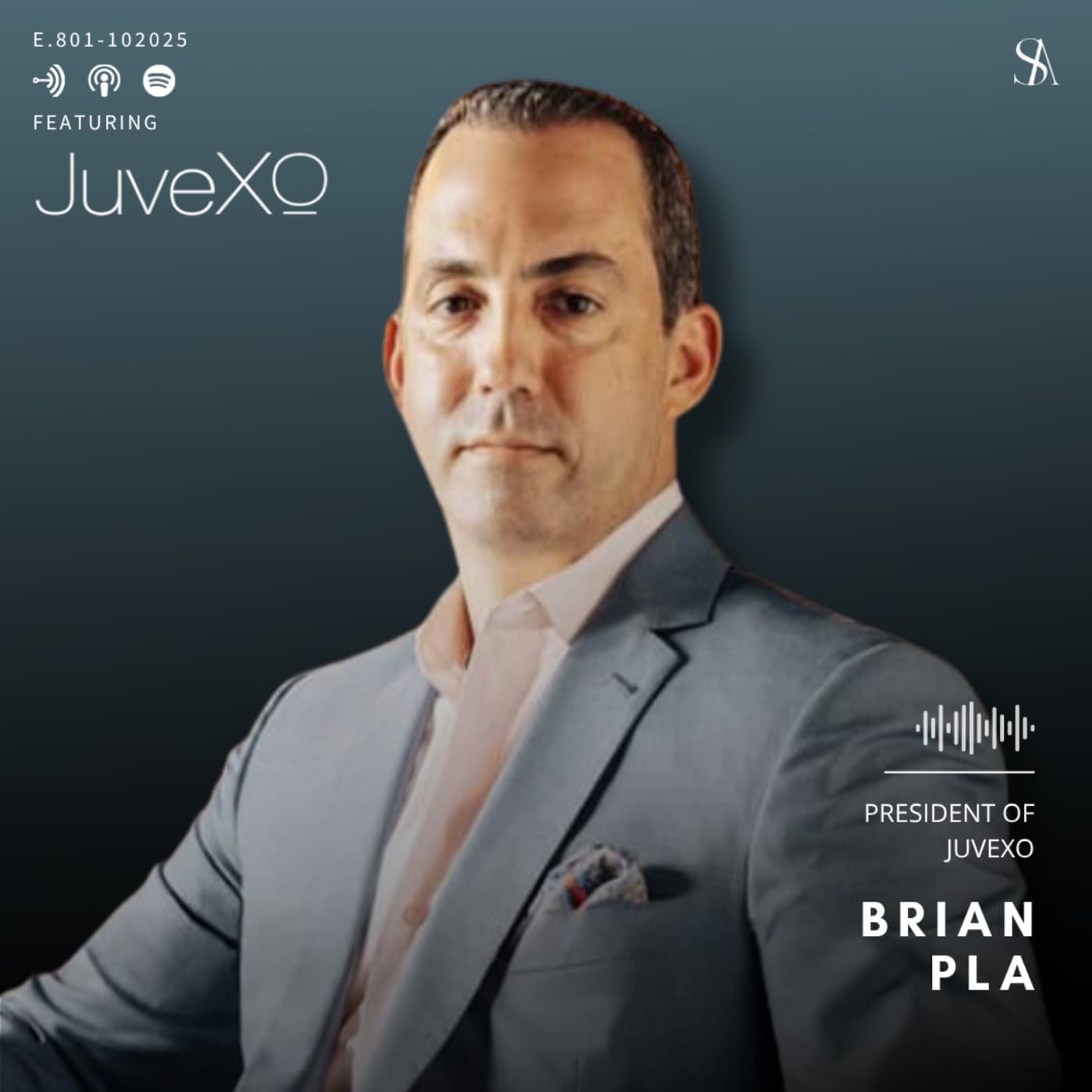
- Brian Pla, President of JuveXO
Episode Overview In this episode of Skin Anarchy, Dr. Ekta Yadav interviews Brian Pla to discuss the emerging field of exosome therapy in regenerative aesthetics. Exosomes, once considered cellular waste, are now recognized for their significant role in skin repair and rejuvenation. Brian explains the science behind JuveXO's proprietary complex, which utilizes clinically validated exosomes derived from umbilical cord lining cells.
Key Concepts
- Exosomes: Small vesicles secreted by cells, previously thought to be waste but now seen as essential messengers for regeneration.
- JuveXO's ExoCM™: A proprietary formula containing live, viable exosomes, collagen types I and III, hyaluronic acid, and immune-supporting peptides.
- Science vs. Marketing: Emphasis on the need for scientific validation over marketing claims in the skincare industry.
Chapter Breakdown
- Introduction & Guest Welcome (0:04)
- Introduction of Brian Pla and the significance of talking about exosomes.
- Understanding What Exosomes Really Are (0:47)
- Definition and origin of exosomes from stem cells.
- Their role as messengers conveying regenerative signals from healthy cells to damaged cells.
- Stem Cells, Secretomes & Regenerative Signaling (2:20)
- Importance of not just exosomes but also accompanying factors (secretomes) for efficacy.
- The Source: Umbilical Stem Cells & ExoCM (4:33)
- Discussion on the sourcing of stem cells and their importance in the quality of exosomes.
- Exosomes in Aesthetic Medicine (7:42)
- The application of exosome therapy in cosmetic procedures.
- Manufacturing, Safety & Clinical Trials (8:56)
- Overview of JuveXO's rigorous clinical trials and safety measures.
- Inside JuveXO’s Proprietary Technology (13:29)
- Details on how JuveXO's technology differentiates itself in the market.
- Real Results, Downtime & Patient Outcomes (16:20)
- Patient experiences and outcomes from procedures using JuveXO products.
- The Future of Exosomes & Regulation (20:04)
- Insights into the future regulatory landscape for exosome therapies.
Key Takeaways
- Science Before Sales: JuveXO emphasizes the importance of scientific backing and transparency in their products.
- Regenerative Potential: Exosomes are key to enhancing skin healing and vitality but require proper sourcing and conditions to be effective.
- Consumer Awareness: Patients should ask critical questions regarding the efficacy and origin of exosome products to avoid misleading claims.
- Regulatory Landscape: As the market evolves, regulations around exosome therapies will likely tighten, necessitating companies to adhere to higher standards of proof and transparency.
Cautionary Notes
- Be wary of low-cost exosome products that do not provide scientific proof of efficacy or origin.
- The importance of lifestyle choices in addition to exosome treatments for achieving optimal skin health.
- The notion that exosomes should be used appropriately and not continuously as a daily skincare solution.
Conclusion The episode sheds light on the complexities of exosome therapy and the need for informed decisions when navigating the skincare market. Brian Pla’s insights reveal a commitment to science-driven aesthetics, positioning JuveXO as a leader in the evolving landscape of regenerative skincare.
Additional Resources
- Learn more about JuveXO: [JuveXO Website](https://juvexo.com/)
- Subscribe to Skin Anarchy for updates on future episodes and expert interviews across the beauty and science sectors.
---
This summary aims to provide a structured overview of the podcast episode while highlighting its key discussions and insights into the future of skincare through exosome therapy.
Written by AI. May contain mistakes. Listen to the episode to check what was said.
Transcript
Automatic transcript. May contain errors.0:03Hey guys, welcome back to another episode of Skin Anarchy. Today is a very awesome episode because we're going to be diving into the world of exosomes and I can't wait to really dive into the nitty-gritty with you guys. We have a wonderful guest who can really educate us on this topic. If you're involved in the aesthetics world, you've heard of exosomes and they've come up at some point. So without further ado, I want to introduce you guys to the president of Juvexo, Brian Platt. Welcome, Brian. Thank you so much. Thank you for having me. Very excited to be on and one of my favorite topics, exosomes.
0:33I think I almost named my second child exosomes. I just wanted to give you a little bit of a background on the history as to how we got here and how exosomes became hot in the aesthetic space. For a long time, understanding exosomes back from your biology day, they actually, they were considered cellular waste. They thought stem cells would secrete these exosomes and it was just cellular waste. In reality, exosomes are tiny nano vesicles secreted from cells and carry the message. So their messengers carry that regenerative message from the healthy cell to the damaged cell. As science has continued to improve and companies such as ours have continued to invest in the R &D, pushing the envelope as to, hey, how amazing everything the body gives you, right?
1:18From these stem cells, obviously we've heard of stem cells in many contexts. Today I'm going to be focusing primarily as it pertains to aesthetics. We've been in the cell therapy space for almost 20 years. Our chief science officer and the brainchild behind Juvexo is Dr. Rafael Gonzalez, a pioneer in the cell therapy space. As he was working on stem cells, he came up with this product, which we were calling liquid gold in the lab. He was able to get our stem cells to secrete not just exosomes, right? Because I want to also not just emphasize what exosomes are, but the importance in distinguishing and understanding why all exosomes are not created equal and what should you be looking for when finding the right exosome product for a cosmetic or aesthetic procedure.
2:08So just to get our audience lined up, Brian, let me start from the beginning with you. I want you to walk us through this. So let's talk about what are exosomes and where do they come from? Let's start there so that everybody can have an understanding? Exosomes are secreted by stem cells, right? I'm highlighting stem cells because that's where ours are derived from, but they will secrete exosomes. Exosomes are the ones that carry the message, this regenerative message from the healthy cell to the damaged cell, right? But exosomes are one component. We actually call ours secretomes because it's not just the fact that there's exosomes being secreted because they by themselves would not pack the full punch of what the intended the outcome, but it's who's at the party with the exosomes that are important.
2:53So if I asked you, give me two ingredients that you definitely would want to have in a skin product, what would you say? I would say niacinamide and probably vitamin C. Vitamin C. Okay. Two excellent products. But if we take it one step further, would you say hyaluronic acid and collagen are extremely important? Absolutely. So because ultimately what we're trying to do is to get our collagen engine to rev up again, like it used to produce at a younger age, right, or a younger state. So our products is naturally secretes high molecular weight, hyaluronic acid, and that's important because a lot of times when you're buying HA products in the market, they're low molecular weight.
3:33And really other than just giving you a little bit of a glow, there's really nothing that they're doing long-term on the regenerative basis. Nothing could hold more water than HA on a pound-for-pound basis, right? It could hold a thousand times its weight in water, which is why a lot of times when you apply HA, you get a little bit of that plumpiness. It's really that immediate effect of the HA, but the high molecular weight HA is so important. Also collagen one and three, it naturally secretes, which again, ideal. We want to not only stimulate your own collagen production, but also introduce collagen.
4:08Collagen is the most prolific and abundant protein in the body, right? It does everything from cover, helps on the intra-articular side to coating your organs, your lungs, and obviously a very important part in the skin and the skin's health. So as we age, we start to have these breakdowns in collagen. Everybody's looking, how do we get this stimulated again, right? And what we did is that we conditioned our stem cells, which is the source of our exosomes. Very important to understand the source because today there is a lot of confusion. People are just throwing exosomes out there, but they don't know are they plant exosomes.
4:47Even what type of stem cell are the exosomes derived from is important, right? Because ours are derived from what are called mesenchymal or MSC exosomes. And a little bit more kind of on a touch point is umbilical cord lining stem stem cells. If you think what an umbilical cord is meant to sustain and grow life for nine months, that is the most nutrient-rich environment we have. So when we were looking for our optimal stem cell, that's where we found it, right? And we've done plenty of studies. We've invested a lot of money in multiple studies. We're currently in five clinical trials with the FDA, with our stem cells.
5:27The exosomes are an evolution or an offspring of these stem cells. And as we condition them and we started to introduce them into the market back in 2019, there was really nothing out there at the moment that catered to cosmetics. We were the first company to promote this on a B2B basis. We were selling only to doctor's offices and it was meant to be used topically in combination with treatments such as microneedling, Morpheus, laser, etc. So as we started to penetrate the market and seeing all the great outcomes there was really a need to continue to evolve and make other products available to our practitioners our product line has continued to expand at the heart of our Juvexo is our patented formula which is called ExoCM and that is the driver that's present in all our products we have our skin line our aesthetic line and more proline.
6:23If you're maybe a med spa, if you are a trichologist running hair, we have a hairline. And then on the other end, on the proline, if we're on the regenerative side, on the hair transplant side, you know, we have a more potent version of that. So we've really done a nice job of introducing product that will be able to cater to what the market demands. exosomes have become very trendy but the most important thing again i go back to is understand the source of the exosomes right where they came from and what were they conditioned to do right it's just because look i can put a cup of milk on a table and you could find hundreds of millions of exosomes in there it doesn't mean that you want to put those exosomes on your face and and that's what we're seeing a lot of times practitioners are being sold on hey there's exosomes in here Frankly, you have to trust the person selling them to you that that's the case.
7:19But if you're working with a reputable lab that is operating by a higher standard, then that is what you should first trust. And then from there, understand what are these exosomes conditioned to do and what are the core ingredients in the exosomes. Like I would say, it's not the fact that there's exosomes at the party, it's who are the exosomes at the party with. Right. I think it's very fascinating. And I love that you broke it down for us to this level, because the conversation has come up in the industry where people are now aware of exazones, there are so many uses for them, right? So they do come from the regenerative medicine side, which makes me start thinking about a lot of different avenues.
7:55One of the things I wanted to ask you is, can you talk to us a little bit about when you're harvesting stem cells, right, from like Wharton's jelly, you want to focus on things like passage of those cells. So that matters at the end of the day because the more passages a cell line goes through the more likely the mutations are introduced in it can you talk to us about the more technicals there in terms of what you guys made sure you were doing to make sure that the exosomes that you were kind of manufacturing here they're going to stay resilient over time and they're going to kind of withstand moving around and just by the time they get to the actual patient or the consumer they're still viable well that's a great question and if more practices would be asking those questions there be way less noise in the market, right?
8:39You do have to, the conversation doesn't start with the exosome front. Everyone's timeline in the exosome is right here. Let me start you at the exosomes. But the narrative needs to go back further. You need to understand, like you said, where are these stem cells that these exosomes are coming from? Where are they derived? And what work has been done on them, right? Given the fact that we are in the clinical trials with the FDA, my bar is set so much higher in terms of sterility. One of the biggest things you're seeing in the market is everyone claiming how many exosomes they have in their product.
9:11First of all, there's not one practice or anyone that probably has the ability to really vet the amount of exosomes in that. We've done the studies under electron microscopy, which is an over million dollar machine to test ours. Third party images prove that we have live exosomes in our product and the amount, but none of these other companies that are leading with sales and marketing, if they're selling you an$80 vial of exosomes, understanding that they're coming from stem cells and the process of cell harvesting, you could really buy something at that price and it really have exosomes that are going to be regenerative in nature?
9:40The obvious answer is no. Most of these companies lead with their sales and marketing and fancy brochures, not with science. We started with our science. We worked for many years looking for the right type of cell line. We went through 50 something donors. And of course, this is all consented post-birth tissue. So these were, every donation was consented. Another question is like, oh my God, these are coming. No, this is coming from an umbilical cord that was going to be discarded, consented after birth. Very, very important on that aspect. As we ran through the gauntlet of tests, the first thing we had to do is run it through an exhaustive amount of viral testing to make sure that the stem cells did not have, you know, there was no viruses in the cells.
10:26Then we had to do genetic karyotyping, which is we would grow up the cells to 80 years of age and see if it would develop any sort of genetic aberration, right? That's an exhaustive process. And only after passing all those gauntlets did we find a cell line that was viable. At that point, now that we have the stem cells, which we alter the culture expand, it's four passages of culture. So we get it up to about an 18 to 20 year of biological age, because that's where we know is the sweet spot. You've gone through enough of the adaptive immune system aspect, and you have that prolific viability on the cells.
11:04From then, we put the cells, and it's very funny because if you would think, hey, what is the type of diet that we'd want to put these cells under to help it proliferate? Funny enough, it's actually a keto diet. So we stress ourselves under a keto diet to secrete this proprietary ingredient, which is not just exosomes, which again, why we call it secretomes, that has the exosomes, has collagen, the HA that I previously mentioned. It also has something else called beta-defensins, which are immune-boosting peptides, which really help mitigating bacteria. And if you think on the skin, a lot of times acne is driven by bacteria.
11:43We have seen in studies how it helps mitigate even on the surface of the skin. That's why it'll be used a lot post-surgical around wounds to help minimize the chance of getting an infection. So really amazing how our product as a practitioner start to understand its profile, how it's being broadened in its use still within its compliant basis. So hopefully that answered your question. Yeah, it absolutely did. No, it really did. And I really applaud you for doing this properly and for making sure that you're sticking to the science. I can't say enough good things about that component because what I've seen in the industry and a lot of providers and customers out there, you guys have noticed this, if you're selling an$8 serum and claiming their exosomes inside of it, I'm going to pause and say, what are you talking about?
12:28Because it's an expensive technology. And there is a lot of detail there scientifically that you have to consider. That's why I asked you, Brian, in depth detail about it, because I think it's important for consumers to understand that if you are going to opt for something that is technologically advanced, you have to be able to understand that you have to ask certain questions from the science side. And I think we're finally entering this era in aesthetic medicine where the consumer is very well educated now and they're asking better questions. I really champion that kind of mindset because that's how we get results at the end of the day.
12:59If you look at any part of medicine, you will see that certain things are definitely checked off, like dosing, understanding the viability of certain products, or if you're using an ingredient, the shelf life. These are common questions that consumers need to ask more of, you know? So when it comes to something like exosomes, I get very excited. But at the same time, I get very cautious because I don't want people to be miseducated on this topic. That's very helpful, what you said and everything you've explained so far. Now, I'd love for you to dive in more because I know that you kind of started teasing this a little bit where you're talking about how the proprietary technology that you guys have is not just the exosomes.
13:34It's also the other components that you've packaged in. So let's talk more about that and why that matters for the common consumer that's wanting to get a procedure using Juvexo. Right. And I think it's important to understand if I'm coming into a practice and I'm looking to get something that is going to deliver as advertised, And I'm coming in for some sort of facial rejuvenation procedure, whatever the indication, whether it's from the harsher end, from a laser down to the lower grade of microneedling. You want to make sure that whatever is being used is legitimate and there's going to be an efficacious outcome that warrants the increase in expense.
14:12The market is falling short because a lot of practices, and I always feel like, hey, it's the doctor's job to do the homework because that's what the patients expect. that you've done the homework to assure that what you're putting on me is going to deliver as advertised, not because I believed that I had infinity minus one exosomes. And again, exosome count is secondary. What were the exosomes conditioned to do? If I take LeBron James and put him on a football field and he's dressed in basketball and I don't give him any of the equipment, how well is he going to play basketball? He's not. You have to, and same with the exosomes, You have to tell them what you want them to do.
14:50And we told our exodones, we want you to go and be the best product to help for aesthetic conditions, right? So what else did we need to make sure that it's secreted? Like I said, collagen, elastin, biotin, glutathione, which helps with skin brightening. So as you start to get deeper into the profile of our product, you go, wow, this is like the who's who of who I wanted to have. If I told you, here's who you want to invite to your skin party, here are the top 10 people I want to invite. They're all at this party. I don't think there's any other company that has approached it this way. Everyone's just rushed to produce an exosome product.
15:26And they continue to fool the market that just by saying exosomes that they're going to have. And I just really feel they're doing a disservice to their patients because it's frankly no better than, it's almost like they're giving their patients placebos to a degree. I know of companies that sell exosomes in a powdered format, I reconstitute it with a cheap grade hyaluronic acid and they'll get a little bit of a glow so they feel, oh look, you see the exosomes are working. No, it's not. We're also a third-party lab and we've tested a lot of these products because we have the ability to do so. And I can tell you I've yet to be impressed by anything we've tested and I'll leave it at that.
16:01No, I believe it. I really do believe it. I can tell you I'm on the same page with you and I think it's very important for us to clear this up for all of our listeners that exosomes by themselves are not the goal. The goal is to have something that is going to actually go to your cells and become a signaling mechanism. And that's what the role of exosomes is. That's why they're secreted in the first place. They perform signaling between cells. I would love for you to speak a little bit more about this because when somebody is going in for aesthetic treatment, what kind of results should they be expecting by getting a treatment that involves exosomes?
16:36And how can they track, You know, something like, am I getting the benefits of this versus not? I think it's important that you pick your practitioner accordingly and assure that, you know, they're in. If you're coming in to get an exosome procedure on a Groupon, immediately you have to start to question, right? It is important to understand. I'm big on diagnostics and tracking and why we've invested so much into doing so. One way is before and after pictures over time. There's also skin analysis machines such as Zivizia that you could use. You could take one before you do the procedure, then you could take one after and you could take another week or a month after as a follow-up or for a subsequent treatment to see how you've improved.
17:18These machines are now getting really good at detailing not just what's on the surface but underneath. I always like to quantify what I'm seeing, that I'm getting collagen production. Is there a test that I could run? no but if you see that you are sustaining or you're kind of holding your ground and you're seeing skin texture over time improving because that's the other thing there's no one and done on this we continue to degenerate as humans so we have to do our best to offset so finding the right the right interval of doing these treatments and depending on how much damage you have or how long it's been since your previous one then we'll dictate hey do i have to go laser or morphine or something more aggressive, and then complement it with microneedling or something less invasive.
18:03That I will defer. I know doctors have their protocol, but I can assure you that from what I've seen, because I also have a medical practice and we do a lot of aesthetic procedures, I've seen the difference in terms of us minimizing the downtime. When you're doing a laser, the downtime is cut significantly down, which is important because you want to be able to get back to what you're doing, to what you have to do, and not miss important events or not be able to get back to work or your kid's thing. So that this day and age is really important. So if we're able to help minimize the downtime, you already start by winning.
18:38I'll give you a personal anecdote. I had a black tie event to go to with my wife on a Saturday evening. That morning, I decided to volunteer for a study that we were doing at my practice with seven patients doing a laser. and then you know five were doing it without exosomes two were doing it with i was one of the ones doing it with uh and i get out of that procedure right extremely you know extremely red as is expected when you're doing anything ablative as as the day wore on i started to already start to see it get mitigated and i know when i got home my wife told me she's like why would you pick today to do this procedure so here i am starting to pray to everything going please let these exosomes work because if Juvexo doesn't come through, I may be not only looking for another profession, I'm going to be looking for another home to live in.
19:25Sure enough, come seven o 'clock, I'm here getting in my tux. By then, it already looked like I had just kind of gotten some sun that day, but not anything that was going to make me look horrific. The next day, as everyone had to submit their day after photos, and there were a lot of patients way younger than me with better skin, they had way more redness than I did. The only difference was the exosomes, And I think it goes to those anti-inflammatory properties that Juvexo and our XOCM formula contribute. That's very fascinating. I really, I'm glad you mentioned that because I think that's also one of the big questions I wanted to clarify for our listeners was when we're talking about something like exosomes, what should people's minds be geared towards?
20:08You've mentioned a great example, but if you can touch more on this, because right now, here's my frustration. I'm seeing a lot of brands out there, skincare over-the-counter brands. They're coming into this world. That's fine. I applaud the scientific, I guess, whatever. Like just you're curious and you want to expand. But at the same time, I think it's sending the wrong message because I don't believe that exosomes should be used continuously every day, every product. You know what I mean? No, agreed, agreed, agreed. I don't believe in that. And I think that's where I get very stuck because what you described just now is the real purpose of something like nanotech.
20:45It helps you heal faster. It comes from regenerative medicine, this technology. So the idea is regeneration of tissue. If you're applying it every day, it's not supposed to be used like that. So I'd like for you to speak on that in terms of setting expectations for ourselves as consumers and patients. We need to understand if we're utilizing something like true exosome technology, what should our approach be and our mindset be about why we want to utilize something like this versus not? And I think you'd have to divide that into the clinical setting and the take-home setting, right? But the most important thing is, and I equate this even to our anti-aging patients, is the lifestyle changes, right?
21:22If you're going to continue to put yourself into positions that you're exposing yourself to skin damage, you're not eating well, hydrating well, sleeping well, you're drinking alcohol, you're smoking. Listen, the mother of all exosomes is not going to save you, right? Yeah. So the first thing we have to do is make sure we're making these lifestyle changes to help. There is no panacea, no one-stop product that's going to help all. But I can tell you that this is a catalyst. If you have one of these stronger clinical procedures done, it is important that you do them in moderation, right? Doing laser very frequently would potentially lead to Leatherface, right?
22:00No matter how many times you had exosome, you have to have a practitioner who really understands skin health and not start at the dermis, but start on the inside, right? What are you doing to help mitigate the damage that's been done? And then on top of that, how are you looking to keep your post-treatment care? Again, there's a lot of products out there now that I start to see that are like serums and whatnot. And one of the things you have to be wary on these take-home products is that exosomes are not easy to encapsulate to assure that they're viable and that the product you buy actually has viable exosomes to deliver what you're being sold.
22:38If they don't understand how to encapsulate and maintain the viability of the exosome, you're ultimately just getting an overpriced serum. Sarah, that's one of the reasons why we haven't launched a take-home product. And we're working with a couple high-grade labs to make sure that, yes, you're going to lose exosomes in the process, but that there's still viable exosomes that could drive the regenerative process after the fact, sufficient to be in a complementary role where it doesn't become something you drink all day, every day. So I guess that's as much as I wanted to add to that. Yeah, no, it's a great explanation.
23:12Thank you for that. I think one of the biggest questions for me is what has been a real challenge in terms of transitioning a clinic-grade formulation into a broader aesthetic product for you guys? How did you preserve the science without diluting its performance? That's a great question. If I would have just been concerned about, hey, let me hurry up and get something commercial, I would have had something years ago. But we had not been confident in what we've seen yet to put out the right product. We're working with a couple of really high-end formulation labs that understand cell biology. They're not just trying to throw a ton of ingredients together, stamp it with, hey, exosomes were once here, right?
23:52At some point, exosomes may have lived here. They don't live here any longer. We're looking at different technologies that could almost encapsulate that exosome because the other ingredients are more robust. If they don't have the orchestra conductor, then they're also not going to be optimized. and very important is that our exosome formula, we don't add this to the product. We get it to naturally secrete. If you see the narrative across the market, everyone's talking about exosome, but no one is mentioning how important all the other ingredients are in the symbiotic basis. And we're getting very close.
24:25I think we would have some demo products. Probably one of the first ones we're going to have out is an acne product because we've seen how well this works just on the antibacterial component alone. And in the beta products that we've put out there, we've gotten rave reviews. So we're definitely closer, but not until I'm confident because the same mantra that I follow on my clinical side, I want to follow on my consumer side. And it's okay that everyone's out there. And I understand that there's a business side and not to say there's no good products out there. I'm just trying to educate on what are the questions you have to ask.
24:57No, I think that's all we can really do is to really put the information out there. And I find it fascinating because there are so many potential therapeutic benefits of utilizing exosomes, what's something that you would want practitioners or clinics to understand when they are entertaining, carrying these products, maybe a quick rundown of questions they should ask before saying yes to companies or a fact check they can do internally before they decide, because I won't lie to you, the regulatory area for this, for me even, it's very gray, you know, and it's fuzzy because to understand, I'm not saying that, you know, obviously you guys are really checking off every box, but not every company is doing that, right?
25:34So like if I'm a practitioner and I'm wanting to carry? What are some things I should understand before I say yes? Look, I think you really have to understand the source. Let's start also, I know that there's plant exosomes, and I think we're seeing an iteration back in the day when stem cells got popular. You started to see apple and deer and all these other iterations of stem cells. Have you seen any of those kind of proliferate or still? Is there one apple stem cell product that you say, wow, that is the holy grail is there one deer stem cell no so those all probably went by the wayside of the next fad what i can tell you is that exosomes are a catalyst in the regenerative process no stem cell would be able to do its work if it's not the exosomes that are carrying the message to the damage so exosomes are here to stay the only thing is what you need to ask is understanding um where your exosomes source from, what testing has been done on those cells.
Read the full transcript
26:30And I'd love to see some proof that you actually have exosomes. And here you are claiming to me that you're selling this to me like a tequila, right? Like it's triple filtered and all of this stuff. But how do I know what you're telling me to be true? Do you have any images of exosomes in your, and that's where you're going to get crickets, right? Because people are making this investment. Again, they're just, they're doing it now with AI. They're just throwing really nice crafted messages and brochures, what it's supposed to do, right? But show me the company that's invested, like we have, in these studies to show the changes in collagen, in skin texture, to show how we're minimizing bacteria present at the skin surface.
27:06That's important. These companies could be cosmetic companies, but they're really rooted in the science. Ask for certificates of analysis on the exosomes, the viral testing. When you start to get the buzz of why that's not important, then you know there's a stronger commercial pitch here than a science aspect. I hope that answered your question. Yeah, absolutely. I think that's a wonderful answer. I wanted to ask because I know there are many practitioners that are always wanting to stay on the, we all want to stay on the cutting edge, right? Science demands that in a way and medicine demands it.
27:35But I think, yeah, exactly what you said. We have to be bold enough to ask these questions ourselves until we get to that point as an industry where the regulatory side of it is so in your face, you know what I mean? Where everybody's got the checklist in front of them, there's no way to get around it. We're going to have to ask those questions. The reality is that initially the exosomes were, people were promoting it cosmetically, was to get around the regulatory environment. But they were pitching it for all sorts of usage. Then the FDA stepped in and said, hey, this falls under the same auspices of stem cells.
28:09Now, when you're talking about a purely topical cosmetic use, then there is no FDA because it's not being used as a drug. right and that's why even for cosmetic use you can't make claims like i'm going to make you younger you still can't make those claims right so it's twofold it's the usage of the product but also the claim exactly yeah no i think that's a very valid point it's very important to understand and i think for consumers as well it's like going back to that bit we talked about where setting consumer expectations patient expectations is very important in this realm because with anything related to biotech and i'm a firm believer in this biotech is now taking off and we see it everywhere, I think it's important for us as consumers, patients to also understand that there are going to be things that you can reasonably expect from technology and things that you just simply can't.
28:58And so when you are going to a clinic, you should ask that. I've said this before on the podcast where I was talking to a doctor once and we're talking about lasers, you know, and he brought up a very good, he was like, you need to be, as a patient, you have to ask, you have to pose these questions and get your knowledge because that's going to make you understand what to reasonably expect from the treatment. So now that we're seeing the emergence of something like nanotech in the space, that's a very, this is very like hard to pinpoint. I think that's another thing, right? Where exosomes are nano, so they can go pretty deep into the skin layers.
29:31Understanding what that actually entails for you long run, you've got to know that kind of stuff. And I'm glad you, because you're right. Exosomes are measured in nanometers. So the way we qualify is based on the international society of extracellular vesicles you have to meet at least two of the three criteria one of those is particle size but it also has to exhibit certain markers just because you have something that's in that particle size you know that it's an exosome and that is not the case and when you look under electron microscopy you can see it we have copyrighted images of exosomes we've taken in our different products even are lyophilized which people said oh it's impossible to maintain an exosome through a lyophilization process because you stress it.
30:09And I say, well, it's impossible for you. I always give the analogy that if tomorrow we found people that were able to travel the stars and showed up here, you say, hey, that's impossible. It's impossible for our civilization. We haven't figured it out, but someone else has. So it's just that our science is that much further ahead because we've been at the self-therapy game, which is where the conversation needs to start, not at the exosome space. Yeah, no, that's a very good point. Yeah, civilization comes up a lot, actually. And there's never a clear answer about it. doesn't damage the actual integrity.
30:39The answer is yes and yes. So we have, so our lyophilized product, we lose about 50 % of the exosomes that we have in our equivalent. One cc of serum is about half of that in powder. You do lose some of it, but if you know how to do the lyophilization process correctly, you're able to maintain that. We've tested it, but most people do not have the ability to do that. What you're going to be putting out is probably a dead product. So I I would be, especially at the price points that I'm seeing today, I'm pretty confident that most of our products on the market do not have live exosomes, much less any sort of secret home benefit in it.
31:17So again, you just want to go to Canal Street and buy a Louis Vuitton because it has the label, or do you want to make the purchase knowing that this was done the right way? Right. It has the real leather and it's the real deal. Yeah, exactly. I hear you loud and clear on this. I think that it's been such an eye-opening conversation for myself and a lot of our listeners, because like I said, no one wants to discuss these details. And that's one of the biggest hurdles in aesthetic medicine that I'm seeing that there needs to be a lot more transparency, you know, and everybody needs to know what's going on, what we can expect and where this field is headed.
31:51I would love to get your thoughts on this. Where do you think regenerative aesthetics and the whole industry is really headed in the next three to five years? Do you think there's going to be any shifts taking place or anything on the horizon that you can think of? You're always going to have to navigate through a lot of fluff and very little stuff, right? You're seeing it with a PDRN, right? Or the salmon sperm, which falls almost into the same regulatory environment. You're starting to see tons of different groups now getting all worked up about, oh, we should be able to inject this. There's way less clinical data on the benefit.
32:21Now, do I think that in theory, a good product of PDRN could, a peptide product could work? Absolutely. You know, and I actually think they would be synergistic with exosomes, believe it or not, not to go too much into the science. But that product is way further behind. But just because certain claims and certain high profile people have used it, there's been a massive rush into salmon sperm and salmon sperm facials. And years ago, it was snails. And then God knows what's next, right? We have to always understand that anything truly regenerative is going to take time because there's a cell cycle and there's no instant approach.
32:59So while you're doing things to help cosmetically, topically, I think the subdermal stuff, right, the lifestyle changes. So it's really a combined effort. But do I think that cell therapeutics or what I like to call biocosmetics are here to stay? Absolutely, because we're seeing the advances in stem cells and what they've done in a variety of regenerative conditions from autoimmune to cardiac, et cetera. understand that really what you're saying that when the stem cells are working is that the stem cells are releasing exosomes that have done their job the exosomes are the workers that ultimately carry this message and start that regenerative process now if you have viable stem cells that they will continue to release exosomes that's why stem cells are more powerful because they will be releasing exosomes on an ongoing basis exosomes are more like a one shot they have to work on that But that's why the continual effort to incorporate exosomes into this will be better.
33:58So I think if you're able to see the products that really get through the skin that are viable with exosomes, other ingredients I mentioned, and potentially others, because you mentioned niacinamide, I'm a big believer in that. Vitamin C is great for skin brightening as well, as is glutathione. If they're able to encapsulate and preserve that exosome, I think you're going to be seeing an optimal cell therapy or biologic cosmetic product that's going to deliver as advertised. And so I think we're only going to see really big movements in there. I also think we're going to be seeing like designer exosomes at a certain point where potentially we'll be able, kind of like you're able to derive your own sense in perfumes, you're going to be able to derive exosomes for different types of indications.
34:41I think we're going to see that maybe not in three to five years, but in five to ten. Wow, that's very exciting. I'm very excited to see where this field evolves and what direction we go in, but this has been such a great conversation, Brian. Thank you so much for all of your knowledge. I mean, I can't tell you how amazing it is to finally have this conversation with somebody who can really debunk so much of what's been out there and the gray area around this entire technology. So, huge fan of Juvexo. Thank you so much. Yeah, so a lot of you listening out there, if you're interested in learning more, definitely check the show notes for this episode there's going to be all the contact information there as well so you can get in touch with them if you're interested from the provider side or if you just want to learn more as a patient so thank you so much awesome thank you so much doctor hey guys so i hope you love that episode please make sure to hit subscribe if you're tuning in to us on any podcast platform we are available on so many different platforms so wherever it is that you're tuning in just go hit subscribe you will be immediately notified when we publish new episodes this way you're able to tune in to amazing insights from experts, brand founders, industry leaders, authors, all the wonderful people that we host.
35:48And that's very important for me because I love to hear from you guys and really understand what you love and what you want to hear more of. Also, make sure to give us a follow on all of our social media outlets. We're available on Instagram, TikTok, X, you name it, we're there. We also have a blog on Medium. So if you're a reader and you love Medium blogs, check us out on medium we publish some really great articles on there that do deeper dives than just what's available on the podcast and it's really a great place for all of you science geeks out there that want to learn a little bit more we go above and beyond with our research and making sure we're bringing you information that you usually probably won't hear about in other outlets so check us out leave us a comment leave us a review and we'll be back next time with another episode thank you
From the publisher
In this episode of Skin Anarchy, host Dr. Ekta Yadav sits down with Brian Pla, President of JuveXO, to explore one of the most advanced—and misunderstood—frontiers in regenerative aesthetics: exosome therapy. Once dismissed as cellular waste, exosomes are now recognized as the biological messengers behind repair, regeneration, and skin rejuvenation. Brian breaks down the real science, cutting through industry hype to explain what makes clinically validated exosomes fundamentally different from the countless unverified claims in today’s skincare market.
At the core of JuveXO’s innovation is its proprietary complex, ExoCM™, derived from umbilical cord lining cells rich in regenerative nutrients. Each formulation is verified under electron microscopy to confirm the presence of live, viable exosomes—setting a new standard for transparency and efficacy in medical aesthetics. But JuveXO’s secret lies beyond exosomes themselves; its advanced bioactive system includes collagen types I and III, hyaluronic acid, and immune-supporting peptides that collectively accelerate healing and enhance skin vitality.
Throughout the conversation, Brian emphasizes one principle above all: science before sales. With five FDA clinical trials supporting their process, JuveXO leads with data, ethics, and precision—proving that not all exosomes are created equal.
From clinical insights to cautionary advice about misleading “$80 exosome serums,” this episode offers an unfiltered look at the future of regenerative skincare. Tune in to hear how JuveXO is redefining what’s possible in healing, repair, and cellular communication—ushering in a new era of true biotech-driven beauty.
Learn more about JuveXO: https://juvexo.com/
CHAPTERS:
0:04 – Introduction & Guest Welcome
0:47 – Understanding What Exosomes Really Are
2:20 – Stem Cells, Secretomes & Regenerative Signaling
4:33 – The Source: Umbilical Stem Cells & ExoCM
7:42 – Exosomes in Aesthetic Medicine
8:56 – Manufacturing, Safety & Clinical Trials
13:29 – Inside Juvexo’s Proprietary Technology
16:20 – Real Results, Downtime & Patient Outcomes
20:04 – The Future of Exosomes & Regulation
Please fill out this survey to give us feedback on the show!
Don’t forget to subscribe to Skin Anarchy on Apple Podcasts, Spotify, or your preferred platform.
Reach out to us through email with any questions.
Shop all our episodes and products mentioned through our ShopMy Shelf!
*This is a paid collaboration*
Hosted on Acast. See acast.com/privacy for more information.


