
In short
Podcast Notes: Unstressable with Gabor Maté - Overcoming Stress, Pain, and Suffering
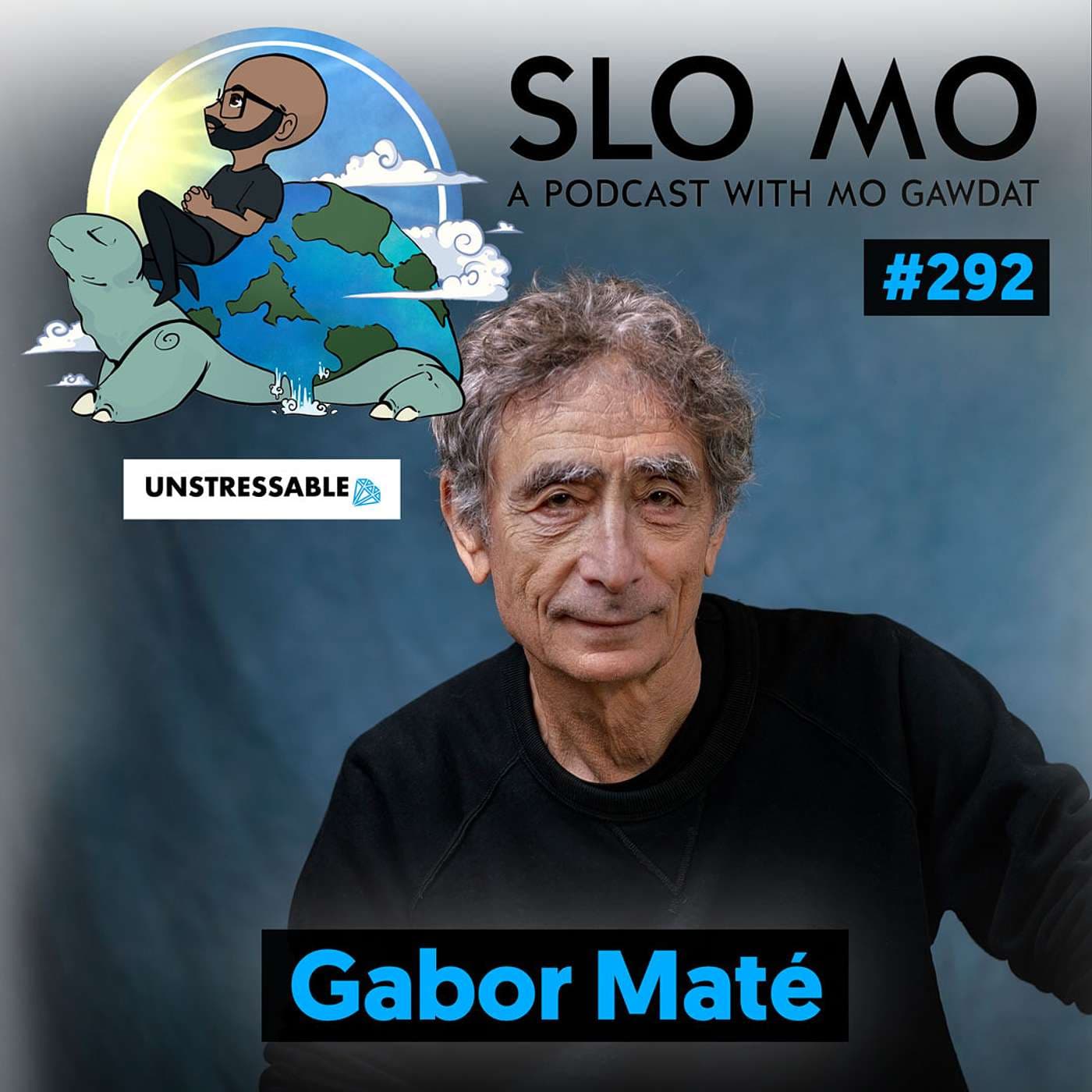
Episode Overview In this episode of Slo Mo, hosted by Mo Gawdat, the esteemed Dr. Gabor Maté joins the conversation to delve into the intricacies of stress, trauma, and human resilience. Dr. Maté, known for his work in addiction, stress, and childhood development, shares poignant insights from his life experiences and professional journey. The episode emphasizes the importance of understanding and confronting stress as a means to alleviate suffering in oneself and society.
Key Themes and Discussions
Introduction to Dr. Gabor Maté
- Mo introduces Dr. Maté as a significant teacher in his life.
- Highlights of Maté's influential books:
- *When the Body Says No* - Discusses stress's impact on physical health.
- *Scattered Minds* - Focuses on ADHD and attention.
- *The Myth of Normal* - Explores the complexities of mental health and society (co-authored with his son).
The Nature of Trauma and Healing
- Dr. Maté shares his early life trauma as a Jewish infant born shortly before the Holocaust.
- Discussion on how trauma shapes individuals and their willingness to confront personal struggles.
- Key takeaway: Acknowledging one's wounds is essential for healing.
- Some individuals find it easier to confront trauma than others, often due to varying levels of confidence and support.
The Role of Stress in Modern Society
- Dr. Maté explains how chronic stress is pervasive in contemporary life, driven by societal pressures and conflicts.
- Chronic vs. Acute Stress:
- Acute stress is a survival mechanism; chronic stress is detrimental and can lead to various health issues.
- The conversation addresses the societal mechanisms that perpetuate stress, including media distractions and the culture of passivity.
Empathy and Altruism in the Face of Global Suffering
- The discussion shifts to the current humanitarian crises, including the suffering of children in Gaza.
- Dr. Maté expresses deep empathy for global suffering and the shared responsibility of humanity.
- He emphasizes the importance of speaking out against injustices, regardless of political affiliations.
The Importance of Awareness and Engagement
- Dr. Maté discusses the need for awareness in overcoming personal and societal challenges.
- He introduces the concept of "integrative thinking," which allows individuals to hold multiple perspectives without bias.
- Techniques for managing stress include finding a balance between engagement with societal issues and personal well-being.
Personal Growth and Transformation
- Both speakers reflect on their personal journeys, emphasizing the importance of self-awareness and emotional regulation.
- The conversation highlights moments of personal awakening and the necessity of confronting personal histories to move forward.
Future Endeavors
- Dr. Maté mentions upcoming collaborative work with his son on a new book titled "Hello Again: A Fresh Start for Parents and Adult Children."
- Mo promotes his upcoming book, *Unstressable*, which aims to help a million people overcome stress annually.
Key Takeaways
- Confronting Trauma: Acknowledging and addressing personal trauma is crucial for healing and growth.
- Chronic Stress: Understanding the impact of chronic stress on health can lead to proactive changes in lifestyle and perspective.
- Empathy and Responsibility: Acknowledging global suffering invites a collective responsibility to advocate for change.
- Engagement vs. Passivity: Finding a balance between being engaged in social issues while caring for oneself is vital for personal well-being.
- Continuous Learning: Both speakers stress the importance of ongoing self-discovery and learning from life experiences.
Conclusion This episode fosters a deep understanding of the interplay between personal and societal challenges, emphasizing the power of empathy, awareness, and active engagement in creating a more compassionate world. Dr. Maté’s insights serve as a guide for listeners to navigate the complexities of their personal and shared human experiences.
Listeners are encouraged to reflect on their own lives, confront their traumas, and find ways to contribute positively to the world while prioritizing their mental and emotional well-being.
Written by AI. May contain mistakes. Listen to the episode to check what was said.
Transcript
Automatic transcript. May contain errors.0:01I am so glad you could join us. I'm your host, Mo Gaudet This podcast is nothing more than a conversation between two good friends sharing inspiring life stories and perhaps some nuggets of wisdom along the way This is your invitation to slow down with us Welcome to Slow Mo
0:34Welcome back. I flew to London yesterday for the sole purpose of meeting one of my absolute favorite teachers. Even though first time we meet, he doesn't disappoint, I'll tell you that much. Gabor Matei has taught me so much that I have had the honor of learning and then passing some of that to you. His books, without mistake, are must-reads, every single one of them. Let's put them in a little bit of an order. When the body says no, the impacts of stress on your physical well-being, unbelievably powerful. Scattered minds for ADHD and how we can focus a little more. I think earlier on the realm of the hungry ghosts about addiction, one of my absolute favorite books of all time.
1:17Hold on to your kids and parenting and how we impact our kids in so many ways and their well-being. And of course, if you haven't read the 2022 The Myth of Normal, which is now coming out in its paperback version, more than a million copies sold. Incredible piece of work that Gabor wrote with his son Daniel. So definitely worth the time. I have been waiting for this for a long time. I have always prepared questions for the day. I'm going to meet one of my favorite teachers, but we're not going to go into all of them in order because today, as you know, this is part of our mini series on stress, celebrating the publication of Unstressable, end of April in the US and 9th of May in the UK and international English.
2:05So Unstressable, as you know, is a mission. It's not just a book. It's a mission of taking a million people out of stress every year. And your part of the mission is if you intend to buy it, please pre-order it. Don't wait for the publication date because pre-orders, as you know, the way the industry works is all pre-orders will be released on the day of publication, which helps us get on the bestseller spot. And if that happens, then you would have helped many others recognize the book. It is really one of my favorite works so far with Alice Law, who brings a lot of balance of the feminine into the book.
2:39If you do pre-order the book, keep your pre-order receipts because then you can come to our launch webinar, end of April. Just go to unstressable.com and register your pre-order receipt and you'll be welcome to our webinar, two hours to explain the book and listen to your questions and meet a community of people who are stressed so that we together make you unstressable. Without further ado, historical moment for me, my conversation with Dr. Gabor Mate. Gabor, thank you so much for being here. I want to start with why I love your work so much. There are many teachers. Your books are full of gold nuggets.
3:14But, you know, some others speak about some of them. What I found mind-blowing about you is that you're not shy to say that you struggle with many of the things that you teach. So, you know, from being a doctor for 20 years in your practice and feeling the stress and anxiety of mainstream warrior, if you want, from your struggles with ego, which you express so beautifully in our conversations and work, to, of course, the very early trauma of being born four months before Auschwitz, the horrendous events that even affected your own grandparents. parents and you speak so beautifully about how that trauma still remains with you throughout your life.
3:55And so I want to start by asking you a couple of questions. One is, of course, if you can share with us some of those stories and how they affected you, but mostly why is it that some of us are willing to accept and acknowledge and work on those things and some of us are not? Some of us will just deny that this has been part of their life.
4:21well first of all i being an author yourself uh i imagine you'll agree with me when you say that when you write a book you're writing as much for yourself as for the audience yeah and very often we write what we have to learn ourselves correct so for me the writing of the books has been a way of also teaching myself yes and learning from others you know So why some of us are willing to do that, I think it takes a certain degree of confidence that on the other side of stress, on the other side of pain, and the other side of trauma, there's some growth and liberation possible. In other words, even though it's difficult and challenging and disturbing to look at those dark aspects of yourself, but there's light at the other end.
5:13and it's just that faith that there's something to be gained and something to be learned and to be transformed by. I think that's why some of us do it. Now, how does somebody acquire that confidence? I really wish I had a good answer for you. A lot of people don't. A lot of people are in denial. A lot of people find these conversations not just difficult but even prohibitive, which is why I do write because people feel I'm just an ordinary human being like everybody else. So if I can deal with it, if I can look at it, maybe they can. But it takes some confidence that there's something to be gained, that there's something to be, that some beautiful flower can grow from all the dirt that you uncover.
6:00I mean, in a very interesting way, I think the first step to acknowledging or to healing as they use the word is to acknowledge that all of us are wounded somehow. I find that quite fascinating because the nature of my work, I get to meet amazing thinkers like yourself. You know, we cross paths on an event and you have those amazing, glorious speakers and thinkers on top of a stage. And when you're sitting in the audience, you go like, oh, this is godlike, right? But, you know, you meet them in the green room and we're all messed up, right? And I think that kind of acknowledgement that, hey, by the way, you reading the book or writing it, we're all always on that journey of discovering ourselves is a very big eye-opener for most people.
6:50You start with what I would probably think is an unerasable trauma. Like almost everything you teach about the first few years of a childhood of a person, you had the worst. You know what, I don't go on comparing people's traumas. Oh, it's interesting. Pain is not quantifiable or comparative. And I don't want to say that what happened to me was worse than what happened to other people. Yes, I had a very challenging, difficult, painful first year of life as a Jewish infant, under the nasty occupation with a terrified and terrorized mother and a father who was away in forced labor, my mother not knowing if her husband was dead or alive, her parents being killed in Auschwitz.
7:41Yes, that's dire and dreadful for an infant to experience the terror and the panic of the mother.
7:53But after the war, my father came back and we had a fairly functional family. You know, my parents respected each other. They were not perfect parents, but there was a stable, loving, nurturing family home. A lot of children, they don't have that. Yeah. And so for me to say that my pain is somewhat deeper than somebody else's, I wouldn't want to go there. and especially not these days. I mean, I know yours is not a political program, but we're talking in March of 2024 and I wake up every day with Gaza on my mind. I go to sleep with it, I wake up with it. And to think of the horror that's not being inflicted on Palestinians in the name of my own people, it's just devastating for me.
8:53And the trauma imprint that's in me that you mentioned has certainly been awakened now. And, you know, when I think of my own infancy in wartime, and when I think of what those infants have to go through right now, I'm not here to say that my suffering is worse than that of other people. I don't compare people's suffering. and I'm just aware of how much pain and suffering there is in the world. This by a very, very, very long margin is angelic to say, interestingly, because there is one way of looking at your own traumas and saying, I'm the worst, I've struggled, I've suffered, or the other way where you now can so empathetically, so compassionately support anyone who goes through this, even if propaganda of the modern world tells you the other way.
9:50And I have to say, this definitely is not a political show, but this is not a political topic. It's not, is it? It's a human topic. This is a humanitarian topic. A question of, do we submit to the powers of the modern world or do we simply say, my heart aches for killing children? It's as simple as that. I know. And I know I saw your original conversation on the topic when, you know, back in October. And I have to say, again, I don't believe in politics. I think politicians on any side of any conflict are the reason for the struggles we have. But, you know, the question is how can humanity shut their hearts to the pain of others?
10:38Well, you know, I grew up with that question because I was about 11 years old when I found out about the Holocaust. I mean, I didn't know much about it until I was then. And then I found out. And for years, my head would spin, literally, my head would spin every day. And I'd say, how is this possible? How can human do that? And how can the world could have let this happen? I don't wonder anymore. We're letting it happen right now. We're watching it on our YouTubes and our screens and read about it in our newspapers.
11:16And children in Gaza are having their limbs amputated without anesthetic. Oh, my God. People are eating dogs and cats who themselves are feeding on carcasses. and the politicians here in this country, in Britain, in the United States, in Canada, are just, it's okay, it's necessary. So how can the world let this happen? It's let it happen over and over and over again. And for me, this is the darkest times I've lived through as an adult. And I'm sure that some of the imprint of my own infancy is showing up right now in my emotional reaction to this. It just feels very heavy. And now, speaking of stress, one of the interesting questions or the essential questions for me is how do I maintain some sense of myself and purpose and intention and even optimism in the face of all that?
12:19I think it's been the hardest part of all of this, to be honest. So I am a very effective engineer. I only engage when I know that my engagement is going to make a difference. And of course, most people don't understand, but unless you have a shot to make a difference, it's actually wise not to take any shots at all. But the challenge of the world we live in now is that you're left carrying the burden but unable to express in any effective way that changes anything. Because of a cumulative trauma, I would tend to believe that humanity has gathered over the years that the only way to move forward is to kill the opposite, to kill the enemy.
13:14I don't quite see it the way you do. Explain to me. I'll tell you why not. Teach me one more thing. Yeah. Have you ever heard about the White Rose Movement? No, what's that? Okay. There were young Germans during the Second World War, students, who started putting up posters against the genocide and calling out the Nazis for their murderous regime. And they were caught within a couple of months, and they were executed. but their example lives on and inspires to this day. They weren't able to stop what was going on but they made a difference in the long term in the consciousness of human beings who remember them.
14:05And so I think, for me at least, and I'm not here to prescribe for anybody else what they should do but to the extent that I have any kind of a platform even though me speaking about this issue is not going to save a single baby's life but I do trust that in the long term it will contribute to some light spreading in the world more people waking up some possibility of some transformation emotionally or politically so that even if nothing I say will make any difference in the short term I do trust that I'm contributing to some continuation or growth of human consciousness. And for me, that's not an option not to participate in that.
14:49So that's how I see it. So a bit of progress is better than no progress at all. Well, you know, one way to look at human life going back thousands of years is there's a constant struggle between the, what you might call light and darkness, between the consciousness of awareness and consciousness and love you might say in the world and then those forces that are destructive and controlling and acquisitive and selfish. And for the most part, the bad guys win most of the time. But is it true to say that those that represented the other side have made not a difference? I mean, from a certain point of view, I can name you some very spectacular failures, like Buddha and his divine wisdom and peace.
15:44How's that going? Or Jesus with his divine love and non-judgment of your neighbor and acceptance of everybody. How's that going? Yeah. Not to compare our ordinary selves with any of those great avatars of wisdom, but didn't they make a difference? They did. Yeah, even though the world, for you to look at it, hasn't gone there at all, has it? It's incredible, really, because my son, we were talking about, Ali, that I lost, used to teach me that you will never fix the world. Yeah. And I think he was addressing that same part of me that says, I want to be effective, my actions. He said, you're never going to change the world.
16:27You can change the world, but you can never fix it. There will always be suffering, which again is the first noble truth of the teachings of the Buddha. And we know in all spiritual faith that suffering is part of human life. Your son was a very wise person. There was a Jewish rabbi 2 ,200 years ago now who said that the task is not yours to finish, but neither are you free not to take part in it. and in the Bhagavad Gita it says that you're entitled to your labor but not to the fruits of your labor in other words, do the work but not because you think you'll succeed just do it So what's the work today?
17:11The work today? Well look, you're just written this new book that you mentioned Unstressable What are you trying to do? I'm honestly, in the last three books I've been trying to I've been looking at the shifts of how much more difficult and more suffering is happening in the world. Alleviate that in some way. Okay, you're trying to alleviate it. Yeah. Right. That's the work. Yeah. Is to alleviate the suffering in the world. That's the work that I do. That's the work that you do. That's exactly the work you do. So it's all about, yeah, there are these broad social forces that generate more and more stress and more and more suffering and the contradictions becoming more clear and the suffering is getting more intense in many ways.
17:55Many ways. I mean, in Britain where we were talking this morning, they're just going to raise taxes, people are going to have less income now, you know, this rich country, people are going to suffer more. So all these forces are sharpening and things are getting more difficult for a lot of people, more stressful for a lot of people. It's sacred work to do what we can And to try and alleviate that stress, to try and diminish that suffering, to try and empower people more, to give people more of a sense of agency and freedom, that they can have some impact on their lives. And so that's the work.
18:29That's the work that I do. Sounds like that's the work that you do as well. We may not do it the same way, but it's the same intention. You think there is a more effective way to stop? Simply, every time I've been asked about the genocide in Gaza, again, because I do not hold any political positions, I simply said, stop killing children. On either side of any conflict anywhere in the world, stop killing children. Now, to me, this doesn't sound like a very big ask, to be honest. And it doesn't sound like something that needs explanation. You know, sometimes in public, I give the example of saying, you're walking back home at 9 p.m.
19:11and you see a child being, you know, battered and abused by a big, you know, guy. Would you stop and ask yourself, oh, maybe the big guy has a reason why he's doing that? Right. You know, maybe it's because the child's parents are bad and they're hiding behind the child. If you find yourself trying to find the justification for why a child should be hurt, I think you need to question yourself. That's right. But it is so clearly part of fundamental human nature to not want to hurt children. And yet it's happening in massive numbers everywhere in the world. Yeah. How can we stop that? Well, I don't know that we can stop it, given the well-stacked political and economic forces that are driving it.
20:02I mean, all the suffering in the world, whether it's the hunger in a lot of countries in the world or whether it's the exploitation of lower caste people in India, whether it's the oppression of the Palestinians in the West Bank and their mass murder now in Gaza, they're not just random acts of cruelty. They are expressions of a system from which some people benefit and they wield a lot of power. So I don't know if I can stop it, But the question is, what do we do in the face of it? Yes. And, well, we speak our truth as best we can, and we make a contribution, and at the end of the day, that's all we can ask for ourselves.
20:55How it will stop and how history will unfold, that's not in any of our hands directly. And when you speak about how you try to stay on top of your own emotions, on top of your own stress. What's your top advice for people who acknowledge, as you say, that we may not be able to fix it, but we have to deal with it every day? Well, for me, on this subject, but on many other subjects, like the way indigenous people are treated in my country, Canada, or any other issue, it's much more stressful to stay silent than to speak out. So I think for one thing for me, stress really if you just speak my truth, which doesn't make me right when I say my truth.
21:45I don't mean the absolute truth, but the way I see it and feel about it, not to speak about it would be highly stressful. But in these last five months, I noticed something in myself, which is that it's different to be engaged with a subject than to be enmeshed with it. and meshment means that you don't separate yourself and it totally takes over your emotional functioning and you can't think about anything else and you're compulsively watching the TV news and the discussions and I'm not taking care of my own needs I'm not doing my yoga I'm not doing my meditation I'm not taking care of my physical emotional needs I'm just totally caught up in something else that's stressful that's killing yeah Yeah, and there I've given up agency over my own life and allowed something else to take over.
22:39Now you can be engaged, which is to say you still consciously choose to be active and to be outspoken, but not let it run your life. So it's that balance between... The third possibility that a lot of people fall into by default is passivity, where they do nothing, where they don't even pay attention that much. I mean, look, we live in a world where whether Aaron Holland or Mohamed Salah scores one or two more goals is much more important than how many kids are dying in Gaza. Well, that speaks to an incredible passivity or the issues that are facing the world in terms of climate change that you're either in denial or you're an oil company executive or a venal politician if you deny it.
23:42Everybody knows it's happening, but we're all passive in the face of it. So there's engagement, there's enmeshment, and there's tremendous passivity. And this world encourages a lot of passivity, which is stressful because lack of agency, lack of control is one of the triggers for stress. 100%. You know, so for me, it's a question of how can I stay engaged without being unmeshed and without... Falling into passivity. Falling into passivity, exactly, yeah. Yeah. It's quite interesting because I think there is a very big machinery, you know, from my tech background that is teaching us in general to be either passive or distracted by other things, basically.
24:31Are you an engineer by training? I'm a very serious geek, yes, sir. I'm an engineer by training, and I wrote a lot of code in my life, more than books. Well, let me tell you about engineers. Yeah. I don't know how this will sit with you, but my observation is the people in engineering tend to be very much from the neck up. Yeah, 100%. They tend to be very much in their heads. Yes, yes. So they're brilliant up here. they can create and conceive and achieve amazing things but they're kind of cut off from the body and from the emotion yeah i worked on the emotion actually quite a lot in my life but like you i mean my typical uh until my 40s my entire life existed above my neck yeah and yes you feel the emotions but you send them up to the brain and you go like okay deal with it yeah that's right Yeah, I'm luckily much more connected to the rest of me, but that's like 17 years of work now.
25:26Yeah. But you see, this is the challenge. The challenge is that I think, you see, I think, not I feel. I think that's who I am. Yeah, I think in reality that what's happening today is that technology over the years has been taught how to manipulate human emotions and how to distract human concentration to the point that, like you rightly said, the most important topic on the planet is the suffering of a child, which by the way, normally is ethnicity neutral, gender neutral. You look at a child and you can easily relate, but then somehow technology takes us and distracts us and takes us to the goals scored by Moh Salah.
26:11And then you forget about it. And it's quite shocking because I tend to believe that it's even worse because you talk to anyone on any side of any conflict and they'll tell you, you see, my side is finally winning because the social media machine is showing them what the machine knows they will want to see. So it's sort of biasing their opinion by supporting it, by showing them content that is aligned with their opinion rather than giving them the opposite side of the coin. and that's a call for awakening it's a call for us humans to say maybe whatever it is that I believe I should look for someone that believes the opposite and just listen just understand that there is another point of view in life yeah and that takes a certain degree of maturity like what you're talking about is called integrative thinking integrative thinking is when you can consider different and even opposite point of views at the same time and not be automatically driven to choose one over the other.
27:17Now, young children are incapable of it. Correct. To a four-year-old, I either hate you, mommy, or I love you, mommy. In fact, one minute later, it's one or the other. Yeah. What they cannot hold is, I'm very angry with you, mommy, and I love you. Correct. They can't handle that. So that integrative thinking doesn't develop until about eight, seven or so or beyond that. Now, a lot of people never develop past it. So a lot of people are incapable of integrative thinking. That's so eye-opening. And it shows up in politics a lot. Oh, wow. So that once you choose one side, you can't for a minute consider that there might be a valid point of view on the other side.
28:02Yeah. And you can't hold them and consider them. There's no conscious awareness there for you to evaluate different points of view. You just identify. And once you identify with one, the other gets dehumanized and discredited and deleted in a certain sense. And that lack of integrative thinking characterizes so much. And the media, of course, just feeds that. Feeds it completely. Desperately and vociferously. Yeah. And it's quite interesting now how there are so many myths of finding the truth. One of them is I won't listen to someone that I disagree with. And so many others, like I will not listen to someone that is of a different skin color or of a different background or of an opposite party.
28:52or, you know, so I basically characterize the speaker, not the content. And, you know, in doing that, I'm completely shutting off and reinforcing my own beliefs. It's almost as a bit of a, I want to live within my own trauma and I never want to see a way out of it. Exactly. Yeah. I was listening to Rishi Sunak yesterday. Yes. and he was actually responding to some to do with Gaza and Palestine and he was saying, here's this guy from a, I think a Hindu background, speaking about what a beautiful country Great Britain is and what a beautiful past and what a beautiful future he has. It has. And as I told you earlier before our conversation, I'm just reading this great Egyptian novelist, Nagima Fooz, and his Cairo trilogy, which takes place in Cairo just after the First World War, under the British protectorate.
29:58And the British are there as oppressors. I mean, they arrest nationalist Egyptian politicians. They deport them. They put them into exile and so on. They kill Egyptian protesters and so on. I want to say to Rishi Sunak, Rishi, have you ever heard of India? Do you actually, do you have any sense whatsoever what actually happened there? Do you realize that the British used to massacre Indians and used to destroy their economy and forced it into the British orbit and exploited the population? And then they left. They left this horrendous conflict in their wake where hundreds of thousands of people massacred each other.
30:42and this is the beautiful British past that you're talking about. What world do you live in? You know, and it's one-track thinking. It's also the world where words are for free. Anyone with a good script writer that can write speeches for you can say anything. Yeah, but does he even believe what he's talking about? A politician doesn't need to. And he's speaking in his clipped upper class British accent. This show has become very political. No, but we're talking about human dynamics here. We're talking about lack of integrative thinking. Because integrative thinking would have said, he would have said, Britain has a rich history, great culture, and at the same time...
Read the full transcript
31:31We made mistakes. No, we didn't make mistakes. We exploited the world for our own benefit. We accumulated our wealth by sucking up the resources of Africa and Asia and India. And we owe something and we need to understand our role in that. If we want to integrate into humanity, let's acknowledge our role in our history. So is that a political question or a human question? It's very much a human question. And in my personal life, it's the same thing. Yeah, I was just going to say, I think this goes back to your work spot on. because all of the suffering, all of the person that I am today is partially because of the choices I made through my life, right?
32:13Exactly. And yes, I say partially because some things get thrown at me and the way I deal with them defines me. But that's the truth of nations as well. It's the truth of relations as well. It's the truth of everything really. Well, let me ask you personally though, you talk about choices. How conscious were you when you made certain choices, when you caught what you call choices? Not at all. but that's not a choice then that's interesting like choice is when there's some awareness you know you go to the supermarket and you can buy this cereal or that cereal and you know that isn't isn't awareness itself a choice well that's an interesting question there's a american um neuroscientist neurobiologist called robert sapolsky i i just hosted robert is going to be the episode before you yeah okay okay i love his work well so as you know then he just wrote this book called Determined.
33:05And he basically argues there's no such thing as free will, or almost none, because we're so determined by our past history and our biology and our culture and our programming. That's to a large extent true. And so that when I look at my life, and a lot of my books are about that, it's just how programmed we are by our childhood experience. And to the extent that I'm programmed by my childhood experience, I'm not free. Freedom Time only comes when I become aware. So there's no freedom without awareness. So when you talk about choices you made, some of them were choices if there was awareness there, but if there's no choice, if there's no awareness, there's no freedom.
33:45Therefore, there's no choice. And so that when I look at my life as a workaholic doctor, for example, I never woke up one morning and said, I want to be a workaholic doctor. I was driven by something as I write about it in my book, The Myth of Normal. I was driven by a sense I got early in infancy that my life had to be justified, that I have to justify my existence. Now I'm driven to be a workaholic. I'm not choosing it. And until I'm aware that I could tell myself I became a doctor because I want to help humanity, that's true. I can also tell myself I became a physician because I wanted to be sure of a secure economic existence.
34:29that's true too but the unconscious part the driven part is where I have to justify my existence and that's what has me working too hard and ignoring the needs of my own children for the sake of proving my value in the world I didn't choose that Correct I mean in a very interesting way when I was speaking to Robert I'll probably say the same thing to you but then there was a moment where you interrupted the programming. In computer science, when we used to write code in the early days, you would run the code and you run it in subroutines and it repeats itself, right? And most of our code is unconscious, so we don't really know, right?
35:12Bruce Lipton talks about that very openly. The trick is interesting. Within those codes, we used to include what was known as an interrupt level. So if you pressed control and Y at the same time, the computer would stop and go like, what do you want me to do? And I think we all have those moments where we choose and say, no, I'm not going to perform the program this time. Exactly. And I think this is where free will really comes in. It has to come with some interruption in the programming. And if I interpret your personal history correctly, for you a big wake-up call or at least a reset was the tragic death of your son.
35:58The biggest of all, yeah.
36:27choices you know so in that sense i'm much freer now than i was 20 years ago or 40 years ago and so that in a sense human existence can be can be a movement towards freedom but we have to choose that and we have to we have to have awareness otherwise sapolsky is all too right 100 i mean from from a from a statistical mathematical point of view we're completely pre-programmed yeah i I mean, your conditioning is unavoidable. It happened at a time where you didn't make a choice at all, you know, your childhood. Even further in life, you know, the programs of your childhood make you unaware. And so the programs in your teen just seep into the computer without you being aware of them.
37:11But I think the choice is for someone to, every now and then, I normally tell people to do an exercise. I call Meet Becky. I call my brain Becky. And so I say - Becky? Yeah. You got a female brain. And I got a, yeah, let's not get into what would get us in trouble. But yeah, my brain talks a lot. And so the idea is when I let Becky run wild, literally ask my brain to keep bringing ideas and thoughts and I write them on a piece of paper. Suddenly you start to see the crap that's in there. It's like, what, where did that come from? And I actually use a red pen and scratch some of them out visually for my brain.
37:53Like this doesn't make any sense. what are you talking about, right? And I think the reality of the matter is that for most of us, we're on autopilot. I'm just curious, it doesn't make any sense or is it possible that there's some sense that you haven't recognized yet? Or maybe there is a sense that, you know, that it made sense at a point in my past, but it doesn't anymore, right? At this moment in time, you know, when my brain, if my brain tells me your daughter doesn't love you, it doesn't make any sense at all, right? There is so much evidence. And by the way, even if there is doubt, I might as well go ask.
38:27I might as well. You can ask, yeah. Right? The thing, and I want to go back to us as individuals, but the thing that I asked Robert and I want to ask you is, do you think we've pre-programmed humanity at large so that we are in that autopilot of response to capitalism, response to hunger for power in a way where there is a need for a moment of awareness that says, hey, don't brainwash me with democracy when there is no real democracy. Don't brainwash me with freedom of expression when I'm only allowed to express my opinion if it matches yours. Don't brainwash me with capitalism is good for economies when economies keep collapsing and we suffer.
39:06Is there a way to wake up, to take that interrupt level and say, this is not working? I think that happens when people come to the conclusion on mass that things just aren't working the way they're supposed to be. Yeah. Like, look, I grew up under a communist dictatorship in Hungary and with a very crude propaganda system because the government was lying, but everybody knew they were lying. Yeah. You know, no, you couldn't talk about it. Exactly. Because if you did, you'd end up in trouble, perhaps in jail. Being lied about. You know, but so people went into what's called internal exile, you know.
39:47Oh, yeah. Nobody believed it, you know. capitalism, Western democratic capitalism, the propaganda system is much more effective. Because people actually think they're free and they don't realize all the levers of manipulation that are actually running their lives. The media, the way they cover any particular issue is so slanted so that to not to be free and to know it is in a sense more liberated than to... 100%. Than not to be free and not know it. Correct. But I think, again, to go back to personal life, like it's when things don't work and you get that they don't work that you start asking questions.
40:34And the system's got a way of lulling people. Like, look, in the States, there was just a Super Bowl. By the way, that's another interesting thing about the Americans. what they call football the ball rarely ever touches the foot the real football which is played with the foot they call soccer and we all believe that it's an interesting country the states it's funny when you're saying that there has to be pain and awakening awareness what I meant to say was how much ink was spilled on Jason or Travis Kelsey, who's one of the football stars of the Kansas City Chiefs that won the Super Bowl, and his girlfriend Taylor Swift, how much analysis and TV time and ink was spent on those deep questions as compared to let's understand the civil war in Yemen or let's understand the role of the West in fomenting the Palestine-Israel conflict or let's understand what's happening with the climate.
41:52I mean, these latter topics are infinitely less important. And rarely ever covered. So the propaganda system is beautiful that way because it makes people believe that things are important that are not and what is important is not important. Which, going back to stress again, And if you look at the triggers that evoke the physiological stress response that activate the adrenal gland and the pituitary and the hypothalamus, the axis, the hypothalamic-pituitary-adrenal axis, which is the physiological stress system in our bodies, what activates it are uncertainty, lack of information, loss of control, and conflict.
42:42And these are the essential conditions in this society. A lot of people lack information. They know a lot of facts, but they lack information. There's a lot of uncertainty. People don't know what's going to happen next, who's going to make what decision that's going to affect their lives, loss of control, and conflict. So, of course, there's a lot of stress. There is a lot of conflict. And a lot of the system is designed to keep people lulled. Like when you write a book or when I write a book about stress, we're not talking about diverting people from stress or from lulling them. We're talking about getting them to confront it and to deal with it.
43:23But a lot of the cultures is designed to lull people and to put them to sleep in the face of stress rather than to confront it, rather than to take it on, rather than to deal with it. it's interesting because in in my own home country when you know growing up let's say that the easiest way to blur the truth is not to lie it's to distract just talk about something else it's you know it's to bring up football and say yeah just go stay distracted there or to get to bring up taylor swift or you know whoever and say this is important for you spend time on it that's right and and and the truth is you know it takes two layers of awareness not one to be able to say, first, this doesn't matter.
44:05Here's the stuff that matters. And then second, within the stuff that matters, I need to find the truth. I need to pinpoint where the truth is. And it's quite interesting, I would say, that the modern world is almost designed for stress because you speak of conflict and conflict is becoming the name of social media, right? It's like, let's create conflict, Let's create friction and rudeness because that draws people in. And as they follow and flow in, they don't cover the other topics. They're just engaged in that one topic of I'm Republican and you're Democrat and forget the rest of the world.
44:47And the reality is, interestingly, if you think deeply about stress, stress in itself is one of the methods of distraction. It is - Method of? Of distraction. If you're stressed and you're constantly inefficient, you're constantly struggling with the pains in your body and so on, you don't have the time to look for the truth. Well, we have to make a distinction between acute stress and chronic stress. And what you're describing very accurately is chronic stress. Constant, yeah. Now, acute stress is just a defense mechanism on a part of your organism. If I were to threaten you right now, your body would mount a stress response.
45:29Your heart rate would go up. Your muscles would tighten. Blood flow would be diverted from your intestines to your muscles so you'd have more energy and strength. Adrenaline and cortisol would flood out from your adrenal gland based on messages from your brain, all of which would make it more possible for you to fight back or to escape to deal with the stress. That's essential for human life. 100 % It's a survival mechanism It's a survival mechanism But it's meant to be acute In response to specific threats It goes up And then it dissipates That's right It goes up And then it dissipates Modern society Is designed to keep people In a state of chronic stress Chronic tension And that chronic stress Undermines the immune system It thins the bones It puts fat on your belly Increasing the risk of heart disease It causes high blood pressure narrows your arteries, increases clotting factors in the blood, increasing the risk of strokes.
46:30It makes you feel depressed. It turns on genes that promote cancers, turns off genes that protect you against cancer. It causes more inflammation in your body. It interferes with the functioning of your chromosomes. Chronic stress in this society generates a lot of chronic stress, not the acute stress that sometimes is necessary, but then is meant to abate, but chronic stress. So the same hormones and the same mechanisms that are designed to protect you in the short term actually kill you in the long term. Correct. And I know this sounds like a very bold statement, but does that mean that at least partially cancer is our choice?
47:17At least partially diabetes is our choice? at least partially, if we manage to prioritize those response, you know, to prioritize finding a way to deal with chronic stress so that we're less stressed, isn't that a path to a healthier life, a path to a more successful life? Oh, definitely. Like diabetes is another stress-driven disease. High cortisol levels elevate sugar levels. And furthermore, they can damage the pancreas, which is the organ that manufactures insulin, to lower the blood sugar levels. It's not choice, though, in the sense that it tends to happen to people that are more stressed, more economically oppressed, and often racialized.
48:04And these are the people that suffer pre-diabetes and diabetes in much higher numbers than people who are better off. Now, they didn't choose to be sick. They didn't choose to be born of color. or they didn't choose to be discriminated against. So that you might say that diabetes is a political disease and it's spreading right now.
48:31So I hesitate you would use the word choice when it comes to that. But definitely, if people learn to deal with their stress, I know of cases diagnosed with diabetes or multiple sclerosis or some autoimmune disease who dealt with the stress in their lives. As a result, the disease is gone. And one of the assumptions of modern medicine for all its great achievements and its incredible interventions that are miraculous, but we chronically miss the boat when it comes to chronic illness, precisely because we don't recognize the role of stress. So we try and deal with symptoms rather than the underlying causes.
49:14Correct. We try to use an external intervention in terms of like a pill or a surgery or whatever to deal with the symptoms when they happen. When, you know, it's interesting how, you know, a long walk in nature could probably prevent a lot of that, right? And, you know, I'm simplifying, but I mean, contribute to working on a lot of that. When I say it's a choice, I mean, isn't it a priority for all of us to first, like you rightly said, instead of being consumed by something, just engage with it properly? You might say that, but let's admit it, you and I are pretty privileged people. Correct, 100%.
50:01If you're struggling to make an existence, if you're struggling to put food on your family's table, increasing poverty in this country or in the United States, increasing homelessness, you might not be in a position to optimize your life to prevent or to alleviate the stresses in it. So again, and this is a point I make in the myth of normal, human beings are biopsychosocial creatures. Our biology is not separate from our emotional lives, and our emotional lives are certainly bound up with our social relationships. So really, our biology reflects social factors as it must reflect. So how our chromosomes function is often determined by the neighborhood that you live in.
50:50American women, American black women the more episodes of racism they experience the higher their risk for asthma in general we've known this for decades that the more stressed parents are the more likely the kids are to have asthma in other words the social factors that stress parents then create an emotional atmosphere in the home that then stress the child which evokes inflammation in their lungs so that you just can't separate the individual from the environment. And some people, let's face it, are facing much more dire circumstances than others. I think that's, you know, we tend to assume that if you have a device and you're listening to a podcast, you're in the lucky group.
51:42I normally react to this reality of how much poverty and suffering and injustice there is in the world in two ways. One is, of course, you feel the compassion and empathy in your heart and you try the best you can to alleviate it. But at the same time, it should remind you to trigger your own gratitude for how lucky you, you know, almost every one of us is in some sense. Like there is always something that is working well. You know, those who are more privileged are traveling a little more. They don't have a little bit, you know, enough time with their loved ones. But, you know, you could try to look for the positives.
52:18If you're oriented that way, actually Sapolsky, the person we were talking about, I quote him in my book. And he says at some point, like we live in a society that values wealth and achievement. And so that means that even people who've got all kinds of reasons to be grateful for, but since they're valued by their attainments or their acquisitions, they compare themselves to people who have more. Correct. And they feel stressed. The unhappiest people on earth. And he says that it's hard to be happy when your pace is always rubbed into the fact that some people have more than you do. So even people have all kinds of reasons to be of gratitude.
53:03Our inner society find themselves miserable because of the value that's based on external factors. I had a friend once who lived in Monaco, a very rich guy. And I went to visit him once. We were talking about a business deal. And he basically would sit in his balcony and point out the yachts of all of the billionaires. And how depressed one of the billionaires is because the other billionaire now has a bigger yacht. And I'm like, depressed, where does that come from? And it's just that constant comparison, basically. You know, the Islamic culture will say that the desire of, you know, we call humans the sons of Adam or, you know, the children of Adam.
53:45You know, the desire of the children of Adam will only be filled with the sand of the grave. So basically that's, you know, that we know we will always look for one more reason to say why life is not going well. And when you mentioned gratitude, that's certainly been an issue for me. Yes, you spoke about that. You know, that I've had trouble with gratitude. I mean, I just turned 80 years old. Doing well. And I often say that, thank God, I wouldn't be as young and stupid as I was when I was 79. And the older I get, the more gratitude I'm experiencing. and that partly comes from being able to distinguish what matters and what doesn't matter.
54:32But in a culture that values things that don't matter, it's hard for people to be grateful. Oh, interesting. So gratitude, and what's really interesting, you know, I've met people virtually who are on death row in Texas, and these are usually young black men who traumatized, racialized, they get into gangs they kill somebody at age 18 then they're sentenced to death then they spend decades on death row where all the appeals are going on that means that they're living in cages and they're friends or other people on death row and they see each other being carted off to execution every once in a while and I've been people there who have lives of deep gratitude because they dealt with their traumas they've experienced remorse for what they've done they've acknowledged what they've done they've meditated they've found some meaning and purpose and they want to live and if they win their appeals the best thing they can hope for is life in jail without parole.
55:52And they say, I'm so grateful for life. And I'm thinking, my God. And they mean it. Now, if those people in most circumstances can experience gratitude, then who can't? And yet, look how churlish we are and how dissatisfied we can be. I think that's the whole learning, honestly. I think that the reality of life is that if you learn to love what you have, whatever you have, then there's always something to be grateful for. It's as simple as that. You come across, Gabul, as someone who, I don't know, practices hyper-realism. Hyper-realism? Yeah, it's like you look at things and you explain them in ways that show the reality of their ugliness.
56:45but you somehow seem to accept them, to not approve of them, but to acknowledge their presence and just do the best you can and that's it. Well, if I come across that way, I must do a good job of pretending. I don't know. That is my point of view, is that you just have to look the truth in the face. and Jesus said that you will know the truth and the truth will liberate you. It won't liberate you by itself, otherwise we'll all be free, but you have to know it. So I think the deeper you look into reality, the more you can actually accept it. Not say that it's okay and I'll accept everything and I won't do anything about anything, but just you got to say this is how it is.
57:36You have to say this is how it is. If we're going to do anything with anything, As an engineer, can you do anything? Can you do anything if you don't realize the real nature of what you're working with? I mean, believe it or not, so engineering, and I used to trade in the stock market, they get you to that exact point. It's like, oh, the market has turned, I lost a lot of money, if I'm stuck in here, I'll still lose a lot of money, I might as well swallow my emotions and do the right thing, right? Look at it, like literally stare the truth in the eye and say, what is the right thing? and I think in our world of uncertainty that we live in today this is probably the biggest skill that anyone should have it's to acknowledge what's wrong but at the same time I've never played the stock market, I never understood it I couldn't even tell you what it is to tell you the truth but I do know that some people will lose and they'll go jump off a building but what you described here is like almost you're looking at like as a game that you win or you lose but it it's like it doesn't affect your life that much like it's like it doesn't really i know that liverpool and madchester city are supposed to play this weekend i think i have no idea yeah well it's true it's true yeah they're the top running teams in the premier league in soccer yeah and what they what the americans call soccer yeah um but uh it's just a game it doesn't matter which of them and correct no nobody's gonna live or die because Liverpool scores more gold than Manchester City.
59:12So if you can play the stock market, now we talk about playing the stock market, don't we? So if it's a game where you win or lose, it doesn't affect your life and who you are, then you can do it. But if you identify with it, then if you lose, then your life is not worth living. So it's a question of... For football. Yeah. I mean, I remember vividly, I was in fourth grade. And Egypt is a very football oriented place. And I never really understood football. I mean, I played, I was a very good goalkeeper, but I didn't think there was any value in watching a game where you can't participate, right?
59:51Anyway, people will ask you, which team are you a fan of? There is Ahli and Zemelek, these are like the top two. So one of them wore a nicer T-shirt than the other. So I said, I'm a fan of Zemelek. And, you know, my friends would slaughter me when Ali wins. I'm like, why are you doing it? And then eventually, I remember vividly on fourth grade, there was that game between the two teams, and Zamelik lost miserably, right? And so everyone is coming to tease me, and I'm like, look, guys, honestly, I was just entertaining you. I don't give a shit. It's just a T-shirt. It's honest, I like the T-shirt.
1:00:30And I think this applies to so much of life. You know, it's like so many of the things they pour into our heads and we start to become fanatic about them. Well, listen, when I was growing up, our team, Hungary, had the best team in the world. Did they? Yeah, we did for three years. Oh, you're just saying that. No, no, it's true. Okay. We actually had the best team in the world. We didn't lose a game for three years until the final of the world championship where we unfortunately lost to Germany by one goal. That's a horrible loss after what happened, honestly. It was the country went into mourning.
1:01:05Exactly. And one of the football players came back and said, you know, a country where the football players are the heroes is a country in trouble. Wow. You know? Wow. No. And it was. Hungary was a miserable, difficult country, and people poured into the football all the angst that they carried in real life. Yeah. You know? What's interesting then is that I came to Canada. I've told this story before. in 1957 I arrived in Canada as a 13 year old and in school my friends were listening to the world series of baseball and Hungary had been in the world championships the whole world plays you know in the world series of baseball there's only one country and I thought to myself only the Americans are arrogant enough to think that this game that only they play is the world series exactly when it's one country it's one country how can be the world you know anyway and canada you know was very caught up in the american culture so you know now now more people are playing baseball and now this baseball championship and the costa ricans or the puerto ricans are very good and latin americans and the japanese are good so now it's really a world It's becoming part of the world.
1:02:24But at that time. Yeah. I think if you really think about it, there is so much more to the world than a ball. So, you know, really there is so much to pay attention to. I wanted to ask you what it was like to write with your son. Well, this is my fifth book and I couldn't have done it without him. Oh, okay. How old is Daniel? Daniel is 48. Okay. And I wrote four successful books before then, but this is the magnum opus. Yes, this one is amazing. I collected 20 ,000 or more articles for it over 10 years. At some point I thought, I can't do this, and I gave the money back to the publisher. I thought it was too much because I was trying to bring everything together, Human health, society, child development, trauma, physiology, psychology, social circumstances, race.
1:03:20And to say that we really are creatures of all those influences. And our individual health reflects both those internal dynamics that you and I have been talking about, but also some broader factors. So there was a lot to say, and I needed somebody to rein me in, to make sure I didn't say too much, to make sure that what I said was intelligible for the average person, to make sure that it was a fun read for people, at least an interesting read. And my brilliant son really helped me. Now, what was it like? It was tough because he had a tough childhood with me as his father. And at times when I was writing this book, I'd get very tense.
1:04:03In fact, at a certain point, I had almost, I didn't have panic attacks, but I had a lot of anxiety. I thought, I can't do this, it's too much for me. And my blood pressure started going up. Now I get tense, I would project the tension onto my co-writer. Now he had quite a history of having a tense father when he was small, so it would trigger his stuff. Wow. You know, so that sometimes it got very - That's an amazing experience. So we had to work through all that. Which is, I think, an amazing thing to do. And by the end, we did. We had a beautiful working relationship. But we really had to negotiate it all and to work our way through.
1:04:45Oh, wow. Because physiologically, when I get stressed, he would get a reaction. Of course. You know, which is programmed from his childhood. Yeah. So our next book together that we're just beginning to work on is called Hello Again, A Fresh Start for Parents and Adult Children. Oh, wow. Yeah. That is so needed. Well, I'll have to come back and talk to you when I book it out. 100%, yeah. Yeah, yeah, yeah. We just started to work on it now. But anyway, it was a beautiful, very difficult process. This is so eye-opening. I mean, so much of our challenges are childhood programming. And, you know, it's incredible.
1:05:22If you don't mind me saying with all due respect that Daniel can live 48 years without having to handle it and become a very successful, very intelligent, man in the world and still having not addressed those childhood traumas, which I think is a call to action for everyone. Again, goes back to awareness and engagement. Yeah. Well, he has been addressing them for a while. My kids were imprinted by my own trauma. It's been their adult journey to work that through. Yeah. And working together was another platform for us to, for him to work out through his traumas and not to let himself be dominated by my own emotional stuff.
1:06:06Yeah. I just texted my wonderful daughter this morning. I don't remember who I was listening to. I mean, I'm constantly listening to useful stuff. Probably was your work about, you know, yes, it was your work actually. I was texting about how you said some parenting experts will tell you to leave your child to cry when they're crying so that they sort of go back to sleep. And I used to do that with Aya. And when you said it, I realized that, wow. Well, let me ask a question. Yeah. Because I used to teach that as a doctor. What did you? Oh, I used to believe in it. I don't like you anymore. No, until I woke up.
1:06:49Yeah. But I reassured, oh yeah, let them cry it out. Now you tell a mother cat to ignore the baby's crying. Exactly. But your daughter's name is Aya? Aya Aya. So when she was crying and you didn't pick her up, what was in your heart? I was basically listening to someone who knew better. I understand that in your head. What was in your heart? Pain. Exactly. Constant pain. You were told ignoring your own heart. Yes. And so in this society, we're constantly telling parents to ignore their hearts. And yet kids have to be raised from the heart. And these parenting experts are out to lunch. You know, because they're coming from their heads.
1:07:33I think what I'm trying to say, actually, for most parents, I'll talk to fathers, is if you recognize that you caused the trauma of your child, it's time to go and apologize. It's time to face up to it. Because if I show you the response that Aya sent to me, saying, oh my God, I was not aware of that. I basically texted her and I said, baby, talk to your therapist about this because it's very important. I didn't know that this would cause, the way you explained it is that when they call for help and help doesn't come, they eventually recognize that there is no help coming. And they feel they're alone and they don't matter.
1:08:14Alone, yeah. And so I think the idea of acknowledging that and every parent taking charge of their, let's not call them mistakes, but maybe mishabs. Like they were not aware as they - Missing the mark. Missing the mark, yeah. Well, the only language I would quibble with when you say you caused their trauma, you didn't cause it. You weren't a conscious cause. It came through you. Came through you, yeah. And this is where the dance of the generations comes in. It's not that there's no, it didn't start with you, you weren't the cause. It came through you. You know that poem by Philip Larkin? So Philip Larkin wrote this poem.
1:08:55It's wonderful. He's a former British poet laureate. He says, they f*** you up, your mom and dad. They may not mean to, but they do. They fill you with all the faults they had and add some extra just for you. and then he says but they were f***ed up in their turn by fools in old style hats and coats who half the time were soppy stern and half at one another's throats man hands out misery to man it deepens like a coastal shelf get out as early as you can and don't have any kids yourself so that's how it is it's multi-generational it didn't begin with you it didn't begin with me there's no cause, there's no fault, there's no blame.
1:09:41But once we become aware of it, let's do our best to clean it up. A hundred percent. And you know, my chance to say, I love you, very, very much my favorite thing in the world, more than anything in the world. And I love you, Gabor. I think it's such a beautiful experience when someone I hold so highly in my life, so, you know, as a teacher, turns out to be exactly what I hoped they would be. And your humbleness, your realism, your incredible knowledge and your kind sharing is just enriching. I'm really grateful that you joined me. Well, thank you for the kind acknowledgement and thanks for giving me the space to speak with you.
1:10:24It's a real pleasure. Yeah, everyone, we want to sell a million more of this, the myth of normal. I have read this. This is an incredible piece of work. I also want to sell not a million, but I want to get to a million people on Unstressable. So if you plan to order it, please pre-order it. I think it makes a big difference. You would have contributed to the one million out of stress mission. I will tell you openly, this conversation, we went in so many places. There was a very open sharing of the hearts at the beginning that I believe everyone listening has shared, whether about Gaza and Palestine or about all of the injustice in the world today.
1:11:01So Gabo's view is speak up, don't keep it inside. My view is take charge of how you're going to respond to it, whichever way. I think those overlap very strongly. But at the end of the day, don't let it consume you to the point where you are not at your best to deal with it or to contribute to making the world better. So with that, I am so grateful that you give me the opportunity to meet my heroes. If it wasn't for slow-mo, Gabor would have never given me the time. So for you guys, I am eternally grateful. I hope you enjoyed this as much as I did. Do share it with others. I think this was a conversation that will make a difference to the world.
1:11:44And do remember that whatever is you're doing this week, however busy you are, there's always a tiny bit of time to slow down. I love you all for listening, and I will see you next time.
From the publisher
Joining us on Slo Mo today is Dr. Gabor Maté, a revered figure in the fields of addiction, stress, and childhood development and someone I personally deeply respect and admire. We engage in a conversation that feels as intimate as one between lifelong companions and Gabor shares insights from his extensive exploration of the human condition.Don't forget that you can help us in our mission by preordering "Unstressable: A Practical Guide to Stress-Free Living" written by me, Mo Gawdat, and my w...