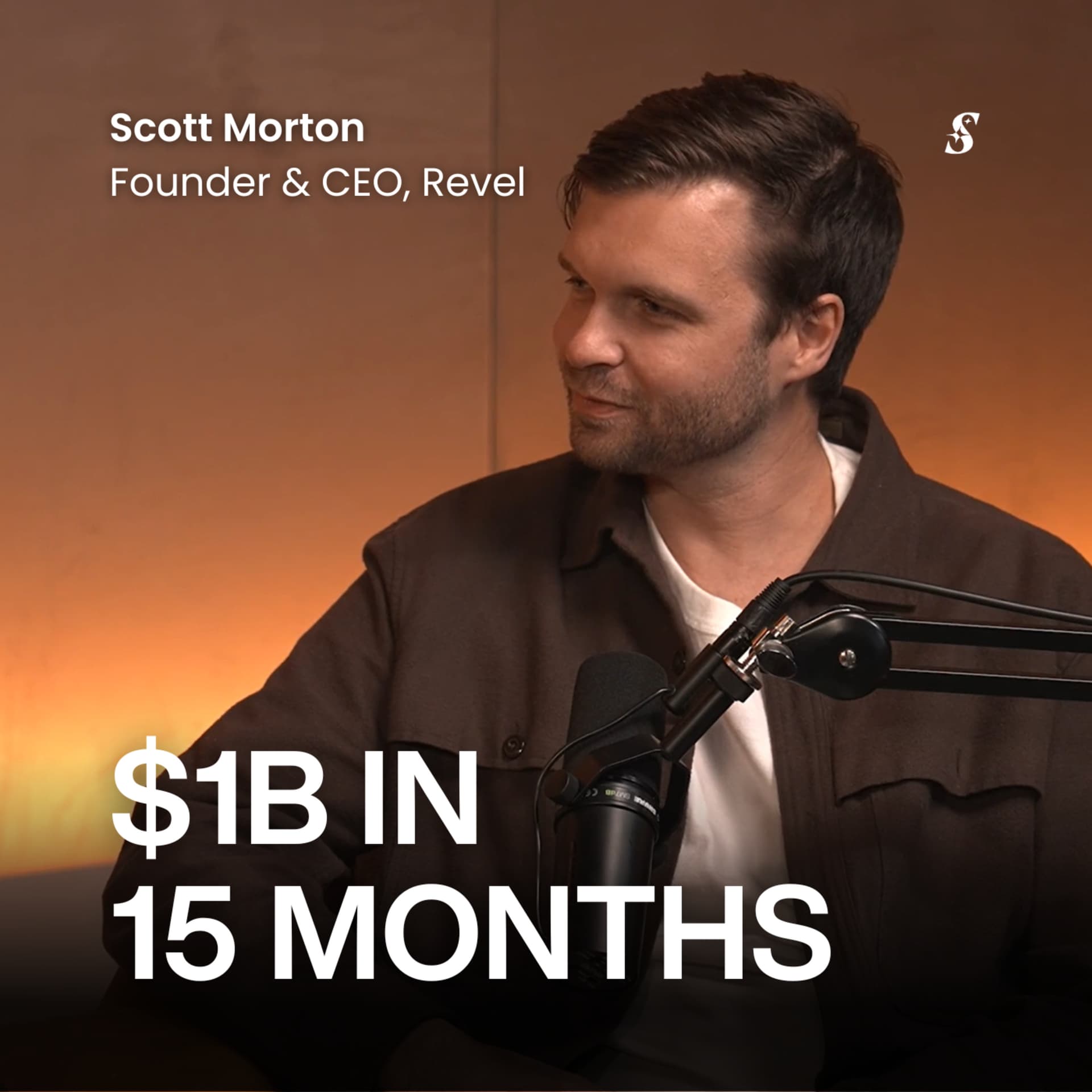

In short
Sourcery Podcast Episode Notes: From SpaceX to $1B in 15 Months: Scott Morton’s Revel Story
Episode Overview
- Podcast Title: Sourcery
- Episode Title: From SpaceX to $1B in 15 Months: Scott Morton’s Revel Story
- Episode Description: Scott Morton, Founder & CEO of Revel, discusses creating a unified software platform for modernizing hardware test and command systems in aerospace, defense, robotics, and advanced energy. Revel recently raised $150M at a $1.005B valuation, just 15 months after its founding.
Key Highlights
- Funding Success:
- Revel raised $150M led by Index Ventures, achieving a valuation of $1.005B in just 15 months.
- Other participants included Redpoint Ventures, Thrive Capital, and several angel investors.
- Scott emphasizes the importance of a "high conviction" investor team for rapid growth.
- Revel's Mission:
- Revel aims to modernize the outdated infrastructure used in hardware control and testing, much of which dates back to the 1980s and 1990s.
- The platform allows engineers to:
- Visually configure hardware systems
- Monitor live telemetry
- Issue commands in real-time safely.
Discussions and Insights Background of Scott Morton
- Previous Experience:
- Worked at SpaceX for nine years focusing on high-consequence control software.
- Designed systems like the propellant load sequence for the Falcon 9 rocket.
- Journey to Revel:
- Motivated by the challenges faced at SpaceX and the outdated tools in the aerospace industry.
- Scott's background in robotics and control software shaped his vision for Revel.
Revel's Impact
- Efficiency Gains:
- Scott highlights an example with Impulse, which increased rocket engine testing frequency by 5-10 times using Revel's software.
- The platform enables engineers, even interns, to quickly learn and implement control software.
Key Philosophies and Lessons
- SpaceX Influence:
- Scott shares a pivotal moment at SpaceX, the "T-minus 1 minute" scenario where precision in coding is critical, emphasizing the need for robust software systems.
- Lessons from Elon Musk include pushing engineers to explore beyond perceived limits, promoting innovative problem-solving.
- Customer Focus:
- Revel aims to work with dynamic companies that are leaders in their respective fields.
- Scott identifies companies like Radiant Nuclear and Astro Mechanica as key partnerships in their mission.
Future Outlook
- Plans for Expansion:
- Revel aims to continue scaling while maintaining a focus on quality and innovation.
- Scott expresses excitement about upcoming pilots and projects, indicating a strong market reception.
Conclusion
- Scott Morton’s journey from SpaceX to founding Revel highlights the intersection of aerospace engineering and software innovation. Revel’s rapid success and modern approach to hardware systems reflect a significant shift in the industry, aspiring to empower engineers with modern tools and efficiencies.
Additional Resources
- Follow Scott Morton: [Twitter](https://x.com/scottgmorton)
- Follow Molly O’Shea: [Twitter](https://x.com/MollySOShea)
- Sourcery: [Website](https://x.com/sourceryy)
- Episode Link: [YouTube](https://youtu.be/1MkfF1KrD7M)
Sponsors
- Brex: Modern finance platform for startups.
- Turing: Talent and tools for improving AI model performance.
- Deel: Global people platform for hiring and managing workforces.
- Public: Investing platform with AI-driven features.
Timestamps
- 00:00 - Introduction of Scott Morton
- 00:40 - Overview of Revel's funding and rapid growth
- 02:58 - Explanation of what Revel builds
- 05:23 - Efficiency improvements in rocket engine testing
- 07:26 - Designing Falcon 9’s propellant load sequence
- 09:12 - Importance of precision in control software
---
This markdown file serves as a comprehensive summary and insight into the episode, providing an organized format for readers to grasp the key discussions and themes presented.
Written by AI. May contain mistakes. Listen to the episode to check what was said.
Chapters
Tap a time to open that second in VORapid Fundraising Success
0:44 to 2:49
Scott Morton discusses his recent $150 million fundraising round for Revel.
“You recently just raised$150 million at a$1 ,005 ,000 ,000 valuation.”
The Birth of Revel
2:49 to 4:46
Scott explains how Revel was conceived and its mission to modernize control software.
“Can you just talk more, go deeper into how this all started?”
Transforming Hardware Testing
4:46 to 7:12
Discussion about Revel's impact on testing hardware systems and improving efficiency.
“And that's kind of the primary way that you would use their platform to write control software.”
Lessons from SpaceX
7:12 to 9:30
Scott shares his experiences at SpaceX and the high-stakes challenges he faced.
“Even interns, it seems, can get up to speed in a matter of minutes.”
Building Infrastructure for Success
9:30 to 10:19
Scott discusses the importance of having the right tools and infrastructure in high-consequence environments.
“And that's why, you know, we were really motivated to take, you know, and spend a lot of effort to go build totally new infrastructure.”
Innovative Engineering at SpaceX
11:48 to 14:01
Scott recounts how Elon Musk pushes engineers to exceed their limits.
“What's the biggest lesson you learned from Elon?”
Creative Problem Solving in Engineering
14:01 to 15:30
Explore how engineers can innovate creatively when faced with challenges.
“And this is what I was like, I'll say like, okay, they're like, this is just not working.”
The Agile Approach of Revel
15:32 to 16:20
Learn about the rapid decision-making process and tools used at Revel.
“similarly build these awesome tools and just make them available to all these teams, you know, startups as well as like, you know, teams inside big companies that are trying to move fast.”
Partnerships with Innovative Startups
16:21 to 18:19
Discover how Revel collaborates with startups and evaluates their potential.
“Like I almost feel like we're like mini VCs.”
Influence of Networks on Performance
19:39 to 20:30
Understand the importance of surrounding yourself with inspiring people.
“They're all about spending smarter, moving faster.”
Show all 11 chapters
Customer Feedback and Performance Evaluation
20:31 to 22:12
Hear about the critical feedback received from customers to enhance performance.
“So it's been really interesting talking with Dylan Field about, you know, kind of our strategy and like what are the key things to pay attention to and how we think about the product.”
Transcript
Automatic transcript. May contain errors.0:00Scott Morton:Aerospace, automotive, aviation, small modular reactor companies, chemical processing, anything where complex hardware systems are being developed. I think there's actually kind of a brain drain in this space. Like all these solutions were developed in the 80s and 90s and all the software engineers in the world got very excited about the internet. It's just like ancient tools. What if there was a company that could go and build something that's like three decades newer? At SpaceX, we ended up actually having to build all the infrastructure from scratch. Sitting on console, countdown clock is ticking down.
0:27Scott Morton:If the software is the bottleneck, that is a problem.
0:40Scott Morton, welcome to Sorcery.
0:42Scott Morton:Thank you. Glad to be here. Well, I think we have a big congratulations to give you today. You recently just raised$150 million at a$1 ,005 ,000 ,000 valuation. Yes. Yeah. Raised in this round,$150 million. Total raised$180 million. 15-month-old company. 15 months. Yes. That's it. Yep. It's been, yeah, full afterburners, full, yeah, over the past year and a half. Who led it and what was the process like? You've only been around for 15 months. That's very fast. So yeah, this is Index Ventures leading this round. They kind of came knocking and I got to know them the course of a few weeks. They came and actually saw a demo and loved what they saw.
1:29Scott Morton:I think overall, at least my philosophy on fundraising is we really want to have just a very high conviction team behind us. And I kind of also just don't want to kind of like span this out over 10 years. I want to go full maximum speed to execute on our vision. having high conviction I think means coming out and like uh putting you know putting your name on the line and that's kind of like what I think a preemptive round looks like on the investor side um so kind of instead of doing like a full process and you create this like competitive atmosphere where you may you might not actually get the highest conviction investor I think I like this this form of fundraising and then who did the seed and the series yeah so the seed uh was I would say kind of a haphazard fundraise, to be honest with you.
2:15Scott Morton:It was like I had, you know, left SpaceX and had actually just gotten married and then I kicked off a fundraise. But yeah, Felice is an abstract, co-led that one. And then it was May Thrive came in for a preemptive series A. And then this one was, it was actually index led. Red Point also has a big participation in this one, Alex Bard at Redpoint. That's phenomenal. I hope you know that. It's pretty incredible to be 15 months old. You were at SpaceX for nine years. Can you just talk more, go deeper into how this all started? And before we get too deep, obviously, I think the fundraising activity is super, super exciting, but we didn't talk about what Revel is.
3:01So could you explain what Revel is and how you started this.
3:04Scott Morton:So just real quick, Revel is a platform for controlling and testing hardware systems. And I think kind of going way back, I grew up building machines with my dad in the garage, could never actually kind of write the or make them do anything. Fast forward into college, I was worked at a research lab in robotics. And then kind of similar story, I could like, I could design the whole robot. I could even fabricate. I could machine it. But then I could not actually write the control software to go make it do what I wanted to do. So I ended up getting a computer science master's. I was a mechanical undergrad.
3:43Scott Morton:And then later at SpaceX, it was really interesting. It was essentially the same problem at a much larger scale. We needed to write a lot of control software for the launch site, for the rocket as well. and there were all these kind of solutions that had been developed over the 80s and 90s and that were some of them were in use at SpaceX but they were you know three decades old at this point and overall it's just like this space has just seen there's like I think there's actually kind of a brain drain in this space like all these solutions were developed in the 80s and 90s and then I think all the software engineers in the world got very excited about like the internet and worked on those problems.
4:23Scott Morton:And this kind of area kind of just fell by the wayside. And so at SpaceX, we ended up actually having to build all the infrastructure from scratch to actually have something that was modern and that also really helped us be more successful. Big companies that have been worked, that kind of came together in the 80s and 90s, like LabVIEW or National Instruments is one of the big ones. They actually built a kind of graphical programming language back in 1986. And that's kind of the primary way that you would use their platform to write control software. And then the other big space, that's kind of in hardware tests, the other big market is industrial control systems.
4:58Scott Morton:And it's actually this, it's like a very similar story. The kind of most modern tools were developed in, it's a language called structured text, invented in 1993. And that is still to this day, like the cutting edge in that space. And so these two big markets have kind of evolved totally separately with very different solutions. It's all actually fundamentally the same problem. It's just how does software control physical systems? Do you have any idea how much time you save for your customers? Yeah, great question. So Impulse, the first big deployment was actually their rocket engine test site, which was like their kind of big burning need at the time.
5:35Scott Morton:And the previous software, it was kind of one of the legacy solutions. They were testing about once every other day, and we've gotten them to over multiple times per day. So over a 5x rate increase, they're able to like rip through engine test campaigns at a rate that's like, yeah, 5 to 10x what they used to be able to. And it also replaces multiple systems. Yeah. So there's kind of, you know, this one's a little harder to measure, but like how they at least report, they're extremely happy with that. Like they have one platform that, you know, spans all these different systems. they can move engineers around.
6:09Scott Morton:Another really big part of the platform is that prior to Revel, normally these test systems mostly have to be built in-house. You're either going to use a legacy system that is super clunky and you have to have specialized engineers, or you have to just fully build it yourself. Our head of product is actually a former Palantir, Jess Winzinger. She came out to really figure out if she wanted to join Revel, and we took her to impulse and before i could do anything she like beeline she saw someone using rebel beelined it to uh it was actually an intern and uh and i couldn't like intervene it was like i was like like she just went directly to like the source and she started just asking him questions he didn't know that we were from rebel and one of the awesome things that came out she was like yeah i mean basically in 15 minutes i was able to get set up on on rebel i was able to quickly learn how to write control software.
7:02Scott Morton:And he was just standing at one of their test systems and just ripping on writing test software. And so I think that's really enabling engineers to be much more self-sufficient. Even interns, it seems, can get up to speed in a matter of minutes. And that's a huge, huge unlock for Impulse and also just helping them move faster. I joined SpaceX back in 2015, worked on a lot of the propellant load sequence for Falcon 9 which is you know I was like prior to that working on you know robots in a lab very low consequence you do something wrong you just broke break your robot and you have to go fix it but yeah this was really my first you know experience with really high consequence control software and it was it was an incredible experience for like I mean SpaceX just gives so much responsibility to the RE I was like I think I'd been there for one year and I was designing like the control algorithm for how SpaceX accomplishes this new scheme.
7:59Scott Morton:It's called loading go. It's how you and it's like loading propellants in the vehicle at base of the last second because that enables it to be as cold as possible and then as dense as possible. So it's like a really kind of high stakes operation. And like the situation is really like if the valve, you know, when you're loading propellant, the valve stays open just a little too long. You like don't have a launch site anymore. more. And so that was really, and I think this is really where like giving an engineer that level of responsibility is really how you sharpen the engineer. Like you like, you know, you have to ace it absolutely first shot.
8:34Scott Morton:And this is, this is the situation. I think that's my going through that. And no, thankfully it was all very successful. But I was like literally having to picture myself, I'm going to be on console. I'm going to be giving updates to launch director. This is like just a totally new system. No one even knew my name. The Dolphin Structure did not know what it was. And it was like essentially how, you know, how we tracked propellant load and how we closed that right on time, T minus two minutes. And so that kind of set the stage for really understanding how this needed to be done. Looking forward into Starship, we were really need to figure out like, what do we want for the long term at SpaceX?
9:12Scott Morton:T minus one minute is where my heart rate would always like, oh, we looked after the operation, like, where did you kind of freak out? And at that moment, it was always for me, I was like, wow, I'm about to have tens of thousands of lines of code execute. One character wrong in one of these lines of code is the difference between like total success and then like maybe no more launch site. like and you always like we always like look back and like try to read these you know the textbook examples of like the n1 rockets from the soviet era programs and you read about how like all the failures and like i honestly was thinking like man like it's total success or this could go down in the history books is like you know there's a sophomore mistake that took out starship in the launch pad it was really that scenario where you think about yourself in that situation and like what tools do you want to have that are going to help you be successful?
10:03Scott Morton:And that's why, you know, we were really motivated to take, you know, and spend a lot of effort to go build totally new infrastructure. And I think it really, at least for me, it was like picturing myself in that situation and what tools do I want to have that are going to maximize my chances of success. Sorcery is brought to you by Brex, the financial stack trusted by more than 30 ,000 companies, including one in three venture-backed startups in the U.S. Nearly 40 % of startups bail because they run out of cash. Rex is literally built to help founders avoid that. Unlike traditional banks that let your money sit idle, chipping away at it with fees, Rex is designed to help you spend smarter and move faster.
10:42Their all-in-one solution combines checking, treasury, and FDIC protection into one powerful account. You can send and receive money globally at lightning speeds, get 20 times the standard FDIC coverage through their partner banks, and even high yield from day one. With same day and even same hour liquidity, access your funds anytime. Companies like Scale AI, DoorDash, Service Titan, HIMSS, Anthropic, Flexport, Robinhood, and Plaid trust and use Brex. Start today at brex.com slash sorcery. That's B-R-E-X dot com slash sorcery. Turing is training the next generation of AI with tasks that require real expertise and real-world judgment.
11:26That's why companies like NVIDIA, Anthropic, Salesforce, and Gemini partner with Turing. Turing builds realistic reinforcement learning environments and data systems based on real operational traces, the kind of infrastructure Frontier Labs need to train superintelligence. Visit turing.com slash S-O-U-R-C-E-R-Y. What's the biggest lesson you learned from Elon?
11:50Scott Morton:Oh man, I have so many stories. but actually yeah actually there's a good one here so I think what Elon's really good at is he's really tapped into asking engineers to go further than they otherwise would have and then there's like a very like one of the most interesting examples is like we first orbital flight of starship we had this maneuver to separate the booster from the ship we call it the twig snap and it's where they just would kind of like uh it was like a it would kind of uh it essentially looked like a twig snap in space and uh it was a very not efficient way to do it and um and he for flight the next flight he was like we're gonna do hot staging which is where you literally start the starship engines while it's still connected to booster and just blast the booster and coming out of like we all thought like okay cool we're gonna like do the same exact uh con ops conceptual operations for the next flight of course like we're just gonna go nail at this time right like no we're gonna go do hot staging on the next flight and it was like I was actually like sitting outside of the I wasn't in this email meeting but I was outside I saw everyone walk out and they were all just like oh my god like how are we gonna do this and then like that week like like CAD screenshots getting started getting like shot around and people like you know I'm sure everyone was like oh this is gonna be really difficult and then throughout the course of the week some really awesome ideas started coming up and then it started to look more and more feasible and this and they're like and then they're like how would you manufacture this and how would you know how would this all go together and they ended up inventing like just out of nowhere a new stage that would sit between the booster and the shit called the hot stage that would just take the blast and then that would get ejected on re-entry for booster and it worked first shot and we were all i just remember the vibes at spaces were just like oh my like how and how in the hell are we going to go do this but i think the big lesson there and that I've also pulled forward to Revel is that, you know, when engineers come to you and say like, hey, this is just like, we can't get this to work.
13:52Scott Morton:Like, this is just not possible. I think pushing them to just like, say like, well, why don't you spend two more days thinking about it? And let's see what comes up. And if nothing, you know, we'll think about it then. But I think engineers really underestimate like their ability to like creatively problem solve and just come up with new ideas that they otherwise never would have thought of when they're kind of presenting on what they think is possible in the moment. And this is what I was like, I'll say like, okay, they're like, this is just not working. We don't think this is a path. We're like, okay, let's spend one more day thinking about it.
14:26Scott Morton:And oftentimes there'll be some breakthrough that no one kind of saw coming. I don't know how someone hasn't made a movie about this. There's just so many stories. I wish, I mean, early Starship was like hopper days. it was like literally an episode of the office
14:47Scott Morton:and actually honestly this is like a good like another big i think for me realization of that really carried forward into revel was like at that time it was a really small team actually for starship it was like i was like the software guy down in boca chica texas you know now known as starbase and there were like a number of other key hardware engineers but the awesome thing is like we were, you know, as this tiny team, we were able to make decisions super quickly and just like, you know, make a decision. And that was it. There wasn't this like big review process, but what was really awesome is we were able to like the tool, it was like tiny team, but we had the tools of SpaceX.
15:22Scott Morton:And we also had this, all this awesome new infrastructure, but seeing how fast a team could move, like a tiny team like that can move with awesome tools is another big inspiration behind Revel. And like, that's, you know, what if we could like similarly build these awesome tools and just make them available to all these teams, you know, startups as well as like, you know, teams inside big companies that are trying to move fast. Do you want to keep Revel small? How big do you want to scale the team here? You know, I think we'll scale as big as we need to to complete the mission. Okay, fair answer.
15:52Scott Morton:Yeah, we've been kind of honestly trying to work with like the best startups are definitely and like I'd say more scaling startups are definitely really fast to adopt. Once they're convinced, it's like, you know, that's it. And so we've tried to work with like the best scaling startup in each space. So Impulse and K2 space are awesome in satellites. I think Radiant is doing really well on small modular reactors. Astromechanica is another one we're doing their jet engine test facility. And so I think it's like balancing working with companies. Like I almost feel like we're like mini VCs. We have to like, we have to think about like, is this team moving really fast?
16:29Scott Morton:Is this, you know, a company that we really want to invest in ourselves? Yeah. So definitely like for us, you know, we're looking at, you know, working with the best teams that are really taking it seriously to move fast. Because I think that's where we can provide the most value as well as if they're trying to move fast. Like, all right, that's what our platform does. If you could pick anybody to be a customer, who would you pick? Could be multiple people. We're in LA, you have to man FF. We're actually, we're trying to do a wastewater treatment company now. It's been an interesting, I don't know if we talked about this, but there's like, you know, we actually have kind of soft launched another product.
17:06Scott Morton:So we have Revel Test, which is focused on test systems, and those span the different kind of verticals, automotive, any kind of automotive, aerospace, aviation, defense. And there's like industrial control. And that's what we have. Our platform actually looks very similar, except for like the software is very similar, but the actual hardware and how we deploy in the architecture is quite different. That's actually what Radiant is using. is we call it REVEL C2, which is C2 stands for Command and Control. And so it does things like high availability where we have primary backup systems. We have data logging redundancy as well.
17:43Scott Morton:And we also have what we call a repeater, which is where you have another system back kind of at HQ. If you have like, I'm sure when Radiant goes critical, they're going to have a lot of people wanting to watch that live, just like SpaceX does. And you don't want to have all that load go on to the system that is used for control. So we have this system that enables many people to then access it that is not going to put the control system at risk. So in terms of like dream customers, I think, I also think, I think Exxon would be awesome. I think helping the energy space and specifically in industrial control systems.
18:19Good answer. Okay. Some of you may not have heard this yet, but our sponsor Public just launched something called Generated Assets, And it brings AI into investing in a way I've honestly never seen before. Here's how it works. You type in an idea like AI-powered supply chain companies with positive free cash flow or defense tech companies growing revenue over 25 % year over year. Publix AI then dispatches a swarm of agents that scan every single US stock, evaluates them, and instantly builds a custom index around your thesis. What really stands out is how clearly it explains why each stock is included.
18:52And before you invest, you can even backtest your idea against the S &P 500. So you're making decisions with real context, not just guessing. And beyond generated assets, Public lets you invest in stocks, bonds, options, crypto, all in one place. They'll even give you an uncapped 1 % match when you transfer your investments over from another platform. If you want to build a portfolio that actually reflects your thesis, visit public.com slash sorcery. Paid for by Public Investing. Full disclosures in the description. Founders ship faster on deal. Set up payroll for any country in minutes. Hire anyone anywhere.
19:27Get visas handled fast and get back to building. Visit deel.com slash sorcery. That's deel.com slash S-O-U-R-C-E-R-Y. So as we close out, I love to ask this question for one of our sponsors. It's Brex. They're all about spending smarter, moving faster. All about performance. The intelligent AF finance platform.
19:50Scott Morton:Okay. Do you remember that? I think so. You went down? Okay. So one thing that I think is so important for performance is who you surround yourself with. And so who are some people or maybe one person that you admire or people in your network that you keep close to keep you motivated? So Dylan Field is actually a pretty big investor in Revel. And it's been super interesting. I think what they did to design, like design is everyone's business, what they did for that space is actually a really good analog for what we're doing in these hardware control systems, where we're really lowering the barrier to entry for engineers, but enabling any engineer to go in and set up one of these systems, build control interfaces, write the code themselves, and just be fully self-sufficient.
20:41Scott Morton:So it's been really interesting talking with Dylan Field about, you know, kind of our strategy and like what are the key things to pay attention to and how we think about the product. Amazing. Good answer. I was not expecting that. Dylan's awesome. Yeah, he is awesome. What are you most looking forward to in the next 12 months? We have so many pilots that have stacked up and I am like just every pilot is actually converted. We're at about a thousand so far. Wow. Yeah, we do. So is that why you have a billion and five million? Might have something to do with that. Yeah. I mean, we, it was pretty interesting from index.
21:17Scott Morton:They shared some of the background research and it was all, I was like, I had to share the team. I was like, really? Yeah. I mean, so far it seems like everyone loves what we built. We kind of also go ask them to grade us. There's actually this, the engineer at aster Mechanica is this guy named Matt Perkins. And he was actually with me early starship. He was, so he and I was like the software guy. He was the avionics lead. And I asked him, hey, so how do you think we're doing? Like, what do you think so far? And it was pretty, it was actually pretty early. This was like maybe five months ago. He's like, I give you guys an A -.
21:49Scott Morton:And I was like, no way. Like, we got an A - from Matt Perkins. And I took that around. I was like, then I went to other engineers. And I was like, Matt Perkins gave us an A -. And that's like, I mean, Matt giving you an A - is like incredible. So that was pretty sweet. And he, you know, he's definitely not one to, you know, give out compliments. He's like he he's has a very high bar. So that was pretty sweet. OK, sounds like we got ahead in A plus this year. Yes, we are. I think I mean, the platform's come a long way since then, too. So I think we'll have to ask him again. Fantastic. Thank you so much, Scott.
22:20And congratulations.
22:21Scott Morton:Thank you. This is awesome. Hey, it's Molly. If you enjoy our interviews, check out our newsletter, Sorcery.vc, where we deliver a once a week top deals and tech headlines email and also go deeper on our podcast interviews. Subscribe to Sorcery today and don't forget to subscribe to the podcast on YouTube, Spotify, Apple, or wherever you listen. Link in description to sign up.
From the publisher
Revel just raised $150M at a $1.005B valuation — only 15 months after founding.
In this episode of Sourcery, I sit down with Scott Morton, Founder & CEO of Revel, to unpack how he went from designing high-consequence launch control systems at SpaceX to building the unified software platform modernizing hardware test and command systems across aerospace, defense, robotics, and advanced energy.
The $150 million in Series B funding is aimed to accelerate its expansion across aerospace, defense, robotics, and industrial markets. The round was led by Index Ventures, with major participation from Redpoint Ventures and returning investors Thrive Capital, Felicis, and Abstract Ventures, as well as prominent angels such as Dylan Field, Figma's co-founder and CEO.
Revel replaces decades-old infrastructure — much of it built in the 1980s and 1990s — with a modern platform that enables engineers to visually configure hardware systems, monitor live telemetry, and issue commands safely in real time.
We cover:
Why Index Ventures led a preemptive $150M Series B
The SpaceX “T-minus 1 minute” moment that shaped Revel’s philosophy
How Revel helped Impulse increase rocket engine testing frequency by 5–10x
The difference between Revel Test and Revel C2 (Command & Control)
Lessons from Elon Musk on pushing engineers beyond perceived limits
Why Dylan Field (Figma) is a key investor and strategic sounding board
Revel is now working with companies like Impulse, Radiant Nuclear, Astro Mechanica, and others building mission-critical infrastructure for the autonomous age.
This is the story of modernizing the software layer behind physical systems — where one character of code can mean total success… or no launch site.
Subscribe to Sourcery for more deep dives into the founders building the next industrial era.
Scott Morton: https://x.com/scottgmorton
Molly O’Shea: https://x.com/MollySOShea
Sourcery: https://x.com/sourceryy
𝐄𝐏𝐈𝐒𝐎𝐃𝐄 𝐋𝐈𝐍𝐊
YouTube: https://youtu.be/1MkfF1KrD7M
𝐒𝐏𝐎𝐍𝐒𝐎𝐑𝐒
• Brex—The modern finance platform, combining the world’s smartest corporate card with integrated expense management, banking, bill pay, & travel. https://brex.com/sourcery
• Turing—Turing delivers top-tier talent, data, and tools to help AI labs improve model performance—and enables enterprises to turn those models into powerful, production-ready systems. https://turing.com/sourcery
• Deel—Deel is the global people platform that helps startups hire, manage, pay, and equip anyone, anywhere. Trusted by more than 35,000 fast-growing companies, Deel is the people platform that just works, so teams can scale without the chaos. Visit: https://www.deel.com/sourcery
• Public–Investing platform Public just launched Generated Assets, which lets you turn any idea into an investable index with AI. With Generated Assets, you can build, backtest, refine, and invest in any thesis with AI. Gone are the days of one-size-fits-all ETFs. https://public.com/sourcery
Follow Sourcery for the latest updates!
Disclosure
Paid Endorsement. Brokerage services by Open to the Public Investing Inc, member FINRA & SIPC. Advisory services by Public Advisors LLC, SEC-registered adviser. Crypto trading provided by Zero Hash LLC, licensed by the NYSDFS. Generated Assets is an interactive analysis tool by Public Advisors. Output is for informational purposes only and is not an investment recommendation or advice. See disclosures at public.com/disclosures/ga. Matched funds must remain in your account for at least 5 years. Match rate and other terms are subject to change at any time.
𝐓𝐈𝐌𝐄𝐒𝐓𝐀𝐌𝐏𝐒
(00:00) Scott Morton, Founder & CEO at Revel
(00:40) Raising $150M at a $1.005B valuation in just 15 months
(02:58) What Revel actually builds
(05:23) 10x faster engine testing by replacing legacy systems
(07:26) Designing Falcon 9’s propellant load sequence
(09:12) T-1: When every line of code has to be perfect


