
In short
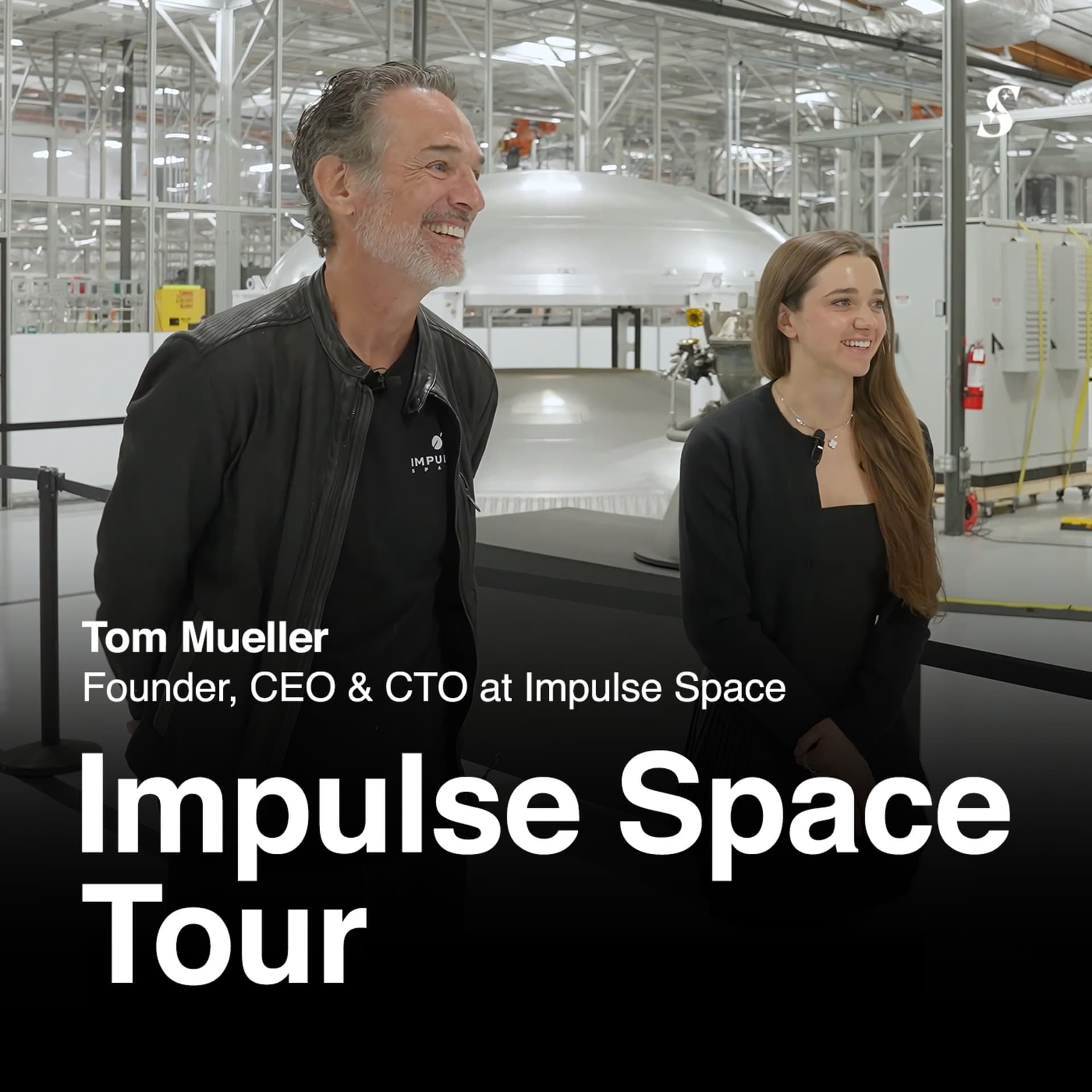
Founder Tom Mueller tours Impulse Space’s factory and explains its in-space transportation products and propulsion development, including Mira (orbital maneuvering) and Helios (high-energy orbital transfer), plus engine and tank manufacturing (3D printing, COPVs, and test stands).
Guest backgrounds
Tom Mueller is a founding SpaceX employee who led propulsion development for Falcon and Dragon and helped originate Starship; he worked on Starship for six years. He also built amateur rockets and met Elon Musk through that work.
Key claims
Impulse’s next step is moving cargo in space (not Earth-to-space). Mira can maneuver fast with eight ~6-lb thrusters and steer via pulsing (PWM). Helios uses a 12-ton LOX/methane tank and a ~15,000-lb engine to raise payloads from LEO to GEO and improve Mars payloads up to 5x. Deneb is an ox-rich staged-combustion engine expected to be among the highest-performing hydrocarbon engines flown. Vertical integration enables rapid build/test/iterate.
Notable examples
Mira rendezvous within 1200 meters; collision avoidance using Air Force/LeoLabs tracking; vacuum thruster firing in a chamber; 3D-printed Inconel/Novaloy engine parts; COPV tanks (including VAST station propulsion system); electric propulsion hall thruster test showing ~10^-6 torr vacuum.
Written by AI. May contain mistakes. Listen to the episode to check what was said.
Chapters
Tap a time to open that second in VOTom Mueller's Background and Impulse Space
0:00 to 0:35
Learn about Tom Mueller's experience at SpaceX and the formation of Impulse Space.
“I led the development of the propulsion systems for Falcon and Dragon and also started the origins of what became Starship.”
Cars and Personal Insights
0:52 to 2:32
Tom shares his car collection and personal anecdotes.
“Okay, so before we start, I believe we're in a very special part of the office.”
Tour of Impulse Space's Facilities
2:32 to 4:31
An overview of the avionics clean assembly area and its purpose.
“So this is the avionics clean assembly area.”
Mira: The Orbital Transfer Vehicle
4:31 to 7:58
Detailed insight into the Mira prototype and its capabilities.
“So Mira is a highly propulsive orbital transfer vehicle.”
The Deneb Engine and Development Insights
7:58 to 13:12
Discussion of the Deneb engine's design and development process.
“For those who don't know your origin story for Impulse and why you've decided to go after this after SpaceX.”
3D Printing in Rocket Engine Manufacturing
13:12 to 14:01
Exploring the advantages of 3D printing in rocket engine production.
“You need something like this to do these, you know, big payloads to, you know, to space.”
3D Printing Innovations in Rocketry
14:01 to 18:20
Learn about the advantages of 3D printing in rocket engine design.
“Started the company within the first year we bought it.”
3D Printing Innovations in Rocketry
18:28 to 19:24
Learn about the advantages of 3D printing in rocket engine design.
“Nearly 40 % of startups fail because they run out of cash.”
Machining and Manufacturing Techniques
19:25 to 19:47
Explore complex machining processes used for rocket components.
“That's why companies like NVIDIA, Anthropic, Salesforce, and Gemini partner with Turing.”
Machining and Manufacturing Techniques
19:52 to 24:46
Explore complex machining processes used for rocket components.
“There's a turbo pump part for the Deneb engine.”
Show all 14 chapters
Testing and Assembly of Rocket Engines
24:47 to 28:00
Understand the assembly and testing process of advanced rocket engines.
“Like, Raptors cast, because they're big parts.”
Rocket Engine Testing and Performance Metrics
28:00 to 37:03
Learn about the dynamics and metrics involved in testing rocket engines, including cooling mechanisms and performance evaluations.
“So we're six seven sixties of atmosphere.”
Future of Computing and Space Data Centers
38:50 to 42:00
Discuss the potential for data centers in space and the importance of moving computing resources off Earth.
“I think it's going to take a while before it's straight-up cost competitive with terrestrial.”
Discussing Roles and Excitement for Lunar Exploration
42:00 to 43:32
Learn about the roles in aerospace and the importance of lunar exploration.
“If you didn't have your role as CEO, which job of all these jobs would you want?”
Transcript
Automatic transcript. May contain errors.0:00I was a founding employee at SpaceX. I led the development of the propulsion systems for Falcon and Dragon and also started the origins of what became Starship. My proudest development was the Merlin engine, which is currently flying on Falcon 9, the most reliable rocket engine ever developed, and also the highest thrust weight of any rocket engine ever developed. I worked on Starship for the last six years at SpaceX. So when I left, I had the plan of launch mostly being solved or being solved. Like the next big opportunity is to move all that payload, all that cargo around in space. So I started Impulse Space to do in-space transportation as opposed to from Earth to space transportation, which was SpaceX.
0:34We feel like the next step is in-space transportation, including to the moon and landers on the moon.
0:49Tom Mueller, welcome to Sorcery. Thank you. Great to be here. Okay, so before we start, I believe we're in a very special part of the office. What are we standing on right now? Oh, you mean right here? Yeah. This used to be my parking spot. This was your parking spot? But now we moved to new offices. Now I lost my parking spot. No. Okay, so I want to know, and we'll get into impulse in a second, but could you name every car model that you own? Oh, I have about five 911s from various models. RSR, three GT3 RSs, two R race cars, and a 64, like a first year. How many was that? That's like more than five.
1:37Two Ferraris, a F40 and a 458. A Lotus, 66 Lotus Elan. Three 9-6-2s, one in pieces being put back together. Porsche 9-6-2 race cars. Two Tundra trucks. No, two Raptor trucks. Used to have a Tundra. One's in Idaho. And a whole bunch of dirt bikes. I probably missed a car too. Oh, the one I used to park here, my Taycan, which is probably gonna get lemon-laught right now because it's broke for the third time. Love that car except for the braking part. Well, I think you're properly warmed up. So we're in Impulse right now. You have another facility here in LA, but right now I'd love for you to walk us through and tour Impulse for us.
2:31Sure. Okay. Okay. So this is the avionics clean assembly area. So this is where basically all the avionics and go on our spacecraft, get assembled and tested. You can see there's a vault right there that's getting ready to go into maybe thermal back or electrical test, something going on with it. So this is set up for high production rate for Mira and the other spacecraft. Let's go talk about Mira. Okay. So you also in your garage make your own rockets? I do. I have been doing that for a long time. Yeah. In fact, that's how I met Elon was through the amateur rocket stuff that I was doing.
3:11Tom Mueller:Yeah. But I like to make prototypes for, you know, just to get some pre-production data on things that we're doing here. So I've done a few things in my garage. Yeah. One of the things that I learned from our interview with Eric and research ahead of time was how fast Impulse has for iteration and testing and development. Yeah. It's really core to the business and vertical integration. Being extremely vertically integrated. Having the machine shop right here with the assembly areas and just really rapid prototyping, test area out back so we can build, assemble, test, and iterate. And so as we walk through, what are we going to see today?
3:53Could you just give us a little run through? Yeah, the assembly area out here where we'll see spacecraft like these being assembled. And then our next product, which is Helios, which is right over there in that area being assembled. Then we'll go back to the machine shop where the actual parts are made and then in the back is The propulsion assembly area where the propulsion products are put together and then tested back there in the test area We're gonna see a rocket engine test today back there and yeah should be pretty cool. Amazing. All right. Well starting here This is the mirror. So this is a This is our mirror prototype.
4:30So this is one we can have out here that you can actually touch so So Mira is a highly propulsive orbital transfer vehicle. So it's got these thrusters, actually, these thrusters, two on each corner. So it's got eight of these thrusters. They're about six pounds of thrust each. So total of almost 50 pounds of thrust, which for a small spacecraft like this is a lot. That's good enough to move around in space very fast. Inside the chassis, we've got three propellant tanks, two oxidizer tanks, and a fuel tank in the middle that feeds these thrusters. It's got the solar panels which unfurl and they're steerable so you can point the spacecraft wherever you want and still have the power positive pointing at the sun with the solar.
5:11The avionics that we just talked about being assembled in there are all in this box down here we call it the vault. We keep them all in one box. And it's got, these are reaction wheels which are basically flywheels with a motor that you can actually very precisely steer the spacecraft with. and then there's a bunch of antennas and stuff that go on this which you can see on the flight vehicle in there so they've got red hats on a red red removed before flight covers on but those are antennas so we can talk to the spacecraft it's got the multi-layer insulation or MLI that that gold foil that thermally protects it keeps it it's kind of makes it like a thermos bottle it's really when that when that gets into vacuum of space it acts like a thermos bottle really thermally isolates the spacecraft.
5:59Here's some flight solar panels right here that are assembled and ready to integrate onto the spacecraft. So we've got I think three spacecraft being built up in there right now in various states of assembly. We can see the one back there if we walk this way. And then we can talk about Helios. Yeah here's another one that's... Oh wow. Got a team working on it. Yeah, wow. This I believe is the next one to go up here. It's going up later this fall. So you have three in orbit? We have three on orbit right now. We did a rendezvous last year between two of them. Got within 1200 meters of each other, which is really damn close in space.
6:41Yeah, got some cool pictures. We know right where it's at. They're all alive. We have GPS so we know where they're at, what their state is.
6:52So, Mira is our space maneuvering vehicle that can stay up there for five years, but then we have a vehicle to get you there and that's this. This is Helios. So Helios is basically a tank of propellant. That tank right there holds 12 tons of liquid oxygen and liquid methane. And then we have a very high performance engine that goes on the bottom of it that you'll see back there that provides 15 ,000 pounds of thrust. This can take a large satellite, like a four-ton satellite, from low earth orbit at a couple hundred miles up to geosynchronous orbit at 22 ,000 miles. So basically it's escaping most of the gravity well of Earth.
7:39Very high energy
7:40Tom Mueller:transfer. It can take, you know, five tons of payload to the moon on a Falcon 9. It can improve your payload to Mars by up to a factor of five. Yeah, just it basically adds a third stage to a two-stage rocket. For those who don't know your origin story for Impulse and why you've decided to go after this after SpaceX. Can you share more on that? Sure, yeah. I was a founding employee at SpaceX. I led the development of the propulsion systems for Falcon and Dragon, and also started the origins of what became Starship. Probably my proudest development was the Merlin engine, which is currently flying on Falcon 9, the most reliable rocket engine ever developed, and also the highest thrust weight of any rocket engine ever developed.
8:35But I worked on Starship for the last six years, that SpaceX. So when I left, I had the plan of, you know, launch mostly being solved or is being solved. It's like the next big opportunity is to move all that, all that payload, all that cargo around in space. So I started Impulse Space to do in-space transportation as opposed to from Earth to space transportation, which was SpaceX. So we feel like the next step is in-space transportation. including to the moon and landers on the moon, which we're also bidding on. Going to the moon? Going to the moon. I'm all about the moon. And so one of your engines is over here.
9:15Yeah, let's go look at it. So these are domes that go on these are tanks. They're not alien spacecrafts. They're not alien spacecrafts. No, they look like flying saucers, don't they? Yeah, so three of those are in that tank to make up the liquid oxygen and the methane tank. Yeah, so this is the Deneb engine. Deneb is the name of a star. Rigel, another engine that we're developing, you'll see back here, is the name of a star. We named all and the little the little engines that you see on Mira are safe. Those are really cute. S-A-I-P-H which is also a star in Orion. So we name our engines after stars.
9:54So this is Deneb, which is a blue supergiant star and this is our super giant engine. This engine makes about 15 ,000 pounds of thrust. It's pump fed so it's got the turbo pump there on the back and it's ox rich stage combustion. So all of the liquid oxygen off the pump comes out of this line. There's a valve missing here but through the main ox valve into the pre burner where it gets burned with a little bit of the fuel, liquid methane. So we burn all the oxygen with a little bit of fuel which makes hot oxygen at about 4 ,000 psi, which goes into that housing, drives the turbine, which provides 1 ,500 horsepower to run the turbo pumps.
10:36Then the hot oxygen off of the turbine comes across this transfer tube
10:41Tom Mueller:and into the main injector. The fuel, other than the little bit that goes into the pre-burner, goes through this main valve into a bunch of cooling channels inside the combustion chamber to cool the combustion chamber and then goes in as hot gas into the injector and gets burned with the oxygen. So that's how the cycle works, Oxrich stage combustion. This engine will probably be the highest performing hydrocarbon engine ever flown because it has a very high area ratio. The way you get ISP is you have very high mixing efficiency, which this is designed to be a very very good mixing gas gas main injection very fine injector and then it has a huge skirt when you see the engine back there it's got a big carbon skirt on it so this is this is only half the engine by height it'll have a it'll have a carbon skirt that'll glow white hot that gives it area ratio that that nozzle converts pressure into velocity which is pure performance so the more expansion nozzle you can have the more performance you get what is the development process like been with this.
11:45I know you have land in Mojave too, so do you have to do something special when you're testing it there? A lot special. Difficult engines. Oxbridge stage combustion is a very difficult development. So right now we're finishing up the turbopump development and just starting to get into engine testing. So we're just getting there. Yeah. Exciting. How long have you guys had the land in Mojave? A couple years now. Yeah. We started with Rigel there, a little 200 pound thruster, and then moved to onto this in the last year. What's your favorite part? What's my favorite part of this thing? The main injector.
12:27I'm pretty proud of the main injector. It's a very fine mixing. I think we're going to find out it's going to be a real high class engine. We've got the design team, the test team, the manufacturing team. We've got the valve team. It's a bunch of pieces that come together. There's even an avionics box. There's an engine controller, so there's even an avionics contribution to this. But this is the heart of the stage, and this engine will probably become our prime mover. This engine, very high-performance, high-thrust engine. Imagine if we built a bigger version of this with multiple engines or say in the farther future, say a human lander would have several of these engines to land on the moon.
13:16You need something like this to do these, you know, big payloads to, you know, to space. So this is going to be our prime mover. Cool. So should we see how it's built? Yeah. It's all, it's in fact, while we're here, it's mostly 3D printed and you'll see. 3D printed? Yeah. Really? It's 3D printed right here. Wow. Yeah, so I'll show you the 3D printed part. It's actually easier to show you the parts that aren't 3D printed. Okay. This part right here is hydroformed. This part right here is machined. Everything else is 3D printed. So this part, this part, this part, all these parts, and this part, and this part are all 3D printed right back here.
13:58This is the igniter that lights it, 3D printed. When did you get into 3D printing? Is this just the core? Started the company within the first year we bought it. Really? Yeah. When did you? The little thrusters on there are completely 3D printed. You'll see them back here. I heard you make little party cups out of those ones. Yeah, yeah, yeah. They make little shot glasses. That's amazing. I'd love to get into more of the knowledge that you've built along the way. So you prefer 3D printing. What are some other aspects that are for? Let's talk about 3D printing a little bit. For rocket engines, it's almost like a cheat code.
14:37It's so easy to make a high-performance rocket engine or 3D printing because the rocket injectors and the cooling passages are pretty small and complex. So to make a rocket engine by machining and assembling and welding and brazing is really difficult. With 3D printing, you just basically draw the fluid passages you want and then put a wall around it and just print it. It's whatever you draw, you know, within reason you can make. So it just makes making rocket engines really easy. But we still have to do a lot of machining. But before we get to the machine shop, I want to talk about this. These are composite overwrapped pressure vessels, our COPVs.
15:21So these are the lightest way to make a propellant tank or a gas tank, a high-pressure tank. Because we wrap the carbon, which you can see happening on that machine back there. Yeah. The carbon fiber is extremely strong. So we have an aluminum liner that seals the propellant in, and then a carbon overwrap that holds the pressure. So a properly designed COPD will be about half the mass of a state-of-the-art all-metallic tank, like a titanium spacecraft sphere. The carbon is so much stronger, it'll actually be about half the weight. So we brought this in-house early on too, along with 3D printing, just because a major portion of the spacecraft mass is the tanks for the propellant.
16:03And we want to be able to control the, you know, the quality and the quantity and the cost. So here they are. We're making, these are, these are tanks for the Mira spacecraft. The bigger one there is a tank for VAST space station. We provided the whole propulsion system for VAST, including the thrusters. And then the one that's getting wrapped there, it will be a very high pressure, like a 5 ,000 psi helium tank for the Helios vehicle to pressurize the tanks. So everything from 1 ,000 psi for the spacecraft up to 5 ,000 psi for the helium tank.
16:40Tom Mueller:Wow. These things are really hard to get typically from industry. Like if you wanted to buy one of these, it might take, you know, after you order it, it might take a year or two to get them and be hundreds of thousands of dollars a piece. How do you find the talent to build them? We learned. Mostly it was guys that hadn't done it before. So we bought the winder and learned. And then we've since hired people that run the winders before and stuff. And so people have carbon experience. But we mostly learned. We had a consultant come in and show us how to design properly. And a lot of cut and try.
17:19You saw the one that we burst back there? Yeah. Yeah. So you make one, you blow it up, find out how you did, and then design from there. Where does software come into the development piece for you? I know, like, I would even love to learn about the long tail of that. I mean, clearly you've seen a couple eras of space. Well, in 2026, you can't have modern hardware without software. So the spacecraft has, you know, has autonomous software on it. We use AI for coding and for design. We use pretty powerful generative software for 3D printing. So, you know, everything, you know, like the machines here all are running on software to do the machining.
18:12So a lot of software. Big IT department. Okay, so what are we going to see through here? I know there's one machine we're not allowed to see, but... Yeah. Sorcery is brought to you by Brex, the financial stack trusted by more than 30 ,000 companies, including one in three venture-backed startups in the U.S. Nearly 40 % of startups fail because they run out of cash. Brex is literally built to help founders avoid that. Unlike traditional banks that let your money sit idle, chipping away at it with fees, Brex is designed to help you spend smarter and move faster. Their all-in-one solution combines checking, treasury, and FDIC protection into one powerful account.
18:52You can send and receive money globally at lightning speeds, get 20 times the standard FDIC coverage through their partner banks, and even high yield from day one. With same day and even same hour liquidity, access your funds anytime. time. Companies like Scale AI, DoorDash, Service Titan, HIMSS, Anthropic, Flexport, Robinhood, and Plaid trust and use Brex. Start today at brex.com slash sorcery. That's B-R-E-X dot com slash sorcery. Turing is training the next generation of AI with tasks that require real expertise and real world judgment. That's why companies like NVIDIA, Anthropic, Salesforce, and Gemini partner with Turing.
19:36Turing builds realistic reinforcement learning environments and data systems based on real operational traces, the kind of infrastructure Frontier Labs need to train superintelligence. Visit turing.com slash S-O-U-R-C-E-R-Y. Let's see what we got on here. There's a turbo pump part for the Deneb engine. So this is what's called a mill turn. So that table can spin fast and you can actually run it like a lathe where you can just single point turn the bore, which I believe he's doing now. Yeah, he's putting a boring bar on it to turn the bore. That way you can turn all the all the different bores in there, the different diameters at the same time and have a very precise and concentric machine.
20:23Yeah, see that's the boring bar there. So it doesn't spin, it just holds stationary and the part turns and that's a lathe basically. Then on the same setup, it's a milling machine. So they'll replace that boring bar with a milling cutter and then it's a five axis milling machine so they can go and they can cut the ports and the bolt holes and the ceiling surface and everything. So in one setup you can machine, you know, like three quarters of that part. Then you flip it over and hit the backside and it's done. So really you've got two of these machines and another one similar back there. so a lot of these machines because they're very very handy for making parts like this.
20:58I think we're going to go see a copper liner back there. Yeah.
21:05Yeah, the inside of the dead of engine, the combustion part is made of copper, just like the bottom of your cooking pans is, because the heat transfer inside the combustion, inside the combustion chamber is so intense that only copper can get the heat out without melting. So we start with big forgings of copper like this right here. Wow. And then they go on this lathe right here to turn them down, to thin them out, to make them very thin. And then they... can't see that machine. Then they go on that machine over there and they get slotted. Which Lee is going to make, stop them from filming. Yeah, we can see that.
21:47So we start with these forgings that weigh about 700 pounds and the final slotted product weighs about 25 pounds. That's some pretty strong employees. Yeah, and there's all the chips that we end up generating. Oh, those are pretty. And then we have a big milling machine here to make big parts like that. The Mira chassis, all that aluminum on the Mira is made right here on this machine. So this is our big mill. This is huge. It's huge. How did you get this in here? You can machine a motorcycle on this thing. Oh my god. Yeah, it's huge.
22:27Did we see the 3D printers yet? Or are we gonna... We're right there. Okay. Yep. So see this part right here? This is the payload deck for Mira. So we call it the pegboard. It's got all these bolt holes so you can bolt anything to it. That's done on that mill right there. How did you get to this design? Was this original or did you have to go through the... And this is like our sort of like for a development mirror, like our demo flights where you can mount anything. Like you have a whole bunch of hosted payloads. If we have a specific mission where they just have one payload in the middle, we actually redesigned this to get rid of some mass.
23:05Okay. So it can be custom fit to whatever your payload is. And this is the one size fits all. You can put anything on it. Try payload deck. Okay. Let's talk about 3D printing. So this is a 3D printing lab. So we've got three 3D metal printers in there. Wow. This machine right here prints Inconel, which is a nickel alloy, a pretty common nickel alloy. And it prints the little safe thrusters. You can see them there. In fact, over here is an even better one. Right here are the safes as they print on a plate. And then we cut them off and machine them and add the igniters and the valves and everything.
23:45They're all 3D printed, the injector, the combustion chamber, everything's all printed in one piece. And then these two black printers here, these are Vellos, and these are printing a special alloy that's like ink canel but it's burn resistant in the hot oxygen in that cycle that we have on the denivated. So all the turbo pump parts, the main injector, and anything that sees the hot oxygen is printed with this alloy called Novaloy, which has the strength of high strength of in canal but is very burn resistant so proprietary alloy I would say casting could be faster but you can't cast really tiny fine passages like the injector on Deneb has hundreds of elements that are really small and you can't cast that and casting does not have the strength that a 3D printed part has the casting has big grains and yeah it's just It'd be really hard to make these parts of the casting.
24:44The castings are fast. No. Like, Raptors cast, because they're big parts. They don't have a lot of fine... They print some of the fine stuff, but the big parts, they cast. What was it like to see the iterations of Raptor over time to get... Oh, we lived through it. ...to the last, the latest version, which just looks a lot... It was amazing. That one chart is so great. It was amazing. And I always said it took three versions of Merlin. to get it to be really tight. And it took three versions also of Raptor. I always say it takes really three iterations to get to a really, really tight product.
25:22And Raptor's there, yeah. And Merlin's there, yeah. All right, so we're entering the back area. I heard this is the secret area. Yeah. This is shipping and receiving, so boxes everywhere. And now we're in the assembly and test area. So in these clean rooms here, they assemble things like valves. You can see the valves for dinner right here. That's a ball valve right there. You can see the ball. Oh, yeah. There's a pre-valve, some actuators. So these all get assembled in this room. Here's the thrust chamber assembly. So that copper piece that you saw back there is inside there is the inside of this.
Read the full transcript
26:08and then the outside is is this in canal um jacket that gets brazed to it so the the copper basically the hype the the high parts except for the channels of the copper are stuck you know brazed to the to the to the outer shell and then that that forms grooves uh you know channels that the fuel flows through to cool it so that fuel will come into this combustion chamber at you know minus 250 degrees F as liquid, liquid methane, and it'll go into the main injector at plus 500 degree gas because it picked up so much heat from the combustion. And here's the whole engine. So like I said, you've got this big carbon ceramic skirt.
26:48This is not carbon ceramic. This is carbon ceramic. This is actually carbon epoxy, just a mock-up. But the final part, it'll look like the brakes on my car. That's that carbon ceramic material that can run red hot. Actually white hot this thing will run at over 3000 degrees F. So it'll be probably the hottest skirt your nozzle ever flown on our This thing's gonna break a few records probably highest performance and the hottest Nozzles that's ever been blown in space Have you thought about putting one of these on your car? That'd be awesome. Yeah, that would be awesome 15 ,000 pounds of thrust on a 2000 pound car.
27:30Yeah, that would get up and move out All right, let's see a rocket firing. Are you guys ready to do a firing?
27:40Tom Mueller:Yeah, ready when you're ready. All right, let's come over and I'll show you what we've got. Okay. This is one of the safes, the six pound thrusters that we use on Mira. It's in a vacuum chamber and it's sitting right now at about six tor, atmosphere 760 tor. So we're six seven sixties of atmosphere. So it's got a pretty good vacuum in there. And When they give us the count, you won't hear anything because it's in vacuum But you're gonna see a flash in that gap between the nozzle and that pipe and then it's gonna start glowing. Oh Give us a count when you're going Fire in five four three two one
28:29I didn't even see the flash that time. How crazy that you can sit this close to a running rocket engine. Yeah.
28:42So the way it's designed, the part that's glowing red hot is uncooled novel, just like that carbon skirt will be. That's called radiation cool. It just radiates the heat out to space. The forward part is cooled by the propellant. see that pipe on the top that comes down to the nozzle? That provides the oxygen, nitrous oxide, and it flows through little channels to cool it. So that part runs, it's still red hot, barely glowing, but it's much cooler and it's carrying the combustion chamber pressure too. So it has more stress on it, so it's running at a lower temperature where it can actually take the stress.
29:19The skirt is so hot, it doesn't have very much strength, but there's no pressure load on that skirt there's no stress on it other than thermal so it actually worked out pretty pretty good the 3d printing and the cooling scheme uh made this a pretty efficient little tiny thruster what was it like when you tested the first one it worked really well the first the absolute first one didn't but we just uh and it was a machined one it wasn't even printed um the one that that that i machined uh on our lathe here and um after a couple tries we tried a few things and we got to light and we were super excited and that wasn't in we didn't have a vacuum chamber then it was out it was sitting out in the shops it was loud we were in hearing protection goggles then we got this vacuum chamber and we did all the development qualification and this is the flight acceptance test of them so hundreds of these have now already been through tests on this on this stand so we're measuring on that you see it's mounted on that pedestal right there there's a wire cut the black wire come up the back that's a load cell so that's measuring the thrust And then in the propellant feed, we're measuring the flow rates.
30:26So the thrust divided by the flow rate is the ISP. So we're measuring the ISP, which is the performance metric of the engine. This engine has about a 290-second ISP, whereas the Deneb engine will have almost 400-second ISP, about 285-second ISP. How are you measuring all the data off of this? I'm assuming this just fused off data. Oh, yeah. Yeah, you can see the yellow things are thermocouples. There's little pressure transdures. We're measuring three pressures, a bunch of temperatures, the flow rates, the thrust. And then all the temperature. These are test stand temperatures. We're measuring temperatures on a test stand.
31:10So there's probably 100 channels of data that's being recorded. And then they look at the data after every run to make sure it's running in family. It's a little longer on three minutes. It's getting really far. So vast, there now, now it shut off and now it's gonna do some pulses. Oh wow.
31:36So as you can see, this engine can do anything from running steady state to pulsing. And on the Mira spacecraft, the way we steer it is all eight engines light and then to steer we off pulse. So if we pulse one at like, say 80 % duty cycle, it'll have an 80 % thrust and that'll allow it to steer. So some will be pulsing, some will be running steady state to steer the spacecraft. That's kind of how we do it. So instead of using continuous throttle, adjusting continuous throttle like DENIB can do, this is called pulse width modulation to set an equivalent for us. Have you had to maneuver across any asteroids?
32:17Not asteroids, but we've had to do collision avoidance on the first spacecraft. Oh, wow. Yeah. Like in the first, I think within the first three or four months, we had to do a collision avoidance. How did you get warnings of that? What was it? Air Force tracks everything, and you get warnings. There's actually some commercial companies like Leo Labs tracks things, and they just tell you, hey, you've got a potential impact. And that's exciting for you because it's your job. It was kind of it kind of caught us by surprise because okay, we got to do this maneuver and we haven't done very much yet But we were able to do it and get out of the way.
32:52Yeah. Wow pretty cool. Yeah And so what is this huge ginormous machine? This is a that's this is electric propulsion. So if you look in there, that's a that's an electric propulsion thruster right there that's a hall thruster just like Starlink has that runs on Krypton and this this chamber pulls down, this one will pull down to about one torr, this will pull down to ten to the minus six, so about one millionth of a torr. So the vacuum in this chamber is literally one million times lower vacuum than in here because the electric propulsion needs, the plasma only works in a hard vacuum. So this one really, that's why it's got so much piping and machinery to pull that back, to pull a very low.
33:37What are you going to use electric propulsion for? Um, for probably for north-south station keeping, when you're in geosynchronous orbit, um, the, the orbit gets perturbed and you want to take out that, those perturbations. So it's called, it's called north-south station keeping. So if we want to preserve, we want to preserve the, the chemical propellant for when the customer wants to make a fast move. So by using just a small tank of Krypton and a couple of these, you can do the north-south station keeping for five years and not use any of your chemical problems. Most big geo satellites are all electric propulsion, but they're not orbital transfer vehicles.
34:23We're an orbital transfer vehicle, so we need chemical propulsion to move fast. What do you think about nuclear? Do you think that's going to enter anytime time soon? I'm a huge proponent of nuclear. I've been talking with NASA folks or anybody that would listen about how the next step, the future in propulsion is nuclear electrics, I think. Really? Yeah. Yeah. What do you think the timeline for that will be? Well, they're doing that SR-1, the space reactor one mission to Mars, so it's starting now. Yeah. I think nuclear electric NEP propulsion is going to be important for going out to the outer planets.
35:04If you're staying near Earth or even between Earth and Mars, probably solar electric is going to outperform it on cost and performance just because solar is now getting very light in space, especially if Elon starts doing these data servers, servers in space, they're going to really optimize the solar panels to be really light. So I think solar electric is still going to be a major form of propulsion for, you know, for the like cislunar. But if you want to go to the outer planets where you get far away from the sun, the example I always give is the New Horizons mission where they flew past Pluto and got those awesome photos of Pluto.
35:49Well, that spacecraft was going so fast when it went by Pluto that they only got a few hours of pictures before it was gone, right? It went past. With a big nuclear electric stage, you could actually get to Pluto faster because you got high performance, and you could slow down an inner orbit around Pluto. And even if you may be out of propellant at that time, but now you still have potentially megawatts of power, depending on how big your nuclear reactor was, to do science. So you've got all this power that you can do crazy science things with like, I don't ground penetrating radar or whatever.
36:25And you can keep it warm because you've got the nuclear heat. So you keep it warm for decades. So you can do science or you could run a very powerful radio for decades. Like we know Voyager is, they're shutting off experiments because it's so far out and the power is starting to fade. With a fission reactor, you could do the same thing. You could run for decades and still have a lot of power to run experiments. So I think it just opens up. I think it's pretty far in the future. I mean, you know, and maybe maybe a few decades away before we're really doing big nuclear stages. Hopefully sooner than that, depending on how much funding it gets.
37:01But that's the next step. Today's episode is sponsored by VCX by Fundrise, the public ticker for private tech, allowing investors of all sizes to invest in venture capital. Learn more at GetVCX.com. Some of you may not have heard this yet, but our sponsor Public just launched something called Generated Assets, and it brings AI into investing in a way I've honestly never seen before. Here's how it works. You type in an idea like AI-powered supply chain companies with positive free cash flow or defense tech companies growing revenue over 25 % year over year. Publix AI then dispatches a swarm of agents that scan every single US stock, evaluates them, and instantly builds a custom index around your thesis.
37:45What really stands out is how clearly it explains why each stock is included. And before you invest, you can even backtest your idea against the S &P 500, so you're making decisions with real context, not just guessing. And beyond generated assets, Publix lets you invest in stocks, bonds, options, crypto, all in one place. They'll even give you an uncapped 1 % match when you transfer your investments over from another platform. If you want to build a portfolio that actually reflects your thesis, visit public.com slash sorcery. Paid for by public investing. Full disclosures in the description. Enterprise AI runs on Merge, the AI infra platform for integrations, agent tooling, and model orchestration.
38:23So your teams ship product, not plumbing. Mistral, Dropbox, and Drada already trust Merge in production. Start building at Merge.dev. Founders scale faster on Deel. Set up payroll for any country in minutes. Hire anyone anywhere. Get visas handled fast. And get back to building. Visit deal.com slash sorcery. That's D-E-E-L dot com slash sorcery. What are your thoughts on data centers in space? Data centers in space are a no-brainer. Yeah? Yeah. I think it's going to take a while before it's straight-up cost competitive with terrestrial. but the real cost is how soon you can get the power. And from what I read, it can take up to seven years right now to get power for a new data center.
39:17If you can build like Elon plans to do and get there faster, I think that's gonna be the right answer. So I've actually been saying this for a long time that compute will need to move to space at some point. That's my hot take. Really? is compute needs to move to space. It makes the most sense of anything to move to space to build megastructures because all you need as an input is power and all you have as an output is data. So you move it to space, you have all the power you would ever need, and you transmit that data back down on a laser beam, terawatt laser beam. So it's solved. It's just so simple.
40:00Compute, power for compute is growing at greater than 15 % per year. Some people say that it'll be equal to all the Earth-based power right now in about 20 or 30 years. It's crushing our resource use on Earth. So I think it's just important to move it up. I'm glad that it's getting moved earlier, not wait until it's crushing us on total power use. Are you surprised at how big SpaceX has gotten and especially the Starlink business? Yeah, I mean, it's been amazing to, you know, to be part of that company and see the growth and the, yeah, just the incredible. Like when we first designed Starlink, we all had spreadsheets and we're looking at the return on investment and going, we need to make and fly as many as we can.
40:53We all saw it. It was really funny to see, you know, all the naysayers online saying, there's no way they're going to be powerful. They're going to crush them. We're looking at it going the other way, going, make them as fast as you can and launch them. This is going to, you know, this is going to hockey stick the stock, which it exactly did. Were there any secrets to working with Elon and handling his Elon-ness? Tons. Yeah. I mean, Elon's great to work with. Generally, he just energizes you. He's got this infectious enthusiasm and gets you just hyped up to go do crazy stuff. And we do. And, you know, it's all about urgency and getting it done.
41:39And he really gets the best out of everybody. And that's why that company is so incredible. He's also really good at finding and recruiting talent. Like the key to success is having a great team. And we spend a lot of time too, making sure we get good talent. Basically, we're kind of the same plan, vertically integrated, hire the best, and move fast. And that's what we learned at SpaceX. If you didn't have your role as CEO, which job of all these jobs would you want?
42:17CTO. Really? I am CTO, actually. I'm a better fit than CTO. I like designing the rocket engines and the avionics and the radios and the telescopes. I'm very technical. Well, cool. As we wrap up, any last remarks? Anything you're super excited about? I'm super excited about the moon. You know, NASA is, you know, Jared Isaacman said, we're going to build a base on the moon and we're going to stay there. And that's right on, man. and that's exactly what I want to do. I think the moon is more important than Mars in the near term. And I think the same thing I was talking about earlier, using the resources of space to offload the crush of resource on Earth.
43:01Like people are predicting we're gonna run a copper here in the next few years. Data centers require so much copper, we need to start getting copper from the moon, from the asteroids. There's almost infinite supply in our solar system of material, enough to supply us for thousands of years. We just got to get ready to go get it. Well, are you interested in photonic chips if copper is becoming the train? I think we're going to have to flip to something else. I think it's going to drive that technology. Okay. Well, thank you so much. Thank you. Great talking. Cool. Hey, it's Molly. If you enjoy our interviews, check out our newsletter, sorcery.vc, where we deliver a once-a-week top deals and tech headlines email and also go deeper on our podcast interviews.
43:46Subscribe to Sorcery today. And don't forget to subscribe to the podcast on YouTube, Spotify, Apple, or wherever you listen. Link in description to sign up.
From the publisher
Tom Mueller, Founder, CEO and CTO of Impulse Space, (aka Employee #1 at SpaceX) gives Sourcery a full walkthrough of the company's Redondo Beach factory, from the avionics clean room to a live rocket engine firing in the vacuum chamber.
As SpaceX's founding propulsion lead, Tom led development of the engines for Falcon and Dragon and started the origins of what became Starship. His proudest project, the Merlin engine, still flies Falcon 9. In this episode he explains why he left to build the next layer of space infrastructure: moving payloads and cargo around once they're in orbit.
We tour Mira (the company's orbital transfer vehicle), the Helios same-day delivery, and the Deneb engine, and get into how Impulse designs and builds: extreme vertical integration, 3D-printed engines, in-house composite tanks, and a "build, test, iterate" loop.
Tom also shares where he thinks the industry is heading, on nuclear electric propulsion, data centers in space, the return to the Moon, and what it was really like to work with Elon Musk.
Tom Mueller: https://x.com/lrocket
Molly O’Shea: https://x.com/MollySOShea
Sourcery: https://x.com/sourceryy
𝐄𝐏𝐈𝐒𝐎𝐃𝐄 𝐋𝐈𝐍𝐊𝐒
YouTube: https://youtu.be/WIORHdlPWAI
𝐒𝐏𝐎𝐍𝐒𝐎𝐑𝐒
• Brex—The modern finance platform, combining the world’s smartest corporate card with integrated expense management, banking, bill pay, & travel. https://brex.com/sourcery
• Turing—Turing delivers top-tier talent, data, and tools to help AI labs improve model performance—and enables enterprises to turn those models into powerful, production-ready systems. https://turing.com/sourcery
• VCX—VCX is the public ticker for private tech, allowing investors of all sizes to invest in venture capital. View The Portfolio at http://GetVCX.com
• Deel—Deel is the global people platform that helps startups hire, manage, pay, and equip anyone, anywhere. Trusted by more than 35,000 fast-growing companies, Deel is the people platform that just works, so teams can scale without the chaos. Visit: https://www.deel.com/sourcery
• Public–Investing platform Public just launched Generated Assets, which lets you turn any idea into an investable index with AI. With Generated Assets, you can build, backtest, refine, and invest in any thesis with AI. Gone are the days of one-size-fits-all ETFs. https://public.com/sourcery
• Merge—The leading provider of customer-facing integrations and agentic tools for frontier LLMs, Fortune 500 organizations, and B2B SaaS companies. Visit https://merge.dev
Follow Sourcery for the latest updates!
Disclosure
Paid Endorsement. Brokerage services by Open to the Public Investing Inc, member FINRA & SIPC. Advisory services by Public Advisors LLC, SEC-registered adviser. Crypto trading provided by Zero Hash LLC, licensed by the NYSDFS. Generated Assets is an interactive analysis tool by Public Advisors. Output is for informational purposes only and is not an investment recommendation or advice. See disclosures at public.com/disclosures/ga. Matched funds must remain in your account for at least 5 years. Match rate and other terms are subject to change at any time.
𝐓𝐈𝐌𝐄𝐒𝐓𝐀𝐌𝐏𝐒
(00:00) Tom Mueller, Founder, CEO & CTO of Impulse Space
(00:49) Inside Impulse Space
(02:32) Avionics Bay floor
(02:59) Building rockets at home
(03:50) Mira and Helios
(08:00) Why he left SpaceX
(09:33) The Deneb Engine walkthrough
(11:42) Testing in Mojave
(12:23) Favorite part of the Engine
(13:30) How it's 3D Printed
(14:21) Why 3D Printing changes everything
(16:54) Finding Talent for COPVs
(17:28) No Modern hardware without software
(19:52) The Mill Turn explained
(22:42) Payload Deck Design
(25:28) Entering the Secret Area
(30:48) Thrust, Flow Rate, and 100 Sensors
(32:13) Collision avoidance in Orbit
(32:57) The Electric Propulsion Chamber
(34:28) Nuclear Electric is the future
(38:49) Data Centers in Space
(40:28) SpaceX and Starlink's Growth
(41:10) Working with Elon


