
 Ask ChatGPT


In short
StarCloud’s “space factory” for data-center compute in orbit, including StarCloud 1/2/3 hardware, launch economics, and in-orbit AI inference.
Guests (and backgrounds)
- Philip Johnston, CEO: leads StarCloud’s satellite/data-center-in-space effort.
- Ezra Fieldin, co-founder/CTO: previously at Airbus designing large deployable satellite structures; PhD in materials engineering.
- Adi (name not fully given), co-founder: previously at SpaceX (Tracking Beams for Starlink to in-motion vehicles, including Starships); previously at Microsoft on large-scale GPU deployments and early LLM-era infrastructure; worked closely with NVIDIA on “Space One” GPU-related efforts.
Key claims
- StarCloud 1 launched in November with first NVIDIA H100s; StarCloud 1 cost quoted $75M–$100M by primes but built for ~$2.5M.
- If launch cost drops below ~$500/kg, orbital compute becomes cheaper than terrestrial.
- They aim to deploy up to 50 StarCloud units per Starship launch; target ~10 terawatts in dawn-dusk sun-synchronous orbit; filed with FCC for a constellation of 88,000 units.
Notable examples
- Vibration testing on a secondhand “janky” 16-ton vibe table (new ones: ~26-month lead time, ~$1M+).
- HDRM firing to deploy solar panels on StarCloud 2.
- Chip reliability strategy: burn-in for “infant mortality” (e.g., 3-month hot testing) plus radiation shielding/testing.
- In-orbit inference for government imagery (SAR/hyperspectral), sending coordinates within minutes instead of waiting for ground downlinks.
Written by AI. May contain mistakes.
Chapters
0:45
StarCloud 1 Launch and Cost Savings
Discussion of StarCloud 1's launch and significant cost reductions.
“We are here at StarCloud in the Seattle region.”
2:05
Spacecraft Specifications and Capabilities
Details on StarCloud’s spacecraft specifications and potential power generation.
“Okay all right so we're gonna walk through the facility, just give us like a sense of what we'll be looking at, what stages of development, are we going to see StarCloud 1, StarCloud 2, maybe?”
3:15
Facility Tour and Production Insights
A walkthrough of StarCloud's facilities and stages of satellite development.
“So yeah we're standing in front of vibe table, our very old, very beasting up vibe table.”
4:34
Challenges and Innovations in Engineering
Insights into engineering challenges faced by StarCloud and innovative solutions.
5:41
Technical Challenges and Rapid Development
Exploring the rapid development and technical challenges faced by the team.
“It's a great point because StarCloud you guys went from founding to in orbit in 21 months.”
7:06
Why Seattle? The Aerospace Hub
Discussion on why the Seattle region is a hub for satellite development.
“I think the fastest anybody did that before us was four years and that was basically because Addy and Ezra built the satellite by hand.”
8:32
Co-founder Insights and Backgrounds
Backgrounds of co-founders and their roles in developing StarCloud technologies.
“which essentially gives Starlink to all the in-motion vehicles, including aviation, cruise ships, and even the Starships.”
9:46
Deployment Events and Technical Systems
Insights into the deployment systems and technical operations of StarCloud satellites.
“So we're standing in front of StarCloud 2.”
12:15
Engineering Costs and Cooling Systems
Discussion on engineering costs and the importance of cooling systems in space.
“It is very, very cold, but you still need radiators, you need cooling, all that kind of stuff.”
13:43
Fermi Explorer Mission and Future Goals
Exploration of the Fermi Explorer mission and its significance for interstellar travel.
“So we realized you can do things very cheaply.”
Show all 34 chapters
14:00
Spacecraft Journey to Alpha Centauri
Explore the ambitious plans for a spacecraft mission to Alpha Centauri and the challenges ahead.
“that allows us to get a spacecraft on a trajectory to Alpha Centauri for about 10 or 15 million dollars.”
16:44
The Fermi Paradox Explained
Delve into the Fermi paradox and the implications of intelligent life in the galaxy.
“And one of of the reasons to do this mission is to make people think more about our place in the galaxy and more about the Fermi paradox and other things.”
18:09
Personal Motivation and Space Exploration
Learn about the personal journey of the guest and their motivation for space exploration.
“Femmingsplorer.com slash donate and people can put whatever message they want on there.”
24:22
Inside Starcloud's Fab Shop
Get an inside look at Starcloud's manufacturing and fabrication processes for spacecraft.
“Okay, so we just finished the vibe table.”
28:00
Insurance and Risk in Space Launches
Learn about the insurance considerations and risks involved in launching innovative spacecraft.
“So we're definitely in a crunch time at the moment when it comes to launch.”
28:34
Challenges in Composite Manufacturing
Understand the difficulties of composite manufacturing and timelines for new spacecraft.
30:00
Innovations in Space Radiators
Discover the advancements in radiator technology for space applications.
“They've proven that they, you know, 100 launches of Electron, so they can do scale.”
31:17
Economics of Space vs. Terrestrial Data Centers
Explore the economic comparisons between space-based and terrestrial data centers.
“As Addy was mentioning, our design is way more efficient than any other.”
33:27
Chip Reliability in Space Operations
Learn how chip reliability and testing affect space mission economics.
“We've basically solved the cooling challenge.”
35:37
Utilizing Satellites for Government Data
See how satellites are used for real-time government data processing and insights.
“months at full power, the chance they have a failure from that point onwards diminishes very dramatically versus the chance they have a failure in the first three months.”
37:46
Future of Solar Power in Space
Discuss the potential for solar power generation in space and its impact on Earth.
“So the business as it is today runs really, you know, economically with the current launch price.”
40:04
Testing Satellite Durability with Vibe Tables
Understand the importance of vibe table testing for satellite launch preparation.
“So will we have access to sunlight on Earth if we have so many solar panels up?”
42:00
Testing Drone Vibe Tables
Explore the testing methods used for drones, including the use of vibe tables.
“I have never sat on that, I have to say.”
43:38
Thermal Management in Satellites
Learn about the thermal management systems used in satellites, specifically the accumulator.
“allows that expansion to take place otherwise you'll burst your cooling system.”
47:29
Spacecraft Launch Testing Protocols
Understand the testing and regulatory processes spacecraft must go through before launch.
“move the whole stack or you're not gonna have things flying off and killing other spacecraft.”
49:23
Laser Cutting Demonstration
Watch a demo of laser cutting technology and its applications in prototyping.
“As I say we have like the most kick-ass engineering team on planet Earth.”
51:46
Welding Techniques and Backgrounds
Discover various welding techniques and the background of the welding engineer.
“The next one is going to be my favorite.”
54:48
Preparing for a Welding Test
Follow the preparation and safety measures needed before welding.
“So I ended up going that path, but I went to college for art.”
56:00
Welding Experience and Evaluation
The hosts engage in a welding activity and evaluate performance.
“And then you can do your sleeves as well.”
58:28
Introduction to StarCloud's Engineering
Discussion about the engineering team and their roles in satellite production.
“Maybe it's too late to get footage of that, but if you want, we just...”
1:00:28
Bailey's Journey and Contributions
Bailey shares his background and significant contributions to StarCloud.
“So right now we have a fully fueled electric propulsion system ion thruster and we're testing it after VIVE to make sure that we didn't introduce any cracks or other leaks during the VIVE test.”
1:03:01
Scaling Manufacturing for StarCloud 3
Discussion about the facility expansion and production capabilities for future satellites.
“In Colorado, in the bus provider's office.”
1:05:24
National Security and Satellite Risks
Exploration of national security concerns regarding satellites and their protection.
“We load them on the back of a truck and then drive them down the motorway.”
1:08:36
Looking Forward: Launch Plans
Philip and the hosts discuss the upcoming launch of StarCloud 2 and its importance.
“So as we just finished walking through the HQ, seeing the tracking of StarCloud 1, the development of StarCloud 2, and some of the early innings of StarCloud 3, what are you most looking forward to in the next 12 months?”

Ask about this episode
Get the gist, explore an idea or ask about something said.
 Claude
On Sourcery, what are the key points of this episode?
Searching your listeningTranscript
Automatic transcript. May contain errors.
0:00We're with Philip Johnston, the CEO, and we're going to go through the$2 billion company and what they're building behind us.
0:07Philip Johnston: That's the satellite we launched in November last year with the first NVIDIA H100s on board. Star Cloud 1, separation confirmed. They told us it would cost$75 million to$100 million to do Star Cloud 1. We did it for about$2.5 million. If the launch cost gets below around$500 a kilo, then it will be much cheaper to do this in space than terrestrially. We think we can fit about 10 terawatts in this Dawn Dusk sunsynchronous orbit. So that's about 20 times the entire US power grid. It's around two tons, fully loaded, 235 kilowatts. And we can deploy up to 50 of them per Starship launch. Do you think Tesla will merge with SpaceX?
0:39Philip Johnston: This isn't a hot take. This is just a fact. SpaceX is going to buy Tesla.
0:53We are here at StarCloud in the Seattle region. Not going to disclose the exact location because it's a secret, right, Philip? Top secret. Top secret. Okay. We're with Philip Johnston, the CEO, and we're going to go through the$2 billion company and what they're building behind us.
1:10Philip Johnston: So welcome to StarCloud. On the screen we actually have the location of StarCloud 1. So that's the satellite we launched in November last year with the first NVIDIA H100s on board. This little green area is everything that it's visible anywhere on earth where you have line of sight to the satellite because it means if we have ground stations anywhere in this green area we can see the satellite. It's moving about 17 ,000 miles an hour so it takes about an hour and a half to circumnavigate the globe. So if we come back in half an hour you'll probably find out over Africa somewhere. Yeah it's moving fast.
1:42And before we walked over here it was down here. Something special happened over here? Oh yeah yeah.
1:48Philip Johnston: So it actually just came over Cabo which is where I proposed to my fiance and it only comes over there once every three days so I waited till 6am and then showed her on the phone because I'd written a proposal on StarCloud One. Yeah. So yeah. It's cute. Check out the post if you haven't yet. Okay all right so we're gonna walk through the facility, just give us like a sense of what we'll be looking at, what stages of development, are we going to see StarCloud 1, StarCloud 2, maybe? Yeah. StarCloud 3, anywhere close? Yeah, well, so StarCloud 1 is launched, StarCloud 2 we have in the assembly facility.
2:22Philip Johnston: As I say, it's, we are, this is midway through moving, so please take it with a pinch of salt, there's boxes everywhere. And then we'll go through to the fab shop, we've welded up a mock-up of the chassis of StarCloud 3 so you can get a sense of how big it is and then we'll go through and we'll finish the tour in some of the newer facilities that we'll bring in online next year. Awesome, cool. This is the main assembly area for StarCloud 2 and this is a satellite in the background you can see StarCloud 2 you can see on the top the two lasers and then we have some deployables it's about 120 foot wingspan deployment and we actually just put this through vibration testing so this is our vibe table here fun story about this vibe table is we we were we actually had I'm gonna move around here so you can see it so we couldn't find a vibe table in the US that would vibe with a pressure vessel on there in the time we needed and the lead time on new vibe tables is about like almost two years now yeah so and it's about 1.5 million dollars for a vibe table so we actually bought this secondhand broken vibe table for 200 grand and then the team worked all weekend to fix it up um i don't know if you can see maybe we can go around you can see how janky like the amp that we bought for it is all right we have a new entrant on the video so we're here with ezra ezra is also a co-founder do you want to give a couple sentences on your background and then we'll talk about the vibe table for sure yeah my name is ezra fieldin i'm co-founder and CTO at StarCloud.
3:58Before StarCloud I was with Airbus designing and building satellites focusing on large deployable structures which is a very critical piece of what we're building here and then before that I did my PhD in materials engineering. So yeah we're standing in front of vibe table, our very old, very beasting up vibe table. We had to get this on an extremely short lead time and new vibe tables are 26 month lead time over a million dollars and that didn't work for our schedule so the only option available to us and we had to do this test in-house for various reasons so the only option available to us was to get a secondhand vibe table and this one I can tell you has had a life it is as old as I am it came to us filled with water no and with a horrendous internal leak so there's very high voltage inside there's obviously it's vibrating there's high temperatures and right in the heart of all of that there was a very large leak which is the reason why the previous owner sold it evidently um so we didn't realize that until we got it in house um you know two days before the test essentially um and so through the weekend like evenings and weekends we had to absolutely hustle to tear this thing down right to the core um repair the leak we had an expert who from um basically like the the country's experts in vibe tables come and tell us that the repair is is not possible um and uh and we pressed on and um we got it limping along at least um enough to complete our spacecraft level vibe test um so do you find this on like facebook marketplace like where do we find old vibe tables yes it tends to be auction houses um yeah surplus auction houses when companies go out of business uh they um they get rid of all their assets and um yeah that's a bit of a um yeah there's some diamonds in the rough there for sure um it's not easy to move there's
6:05Philip Johnston: about 60 tons oh my god 16 tons oh 16 sorry 16 tons yeah yeah which is uh yeah a bit of a beast it's hefty um and um you know to run just to power this thing we need a generator so we have a very large generator outside i know when i was pulling up i was like oh we're in kind of like a warehouse office park which one could possibly be store cloud probably the one with huge generators outside yeah yeah I mean this is when you have extremely tight timelines when you're trying to do new things very quickly you often find yourself in these these kind of situations where you have to get very creative and and hustle and and basically not take no for an answer and and just be incredibly scrappy and that's that's you know our superpower as a startup I think is the ability to turn these crazy scenarios around and make a success of them.
7:00It's a great point because StarCloud you guys went from founding to in orbit in 21 months.
7:06Philip Johnston: Yeah, which is a record. I think the fastest anybody did that before us was four years and that was basically because Addy and Ezra built the satellite by hand. Yeah, we'll speak with Addy in a minute. Oh my god. And so I know this is something that might surprise people. It definitely surprised me because now I'm doing more of these tours and the locations like it's not El Segundo it's not down in Long Beach but you guys are up here in the Seattle region so why Seattle? Yeah so people know people don't realize this but 90 % of all satellites launched in the last few years by mass were designed built and tested in Redmond Washington which is exactly where we are now so So if you run, we were literally, me and Ezra were sitting in El Segundo for the first month of the company.
7:56Philip Johnston: And we were typing into LinkedIn like, okay, spacecraft thermal engineer. And it was literally going like Redmond, Redmond, Redmond, Bellevue, Seattle, Redmond, Redmond. And we were like, okay, shit, I guess we have to move up. And yeah, so about half our team actually formerly worked at SpaceX. The other half were the hyperscalers. So we have AWS and Azure down the road. So for doing data centers in space, this is literally the best place in the world you could be. Okay, so we're also joined by another co-founder of StarCloud, Adi. So Adi, tell us a little bit about your background and how did you end up here?
8:26Yeah. Before StarCloud, I was at SpaceX for about two years. I was a responsible engineer for a feature called Tracking Beams, which essentially gives Starlink to all the in-motion vehicles, including aviation, cruise ships, and even the Starships. So if you've ever seen those cool Starship videos, I have built that. Before SpaceX, I was at Microsoft for about two decades. And in the last couple of years or so, I was working on the GPU, large-scale GPU deployments in production. We onboarded the very first large-scale models before they were called LLMs in a bunch of data centers and working very closely with NVIDIA on that.
9:11and it was really rewarding to be part of two keynotes in GDC, one in 2019 where Jensen talked about conversational AI, that was what it was called back then, and our demo was part of that keynote, and then later this year, part of the same GDC keynote in San Jose, Jensen introduced Space One, which is one, the very first GPU designed to work in space. Damn. Yeah, Philip was telling me you've been mentioned in GTC talks multiple times. Not me personally, but our team, yes. That's incredible. I helped build a demo. Yeah. So we're standing in front of StarCloud 2. Do you want to give us a little rundown on it?
9:53Yeah. So people are busy at the moment. They are about to fire the HDRM, which is essentially a latch that will deploy the solar panels on each side of the spacecraft. And if you hear a loud pop, that's it. So we are testing the satellites actively. We are testing various systems. There you go. No, sorry. I was like, something's gonna explode in here. Maybe not as climactic as I wanted, but this is actually the most important deployment event that happens in orbit. We use that to kick off the deployment of both solid panels in orbit and make sure we can get kilowatts of power to allow our compute.
10:42So I know this is a very new facility, but where does that get made? Like where are all these components coming from? Is it vertically in vertically integrated how do you think about engineering? We try to vertically integrate as much as possible. Obviously we are not manufacturing the NVIDIA ports or other high-level compute systems but we integrate everything here and we manufactured our radiators we we put together the solar panels so a lot of the cooling system is being built internally here so which is kind of our And secret sauce, if you will, another HDRM firing. And yeah, we try to integrate as much as possible in-house.
11:27What's been the biggest technical challenge coming over to StarCloud? I think the cooling system and the radiateers are by far the largest technical challenge. And I think we are very proud of what we did and how it works and how compact the whole thing is. it's mostly a focus on engineering costs rather than is this possible or not we know it's possible but the question is how do you make it super cheap and how you make it manufacturable at scale yeah i mean that's a big point i was interviewing sean mcguire and he was talking about data centers in space and he was like i did the math on it and it makes sense the math maths and so a large component of that is energy transfer and like how much energy is used on earth for earth data centers versus in space.
12:13And so in space, this is going to be a little bit of a different environment. It is very, very cold, but you still need radiators, you need cooling, all that kind of stuff. So could you explain that out a little bit more? Well, it's basically the engineering math is hard, but economic math is the one that truly matters in orbit. So what you want to dissipate every single watt you're receiving from the sun. So that is the hard part, how you make it it very efficiently. How do you essentially emulate a cooling system that mimics the one in data centers today on Earth? As probably people know, 2025 was the year of liquid cooling in all the data centers.
12:56So people have to switch to liquid cooling because that's the only way to achieve the incredible densities of compute in the next generation of data centers. And we are We're capitalizing on that and using the synth anthology in space as well. For those who don't know about the Fermi Explorer mission, can you explain that and why it's significant for you?
13:17Philip Johnston: Yeah. So my co-founder Zadie Ezra and I have created a non-profit with a few others, Kamgrafaran and others. We created a non-profit to send the first spacecraft to the nearest star. So the nearest star system to us is Alpha Centauri. It's about four light years away. And we realized after doing StarCloud One that you can do things very cheaply. Like for example, StarCloud One, we had a quote from one of the primes. They told us it would cost$75 million to$100 million to do StarCloud One. We did it for about$2.5 million. No way. So we realized you can do things very cheaply. You just put things in space.
13:51Yeah, pretty much.
13:53Philip Johnston: And we found a trajectory. We had a physical AI lab out of MIT run this analysis and find a trajectory that allows us to get a spacecraft on a trajectory to Alpha Centauri for about 10 or 15 million dollars. So it won't use any technology that doesn't exist today. It's going to use Hall Effect iron thrusters with solar to power it. And we're going to basically spiral in towards the sun for five years and then we're going to fire the thruster at the perihelion at the closest point to the sun for another five years to create these ever-expanding ellipses. And then on the last firing we're just going to fling off in the direction.
14:31Philip Johnston: It's actually not even anywhere close to where Alpha Centauri is today. Alpha Centauri is moving towards us and it will intersect on a path in about 80 ,000 years. So the hope is that we'll be both the first to leave on this journey to another star and also the last to arrive. So, you know, hopefully in 50 years or 100 years, there'll be better propulsion technology. In a thousand years, there'll be much better propulsion technology. So I hope stuff starts flying past us. And then by the time we arrive in 80 ,000 years, you know, maybe for 15 ,000 years, there's already been a colony, even if your propulsion technology was only 20 % faster.
15:06Philip Johnston: And so what I hope happens is they sort of applaud our spacecraft across the finish line, they capture it, and they put it in a museum or something. And then from there, it'll take sort of five to 10 million years to settle the galaxy, even with just today's technology. And then from there, it's about a billion years to get to Andromeda, our nearest galaxy. galaxy. And then from there to get to the local group of 50 galaxies is about another sort of 5 billion years. And the purpose for me of doing it is like either all of that happens or it doesn't for some reason. And like, yeah, there's this idea of the Fermi paradox, the idea, the question of why we don't see more intelligence in our galaxy or more obvious evidence of it.
15:44Philip Johnston: Maybe in aliens. Yeah. Or why our solar system isn't part of a galactic empire, you know. Yeah. It's pretty quick, like 10 million years to settle the galaxy is the blink of an eye in galactic timeframes. So if there had been intelligent life on any other star, a trillion planets in our galaxy, if there'd been intelligent life on any other one in the last 10 billion years, galaxies been around for more than 10 billion years, then it would have been 5 million years to settle the whole galaxy. So it's really kind of concerning that we don't see more evidence than that. To me, there's two options.
16:16Philip Johnston: either we're exceptionally rare, maybe we're the first species or intelligence to get to this level of complexity in the whole galaxy, or maybe even in the local 50 cluster of galaxies, or, and by the way, I'm open to that. I like that idea. Like maybe we're going to be the first to settle the galaxy, and that's a great privilege. Or the other alternative is intelligent life doesn't last very long. Maybe there's been intelligent life on many other stars in our galaxy, and for some reason it doesn't survive very long. So either way, I think we should like know about that. And one of of the reasons to do this mission is to make people think more about our place in the galaxy and more about the Fermi paradox and other things.
16:52How did you get into space and how did you get interested in this?
16:55Philip Johnston: So I mean I've always been interested in space like I wanted to be an astronaut as a kid like anybody. But why like what exposed you to that? You just. Um I guess like yeah sci-fi movies when I was a kid like I read the Asimov novels and Foundation series um yeah it there was this phrase that people sometimes say, which is like, we're too late to explore the Earth and we're too early to explore the solar system and the galaxy. And I always thought that was really sad. Like it was exciting to me to be an explorer and the voyages across the globe were kind of exciting to me. And then realizing, okay, we've kind of explored everything now, everything's done, it's kind of sad.
17:38Philip Johnston: And then, yeah, recently started thinking, okay, well, maybe we can do our own like our own effort maybe we can be the first to send a spacecraft to the nearest star and well like what an incredible privilege that would be so if you wrote a sentimental note on star cloud one what are you going to put on the spacecraft i'm definitely going to put the name of my fiance on there um so for the low low price of uh oh you're going to Femmingsplorer.com slash donate and people can put whatever message they want on there. But what would I put on there? I'm excited to put lots of information, like records of what Earth is like.
18:26Philip Johnston: We're going to have some interest. We'll have some scientific payloads on there. We'll have the golden record, which is one of the artworks that they put on one of the probes going out of the solar system. But then we'll also have a solicitation period for various artistic payloads. So like various artworks that people can put on there. So we're actually, yeah, we're drawing ideas from various places. One of them, one cool-ish scientific, did you ever see this fruit fly that Google, or there was a startup, they cut, they sliced the brain of a fruit fly. Yeah, so we'll put a digital copy of that, like this fruit fly thing and like.
19:01Whoever finds this is gonna be like, humans, they're tiny. Yeah, yeah, yeah.
19:05Philip Johnston: They're like, how the hell did they build this? This made this? Yeah, yeah, yeah. That's awesome. All right, so I do have to address this because we've done plenty of hot takes now. We did one at the New York Stock Exchange. We did one in Paris at the Raise AI Summit. So I have to ask you now, what is your hottest take? Every time I do a hot take with you, I get in trouble. Because usually, last time we did it, I said, you should buy SpaceX stock, and then Elon retweeted it. But you were right. I was totally right. I was 100 % right. Okay. And then what was my hottest take? Let's stick on the theme.
19:44Philip Johnston: So Elon posted that they're going to be worth$100 trillion in 10 years. I think they might be worth more than$100 trillion in 10 years. You do? Yes. If all goes to plan and there's no world war, you believe SpaceX will be worth more than$100 trillion? Correct. Okay. Well, that'll be good for business. Yeah, exactly. What would make that up though? So like break that down, how do you think about it? Actually, well mostly a good chunk of it will come from the fact that Tesla's Optimus will be up and running and so once you have Optimus is building Optimus factories, then you have this incredible exponential and so for all of manufacturing all of the rate of The rate of growth will increase a lot once Optimus is producing Optimus.
20:37Philip Johnston: It's a bit like what's happening now with the recursive self-improvement, but for the physical world. Do you think Tesla will merge with SpaceX, which will help with that? This isn't a hot take. This is just a fact. SpaceX is going to buy Tesla and they have to wait until the unlocks of the stock, because if they do, then everyone's going to say the price wasn't fair. So at the moment, you're not going to see too many announcements, but I think there's a Roadster announcement tonight. But beyond that, I don't think you're going to see any announcements about Optimus for the next year. And then once they do the merger, then we'll hear a lot more.
21:14I know this will come out after the Roadster announcement, but what's your prediction?
21:20Philip Johnston: uh what i've heard is they have these cold gas thrusters from star from one from like the spacecraft that they've so you have a compressor that's compressing air essentially and then that's being fired out the back um which means which gives you like absurd acceleration and cornering and everything else and also i think i think there's i think lift lift yeah i actually think you can get lift on these things oh my gosh what do you what do you think i just i kind of thought it might be an eVTOL. That would be wild but I don't think it is. You don't think it is? We would know by now if it's an eVTOL.
21:58I think you could just skip the whole car thing and just go to eVTOL, call it a roadster.
22:03Philip Johnston: That would be amazing, like that would be incredible but uh I would be extremely surprised if it's an eVTOL. All right stay tuned for our prediction! Oh my god. I don't know if this one is a little bit more than length. Length and girth. Length and girth. That's crazy. So what do you use this for what? What do you use this for? This is for screwing in bolts. That's crazy. Where did you find this? I went to a Halloween store this morning because I was like... Well that's actually pretty impressive for a Halloween store. I can't be swordmogged by the rest of your guests. That's wild.
23:08expenses, and banking into a single stack with agentic finance built in. AI agents that handle expenses automatically enforce policy before spend happens and close your books in minutes. That's why Sorcery runs on Brex, so I can spend time on building and not busy work. It's time to get Brex AF. Learn more at brex.com slash sorcery. That's B-R-E-X dot com slash S-O-U-R-C-E-R-Y. Bye. From handshake to signature faster, Harvey, the AI platform built for legal work, is trusted by 80 % of the AMLA 100 and over 20 % of the Fortune 500. Learn more today at Harvey.ai. That's Harvey.ai. AI needs more than chips.
23:58It needs power, land, and infrastructure. Zone develops next-generation data center campuses, partnering with AI companies, site developers, and technology leaders to bring compute online faster and at scale. Zone is building the foundation of the AI frontier. Visit zonefrontier.com to learn more. That's zonefrontier.com to learn more. Okay, so we just finished the vibe table. finished looking at StarCloud 2 now you want to go into...
24:29Philip Johnston: We'll go to the fab shop so we can see where we're welding and fabricating various aluminum and steel parts some of which for the actual spacecraft and most of which is for test equipment and other things. Maybe Ezra can talk a bit about the fab shop. Yeah this is a this is a big upgrade from our last facility so we've literally just moved in here as of like the last few days so everything's a little bit chaotic but we moved from this tiny office building into into this lovely manufacturing space and this area of it is we call the fab shop so this is where we do dirtier work so that the cleaner work goes on in there dirtier work happens here so we're talking sheet metal work welding and general general fabrication.
25:25So we have lots of fab shop equipment here, we have MIG welding, TIG welding, laser welding, we have a shear for sheet metal and right here we have the manufacturing demonstrator for StarCloud 3. So StarCloud 3 is our largest platform, it's a two-ton vehicle approximately. Okay so this is the StarCloud 3 manufacturing demonstrator. So we wanted to get some experience building a primary structure of the scale of our StarCloud 3 vehicle. So this vehicle is designed to go through the PEZ dispenser door for Starship. It's around two tons, fully loaded, 235 kilowatts, and we can deploy up to 50 of them per Starship launch.
26:11My god. I've not seen Starship or I have no idea on the scale of that but you said two of these fit in? So per layer so you get two of these wide and then 25 tall. Oh my god. So yeah from here to the ceilings of these stacked in two rows. So right now we're in the middle of Starship we're inside of it. Yeah that gives you an idea of the diameter of Starship the fact that this can fit in there. That's insane. It's an enormous vehicle. Where how have you guys been launching today? What are I know you have three launches coming up as well? So our first launch was with Falcon 9, so yeah Falcon 9 rideshare mission.
26:52Our upcoming launches are all with Falcon and yeah it's really hard to beat the the benefits and the economics of rideshare when you're when you're producing single missions like we are at the moment. The future is definitely Starship and that's what we're gearing up for here. What's the process like for booking a ride? So booking ride share is unbelievably easy. So it was actually the basically the first thing we did as a company was we booked the launch for Starcloud One. Do you have to book it really far in advance? Like how do you how do you I mean you're like gunning for getting on the vehicle but like how does that work?
27:32Yeah so we we booked about yeah 21 months in advance and the process is the the initial booking is you can pay for it with a credit card, you can get a confirmation straight away. You could. You could. You could. Right there is Falcon 9 ride show is going away though. So these were the rosy days when it was much easier to get a single payload launched. So we're in a transitionary period at the moment where Falcon 9 is being wound down and Starship is yet to be wound up. So we're definitely in a crunch time at the moment when it comes to launch. What is the process for that though? Do you need insurance?
28:14What happens if it doesn't go to plan? So insurance is relatively inexpensive for Falcon 9 because it has such a strong track record, 300 launches, consecutive launches without a failure. So you can ensure a failure on launch. The rocket explodes, the payload doesn't separate, that kind of thing. It's much more difficult to ensure things going wrong with the spacecraft as it's you know this is the first first spacecraft of its type to be built so we got insurance for the for the launch and you know that can if something goes wrong then that can give you a bit of a financial payout but what we what it can't compensate you for is the lost time which is really the most valuable resource for like a fast moving startup so yeah i'm slightly on the fence of the value of ensuring payloads but um yeah we'll take it case by case we were just at rocket lab and we did a tour we did a series there and the one topic that keeps on getting delayed is neutron how do you think that will or will not affect the market if and when think it starts to be serviceable yeah it's um yeah they i think that yes just yesterday they publicly announced the um the first flight will be 2027 um you know composite manufacturing is really hard i know from your personal experience um very large composite structures um often take a little a bit longer than you expect especially when you're producing them for the first time and you're running the tooling for the first time um i have i have a lot of faith that rocket lab can can get Neutron flying regularly.
30:02They've proven that they, you know, 100 launches of Electron, so they can do scale. So yeah, we're definitely rooting for them as well. All right, so now we're walking around here. You have a motorcycle. We're gonna go look at that. You can look at it if you want. Who's is that?
30:17Philip Johnston: That was a joke, by the way. I think it's Bailey's. Does that go into space? Yeah, maybe. Depends how fast they go. I'm like, I'm permanently terrified that somebody's gonna kill themselves on a mobile. Oh no, yeah, that is a liability. Yeah, yeah. So this is kind of interesting. This is a half built zero gravity sort of offloading rig. And so we have these runners that run in two accesses. And so the deployable for StarCloud 2 runs down this. This is one half of it. So yeah, the other half goes that side. So it's like 120 foot long deployable. Oh my God. Yeah, so that small package you saw there extends down the length of this and then on one side and then down the length of that on the other side.
31:06Oh my god.
31:07Philip Johnston: Yeah, yeah. And the first few segments of that is a radiator segment. That's the radiator we've designed and fabricated in-house. As Addy was mentioning, our design is way more efficient than any other. So when we launch in January, it will be by far the largest commercial deployable radiator in space. And the nearest comparison is the International Space Station. Our radiator is at least 10 times less mass per watt of dissipation than the ISS radiator, and about 500 times less cost per watt of dissipation than the ISS radiator. Now the ISS is an easy benchmark to meet on cost, but on mass it's quite an achievement.
31:44One of the biggest topics, and I know we talked about this with Addy, is the economics of this. you are making more economical satellites going out in space and the vehicle itself. So that's one thing. And so I'd love to break that down in the economics there and then also further drill down the difference between on land, like terrestrial data centers versus orbital.
32:11Philip Johnston: Yeah. So the whole thing is actually contingent on the launch cost. So if the launch cost gets below around$500 a kilo, then it will be much cheaper to do this in space than terrestrially. And I think a sort of good comparison for this is if you build a new solar project on Earth to power at a center, because solar is kind of the cheapest form of energy we have terrestrially, and so the way you can think about it is solar terrestrially has these three big costs. The biggest cost is the cost of permittal land depending where you are. Second biggest cost is the cost of batteries storage and backup power, and then the last cost is the cost of the solar cells themselves.
32:47Philip Johnston: And so in space number one we don't need permitted land so your biggest cost is gone. We don't need batteries and backup power because they're 24-7 in the Sun and then we need eight times less solar cells because one square meter of solar panel in space produces about eight times the energy of one in space. So we have all these savings in space. The main additional cost we have is the launch cost and so that's where this trade-off comes and that's where we see when you run those numbers you come out to about$500 a kilo where it makes more sense to do in space and terrestrial and of course right now with starship we're at about five thousand dollars a kilo um sorry with falcon 9 the design of starship is designed to produce launch costs of internal launch costs for spacex of sort of 20 to 20 to 40 dollars a kilo um so so long as they pass that launch cost through to us at anything less than say 10 times their marginal launch cost or even more uh whether that makes sense for us um right now by the way in falcon 9 they charge two or three times their marginal launch cost so it seems reasonable yeah another thing that i listened to so i listened to a handful of your interviews one of the other very concerning points is chips and chip failures so how does that work into the model yeah for sure it's actually a super uh like relevant point i think it's actually more relevant and pertinent than even cooling which is people think is the biggest challenge.
34:11Philip Johnston: We've basically solved the cooling challenge. The other part of it that we're working on is the radiation shielding and testing all the chips in different particle accelerators to make sure they can survive the radiation environment in space. And the reason we put so much time into that is if the chips have you know like a 10 or 20 % higher failure rate in space than they do on the ground then the whole economics of the model fall apart. And the reason is the chips are by far the most expensive part of what we're doing actually. and so there's a few ways that you you can go around that I mean essentially we're not going to have access to the satellites once they launch so they're they'll operate a bit like the way the Starlink satellites work which is you need to have redundancy on critical systems you know things like pumps and then you over provision things which fail over time like the solar panels you're going to lose a few percent per year so you slightly over provision that and then on the chips we have a longer burning period on the ground most chips actually fail in the first period of their life and so if you can put them through a more rigorous burn why is that I don't know it's basically the inform they call it infant mortality of the chips oh yeah so what you want is to get through the infancy period and find out all those failures so for star cloud two we had a three-month burn in period basically means you run the chips hot for three months so you can find all those failures early.
35:32Philip Johnston: It's basically like, yeah, if you can survive, if the chips can survive three months at full power, the chance they have a failure from that point onwards diminishes very dramatically versus the chance they have a failure in the first three months. So you have five chips up in space right now, including one H100. Yes. What are they doing? So actually we have, yeah, so we have three chips from NVIDIA, two from ARM, and we also have some CPUs from AMD on StarCloud1 and what they're doing is at the moment we use them to do some interesting workloads like train the first model in space nanoGPT from Andre Carpathie we did the first round the first version of Gemini but now they're actually doing useful workloads for government customers so they are mainly in sort of as a test phase but we're doing inference on satellite imagery so on synthetic aperture radar data on hyperspectral data So we actually just will do an announcement about some of the results of this, but we've got some very interesting results.
36:34Philip Johnston: And the use case for that is, let's say the government has a bunch of military satellites. They collect enormous amounts of mostly imagery, but also other types of data. They don't want to have to wait for a ground station to downlink all of that data. So if they can run inference on that at the edge, we can then send down the insight much quicker. And so, for example, if they're monitoring a patch of water, they might want to know, is there a vessel crossing some boundary? At the moment, what they do is they take an enormous amount of imagery, and then they have to wait at least an hour and a half to get to a ground station.
37:05Philip Johnston: And then they try and downlink as much as they can, but that's usually not very much. Once we're in space, we have a bunch of optical terminals on our satellite. In real time, they can send data to us. we can then run the inference workloads on our satellite and then we can downlink the coordinates of a vessel for example in minutes rather than hours and days which is the current way that this works. That's wild oh my gosh so our initial use cases for these satellites and what they're doing right now all the satellite operators and that kind of data when do you think it'll reach outward into other parts of the economy?
37:41Philip Johnston: Yeah so it's entirely dependent on the launch cost sitting 500 bucks a kilo. So the business as it is today runs really, you know, economically with the current launch price. In order to be competitive with terrestrial data centers on energy and infrastructure cost, that's where we need the launch cost to be 500 bucks a kilo or less. My expectation is that sort of, we've already seen Starship deploying its first payloads. We'll see reusability of Starship probably within a year, or at least we'll see the capture of the upper stage. Re-flight might take a little bit longer. And then 2028 onwards we're hoping to see SpaceX selling capacity to commercial customers.
38:24Philip Johnston: If they don't we also are considering other options and so we've booked on a bunch of different other launch vehicles not just Falcon 9 but also some others. I think we announced Stoke already, we announced Firefly and we'll announce some others soon. Congrats. Well, if the goal on Earth is to get to a one gigawatt facility, a five gigawatt facility, what is realistic for space and what does that look like in mass? Yeah, so very large data centers on Earth are usually used for training large models. So you need a very highly internally networked cluster to train a frontier model. it's a in space for a long time we're probably not going to be docking together things and so most of the workloads we're gonna be doing in space is running inference and that's usually for things like coding agents and back-office business processing agents and chat gpt queries so the the the roadmap is we launch a bunch of things like this so the 200 kilowatt one we can launch 50 per starship so you're talking about close to 10 kilowatts sorry 10 megawatts of new compute capacity per Starship launch and we've filed with the FCC for a constellation of 88 ,000 of those.
39:36That's crazy.
39:37Philip Johnston: Yeah so and that's just the first 88 ,000. So that was the first 88 ,000. I mean we're not stopping there so that enables us to deploy the first 20 gigawatts. We think we can fit about 10 terawatts in this dawn-dusk sun synchronous orbit so that's about 20 times the entire US power grid and then once we run out of that we can go to syslunar, MEO, beyond Geo, and to the Lagrange points. And we can, yeah, essentially, if you want to scale much more compute, then you really need to do it in space. So will we have access to sunlight on Earth if we have so many solar panels up? Yes. And the reason is...
40:16Because I saw, Was it Star Cloud 3? It's four square kilometers in orbit? What is that? Yes,
40:26Philip Johnston: Star Cloud 3 will take a while before we start docking together these large structures, but even when we do, they won't ever cast a shadow on the Earth. And the reason is they're flying over the poles. So if this is the Sun who is here and this is Earth spinning on its axis, they fly over the poles like this. And so the, yeah, the Earth will never create a shadow on our satellite and our satellite will never create a shadow on Earth. So they never go behind or in front of Earth, basically. The more you know. The more you know. Science. So, Philip, we're back at the vibe table and we're about to do some testing.
41:01Do you want to explain this?
41:02Philip Johnston: Yeah. So we need to simulate the launch environment. And so in order for SpaceX to allow us to launch on a rocket with multiple tenants, they want to make sure that both nothing's going to fly off from any individual satellite in launch, but also they don't want any satellite to resonate at a certain frequency which throws the whole stack off. And so the point of the Vibe Table is to put the satellite through every different frequency and amplitude that the satellite is going to experience during launch, and also this shock test so that we make sure nothing flies off and we also make sure that we don't have resonance at a certain frequency.
41:37How long do you run it for?
41:39Philip Johnston: It depends on the test, but the launch environment itself is about seven minutes, and so there are some tests we would run for a few minutes. Most tests we run for a shorter period, especially what they call the sort of, yeah, like random vibe we run a bit longer, but there's the shock test we run for shorter. Have you ever sat on a ViTable? I have never sat on that, I have to say. yeah people i've touched them before but oh yeah we were at zipline and we went into their testing room and they had a vibe table and these like rc propeller like rc fans oh yeah to test the drones with and they would fly them in front of it and see if anything would you know be fragile or break if there were any like fractures and it ended up just being me walking through RC bands which is there I think they go like 80 miles an hour.
42:41Wow, crazy.
42:43Philip Johnston: Oh there you go. Oh. So this is a very low frequency test we're doing it as low frequency mainly so that you can see what it looks like when it moves but when it moves faster basically you won't be able to see it moving that's if they're moving at least 50 hertz so 50 times back and forth per second. And this is basically a huge solenoid, so a huge magnet that's pulling this thing in and out. It's basically speeding up now. So we lock in? Yeah, we're good.
43:22So the hardware we have on the table at the moment is part of our thermal management system called the accumulator. So we have liquid cooling on StarCloud 2 and all of our future vehicles. As the liquid heats up it wants to expand and so you have to have a component which allows that expansion to take place otherwise you'll burst your cooling system. So that's what the accumulator does. It allows for that thermal expansion of the fluid to manage the pressure inside the cooling system and that's what we have on the table right now is the accumulator for start cloud two yep we get yeah there you go so oh my god yeah so this is right now the test is
44:21Philip Johnston: doing is what's called a sine sweep. It's where we're going to go through every different frequency and amplitude that the satellite will experience during launch. So it starts very low frequency. We're doing this low frequency. Normally we wouldn't even start this low, but we wanted to be able to see that it's moving here. As it gets faster and faster, it won't really be able to see the moving of it.
44:43What is the worst thing that a Vibe Table has done?
44:49Philip Johnston: The worst thing that a Vibe Table will? Has a Vibe Table ever, like as a magnet, like shot out or anything? Uh, no, the actual Vibe Tables themselves are pretty safe. The worst thing that can happen with a Vibe Table is whatever you're testing can explode. So, for example, underneath Starcloud 2 we have this xenon tank for the thrusters. And if the xenon tank explodes, it's about half the explosive power of a hand grenade. so that's awesome that's really good to know yeah okay that's why we're not doing that test today so yeah so does everyone leave the building when you test that literally everybody leaves the building so we had we put this entire satellite uh on this by the way you can see it's in two axes so the solenoid actually can flip up and we can test it like this so that we can test uh in different axes but yeah when we fire that test that we have to everybody has to leave the building I doubt the toy manufacturer that has storage across the street has any idea what's going on in here.
45:51Philip Johnston: They have no idea. But they are far enough away that we know that they're good. They're going to be okay. Why is everyone running out?
46:07Philip Johnston: That's first mode. Okay, okay. So what they're testing for is this first mode. It's the first frequency at which is resonating. And when you can hear it making this clicking sound, that means we've hit the first mode of this thing here. What SpaceX requires is that you don't have a first mode below a certain frequency. I think it's around 40 Hertz. So it cannot resonate at anything less than 40 times a second. And the reason for that is, let's say it would resonate at like twice a second, then the whole thing's going to go like this back and forth. And that will move all the other payloads in the stack.
46:45That's a really good point. So what is the process to get your spacecraft or any kind of components up into space tested to make sure that it's viable for Falcon 9 or Starship?
46:57Philip Johnston: Yeah. So as I mentioned, booking is just put your credit card down, but then that kicks off a whole long process where both regulatory we have to file with the FCC for the orbit and for the spectrum we're going to use and we have to have a de-orbit procedure and all of these kinds of things. And then SpaceX has a whole laundry list of requirements, mainly to be honest, to make sure that your spacecraft isn't going to destroy any other spacecraft on the stack. So if you book a fully dedicated Falcon 9, the requirements are less stringent than if you're booking a rideshare because they need to make sure you're not going move the whole stack or you're not gonna have things flying off and killing other spacecraft.
47:34Damn. So how do they actually verify your approvals?
47:41Philip Johnston: So we have to do VIBE and then we send them the VIBE reports after we've done the VIBE testing. Has anybody ever lied? I don't think so. It would be quite hard to lie. I mean reproducing these VIBE reports would be quite a challenge. I don't know why you would do that unless you're an op. Unless you're an op. Unless you're an op. There you go. Jeez. I think we just uncovered something. Okay. Cool. How good is AI at real professional work? Merkur's AI Productivity Index, or Apex, tracks it with every major Frontier model release. Built with partners like Harvey and Cognition, see where the Frontier actually stands at merkur.com slash apex.
48:23Today's episode is sponsored by VCX by Fundrise, the public ticker for private tech, allowing investors of all sizes to invest in venture capital. Learn more at getvcx.com. Public is a multi-asset investing platform where you can automate your investing with AI agents. Create your own custom agent with a simple prompt. Agents can monitor markets, execute trading strategies and manage your cash across stocks, bonds, options, crypto, and more. Want to buy at market close and sell the next day's open? Just tell your agent. Automate your investing at public.com. Founders scale faster on Deal. Set up payroll for any country in minutes, hire anyone anywhere, get visas handled fast, and get back to building.
49:11Visit deal.com slash sorcery that's d e e l dot com slash sorcery all right so we're walking on through to the laser
49:22Philip Johnston: lab how many people work at star cloud right now it's 30 people at star cloud wow that's it that's it yeah yeah oh my god 30 only two non-engineers um and so we'll probably have 50 by the end of year maybe 100 by the end of next year but we very deliberately oh there's a minute very deliberately keep the team extremely lean. As I say we have like the most kick-ass engineering team on planet Earth. This will become a full like laser lab so we'll use this for cutting and welding of aluminum and things. We just want to show you the we have a little demo for you. Make things go zap. Yeah, yeah. This is Camilla.
50:02Do we want to give you a mic and you can talk through it? or do you want to talk? I can just do the demo. You can have a little watch. Demo! So this is our CNC X-Tool laser cutter. We use this to do quick prototyping on different types of materials. It just gives us a lot of different flexibility of getting things done as fast as possible. So right now I just have a little demo with some 30 thou stainless. Sorry for the compressor. A little loud. But um, you'll see just how fast and how quick like how quick this can do very complex cuts and it's extremely accurate so I'm nervous
50:43Philip Johnston: I'm always getting nervous if you want to get the camera in there you can probably here you can go in there bro yeah I'll hand this back to you thanks all right ready to go fire I can't see it's too reflection you'll see it here
51:28Oh my god! It's so cute!
51:32Philip Johnston: It's a little present for you. That's awesome. I got some here that are ready. Oh my God. So stuff like this helps a lot to move quickly and it gives a lot of flexibility. And this is just a start. We're going to get a much larger professional machines. Wow. Is this your favorite tool or? One of them. One of them? The next one is going to be my favorite. What is it? It's going to be an Amada fiber laser cutter. So that we can fit material that's up to, I believe five by 10 feet. So it's a professional grade laser laser cutter. So it's gonna be significantly more more capable than this one is. Damn.
52:10Thank you.
52:12Philip Johnston: And as I understand you yourself. Oh really? Okay, I gotta keep it. I can take it if you want me to put it in my pocket. Here, I'll give it to Brett. Alright, so we walked through... Bab shop, the assembly area. assembly area, laser. We've got, we'll be assembling a clean room, which I don't think we showed you, but that's on the other side. But as I understand, you yourself are actually a proficient welder. Is that true? I made a very bold claim, but I did learn how to weld in college. And I think we should put this to the test. I'm down to dry. I think your viewers would find this very exciting.
52:52I am down to dry. I was called a prodigy, so we'll see. Still the case.
52:57Philip Johnston: We'll find out. So we have some welding materials back here. Shall we get you in? Sure. Do I have to like, should I change everything? You might. Yeah, you need to change. Then I'll change. All right, we've now advanced. We're now with Miguel, the engineering operations lead here at StarCloud. What are you going to show us today and what's your background? Yeah, so we're going to do a little bit of welding, just traditional welding. We do a lot of laser welding here at StarCloud, but we can also fabricate pretty much anything out of steel, aluminum, titanium, stainless steel. So we're set up for doing MIG welding right now, so we're gonna have you run some beads and make some sparks.
53:33And yeah, so before here, I was the welder for Helion Energy, where we built fusion generators. I ran their fabrication shop over there for over a year. And before that, I've been working a lot of different fab shops, doing architectural, structural, you know, welding and fabrication. And before that, I spent a decade in the U.S. Army. Oh my God. Deploying overseas. How did you get into welding? I wanted to do something very different. I wanted to do something that was, you know, neutral. So in the sense that I was contributing to society in a different way. So I decided to get into fabrication and welding after listening to Mike Rowe, the guy from Dirty Jobs.
54:11He said, you know, United States really needs welders and it needs people to build stuff with their hands. And I was like, well, I can build stuff with my hands. So that led me to this career path, which has been very rewarding. Very satisfying. Yeah, it's a lot of fun. A little redicting. Yeah, it's a lot of fun. A lot of fun.
54:26Philip Johnston: That sounds like you. You posted recently on X. Somebody was like, American Needs More Welders, and you're like posting shit about how good you are at welding. Now we're going to find out. Now we're going to find out. I used to be very good. So for background, this is like not at all in this world, but I went to college for studio art. Like I grew up as an artist and I was also very entrepreneurial. So I ended up going that path, but I went to college for art. And so the first year of studio art, you do every discipline, every practice. And one of them we went and we did metal work, woodwork, glass blowing.
55:04Nice. All of the fun flame stuff. Like it was so fun. And then I'm like, well, making this for fun isn't really a job, you know, like it's like it's you might as well be doing. But I'm trades good. So I think I don't really understand that but it was so much fun nice and I was called the prodigy We're gonna find out We're gonna give you a little bit of PPE so the sparks can burn you so just put this jacket on And we're gonna give you some should I tie my hair back? As long as it's behind you you're fine Make sure that you button at least a couple of the buttons I'll button it on. As long as you have all this on, closed-toe shoes, you'll be just fine.
55:47If you feel anything hot, just stop and step back, but you should be perfectly fine. Yeah, I remember we weren't allowed to wear any polyester. Yeah.
56:00Perfect. And then you can do your sleeves as well.
56:06You haven't done any of this? Why? He's never here. Oh my God. Traveling the world. It's true. He's always on stage somewhere. Why aren't you in the shop? So we'll have you put this on first. So the way that you put it on goes over your head and you click this and then you can leave this up. Right. Then when it's time to weld, you can put it down. You can see through it just fine. And the second that you start welding, it'll auto darken. Okay. So you don't have to worry about doing anything. All you have to do is put it on, crank this down. Okay. Let me try this one first. Yep. I'm going to do the same.
56:39I'm gonna put on some PPE.
56:45Philip Johnston: Do you have any kind of glasses? I'm gonna be quite far back. You can use the same one right there. This one? Yep, you can put that on. Who is she?
57:13Very nice. That one my hand skipped a little bit. Yep, that's fine. Still counts. We can do one more if you want. Okay, one more. Alright, last one.
57:22Philip Johnston: This is one that counts. Alright. Stay nice and tight.
57:33Closer.
57:36Nice.
57:49All right, you're hired. Not bad. Good job. Let's go. Nice. America needs welders. Woo.
57:57Philip Johnston: Nice job. Cool, thank you, Miguel. You're very welcome. This was so much fun. That's my real reaction.
58:10So on a scale of 1 to 10, what are we talking about? You're a solid 5. Wow! That's amazing! I've seen guys that sit down for 10 years and don't do a job like that. Damn! There you go. That's pretty good! You must pay attention and take good instructions. They tend to be very good. That's right. We do. That's great. Cool. Thank you.
58:33Philip Johnston: They just lifted the satellite. I don't know if you want to know. Maybe it's too late to get footage of that, but if you want, we just... Yeah, let's go over there. So we just did the welding and... You crushed it. I'm a five. Out of ten. He didn't say out of ten. It could be out of five. He did say out of ten. Did he? Yes. I thought he said you're a solid five. No, he said you're a solid five out of ten. Did he? Okay, okay, okay. It's like, damn, that's pretty good. Okay, but I was wondering, like, how does the flow change of how many people are working on the floor versus up in the offices through the different stages and processes of building out StarCloud 2?
59:12Philip Johnston: Yeah, so actually most people you can see are both engineering and we have all the engineers make sure that they are hands-on with the satellite as well. So half the time these people will be upstairs designing stuff on CAD, the other half the time they're down here fiddling with wires and testing stuff. We also have a technician team that was Miguel. We got four technicians some more coming on soon maybe five now I don't want to get it wrong and their job is like welding and fabrication making actually producing the satellite so yeah Miguel's team with the whole compute module here is a aluminum box that they in-house produced and fabricated and I am contributing you You are contributing a huge amount.
1:00:01Whenever you need me, let me know. I can come on. For your listeners, it is official.
1:00:05Philip Johnston: You have now done more welding at StarCloud than I have. Wow. You got to really visit Miguel. I think he's waiting for you to put in some work. You're not doing enough. Bailey, tell us a little bit about yourself. I know we're in front of StarCloud 2, and something just happened, and you guys are testing things. But we'd love to learn more about you and how you contributed. So I'm the engineering manager here at StarCloud and what we're doing right now is a leak check of the prop system. So right now we have a fully fueled electric propulsion system ion thruster and we're testing it after VIVE to make sure that we didn't introduce any cracks or other leaks during the VIVE test.
1:00:44How did you come here? How did you get to StarCloud? It was a bit of a long journey so I started my career at SpaceX in aerospace. I spent about four years there. Then I did a couple other side quests in like biotech and consumer product design. Those didn't really stick. I moved on to fusion energy, which was really cool. But at the end of that three-year stint, I realized I'm a space nerd. I need to be working on space to be happy. And fortunately, living in Seattle, there's a ton of cool companies in the area. But StarCloud really stuck out. Back then, they had a different name and got in contact with others super early on.
1:01:15And the rest is history. What's your favorite thing about Philip?
1:01:23Philip Johnston: You can't do that. You can't do that. What's your least favorite thing? Yeah, what do you hate about him? What's your least favorite thing? We don't say hate. What's your biggest challenge with Philip over here? Does he not give you enough attention? What's going on? Let's work this out on camera. It's a two-sided coin or whatever, but the office is very busy with tours and things like that all the time. We gotta go. Yeah, there you go. There you go. There you go. There you go. He's like, I have to work. Stop interviewing me. That was the politest way to tell you to fuck off. Oh my god. Damn, Bailey.
1:01:57Give me the mic. Oh, that's funny. Okay, so what are you most looking forward to? What is your favorite part of the process? I think the next thing I'm looking forward to most is obviously the launch for sure. I'm going to be tremendously proud of this. Like a lot of blood-threatened, literal tears into this thing. as far as the whole design process goes I would say kind of the test is my favorite part that's where the rubber really hits the road so this recent vibration test was a really big one and then the cooling system was another big one where back when we were in Colorado not long ago that was our first like full up integrated test of the whole cooling system which was kind of like my baby from day one so it's really cool to see that up and running too so everybody always asks about
1:02:41Philip Johnston: what the hardest thing about StarCloud is, and it's the thermal system, these radiators in particular, and Bailey was responsible for designing, fabricating the radiators, and also Bailey is responsible for this satellite being here. So we had, in the end state, we only had three weeks to do the final assembly of all of the satellite, and Bailey went down and basically built that bus by scratch, from scratch. Damn. Where'd you build it? In Colorado, in the bus provider's office. Oh my god. All right, so we're just leaving the main facility. we're now going over here. Yeah we're going to go to...
1:03:12You're buying up the entire...
1:03:14Philip Johnston: We're building a bit of a campus here. This is definitely the place where you need to be to build AI satellites basically, SI satellites. Yeah. So we've got now this middle section that we are we have now where this will come online in November and then we have access to the third one in February next year. And so this enables us to scale manufacturing for StarCloud 3. And the reason we need so much space, one of the reasons is you have 100 meter, well, it's 400 foot deployables on StarCloud 3 that we need to test the mechanisms on. But also, to manufacture something like 88 ,000, we're going to need a way bigger facility.
1:03:56I just think Fred's going to trip up. I'm so sorry. It's fine. It's fine. To manufacture 88 ,000. Yeah, yeah.
1:04:04Philip Johnston: To manufacture 80 ,000, we're going to need a whole bunch more space. So how many do you think you'll be able to produce a day? So we'll be up to 100 a week from what we've got here. So 10 a day, or more than 10 a day after you. So this is one of the three spaces and so we've got about 100 ,000 square foot that we can fit out for manufacturing. So we're going to remove this wall and we'll remove that wall and then And that enables us to... This is huge! Oh my god. Yeah, it's going to be quite a sight to behold when this is up and running. You should throw a Halloween party in here with this one.
1:04:42Oh yeah.
1:04:44Philip Johnston: Yeah. We're going to do an opening party sometime soon. So you're very much welcome. Thank you. I know you're on the road all the time. You never know where I land. Who knows? Maybe Woodinville in three weeks. I know. Okay, so in here it's going to look much different than the previous facility. It will look pretty similar actually to the previous facility. It will look the same? Except with a manufacturing line, like a proper, in the end state we want it to be like an auto manufacturing line. So when you see a Tesla factory, you see cars going down the line, it will be exactly like that, except with Darkload 3 chassis going down the line, with various things being added.
1:05:23How do, okay, so this is a crazy question. How does StarCloud 3 get to Starship?
1:05:34Philip Johnston: We load them on the back of a truck and then drive them down the motorway. That's it? That's it, yeah. It's very similar to the way, at the moment, just down the road from here is where the full Starlink facility is. So they literally load all those on the back of a truck and then drive them across the country to Florida. Damn. Yeah. Okay. Wow. All right. So one thing we haven't talked about yet is StarCloud has raised$450 million in total. What are you using the money for? Yeah. How is the capital being utilized? Yeah. Well, right now, so launch is very constrained right now, especially from 2028, 2029 onwards.
1:06:15Philip Johnston: So a portion of that cash is going to reserving launch slots. A bunch of it's going to fitting out these places and then hiring and materials and everything else. Yeah, we're making about a million dollars a week on interest right now. Oh, my God. A million dollars a month, sorry, on interest. Wow. But soon we'll be spending. Brex has a really good treasury product. We do use Brex, actually, and they do have a great treasury product. Oh, my God. I know. I get a good interest on that. There you go. So one major thing that has been a topic of discussion as global competition heats up and satellites become the greatest asset for national security is what happens if someone tries to shoot it down or our adversaries get in contact with it or maybe there's a listening device.
1:07:09apparently there was one at OpenAI. So how do you think through the national security concerns when it comes to chips and data centers in space?
1:07:18Philip Johnston: Yeah, so it's a great point and one we think a lot about. It's actually a lot harder to shoot down a satellite than it is to, for example, blow up a data center in Virginia, which is surprising because and the reason is satellites are traveling at about 17 ,000 miles an hour. And so to target and have some kind of kinetic impact on a satellite at that speed is very difficult. And we know this. One of the reasons we have a pretty good case study, actually, from the Starlink satellite. So Starlink is being used in Ukraine and also Starshield. And it's not like the Russians are particularly happy about that.
1:07:54Philip Johnston: And so both in terms of cyber and in terms of the physical security of satellites, we can kind of see the tactics people are using already on Starship. I'm sorry, on Starlink. And so, yeah, we're using the same kind of cryptography for making sure that the satellites are secure from that perspective. And then, yeah, anything that approaches a satellite would be very visible. So anything bigger than one inch cube, you could track in space. And so we would see if somebody was tampering with our satellites, and it would be considered an act of war. You know, there's this outer space treaty which governs what you can and can't do, and that would be considered an act of war on the US.
1:08:32Philip Johnston: And that's the purpose, the primary purpose of Space Force. One of the key purposes is to, you know, they're developing interceptors and things to dissuade offensive action. So as we just finished walking through the HQ, seeing the tracking of StarCloud 1, the development of StarCloud 2, and some of the early innings of StarCloud 3, what are you most looking forward to in the next 12 months? Definitely the thing I'm most looking forward to is the launch of StarCloud 2. so that's going to happen in January and it's going to be a huge proof point with the radiators and everything else we've designed in there.
1:09:06Exciting. Well thank you so much Philip.
1:09:08Philip Johnston: Thanks so much for coming. Cool. Hey it's Molly. If you enjoy our interviews check out our newsletter sorcery.bc where we deliver a once a week top deals and tech headlines email and also go deeper on our podcast interviews. Subscribe to Sorcery today and don't forget to subscribe to the podcast on YouTube, Spotify, Apple, or wherever you listen. Link in description to sign up.
From the publisher
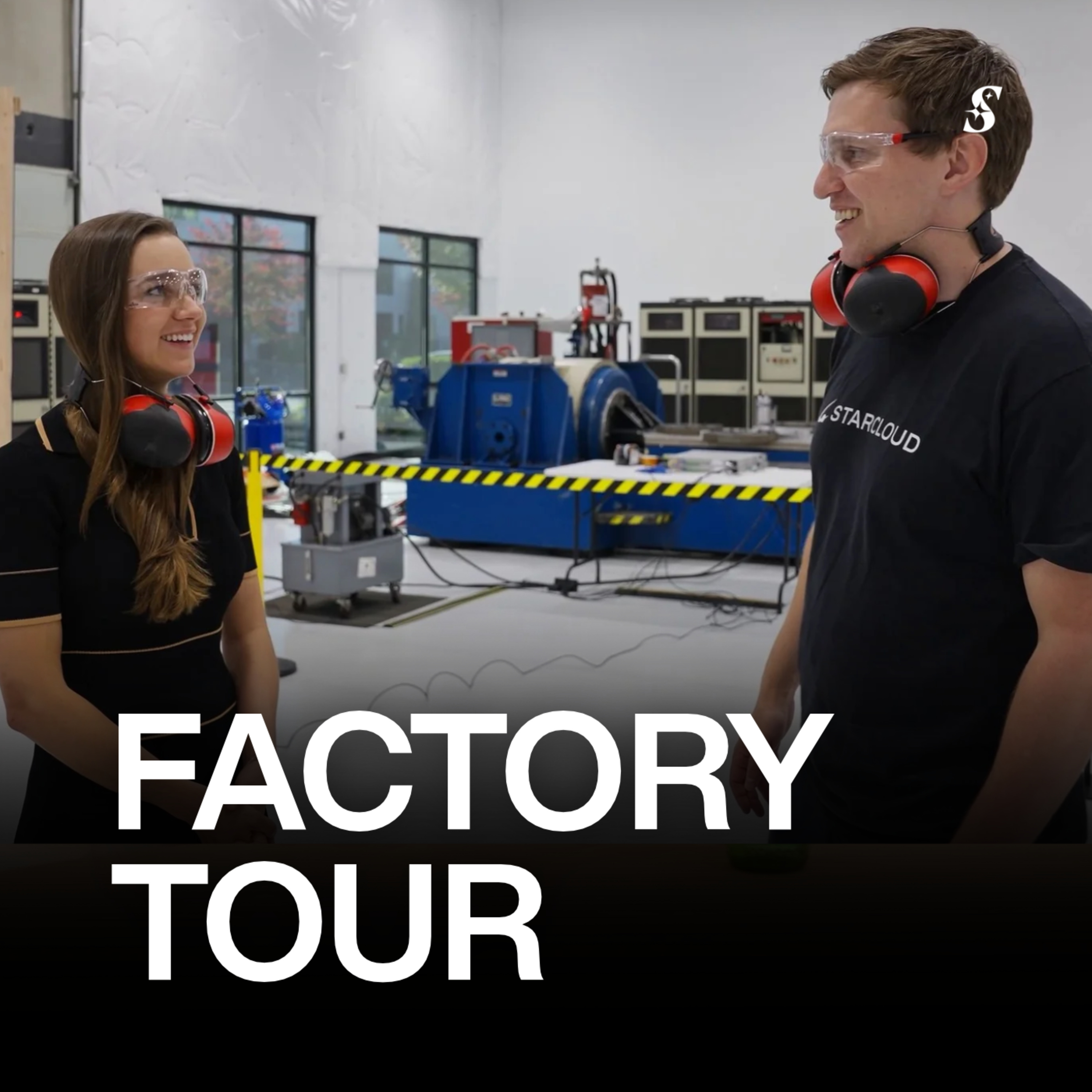
I went inside Starcloud’s headquarters in Redmond, Washington, right outside of Seattle, to tour the $2.3B company building AI data centers in space.
Philip Johnston, CEO & Co-Founder led the tour, alongside technical features with Co-Founder & CTO Ezra Feilden, Co-Founder & Chief Engineer Adi Oltean, as well as Bailey Montaño, Miguel Rivera and Camilo Lopez from the engineering team.
Starcloud has raised $450M to put Nvidia GPUs, AI inference and eventually gigawatts of computing infrastructure into orbit. Its latest round was $250M, led by Manhattan West, with Nvidia, Cisco Investments, Benchmark and EQT. The team went from founding to orbit in 21 months. Starcloud 1 launched with the first Nvidia H100 in space. Starcloud 2 launches in January with 100x the power, and Starcloud 3 is designed to deploy up to 50 satellites per SpaceX Starship launch.
We cover the economics of orbital vs terrestrial data centers, the $500/kg launch cost threshold, SpaceX rideshare and Nvidia chips in space. We also get into liquid cooling and radiators, radiation and chip burn-in, edge inference for government customers and plans for an 88,000-satellite constellation.
We also go behind the scenes of spacecraft testing, including a rebuilt secondhand vibe table, plus laser fabrication and welding. We close with Philip’s take on SpaceX passing $100T and his mission to send a spacecraft to Alpha Centauri.
Philip Johnston: https://x.com/PhilipJohnston
Molly O’Shea: https://x.com/MollySOShea
Sourcery: https://x.com/sourceryy
𝐄𝐏𝐈𝐒𝐎𝐃𝐄 𝐋𝐈𝐍𝐊
YouTube: https://youtu.be/mdq6urSx-f8
𝐒𝐏𝐎𝐍𝐒𝐎𝐑𝐒
• Brex—The modern finance platform, combining the world’s smartest corporate card with integrated expense management, banking, bill pay, & travel. https://brex.com/sourcery
• Harvey—The AI platform built for legal work, is helping the best firms and companies close deals faster. More than 200,000 lawyers, 80% of the Am Law 100, and over 20% of the Fortune 500 build with Harvey. Visit: http://harvey.ai/
• Zone—develops next-generation data center campuses, partnering with AI companies, site developers and technology leaders to bring compute online faster and at scale. Visit: https://zonefrontier.com
• Mercor—The human intelligence behind frontier AI. Frontier labs and leading enterprises use Mercor to turn the knowledge of 5M+ experts into the data, evals and benchmarks that make AI better at real work. Visit: http://mercor.com/sourcery
• VCX—VCX is the public ticker for private tech, allowing investors of all sizes to invest in venture capital. View The Portfolio at http://GetVCX.com
• Deel—Deel is the global people platform that helps startups hire, manage, pay, and equip anyone, anywhere. Trusted by more than 35,000 fast-growing companies, Deel is the people platform that just works, so teams can scale without the chaos. Visit: https://www.deel.com/sourcery
• Public–Investing platform Public just launched Generated Assets, which lets you turn any idea into an investable index with AI. With Generated Assets, you can build, backtest, refine, and invest in any thesis with AI. Gone are the days of one-size-fits-all ETFs. https://public.com/sourcery
Follow Sourcery for the latest updates!
Disclosure:
Paid Ad. Agents are an experimental AI tool. Its output may be inaccurate and is not investment advice. Public Holding’s, Inc. makes no guarantees about its accuracy or reliability—verify independently before use. Brokerage accounts and services provided by Open to the Public Investing, Inc. See additional disclosures at https://public.com/disclosures/agenticdisclosures.
More from Sourcery
All episodesWe use cookies.They keep VO running smoothly and help us improve it. Privacy policy