
 Ask ChatGPT


In short
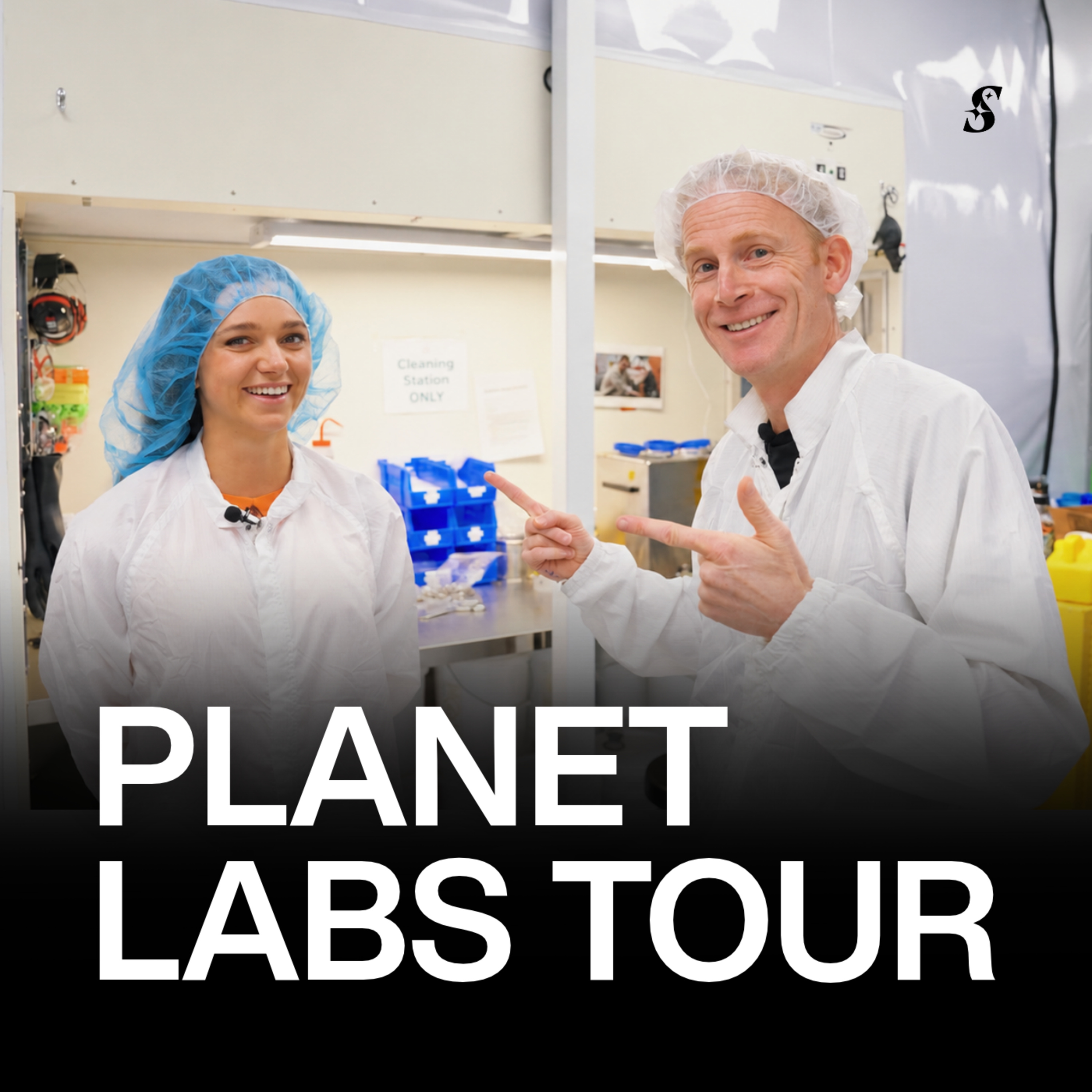
Planet Labs’ satellite manufacturing and testing facility tour, plus how its fleet produces daily global Earth imagery and an AI “interface” that lets users ask questions and search changes over time.
Guest backgrounds
The transcript is a tour with an unnamed host/interviewer and Planet Labs staff (manufacturing/testing, AI engineers). No specific guest names or bios are provided in the text.
Key claims
Planet built about 700 satellites in 15 years—more than any company except SpaceX—and says the total cost of all 700 is less than a typical NASA satellite (about 1,000x cost reduction) due to miniaturization and using commercial electronics. Planet images the entire Earth every day with ~200 satellites, ~4,047,000 megapixel images/day (~100 terapixels) across eight spectral bands. It ties an LLM to its geospatial data so users can ask questions and get results in under a second.
Notable examples
telescope resolution tests from ~500 km (seeing trees/houses), shock/vibration/thermal-vac testing (e.g., ~200G shock), “phone in space” robustness test, methane plume tracking (Tanager) and deforestation/fire/flood examples, and an Area 51 time-change demo. Satellites are named after birds (e.g., Tanager hyperspectral, Pelican high-resolution, Dove SkySat).
Written by AI. May contain mistakes.
Chapters
0:52
Exploring Satellite Manufacturing
Discussion about the satellite manufacturing process at Planet Labs.
“You'll get to see some of our new AI interface to all of our satellite data.”
1:57
Cost Reduction Through Miniaturization
How miniaturization of satellites has drastically reduced costs and increased launches.
“So what has really changed in satellite game has been just the sheer size and number of satellites.”
3:05
Transition to Data Business
Shifting focus from hardware to high-margin data services in satellite technology.
“Fundamentally, we're selling information services.”
3:42
The Evolution of Planet Labs' Technology
Journey from early satellite designs to advanced imaging techniques.
“Let's talk through the lore of Planet Labs.”
4:48
Imaging the Earth Daily
Details about how Planet Labs captures and processes vast amounts of imagery.
“We are taking pictures that far away, but we can see individual trees.”
6:15
The Robustness of Satellite Components
Challenges in designing satellites to withstand extreme conditions and tests.
“It's the only system that does that, that images the whole Earth every day.”
11:47
From Phones to Satellites
Comparison of modern phones and satellites, highlighting technological advancements.
“by about three orders of magnitude, which is a big deal for any sector.”
14:47
Inside Planet Labs: Satellite Production
Discover how Planet Labs builds and communicates about its satellites.
“Hi, I know you and your team work very closely together between manufacturing, testing, production, all that.”
18:21
Bird Names and Satellite Features
Learn about the significance of bird names for Planet Labs' satellites.
“So most of the volume is taken up with that.”
21:54
Production Capacity and Satellite Specs
Understand the production capabilities and specifications of various satellites.
“These bigger ones take a bit longer, and we're ramping up the production so we can do many dozens of those.”
Show all 15 chapters
24:23
Satellite Challenges and Testing
Explore the challenges in satellite production and testing methods used.
“So it's not how many satellites you have, it's what you do with them or something.”
28:00
Satellite Testing Challenges
Explore the challenges and intricacies of testing satellite components.
“You haven't got any, but they're up there.”
30:21
Introduction to Satellite Subsystems
Learn about the different testing subsystems used in satellite development.
“What are you What are you putting in there?”
32:14
AI and Satellite Imagery Integration
Discover how AI enhances satellite imagery and data analysis.
“So let's go upstairs and yeah so we're gonna go up to the third floor I guess I could take this at this point.”
36:29
Exploring the Future of Geospatial Data
Discuss the accessibility of geospatial data and its implications.
“Did you have to bring in a separate team?”

Ask about this episode
Get the gist, explore an idea or ask about something said.
 Claude
On Sourcery, what are the key points of this episode?
Searching your listeningTranscript
Automatic transcript. May contain errors.
0:00Will Marshall: We've built about 700 satellites here in the last 15 years. That is more satellites than any other company on the Earth, except for SpaceX. All 700 of our satellites cost less than a typical satellite at NASA. There's about 1 ,000x reduction in the cost. But this is our AI interface. We can ask it questions. We have tied an LLM to the back end, and it can search the entire Earth in under a second. Someone at NASA kept on saying when we were there, Why are we spending a billion dollars on a satellite when a phone like this has most of what a satellite has, but it costs 500 bucks? What was the answer to that?
0:47We are here at Planet Labs. Thank you for having us.
0:51Will Marshall: No problem. Welcome. So what are we going to see today? We're going to see some satellites. All right. Also some AI stuff. You'll get to see some of our new AI interface to all of our satellite data. But we're starting down here in the satellite lab because it's cool. I mean, we got a little peak. So you guys are in for a treat. There's some vibration plates and some like, what is that one thing? You have a thunderstruck testing table? Yeah, that test is the shop table. Yeah. Okay. So as we walk through, we'll start over here. I know you have some older satellites we can look through. but what are the different areas that we'll see today?
1:27Will Marshall: Yeah, I mean basically this is our satellite manufacturing facility. So this is where we build loads of satellites. We just launched 20 more last week. We can pump them out. In fact, we've built about 700 satellites here in the last 15 years. That is more satellites than any other company on the Earth except for SpaceX. So this is the manufacturing facility for satellites. We launch about four or five times a year. We've done it on over 40 rockets. So what has really changed in satellite game has been just the sheer size and number of satellites. And Planet sort of pioneered miniaturization of satellites, taking satellites that are bigger than this room and shrinking them down to small size so that we can then launch loads of them.
2:16Will Marshall: And with loads of them in space, we can do different kinds of missions. Before, each satellite was the size of a double-decker bus and cost a billion dollars minimum. I mean some NASA missions cost up to 10. The really cheapest ones cost a couple of hundred million. We're talking about launching all 700 of our satellites cost less than a typical satellite at NASA. So it's about a thousand X reduction in the cost and that's all to do with the miniaturization of electronics and that's what we pioneered here in this lab. Something that I definitely want to talk about during our sit down is the use cases have kind of pretty much changed substantially, especially with the new you guys just launched with Google.
2:57Yes. So you're moving into the world of intelligence, which, by the way, I've heard has great premiums on it. But yeah, it's a data business.
3:05Will Marshall: Fundamentally, we're selling information services. Exactly. So even though we have a satellite back end, our data business is a very high margins business. Each cell of a picture or analytics from that picture is very, very high margins. I love that because, you know, as a business person, we do have some capex, but really it's a very high barrier to entry. people launching satellites are few and far that come by. They're very complicated. Yet, so we have a high barrier to entry, but our margins look like a software business. And so it has the best of both worlds. Amazing. Okay, so what do we have behind us?
3:46Let's talk through the lore of Planet Labs.
3:49Will Marshall: The lore, exactly. Because we have some right here. Yeah, yeah, we do. This is actually the whiteboard from our garage when we were playing around. This is the garage where we first set. This is our initial team. We were building a first satellite there in the lab.
4:11Will Marshall: We were still working a little bit at NASA and then we slowly left. This is in our nights and weekends and then we were like, okay, this is too cool. So we started building these satellites. I mean, you can see various bits of them, solar panels, the actual boards that we make for the satellites. I can actually show you, this is the optical telescope assembly. So this is the telescope and then the camera system. You can look down there and you can see the actual telescope. You can see yourself in the mirror, so to speak. And that is looking down, taking pictures. Now we're 500 kilometers away, so about the same distance as from here to Los Angeles.
4:48Will Marshall: We are taking pictures that far away, but we can see individual trees. We can see houses. It's amazing that we can do that at 500 kilometers away from a telescope this big. And this is what the satellite looks like all put together except for the solar panels. Now this is one of our older ones but it gives you a sense. As I said, this is the telescope, this is the motherboards, this is perking down, right? That's taking pictures up into the stars. It automatically recognizes the constellations and then goes, OK, well that constellation is there, therefore I'm pointing exactly in this direction.
5:19Will Marshall: then it can turn itself around using these little wheels so it can spin itself in any direction to take a picture that we want it to take yeah then it beams it down to the ground using these radios now these radios you might think what the heck are these bits of wire we can get two gigabits a second from our satellite down to the ground station over a thousand kilometers away so we're talking about about two gigabits a second down to the ground over a thousand kilometers range I mean it's like sometimes our internet in this building is worse than that I can't understand so so basically all of this electronics tells you where the satellite is in space that's a GPS where it's pointing with a star camera the Sun sensors and then we take a series of pictures and then we embed that metadata on that picture so that we know where we're pointing and then we stitch that to the Earth's surface.
6:14Will Marshall: Now we have about 200 of these in orbit. They image the entire Earth every day. It's the only system that does that, that images the whole Earth every day. And how many images do you do a day and what is the file size of that? It's about 4 ,047 ,000 megapixel images basically. So it's of order I think 100 terapixels. Oh my god. Yeah and eight spectral bands for every pixel. So it's Actually, it's kind of eight pictures for every point on the Earth's surface with different colors, but not just the three that we have, RGB in our eye, red, green, blue, but we have eight spectral bands that cover near-infrared into the optical wavelengths.
6:52And so for people who might be newer to Planet Labs, why is image data so important maybe versus like radio occultation data?
7:00Will Marshall: Well, there's all sorts of data that you can get from space. Imagery is, of course, super useful because it is the kind of data that we can visually interpret. We're visual creatures, right? You name it, we can see it, we can understand it. Also, there's a huge amount of work in visual language models now. So, graduating from the machine learning things that we're doing, recognizing cats and dogs in videos online, can now recognize buildings and ships and planes and trains or whatever it is that you're trying to find. So, AI is very ready for it, just like we're very ready to look at it. Of course, we can't look at 4 million images per day.
7:40Will Marshall: So we're using machines to do most of the heavy lifting there. Okay. Do you want to hold it? Sure. Oh, my God. What do you think? No, it's not that heavy. No, don't drop it. Actually, if you dropped it, it wouldn't be so bad because that is more or less dropping it from about this. I heard one of your jobs is to throw this against the wall. Yeah, exactly. Yeah, I'll demonstrate in a second. But actually dropping it from about this height onto a marble floor is about the equivalent of the shock loads that it takes on when the two stages of a rocket separate. Okay, yeah. That's intense. Yes, 200 Gs.
8:14Will Marshall: It's extremely intense. So one of the hard things about designing these satellites is not just that it needs to work, but it needs to work through the launch, which is 15 Gs shaking, 200 Gs shock loads. and then in the thermal environment of space so where we're going from minus 40 degrees c to plus 20 degrees c every 45 minutes i mean that's much colder than you know freezer much hotter than stay sort of like oscillation and this telescope must stay in focus for that whole time even movement of a fraction of a wavelength would put this out of focus so this thing has to survive those shocks, survive that thermal environment and stay in focus.
8:56So the
8:56Will Marshall: difficulty is not so much the fundamental optic design but how do you encase it in a system that will survive all of that load. Right and so the first version that you had you put, I'll put this down, yeah yeah sure. You put a phone up and just... Yeah this was a slightly catastrophic event as you can see. Basically we put this phone onto a suborbital rocket. We were trying to show Well basically, let me step back one sec. Someone at NASA kept on saying when we were there, why are we spending a billion dollars on a satellite when a phone like this has most of what a satellite has, but it costs 500 bucks.
9:35Right.
9:35Will Marshall: It has GPS. So what was the answer to that? It didn't need to cost a billion dollars. Phones work just fine in space. Now this first test did not work, but amazingly, all of the phone electronics has survived and we managed to get all the data. And this just showed the case in point that even though this was a failed launch, these things are incredibly robust. They're designed exactly for you to drop it on the floor and it not break because people do shit like that. And so it actually was a surprising example of just how robust consumer electronics are. See, what happened back in the 60s and 70s and 80s, NASA was pioneering all this technology because it had to.
10:16Will Marshall: To go to the moon, you had to put a capsule with humans in it, you had to have a computer, so they had to develop microprocessors in order to get a computer that's small enough, because computers were the size of a building. They had to pioneer solar panels and various other technology in order to get it done. And so they're used to the idea of building everything themselves, because they couldn't go down to Fry's or whatever and get the component. They didn't exist. You didn't buy batteries that they needed. You couldn't buy computers that they needed. They couldn't buy solar panels. So they invented it all.
10:50Will Marshall: So NASA had a mentality of inventing everything. Now it did incredible things as a result. But now the consumer electronics, the electronics that we have in our back pocket, are far superior to what they had. And the dominant R &D is being spent by Apple and Google and whoever on developing these electronics to be better and better. So we took the attitude of instead of developing all of that, let's take the best stuff that's already being developed commercially and use that for space. Learning to follow the consumer electronics industry rather than trying to pioneer everything. And that whole approach, use cheap electronics that we can buy online.
11:34Will Marshall: And then, by the way, throw up a few more than we need. And if one or two of the satellites breaks, no big deal. totally different risk attitude to what NASA did. And that also enabled us to just reduce the cost by about three orders of magnitude, which is a big deal for any sector. It's a bit like the mainframe computers to desktop computer revolution. And all the applications we have with desktops now are completely different than what we did with a few mainframes, one per country or whatever. So I have endless questions. I guess before I get to all of them, What is the biggest difference between, okay, V1, we're putting a phone up into space, to one of these going up there, to what we're about to see right now?
12:19Will Marshall: Okay, so one way to think about it is how much data they're producing and getting down to the ground. When we first launched the first satellite, some of which are here, various parts, they would produce, get data rates down at about a megabit a second. So we take lots of pictures, we dump it down with a radio that's going at about a megabit a second. Well, if you're taking 47 megapixel images, you can't get very much data down at that rate. In fact, so now our data is about 2 gigabits a second, so about 1 ,000 times better. That means we're roughly getting 1 ,000 times more data than the first ones, per satellite, per unit time.
12:57So huge increases in the amount of data.
13:01Will Marshall: And that's what enabled us to get to this first mission one, we called it, of imaging the whole Earth every day. This episode is brought to you by Brex, my favorite. You become what you spend on, and I refuse to spend my time on work that shouldn't exist. Expense reports, receipt chasing, and manual closes. The companies building what's next from Vercel, OpenAI, Anthropic, Granola, and Deepgram all made the same call. They all run on Brex. Brex is the intelligent finance platform that combines cards, expenses, and banking into a single stack. with agentic finance built in. AI agents that handle expenses automatically, enforce policy before spend happens, and close your books in minutes.
13:46That's why Sorcery runs on Brex, so I can spend time on building and not busy work. It's time to get Brex AF. Learn more at brex.com slash sorcery. That's B-R-E-X dot com slash S-O-U-R-C-E-R-Y. Bye. From handshake to signature faster, Harvey, the AI platform built for legal work, is trusted by 80 % of the AMLA 100 and over 20 % of the Fortune 500. Learn more today at Harvey.ai. That's Harvey.ai. AI needs more than chips. It needs power, land, and infrastructure. Zone develops next generation data center campuses, partnering with AI companies, site developers, and technology leaders to bring compute online faster and at scale.
14:37Zone is building the foundation of the AI frontier. Visit zonefrontier.com to learn more. That's zonefrontier.com to learn more. Let's go take a look inside. Hi, I know you and your team work very closely together between manufacturing, testing, production, all that. So how do they communicate with one another? What's the flow here?
15:03Will Marshall: Well, we build all the satellites here. You'll see some of it. We're actually going to first go into the place where we build the bigger satellites. Now, all of this is done on these sort of automated test stands. This gentleman here is working on them. These guys here. and they they build all the subsystems that all comes together into this main clean room area which you see here which we can actually put our hairnets on and go in and so that we can actually see one of the satellites they're a bit bigger than the those first ones because these ones as I was mentioning trying to get to a much higher resolution on the ground so and I didn't know if you were asking about how they communicate with each other but we can talk about that but basically each satellite dumps its data to the ground stations but we've 48 of those ground stations all around the world.
15:48You have your own ground stations?
15:49Will Marshall: Yes, we built basically no one had that either. You can't go to Fry's and get that either. So basically we built about I think it is 48 or so of these parabolic dish antennas doing dual SNX band in a few dozen locations. We often have four or eight of these ground stations at any one location because we have so many satellites there's many to look at at any one time even in the same spot and And they're in Alaska, northern Canada, northern Norway, southern tip of New Zealand, southern tip of Australia. So basically the highest latitude locations because our satellites are mainly in polar orbits.
16:29Will Marshall: And so they get much more contact points than closer your station is to the pole. So we put them as far north and south as possible with an internet connection because we have to get all that data back. Okay, so as we go and we look through these, I want to address one thing. All of these satellites are named after birds. Yes. Why? Okay, this is actually a space tradition that precedes us. And we were, like, in NASA, there was the eagle that landed. Obviously, a lot of military missions, like Kestreliae. And we wanted to name ours after birds that were a part of our mission. So doves trying to inspire how we're trying to help peace and security around the Earth.
17:19Will Marshall: Tanager is our hyperspectral satellite, and that's because these are looking out for biodiverse areas. Tanagers are some endangered birds with a lot of different colors in the tropics, so we can track ecosystems. Pelicans are highest resolution systems. That's because they fly really low. They fly so low. Pelicans fly really low because they get a bit of lift off the water when they fly really low. They get a little like 10 or 20 percent more lift. We can do the same sort of across the top of the atmosphere. So we fly these satellites really low so that we get better resolution on the ground. So we named them after pelicans because of that.
17:59Will Marshall: So we'll continue to name them after cool birds. Oh, our next one is going to call owl. Oh, yeah. So we're launching all these owls because they've got bigger eyes and they're wise because they have a huge amount of compute on board so we're naming them after hours so we'll keep on doing that just for fun amazing okay okay we'll put some hair nets on yeah all right so we're going into the clean room to see some of the bigger satellites uh you're all hair netted up you look cool we look cool let's go all right so um yeah so in here we actually build the satellites the bigger satellites that's a stand for one of the satellites here you can actually see these are the solar panels that will be attached to these bigger satellites.
18:40Will Marshall: This is a bus of one of the biggest satellites so that's the core spacecraft components that does the attitude determination and control, it does the propulsion, it does the radio communications, the propulsion I think is on the bottom and so basically all of that harness holds the payload which is a huge telescope that looks down. So most of the volume is taken up with that. Now somewhere around here we have one of the actual satellites. Oh, actually this is a bit of fun. You can see there the optics, the primary optics there. That is the big telescope looking down, so that gives you a sense of the scale.
19:20Will Marshall: But here's the spacecraft that we're going to look at.
19:26Will Marshall: So this is Pelican 10. So it's one of our highest resolution satellites. So this, This is now integrated. It has the telescope inside of it. So here you can see in the back. This is the propulsion system You can see this is the feeder. These are the two main tanks. This is the pressurant tank of that propulsion system So that's the back end. The telescope is that this is the connection that goes to the rocket here and then and then these are star cameras that are actually hidden enclosed so that we don't get dust in them. And the telescope is inside of here. You can't really see it. So it's all wrapped up in this main section.
20:13Any questions? Yeah. Go on then. Okay, so Planet Labs is vertically integrated. So how many of these components are you building in-house versus which parts are not as kind of...
20:28Will Marshall: It's a little bit nuanced because at the chip level, we buy almost everything externally. But at the system level, we build almost everything internally. So the telescope, we get the blanks from a company, but we integrate the telescope, as you saw over there, here. And so we build up the framing and the structure. Similar for almost everything else, the radios, we don't build our own chips. You know, we get the same chips from other people, WiMAX components, other things, but we integrate them into special circuits and with special antenna that enable us to get the radio frequency sort of output that we need.
21:04So it really depends.
21:07Will Marshall: I would say the way to think about it simplistically is the chips we buy, the systems we build. And so how many pelicans do you produce a year? How many doves? How many tanagers? Great question. How do you think through all these? So we're ramping up on the pelicans. The doves, we build hundreds. We've built about over 650 of those doves here in this lab. We can build up to 40 a week. So we don't do that every week, but we can build really fast. So I think each satellite takes about eight hours to build. Okay. To give you a sense. Yeah. And to give you a sense, when I was at NASA, it was like eight years.
21:49Will Marshall: Okay, not eight days. So it was like completely changing. These bigger ones take a bit longer, and we're ramping up the production so we can do many dozens of those. In fact, we just announced a new facility in Berlin where we're doubling again the manufacturing space that we have, that we announced could do up to 60 of those, these sort of, per year. So it could give you a sense of scale. And then the Tanagers is rather lower volume because they're sort of specialized instruments that we're working with NASA JPL on. And we just launched our second one literally last week. And we've got another one that's actually, I think, behind there.
22:29Will Marshall: And we can't go in because that one's more export controlled. Yeah, so we can't go into that. You can see it's black. Top secret. That payload is a little bit more specialized. It takes a little bit more work. And so we're launching a couple more of those per year sort of rate. Is there a goal to how many you're going to build in a constellation or is some of this replenishing? Like how do you think now? It is replenishing now. And in fact, it's more about what capability do you have on each satellite than the number of satellites. We have the largest earth imaging fleet. It's about 10 times larger than anyone else.
23:04Will Marshall: and most importantly, it images about a hundred times more area than any other commercial actor, at least Western one. The Chinese are trying to build similar systems. In fact, they even copy our names. They called those, what did they call it, pigeon or something. It was like a close to dove. Anyway, it was like, it looked eerily similar, and they even named it eerily similar. But no, roughly speaking, we're the only ones that cover the whole world every day. If you look at any other players, they might task to a few specific locations. but cover less than 1 % of the land mass of the Earth per day, or maybe a couple of percent at most, whereas we cover the whole of it.
23:41Will Marshall: So, you know, 100 times-ish area collection. So that's what we really care about. The owls are the upgrade to have the area collection the same, but 10 times more data per unit area because we're going from 3-meter resolution to 1-meter resolution daily scan of the planet. And that's roughly 3 by 3 times more data, so 10 times more data almost. And also we're getting it back 10 times faster because we're adding optical links and links to get that back really quickly. So basically you can get it with back within a few minutes. So we're getting 10 times faster back and 10 times more data. But actually the number of satellites will stay about the same if not go down a little bit because of the nature of how we're building those.
24:25Will Marshall: So it's not how many satellites you have, it's what you do with them or something. Okay is there anything else in here that we should see anything? Any technical specs? Well we can see a few other things here. This is a propulsion system all laid out. You can see that on a bench. That's kind of fun. As I said this is our telescope assembly here. So it's about 50 centimeters in size and that determines how small an object we can see on the ground together with the altitude of the satellite. So that's it. What kind of fuel are you guys using? In this is Xenon. So it's an iron engine. So they're very efficient in space.
25:11Will Marshall: The gas comes out of the back extremely fast, much, much faster, like 10 times faster than a rocket engine, a classical rocket engine. It doesn't have as much thrust. So you can't take off using these engines off the planet. It's not nearly enough. But once you're in space, they're much, much more efficient. Like, as I said, almost 10 times more efficient than those big rocket engines. I think it was SpaceX, Starlink that just put out, they want to try to open source the data for anti-collision avoidance. Yes, satellite, space domain awareness data, SDA. Yeah, so I think that's really cool. Early on, I mean, we have a lot more objects in space.
25:48Will Marshall: We want to stop collisions. We work very collaboratively with the other players. The biggest challenge though is less the satellites, it's all the space debris. So we've got about of order 10 ,000 satellites operating in space, but we've got of order 100 million space debris objects. So objects that were former satellites that blew apart, satellites that crashed, satellites that were deliberately taken out by anti-satellite weapons from the ground, and those things caused one satellite to pop into tens of thousands of bits. Okay let's carry on. What a wild, wild problem. It is. It's wild, wild space.
26:27Wild, wild space. Great documentary by Ashley Vance, which you were in, by the way.
26:33Will Marshall: It's cool, right? It's so good. Have you seen it? Yes, I have. Before we went to Rocket Lab, I watched that, and their little fight between him and... And Chris Kemp from Astra. Yeah, Chris Kemp. It was just hilarious. Yeah. Quite some characters, those guys. Okay, we can take all this... Okay, we don't need these straight... We do not need this for anything else. By the way, this is a post of methane tracking activities of the Tanager spacecraft. So this is a plume of gas. By the way, when we enable them to be turned off, because we just tell the gas company, hey, you got a big freaking great leak on your pipeline.
27:14Will Marshall: Turning this one off is the equivalent of taking a couple of hundred thousand cars off the road from a pollution standpoint. Oh my God. So one leak. Oh, when we go to the AI demo later, is it possible to see the difference of COVID versus non-COVID? You know when everything was off the world? We can have a look. Okay. We can ask the AIs. Let's ask the AIs. Is that named after a bird too? No, it should do. Yeah. That's a good idea. Okay, I'm going to steal that. So here we have some of our testing facilities. So here this is a system that tests the shock when two stages of the rocket separate. So basically, we put our satellite here, we bring this up and we let this hammer smack down and it gives this 200G-ish shock load.
28:05Why isn't this in a sound barrier room?
28:08Will Marshall: Well, I guess people put earplugs in. Okay. They're the earplugs. You haven't got any, but they're up there. And then this is a vibration table. so this vibrates to simulate the launch environment. So we put our satellite on there, vibrate the shit out of it, and hopefully nothing falls apart. What have been the biggest failures? Well, we've had telescopes break. We have to redesign it. What is the most delicate part of your satellite? Well, it's probably the telescope. Exactly. So it's because there, again, just think about this. Like the optics of that mustn't move by more than a fraction of a wavelength.
28:46Will Marshall: The wavelength is of order less than a micron, so a thousandth of a millimeter. So the telescope to components, the main optics, must move by more than a thousandth of a millimeter. Otherwise, it's out of focus. Well, that's really annoying because that's a very small distance. And again, even when it's in space, normally, if you just made the telescope out of aluminum like this, it would expand and contract so much that the telescope wouldn't work when it's too hot or too cold because it would be totally out of focus. So we have to design it out of special materials, compensate for that expansion and contraction because of the thermal loads.
29:24Will Marshall: So that's the kind of thing that's really difficult. And I can actually show you where we test that thermal loads. How many satellites do you go up and end up having errors? Like what has been the... error rate. So firstly of all 700 satellites if the launch worked and delivered us into orbit our satellites have turned on and worked. We have had some that are out of focus, we have had a few problems where a solar panel didn't deploy, a reaction wheel stopped working early, things like this, but generally we've got utility out of 100 % of our satellites which I actually think is a problem and I keep on telling folks well because it means we're not pushing the envelope enough if we have a hundred percent success it means we haven't pushed the hard enough and maybe we should have gotten a latest sensor or something that would improve it yeah so we want to push the barriers thanks for your help.
30:21Will Marshall: Alright what's this? We got a little vacuum chamber here. What are you What are you putting in there? That's the Crock-Pot. It's the what? It's the Crock-Pot? What is that? That's for Pelican? Yeah. For the reaction wheels. Oh, it's for the reaction wheels. Ah, cool. So you're testing that subsystem. Cool. What's going on? You need a bunch of 3D printers. Yeah, 3D printers. Fine. Normal, normal stuff. But those are the three main tests. The shock, the vibe, and the thermal vac. Let's go here. By the way, I like this sign. Oh, you actually have this? Yeah. You know how many people talk about this, but they don't actually have it?
31:03Will Marshall: Well, these guys have it. Anyway, let's carry on. How good is AI at real professional work? Mercore's AI Productivity Index, or APEX, tracks it with every major Frontier model release. Built with partners like Harvey and Cognition, see where the Frontier actually stands at mercore.com slash APEX. Today's episode is sponsored by VCX by Fundrise, the public ticker for private tech, allowing investors of all sizes to invest in venture capital. Learn more at getvcx.com. Public is a multi-asset investing platform where you can automate your investing with AI agents. Create your own custom agent with a simple prompt.
31:46Agents can monitor markets, execute trading strategies and manage your cash across stocks, bonds, options, crypto, and more. Want to buy at market close and sell the next day's open? Just tell your agent. Automate your investing at public.com. Founders scale faster on Deal. Set up payroll for any country in minutes, hire anyone anywhere, get visas handled fast, and get back to building. Visit deal.com slash sorcery. That's D-E-E-L dot com slash sorcery. So let's go upstairs and yeah so we're gonna go up to the third floor I guess
32:24Will Marshall: I could take this at this point. You ready? Well he's ready let's go. Come on. So here are some of our doves, there's a SkySat. This is our new Pelican spacecraft that you were just seeing downstairs, the model of it. It's smaller. But that's a scaled down. But this is our AI interface so basically this is our imagery of the whole world. You can zoom in anywhere you want to zoom in on. You can go through time and see it as it changes over time. I mean if we go up further north, if we go down to December, it's gonna be snowier. And so you can see all the snow cover. But the coolest thing is that we have, so we have 3 ,000 layers of images going back 10 years, so pretty much every day for 10 years.
33:14Zoom in as far as you can. Let's see what we got here.
33:16Will Marshall: What do you want to have? But the coolest thing before we do that is not only that we can zoom in, it's that we can ask it questions, and we have tied an LLM to the back end. So LLMs really only trained on the text of the Internet, so they didn't know much of the real world. We have all the real world, and we mate them together, and then you have a system that can understand all of human knowledge and tap into real world stuff. So what does that mean? It means if you're a farmer and you want to understand your crop yields, A normal LLM chat is going to tell you about the theory of agriculture, but he doesn't know shit about your field, right?
33:52Yeah.
33:52Will Marshall: But the farmer, he or she wants to know about their field. So this can tell you about that and can help crop yields. Or if you're a journalist trying to understand and report on some physical event like a flood or a fire or something, it can go and tell you about that flood or fire. And it can search the entire Earth in under a second. It can see changes over time. It can plot graphs. So, like, this is just an example that we were looking earlier. We were, I guess, somebody was asking. But you can actually just ask it yourself. So this is just a visual that it gave of some deforestation that it was showing.
34:33Will Marshall: I asked it earlier, your question of what happened in the last 24 hours, show me some changes. I actually haven't got that here. I've got my computer, but it found a fire in Yosemite. It found a flood that caused a load of crap falling into a river. It found all sorts of things around the world. It was like a daily planet report, if you like. But anyway, we can ask it any questions. So what do you want to ask about? Let's go to Area 51.
35:05Will Marshall: Let's go to Area 51. Anything in particular you want to know about it? Let's see the changes over the last five years. Show us the changes there over the last five years.
35:19Will Marshall: So it's going to zoom in there on Area 51. Now it's going to start to compare 21 to 2026 as you asked. This is a compare. Obviously it's waiting for the data to load here. Showing some changes over time. If we zoom in. We can actually zoom in on that image. We can try and see changes. So, oh, we can't zoom in like that, but I see. But basically this is a structural level. Something changed in that. I don't know what that, look, there's a black. Oh my gosh. I actually don't know what that is. You would see plane movements and stuff. You see there were two planes on there and they're gone. This is a particular zoom level.
36:01Will Marshall: You can get a sense of what it can do. It's still early phase, but our point is to open up geospatial data to not just the satellite imagery experts. It used to be the case that NASA could get value out of this, the NRO could get value out of this, but a farmer, that journalist, that what have you, can't get value. Now anyone can go and play with this because all they need to do is be able to speak. And by the way, you can speak in any language into it. I mean, just LLM takes you in the other way. And so, yeah, I mean, that's the power of AI and satellite data put together. Amazing. So you build this internally.
36:36Did you have to bring in a separate team? How did you?
36:38Will Marshall: No, we just have a couple of engineers, an AI team specialized in doing this. Yeah. Cool. All right. Anything else we should see while we're up here? Great. All right. Well, here's some of the AI engineers. Oh, we have an AI engineer with us right now. In the house. Was that demo sufficient? I don't know why I wasn't doing the search tool. I swear you're trying to get it to do, right? Yeah, yeah. But it doesn't do a perfect job, but it's getting better and better. And can anybody access that? How do you get access? It's on a beta launch right now, so anyone can access it, but it's just a testing version.
37:23Will Marshall: But soon, we hope to launch it. Exciting. Cool. All right, well, we're going to go to the sit-down interview now. Let's do it. There's another floor. This is the first time anybody has seen this floor. It's true. You're the first one to come in. Yeah. All right. So, actually, I can show you just a couple of things before we sit down.
37:47Will Marshall: But this is the so-called dove nest. Oh. So this is where we built all the doves, and they're sitting in their nest waiting for the launch. So you can see that two by two in there. Quite the difference from the garage you started in. Yeah, it's a little bit more substantive. That's true. Oh, and there's one more fun thing. Thank you. You can put it back. One more fun thing for you to see in here.
38:12Will Marshall: So here, you have to go in there, both of you. You want to go first?
38:19Is this where you scream?
38:20Will Marshall: Yeah, exactly. I'm going to shut the door and then you can just talk a little bit. Okay. So we are here at Planet Labs in San Francisco and now we are trapped inside. Did you catch that? Yeah. It's cool right? It's really cool. So this is where we test the radios to go to space. Faraday cage or is it a soundproof? No it's an RF chamber such that all the radio frequencies get absorbed by this. Okay. So that we can put our satellite here, point it there, and then basically reduce the power such that we can check that the right power is getting to the antenna without reflective rays spoiling our ability to tell whether or not it's actually emitting at the right power.
39:09Will Marshall: So basically it's a way of testing that the radios are going to work in space. Yeah. One final cool thing for you to see. Sorry, am I getting in your way? Off you go. No, yes. We were just setting it up for you. It's your paper. All right, let's go. Hey, it's Molly. If you enjoy our interviews, check out our newsletter, Sorcery.vc, where we deliver a once a week top deals and tech headlines email, and also go deeper on or podcast interviews. Subscribe to Sorcery today. And don't forget to subscribe to the podcast on YouTube, Spotify, Apple, or wherever you listen. Link in description to sign up.
From the publisher
Planet builds a satellite in about 8 hours. At NASA, the same work took 8 years.
Will Marshall is Co-Founder and CEO of Planet Labs (NYSE: PL), which has built about 700 satellites in 15 years, more than any company except SpaceX, and runs the only fleet that images Earth’s entire landmass every day.
Marshall walks through Planet’s SF factory, from the garage whiteboard and the phone the founders launched on a suborbital rocket, to the clean room where Pelican-10 is being integrated, the shock, vibration, and thermal test stations, and the RF chamber.
The tour ends with a live demo of Planet’s AI interface querying 10 years of daily imagery, and a first look at the new Dove production floor.
𝐓𝐈𝐌𝐄𝐒𝐓𝐀𝐌𝐏𝐒
(00:00) Will Marshall, Co-Founder & CEO at Planet Labs
(00:48) 700 satellites for less than one NASA mission
(02:44) Why Planet Labs is really a data business
(03:45) How a satellite sees trees from 500 km away
(06:22) 4 million images of Earth, every day
(07:44) What a satellite goes through to reach orbit
(09:03) The $500 phone vs. the $1B satellite
(12:05) 1,000x more data than the first satellites
(14:47) Planet Labs' 48 ground stations that bring Earth’s data home
(16:44) Why every Planet Labs satellite is named after a bird
(18:19) A look inside Planet Labs’ sharpest satellite
(20:17) Why Planet Labs doesn’t make its own chips
(21:14) Building a satellite in 8 hours, not 8 years
(22:47) Why fleet size isn't what matters
(24:30) The engine that’s 10x more efficient in space
(25:29) Why the 100 million pieces of space junk is the real collision risk
(26:56) Spotting gas leaks from space
(27:40) Testing satellites to the breaking point
(32:19) What changed at Area 51 in five years?
(37:31) The room where satellite radios are tested
Will Marshall: https://x.com/Will4Planet
Molly O’Shea: https://x.com/MollySOShea
Sourcery: https://x.com/sourceryy
𝐒𝐏𝐎𝐍𝐒𝐎𝐑𝐒
• Brex—The modern finance platform, combining the world’s smartest corporate card with integrated expense management, banking, bill pay, & travel. https://brex.com/sourcery
• Harvey—The AI platform built for legal work, is helping the best firms and companies close deals faster. More than 200,000 lawyers, 80% of the Am Law 100, and over 20% of the Fortune 500 build with Harvey. Visit: http://harvey.ai/
• Zone—develops next-generation data center campuses, partnering with AI companies, site developers and technology leaders to bring compute online faster and at scale. Visit: https://zonefrontier.com
• Mercor—The human intelligence behind frontier AI. Frontier labs and leading enterprises use Mercor to turn the knowledge of 5M+ experts into the data, evals and benchmarks that make AI better at real work. Visit: http://mercor.com/sourcery
• VCX—VCX is the public ticker for private tech, allowing investors of all sizes to invest in venture capital. View The Portfolio at http://GetVCX.com
• Deel—Deel is the global people platform that helps startups hire, manage, pay, and equip anyone, anywhere. Trusted by more than 35,000 fast-growing companies, Deel is the people platform that just works, so teams can scale without the chaos. Visit: https://www.deel.com/sourcery
• Public–Investing platform Public just launched Generated Assets, which lets you turn any idea into an investable index with AI. With Generated Assets, you can build, backtest, refine, and invest in any thesis with AI. Gone are the days of one-size-fits-all ETFs. https://public.com/sourcery
Follow Sourcery for the latest updates!
Disclosure:
Paid Ad. Agents are an experimental AI tool. Its output may be inaccurate and is not investment advice. Public Holding’s, Inc. makes no guarantees about its accuracy or reliability—verify independently before use. Brokerage accounts and services provided by Open to the Public Investing, Inc. See additional disclosures at https://public.com/disclosures/agenticdisclosures.
More from Sourcery
All episodesWe use cookies.They keep VO running smoothly and help us improve it. Privacy policy