
 Ask ChatGPT


 State of the World from NPR
20 Oct 2026 · 9m · 6 chapters
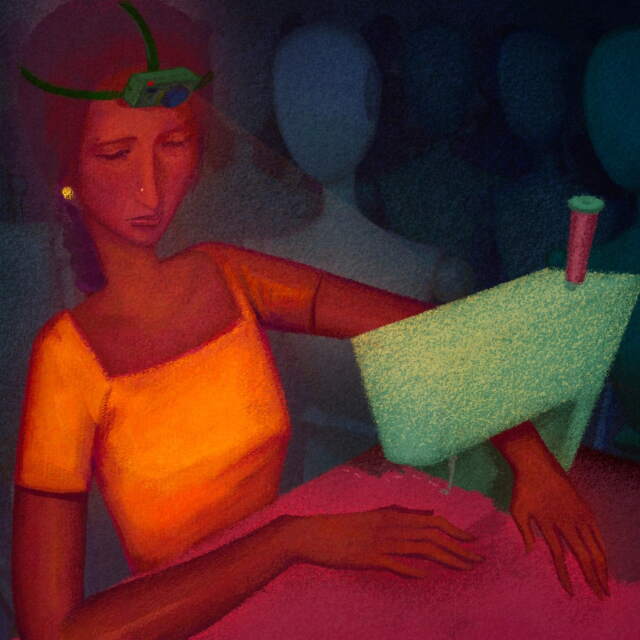
The episode (State of the World) explains how AI companies in India are collecting data to train robots for household and factory work, using human workers to record or demonstrate tasks. Guests/backgrounds: Dia Hadid, NPR reporter in Karur, Tamil Nadu; Prathosh AP, professor at the Indian Institute of Science specializing in machine learning in data-scarce environments; Rajesh Kumar Ramaswamy, senior Objectways employee overseeing robot-data collection; Aftakapur, co-founder of the Afti Institute studying technology’s impact on people; Amit Basole, economics professor focused on India’s labor market; Kapoor of the Updi Institute (robot deployment/cost perspective).
“physical AI” needs motor-skill training; data can’t be scraped from the internet; some workers are ordered to record without informed consent.
domestic workers recording themselves chopping, folding laundry, mopping; textile workers wearing GoPros in viral footage; Objectways labs using grippy “robot claws” to learn bottle-lid handling.
Written by AI. May contain mistakes.
Discussion on the impact of AI on workers in India, focusing on their roles in training AI.
“Today on State of the World, why workers in India are training their AI robot replacements.”
Exploration of how domestic workers in India record their tasks to train AI.
“From promises about the utopian future that technology will bring to apocalyptic predictions of humanity's downfall.”
Insight into Objectways, a company training AI using recorded human actions.
“There's enormous demand for this kind of footage because AI companies need millions of hours of these recordings to feed into AI robots so they can do household chores.”
Discussion about factory workers unknowingly training AI for their replacements.
“The chores will be done by a humanoid robot.”
Concerns from labor experts regarding the implications of AI replacing jobs in India.
“We can just call it what it is, which is exploitation of labour.”
Description of practical AI training processes being used in India’s industries.
“On a Karur Main Street, music blares from a stalled rickshaw before a nondescript building.”

Get the gist, explore an idea or ask about something said.
 Claude
On State of the World from NPR, what are the key points of this episode?
Searching your listeningAutomatic transcript. May contain errors.
0:01This week on Up First, the midterms less than 15 days away. President Trump, Vice President J.D. Vance and former President Obama all crisscrossing the country, rallying voters in key races from Michigan to Georgia to North Carolina. Join us every morning as we guide you through the homestretch of this election season up first on the NPR app or wherever you get your podcasts. Today on State of the World, why workers in India are training their AI robot replacements.
0:34You're listening to State of the World from NPR, a human perspective on global events. I'm Greg Dixon. Artificial intelligence. Are you sick of hearing about it? From promises about the utopian future that technology will bring to apocalyptic predictions of humanity's downfall. Then there's the anxiety about data centers and the potential for jobs going away. It's a lot. Today, we're going to India to hear about concrete ways in which tech companies are working to replace humans in certain tasks. And while we often hear about the possibility of large language models revolutionizing white-collar work, the jobs this technology is being trained on are much more working class.
1:15NPR's Dia Hadid takes us to a small town in southern India called Karur, where she found domestic workers being enlisted to train AI. 24-year-old Sneha Jagadish chops a carrot in her kitchen. It's an ordinary scene in a middle-class home in a small Indian town. Except Jagadish has clipped a smartphone to a headset. It's recording her every hand movement. AI industry experts say there's thousands of people like Jagadish across India who over the past year have found work recording themselves like this. And for about two or three hours every day, Jagadish records herself folding laundry, mopping the floor, any housework she can find basically, and she earns about$120 a month.
2:10There's enormous demand for this kind of footage because AI companies need millions of hours of these recordings to feed into AI robots so they can do household chores. This data can't be scraped off the internet. Prathosh AP is a professor at the Indian Institute of Science in Bengaluru. Like many southern Indians, he uses initials to refer to his family name. He specialises in machine learning systems in data-scarce environments. He says this is called physical AI. Think of today's AIs as brains without a body, right? They don't have any agency to act physically because they don't have a body.
2:49Now you have to give them all motor skills. Because they're brains and they need to learn how to use their bodies.
2:59Today, we're launching NEO. The demand for this kind of data has created opportunities for Indian companies like Objectways. It occupies a few buildings on the main street of Karul. Senior Objectways employee Rajesh Kumar Ramaswamy tells us they pay thousands of people to record themselves working. Philippines, Nigeria all over the world. From all around the world. Ramaswamy's team also does some in-house recordings, he says, to obtain better quality data. We walk up a few flights to a floor set up like a house. Oh my God, it's like Uncanny Valley, hey? Like in a TV studio. This is a living room.
3:42Then that is the kitchen. Then we have three bedroom setups over here. In the setup kitchen, Rani N records herself chopping onions. Like other southern Indians, she uses an initial to refer to her family name. Then she'll record herself doing other jobs. Next time, carrot beans. We change the task, like wiping the table, wiping the cupboard. Ramaswamy says at this pace, domestic robots could retail in India in the next few years. He thinks about how a robot might help his own stay-at-home wife, who's raising their baby son. It will be preparing food, washing the clothes. My wife will get rest and all the things will be done by humanoid robot.
4:25The chores will be done by a humanoid robot. Back at the home of Sneha Jagadish, the young woman who records herself doing housework, She's pretty sure AA robots doing housework are coming down the line.
4:42And she can't wait for the day that a robot takes over this tiresome job, even if it means she loses this gig, the one she has right now. While that domestic worker may have already made plans for our technological future, other blue-collar workers in India have not. As Dia found in that same South India town, some factory workers are training their robot replacements without even being told they're doing it. Women thump down aprons they're packaging into plastic as a radio warbles through their textile factory. Three men walk around, hand out GoPros to workers, including 40-year-old Shoba Kiribakaran.
5:25It's the third time Kiribakaran says she's been told to don a GoPro. But nobody's ever told her that it's recording her every hand gesture to train AI robots to do this job. Kirubakaran says she's worked here for 10 years, six days a week, nine to six, earns$90 a month. She says, I don't know how to do anything else. Scenes of workers wearing GoPros, recording themselves working, shook the Indian public in April after a video went viral of textile workers sitting in rows, all recording themselves as they process fabric. This is not a sci-fi plot. That is happening right now on factory floors across India.
6:15Workers are training their own replacements. That's from Upskill Abhi's YouTube channel and News 9 Live. And it appears India is emerging as one key place to record this kind of footage. Some workers are paid to hand over this data, but many others, like Kirubhakaran, are just being ordered to do it. We can just call it what it is, which is exploitation of labour. Aftakapur is the co-founder of the Afti Institute. It studies the impact of technology on people. Labour experts worry about what it will mean for India if AI industrial robots take over workplaces here. Already, this country struggles to absorb the some 600 million people who make up India's workforce.
6:56I see these factory jobs as not good jobs. If robots take them over, I don't necessarily shed tears for the job. But there is the question of what people are going to do. Amit Basole is a professor of economics who looks at India's labour market, who says the government here is not equipped to handle the shockwaves of AI replacing workers. We have a slow apparatus here. I'm not sure how well set up we are to do all that. But others say AI robots are unlikely to be deployed at scale in India, in the near future at least, because they're expensive, power-sucking machines in a country where power, at least, is costly.
7:31This is Kapoor of the Updi Institute. We may be able to make the robots, but they're bloody expensive to run, as we have understood that humans are cheaper to run than robots are. And yet AI robots are in the pipeline, even if they might not be deployed in India at first.
7:50On a Karur Main Street, music blares from a stalled rickshaw before a nondescript building. It's where Objectways houses some of its labs. Employee Rajesh Kumar Ramaswamy shows us another way robots are being trained to do industrial jobs. In a large room, young men with GoPro cameras strapped to their heads hold what look like grippy robot claws. One man uses the grippy claws to screw bottle lids off and on. The bottles are on a desk. There's big and small bottles, plastic, metallic. This is Ramaswamy. The robot needs to learn what is the water bottle. It's to teach AI robots that all these different shapes are bottles, because what these men are doing is showing a robot how to see for itself, how to do this job, using its own grippy hands.
8:42Ramaswamy compares teaching an AI robot to raising a baby. The robot is like a child. It is a born child. So we need to teach which need to be done. Back in the textile factory, Kannagi Periasami is folding and packing aprons with a GoPro fastened to her head. She's one of the few folks here who've been told why she's wearing a headset and she tells us she's teaching a robot to do her job. And she says she's certain that one day she'll be replaced. When that happens, she says, I'll go to my village and raise cows. Dee Hadid, NPR News, Karor, Tamil Nadu, India.
9:29That's the State of the World from NPR. Thanks for listening. Stay tuned for the following announcements and messages from our sponsors. This election season, let the NPR Politics podcast save your time and your sanity. We'll help you understand key races, which polls you can safely ignore, and what might happen if power shifts in Congress. Our short daily episodes come out every afternoon so you can spend less time scrolling through each chaotic news cycle. Make NPR Politics your hub for midterm election coverage. Follow our podcast on the NPR app or wherever you get your podcasts. It's election season, which is an easy season to doom scroll, but it can be a hard season in which to find valuable information.
10:10NPR can be your source. We're a nonprofit that relies on your support, which means we can act and report in your interest. And with NPR Plus, you can hear dozens of NPR podcasts sponsor free, all while powering our independent newsroom. Sign up today at plus.npr.org.


