Ask ChatGPT


 Super Data Science: ML & AI Podcast with Jon Krohn
17 Nov 2026 · 56m · 17 chapters
How AI and advanced semiconductor manufacturing intersect—especially how AI chips are built (materials, atomic-scale deposition, and advanced packaging) and how AI is used inside Merck’s R&D and manufacturing to speed discovery and improve quality/energy efficiency.
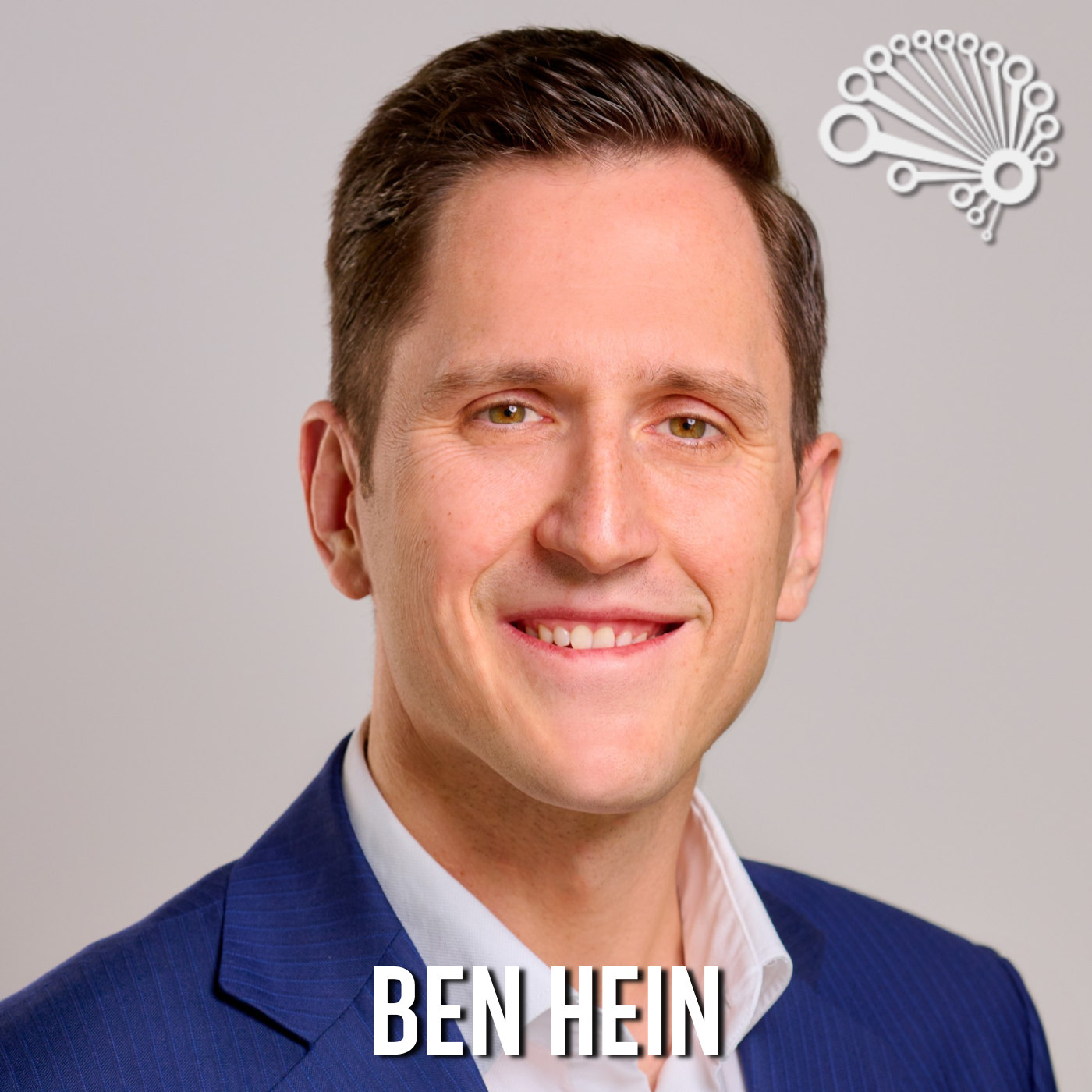
Benjamin (Ben) Hein, CEO of the electronics business at Merck KGAA Darmstadt, Germany. Merck is a 358-year-old science/technology company with healthcare, life science, and electronics divisions; Ben joined in 2011 and previously lived in Taiwan and Boston. Merck employs 60,000+ people globally and is involved in semiconductor fabrication materials and systems.
Chips are moving from smaller 2D scaling to 3D/advanced packaging to improve performance per watt. AI helps Merck teams simulate molecules before lab work, improving hit rate by 5x and eliminating 85% of candidates early. For 2nm-class nodes, contamination tolerances reach parts-per-billion to parts-per-trillion; AI helps validate quality when analytical methods fall short. AI will also improve healthcare affordability via earlier diagnosis and physician productivity.
atomic layer deposition/selective deposition at ~2nm features; advanced packaging integrating logic and memory; silicon photonics for faster interfaces; EUV lithography as a commercialization example; molybdenum/polyptenum replacing tungsten in high-volume manufacturing.
Written by AI. May contain mistakes.
Discussion about Merck's history and its role in the electronics industry.
“Science is made possible by Anthropic, Dell, NVIDIA, Parallel, and Merck KGAA Darmstadt, Germany.”
Ben explains his role and the workings of Merck's electronics division.
“And for reasons that take too long to explain any time that I say the company name, I would have to say that full Merck KGAA Darmstadt, Germany.”
Insights into the semiconductor industry and Merck's contributions.
“So Merck KGA Darmstadt Germany is a global science and technology company today.”
An overview of the semiconductor fabrication process and its complexity.
“We've always made and kept our promise on quality and purity first.”
Discussion on the relationship between AI advancements and hardware improvements.
“So there are six steps in semiconductor fabrication, and we are present in all six of them.”
Exploring future trends and innovations in AI and semiconductor technology.
“We've seen the invention of the steam engine.”
Explore how AI advancements will revolutionize manufacturing processes.
“For example, if you use advanced AI models for your own work.”
Discuss the impact of AI on research and development in chemistry.
“Yeah, so we won't stop until we've exhausted all elements of the periodic table.”
Understand the challenges faced in the chip production process at the atomic level.
“Then you actually need to make this chemistry in very high volumes with a very high degree of quality and purity.”
Learn about the geographical dynamics and globalization of chip manufacturing.
“It's also a highly global industry, John.”
Discover how AI and new technologies are shaping the future of chip design.
“I didn't know that UV lithography had been around so long and not in use commercially until recently.”
Learn about the complexities of integrating chips and managing heat in semiconductor manufacturing.
“to actually make these chips, 200, 300, 400 layers of chips on one of each other, we're doing pretty well.”
Explore the speaker's background and recommendations for aspiring professionals in semiconductor manufacturing.
“Molybdenum, not an element that you hear every day, at least that I don't hear every day.”
Discuss the potential future of AI in healthcare, including automation and accessibility of medical care.
“That was a fascinating tour into what the future could look like.”
Discussion on the transformative impact of AI on the semiconductor industry.
“but it will help them to be a ton more productive and actually doing their work, diagnosing, but then also treating the patients versus maybe tapping in the dark, having some bits and pieces of information.”
Insights into the necessity of collaboration and innovation across the semiconductor industry.
“And it seems like having your business involved across the entire semiconductor manufacturing process gives it a unique advantage relative to competitors, perhaps.”
Exploration of how AI can augment human intelligence and improve productivity.
“First of all, really appreciated the conversation.”

Get the gist, explore an idea or ask about something said.
 Claude
On Super Data Science: ML & AI Podcast with Jon Krohn, what are the key points of this episode?
Searching your listeningAutomatic transcript. May contain errors.
0:00Jon Krohn: Making a cutting-edge chip is like being asked to paint one specific wall on the 57th floor of a skyscraper without ever setting foot inside the building. Today's guest does that at the scale of individual atoms millions of times a month. Welcome to another episode of the Super Data Science Podcast. I'm your host, Jon Krohn. And today's guest is Ben Hein, CEO of the electronics business at Merck KGAA Darmstadt, Germany, a 358 year old science and technology company whose materials end up in nearly every electronic device on the planet. In this episode, Ben explains why chips are now going three-dimensional, how AI helps his teams throw out 85 % of candidate molecules before they ever reach the lab and why he's optimistic that AI will make high quality healthcare affordable for everyone in our lifetimes.
0:49Enjoy.
0:50Jon Krohn: This episode of Super Data Science is made possible by Anthropic, Dell, NVIDIA, Parallel, and Merck KGAA Darmstadt, Germany. Ben, welcome to the Super Data Science podcast. It's great to have you here. How are you doing today? Thank you, John. Doing fantastic. Really glad to be here. Yeah, yeah. And you're calling in from Darmstadt, Germany, I assume? Exactly. Absolutely. And so there's an interesting thing here that we have to explain to listeners at the beginning, whenever we refer to your company name, we have to call it by the full proper company name. This is like a requirement. And so it's Merck.
1:27Jon Krohn: It will take a long time. Exactly. Merck KGAA Darmstadt, Germany is the proper full name of the business. And for reasons that take too long to explain any time that I say the company name, I would have to say that full Merck KGAA Darmstadt, Germany. And so probably most of this episode, I will call it your company. Sounds good. So yeah. And it also makes it pretty easy to guess where you are calling in from. And like you said, it is Darmstadt, Germany. So you recently became CEO of the electronics business at Merck KGAA Darmstadt, Germany. We actually had your predecessor on the show in the past, Kai Beckmann.
2:10Jon Krohn: You must know him pretty well. He was in episode number 875 about 18 months ago. And at that time, he had the role that you now have. So tell us about the role that you have, how it fits into the broader company, and what it's been like in your early days in that role. So first of all, John, again, thanks for having me. It's really great to be here. And indeed, Kai has been promoted. So I'm his successor. He's my predecessor. So really big footsteps to follow, big shoes to fill. So Merck KGA Darmstadt Germany is a global science and technology company today. We just celebrated recently our 358th anniversary.
2:52So it's been more than three and a half centuries and we haven't stopped changing. So we constantly adjust to the times. Today, we operate three businesses, a healthcare business, a life science business, and an electronics business, which primarily focuses on the advanced semiconductor industry. So it's a really exciting job. I joined the company first in 2011. So since then, I had a privilege to move around quite a bit, see different businesses, different functions, different geographies. Most recently, I actually spent three years living in Taiwan and about three years living in Boston, Massachusetts.
3:30And as you said, I just moved my family back to the city of Darmstadt in Germany.
3:36Jon Krohn: Wow. All right. And it's kind of interesting to hear. So Kai, with him being CEO of Electronics before, CEO often sounds in a lot of businesses like the highest you could go. But I guess you can be promoted to CEO of kind of the whole group. Absolutely. Yeah. So we have three different business sectors, which each have their own CEO. So I have the pleasure to run the electronics business. But then, of course, we have finance, we have HR and other functions as well. So indeed, you could be the group chair and the group CEO. Maybe also worth noting that we've been in majorly family ownership for three and a half centuries since our founding, actually.
4:13So today, the family holds approximately 70 % of the companies. So they determine the long-term future and investment allocation. That is interesting.
4:22Jon Krohn: And to hear a company as old as that, I think something that we talked about in Kai's episode is that it's one of the oldest still existing companies in the world. Absolutely. One could say it's probably the first science and technology company. We started out as a pharmacy here in the beautiful city of Darmstadt. The pharmacy still exists. So since then, we obviously moved on. We've industrialized and we've entered different industries, such as the semiconductor industry. So over time, we have really tried to put the customer front and center of everything we do. We've always made and kept our promise on quality and purity first.
4:59And we've always tried to commercialize and stay at the cutting edge of technological development worldwide. So it's a pretty exciting company overall. One day you could wake up and work on rare diseases and oncology. The other day you could wake up and speed up the development of novel pharmaceuticals in the bioprocessing space. And the next day you wake up and you work on cutting edge semiconductor manufacturing. Today, I think there's no day without opening a newspaper and reading something about artificial intelligence. So we're pretty proud to play our part in that industrial revolution.
5:31Jon Krohn: Yeah, you're playing a huge part in it. It's probably interesting for some listeners to hear, oh, you're CEO of the electronics division. I wonder where I can get one of their stereos or one of their television sets. but in fact the components that you make um so i correct me if i'm wrong but i think your your customers are all other businesses you don't sell directly to consumers and you're selling them the components for electronics so like semiconductors and lots of other components if i'm remembering the statistic correctly there's something really staggering so first of all the company is big Merck KGA at Armstead Germany has over 60 ,000 people globally.
6:10Jon Krohn: But even more staggering is that and again, correct me if I get the statistic wrong, but it's something like 99 % of electronics that we could buy contain one of your company's components in them. Yeah, absolutely, John. So as you said, more than 60 ,000 colleagues worldwide, north of 22 billion in revenue. And there's a very high chance that we are either in your pocket or in front of you as we have this conversation right now. As I said, we focus mainly on the cutting edge parts of semiconductor fabrication, but we really support a variety of semiconductor device makers and also, by the way, display manufacturers.
6:48So we've been a pioneer in liquid crystal technology, which now is more than 120 years old, which, as you remember, fueled the display revolution a while ago. So the semiconductor industry is, of course, very complex and it's got a wide range of different players in it. We're not making the chips themselves that end up in your smartphone or in your laptop. We are really thinking of ourselves as the company behind the companies that makes all of that happen. So there are six steps in semiconductor fabrication, and we are present in all six of them. So we are probably having one of the broadest offerings in the entire industry from thin film deposition materials, lithography, photoresist materials, all the way down to a variety of specialty gases.
7:36But we don't only cover the materials supply, which again, some of these materials stay on the chips. Some of them get actually removed as layers build up on the semiconductor device. We're also providing systems and integrated services for our customers. Because as you may know, making an advanced semiconductor chip takes more than 1 ,500 processing steps. And it could take up to six months from the day you start until the day that actually the chip leaves and gets assembled into, for instance, a smartphone, a laptop, or could end up in a variety of applications such as your car, such as your washing machine.
8:13So think of us really as the company behind the companies supplying critical material systems and integrated solutions to make advanced semiconductor chips.
8:22Jon Krohn: It is really interesting. And semiconductors are famously some of the most complex things ever built. And I think it's getting more complex all the time. That 1500 steps probably increases every few years, more and more of these steps to make even more precision, even more accuracy, even more value. It's wild to think about. And for your business, for Mark KGAA, Darmstadt, Germany, to be involved in so many of those steps is pretty wild. Now, obviously, semiconductors are critical to the AI revolution that's happening right now. They work hand in hand. It seems to me as, you know, maybe not the most important expert in the world on this, but it seems to me like the driving force, the biggest force behind AI advancements is in fact hardware advancements.
9:17Jon Krohn: We don't necessarily, a lot of the neural network math has been around since the 1950s. And yes, there were new ideas in the 1980s and 2010s and even the 2020s to some extent. But a lot of it is just about being able to do more compute with the same math. And that's driven by the hardware itself. Absolutely. So we've really entered the era of AI. We're not about to enter it. We've already entered it. So all the models that many consumers, but also companies use and deploy every single day, they need to run on hardware. So mostly AI accelerators, GPUs, and then integrated devices that have both the logic as well as the memory in one system.
10:03And we are really a critical partner to companies that make this hardware. It gets deployed in the millions and up to the billions in data centers. So when you ping your model, it needs to get processed somewhere, which happens in a data center. The majority of the market this year is actually driven by the AI segment. So data center build out. You open the newspaper. Every day there's another announcement about a data center being built, which then consumes the most advanced chips. Because when you ping your model, you don't want to wait for three days until you get a response. You want to have a conversation with your model.
10:39You want to have an immediate response. And I believe we're just scratching the surface in terms of the possibilities of AI in solving really tough to solve problems and seeing mass market adoption. So I don't want to speculate where this could go, but definitely we've seen the industrial revolution. We've seen the invention of the steam engine. We've seen the invention of the Internet, which all had groundbreaking effects on society, but also on the economy. And for sure, there will be major productivity gains as a consequence of all of that. So we've just scratched the surface and you see the progress that's already happening within a very, very short period of time.
11:18Jon Krohn: That is wild. I mean, I think a lot of people probably listen to the show to try to be keeping on top of how fast things are moving. And one of the things that's interesting is when you are in semiconductor chip manufacturing, when you're working in material science like you are, it isn't just that you are advancing AI, but there's a loop where you can then be taking those AI advances and using them to improve your semiconductor chip manufacturing and the material science itself. Absolutely. It's a reinforcing mechanism, John. And when you peel the onion, the single biggest problem that we're trying to solve right now is performance per watt.
11:58So how can we improve the performance of semiconductor devices? And at the same time, how can we actually make them more energy efficient? because all of this compute will need to be fed by energy. So there will be a scarcity of energy on the horizon. You already see areas in which data centers are being built. The power prices keep going up. So you will have the impact on consumers in particular. So we play our part in making sure that as the technology progresses, we develop new novel chemistries that are both driving performance as well as more sustainability and energy efficiency. As an industry, we are trying to bring different components closer together.
12:38In the past 50 years, 40 to 50 years, we were following something called the Moore's Law. So you try to get smaller and smaller and building ever smaller devices. I wouldn't say we reach an end of that. So that definitely continues the innovation and front end chip fabrication, manufacturing. There's continued to be innovation, again, both on the performance as well as on the sustainability side. At the end, it's hardcore chemistry that's actually needed in order to make these layers and layers and structures. But then we are really trying to bring both the processing as well as the memory closer together, as close as possible.
13:14So in the future, we should see a lot of growth coming from what's called advanced packaging. So you pull out an NVIDIA chip, for example. There's dozens of different components put onto one integrated stack, one substrate platform. So how you do that to some degree at the nanometer level, making sure there's precision alignment, that electrons can actually move in the fastest possible way on this device, but then can also be transferred out and transferred back in in the fastest possible way. It's what's really driving the industry's growth, especially when it comes to AI. And what we're seeing right now, the limiting factor is not so much the compute that actually happens within a data center or within a GPU.
13:55you, it's really transferring the data between different systems within one data center and ultimately back to the consumer's hand. For example, if you use advanced AI models for your own work. So the past 40, 50 years, it's all about getting smaller. Now it's about getting three-dimensional and making sure you can integrate these different components in the closest and densest possible way in one system. In the future, based on this progress, what we should all expect to see is novel technologies in terms of data transmission and interfaces, such as in silicon photonics. Like I said, in the past, it's all about electrons, right?
14:33In the future, what we'll see more and more is photon technology playing a key role because light simply travels at a much faster pace. So that will make it easier for us to actually have a real-time conversation with an AI model. And in industrial applications, we haven't even started. When you look at Europe, for example, there's a huge industrial base. We're actually making things in Europe. We're making cars. We're making chemistry. We're making pharmaceuticals. So all of these factories are now being equipped with the technology and smart manufacturing to actually be able to adopt AI when it comes to improving yield, improving quality, but improving the overall efficiency of the manufacturing sector.
15:14Jon Krohn: Shout out to Dell and NVIDIA for sponsoring today's episode. Dell Deskside Agentic AI lets you run agentic AI workloads locally, keeping your data secure and letting you break even in as little as three months compared to public cloud API costs. Whether your teams are using agents to write and review code, to process research papers, or to run a private assistant on sensitive data, you can do it all locally with full control over your data and your costs. See how Dell Deskside Agentic AI can help your organization at dell.com slash Deskside Agentic AI. That's dell.com slash Deskside Agentic AI.
15:52Jon Krohn: There's probably only so much level of detail that you can go into on that before you'd be disclosing something that you couldn't be telling our listeners. But that sounds really fascinating where I suppose you're having sensors increasingly installed in manufacturing facilities that are able to detect problems early or be able to collect data that can then be modeled in an AI model downstream to figure out where there might be some extra efficiency. Yeah, so we won't stop until we've exhausted all elements of the periodic table. There is still a lot of innovation in terms of chemistry and molecules.
16:29So if you're studying chemistry out there, please keep studying. The world's not ending because of AI. So there is a need for innovation. What we see is we deploy AI ourselves. We're not just enabling it in terms of hardware. And the way we deploy it is, number one, to make our whole operations more efficient. So think of process optimization. That moves the needle a little bit, but it really mainly frees up resources that we can then invest elsewhere. The second area, which is a lot more exciting, is on R &D. So you see materials AI companies shooting up like mushrooms, getting really record funding.
17:04Why? Because there's a huge need for new materials. We have a fundamental advantage as a company because we have more than three and a half centuries of experience in chemistry. ultimately in the data and integration know-how to know what is actually being done with these molecules. So that's huge for us. What we found as we deploy AI and R &D is we can improve our hit rate by more than 5x. What it means is we simulate before we actually go to the lab, which different molecules could actually solve the customer's challenge, the integration challenge. And we already take out more than 85 % of the candidates.
17:42Traditionally, you would start, you would do your lab work, you would synthesize a molecule, you get tested. It takes forever. So now we can eliminate through the use of AI and modeling already 85 % of the candidates that we know are actually not going to move the needle from a performance or from an energy efficiency point of view for our customers. So that really compresses the speed of innovation for us. It positions us better to work with our customers around the world on innovation. And then the job is not done. Then you actually need to make this chemistry in very high volumes with a very high degree of quality and purity.
18:16Because in the semiconductor industry, as you're building these layers and layers, and you're looking at 2 nanometer, 1.4 nanometer technology, every single contamination could break the entire performance of the chip. And remember, these are GPUs that could cost the equivalent of a BMW 5 Series. So it's massive. You really need to make sure that all of the individual components are functioning. So we're looking not only at parts per million contamination levels, we're looking at parts per billion, we're looking at parts per trillion. Because of the complexity, as you said, John, it's probably the most difficult engineering problem in the entire world to make a chip at the two nanometer level.
18:57And quality purity, it sounds small, but it has a huge impact ultimately on the performance, which is then why we extend the adoption of AI for us when it comes to manufacturing and predictable quality. Because our customers don't expect us to only catch up with the development. They expect us to shape the industry's development. So, okay, we had parts per billion. How could we get to parts per trillion? At one point, there are simply no analytical methods to prove that you have this certificate of analysis. So we need to use these advanced models to simulate are we actually going to have a product that works or not?
19:31And then later on, when it comes to manufacturing, We definitely are adopting, again, like you said, smart manufacturing upgrades to our plants to make them more intelligent. But once they are more intelligent, we can actually use AI for real-time production, steering, and interventions.
19:47Jon Krohn: Incredible. We're only getting kind of a taste of all the kinds of things that you're doing over there. When you talk about two millimeter chips, what does that mean exactly? It's two nanometer level. Sorry, two nanometer. Oh my goodness. You will not be able to see it with your eye. You know, it's a fraction of the human hair. The typical medicine, if you look at a liquid nanoparticle, it could be 180 nanometers. So this is really, really small stuff here. We're talking atomic layers. So you cannot get smaller than that. Basically a hundredth of a hair in width. Yeah. And getting even smaller and smaller to the degree that we're now thinking about, how can we build these layers, these structures with individual atoms?
20:30So not molecules, but individual atoms. So it's really the size of the structures that you're building on these chips layer after layer.
20:38Jon Krohn: Gotcha, gotcha. It's kind of like, it's like the smallest, it's like the smallest Lego block brick size that you have to work with is two nanometers wide. Absolutely. And you don't only need to do that in an R &D lab. You need to do that in high volume manufacturing where you have millions of chips coming out of a fab every single month. Right. Yes. Yes. So this probably it would take years potentially in a lot of cases. I have no idea from, you know, inventing some kind of method that allows you to work at two nanometers or in the future, even smaller. But then to get to being able to create all of the chips for an iPhone with that same specification, it would take years to go from the invention of the idea, being able to do it once to being able to do it billions of times.
21:24Absolutely. It's also a highly global industry, John. So no individual player can solve the entire problem on their own. It's impossible. It's a global industry. It's built on the premise of globalization. You had research of all parts of the world from the US. That's where a lot of the chip design has originated in the Silicon Valley to then the foundational research and technology that's been developed in Europe, for example, on lithography and the base chemistries. Japan played a huge role. So this is an industry that's both very concentrated on a few key geographies, but at the same time, highly global.
22:00Because otherwise, we cannot solve these very complex engineering challenges if we don't work together across industry boundaries, across functions, and ultimately across geographies. So everybody really needs to contribute their part. And the good thing is the industry is, to some degree, very predictable. And to some degree, it's unpredictable. For example, about five years ago, we were all thinking by the end of the decade, the industry should hit$1 trillion in valuation. So we've already hit$1 trillion. We're probably on track to hit$1.6 trillion this year because of the advent and the acceleration of artificial intelligence and the deployment of hardware mainly in data centers.
22:41You should expect that trending to continue. It's not going to be a straight line overall. There will be bumps in the road. There will be peaks and valleys. But I think we've underestimated as an industry the pace of the growth. And that is not expected to slow down. There will be new technologies, like you said, that have been in the works now that really find their use case. You think about topics like EUV lithography. It's been worked on for decades, but it wasn't until recently that it actually had a commercial application through ASML and the EUV machines that are deployed right now. Definitely a very strong and very unique technology.
23:18So that's an example where no individual company can actually make these chips in high volumes.
23:24Jon Krohn: Interesting. I didn't know that UV lithography had been around so long and not in use commercially until recently. And yeah, obviously with ASML, one of the key things that allows fabs like TSMC to be able to make their cutting edge chips. I think a lot of people are aware that much of the chip manufacturing happens in Asia. And you mentioned recently living in Taiwan at the beginning of the episode. However, when we look at the entire value chain, I understand that with Merck, KGA, Darmstadt, Germany, the first step is actually mainly in the U.S. Yeah, the U.S. is really important for us, John.
24:04So that's been the inception of the industry. And it's really been a very strong presence and foundation for us as a company as well. We have roughly one third of our workforce in the U.S. We employ more than 900 folks in innovation, mainly in R &D. And a lot of that happens in the US, in California, but really across multiple states. We have 11 sites in the United States. So that's where the innovation really started. And that's where the innovation continues to be extremely robust and extremely strong. A lot of the process development happens with the equipment makers in the Silicon Valley in the US.
24:41So we have to be close to the process developers. We have to be very close to the device makers to ultimately participate in what does it take, which new chemistries are needed on the most advanced chips. The manufacturing itself, as you said, John, this has been really strong, I think, historically in Asia. So when you look at Taiwan, the very large majority of advanced semiconductor chips are made on the island of Taiwan. I would say more than 95 percent of the most advanced logic. You look at memory manufacturing, the high bandwidth memory that's needed, especially for these AI chips. A lot of that's made in Taiwan, but then also in Korea, of course, Singapore.
25:21So I would say, by and large, Asia plays a really big role, multiple markets underneath. But the innovation and the origin, one could say, has really been in the United States, on the West Coast in particular. And when you peel the onion, a lot of the tech companies and all the ecosystem players, the design houses that are making the designs for the next generation ships, there's still a very, very strong footprint, especially in California.
25:46Jon Krohn: Yeah, really interesting. Not necessarily something I would have expected, even after my interview with your predecessor, Kai Beckmann, a little over a year ago. So that is a new piece of information for me. How about half of our listeners come from the US? So I suspect we would have some listening out there who are getting their interest piqued by such an interesting company as yours and the opportunities there. AI is obviously transforming our world when it comes to semiconductors. How does AI, you know, we've talked about AI at a relatively high level in how it can be used within materials manufacturing.
26:21Jon Krohn: Is there anything that you specifically have to add around the next generation of chips? like how does ai drive the development of the next generation yeah so so the next generation is not going to be about volumes of wafer output it's really more going to be about the complexity and the compute power and energy efficiency of the entire system so that's what we call advanced advanced packaging individual chips such as memory they're going to move more three-dimensional because ultimately the surface on which they're placed on the wafer is limited. So everything's much like a skyscraper. Think of a traditional village, one story, maybe two stories.
27:01Now it's really going three-dimensional. And the challenge of actually making these individual chips is, think of the Taipei 101, for example, or any large skyscraper that comes to your mind. What if somebody asks you from a distance, So you cannot actually enter the skyscraper. You need to paint the wall of the 57th floor in the first apartment on the left with a very high degree of accuracy. How do you do this? So that's the type of challenge that we're facing, especially as things get more three-dimensional. We call that atomic layer deposition and selective deposition as well. So you're only supposed to paint this one wall green.
27:43You're not supposed to paint the other one blue and the other one black. and you're not supposed to spread the green all over the place, it's got to be pretty accurate. And this is a challenge we're facing at the atomic level. So it cannot really get smaller than that. If we manage, and we're doing a pretty good job as an industry, to actually make these chips, 200, 300, 400 layers of chips on one of each other, we're doing pretty well. But then the next challenge is going to be, how do you actually integrate this? How do you bring the logic processor as close together with the memory chip as possible so that you decrease the time that it takes to transfer data.
28:21Okay, so we solve that, for example, with advanced packaging. The next challenge that you're facing is heat, because there's a really high amount of processing that happens on a very small system. How are you going to actually manage this heat? So we need new chemistries, new solutions for thermal management to make sure that the chips are not overheating and at the same time can actually do that job. So there are newer and novel chemistries that are solving some of these most advanced problems, especially in semiconductor manufacturing. And let me give you one example. Molybdenum is a metal that's been researched and that's been used for several years, but it hasn't really taken off in terms of commercial adoption.
29:00Now the industry, we together with the tool makers, the device makers, we have really figured out a way how we can use polyptenum in high volume manufacturing. And it's going to replace, it's already replacing, now we are scaling things up as an industry, traditional molecules such as, for example, tungsten as an element. So we can be faster in the most advanced compute and we can be at the same time more selective in how we build these chips. So that's an example of a technology transition that we are just about to see. And that's going to get really big very quickly over the next couple of years.
29:36Jon Krohn: You spent weeks choosing the right model for your agent. How long did you spend choosing its web search? Agents need reliable and accurate access to the web to do their best work. And that's where Parallel comes in. Parallel is web search built for agents, not people. And it delivers the best quality results at every price and latency tier. Building a voice agent, Parallel Search Turbo answers in about 200 milliseconds for only a dollar per thousand requests. Tackling thorough research, Parallel Search Advanced digs deep to answer your toughest questions. Parallel works with any model and drops straight into Cloud Code, Cursor, Vercel, or Langchain.
30:16Jon Krohn: And it goes beyond search with web monitors, deep research, and batch record enrichment. Get started with a free MCP plus$5 of free credits every month at parallel.ai.sds. That's parallel.ai.sds. Molybdenum, not an element that you hear every day, at least that I don't hear every day. Maybe you hear it every day. But yeah, for our listeners, it's in the periodic table of elements. It's got atomic number 42. too. Yeah, it's so interesting to hear. Yeah, you use it to make interconnect layers, for example. It's wild how you get to dig deep into this stuff every day. What's your, for our listeners to understand if they want to be, have a role like yours, where they can be understanding so much end to end in semiconductor manufacturing, you know, what's your background and what do you recommend for people that want to be able to have a position like you in the future?
31:21Right. So first of all, my background is in business. I took the wrong turn when I left high school. So that's one of these regrets you have. But then there's no easy way, John. So you just got to work really hard. You got to be curious about the technology. There's a lot of things that you cannot know because the industry is very complex. I would say really be humble, Be curious about the technology. Know that you're never going to be an expert in everything. I think that's really important. As I said, there's no easy way. So what really worked well for me is to spend a lot of time in the R &D labs, talking to people, really digging into the depth of the technology, making sure I understand how it works and how it connects.
32:05That's number one. Number two, nowadays with AI, you can do a lot of self-learning, right? So please learn. Use these tools for your self-development. That's the best you can do. If you don't know anything about molybdenum, you don't know anything about advanced semiconductor fabrication, use any advanced AI model. You can learn a lot in 30 minutes. Have a conversation. Maybe some of you guys have your own agent already. Talk to your own agent. Talk to yourself. I think that's really good. Works quite well. And then I spend a ton of time talking to customers. That's probably the most valuable source of information to really understand where are they heading?
32:40Where is their technology roadmap going? What challenges are they facing? You know, besides making things work in HVM, high volume manufacturing, what are the technical issues that they're trying to solve and what's on their roadmap? The good thing is, like I said, some technologies have been researched on, but maybe not at a commercial scale for some time. So the good thing is the technology roadmap of the semiconductor industry is quite transparent. So if you really research that, where could it go? how about the next generation logic, next generation memory? What's advanced packaging? What's silicon photonics?
33:16What's the 40 year roadmap? You maybe don't get 100 % clarity, but it gives you a pretty good view on where things are headed. And sometimes, as we've seen with the UV, for instance, some technologies take off like a rocket and others get maybe deprioritized. It depends a bit on what's the end application, right? What's ultimately actually going to be done with these chips. And up until recently, you know, AI wasn't around. So really what people did with all these chips is they used them in the most advanced smartphones. They used them in the most advanced laptops. They used them for gaming. They used them to get their work done.
33:50And fundamentally, more and more devices are getting intelligent. We all know our washing machines. I assume most of your listeners, they're in the age that they actually have a washing machine that's equipped with semiconductor devices. If I ask my parents or my grandparents, they don't understand what I'm talking about. So that's a good example for where more and more hardware is becoming intelligent and ultimately equipped. And that trending, you should all expect to continue. So we're talking about data centers. The next generation is going to be all about robotics. And then after that, how can we actually deploy what we've learned through AI in healthcare applications?
34:29Because the biology of things is not really well understood. it's very, very easy to predict what happens on the chemistry side and maybe on physics. But on biology, there's still so much that we simply do not understand how the human body functions. So ultimately, we may experience that in our lifetime, we actually be able to cure most diseases that are around. We actually be able to solve most of the manual labor challenges through the adoption of robotics and AI. So that's been my experience, how I got into that space and how I continue to learn. But honestly, John, it's a journey. You know, it's changing so rapidly that you constantly have to stay on top of it.
35:09Jon Krohn: That was a fascinating tour into what the future could look like. And it reminds me of a conversation that we recently had on the show with a brilliant AI researcher and entrepreneur, one of my favorites ever, a guy, Dr. Richard Socher. He's German originally himself, so Socher, but he's been in the U.S. so long that I even asked him before we started recording the episode. I was like, do you want me to pronounce it in kind of a German way? He was like, nobody does. You should just say Socher. So Richard Socher, he was on the show in episode 1037 about a month ago. And he was talking about his, at that time, brand new national bestselling book, The Eureka Machine, because his company Recursive has raised over half a billion dollars, despite only being a year old, to bring about recursive self-improvement and artificial superintelligence.
36:01Jon Krohn: And he thinks that this will make big advances in how quickly, you know, kind of, it could be anything from material science that you focus on at your business to biology. And so it kind of, it reminds me of how, so you were saying how, you know, in chemistry, things are so much better understood, or maybe in physics, things are so much better understood. and Richard made this case that things that we historically think of as just a science, where we're trying to understand how biology works, that biological engineering becomes more and more and more prominent than biological science as we start to understand it better, or as machines help us understand it better.
36:44Absolutely, John. First of all, Well, I should get a copy of his book. Sounds really interesting. And I fundamentally agree that there is a convergence of different fields and different disciplines, especially biology, chemistry, and physics. We see that as a company converging more and more where people thought that they were at the limit of what they could contribute. For example, in physics, through our display technologies way back then, that now find totally different value when they look at semiconductor related challenges. So there's a convergence of different fields. There's also a convergence of different industries.
37:20I mean, remember when we were founded in 1668, there was technically no definition of all these industries. There was no chemical industry. There was no pharmaceutical industry, no semiconductor industry. So there's a creation of, I think, a new industries and there's ultimately a convergence as well. When you think about topics such as bioelectronics, so human sensing and ultimately treatments, there are some first encouraging examples, but that's a training that we should all expect to continue as we look into the future. And with the tools such as AI, we'll be able to understand much better the human body.
38:00And I'm sure most of you know somebody who suffered from a really difficult disease may have recovered, may have passed away. It's really frustrating to see all of the progress we made in society in these different industries. But at the end of the day, we know so little. There's still not enough optionality for patients that are suffering from really difficult to treat diseases. So we feel like there's tremendous opportunity for us as a company to make a difference. And that's why if you look at us, you wonder, why do these guys have a semiconductor business? and why do they have a pharmaceutical business and why do they have a life science business?
38:36I believe eventually there's more and more convergence and we feel super well positioned to tackle some of these problem statements.
38:43Jon Krohn: Yeah, I've recently been dealing with a critically ill family member. She's been in hospital care for months now. So my 96-year-old grandmother. And it is interesting to see, she lives in Canada, which is a relatively advanced, relatively wealthy country. And even there, the amount of, um, you know, kind of like decision making intelligence that is provided to her on any given day, we're talking minutes of, you know, of, of the physician being able to come around and kind of look at how the labs are going, uh, lab results are going and okay, should we make some adjustments or, you know, what's really happening here?
39:26Jon Krohn: What's the root cause? They only have a few minutes a day per patient. And so I, you know, I can't even imagine if you're in a, you know, there's lots of, lots of people all over the world who won't see a physician in their entire life. Yeah. And it seems obvious that, uh, you know, having that experience with her in the hospital, I was like, well, hopefully we're not too many years off from being able to have AI systems be providing guidance to the physicians, um, to be having, you know, much more breadth and depth of cognition happening on each individual patient. And yeah, I can make a huge difference to people who are able to see a physician like she is, but then there's billions of people on the planet who don't have access at all.
40:14Um, and as you're saying, people might have, you know, some rare disease or some difficult to treat disease, but theoretically in our lifetimes,
40:23Jon Krohn: it could end up being the case that we have these more and more automated pathways. Maybe there doesn't even need to be a physical physician in the loop, but some kind of pharmaceutical solution can be developed for this individual. It's pretty wild to think what could happen. And maybe that kind of all ties back to the 350-year history of your business and its roots in pharmaceuticals. Absolutely, John. I think, knock on wood, there's a pretty high chance that in our lifetime, everybody in the world is going to be able to enjoy really high quality healthcare at affordable cost. Like I said, today some get treatment, it might be very expensive, but at least there is optionality.
41:03In the future, I think it's just going to be universally accessible because it's going to be so affordable and all the models that we're seeing today are going to mature big time. The first applications I think are going to be more about pattern recognition so diagnosis and detection of diseases which honestly is is a phenomenal start if we were able to diagnose everything that's happening in our body and if it goes the wrong way we know that instantly rather than years later when it's when it's maybe already too late because then we can take early action to actually treat things like cancer before it takes it takes a direction that's simply going to be very hard to cure or control.
41:43So I think there's a very high chance that, first of all, all these data sets and sources are going to be integrated so that physicians can use their time more smartly instead of being overloaded by a variety of patients, variety of issues. They will get more of a hint. So I don't believe AI will replace physicians, for example, but it will help them to be a ton more productive and actually doing their work, diagnosing, but then also treating the patients versus maybe tapping in the dark, having some bits and pieces of information. So I think it's pretty encouraging. Like I said, I'm an optimist.
42:19I don't believe that we're going to see that downside scenario of AI. I think humanity is really going to figure out the best use for that technology. While of course, we shouldn't be naive. We need to think about what are the right boundary conditions in which we're deploying and evolving, especially the software side of things.
42:36Jon Krohn: And so, of course, as we're just describing, you and I are big believers and you don't even need to be believers in the future. You can see today that the pace of innovation across industries is accelerating. When it comes to the future of semiconductors, how does AI impact your approach to innovation and ensuring that we're keeping up with that speed? Yeah, I think we and our industry remains in a highly transformative state. So that's not going to change. In fact, I think it's going to accelerate. In the past, say 10 years ago, when I met with customers, they would tell me we introduce a new innovation every three to four years.
43:16When I meet with customers now, for example, on the memory side, but also on the logic side and on the integration side, they would introduce a new system, a new chip pretty much every single year. So what we see is more diversity in use cases because you simply cannot use the same hardware for every single problem. So there's more customized chips. These customized chips need new process know-how, new process integration, and ultimately also new materials depending on the problem that you're trying to solve. Neuromorphic is already here. So we're trying to understand what's the brain actually doing.
43:52The brain runs on approximately 20 watts, and it's doing a pretty good job. I would say AI is maybe more intelligent in terms of solving cognitive problems and general pattern recognition problems compared to the human being. But our brain is pretty good. So there's already technology out there that can simulate parts of what the brain is doing. For example, when you think about agriculture, you don't need to always have two nanometer chips monitoring precipitation or what's happening with your crops or what's happening with the sunshine or so on. You could simply have a system that gets activated when it needs to be activated, and then it steers whatever has to be steered, like, for example, watering.
44:35So that's what I think we should expect moving forward. There will be more diversity of technology. I think technologies are going to be actually additive. There is no scenario where conventional logic chips or memory chips are going to be completely replaced by neuromorphic or by quantum computing. But if you think about something like neuromorphic or quantum computing, it will add to everything that we're seeing already today, and it will be able to solve very specific, unique challenges in a much better way. So what it means for us is we have to be faster, we have to continue to innovate, and I believe we have to continue to move even closer together as one industry.
45:17So it's not just about the iteration or innovation model of the past where every six months you ship a sample it gets tested every four or five years there's maybe a new innovation coming out it has to be much faster so all of us have to step up the game the reality is also in the semiconductor industry everybody's a choke point so especially if you have a leading role in the industry you really need to make sure that like in a concert but it's a concert of thousands of different musicians everybody really needs to play their part so that's why collaboration again within the industry but also across geographic borders is absolutely essential for us and we believe the future is absolutely bright when you look at it 13 years ago we basically had no semiconductor business today we're three and a half billion euros majority of that sets into advanced semiconductor fabrication but what we have to do is what we've done for the last three and a half centuries constantly challenge ourselves reinvent ourselves put our customers and our people front and center of everything we do.
46:20And then we'll be able to succeed much like we've done in the past years.
46:25Jon Krohn: Claude Cowork now runs in the cloud and that's changed how I work. Recently, I asked Cowork to pull my scattered notes from Gmail and Google Drive into a research brief for an upcoming podcast guest. Then I closed my laptop and headed out. I checked in from my phone on the subway and Claude was still going strong. By the time I got home, a polished, well-cited brief was waiting for me. Claude is the AI for problem solvers. It's the collaborator that understands your entire workflow and thinks with you, not for you. Whether you're debugging code at midnight, building a financial model, or strategizing your next business move, Claude extends your thinking to tackle the problems that matter.
47:02Jon Krohn: Ready to have an AI that can tackle real work? Try Claude Cowork today on any paid plan at claude.ai slash superdata. That's claude.ai slash superdata. And And check out Claude Pro, which includes access to all the features mentioned in today's episode. Claude.ai slash superdata. And it seems like having your business involved across the entire semiconductor manufacturing process gives it a unique advantage relative to competitors, perhaps. We really believe that you cannot be successful or relevant if you only provide one product. that's not how it works because then you'll need to collaborate with thousands of individual companies so we offer both a really broad portfolio that spans all the six manufacturing steps of wafer processing but we're also supplementing that with equipment systems but also services needed to solve a very specific challenge so in the future that will come in quite handy that combination of materials equipment metrology and inspection but also process understanding so that we can be an even better partner to our customers as they continue to innovate.
48:11And by the way, innovation doesn't happen only in one place. It's going to be a global cooperation. And we've always followed a local for local approach. We want to use our global capabilities across more than 34 sites in the world, like I said, 11 in the United States. But then we have to really execute locally because if a customer needs a sample of a new chemistry, You can't wait a couple of weeks until you put that on a boat from one location and ship that to the other. It has to be all happening within a one or maximum two mile radius so that things can actually move much faster at a faster speed.
48:46You have to collaborate in language, in culture to ultimately make the progress. It's really about the speed and making sure that we can bring a combination of different solutions to our customers to solve their workflow problems. Yeah.
48:59Jon Krohn: And speaking of speed, we talked about, or you talked about a few minutes ago, some of the advantages of artificial intelligence relative to human intelligence. But my understanding is that you personally believe that people remaining at the center with AI multiplying our brain power as opposed to replacing us is a key part of how your business will evolve and probably a lot of businesses should evolve. Absolutely. Again, I'm an optimist. So I don't believe in all these doomsday scenarios that are out there in the news every day. I think we will figure this out. We'll figure it out as society.
49:35We'll figure it out as an industry. And as a company, we believe in actually augmenting our people. Think about it. If you're an R &D researcher, in the past, you spent months and months and months synthesizing different chemistries to then be able to test them and figure out 99 % are actually not working. So now you can skip 85 % of that work and you can go straight to the chemistries that actually make a difference when it comes to the process integration and the application of it. And our people love it. Not everybody loves it equally, but just the fact that we are augmenting the expertise and we can get rid of non-value added work or manual laborious work that actually makes no impact on our customers, on our business, generally people appreciate that.
50:23So they can spend their brainpower, reinvest their brainpower on higher value added activities. I think maybe another way to look at this is when the industrial revolution happened or when the internet actually came about, I think likewise, people were expecting it's the end of it. Now there's going to be major productivity gains. What are we going to do with all the people? What are all people going to do are they going to have jobs are the jobs going to go away when you look at the statistics and the numbers every single one of these errors people went out being actually more productive and not less productive i i haven't heard of you know 99 of the people now lying on the beach around the world not knowing what to do because of the internet or because of the industrial revolution the human mind is really made to be curious to think about what else could I do?
51:15How can I explore the next frontier? And good thing is everybody has different passions, different industries. You could continue to get into technology, you could get into arts, you could get into culture. So there's still a lot that you can do with your time. And I think after we've seen really the full spectrum of the AI era, there's going to be an improvement, significant improvement in productivity. And we see that translating not in terms of efficiencies, but in terms of how we're investing the resources to create more value when it comes to innovation, when it comes to quality, when it comes to manufacturing, when it comes to supporting our customers worldwide.
51:54So I see that as a major opportunity, not just for us, but really for all companies around the world.
51:59Jon Krohn: Fantastic answer to a great interview. Tons of optimism. You're very aligned with me on that. and yeah congratulations again ben on becoming ceo of the electronics business at kgaa at merc kgaa darmstadt germany and um yeah hopefully we can have you on the show again in the not too distant future uh i learned so much from you today and i'm sure our audience did as well in between today and your next appearance on the show what's the best way that people should be following you or following your business. Thank you, John. First of all, really appreciated the conversation. Let's stay in touch. I try to be active on social media.
52:43Right now, customers push me left and right as we are in a major demand surge and a super cycle in the semiconductor industry. So LinkedIn is a really good way to stay in touch. Otherwise, just drop me an email. Happy to stay in touch with all of you. Wow.
52:57Jon Krohn: What an offer to make. Okay. Thank you so much, Ben for taking the time out of your busy day for me and for our listeners and hope to catch you again soon. Thank you, John. Have a great day. Absolutely gripping episode today. In it, Ben Hein detailed how Merck KGAA Darmstadt Germany supplies materials, systems, and services across all six steps of semiconductor fabrication, a process with more than 1 ,500 individual steps that can take up to six months for a single chip. He talked about how the industry's single biggest problem is performance per watt because all of this compute has to be fed increasingly scarce energy.
53:34Jon Krohn: How after five decades of making chips smaller, the frontier is now making them three dimensional and packing logic and memory as tightly together as possible, with light-based silicon photonics coming next. How AI-driven simulation lets his R &D teams eliminate 85 % of candidate molecules before any lab work, improving their hit rate more than five-fold. how molybdenum is starting to replace tungsten in the most advanced chips, and why he believes AI will augment people rather than replace them, and that we may see universally affordable, high-quality healthcare within our lifetimes. As always, you can get all the show notes, including the transcript for this episode, the video recording, any materials mentioned on the show, the URLs for Ben's social media profiles, as well as my own at superdatascience.com slash 1045.
54:19Jon Krohn: That's because today is episode number 1045. I hope you enjoyed it. And if you'd like to engage with me in person, as opposed to just through social media, I love to meet you in real life at the Open Data Science Conference's AI for Work Summit, running from December 2nd to 3rd in Midtown Manhattan. It's a conference focused on building AI agents and applications for your everyday work. There will be workshops for hands-on practitioners, as well as no-code workshops for more business-oriented folks. I'll be delivering the opening keynote on how to thrive in the agentic AI era. I hope to see you there.
54:53All right.
54:54Jon Krohn: Thanks to everyone on the Super Data Science podcast team, our podcast manager, Sonia Rejovic, media editor, Mario Pombo, our partnerships manager, Natalie Zajski, researcher, Serge Macisse, and our founder, Kirill Aramengo. Thanks to all of them for producing this super episode for us today, for enabling that super team to create this free podcast for you. We are deeply grateful to our sponsors. You can support the show by checking out our sponsors links and you can head to johnkrone.com slash podcast if you'd ever like to sponsor an episode yourself. Otherwise, please help us out by sharing this episode with folks who are fascinated by how AI chips are made.
55:27Jon Krohn: Review the podcast on your favorite podcasting platform or YouTube. Subscribe if you're not a subscriber. But most importantly, I hope you'll just keep on tuning in. I'm so grateful to have you listening, and I hope I can continue to make episodes you love for years and years to come. Till next time, keep on rocking it out there, and I'm looking forward to enjoying another round of the Super Data Science Podcast with you very soon. Thank you.
In Episode #1045, Ben Hein (CEO of the Electronics business at Merck KGaA, Darmstadt, Germany) joins Jon Krohn to explain how the chips behind the AI boom are actually made. His company is 358 years old, began as a pharmacy, and now supplies materials, systems and services across all six steps of semiconductor fabrication, a process of more than 1,500 steps that can take six months for a single chip. Ben succeeded Kai Beckman, who appeared on this show in Episode #875 and he has spent time in Taiwan and Boston on the way to the role. In this episode, he explains why performance per watt is the industry’s single biggest problem, why five decades of shrinking has given way to building upward, how AI-driven simulation lifted his R&D hit rate more than fivefold, and why he expects affordable high-quality healthcare in our lifetimes.
Additional materials: www.superdatascience.com/1045
Interested in sponsoring a SuperDataScience Podcast episode? Email [email protected] for sponsorship information.
In this episode you will learn:
(00:07:18) The six steps of semiconductor fabrication
(00:11:47) Why performance per watt is the industry’s biggest problem
(00:25:51) Painting one wall on the 57th floor
(00:41:18) Neuromorphic chips and the 20-watt brain