In short
BevNet “Elevator Talk” profiles five early-stage beverage brands and founders, with feedback on positioning, packaging, distribution, and consumer messaging.
Guests (backgrounds)
- Madeline Hayden (co-host): Founder of Nut Pods; started in her kitchen (2013) and sold/acquired in 2024; lactose-intolerant coffee drinker.
- Eric Ramstad (FarmWell): Built a regenerative organic certified aronia berry farm with family; launched antioxidant hydration drinks.
- Angie Max (Umma Juice): Nonprofit maternal/child health background; started juice to replace “fresh fruit” routines for her child.
- Jay Ashton (Last Rep): Co-founder/CEO; created an athletic recovery cocktail concept with co-founder Steve Sampson.
- Greg Mike (MadPop): Artist/muralist and creative entrepreneur; built brand from upcycled soda-can artwork.
Key claims + notable examples
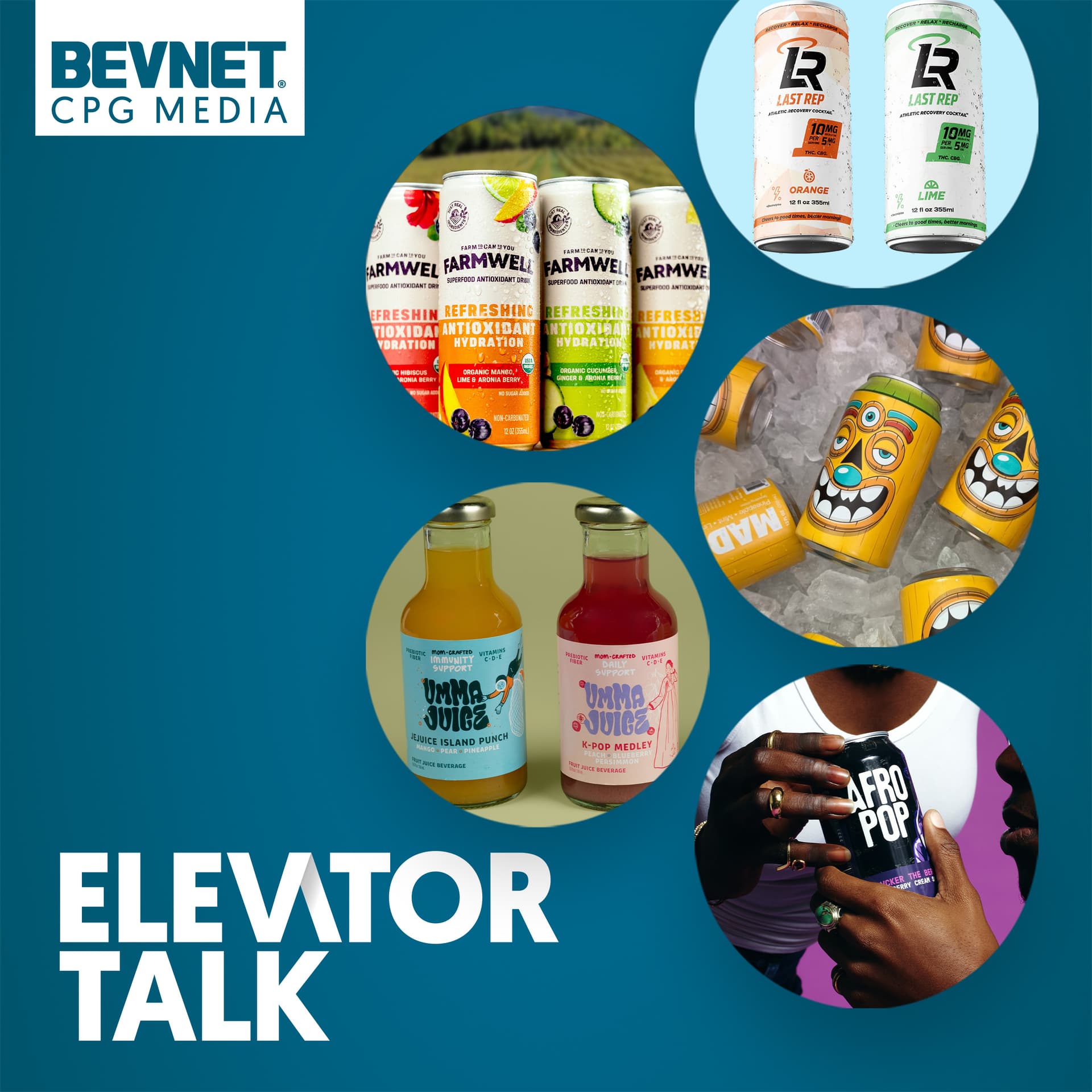
- FarmWell: Aronia berry “3x blueberry” antioxidants; no added sugar; SKUs include cucumber, pineapple, hibiscus, mango; regenerative farm story; no caffeine/no bubbles.
- Umma Juice: Whole fruit purees, no added sugar, prebiotic fiber; vitamins/electrolytes; flavors like Subak Splash (watermelon + sweet potato + persimmon) and K-pop Medley; glass bottles; launching at Misfits Market and Dallas-Fort Worth area.
- Last Rep: Delta-9 + CBG, electrolytes/adaptogens; zero sugar, 6 calories; “cocktail” for post-workout and social nights; launched in Tampa; 25 doors; 5mg vs 10mg (retail favors 10mg).
- MadPop: Sparkling craft soda with art-forward packaging; 7g sugar, 30 calories; flavors like watermelon haze, blackberry bisque, pineapple paradise; upcycled soda-can origin; seed round $500K; picked up by United Distributors.
Written by AI. May contain mistakes. Listen to the episode to check what was said.
Chapters
Tap a time to open that second in VOIntroducing Madeline Hayden
0:45 to 2:09
Discussion with co-host Madeline Hayden about her background and insights.
“Today's the Boston Marathon, or at least the day of the Boston Marathon.”
Madeline's Entrepreneurial Journey
2:09 to 4:38
Madeline discusses her journey with Nutpods and the acquisition process.
“And you're also someone who hit the dream of a beverage entrepreneur, at least the dream of most, I would think, in that your company was acquired.”
The Importance of Building a Brand
4:38 to 10:43
Madeline shares insights on branding, talent development, and entrepreneurship.
“So in Pearl Rock, we have phenomenal people on our board.”
Introducing Eric Ramstad from FarmWell
10:43 to 11:37
Eric Ramstad introduces his beverage brand, FarmWell, emphasizing its unique story.
“as well of like what people are going to experience when they try it.”
FarmWell's Unique Selling Proposition
11:37 to 12:23
Eric discusses the health benefits and market positioning of FarmWell drinks.
“But it wasn't like we didn't even mention the farm on our previous can.”
Consumer Insights on FarmWell
12:23 to 14:04
Discussion on consumer perceptions, flavors, and market demands for FarmWell.
“And that's really resonated with people who are looking for that alternative.”
Farmwell's Unique Approach to Juice
14:04 to 16:30
Learn how Farmwell differentiates itself in the juice market through flavor and regenerative agriculture.
“It was unique and really refreshing in the set.”
The Story Behind Umma Juice
17:41 to 20:31
Explore Angie's unique background and how it influenced the creation of Umma Juice.
“And I think we mispronounced it on the show.”
Umma Juice: Product Insights
20:31 to 24:18
Learn about Umma Juice's flavors, ingredients, and market reception.
“We're trying to bring juice back to the family table.”
Consumer Feedback and Marketing Strategies
24:18 to 28:00
Understand the value of consumer feedback and targeted marketing for Umma Juice.
“You have, you point out zero grams of added sugar, three grams of prebiotic fiber, organic ingredients, vitamin C, D and E, no artificial colors.”
Show all 23 chapters
Encouragement and Mentorship in Entrepreneurship
28:00 to 28:45
Discussing the importance of mentorship and community support for new entrepreneurs.
“you know, it's an opportunity for you to just continue having the relationship.”
Last Rep: The Athletic Recovery Cocktail
29:05 to 31:22
Jay Ashton explains Last Rep's unique position as an athletic recovery cocktail.
“we're seeing a lot of blurring lines, right?”
Use Cases and Market Positioning of Last Rep
31:22 to 34:16
Discussion on the versatile use cases and market positioning of Last Rep drinks.
“We're already in 25 doors, both on-prem and off-prem.”
Understanding Dosage and Consumer Preferences
34:16 to 36:38
Jay discusses consumer preferences between different THC dosage levels.
“And it's been a challenge because, again, if you look at our social media, for example, we're doing a ton of events, a ton of sampling, and they are wellness focused.”
Pricing Strategy and Market Comparisons
36:38 to 40:02
Discussion on Last Rep's pricing strategy and how it compares to similar beverages.
“I was curious if the 5 milligram is kind of like the tiptoe in, the tiptoe in to see like how you do with THC.”
The Artistic Journey Behind Mad Pop
42:08 to 44:36
Learn about the creative origins and branding strategy behind Mad Pop.
“I've always been fully ingrained in creativity and art and the power of art.”
Connecting Art and Consumer Experience
44:36 to 47:44
Discover how Mad Pop integrates art into its branding and consumer engagement.
“and just flipping it upside down and doing things differently.”
Product Launch and Distribution Insights
47:44 to 49:40
Explore the challenges and strategies for launching and distributing a new beverage.
“But I also want to learn a little bit more about the product.”
Transition to Afropop: Celebrating Black Culture
49:40 to 51:34
Meet Jamel Stevens and learn about the cultural significance of Afropop's offerings.
“I noticed that you recently got picked up by United Distributors out of Georgia, which is great, the largest distributor in the state.”
Afropop's Unique Flavors and Cultural Connections
51:34 to 56:12
Discover how Afropop uses nostalgia and flavor to connect with consumers.
“On to our final guest for this episode of Elevator Talk.”
Exploring Unique Beverage Flavors
56:12 to 58:11
Learn about the innovation in beverage flavors and cultural representation.
“We're kind of pushing against the grain of, especially in the beverage market, it can be very monotone.”
Distribution Challenges and Strategies
58:11 to 1:00:18
Discover the distribution strategies and challenges faced by new beverage brands.
“You know, I actually got the opportunity to share with BevNet that we recently signed with RNDC as our beverage distributor.”
Networking and Mentorship in the Industry
1:00:18 to 1:04:09
Understand the importance of networking and mentorship for brand founders.
“And I think for, like I said, for me, it was more, how can we make sure that we are prioritizing artistry?”
Transcript
Automatic transcript. May contain errors.0:05Hey folks, I'm Ray Latif, the editor and producer of BevNet's Taste Radio podcast, and you're tuning into the latest episode of Elevator Talk, the series that profiles early stage and disruptive brands from across the food and beverage industry. Today's episode will focus on five beverage brands whose entrepreneurs will have an opportunity to hear feedback and advice from our co-hosts for this episode. That's Madeline Hayden, who is the founder of Nut Pods. Madeline, I am thrilled to see you. How are things? Awesome. It's sunny here in Seattle, so life is great. Yeah, well, it's a little cold here in Boston, but there's about 50 ,000 people running up and down the street.
0:45Today's the Boston Marathon, or at least the day of the Boston Marathon. And it's always an exciting time to be in the city when that happens. Just makes you want to be more fit. Yeah, it does. and maybe have a nice beverage to cool off with or enjoy post-exercise. And we've got five amazing brands here today on the show. And you yourself know something about building an incredible brand. You are the founder, as I mentioned, of Nutpods, which for folks who may not be familiar with, tell us a bit about your brand and how you got started and where it is today. Absolutely. I started Nutpods in my kitchen when I was pregnant with my second daughter.
1:26I love a good cup of coffee being from Seattle, but unfortunately I'm lactose intolerant and I could just never take my coffee black. I was drinking a lot of almond milk at the time and just wanted to have a better for you option rather than the processed legacy creamers of processed, you know, artificial this and that's and partially hydrogenated oils. And so it started in a blender in my kitchen. We have since grown to be sold nationwide. Number one, Amazon and online channel. Number one, in natural. And number two, in the all channel category, which is pretty crazy considering, you know, the multinational competition that we go up against.
2:08And so have definitely been a part of BevNet and the beverage school and just love this time, have been in these shoes and happy to talk to the entrepreneurs today. Yeah. And you're also someone who hit the dream of a beverage entrepreneur, at least the dream of most, I would think, in that your company was acquired. And it was a very successful acquisition. You're still obviously with Nutpods. Talk about that process of getting to a sale, because this is one of the, I guess, dirty secrets, for lack of a better phrase, of our CPG industry, which is that everyone wants a successful exit. But it's not necessarily something that happens overnight, certainly not something that happens overnight.
2:51And it takes time to find the right partner who can help you achieve your vision at a much more broad scale. Absolutely. You know, I think this is really a marathon. And so all these overnight successes are usually 10, 12, 15 years in the making. You know, for us, I started in 2013 and we were acquired in 2024. And so it's been two years since we've sold. I'm still on the board, guiding the brand at the board level, happily semi-retired and focusing on some philanthropy and doing things like this, supporting entrepreneurs and being able to do some public speaking because we have such a crazy underdog story of how we've been able to do this.
3:35And so I hope to inspire, I hope to equip, I hope to empower entrepreneurs. Entrepreneurship has been such a life-changing journey for me. It's changed me. And I know it will change for these five entrepreneurs. The journey of building a brand, you know, you think you're building a product, but you're actually building three things at the same time. You're building the product for sure, but you're also building a brand, hopefully, that has a defensive moat. We'll talk about that, I'm sure. But, you know, in addition, you're also talking about building an organization where you can attract, develop, retain talent.
4:12And so as an entrepreneur, you need to do all three basically from day one. And so, you know, I used to think like, oh, raising money is so hard or getting into retail is so hard. Every step you take, you're building on the success of your brand, but you're also building something that will have value. And so for us, we were lucky to be acquired by a joint venture of Mid-Ocean Capital in Pearl Rock. So in Pearl Rock, we have phenomenal people on our board. Our chairman of the board is Brian Kelly, president of Coca-Cola and put together Curry Green Mountain, sold it to JAB. There is not a better partner that I can think of that will steward Nutpods, hold what we have built and build upon that.
5:06And as you know, you know, my BHAG goals for Nutpods has been to be able to have a global brand that helps other people around have a better tasting, better for you option. So that's something that I have in common with these entrepreneurs here. And of the five entrepreneurs that are going to be joining us today, there's quite a few that participate in large competitive categories. But I do like what you talked about when you said premium in quality and really focusing on those two elements of your brand as being key differentiators for everything else. And I'm really excited to speak with our founders.
5:43Are you ready to meet our first? Love to. Fantastic. That person is Eric Ramstad. He is the founder of FarmWell. Eric, it is fantastic to see you again. Yeah, right. Thanks so much for having me on. And Madeline, wonderful to meet you. Thank you so much. Thank you. Eric, you and I met at Expo West 2026, and I was thoroughly impressed with FarmWell from the first sip of your product I was sold. you make just such a fantastic beverage line of beverages that is and it's a great authentic story behind what you're doing i'm giving away everything but uh please no i appreciate it appreciate the kind words so thanks so much uh please tell our audience all about farm well yeah so we're farm well refreshing antioxidant hydration from the farm um just real ingredients no added sugar so all of our drinks are powered by the aronia berry antioxidant powerhouse berry three times the antioxidants of a blueberry and run supported by our family run regenerative organic certified farm.
6:50A little backstory, we, my dad was in the organic deli business for organic food business for 30 years and didn't want to retire when he sold his company. He had always dreamed of being a farmer one day. And when he sold his company, went to my mom with this dream. And after a little bit of initial shock, she was like, okay, let's do it. But her condition was to do something unique, something special, something that could make a lasting impact from the ground up. So they discovered the aronia berry and went all in. We planted three, planted, we put in three miles of irrigation lines, planted 25 ,000 aronia berry bushes by hand and built what is today are regenerative organic certified farm.
7:33And the goal was from the beginning to create something incredibly refreshing, infinitely chuggable was what my dad had said, just refreshingly real. And I've been really excited with the initial reception and just wanted to kind of match the real ingredients and the real things or real products that are out there and food with a real beverage that comes from the land. We're honored to be a finalist for Best New Organic Beverage at Expo West this past year and are just about to launch in Raley's coming up in the next week or so. Outstanding. Congratulations on that. And, you know, when I think about new beverages that come to market, there's a lot of functionality, but flavor wins always.
8:21And the question is, how do you get someone to sip? How do you get someone to be interested in what you're doing? And Madeline, you know, from your standpoint, what are you seeing in this story? What are you seeing in terms of the product, the packaging and the story that really resonates most with you and that may resonate most with that end consumer? You know, what I like from the get go is you tell the story of your brand very well. I feel like I know your parents, Peggy and Ron, you know, there's pictures of you guys on there talking. You're hitting on some great, some great trends that I think are going to stay regenerative agriculture, you know, certified organic.
8:59I like that you are very clear about what you're not, which is no caffeine, no bubbles. And so it's very clear about if you don't like seltzer water, but you want to have a healthy wellness product like this, then I think that's fantastic. One thing I noted, Eric, is that you actually have four SKUs. So cucumber, pineapple, hibiscus, and mango. And so you could trim it to the top three because the brand block is typically your top three. And so sometimes we have to preserve working capital. Sometimes we have to make sure that the cash flow gets you through. That's the toughest part about being a startup.
9:43And so that's one thing that I might want to put out there. But, you know, you're about$3.75 each. 12 cans runs about$44.99 for a 12 ounce. And so you're on the premium side, but you know who you are. You're, you know, organic and you've got antioxidants. And I think there might need to be a little bit of education on the Arona berry. Like how is that versus the Cascara berry, you know, in terms of antioxidants. And so maybe lean in a little bit more about that source as an antioxidant. Yeah. And that's been one of our like opportunities we found is just like education. And for us, we leaned like we didn't want to like ignore.
10:22So the Arona berries, like in our flavor names, we went with like, what the ingredients are in the name, like, so the aromia berry is a part of the name itself. But for us, like trying to describe, because it's a new ingredient, describing the expected flavor profile, just with refreshing, kind of like painting that expectation as the, one of the biggest words on the can was how we tried to lean into like the expectation component as well of like what people are going to experience when they try it. But thank you for the kind words. Appreciate it. Yeah, when you're talking about functional beverages, a lot of times it definitely helps to make it as clear as possible what the consumer is getting out of this product.
11:04Antioxidants, it's a term that I think a lot of people are familiar with, but not necessarily everyone. But between antioxidant and hydration, Eric, what has really stood out for consumers? I know it's still early into your brand, but if there's a reason that someone's buying your product, is it more about hydration or is it more about the antioxidants? Yeah, it's a great question. It's been a little bit of both, actually. And interestingly enough, like the farm story has been a huge component that's resonated with a lot of individuals. So we went through a big rebrand and actually changed the name of our company because it was doing okay before.
11:41But it wasn't like we didn't even mention the farm on our previous can. That's really who we are and what drives almost every decision that we make. We truly believe in farming well and have pursued regenerative organic certification to kind of help showcase that and help talk about it a little bit easier. So antioxidants and hydration have been one component we've really been leaning into in a lot of our marketing and advertising as well. to Madeline's point is like, we know what we're not like, and some of that is setting the expectation on it too. Like we're not sweet. We are not overly sweet.
12:14We are not artificial. So a lot of our marketing and a lot of our, like, like that is the number one thing we talk about when we have demos is like, this is not something sweet. If you're looking for something sweet, like that's awesome. But that's not us. And that's really resonated with people who are looking for that alternative. So we're working to continue to find different ways to communicate that in our packaging and through different marketing and different advertising things as well. Eric, I think one of the best things you can do in that early stage is really honing in on what consumers are, you know, what are they drawn to for your brand and also positioning it.
12:51It's amazing about how important it is. Are we non-dairy? Are we plant-based? Are we, you know, Whole30, like all the things. And so, and are we just a coffee creamer? What about tea? London Fog, anyone, you know? And so being able to really hone in and know what the consumer wants from your brand and also positioning it, you might find, are they really drawn to their regenerative agricultural side, which is great. But then as more farms go that way, then are you creating a differentiation. So make sure that you really know how to speak about your brand that pulls that consumer back to your brand.
13:30It's one thing to talk about what the consumer wants. It's another thing to talk about what the customer wants. And by the customer, I mean the retail buyer. You're getting into Raley's, which is great. What got the Raley's buyer excited about FarmWell and the potential for FarmWell to create incremental value for their stores? Yeah, I think the feedback that we have heard throughout the process from like buyers has been a little bit about the regenerative piece, particularly here as well was the flavor that it was different. It was unique and really refreshing in the set. So something that's a little bit different that doesn't have the artificial components, like we use a little bit of monk fruit in one of our drinks, but that's it.
14:14So it's really refreshing. And that was some of the feedback that we had heard that like the taste really knocked it home, which was really encouraging. And for us, it's so like, I love hearing that like our story resonates, that the regenerative agriculture component, that farming, like we are unique in that regard. But to your point at the beginning, Ray, as well, is just like if the flavor isn't there, then story can be the best story in the world, but people aren't going to continue to approach it and buy it. So it was really encouraging that I heard that the flavor really resonated and they were wanting to dive in.
14:48And Nutpods grew quite a bit as an online brand and had a real great foundation with online sales as it went into retail, as it went into wholesale. And your online presence, your brand's online presence was amazing. Do you have any tips for Eric and our other entrepreneurs about how to enhance that online presence as an early stage brand and get people really interested and excited about the idea of buying and certainly trying FarmWell? Our brand would not be where it is without the start of D2C. It's really important. You have so much feedback from the consumer reviews. You're in a stronger position when you go to Raley's or to another retailer.
15:37We have a multi-million dollar brand, or we have so much traction online, and we want to partner with you to bring FarmWell into Publix, into Sprouts, into Whole Foods. and they want to be able to see that you have a foothold somewhere. And so being able to do that online saves you from all the trade spend, saves you from the sales force, the brokers, all of the things that are associated with retail. And so I can't say enough about if you have a compatible product for DTC online, it's a great way to go. and financially in terms of cashflow, it also will be advantageous as well. Outstanding. We are out of time, Eric, but I would love to keep this conversation going and let's just do that.
16:27I think FarmWell is off to a great start and we definitely want to follow everything that's going on with the brand along your journey. Please stay in touch. Please let us know if we can help in any way. I'm just going to start off because I always mention this in the elevator talk. BevNet as an organization, yes, we're a media company, but we're also a community organization. We're here to support entrepreneurs along their journeys and make those connections whenever possible to a supplier, to a retailer, to an investor. So we want to see you all succeed, and we want to be a small part of that process if we can.
17:02So thank you so much for being on Elevator Talk today. And like I said, let's definitely stay in touch. Sounds great. Yeah, thank you so much, Ray. Thank you, Madeline. Really appreciate you having me here today. Thank you, Eric.
17:15All right, great start to the show. Let's keep it going with our next founder. That's Angie Max, who is the co-founder and CEO of Umma Juice. Angie, it's great to see you. Great to see you. Thanks, Ray. I feel full circle because I met you before we launched a product and you gave me your card and you're like, let me know when you're ready to share. So thanks for having us on and Madeline. Nice to meet you. Nice to meet you. Yeah, we are coming full circle. Here you are today. And in last week's episode of Taste Radio, our very own founder and CEO, John Craven, was singing the praises of Ama Juice.
17:49And I think we mispronounced it on the show. I think we called it Uma Juice, perhaps. But sorry about that. For folks who may have missed that episode, tell us all about your brand. Sure. So I didn't actually plan to start a juice company. I just wanted to be a good mom. And it turns out one led to the other here. So that's how I started Ama Juice. You know, the plate of parenthood, we often get pulled back to our childhood of the things that we love, things that maybe we're resentful for, and then what we wish we had. So when my son started daycare and I went back to work, he was giving us all the bugs.
18:19And so we were desperate to kind of bring back what we had lost. And then what we found on the shelves weren't really meeting that need. And then similar to your story, Madeline, I actually had a decade's worth of experience in nonprofit, so maternal and child health. So it just felt like a fit as far as starting on Majuice. And then thinking back to my own Oma, which is mom in Korean, peeling fresh fruit for us every day. I don't have that time. And so being able to put it in juice form has been great. We have watermelon juice called Subak Splash with sweet potato, persimmon juice, that's persimmon, blueberry, and peach.
18:54That's called K-pop medley. And also features my mom as the illustration. And then Jeju Silent Punch, which is mango pineapple pear inspired by Jeju Island. So we include whole fruit purees, no added sugar, prebiotic fibers. And again, there's vitamins and electrolytes that we often lose when we do get sick or feel unwell. So you haven't tasted it, Madeline, I'd love to send it to you. But what comes out most is that it's fresh, light and not too sweet, which as a juice brand owner and an Asian founder, that's the highest compliment. And so we're excited for the movement we have for responding really well to the market.
19:31And I'm excited to announce that we'll be launching at Misfits Market. So Jesse and the team there have been phenomenal to work with. And then we're approved to open up in Kehi for Dallas-Fort Worth. And then, of course, some Central Texas stores like Weedsville Co-op, People's Pharmacy. At demos, we're averaging around 85 % conversion rate. People are trying us and buying us. We had 100 % at an event yesterday. And then we've also been engaging in large-scale events. So Laneige and Innisfree, which are a big Korean skincare company and beauty brand in the U.S., they've invited us to be their beverage partner, I think in part because there are no Asian brands that they have found to partner with and they'd love to do that.
20:15and then we've also sampled to thousands of people at Ghirardelli Square during the big game weekend. So in a few short months, we've been able to make an impression with those brands and community is something that I'm passionate about. So we're just leaning into that as much as possible. So yeah, that's Oma Juice. We're trying to bring juice back to the family table. Fantastic. I'm a big juice guy. I love juice and I love differentiated juice brands. And this is definitely one that I haven't seen. I haven't seen this angle in terms of juice before. Madeline, do you typically consume juice on a regular basis?
20:51And, you know, what are your original, what are your initial thoughts on almond juice? I'm really excited to try it. And the reason why is, is that I don't normally drink a lot of juice because I don't like how sweet it is. Now, you know, if you've ever had like Taiwanese cakes, the cakes in Asia are not as sweet. The frosting is not as sweet. So I'm hoping that it's going to be the same. There's great things about juice, you know, all of the vitamin C's and the things that you call out for your product as well. And you're right. I mean, kids are a Petri dish when they start preschool. So I think that that's fantastic.
21:30I think one thing is I'm just curious about the weight of the glass. That's, you know, it's great because it's premium. It's also heavy and you will have more breakage. And so, but I know glass is something that you specifically called out as a source of pride. Yeah. Tell me about that decision a little bit. Yeah. So we actually thought about doing juice boxes at first. I'm actually really glad the direction we went. And part of it is being able to find a partner that we could buy materials from so that we weren't crushed with the high MOQs. And then the other piece is that we have such high quality ingredients that I'm not afraid to show what's inside of it.
22:11It's nice that the fruit settles a little bit at the bottom. And that's kind of the feedback we've gotten. And the weight is a problem, I would say, definitely. So we're in D to C. We're about 50 percent of our revenues from D to C. and we've got great repeat rates, but that's why we're focused on the retail side of it, knowing that that cost piece with shipping and breakage. So far, we've not had much breakage, which is good because we're lovingly packaging it out ourselves still. But we know that's an issue and that was actually another question. Madeline, I know that DDC was great for you and we're trying to just balance because even we've got some independent retailers across the coast, we've got great visibility.
22:55with them, but even kind of shipping to them or getting product would cost way more. And so the math isn't mathing right now for us. Even with girl math, it's not mathing. Yeah, no. And so, you know, I think one of the questions that I have for you is the use education. So ideally in, in the world, are you selling to moms who are going to have this in the refrigerator? And this is the first thing they reach for when their kids come home and, or, you know, have it at dinner or breakfast or do you want to move in the place where it is going to be like a juice box and it's portable and you can go ahead and have that in to the the lunches and so I would think a little bit about about the usage occasion because that will help you determine your form factor.
23:40Yeah that definitely helps and and so far parents are really appreciative of the glass bottle. I think there's just been a mindset shift as far as like portability and being able to carry it and And then, yeah, we're usually, we're shelf stable, but we've so far been placed in more refrigerated sections. And just anyone like Ray or Juice Fanatic, Juice Fanatics in general love it. And families who haven't bought juice in a while, because there's nothing that's like this yet, are now more encouraged to buy juice. So we're hoping to just like bring juice back, the fun and the memorable moments of it to families.
24:15I love it. Yeah. As I asked Eric, Angie, is there one particular part or is there an aspect of your brand that has really popped for the early stage consumers of your brand? And I'm on your website right now. You have, you point out zero grams of added sugar, three grams of prebiotic fiber, organic ingredients, vitamin C, D and E, no artificial colors. Is there one part or there are a couple of things that people are like, wow, I love this brand because it has this or it doesn't have this. Yeah. You know, when you're in the CPG bubble, people kind of point out the different facts, but our consumers, which we've definitely sampled over 5 ,000, 6 ,000 people at this point, it's just the flavor and the craveability of it.
25:04And I think the education on Korean culture, that's been very big. And then the benefits help. I can tell when a consumer is buying. So right now we're only selling in 12 packs just because of packaging on DTC. I can tell when a family is going through an illness because they will buy two 12 packs at the same time. So there's just some signals of something that is functional and helpful in the moments that you need it. But the flavor, I think really, it's my best, it's my favorite part of sampling, seeing everyone's reaction to it. Angie, if you could, and you have to work out, you know, field marketing and staffing for that, but I would be in front of every K-pop, like concert you can have or the conventions or, because that's pulling right into the demographics that you want.
25:52And I think it's also just a fun experience as well. I think Laneige, of course, and Korean skincare, I think that's lovely and you can pull out the vitamins that help with the glow without having to get into collagen or anything like that. But I think also just you have such fun flavors as well and being able to go where your prime demographics are. Just saying, I think in Hypen is coming to Tacoma, Washington. So I'll get my cooler out. Exactly. And, you know, sampling, it's hard work for sure. But if you want feedback, if it's too sweet, if it's not sweet enough, the size, you know, temperature is the best served.
26:38I used all those details. Yeah. That's the best way to get it. Thank you. Yeah, that's such good advice. And I was speaking with a founder the other day about demos and he said, sometimes the best feedback that you'll get is when you tell them you're not the founder, that you're just some brand ambassador or rep, because they'll be a little bit more honest with you. If you're the founder, sometimes they don't necessarily want to give you the straight answer because they feel like they might hurt your feelings if they're going to say something that's negative or offer some constructive criticism.
Read the full transcript
27:07So yeah, it could be something that an angle that you take when you're demoing as well. Definitely. Yeah. Angie, thank you so much for joining us on Elevator Talk today. Really excited for the development of your brand. And I feel like we're going to see some iterations that are going to be really exciting in the near future. And please stay in touch and let us know how the brand is doing, when you're getting new retailers on board, when you're getting new distribution, because we want to write about it on BevNet.com. For sure. Thank you. I'd love to just continue on this conversation. and also Ray and Madeline, just with your, just some kind of mentorship if you're open to it, but I appreciate it.
27:44And just real quick, Ray, I mean, I'm still at Madeline at nutpods.com and it's amazing about with all the podcasts, actually very few entrepreneurs follow up. That is a, that's a pro tip right there. Just follow up because a lot of times, you know, it's an opportunity for you to just continue having the relationship. And so not everyone's meant to be your mentor, but they will help you along the way. We are all here because we want you to succeed. Thank you all. Thanks so much. Thanks so much for that, Madeline. That's great. And I do highly recommend that folks continue this conversation with Madeline and reach out because she's paying it forward.
28:24You know, I'm sure there are people in your life who have helped you along your path and journey. So, you know, if you can offer some of that back to new entrepreneurs, they would appreciate that for sure. And I can tell you're already doing that and you'll continue to do that, which is amazing. Thanks, Ray. Yeah. All right. On to our next guest for this episode of Elevator Talk. We have Jay Ashton, who is the co-founder and CEO of Last Rep. Jay, it's great to see you. Great to see you, Ray. Nice to meet you. Thanks for having me on. Madeline, very nice to meet you. I loved hearing your origin story and your journey.
29:00It was fantastic. I feel like one of the most interesting things about the beverage industry today is that we're seeing a lot of blurring lines, right? And so with Last Rep, I feel like we're seeing three or four different categories in one brand, which is fantastic. Jay, tell us all about Last Rep. Yeah, I feel like he just threw me in a blender. Puns intended with blurring lines too. So I'm Jay Ashton, co-founder and CEO of Last Rep. Last Rep is a, you know, it's the first of its kind athletic recovery cocktail. So our drinks pair Delta 9, MTHC with CBG, electrolytes, adaptogens, zero sugar, and six calories.
29:43My partner and co-founder, Steve Sampson, this was really his idea coming off the sale of his company, realized that the stress that goes, and Madeline can attest to this, when you are being acquired, those are long days and longer nights sometimes. And when you turn to alcohol, it makes for longer mornings and you're not, you know, functioning at a high level in a morning. But what also happens is when you make a decision to slow down the drinking, the text messages, the meet me here, meet me there of the social life starts to slow as well. So Steve and I really talked about how could we bring something to a category that we saw that was split really between indulgent sugary options, you know, really stripped down seltzers that were built around getting high.
30:31No one was building anything for function or recovery. So Last Rep is different because, you know, our drink is purposeful. It's for post-workout, but it's also for a night out with friends, you know, unwinding on a long day. So it's one can with multiple use cases. It's really perfect for anyone who, you know, doesn't want to have to choose between a healthy lifestyle and having a great time. Everyday athletes is what we kind of coined the phrase of, you know, people who are fitness first, you know, those wellness minded individuals that are really looking to train hard, recover without sacrificing a social life.
31:11So our journey, you know, we're brand new. We launched January 3rd in the greater Tampa area, focused primarily in this market. We're self-distributing. We're already in 25 doors, both on-prem and off-prem. Our second SKU, Orange, just dropped April 1st. So our initial SKU lime flavor was January 3rd. So we're doing D2C e-commerce in every state that D9 can ship to, kind of your point, Ray. It's a little bit of a gray market. So that's kind of our origin story. Well, thank you for sharing it. And I'm really excited to talk about your brand because I have a thousand questions. I'm sure Madeline does as well.
31:51Me too. Yeah. The one question I want to lead with, which is about how you describe this brand. I'm looking at my notes here and it says, Last Rep is the first ever THC seltzer for everyday athletes and wellness focused individuals. On your website and on your cans, you describe Last Rep as a cocktail. is one more effective than the other in terms of a descriptor? We're trying to figure all that out, right? Because it's easier when you're having these conversations to slow the conversation down versus just what's in print, what's the first thing that somebody sees. Cocktail kind of came to fruition because we were intending on, you know, being in bars, being in liquor stores, et cetera.
32:32So we wanted to make sure while we weren't broadcasting the THC, get high in a can thing, we wanted to make sure that people knew that we were still about having a good time, putting a smile on your face without being over-indexed for flashy colors or something that might be misconstrued as that, again, get high in a can, if you will. Yeah. And I think athletic recovery cocktail probably speaks to me a little bit more than THC seltzer, specifically because I'm not really a THC consumer, but I do love the idea of something that you can have post-recovery that's kind of fun and social. Something more than like coconut water, right?
33:13Sure, exactly. I liked how he described it online, light euphoria, stress relief, physical and mental recovery. At first I was going to say, Jay, I was a little bit confused because when you go and you have a workout, you already have your endorphins. So there's already the stress relief that you have there. And then I was reading your reviews on your website. And as you saw, they're not all a post workout. Sometimes it's like, this is what we have, you know, watching a sports game. And I think, again, you know, what we had talked about with Angie is you really want to hone like, where is the use education for last rep?
33:51I think it's a great name, by the way. But if people are using it as something that is not, you know, non-alcoholic and something that really is THC, I think being able to be very clear about what is your youth education, because that will help you be so much more efficient with your marketing. And who are the people and what time of the day are they enjoying last rep? I appreciate it. And it's been a challenge because, again, if you look at our social media, for example, we're doing a ton of events, a ton of sampling, and they are wellness focused. But they are about having a good time. There's no mistake.
34:32For sure. But I think you need to, I think I would also encourage you to parse out like when we're talking about wellness, are we talking about Peloton or are we talking about CrossFit? You know, are we talking about like Boston Marathon level or are we talking about, you know, Planet Fitness folks? And so, and again, just being able to have the psychographics of who you're trying to target. I think the other question I'm dying to ask is you have the two different levels. the five milligrams and the 10 milligrams. I know you're early, but I think it would be really curious. It'd be really like, I'm curious about which one is outselling more because which dosage level.
35:17And then also when you go to retailers or convenience stores, or, you know, you have to be careful with those that will take in THC. Is there a preferred level for them as well? So what we're seeing right now is 70 % of all sales are the higher milligram, they're the 10 milligram. And for retail specifically, retail is purchasing 90 % 10 milligram versus 5 milligram. Where we are seeing 5 milligrams be sold more of is actually in the bars. And that's because they want to encourage more volume, right? There are concerns that a 10 milligram, somebody might only have one, maybe two max, whereas a five milligram or even a lower dose could encourage somebody to spend an entire afternoon watching a football game and having more than one or two.
36:11What we're also seeing is, especially through tastings, we do sample five milligrams and we give out five milligram cans. I want to be very clear. Obviously, it's five milligrams for a whole 12 ounce can, not doing a shot. And once it comes time for someone to purchase on the spot, they smile like, well, I'll take the 10 milligram. And it's kind of like a wink. And yeah, I know how to use THC is kind of the vibe they give. That's interesting. I was curious if the 5 milligram is kind of like the tiptoe in, the tiptoe in to see like how you do with THC. And then you can upsize, if you will, to the 10 milligrams.
36:52And so we are seeing that. It is very much for those, you know, this drink, my personal opinion is this isn't for someone who is looking to, you know, alter themselves in an immediate fashion. This is supposed to be social. Crack a can with friends and family and, you know, relax. Have a good time and, you know, be social and get your vibe back, if you will. And that 5 milligram for someone who hasn't experienced THC is a great entry point because it's not going to overpower them. They're going to feel the benefits of the drink and it makes them want to come back for more. The 10 milligram isn't going to be that much more extreme, but it's still, you know, for someone who's inexperienced with the plant, for example, it's going to be a little bit more than just a, oh, this is casual, right?
37:47Jay, in terms of price point and retail, where are you for an MSRP and where do you feel like the brand would best be sold? In what retail channel specifically? Is it grocery? Is it convenience? Is it liquor stores? Yeah, unfortunately, regulations is kind of, you know, making that question probably outside of my ability to answer directly. Where do I see it? I think it's great playing a liquor store. I think it's an amazing play on-prem for bars, restaurants. I think restaurants are a little slow to adapt to it right now for obvious reasons with regulations. Bar owners who are either early to the game have seen quite quickly that from a margin standpoint, they make far more on one of these cans than they do on several beers.
38:37Our retail or what we're seeing in retail is our four packs are going for$24.99 for the 10 milligram,$22.99 for the five milligram. So we are in that premium tier. But we're a premium drink when you look at, you know, the adaptogens, the electrolytes and the other ingredients in there, as well as the THC and CBG. It's hard to equate because when you're kind of innovating a new category, how do you price a product like this? And so your online prices, you know, your 10 milligrams was$40.99 for a 12-pack. So you're pushing like$5.12 per can. But right, like I had a board meeting in West Palm Beach and like a cocktail was like$23.
39:22So, I mean, you know, I partake in a gin and tonic. But then when you take a look at prices like that, then it kind of gets back to like, that's not bad. Because this isn't a regular beverage, right? It's not the same as a spin drift or an Olipop. And so I think it's a very different subset. And how you communicate that value of saying, well, a gin and tonic is going to cost me, or at least in a nice place, it's going to cost me$22. But a post-recovery cocktail, THC seltzer at$5 or$6 or even$8 on-prem is a better value for a lot of different reasons. How you communicate that to consumers, I think, is the big question.
40:06And I think you're on your way, Jay. I think, like I mentioned, this is a really interesting brand that's got a lot of different ways it could go. And certainly it's going to be incumbent upon anyone in this business, that of THC and cannabis, to keep a very close eye on what's going on at the regulatory level and hope for the best. Because there are so many moving pieces at this point. Jay, thank you so much for introducing us to Last Rep. You've got a great brand. I'm really excited to see where it all goes from here. Please let us know if we can help in any way as you continue to build this brand.
40:40Absolutely. I thank you guys for all the insight today and hopefully stay in touch and we'll be back on the show again. For sure. Thank you. Let's keep it going on Elevator Talk with our next guest. That's Greg Mike, who is the founder of MadPop. Greg, it is good to see you. How's it going? Good to see you. It is fantastic because I have been really interested in your brand, Madpop. It has a great name, by the way, right? I mean, I don't know how people come up with brand names and then securing the trademark for your brand name is a whole other process as well. But, you know, for folks who are not familiar with what you're doing, please tell us all about your brand.
41:24Yeah, for sure. I appreciate the time. So Mad Pop has a very interesting story because I've kind of built this brand backwards, but I guess everything I've done with my life, I've done backwards and working outside the box, which I think has kind of got me to where I am today. So formerly and traditionally, I'm an artist. I paint murals all over the world professionally, large scale installations, things of that nature, various all creative projects revolve around the art world. Art and creativity has always been my life. I've dedicated to it now. From the murals all over the world to this gallery that I'm sitting in now that I've built from the ground up 15 years ago, ABV, which is an 8 ,000 square foot gallery here.
42:07We work with 600 artists all over the world to running a design agency. I've always been fully ingrained in creativity and art and the power of art. um oddly enough 15 years ago uh when i was a up-and-coming artist before i you know started painting murals everywhere um i didn't have any money and uh as you probably know art supplies are expensive so at the time i was drinking a ton of sodas beers etc um and i couldn't afford canvases uh because they're super pricey so i started painting on soda cans um and i painted one can and then i painted a few more and then uh i was like wow there's i feel like there's something here.
42:47You know, I was just kind of like using this idea of upcycling to create something new. So that's kind of how it really all started. I knew eventually, you know, down the road, I would want to create a brand out of it. But I really felt important as a creative that I launched my artwork first, I let my art, our career stand on its own, before I start going down the commercial lane, because, you know, the art in the commerce world, you know, is kind of sticky sometimes with fine art, and then the products that you sell on shelves. So I took all these cans, I went to San Francisco, I had an art show and all the cans sold out, 100 cans all sold as fine art pieces of artwork.
43:21They're now in my collector's collections still to this day, which is awesome. Fast forward, you know, 20 years later, I had a partner that's, you know, my partner in the business, Mike, he actually came to me and said, you know, I know I've been in your ear for 20 years about this. I think now's the time. You know, he's like, you got 100 different designs of artwork. And I think it's time that we turn this into an actual brand. You know, me being a true creative and building all these businesses and brands and just loving anything creative, I was all for it and understanding branding and marketing and things of that nature.
43:56So we worked with a flavor house out of Cincinnati and we developed three main core flavors. And one thing we noticed is, you know, how art has the power to build culture and create something fun, unique, original, become a collector's item, and something that you can enjoy. So I think the main thing with Mad Pop, you know, it's a sparkling craft soda. And we've really seen that it just, the power of art really opens people's eyes and we wanted to do it totally different. So that's why our branding is, you know, it's on the side of the can. When you see it on the shelf, you see the character first.
44:31So we wanted to develop a brand that, you know, has branding on the side, is art forward and just flipping it upside down and doing things differently. Where when you buy it, you feel like you're, You're not just buying a brand that's trying to sell you a product, but you're buying a piece of art, a piece of community. And hopefully you're inspired not only by the taste and the flavors and how it looks and feels, but just as a bigger piece of history. I mentioned that for folks who are not familiar with Mad Pop, that Greg could tell us a bit more about that. And I said it that way because Greg is actually quite a well-known artist and quite well-known in social.
45:09You have 223 ,000 followers on Instagram, and I'm sure quite a few more on other social networks as well. And the one thing I didn't see on your social account, or at least on Instagram, is MadPop. I'm not seeing a lot of that on your profile. How are you getting the word out about what you're doing? I'm very strategic in terms of like, I don't want to ever feel like I'm, you know, stuffing something, you know, in someone's face too much, right? And like I said, you have to be careful of the art world and respectful of people that have followed me for a certain reason. You know, I also do, I have a music project and I have the gallery and I have the agency and I'm very strategic when it comes to like what I'm, you know, presenting on social.
45:56You know, it is, it is in my bio. There's a link to the Mad Pop. I'm sharing it on my stories, specific events or engagements or murals that are based around Mad Pop. I will feature those, you know, on the feed and on my socials. But I'm trying to be tasteful with it and make sure, you know, I'm not overselling it to people. You know, I want it to be organic. Everything I've done in my life has been by following like my intuition. So I want to, you know, continue to do the same, be respectful of people. And I just was curious about, I understand about your art that you painted, their original pieces of art, and those are collectibles.
46:33And so, but I'm curious that, you know,$30 for a 12-pack, so that's running$250. What do you think consumers do after they consume one of your very eye-catching designs? But what do you think that they end up doing with it? Well, you know, it's funny you say that because I hear a lot of people that'll buy multiples for the reasons to keep them, to consume them, but then also to keep them as collector's items and put them on display in their house, which we think is really cool and unique. You know, it's very rare to see a CPG brand where someone drinks it and then puts it on display because they want to tell the story about it when their friends come over or they save it.
47:11And then they come to my gallery event or studio or art show and they ask me to sign it. I think it's really like you have to find that. like a print version of you, huh? You have to find the balance, right? I think that's the biggest thing where it's like people are willing to buy more than one and throw it away, but then also willing to save them. And hopefully there's some upsell there. I mean, I think you're onto like a nice variety story, you know, watermelon, haze, blackberry, bisque, pineapple, paradise. I just think like for me, when I'm learning about a brand, I want to learn about the backstory for sure.
47:45But I also want to learn a little bit more about the product. And so great design. I love the art story that you're trying to present. Now tell me about the product. Yeah, for sure. Well, I mean, it's a better for you soda, you know, seven grams of sugar, 30 calories. And I mean, I think that's a big thing. Obviously, the artwork is very catching and eye catching. You know, kids are drawn to it, right? And parents are obviously very concerned about what's in typical sodas. So I think this is a win there. And then I think it's also like, you know, we're selling to the music venues and the festivals.
48:18And I think it's something, you know, it's a great product that tastes incredible that can be mixed as a mixer as well. And then just drink, you know, if you do not want to drink alcohol and you're at a, you know, a show, a concert, things of that nature. So it's one of those things, like you see someone holding one of these cans, you're immediately going to say, what is that? Because that looks like nothing I've ever seen in my entire life, like in terms from a branding and packaging and eye-catching standpoint, which we're seeing that it's kind of like the story starting to tell itself. And I think from an organic standpoint, you know, there's, we have billboards in the marketplace with my art because it's been in multiple cities all over the world.
48:58So it's kind of cool and unique where it's like people know the art and know the brand and know how real it is versing a brand that's just taking out billboards. You know what I mean? There's history, there's emotional connectivity to it. So I think that's where it's really unique. You know, I think a lot of brands are totally opposite. They create a product and they're like, how are we going to market this thing? But we actually have the lifestyle, the culture. And then now we have this extension of that, which is an incredible product. I mean, I think it's an incredible product just based on the packaging.
49:30And again, getting people to sip it and to try it for the first time is going to be the most important first and second step of your brand. I noticed that you recently got picked up by United Distributors out of Georgia, which is great, the largest distributor in the state. And you're also raising a seed round, which should also help get the brand out there or at least use, I'm assuming you'll use some of that money to help get the word out and get those trials and get those samplings going. Just out of curiosity, how much are you trying to raise in your seed round? 500K off the jump, yeah, for this round.
50:06Okay, I think that's reasonable. And I mean, are you reaching out to angel investors at this point? Friends and family and then people that are in my extended network, whether that's collectors or just people that I've met, do business with, clients, et cetera. Outstanding. Well, hopefully we're getting the word out about the seed round in this episode of Elevator Talk. And Greg, thank you so much for taking the time. It's a really exciting brand. And I think there's a long way to go, especially as people are even more aware of what you're doing as an artist. And I think just the differentiation you, you know, you're bringing to the soda category via packaging, which is a different route than I can ever recall seeing, especially in soda, which is really cool.
50:49Yeah, we're, you know, we're just, we want to do things different, unique. And I think there's just like tons of opportunity for collaboration, whether that's, you know, with movie, with films, with music, with, you know, limited edition releases. And, you know, obviously at the end of the day, the product's got to be great. And that's what we're excited about and always trying to, you know, expand on the brand. And, you know, thank you for the time and definitely appreciate all the feedback. And, you know, we're excited to see where it all goes. I'll be in Atlanta in June dropping off my kid for a summer camp at Emory.
51:21Nice. We're five minutes from Emory and I'd love to give you a studio tour and gallery tour and get you to taste the product if you hadn't a chance to get. Love that. Thank you. That would be amazing. Greg, thank you so much again. Thank you, guys. Appreciate it. All right. On to our final guest for this episode of Elevator Talk. We have Jamel Stevens of Afropop. He's the founder and CEO. Jamel, great to see you again. Hi. Great to see you again, Ray. Thank you for having me on. I really appreciate it. you know for me afropop started in my kitchen in 2022 it started as a self-discovery journey you know for me i grew up in rural oklahoma and the way that i found my culture was through creativity and um that had became the foundation for everything that we do with afropop you know we focus on black joy black culture and black community through our partnerships with uh emerging artists um and then of course we also create unique products as well you know this one here is Black of the Berry.
52:20It's kind of hard to see there. Black of the Berry. That's our Black Berry Cream Soda. And all of our sodas, 30 calories, seven grams of sugar, pretty on par for what the industry is. But yeah, thank you. Very, very cool brand. When I mentioned, when we talked a while back about Afropop, I think there's just so many things to like about what you're doing between the appreciation of and, you know, discussion of Black culture via a beverage. And then also just the flavors that you have and extremely differentiated. I think a butterscotch soda, maybe Jones soda had something like that once in the past, but I haven't necessarily seen it in this kind of format.
53:02It just sounds so incredible. And before we get to Madeline, I just want to go back to a question I've been asking almost every entrepreneur, which is, what do you talk about first? What's really getting the consumer engaged here? Is it the, you know, your association with artists? Is it the association with Black culture? Is it the flavors? Is it the packaging, which is also so incredible? For a lot of people, what resonates first is kind of like Madeline said, like, I want to go to grandma's house, right? And I think what resonates with people is that they see themselves in the products that we create.
53:35So, you know, sometimes we don't even have to say anything. They walk up and they said, oh my gosh, you know, this reminds me of my grandma when, you know, when we used to go to, you know, go to our grandma's house, you know, as a kid in the South, we would go and get those little butterscotch candies or, you know, with summer nights, it reminds, you know, them of going with their cousins to, you know, to their house and spending a night there and stuff like that. And so I think really for us, what resonates first is the, you know, it almost feels like we've been around forever. It's the nostalgia and the memory of what used to be and what is now, which is Afropop.
54:11I love that you actually scheduled, you know, Jamel after Greg, because both of them have very art forward designs. But one thing that Jamel has on top of that is layering on about the culture, you know, Black history. And so I think it's also in another affinity lane about being able to have great flavors. And one of the things that I wanted to point out about Jamel is that, you know, the convention for sure is to be just upfront about what you are, you know, cucumber, pineapple, hibiscus, mango is what we saw in FarmWell, Spindrift, you know, maybe they might get fancy with the Fuji apple or the green apple, but it's still apple.
54:56So you know what you're getting. I, it was the same for me when I wanted to be Tahitian vanilla because it's fancier than French vanilla. But one of my marketing consultants told me, you got to give them something that is familiar because they're already trying a new brand. So if you have like, I don't know, they might not like Tahitian vanilla, where's Tahiti anyways, right? And so we ended up going with French vanilla, which is our number one bestselling. But Jamela is actually zagging when everyone is zigging. So summer nights, You know, you don't intrinsically know that it's blackberry or lemonade or grandma's house is butterscotch, but it also invites you in to learn a little bit more.
55:39And so I actually really I think it's refreshing. For us, it's been about world building. You know, our blueberry lemonade is very popular flavor. You know, I think it's the most simplistic. You know, you have an idea what that might taste like. Um, but, you know, I, I think whenever we look at, you know, several different like culturally forward, um, beverage brands, um, we, you know, I've really admired that, uh, piece of being forward with, yeah, like even like a lychee soda, um, that's, that's delicious, you know, um, and I think that, you know, um, we are a little disruptive in that, in that space, right?
56:22We're kind of pushing against the grain of, especially in the beverage market, it can be very monotone. There's a lot of colas. There's a lot of lemon-lime sodas. And there's even a lot of root beers. But you don't see a blackberry soda or a blackberry cream soda or a blueberry lemonade or a butterscotch soda. And I think that also can be a layer of actually inviting people in. I think a lot of people are like, what does a black-owned soda company look like, right? We've seen Asian-inspired sparkling water brands, and we've seen a lot of beverage brands, really. And we've seen even in the Mexican soda category, I think one of my personal favorites is actually Delecaille.
57:03It is a personal favorite of mine because I love to see when we actually go deep into who we are and then be able to share that with the world. I think that's so cool. And I'm glad that for the Black community, I've been able to do that. And to see the response from the community has been extremely, you know, rewarding. And to see people outside of the community be able to enjoy the culture and appreciate it, that's also been really rewarding as well. And I think it's beautifully said. And, you know, Jamel, like, you have your favorite brand. You know, obviously, Harito's has really scaled. But bringing forward other flavors that you wouldn't normally.
57:46Like I don't think many people have tried like a tamarind flavored soda. So I think this is a lovely way to share your culture and your roots. And I love that you have a rotating cadre of artists that you work with for the designs. Again, just doubling down on the brand story and the authenticity. Absolutely. I really appreciate that. And we have seen a lot of growth and opportunity. we're in 135 locations, 25 states, and we're continuing to grow. You know, I actually got the opportunity to share with BevNet that we recently signed with RNDC as our beverage distributor. We're starting here in Oklahoma, but I foresee us being able to expand into more states and hopefully we can reach a place close to you so we can try some.
58:34Oh, I already found you. Art and Bar in Seattle. I'm going to find you. Don't worry. Okay. Nice. Nice. Well done, Madeline. I got to find some Afropop here in the Boston area. You know, there's a tangent, there's a bookstore that's right up the street from me that actually has a pretty impressive beverage selection of really independent brands and upstarts. And I feel like it's a really good way to introduce your products to a specialized audience and get a sense of how they're trying the brand, how they're using the products. And before you're going wide and really get that information, get that data that you can share with a larger retailer.
59:16the one question that I have Jamel is about um your sugar count and your calorie count and why you chose to put it on the side of the can versus the front of the can because if I'm looking at your butterscotch soda and you see the front I'm thinking this is a high calorie high sugar soda in reality it's not uh it is a set is a 30 calorie product with only seven grams of sugar So is that something that is intentional in terms of keeping it off the front? Or is that something you could incorporate in the future? You know, I wanted to make sure that we gave as much space to the artists as possible.
59:56And, you know, I think with, for example, like on this can, there's a big Afro Pop logo already on there. with some of the orientation that we started to do. We actually, when we updated our label, we moved it to the bottom right corner. So you can see those 30 calories, seven grams of sugar and all those call outs on there. But it's definitely not as big and bold as you usually see on cans. And I think for, like I said, for me, it was more, how can we make sure that we are prioritizing artistry? Like, you know, I think the value add It's from the culture piece and it's like, oh, this happens to be also a low calorie, low sugar option as well.
1:00:40Jamel, thank you so much for taking the time. It's such an exciting story. All the founders today have such really interesting stories and backgrounds. And I think it's something that consumers want. It's very clear that people want something different, something with a really interesting backstory and something that tastes great. And I think you're delivering on all those fronts. Now it's about really understanding how to tell that story and how to expand your distribution in a really efficient way. And I think you're really onto the right track. So thank you again. Please stay in touch. And if we can help in any way, just say the word.
1:01:15Thank you. Five incredible founders with really interesting brands. And I think when you started out talking about a defensive moat, it's definitely something where these founders are going to try to have to figure out where they do stand out and how they can keep that distance from the next brand or the already existing brands that are out there. But I think they're doing a good job of it. And it definitely helps, as you mentioned, when you can talk to people who have been there and done that, mentors, experienced executives or operators or founders that are willing to talk to you about how to build and successfully scale a brand.
1:01:56I think you were very kind in offering your email address, and there are plenty of people who are willing to talk, but I think the pitch is just as important. How do you advise founders as to what's not just reaching out, but the content in terms of that outreach? You know, if you talk to Mike Bergemeier, he saw me at my most awkward at the very beginning, where it was like, someone told me I needed to meet Mike Bergermeyer. And I was like, so awkward, you know, cause it was a whole new industry. And I'm like, he stopped for a moment to have his food. I'm like, I'm like, I'm at a lead. And it was so awkward.
1:02:38And so, but, you know, I think when you, the way that I, that I have since advised people is that everyone who comes in your path can help you put one piece of your puzzle for your brand in place, you know? And so not everyone is going to sign up to be your mentor, but they can help you in that moment when you're waiting for your car at the valet. It's a great five minute conversation you can have with them. And in little trivia note, sometimes I would be taking an Uber, but pretend to be in the valet line just so I could talk to whoever I needed to talk to, because that was not socially awkward.
1:03:16And you're just chatting about, you know, BevNet live. And so, but being able to keep in touch and so you know i think like for example jamel he could keep in touch with me and say i didn't want to say this on taste radio but i'm really excited about this flavor or you know um or like we can go ahead and talk to you you know angie to be able to say like i'm really curious about how you handled field marketing is it all dirty hands is it all like what what were the favorite ones and so you ask a quick question you give them a quick highlight of what's going on with their brand to keep them interested in your brand.
1:03:54And so, and most people, they feel good when you ask them for advice, you know? And so, and most people in this industry, I've always said, I think, I think our industry is like country music. We're very friendly and we want everyone to succeed. This isn't a dog eat dog world. You know, the market will choose what brands and what products succeed. And so, and it's hard enough. It's hard enough being an entrepreneur. So those of us that have been successful, most of the time I find that we want to help others on their way too. And so those are the ways that I would say is come up to us at industry events, you know, introduce yourself, not as awkwardly as I did to Mike Bergemeier.
1:04:36So, and then keep in touch with us and tell us what's going on with your brand with an easy question, not something that's going to take 20 minutes for me to answer. That's a great answer right there. And I love the fake Uber line conversations. That's a really good one. Madeline, I can't thank you enough for joining us on the show today. You're the best. We've had you on the show once before. We've got to have you back for a third time. Can I count on you to join us again? I will do a hat trick for you anytime. Thank you so much. Thank you, Ray. Always great to see you. You as well. You're the best.
1:05:13And thank you so much to all the founders who joined us today. To everyone who's watching or listening, and to our amazing team at BevNetNosh and Taste Radio, the best in the business. Signing off for everyone, I'm Ray Lateef, and we'll talk to you next time.
From the publisher
The latest episode of Taste Radio's Elevator Talk spotlights innovative leaders from Farmwell, umma juice, Last Rep, Madpop and Afropop. The founders and operators introduce their brands and share recent company updates and milestones. This week's special co-host is Madeline Haydon, the founder of Nutpods.
Madeline offers insightful questions, thoughtful feedback, and strategic perspective alongside regular host Ray Latif, editor and producer of the Taste Radio podcast.
Early-stage food and beverage entrepreneurs are encouraged to apply for future episodes of Elevator Talk. Participation is free, interviews are conducted remotely, and it's a unique opportunity to pitch your product, share news, and receive expert feedback from industry leaders.