In short
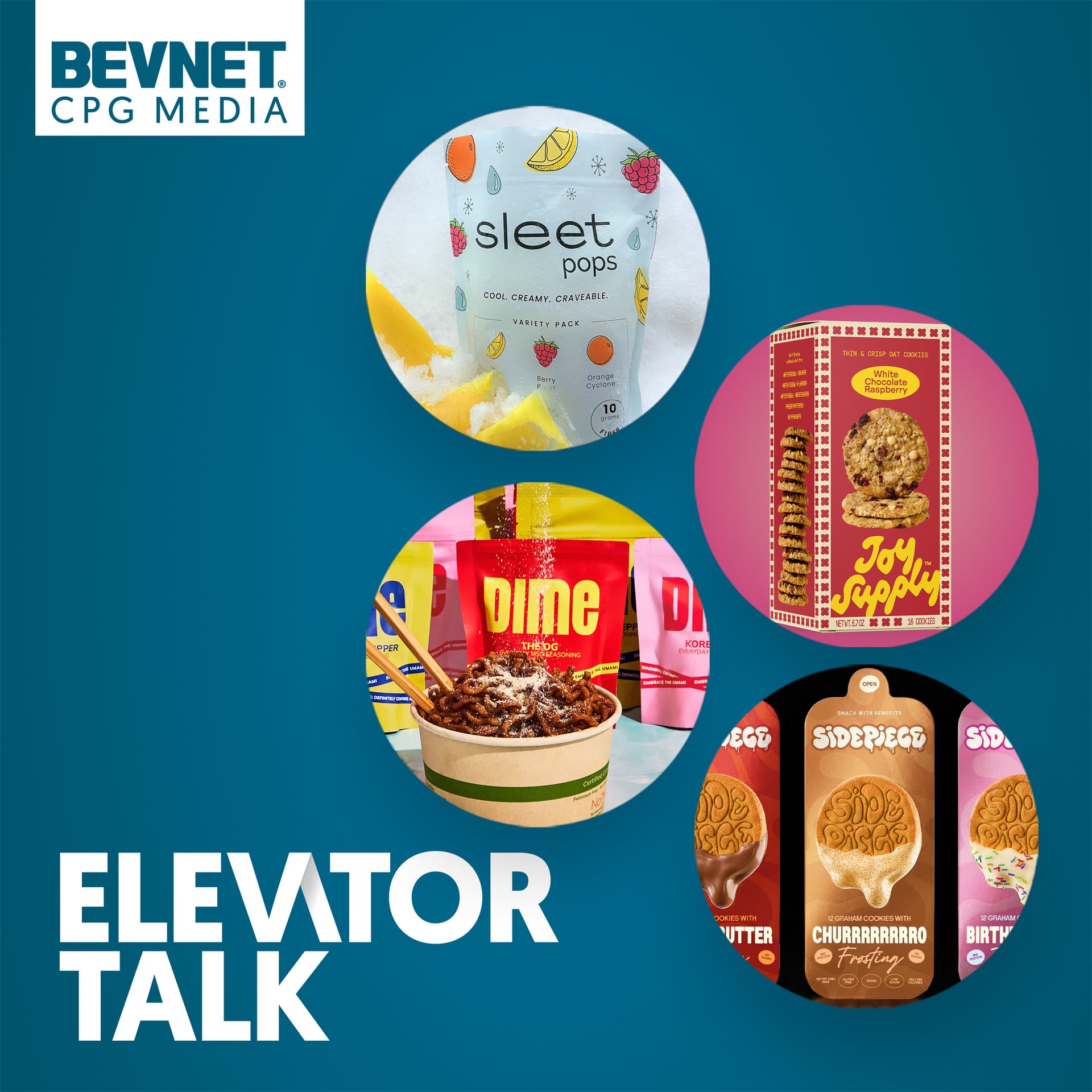
Elevator Talk “Sleet Pops, Dime, Joy Supply, Sidepiece” focuses on how emerging food brands differentiate and win shelf/consumer attention, using 360 messaging, clear front-of-pack claims, and channel-specific merchandising.
Guests (backgrounds)
- Sarah Marie Cole, co-founder/CEO of Sleet Pops: launched a protein-and-fiber freeze pop; previously personal GLP-1 weight-loss journey (110+ lbs).
- Jen Co, co-founder/CEO of Dime: seasoning brand leader; launched on Amazon and D2C; specialty retail now.
- Lindsay Leopold, founder/CEO of Joy Supply: modern heritage cookie brand; family bakery lineage to 1908; Brooklyn-based.
- Chris Enowal and Kelsey St. Hilaire, co-founders of SidePiece: functional grab-and-go dessert; launching cookie + frosting snack packs.
Key claims + notable examples
- Wade Yenny (V Driven) says differentiation must be consistent across packaging/messaging and “easy” to understand in seconds; taste must win.
- Sleet Pops: 10g protein/10g fiber, 90 calories, no sugar; shelf-stable freeze pops for DTC; flavors include lemon, orange creamsicle, nostalgic, berry; potential hospital/assisted-living use.
- Dime: MSG-forward “everyday seasoning” with yuzu lemon pepper and Korean chili; MSG is centered to reframe misinformation; 50 servings/pack; $9.99.
- Joy Supply: “conventional cookie” positioning; regenerative farm sourcing; 7-ingredient list; “Joy grows here” back-of-pack; 14 cookies for $8.99; launch in NY via Fair pre-selling and Pop-Up Grocer.
- SidePiece: functional grab-and-go dessert; cookie + frosting snack packs (churro, peanut butter chocolate, birthday cake).
Written by AI. May contain mistakes. Listen to the episode to check what was said.
Chapters
Tap a time to open that second in VOMeet the Co-Host: Wade Yenny
0:45 to 2:33
A discussion about Wade Yenny's background and his role at V Driven.
“It is the first time in 2026, but certainly not the first time you've been on Elevator Talk.”
Differentiation in the Market
2:33 to 4:28
Exploration of how brands can effectively differentiate themselves in the market.
“And as everyone knows, CBG is really, really tough.”
Introduction to Sleet Pops
4:28 to 7:42
Sarah Marie Cole introduces her innovative freeze pop product, Sleet Pops.
“I think really wetting the pallet, making sure that you have a tight pitch is a huge part of getting the ball rolling.”
Shelf Placement Strategy
7:42 to 11:21
Discussion on where Sleet Pops should be placed on store shelves for maximum visibility.
“She's the co-founder and CEO of Sleet Pops.”
Communication Strategy for Sleet Pops
11:21 to 14:00
Sarah discusses her communication strategy and the evolution of her brand name.
“Because I've seen, you know, obviously, you could, in theory, sell it frozen, which, you know, that that customer that's looking for a cold treat or something like that is is going to be in that area.”
The Strategy Behind Sleep Pops
14:00 to 17:48
Learn about the branding strategy for Sleep Pops and its target market.
“Congratulations on your journey with GLP-1 drugs.”
Pricing and Market Positioning
17:49 to 21:00
Understand how Sleep Pops plans to position their product in the market.
“Yeah, I think those two channels are real potential paths for sleep pops.”
Dime's Unique Approach to MSG
23:37 to 27:32
Explore Dime's innovative approach to using MSG in their seasonings.
“and definitely one of the more eye-opening brands that I saw in the entire event.”
Merchandising and Placement for Dime
27:33 to 28:00
Discuss the best merchandising strategies for Dime in retail environments.
“That's why we put it like literally the center of our package is MSG.”
Merchandising Strategies for Dime
28:00 to 33:00
Explore effective merchandising strategies for a seasoning product.
“The Korean chili is a little bit smaller because of the volume of the chili flakes.”
Show all 24 chapters
Understanding Consumer Engagement
33:00 to 35:00
Discuss the significance of consumer engagement and product use cases.
“Jen, I'm looking at your Instagram page right now.”
Joy Supply: A Modern Cookie Brand
35:00 to 38:00
Introduction to Joy Supply and its unique approach to cookies.
“But I think in most cases, people think it means flavor enhancement, which is a great thing and a great starting point for this brand.”
Creating a Premium Cookie Experience
38:00 to 40:00
Discuss the importance of quality ingredients in creating a premium cookie.
“And it talks about the farms where we source our ingredients.”
Navigating Certifications in Food Products
40:00 to 42:00
Examine the role of certifications in food product marketing.
“Because you're taking – it's very conscious.”
The Challenges of Sourcing Regenerative Ingredients
42:00 to 44:34
Explore the complexities of sourcing regenerative organic ingredients for products.
“back to the soil because they've been growing so much corn and soy.”
Market Launch Plans and Consumer Insights
44:34 to 46:08
Learn about the market launch strategy and initial consumer engagement.
“And I think you can tell part of that story, at least that one, without having to talk about the certification, because I don't know that it's going to resonate at mass yet.”
Navigating Trade Shows and Retail Opportunities
46:08 to 48:00
Discuss the importance of trade shows and how to position a product in retail.
“and you can learn quite a bit about how consumers perceive and buy your brand.”
Creating Brand Awareness and Retention
48:00 to 48:30
Understand strategies for building brand awareness and customer retention.
“So it's really important to have this kind of conversation.”
The Concept and Branding of SidePiece
49:31 to 55:47
Explore the branding strategy and product concept behind SidePiece.
“I'm sweating buckets here thinking I screwed it up, but no one can see it, luckily.”
Operational Strategy for Product Launch
55:47 to 56:00
Discussion on the operational considerations for launching a new product.
Discussing the Dipping Frosting Concept
56:00 to 56:30
Explore the unique idea of a dipping frosting for cookies.
“I think cookies and frosting sounds amazing.”
Advising Founders on Operations Strategy
56:30 to 59:22
Learn how to effectively forecast demand and manage production capabilities.
“when you're forecasting demand and thinking about lead times for ingredients and packaging and so on and so forth, that's one of the more complicated parts of this industry.”
Financing Manufacturing Equipment
59:22 to 1:00:08
Understand the financial strategies for acquiring manufacturing equipment.
“I just want to ask just before we wrap up, Kelsey and Chris, you paid for the equipment or you bought the equipment four-side piece that's located at your co-man.”
Evaluating Market Opportunities
1:00:08 to 1:02:18
Discuss insights on the importance of proving demand in retail.
“a little bit better than you would with a co-man.”
Transcript
Automatic transcript. May contain errors.0:05Hey, folks, I'm Ray Latif, the editor and producer of BevNet's Taste Radio podcast, and you're tuning into the latest episode of Elevator Talk, the series that profiles early stage and disruptive brands from across the food and beverage industry. Today's episode will focus on four food brands whose entrepreneurs will have an opportunity to hear feedback and advice from our co-hosts for this episode. That's the great Wade Yenny, who is the vice president of brand management and business development for V Driven. Wade, the champion of Elevator Talk, how the hell are you? I'm good, Ray. It's always a pleasure to see you and grateful for the opportunity for the first time, I think, in 2026 to do this.
0:47So excited to be here today. Yes, indeed. It is the first time in 2026, but certainly not the first time you've been on Elevator Talk. You have been a great partner to this show and offered so much great feedback, wisdom, and advice to entrepreneurs who are just getting started in this industry. And I can't thank you enough for doing so and once again joining us. You are truly the champion co-host of Elevator Talk. So can't say enough about how happy we are to have you back on the show. But for folks who may not have seen your appearance in prior episodes, tell us a bit about yourself, your background, and your work with V Driven.
1:26Yeah, so again, thanks for having me. I think a lot of people know me, but I have over 20, 25 years experience in CPG in various capacities. First part of my career in CPG, I was a category manager side, category management, and then later an executive in both conventional retail and natural organic and specialty retail. holding roles across the country and back on the East Coast. Now, my last role before joining V Driven was with the Fresh Market here on the East Coast, where I served as their vice president of center store. With V Driven, as you said, I lead brand management and business development, which quite simply is relationships, whether you're an existing client or a potential client.
2:07I own those relationships. And we work with brands, primarily emerging brands, and in a number of capacities in accounting, deduction management, consulting, go-to-market strategy, and sales and brokerage. So that's what we do, and we have a lot of fun. You do indeed, and it's a great team over there at V Driven. A lot of experience and a lot of folks who have seen brands come and go in this industry. And as everyone knows, CBG is really, really tough. Typically, the challenges are pretty similar for a lot of brands, especially starting out. Well, in 2026, I feel like one of the hardest things for any founder is to let people know what you're doing, to create awareness for your brand and to highlight the differentiation that you're bringing to market.
3:01And I think on the industry side, that's one part. And then on the consumer side, that's another part. But, Wade, in your experience, how does differentiation stick? How do you get people in our industry to see what you're doing, understand what you're doing in a really enticing way? And then how do you differentiate on shelf such that the consumer understands that this is something exciting and new? Great questions. I think there's a number of things to unpack there. I think first and foremost, you as a founder or a brand have to understand what your point of differentiation is and lean into it.
3:38And really, that has to come through in your packaging. it has to come through in your messaging, your marketing, and all of all of your go to market strategy, you really have to hit on those points of differentiation. And whether that's attributes, whether that's ingredients, whether it's, you know, a call out of, you know, everybody talks about protein and fiber, it just has to be very clear messaging. And it has to be consistent. And it has when consistency from everything that you do, to the on shelf, if you're if you're having demos, everything around. It's just a 360 approach that you really have to be clear in your point of differentiation and your messaging.
4:17Yeah. And I think making it clear, but easy is another part of this too. It can't be a complicated message. It has to be something that people get within a matter of seconds. If you have to pitch, and I know we're going to hear a bunch of pitches today, but if your true elevator pitch is more than 20, 30 seconds explaining what you do, you might have a hard time getting someone in the industry to want to extend that conversation. I think really wetting the pallet, making sure that you have a tight pitch is a huge part of getting the ball rolling. What do you think needs to be in that pitch? What do you want to hear in, say, a 15, 20-second pitch, Wade?
4:57Concise, clear, and I think what I have on the front of the package, right? And, And if you have 10 certifications, what are the two or three that you're hanging your hat on? Get those on the front of the package. Make it very, very easy to understand. You said it yourself, whether you have 15, 20 seconds at the shelf as a consumer scanning, whatever that message is has to be identifiable on the front, legible, clear, and just stand out. It has to stand out so that when I'm looking and scanning the shelf, it's right there. And I see it. And that's what you want me to take home. That's what I'm taking home.
5:34And whether I pick up the package or whether, oh, yeah, that's what that is. That's what needs to happen. And flavor. I mean, if you can communicate flavor on front of pack, at least get someone to want to try your product, I think that goes a long way. But in terms of macros and nutritional value, you mentioned protein and fiber, and we have folks on this episode who are going to talk about protein and fiber. But where do calories and sugars stand for you? Is it still something where most consumers are looking for lower calorie, lower sugar, but no compromise on flavor? Are consumers willing to shift their palates or adjust their palates for lower calories and lower sugar?
6:16Or does there have to be no compromise at this point? My personal feeling is there shouldn't be much of a compromise because I think at the end of the day, taste always wins. I mean, we're on Taste Radio, right? I mean, it always wins. And it's taste first because if it doesn't taste good, the odds of me coming back and picking up a second time are probably not very, very likely. And I think you can't compromise on that. And I think the other things can come and go because depending on you and your lifestyle, you might be more, more focused on a high protein diet. So you're going to give in some other aspects, you know, whether it's calories, carbs, all those different things, everybody does their own thing.
6:52So I think if you're, if you're going on trends, you have to be prepared to iterate your package because trends don't last forever. You know, I think of things like keto and paleo and things like that. You don't often see those things on front of the package, but when they were at their craze and at their height, you often saw that at the front of the package. But the brands and the nutrition profile still exist, but you're not seeing necessarily those on the front of the package like they were at their height. And I think if you are trying to capitalize off a current trend or craze, you have to be prepared that that's likely not going to last forever.
7:28And you should be prepared to stick to whatever your core messaging is. Well, I am thrilled for you to meet our entrepreneurs for this episode of Elevator Talk. And we've got five fantastic folks. Are you ready to meet our first? Let's do it. All right. That person is Sarah Marie Cole. She's the co-founder and CEO of Sleet Pops. Sarah Marie, it's great to see you. Hey, Ray. Thanks for having me. Wade, great to meet you. What an incredible segue into talking about protein and fiber. You had a great conversation with my colleague, Mike Schneider, who is known as BevNet Mike, and he really loves what you're doing.
8:09And I think that there's some real traction for what Sleep Pops is doing. You talked about protein and fiber, but let's hear the whole story. What is Sleep Pops? Awesome. Sleep Pops is the first ever protein and fiber freeze pop. So we're 10 grams of protein, 10 grams of fiber in a small two-fluid ounce serving, 90 calories, no sugar, in flavors that are light, creamy, and craveable. So we have a variety pack that is lemon, orange, like creamsicle orange, nostalgic, so good, and berry. And we have been sampling at events. We met BevNet Mike at the Startup CPG Alley Rally. He recommended us connecting here.
8:55We are weeks away from our launch. So we've just been sampling, getting feedback, and we're ready to rock. So I'm really excited to be here. I'm ready to taste. I can't wait to taste these because they look amazing. And I love that you have equal. Look at that. There it is right there. Yes. And you put that in the freezer. It freezes up, and then you tear it open, and you eat it like a popsicle? Correct. They are shelf-stable, so we'll be able to turn on DTC. We can easily do sampling, demos. Our logistics become a lot easier that way. um, freeze them at home. And then the texture of them, if you, anyone is watching, they have a slight give, even when frozen, they have this creamy, melty, smooth texture that is not like a traditional, like icy or rocky, uh, freeze pop.
9:44They're like creamy and cool and kind of soothing to eat and inspired. Um, I have a huge weight loss journey. I've been on GLP one medications. I've lost over 110 pounds in the last two and a half years. I'm very grateful for this journey, but the medication is going to take your appetite away and it's still really important to get food, but it's also hard to eat when you don't crave things. And so part of the inspiration for these was to be light, cool, creamy, craveable, and refreshing when you need nutrition. And it's really hard. It's just hard to explain. You want to feel the food and have it be cool versus forced something that may be harder to eat or consume when things don't sound good.
10:28So we were really formulating that texture around that feeling of refreshment being light and creamy. So, yeah. Very interesting concept. Wade, I'm a big fan of frozen pops, especially in the summertime. And I think we've seen some functionality in that category. I don't think we've seen anything like sleep pops yet. I can't think of anything myself, Ray. And, you know, I believe it or not, did not segue in the beginning of the intro. We talked about some of the things that Sarah's touching on. We didn't, that was not queued up. I think, you know, obviously it's on trend when you're talking about fiber, you're talking about protein.
11:08The one thing that I'm wondering, Sarah, is I've seen products, I'm not going to say like yours, because as Ray said, we haven't seen necessarily innovation like this. But where do you see it living on the shelf? Because I've seen, you know, obviously, you could, in theory, sell it frozen, which, you know, that that customer that's looking for a cold treat or something like that is is going to be in that area. But then you also I've seen, you know, more conventional products, obviously, with the different attributes or no attributes in in the ambient shelf. So where do you see your product living on the shelf?
11:42Well, you know, that was going to be one of my questions for you while you were talking about an intro. So I think, well, one of my launch strategies for testing is I want to go on to FAIR this summer and learn from smaller boutique retailers kind of where we might fit in their stores and where are consumers finding us. I think in the freezer section, we would stand out because we're nothing like anything else in that category. And a lot of it is geared towards kids. So we'll still see moms and parents in there, like hopefully identifying with something that this is for them as well. And then in that ambient, you know, better for you aisle, you know, we could get lost in there easily or not understood.
12:30So I think this is going to be one of my bigger challenges in the retail world once we're at that point. So I'd love to hear your thoughts on that. Personally, I think Frozen makes a lot of sense. I think you're likely to get lost in the ambient shelf. I think when I think about anyone that would be comparable in that space, it's probably going to be more geared towards kids, probably not as healthy, obviously. And so, you know, usually in the conventional world ends up somewhere in like the juice aisle or adjacent to like the Kool-Aid jammers and Capri Suns type that. And that's not where you want to be.
13:07The one thing that I would say, and I'm, you know, I'm looking at your package, but you probably want to keep in mind and maybe do some due diligence in advances to look at the height of the product on the shelves in the freezer set. And if I, it looks like it's merchandised vertically. um so i would want to make sure it's it that's so you're going to take up less space that way um yeah and so it's actually a bag it's a bag i'm looking behind you and i see a box so it looks like a box so yeah so it's merchandise like that uh yeah exactly exactly i was thinking if it was a box you want to be vertical and not horizontal because you're going to take up more space but i i think it makes the most sense personally in the frozen section yeah i do too I think maybe as we get brand recognition, I could see us in GLP-1 end caps or summer healthy eating.
13:55We'll be able to play in that space as we become more established. But I think you're right. I think we need to show up. We are a freeze pop. We should be in the freezer. Congratulations on your journey with GLP-1 drugs. I think it's interesting to hear about it and how many other stories there are like it out there and people looking for brands like yours. But what do you lead with? What's your communication strategy look like or sound like? That's a great question. So originally, I was leaning all in on the GLP One story. I even had a different brand, a different name for the company. We were originally going to be called GL Pop and just focus on that sector.
14:33And as we were making prototypes all the last six months, I have college-age stepkids who they were trying them, their friends were trying them, my friends. And, you know, I've had everybody sampling these and like, you know, I'm not a gene on a GLP one, but I need more protein. I need more fiber. I love this. You know, my, you know, I don't know the lingo, the exact words my stepson use, but something hip and cool and fresh about, you know, how we would him and his friends would be all over it. Like, all right, it's right. Like, you're right. We need to change this. We need to make it more neutral.
15:08and it really, you know, for anyone prioritizing protein and fiber, which is so many people, I try to make the brand neutral. And so I think we lead in with, you know, it is protein, fiber, no sugar, 90 calories and a light, light, healthy snack, refreshing snack. And the founder story and all of those other benefits are discoverable based on the type of consumer who's leaning in and wants to learn more about why we've created these and formulated them the way that they are. Wade, what do you think about that strategy in your former role as a retail buyer and then in your role, I guess, if it's a role, as a consumer?
15:49I agree. It's what we talked about in the intro when we talked about messaging like keto, like payloads, some of these that aren't as common now. I think GOP-1s can be somewhat polarizing. Not everyone understands them. And so as a consumer, you know, I may or may not be educated about it. But if I see that, I'm like, well, that's not for me, you know, and I might not, you know, and we're missing the product tastes good. It's got these other attributes that, you know, do pertain to me. But if I got captured immediately by the GOP one, I think we'd probably lose someone in that regard. So I think the pivot you made made a lot of sense.
16:24And it's probably a good thing you made it before you got too far along the journey. And now, you know, you can kind of go and going back to what we said previously, I think the nice thing about your product is it's it's merchandisable in both ambient and frozen so in key seasons you know when temperature and you know whether you're talking about you know i think about moms and baseball games and activities in the heat and things like that that you know these are things that you know conceivably could be taken to shared with a little league game or something like that and so you're going to have opportunities potentially on end cap displays and ambient or palate drops or things of that nature that comparable adjacent novelties in the frozen section don't.
17:06And so that really, in my opinion, gives you a nice advantage in that regard. That's great. One thing to add that's interesting that I was not expecting is we've heard from two different audiences outside of CPG, one being hospitals and leveraging this type of nutrition for cancer patients and people have recently had any kind of gastrointestinal surgeries or having a hard time eating. And also the assisted living community. So those are two channels I have no experience in, but I'm interested in that as we grow and the awareness and those additional kind of consumer segments and places where we can can show up that something like this in a new format that is, you know, again, lighter and easier to consume with nutrition can help a lot of people.
18:03So we're very excited. Yeah, I think those two channels are real potential paths for sleep pops. I think you'll learn more about how people consume the product and who the customer is and what they're expecting as you get to market. it um i do before we wrap up i do i do want to do a very quick exercise here um the variety pack has 12 pops and it's a great looking package and if i saw this on shelf i'd have a price in mind wade what would your price what is the price that you have in mind for a product like this and what's the size of the pop i feel like i'm being quizzed here uh what's the size of the pop again they're two fluid ounces two fluid ounces okay and there's 12 per pack 12 per pack, I guess, what would you pay for it?
18:55What would you be willing to pay for it? Well, I'm going to try and liken it to, you know, because you've got 10 grams of protein, which is, you know, a little bit less than, you know, most of your protein bars and things like that, but it's in that neighborhood. I think of what's in that novelty space. And so, and you're going to be compared to some things that, you know, maybe visually are larger. And so they're not, you know, you're, you're, you're going to be up against maybe a four pack, a six pack or something. There's usually not that many in there. So I think in a perfect world, and I hope I don't burst a bubble here, I would love to selfishly as a retailer, see a price point like less than 1299.
19:35Um, but realistically I saw the face if I'm comparing it to, if I'm comparing it to, um, you know, like a nutrition bar or something like that, I'd say less than$19.99. And I think the challenge, I would throw this back, because I think this might be why Ray had some ulterior motives here, might have brought this up, is you might need to look at that pack size. Because I think if there's a challenge there, if you go in that space that you're going to live in, that you want to live in, you're likely not going to find something outside of a warehouse environment like a Costco or a Mass or something like that.
20:08You're likely not going to find something that high up on the spectrum, you know, as far as price point. And it's not just about how many units. Yes, you're giving more units, but you're also want to live competitively. So maybe it becomes a six pack or something like that to get it to where you need it to be. But time will tell, right? Exactly. We are going to, well, Ray, I'll let you continue with your test before. No, no, now is the time to ask, Sarah, what is the price point? What will be the price point when you roll out? So our direct-to-consumer price that we're going to launch and test and learn on the website is$39 a pack.
20:44So there are$3 a piece. So very much premium, higher end. But we, I think, are going to learn through that phase what is right. And that's our intent. We are not looking to run. We want to learn. Our consumer is going to tell us a lot. So we're going to try to be very smart how we roll this out in phases with feedback being one of the most important loops in the entire thing, especially because it's new. The texture is different, that creamy texture. You know, I think the number one response we get is, wow, I can't stop eating it, but I wasn't expecting that. So I think there's things that we're going to learn about how we communicate, how we price, how we show up, different language maybe on the packaging.
21:29So we only ran a small amount of packaging to do like a 400 pack D to C test before we invest bigger. And I think we're going to just learn a lot and be flexible and adapt. We're totally bootstrapped. So that's also part of our strategy to carefully and cautiously move forward so we don't overextend and spend on packaging that doesn't work. Very wise, very thoughtful go-to-market strategy. And I think you're on the right track, Sarah Marie. I really love what you're doing, and I'm excited to see where this brand goes. If you have more questions, thoughts about where to go in terms of your channel strategy, please reach out and let us know.
22:11If we don't have the answers, we'll do our best to connect you with folks who do and who have been there and done that, again, in those channels that you mentioned, including hospital and assisted living, because I think that is an interesting path for Sleep Pops as well. In the meantime, thank you so much for joining us on today's episode of Elevator Talk. Really, really appreciate it. Thank you both. This was a pleasure.
22:54Vibrant Ingredients is the natural ingredient partner powering food and beverage innovation, delivering flavor, function, and protection through a science-backed portfolio. Vibrant delivers purpose-driven solutions that help brands create extraordinary experiences. Discover what's possible with Vibrant today. Visit VibrantIngredients.com. Let's keep it going with Jen Co. who is the co-founder and CEO of Dime. Jen, it's great to see you. Yeah, really good to see you. Thanks, Ray. And nice to meet you, Wade. Nice to meet you. I met Jen at Expo West and definitely one of the more eye-opening brands that I saw in the entire event.
23:43Very, very interesting stuff. Jen, tell us all about Dime. Yeah, so again, I'm the co-founder and CEO of Dime and Dime is an everyday seasoning brand redefining what MSG is through bold Asian flavors. So last year we launched with three core blends and I'll show them to you because I think it's just people don't realize what seasoning is when they look at our pack. So this is the OG. We have yuzu lemon pepper and then we have Korean chili and all of our blends are designed to add instant umami to your meals, snacks, and we even use it in cocktails. Very cool. Now, just to be clear, because I'm looking at your website, I see two different package types, but everything is MSG based.
24:30Is that right? Is that right? Yes. Yeah. So all of our blends have MSG in them and we blend them with premium ingredients like things you already understand. Garlic powder, onion powder, yuzu juice powder for yuzu, lemon pepper, and then gochugaru chili flakes for the Korean chili flavor. Okay. All right, Wade, I'm going to age us a bit. You're in your late 20s. I'm in my early 20s. And, you know, back when we were growing up, MSG was considered to be just a no-no for anything. And it's so interesting today that we're seeing not only MSG incorporated into foods, but MSG-centric brands like Dime.
25:11Now, there's not a lot of these. This is the only one I can think of. But I think it's a really cool concept, and it's certainly one that seems like it's geared to and positioned to reach a younger consumer. I agree, and yeah, not to date ourselves, but yeah, you're just kind of trained that MSG is bad, right? And I think as you look at the younger generation and you also become a little bit more educated yourself, you also learn very quickly that it is used in a lot of Asian dishes, if not every kitchen, right? And so every commercial kitchen. So I think there's going to be an educational component with the older consumers.
25:50But I think your younger consumers likely already get it or will get it if they don't. So. Jen, why did you feel like it was important to really call out MSG as your key ingredient? I think you could have gone to market with just your flavors, which is I'm looking at your website again. You have your OG, your yuzu lemon pepper and your Korean chili. I know you don't want to hide anything, but why do you feel like it was important to lead with MSG? Yeah. So that truly is the core mission of our product. There's so many seasoning brands and flavor brands out there. The legacy brands hide it. So many of them do have MSG in it, but they don't lead with it, like Ray was saying.
26:32And for us, it's all about kind of the cultural story that we're trying to tell. So MSG has historically gotten a really bad reputation and it's due to outdated and culturally biased misinformation. And so what we're trying to do is to bring a really delicious, really hopefully fun and cool looking product to change people's mind about what they think about MSG. So yes, we kind of have an uphill battle of education. And I think while maybe our branding gravitates towards the younger consumer, when we talk to maybe the older consumers who have this misperception of what MSG is, I actually like to tell them that it's in things like Hidden Valley Ranch and Campbell's Chicken Noodle Soup.
27:18And a lot of brands that, you know, the older generations, like I grew up with Campbell's Chicken Noodle Soup, and we just didn't know that MSG was in it. So I think it's really important what we're trying to do to just reframe MSG. And that's why we're leading with it. That's why we put it like literally the center of our package is MSG. So we don't want to hide anything. And where is Dime sold at this point? So we launched on Amazon first, and then we have our D2C site up as of end of last year, and then we're in specialty retail. So in 2026, our goal is to focus on more national retail. And price point per pack?
Read the full transcript
27:57$9.99. Okay, and how many servings, I guess, do you get out of each pack? Yeah, so you get 50 servings. So it's 75 grams in one pack. The Korean chili is a little bit smaller because of the volume of the chili flakes. But yeah, 50 servings per pack. Wade, as we've talked about, merchandising is really important. Sometimes it's kind of tough to ask for and receive placement in a particular set or aisle in a grocery store. But where do you see Dime as being most efficiently merchandised? understanding the use case i i feel it has to be in the spice section or like adjacent right to it's got to be in somewhere in those areas and i think for me when i think about that and and i'm not sure you know depending on what retail you're in so far if you've had if if you've been questioned um but again i we talked a little bit about about this uh with the previous brand but the the size of the package in the bag when so many of the the competitive items are in shakers or smaller bottles or something like that?
29:03Have you received any feedback that, you know, conceivably you might be taking up two times the shelf space of like a smaller package? Has that come up? And if so, how do you counteract that as far as merchandising on shelf? Yeah, so we're actually just in specialty retail right now. So we haven't had those conversations with more national retailers. Our pack is actually about the size of an iPhone. So it's not too much bigger than your traditional shaker bottle. And I've seen a few other seasoning brands now moving to pouches. So part of that, actually how we explain it is it's for functionality.
29:40When you use a shaker and shake it over your food, the steam gets in it and it cakes the product. So there's actually functionality benefits too with the pouch. But I am interested, Wade, when you're saying like the seasoning section and And yes, we see ourselves there, but also, you know, the ethnic section where you're seeing a lot of like the taco seasonings and, you know, the ranch packets that are there. And then because of the format of our packaging, I could see us doing kind of the clip strips where we're next to produce or protein aisles, because what we're trying to do is make all of your food tastes better.
30:20So it's an ingredient or a product that you need to grab while you're also grabbing your produce or your protein. One of the things I always like to suggest to people is, you know, on this side, previous role, I was the guy you were selling to, but in this role, I always suggest say, okay, Jen, go into who's your target retailer. Let's say pick anybody, you know, let's say sprouts, go into, go into sprout store, take your package in there, put it, you know, you have to do this kind of discreetly, you know, But put it on the shelf kind of where you want to be and take a picture because what you just explained to me, if I was in my previous role as a buyer, it makes sense.
30:57The one thing I would say is when you think about these, what we would call secondary placements, when you start talking about produce and things like that, those you want to do incrementally beyond once you get your – you want to live on the shelf somewhere. You want to have a home that people know where to go to and then incrementality comes when you get these secondary displays, like maybe it's, again, next to produce or a clip strip or something like that. But you want to find a home on the shelf where 52 weeks of the year someone knows this is where I'm going to find it because those other things, even in produce, get moved around a little bit.
31:28And so you always want your consumer to know where they need to find or can find your product. I think it makes sense in the ethnic sections, and I've seen those executed very well. uh i'm not i i wouldn't say i i love one over the other i think it just resonated with me in most of the spice sections i see now is because of the diversity of products there and it's not just your cinnamon and onion powder and garlic powder there's usually rather right next to it or leading into it some of these other items the only concern i have in some of the ethnic sets that i've seen is you might get lumped into if it's a smaller condensed set where it's not you're not next to a seasoning, you might be next to a rice noodle or something like that.
32:11And I think if I'm not shopping for ethnicity, that particular trip, I might, I might miss out on the opportunity, right. And, and go past it. So I, I think you'll learn as you, as you talk and, and get some feedback, like I'm giving you, I think you'll, you'll, every buyer is going to have a different opinion. And I think that's what makes it beneficial. If you can get in and say, here's what it would look like here. And here's who's next to me and, and, and kind of go throughout the store and look at it and then take it back and maybe ask, ask some friends or look and say, what do you think?
32:40And where does, where does it make sense to you? That's, that's how I think I'd approach it. Yeah, that's super helpful. I've definitely done my due diligence of secretly putting my product on the shelf. Nice. Well, I mean, you want to see what it looks like next to other products too, and how it fits into a particular set. Jen, I'm looking at your Instagram page right now. And I think the thing that moves me most about your products is how it's being incorporated into food. And I imagine that's also resonating with a lot of your consumers is, you know, I use Dime in this way and it's making my food that much more flavorful.
33:19Has that been your experience? Is the actual use of the product really what's getting people excited about it? Because your branding is great. I mean, the name is kind of provocative. And of course, you know, MSG itself is a little provocative as well. But what's really getting people enthusiastic and excited about this brand? Yeah, I definitely think like content is our biggest strategy right now and showing people all the use cases. I know we you were talking about protein and fiber before and a lot of the trends that are going on. We're like bringing the flavor. So you could be a gym bro eating your chicken breasts and you sprinkle daimon and it just elevates your meal by 100%.
34:00I think we are also really leaning on umami. So that is trending. It's up 80 % year over year. And MSG is actually the purest form of umami. The person who created MSG created umami, that flavor. so it's really educating people on what MSG does to your food and how it makes everything just around it taste so much better um so yeah content and showing how to use it I think also just telling people that it's not scary like making it very easily accessible um and yeah like telling them what else it's in it's in tomatoes so you're already eating it um it's a glutamic acid it's in your body, it's in protein.
34:42Well, you're doing the heavy lifting for a seasoning that has been vilified for so long. So congrats on that, or at least kudos on what you're doing, Jen. And embrace the umami, which is the tagline on your website, I think is great. I really do think people are familiar with the word, even if they don't necessarily know what it means. But I think in most cases, people think it means flavor enhancement, which is a great thing and a great starting point for this brand. Congrats on everything you've built to this point. I was so impressed with what I saw at Expo West. And I'm like, we've got to get Jen on the show.
35:19And here you are. Thank you so much for being on Elevator Talk today. Please stay in touch. Thank you so much, Ray. Thank you, Wade, for all your advice. Great stuff. Let's keep it going with our next guest. That person is Lindsay Leopold. She is the founder and CEO of Joy Supply. Lindsay, it's great to see you. Hi, how's it going? It's nice to meet you both. Nice to meet you as well. Joy Supply, is that the name of a band? Am I making that up? We do have a Spotify playlist. It's a little bit of a play on that album cover for Joy Supply. But there is Air Supply, the band. Air Supply. Yeah, I just touched my heart there.
35:54I'm a big Air Supply fan and that tells you everything you need to know about me. So now I have to sign up for the playlist. Yes, indeed. Joy Supply, what do you do? What do we do? We are a modern heritage cookie brand that's bringing simple, high quality cookies back to the snack aisle. So when I say modern heritage, what I mean is my great grandpa started a bakery back in 1908 and we are taking one of his recipes that's been in my family and translating it into the cookie that I want to see on the shelf today. So it's only using ingredients you can find in your own pantry. We're taking it one step beyond that and sourcing directly from American family farms that are growing in a regenerative way.
36:35Big fan of cookies. It's a big market, competitive market. I almost feel like the name and the branding is your way in. But how have you thought about talking about your brand and your brand story on front of Pat? because I'm on your website and it's still, you know, ready to, or almost there. Sign up for our newsletter to be the first to know when it launches. But how do you think about that first, that first moment with the consumer when they see your brand on shelf? Yeah, great question. The cookie aisle is crowded for sure. I think for me, one of the things that sets us apart, especially in recent innovation is that a lot of the new brands are better for you, which is amazing, but they tend to be gluten-free, allergen-friendly, or vegan.
37:27And it's my belief, while those products are all great, we've kind of over-indexed in innovation there. And for someone that just wants a conventional cookie on the shelf that tastes great, I'm not seeing one that really lives up to my quality standards. So that's where I started. And I also don't think that something has to be functional. I know this might be controversial given this crowd, but it doesn't have to be functional to be better for you. So this cookie is better for you simply because of where the ingredients come from. And I know you don't have the full box, but one of the things that we do have on the back of pack is we have this little call out.
37:59This is a flat, so it's kind of falling apart, but it says joy grows here. And it talks about the farms where we source our ingredients. And then again, it's just like a simple seven ingredient list. And I think it's something that really attracts like moms that are looking for something a little bit healthier for their kids or their families, but also not compromising on taste. Thanks for showing the back of pack. Can I see the front of pack to your weight? This is the chocolate chip skew. It's not taped together. So it was a flat. And then on the side, we have our no artificial flavors, colors, synthetic sweeteners.
38:35And then on the back, it says Joy Grows here. And it talks a little bit about the farms that we source from. Yeah, I'm getting a little bit of Tate's vibes. I think that's a good thing. Frankly, I mean, I mean, Tate's is a pretty well-known brand and pretty well-respected in the thin cookie as well. Yours, I'm seeing on your Instagram page, the butteriness of what you're doing really speaks to me. And I think that is something that a lot of people remember when they were making cookies as kids. And I think that nostalgia is definitely important. A lot of people are really gravitating toward what they grew up with.
39:11Wade, I think about a brand like this, and I think about the opportunity that Lindsay outlined, which is it doesn't need to be functional to be better for you. I love that. And I think a lot of people love that. It doesn't have to have protein, for example. I mean, I'm not knocking any cookie that has protein. In fact, I eat a lot of cookies that have protein. But sometimes you just want a cookie just to have a cookie. How marketable is that in 2026, Wade? Well, I think what Lindsay outlined, she's told us what her story is, right? She cares about, you know, ingredients you could pronounce. You know, there's no stuff that's not in the kitchen.
39:49And then also, you know, the farming aspect, the sourcing aspect. So that comes at a premium, right? And I think the thing that you'll need to do, Lindsay, is make sure that you're getting credit for that. Because you're taking – it's very conscious. You laid it out for us. It's very conscious what you're doing, how you're sourcing, where you're doing it. And that needs to be very clear. And don't be afraid to lean into that because you're exactly right. It doesn't have to be, quote, unquote, functional. It has to taste good. And I think some of the other ones that – some of the other attributes you talked about, gluten-free and vegan and things like that, I can tell you that's not me.
40:26And so right away, I already have a preconceived notion in my head what that's going to taste like, you know, and so and it's not I don't want that, you know, so if yours is offering an alternative to that, and it's premium, and it's it has all natural ingredients and the regenerative component, I think those are things that you absolutely need to get credit for, because I'm assuming a lot here, but I'm assuming that's going to be reflective in your price on shelf. and so you need to be, that's going to be part of your differentiation is everything I just said. And so you've got to get credit for it.
40:57And then I, as a consumer, I'm going to say, yep, that's why I'm going to pay more for this because boom, boom, boom, if that makes sense. Totally. Yeah. And that's something that, you know, we are at a more premium price point for 14 cookies. It's, we're starting at 899 because we're doing smaller production runs as we get everything figured out. But over time, obviously buying more packaging ingredients and whatnot, it will go down a little bit. I do want to be competitive with other premium cookies of the world. I know you mentioned Ray Tate's, which is an amazing cookie brand. But of course, they're owned by Mondelez now.
41:27So they have really extensive reach. And it would be awesome to be their successor. So that is definitely, you know, a North Star to look to. But, you know, when I think about a premium brand like this, I'd be curious to hear from a buyer's perspective, the value of certifications, because one of the things that we are working towards is we are sourcing these regenerative organic ingredients. Oats specifically are like a hero cover crop. And I know this is not an agriculture podcast, so I won't go too deep there. But we're really trying to support these farms that are bringing oats back into their rotations to bring nutrients back to the soil because they've been growing so much corn and soy.
42:03And so that's why oats are kind of a hero ingredient here, though they are thin and crisp and you will never see a raisin in any of our cookies. But that is kind of another differentiator is that there really isn't a thin crisp oat cookie on the shelf right now. But going back to certifications, I think one thing that I'm curious about is the regenerative organic market is still fairly small and the farms themselves are still working on getting certified. And so I can't always source ingredients at scale from those farms. And so I keep weighing, you know, how much we value that over something like glyphosate free or non GMO or the more, you know, recognizable ones, or if it's good to be one of the first regenerative organic certified cookies.
42:48Well, I can, you know, my, my last role, as I mentioned in the introduction was at the fresh market. But prior to that, I was with Jimbo's in California, which is one of the highest ingredient standard retailers in the country, if not the highest. And when I left there, we were just, and that was in 2022, we were just starting to put a heavy focus on regenerative. And for us at that time, and I'll bring this back around, but for us at that time, I don't know that the certification was as important as the regenerative aspect itself at that time. I think when you talk about non-GMO, if you're making a non-GMO claim, that certification becomes very important, especially for some of your key natural retailers.
43:30retailers like Sprouts. If you make a claim somewhere on there, GMO free or something like that, they're going to want that certification on the package. Organic, I kind of liken it to organic trumps non-GMO, right? Because the organic certification, because if it's organic certified, it's by default non-GMO certified. So I think if you're using organic ingredients, that USDA organic obviously makes sense. But going back to your part, if you're not always consistently being able to source from that regenerative aspect, I think as you look to scale and you look at supply chain, that could be problematic in the future because if you need to deviate from that, and that's truthfully, that's one of the reasons why we held brands accountable to be non-GMO certified was for that very reason.
44:16Because if you ever have to deviate from your sourcing, potentially that might bring a GMO into the store and we prided ourselves on being GMO free. And so there's some give and takes there. I think on the regenerative component, I think it's, you hit it. It's still early in its infancy and it's an important part of your story. And I think you can tell part of that story, at least that one, without having to talk about the certification, because I don't know that it's going to resonate at mass yet. In time, I think it will. I think that's where brands are going and, you know, the future. But I think right now it's, it's on the hierarchy.
44:51I don't think it's as important as some of those other ones. And I think going back to the scale aspect you talked about and talking about when you're talking about to potential buyers and interested parties, I think it's important for you to have an idea of what that scale looks like. You mentioned$8.99, whatever that price point was, but you also know that that's going to come down in time. And so that should be part of your conversations. Like, this is where we're at. However, we have a path to get here, if that makes sense. Totally. That, you know, unit economics, got to make sure that we have the chart.
45:22Exactly right. For a buyer. Yeah, that certification piece is top of mind for me. I think Alex Ice Cream just came out and said, we grew so much, we can no longer source regenerative only dairy. So there's still A2, but they have had to ship things around. Right, right. Lindsay, when are you planning to be on the market and where? You're based in Brooklyn, according to my notes here. Is New York your target market for launch? Yeah, launch in New York. We're on fair pre-selling right now. So getting into some like independent boutique retailers, amazingly in 20 states already, but you know, one or two shops here and there.
45:59And then we will have, you know, DTC presence online, but mostly shipping like three packs or the four pack sampler. So retail focus will be in New York starting with Pop-Up Grocer this summer. Wow, congratulations. Very cool. Pop-Up Grocer is the best. and you can learn quite a bit about how consumers perceive and buy your brand. I also feel like specialty might be a great channel for you as well, at least to start. Are you looking at that as well? Will you be at the upcoming Fancy Food Show? I'm not going to be at Fancy Food Show. I actually, that was another question I was going to have for you guys.
46:30It's kind of, I have watched the show in years past for other brands that I've done development for, but I'm curious to hear your thoughts on when's the right time to debut at a show, how to go about it. Is it worth your money? you know, as an entrepreneur, always a little cash strapped. So I want to, you know, get the most bang for a buck. That's a really good question. Wade, I'm going to hold you to 60 seconds. How about that? I think it's a crawl, walk, run mentality, Lindsay. And I always, I say that in virtually every LinkedIn post I do. And I think the fact that you've been there, you and whether it's previous brands or just walking it, I always suggest you do that first and look around to see who else is there.
47:07I feel I'm leaning towards with your product. I I think it's, I think there's a specialty component to it, but I think you're going to do really well in the natural and organic channel. And I think, so I tend to lean towards a show that would draw more of that, that, that retailer interest. And I think when you get into the specialty side, I think you have a play there, but I feel natural organic for me, your product resonates a little bit more there. So I would, I would likely walk the show, look around, see who else is there. And before I got a booth, you know, because if I, If I have a booth there, I want to draw, I want to be able to attract buyers.
47:45I have to be ready to ship product. I have to be ready to be in stores. And I think if you're not ready for that yet, you don't need to exhibit. That's my personal opinion. Yeah, that makes a lot of sense. Definitely. Lindsay, thank you so much for joining us on Elevator Talk. I really loved hearing about Joy Supply and really love the fact that you're asking questions that I think a lot of other founders have as well. So it's really important to have this kind of conversation. It's definitely not specific to one founder or another. And this is why I love doing this show because the insights, I think, resonate with a lot of folks.
48:20So appreciate your questions for Wade and really appreciate you being on the show and can't wait to be in New York and see your product on shelf. Do you want more repeat buyers on Amazon? Well, this free resource in collaboration with Straight Up Growth will help your brand turn first-time buyers into long-term subscribers. Download Winning the Repeat Purchase Game on Amazon now at Tasteradio.com slash SUG. That's Tasteradio.com slash S-U-G to start building retention-driven growth for your brand on Amazon. Scaling a beverage brand into major retail comes down to operational readiness. From packaging lead times to co-manufacturing strategy, the details can make or break a launch.
49:04In a new e-book in collaboration with Octopi and Asahi Beer USA, industry leaders share what they've learned in helping brands scale. Download it now at Tasteradio.com slash Octopi.
49:19All right, on to our final guests for this episode of Elevator Talk. We have Chris Enowal and Kelsey St. Hilaire, the co-founders of SidePiece. Thanks for having us. You nailed the names. I'm glad I did. I'm sweating buckets here thinking I screwed it up, but no one can see it, luckily. So we had an opportunity to chat at Expo West about a month ago, and it feels like there was a ton of excitement about your brand, and SidePiece just feels like it's a brand and products that fit the moment. Tell us all about what you're doing. Yeah, basically, we're a functional grab-and-go dessert. With clean ingredients, our hero product is a grab-and-go cookie and frosting snack pack.
50:03And we're launching with three flavors, churro, peanut butter, chocolate, and birthday cake. So the snack pack that, again, I'm not trying to date us, but the snack pack that a lot of kids grew up with, at least in that format, people are going to be familiar with it. I wonder, is the younger generation, are Gen Z consumers and millennial consumers, are they as aware of that type of package? I mean, is it as intuitive as I might think it is? I think the format is very familiar because it's still around today. Like either it's cooking frosting or crackers and cheese. And the format is very, very familiar.
50:41And it's very intuitive. but not everybody grew up with the 90s Dunkin' Snack that we're trying to bring back to life but there is a lot of excitement and from multiple demographics so we're very excited about that. Yeah and it's also it's very familiar to millennials but the exciting part is with Gen Z we have an opportunity to show them something new and kind of like bring back a moment that we had as kids and I think we could open up to a new consumer and that's what we're really excited about yeah dunkaroos was the brand that you were referencing and and i definitely remember those and i don't remember dunkaroos having uh eight grams of protein seven grams of fiber and only four grams of sugar which is uh what you guys sell with side piece wade as i mentioned i feel like this is a this is a brand and these are products that are made for the moment um you have indulgence you have a familiar format and you have the macros um i guess the question now is how do you execute and where does this live?
51:43I think that's been a common theme for this episode is, you know, how do you merchandise a product like this? Yeah. And I think, and I, I think Kelsey, you and I, excuse me, exchange the messages. I I've seen some of your branding and things you're doing. I really, it caught my attention. So kudos for that. And, and I think, you know, the brand, you know, is we're talking to Kelsey and Chris, which I'm not going to attempt the last names, but, but you know, they have to know where the, where they want it on the shelf. And before I give my input, I want to make sure this is ambient, right? It's not refrigerated?
52:16No, it's shelf stable. It is. It is. Okay. Yeah. So we have to know where we want it on the shelf, what we want next to it. And then from a merchandising perspective, is that tray that we saw, that's one unit? You're buying one unit or is it a multi-pack? That is one unit and our six pack will look. Okay. So that's what I wanted to see. So you're going to have a merchandisable unit that that top rips off and then I can just put it there. Okay. Okay. So that makes sense. That makes sense. It could be a closed version. Okay. And then from a price point, what is the suggested retail per single unit?
52:53Single unit$299. $299. $17.99 for the six bar. Got it. Got it. Okay. Yeah. So I think you're going to be, I think you want to be near the snack aisle, the cookie aisle. likely, right? And again, as I spoke to someone else earlier, I think going into the retailer and putting your product there and saying, this is where I want to be, this is where the white space is or who I feel my competition is, would be beneficial to you. Because going back to what I said is if you're presenting to me, right, in my prior role as a buyer or a leader of buyers, if you don't know where it lives, you're confused, I'm going to be confused, right?
53:35And so I think Like the more you can help direct me into how you're fitting and the niche you're filling is going to be beneficial to you. And I think, you know, the price point with the nutritional attributes, I don't think is scary. So, yeah, I think it makes a lot of sense. I think the fun aspect of this is really important, too. SidePiece feels like a fun brand. how you communicate fun, not just in front of pack, but on your social, on your, on social media in store, how do you, how do you talk about side piece as a fun brand? I, I, I guess you don't have to do too, too much. Cause again, the packaging and the format feels really fun, but how do you incorporate that part of your messaging in that, in your overall communication?
54:19Well, we knew what the name side piece. it was, it could, it could come off a little provocative, but we thought if we just position it in a way that makes sense by, by using funny taglines, by how we, how we create content that lean into like the liquid death type of, you know, um, positioning and just make it fun. We think we could really, you know, reach a lot of people that way. And that's kind of what we, what we talked with our, um, our marketing agency, our brand agency. We're like, we want to make it as fun as possible. Like we want the letters to be bold and drippy and like, and really communicate the fact that this is a product for kids as well, because we want to live in kids' lunchboxes.
54:56We know it's going to end up there. So we think just how we communicate our mission statement, our vision, and how we communicate the product and just everything from the look of it to the feel. I mean, we wanted everything to just be fun, as fun as possible. So that's how we're trying to position it. Yeah. Where'd the name side piece come from? It is provocative. it was a lot of back and forth for months uh we didn't like any of the options that were presented to us and one day side piece came out of my mouth and we just looked at each other and we just knew at that moment it just it just makes sense because it's a grab and go snack pack it's there's there's two compartments so they're next to each other side by side and it just had it just made so much sense or like like we have to do it one of the things that i've heard from investors about brands like this is making sure that the founders are buttoned up when it comes to operations because there's seems like there's a lot of moving parts here right you've got the cookie you've got the package you've got the the um dipping uh sauce i'm just going to call it a sauce what would you call it frosting frosting the dipping frosting that's a better way of putting it not even dipping just frosting it It took us so long to figure out.
56:11Should we call it dip? Should we call it frosting? Should we call it fudge? So we land on frosting. I think cookies and frosting sounds amazing. I think that's how it should do that. I would definitely be into that. But Wade, especially when you're considering your role at V Driven and advising founders on how to keep their operations strategy all buttoned up, when you're forecasting demand and thinking about lead times for ingredients and packaging and so on and so forth, that's one of the more complicated parts of this industry. how would you advise Chris and Kelsey as to you know thinking about not the long long term but say the next year or so yeah and I think you know we have operations experts on our team that's that's not my complete background but it but I think it's important that again it's kind of look before you leap scenario and understand what you're assuming you don't own your own manufacturing equipment right your co-man or someone's making this for you well we actually have to purchase all the machines are self.
57:08Oh, wow. So, so you're not, it's not shared equipment then. It's not shared, but it will be on their floor. Okay. Okay. Yeah. So it's, it's just understanding their capabilities. And then also from a, you know, from a hierarchy standpoint with regards to, you know, if, if they have a client that's doing 20 ,000 cases and you need one, 1000, you know, are, are you going to take priority, you know, just so understand the limitations and or capabilities of your co-man so that whenever you are ready to start, whether it's DTC or retail, are they going to be able to keep up with the demand or how much notice do they need to keep up with the man?
57:42Because I always tell people that, you know, my worst nightmare is that I fall as a buyer is I fall in love with your product. I give you placement on the shelf and you can't give me the product because that, that relationship is not going to last very long. You know, I mean, I might give you some leniency to say, okay, well, they're having some issues or it's out of stock, But, you know, I'm I'm as a category manager, I'm judged for margin and margin dollars, sales dollars. And when an empty shelf doesn't sell and it's only a matter of time before something takes that space, whether to look aesthetically, look, the shelf isn't empty or because, hey, I'm not getting any dollars out of this brand.
58:16I need to make a change. So it's important to me, I think, to tell you is to just make sure that that is, as Ray said, buttoned up and you're ready for as you start that approach into retail. and say, okay, I've got this first commitment and it's 20, 40, 50, 400 stores. Can you keep up with that demand? And then just be very methodical about that so that you're not biting off more than you can chew, right? Just be very conscious about it. Be very deliberate on as you're breaking into retail. We talk about this all the time. It's no longer, you know, as many doors as possible, as quick as you can.
58:52It's get in, prove demand, prove velocity, grow sustainably and just go, go, go, you know, as opposed to let's throw enough stuff up against the wall, see what sticks. Yeah. And if you can try to be lined up and ready for that big opportunity, if Target comes on and says, Hey, we want to put your brand into 400, 500, 1000 stores. And you want to say yes, but you've got to be ready to say yes. Of course, sometimes you need to say no, because it's not the right opportunity. It's not the right time. I just want to ask just before we wrap up, Kelsey and Chris, you paid for the equipment or you bought the equipment four-side piece that's located at your co-man.
59:34I assume that was a pricey capital investment. How did you finance it? Is it something where it's bootstrapped or are you paying with debt? We're doing a little bit of everything. Some of it is bootstrapped. We raised a small friends and family round that took us this far. And yeah, now we're raising our pre-seed. Okay. Yeah. I mean, it's an expensive outlay to buy equipment or to have your own manufacturing facility. Sometimes you can control your own destiny a little bit better than you would with a co-man. But I mean, it's interesting. And I'm really excited to follow this story because it's not one that everybody has, but it might be one that more founders look at and try to understand if it's the right path for their brand.
1:00:27So let's definitely stay in touch. We're limited here with time on Elevator Talk, but I always want to keep the story going. So the next time we have an opportunity to chat, let's talk a little bit longer. Yeah, let's do it. With pleasure. Thank you for having us. Thank you so much for joining us on Elevator Talk. you know, such interesting concepts that meet the moment, that meet the trend, that meet where the consumer is right now. And I think you nailed it when you talked about proving yourself out and making sure that you're in a few stores and learn as much as you can and show traction and show development and show that people actually want your brand and show that you can be reliable as a partner to that retailer.
1:01:10And it's exciting because all these brands are really at the outset of their journeys. And, you know, we'll see, we'll see what happens. But just in a general sense, you know, what are your thoughts on the four, the four brands we saw today? Yeah, you know, it's interesting, because I have stated that, you know, my experience at Expo this year is a little different than past years, I didn't have as much time to get around as I have. So I didn't get to see a lot of brands firsthand, as I have in years past. But I heard time and time again, there was a lot of innovation, it was a lot of me too. And I heard that from a lot of people.
1:01:41And I think anybody that says innovation is dead should listen, watch this episode very closely because I think all four brands are doing something different. There's white space out there, and I think each one of these are attacking that white space in their given category. So kudos to them for thinking outside the box and trying different things and wish them all the best of luck. You nailed it. You're absolutely right. You know, when people talk about the lack of innovation or just a lot of copycats out there, I mean, that may be true for a lot of what we saw at Expo West. But I think these four brands definitely represented a difference.
1:02:19And we talked about this at the start of the show. What is your point of difference? What makes you special in the eyes of a retail buyer and the end consumer? And I think it's exciting to see what these founders are doing and what they're bringing to market. it. As I mentioned, Wade, you're the best. And I want to make sure that our listeners and viewers stay in touch with you and the team at V Driven. And I'm sure there's a lot more questions to ask of you. How do people get in touch with you and the team? The easiest way for me is just probably just reach out directly on LinkedIn, my name, just find me there.
1:02:53Tune in on normal Fridays on CPG Vibes. We're not there this week, but our podcast that we do for V Driven, you can go to vdriven.com and hit schedule a call. And that'll put, you'll likely reach out directly to me. So any one of the three. Yeah. And I'd highly recommend to Taste Radio listeners that they also tune into CPG Vibes, which is a fantastic show. And Wade has been doing it for, is it your fifth year now? We're going to be, we're approaching 200 episodes and we're coming up quick on five years, but it's just a little over four right now. Yeah. Very cool. Well, for your fifth year anniversary, I got to send you something.
1:03:29So just let me know when that date is. And a bottle of champagne will be coming your way. Appreciate it, Ray. Thank you. I appreciate you, my friend. Thank you so much. And thanks to everyone who joined us today on Elevator Talk. Thanks to everyone who tuned in. And thank you to our amazing team at BevNet, Nosh, and Taste Radio, the best in the business. Signing off for everyone, I'm Ray Lateef, and we'll talk to you next time.