In short
Taste Radio Episode Summary: Elevator Talk - Statesman Marinades, Harlem Baking Company, Häppy Candy, OKO, Sun Ghee
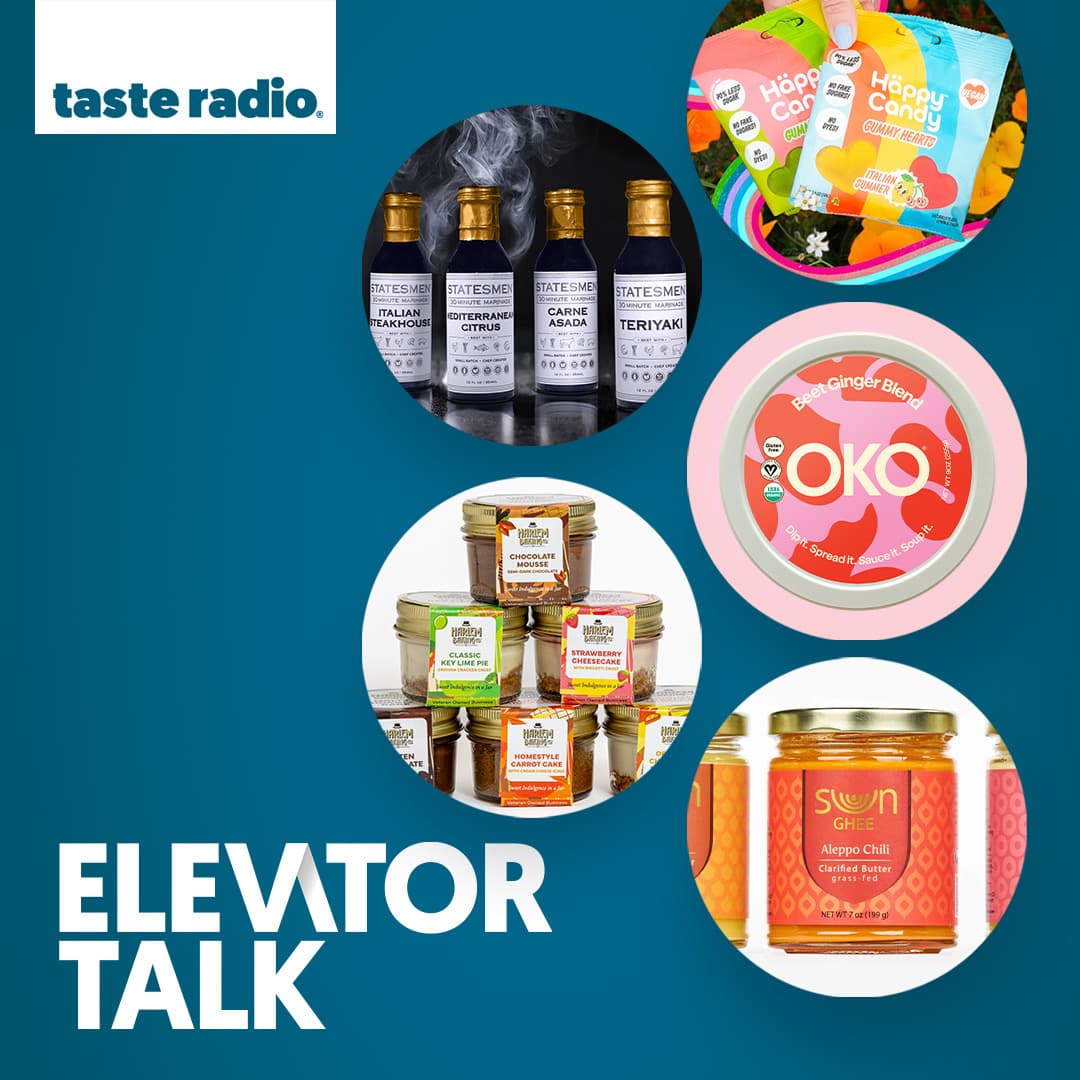
Episode Overview In this episode of Taste Radio, the spotlight is on five innovative food and beverage brands: Statesman Marinades, Harlem Baking Company, Häppy Candy, OKO, and Sun Ghee. Hosts Ray Latif and special co-host Rifle Hughes engage with founders and CEOs, discussing their brands, recent developments, and key insights into the food and beverage industry.
Key Themes & Insights
Common Challenges Faced by Early-Stage Companies
- Lack of Planning: Founders often jump into the market driven by passion but sometimes without a solid plan.
- Overconfidence: New entrepreneurs can become too rigid, assuming their understanding of the market is complete, which can lead to failures in adapting to changing consumer demands.
- Branding & Packaging: Distinction is crucial in a crowded market. Successful branding must highlight unique selling propositions effectively.
Featured Brands and Discussions
- Statesman Marinades
- Founder: Wyman Shaw
- Product: Quick, flavorful marinades designed for busy consumers.
- Key Differentiator: Marinades ready in 30 minutes that cater to various dietary restrictions (gluten-free, vegan).
- Retail Strategy: Focus on both e-commerce and physical retail; aims to establish a broader distribution network.
- Harlem Baking Company
- Founder: Charles Devine
- Product: Premium desserts in glass jars, inspired by restaurant-quality recipes.
- Market Approach: Targets various channels including online sales, retail, and food service.
- Vision: Strives to make high-quality desserts accessible for home consumption, drawing upon the rich cultural history of Harlem.
- Häppy Candy
- Founder: Maxie Heidenblatt
- Product: Better-for-you gummy candies with significantly reduced sugar content and no artificial sweeteners.
- Market Position: Competing against legacy brands by focusing on clean ingredients and unique flavors.
- Consumer Trends: Observations indicate a move away from artificial sweeteners toward natural, healthier options.
- OKO
- Founder: Jane Coxwell
- Product: Fresh vegetable blends that serve as dips, spreads, or sauces.
- Key Attributes: Organic, healthy, and versatile; encourages consumers to embrace new ways of using vegetables in everyday meals.
- Packaging Strategy: Emphasizes clear, vibrant packaging that highlights the natural product.
- Sun Ghee
- Founder: Farnoosh Family
- Product: Flavor-infused ghee made from clarified butter, available in several varieties.
- Unique Selling Point: Offers consumers a flavorful cooking fat that can be used across various cuisines, aiming to educate on its versatility.
- Price Point: Positioned as a premium product reflecting quality and health benefits.
General Industry Observations
- Emerging Trends: There is a noticeable shift towards healthier, cleaner ingredients across the industry. Brands that can effectively communicate their unique value propositions stand to gain traction.
- Market Education: Many products require consumer education to drive adoption, particularly for ingredient categories that are less familiar, like ghee or specialized marinades.
Conclusion This episode of Taste Radio highlights the innovative spirit and diverse offerings from emerging brands in the food and beverage space. Founders share valuable insights about their journeys, the challenges they face, and the strategies they employ to distinguish themselves in a competitive market.
Call to Action For early-stage food and beverage entrepreneurs, there is an opportunity to apply for future episodes of Elevator Talk to gain feedback and exposure. Interested individuals can apply through the Taste Radio website.
---
For more insights and updates, reach out to the Taste Radio team or check out their website at [Taste Radio](https://www.tasteradio.com).
Written by AI. May contain mistakes. Listen to the episode to check what was said.
Transcript
Automatic transcript. May contain errors.0:05Hey folks, I'm Ray Lateef, the editor and producer of BevNet's Taste Radio Podcast, and you're tuned to the latest episode of Elevator Talk, the series that profiles early stage and disruptive brands from across the food and beverage industry. Today's episode will focus on five food brands whose entrepreneurs will have an opportunity to hear feedback and advice from our co-host for this episode. That's Rifle Hughes, who's one of the co-founders of Integral CPG. Rifle, it's so great to see you again. Hey, Ray. Glad to be back. I think it's been a year and a half or so, so excited to dive in again.
0:40Yes, indeed. You are a multi-episode guest co-host of this show, and so you know what it's all about. And you know all about the food and beverage industry because you've been in this business for a very long time. That's not to call you old. I'm just saying you're experienced. That's the way I took it, but it works. Please tell us about your experience. Yeah, so I've been, as you alluded to, I've been in the industry a little over two decades now. Primarily, we've always had a role helping brands identify growth strategies and largely around innovation. A couple of years ago, my co-founder and I, Glenn Pappalardo, we founded Integral CPG to really help brands find more actionable paths to that same growth strategy and innovation journey as they're looking to find their next stage with their brand.
1:29You know, it's a difficult business that our founders are in, CPG that is, because there are so many things that can go wrong. And there is no founder that I've ever spoken with who said, I have 100 % track record on getting everything right. But what are the most common mistakes that you've seen early stage companies make? And how can they avoid them? Yeah, I think one of the biggest things, and this is so true today, is sort of not having a plan, but then having too much of a plan. So kind of going off of that sheer intuition, that passion that drives founders is a powerful spark to begin the journey.
2:10And then you start the process, but then sort of over-indexing as you've got it all figured out, you know the way, and then not reacting to the market conditions. So especially now where there's so much volatility and change with consumers and market conditions, economies, climate change, everything that's coming at us all the time, businesses, brands have to be nimble and react to those conditions. So, yeah, just staying too close, too locked down, not learning from actually what's going out there tends to be a recipe for about to hit a brick wall. Yeah. And I also think coming out of the gate strong when it comes to your branding as much as you can, as it relates to your ingredients and how your product tastes is really important because now more than ever, the industry and store shelves are clogged.
2:59There are so many brands out there. There's so much competition. You know a thing or two about branding and package design. Just quickly before we get to our first guest, what really, in your mind, what's required for great branding, great package design for early stage brands? It all comes down to some sort of distinctiveness of differentiation in a way it would be commonly phrased or recommended. So really interrogating, okay, this is my idea, but look at all the products that are on the shelf today. If you can't very powerfully and with lots of challenge of people trying to beat up what you're suggesting, show that you've got something to offer to consumers that isn't already the same as four or five other brands there, it's going to be a tough, tough, tough road.
3:50So finding a way to truly stand out and then solve a pain point in a job that hasn't been answered for consumers yet. Yeah, I think that's the most important thing because people have products, new products that they bring to the market. And in all likelihood, there's 10 other products just like it. But how do you stand out? What's different about your ingredient deck? What's different about your nutrition deck? What's different about your packaging, your ease of use? So these are all good, good points to make. And I'm sure you're going to make a few more for the rest of this episode. But are you ready to meet our first guest?
4:26Let's do it. Let's do it indeed. That person's name is Wyman Shaw. He's the CEO of Statesman Marinades. Wyman, it is great to see you. Hey, Ray. Hey, Rifle. Thanks for having me on. Good to see you too. Yeah. Thanks so much for being on the show. Statesman Marinades, I have a sense of what you sell, but not necessarily why it's different. So please tell us all about what you do. I created the company in 2023 and doing it. I've been in restaurants for a majority of my career, chef by trade. And I was seeing and hearing a lot of these problems of people's busy lives and how they're struggling to figure out what they want to have and what they want to eat and how they don't really have the time.
5:18And so I'm trying to solve the problem by doing a 30-minute marinade. So you can literally marinate something, any kind of food product, and it's ready in 30 minutes. So it kind of solves that. Well, everyone's on the go these days. Everyone's looking for convenience. But as Rifle pointed out earlier, taste is so important. How do your products differentiate in terms of taste? Taste? Oh, they are extremely flavorful. Um, they, uh, I'm gluten-free, vegan, cholesterol-free, fat-free. Um, and, you know, I do a lot of traveling in my experiences and this is kind of what drove me to give the multiple flavors that we do.
6:01We do a carne asada, uh, teriyaki, Italian steakhouse and Mediterranean citrus. So. Before we get to Rifle, just quickly, um, where are you sold? Uh, what's your distribution footprint look like and what's your price point per bottle? We do two different formats. We do a five-ounce and then also a 12-ounce bottle. The five-ounce actually marinates up to two pounds of food, and the 12-ounce marinates up to five pounds of food. So a little bit goes a long way with it. And currently I am selling through my personal website. We're on Amazon, Etsy, and then we're also in about approximately 40 retail locations across the country.
6:44And I'd assume you're trying to get into more stores, yes? Oh, for sure. Yes. It's a big focus. Yeah. Rifle, marinades are tough for me because I don't want to do the work on my own. But then again, going back to what we talked about before, you go to the grocery store, you see a sea of marinades, and you don't know which one to pick necessarily. What are your initial thoughts on Statement, and how do you see it as being a standout brand or potentially a standout brand in this category? Yeah. So the center of your sort of pain point you keyed on, I think, is spot on. We're all seeking ways to build flavor and everyone has less and less time and we're on the go.
7:26So like that central notion of how do we take something that would normally take maybe six hours at the least, more likely kind of an overnight, throw it in a Ziploc bag and put it in the refrigerator kind of thing. Like what's your magic there without getting into, you know, the secrets of your food science? How do you, how do you make it work in 30 minutes? It's just, it's, it's concentrated. So I use a lot of my ingredients or whole ingredients and they, you know, when they work together, they literally do come together and it's kind of, it actually penetrates the food as opposed to coating it like a lot of marinades do.
8:03So, you know, my, my, my main ingredient is, is, is tamari, which is a gluten-free. And then I also double that up with a little bit of anchovy-free Worcestershire. So it really just gets in there. Got it. It's powerful stuff. Well, I think that's really what struck me when you were describing it and did some digging before coming on to the show here today, too. And so I was kind of curious. It's a powerful statement. It's not hitting me square between the eyes in your packaging. your packaging. I was kind of curious if you've had any feedback on, like, it's a super easy thing to explain like you did.
8:45I'm wondering if you've had any feedback. Is the power of your brand and your product connecting at shelf or even on the website, if people get it? Yeah, they are. Like, we tried to create, we actually did exactly what you were talking about. We went to the grocery stores. We were looking at what's on the shelf and, like, how can we differentiate? How can we stand out above and beyond it? And so that's why we went for more of a luxury look, you know, with the gold, the black, and the clean and, you know, simple. And so, like, because a lot of other brands out there, their labels are just so convoluted and they're trying to get the point across, like, on everything that they do.
9:23And it just gets messy. And so we were just trying to stand out by being the clean one and the one that looks more boutique on the shelf. Rifle, can I ask you a question? this is a product that I believe would be ideal to be merchandised in two places in the store obviously with other marinades on the ambient shelf and in that sauce space whatever you want to call it and then certainly with fresh meat but you know I'm sure you've talked to brands and founders who have wanted that shelf space wanted that you know to be merchandising two different parts of the store, but it's kind of difficult, isn't it?
10:03Yeah, it's a good, the notion's really good. You're hitting people where they're faced with a challenge. When they're at that meat counter and they're picking up their proteins, right here is the convenient solution. You've got it, but maybe you don't know fully what you're going to do with it yet. So finding them there makes a lot of sense. It tends to be a challenge to merchandise in two areas. Quite often, it's represented by completely different buyers. So you can get into that center store aisle with the traditional buyer, but now you're trying to fight it out with the 80 other products to the left and the right and get your story across.
10:47And then that perimeter or the store's management by different groups. And so as a small brand, that is a tough one, but it's doable and it probably gives credence to kind of stay small, not expand too fast, really build a partnership with the key retailers that are where you're working with first and maximize velocity there before trying to open more and more and more doors. And Wyman, what's been your pitch? What's been your most effective pitch to retail buyers? Is it the convenience? Is it the speed of the marinade itself? Is it the flavor? Why are they buying your product? Actually, all of it that you just mentioned.
11:26It is literally the speed, the efficiency, and the quality of the ingredients. And also the fact that it does fit a lot of dietary restrictions as well. I think for me, and I've mentioned this in the podcast a number of times, pretty much every week nowadays, but taste is king. It always has been. And you really have to convince people that this is a product that's going to taste great for them to spend their money on it. So how are you demoing? How are you demoing? Is it with steak? Is it with fish? I mean, what's your preferred method? Steak, chicken, shrimp, you know, because the Mediterranean citrus goes amazing with chicken and shrimp.
12:06The carne asada goes great with pork and steak. The Italian steakhouse is amazing on chicken wings, like the best ones you ever have. and then the teriyaki you know you know a lot of different Asian cuisines too so do like a stir fry or things like that. Rifle just just back to you for a sec you know the the words 30 minute marinades I think might I don't know I mean what are your feelings that is there any kind of conflict in between the convenience and the sophistication of what this brand is all about Can those two things align in a way that is really intuitive to the consumer? Yeah, I think so.
12:46I don't think it's so black and white.
12:51Consumers could even be lowering their bar of expectations. They still want the flavor. They need it to pass a certain level. But are they going to expect it to be the same thing of someone that's building up like a Berea over days or something? So it's like we all are comfortable at lowering our expectations in a tradeoff for convenience. So I think that's fine. It wouldn't put me off. Wyman, I can't believe we're out of time, but this has been such a great conversation. Thank you so much for being with us today. Please stay in touch and let us know if we can help in any way. Great, Ray. Thank you so much.
13:27I really appreciate it. And thank you, Rifle. It's a pleasure meeting you. All right. Great start to the show. Let's keep it going with our next guest. That man is Charles Devine. He is the co-founder of Harlem Baking Company. Charles, it's great to see you. Great to see you. Nice to meet you in person earlier today, Ray. And, Raifel, cool to meet you as well. Good to know you. Yes. Charles is actually here at BevNet headquarters. There was a little bit of a mix-up in terms of whether, you know, this was a virtual show or somewhere you need to be in person. and Charles is just like, screw it, I'm driving to Boston.
14:05That's it. And here he is at Fevernet headquarters and I'm so happy to meet him in person. I didn't get to meet you at the Summer Fancy Food Show where I was introduced to Harlem Baking Company and blown away by what you guys sell. Tell us all about the company. As of last year, I was a restauranter still in New York City and things were, you know, I'd been in the business for 25 years. We survived the pandemic and we had a really in 2020 when um when everything was shut down we stayed open we did so by uh you know sending meals to health care workers through donations and whatnot one problem we had is we had an amazing dessert portfolio and when we delivered our desserts they would arrive in a mess so we brainstorm ideas and we decided to bake them in little glass jars here we are but uh and uh You know, it was just something to do to fix a problem.
15:01But then we got so many great responses from the community and other stores wanting to carry them, restaurants wanting to use them because they had shortages in staff, that it became very, very evident to me and to my partner, Tom, whom you met at the Fancy Food Show, that there was a gap in the packaged goods as far as desserts were concerned. and we just went with it, followed the breadcrumbs. And to be honest with you, I never believed that I would be a brand marketer, creator, but here we are, no more restaurants. Survived a pandemic, couldn't survive a New York City landlord, but here we are and now I'm fully focused on the Hard-Owned Baking Company and we're having a great time and just doing some great stuff.
15:49I have a thousand questions, but I already know some of the answers except for a couple. Where are you sold? What's your price point per jar? Okay. So jars are being sold anywhere from$4.99 to$7. We are in multiple channels. We're all over the place. We are online. We are on uncommon goods. We did some runs on QVC, traditional retail, restaurants, hotels, theaters. There's a small, a large demographic, but everywhere in a little bit. And that's really one of the things that's been so much fun with the hardware making company is that it's such a super premium product that it fits in a lot of different niche.
16:34And it's also the way it's delivered and the way the operators can store it in a freezer and then slack it out. It's just very, very customer friendly. But also what's amazing is what's inside the jar. And that's what really separates us from everybody else, because there is, you know, this might be a question, but this 25 plus years of New York City restaurant that goes in these jars. And we really are, as you've probably tasted them, amazing product. I have tasted them. They're incredible products. The key lime pie just blew me away. The mousse. So Charles was so kind to send me some samples.
17:14And anyone who came near them just got the death stare from me because I was just like, these are not for you. These are for me. Charles sent them to me. It has my name on the package. Don't even think about touching them. No, that's not true. I shared some of them. But you really make amazing products. Like I said, I have a thousand more questions, Rifle. But I know you have a lot to ask as well. So please ask. Ask away. Yeah. So Charles, yeah, I'm admittedly a little jealous that I didn't get to sample some. So maybe it's a little plug, but let's hook up afterwards. Yes. But yeah, it sounds like most of where you're fitting in are kind of food service and specialty channels today.
17:51Yeah, that's right. What does the, three years from now, crystal ball, and of course, who knows, it's probably pretty fuzzy, but like, what does success for you on a three-year timeline look like? What's the shape of the business? I think Harlem Baking Company can become an everyday name for quality desserts for households all over the United States. I mean, again, the fact is you buy us like you buy us at a grocery store in the yogurt, right? But you get home and you get to enjoy something really special. You don't have to go to a bakery. You don't have to spend tons of money to be able to get a wonderful premium quality restaurant quality dessert.
18:39And what's great about it as well is that it's portion control. So, you know, you're getting your jar. It's an indulgent treat, right? We're not pretending to be anything that we're not. I've got customers in New York City that when I drop the dessert, they get so excited because they're like, it's the real stuff. because they look back and they're like, oh, look, there's eggs and there's cream and there's wheat and there's all the stuff that we love. So really, it's something that we want to be, we want to become, you know, the place to go for quality single serve desserts that can be enjoyed, you know, at home for parties and whatnot.
19:16And we're also, you know, on Common Goods, we just started selling with them. We're selling them little six packs. So the gifting opportunities is incredible. And we're doing very well there, surprisingly very well. Very cool. Yeah, I've encountered some products like this, and certainly it's a little bit more established. In Europe, there are products sold in more retail settings like that that are, like you said. And, you know, the occasion, the pain point, like desserts and baking are hard. People don't know how to do it. It's chemistry versus, you know, savory cooking. It's far more approachable by a lot of people.
19:50The occasion makes sense. I think what I'm curious of a little bit is there's solutions for this is what's the shelf life and then how does that come into play as you start to spread your tendrils outside of the New York City area? Right. Well, that's where the Harlem Baking Company also has a secret weapon and that's called the freezer. Everything that we make is immediately flash frozen. And surprisingly, you know, I think there is a sense in this country that frozen food product is inferior or the corners have been cut. But actually, it locks in the flavors for us. But not only that, more importantly, it allows us to not have to use any preservatives, all real ingredients.
20:38Because I sent this to you in California, you treat it just like ice cream. From the moment that it leaves my warehouse to the moment you arrive, it's all frozen. So the clock doesn't start. And it's great for restaurateurs and delis and small shops like that because the way they can handle it is they'll put five on the refrigerated case and then the rest in the freezer. And then they slack it out. So let's say the key line pie is selling because it's the summer and the carrot cake is not, then you don't have to worry. It's almost, you know, and that's the way we approach that whole very, very important aspect of our growth.
21:15Makes a ton of sense. About the key lime pie, can I just say something? Very cool. So we started working with a distributor. You know who's selling this right now? The Miami Dolphin Stadium. I don't know in what capacity, but it's really wild that a Florida team is buying their key lime pie from New York City to sell at their venue. isn't that cool so i mean you know initially i'm excited like we're in an nfl stadium yeah but wait actually the more important thing is like we're in florida and i'm sure they've been looking for key lime pie and they this is really that explains why ray likes it so much sorry i just wanted to share that because that's very exciting to me if it can sell in miami i'm sure key lime pie that is it can sell anywhere because they're pretty uh specific about their flavors down there yes they are but you know i i again i really love what you're doing charles and i love uh when i encounter those portion control desserts like you mentioned i think um there's a brand called petit pole i'm pronouncing it the very french way of its pronunciation and petit pole and maxime and his team have just done a really good job of introducing a very indulgent dessert or a brand of very indulgent desserts that aren't very big.
22:36They're just a nice little after dinner kind of meal. And there are more brands like his coming to market, including yours. And I think in addition to the flavor, the brand and the story has a lot to do with why people are interested. You chose the name Harlem Baking Company. What does it mean and how does it relate to the brand and what you're doing? So the restaurant when these were created was in East Harlem. I lived in East Harlem. My kids went to school. at the time in East Harlem. It had become quite a huge community for me. And when we, the restaurant's name at the time was that closed at the end of last year was the Lexington Pizza Parlor.
23:15And when we tried to find a different brand, I've always loved the story of Harlem, which was really a melting pot where you had multiple different generations of immigrants living there. There is a sense of incredible amount of culture and excitement. And it's really this whole area is being revitalized. And I felt to me, it made complete sense that we are creating them here. We're part of the community here, and we're just going to call it and Harlem Baking Company. And you'll notice there's also a little bit of the fedora there. There is something very important to me about history and about who you are and integrity.
23:58And I really wanted to just not create some fancy idea about what we were selling, but more about who we were, where we were coming from, and to grow the brand that way. We have, you know, experience, questions like that on a regular basis. And it actually has reinforced my commitment to Harlem and to getting more involved in the community there, even though I don't have a restaurant. And I'm very excited. To me, it's a little bit like what Brooklyn was 20 years ago. And the name really has been special for us. That's amazing. I love that story. And I love the way that you explain Harlem as a real melting pot and a place that is sort of becoming more of a hotbed for innovation and entrepreneurship.
24:47Absolutely. It's incredible what's going on there. We're out of time, but just quickly, do you have your own manufacturing facility? Do you have your own kitchen? Are you using a shared kitchen? We use a shared kitchen in Queens right now. Since we lost the restaurant, we had to kind of pivot. And it's been really great because the help there that we get and the knowledge. But we're in the process of looking for a co-packer because, you know, eight, nine hours in the kitchen is becoming, you know, it wears on you pretty quickly. But we're up for the task and it's been a joy and nothing like being hands on, being in the product, selling it, delivering it as an entrepreneur.
25:25You really get a sense of whether or not you want to do this. And I'm still looking for a reason to quit. But, you know, people like yourself and people that taste our product continually drives us to to push this forward. So I'm very, very excited about what the next year has to come. Please, for the love of God, don't quit because you make an amazing product, amazing products. And I see a great runway for Harlan Bacon Company. You're not only a great founder and a good person, Charles, you're a great ambassador for your brand. The energy you bring and the excitement that you have shown in this episode is just so palpable.
26:02So please keep that going. And can't wait to see you again in the near future. I got to come out. You came out to my house. I got to come to yours now. So I'll keep you posted and I'll get Rifle some samples. So I'll just have to get his address at some point. All right, Charles. Great seeing you. Thanks so much. All right. What a great start to the show. Let's keep things going with Maxie Heidenblatt, who is the founder and CEO of Happy Candy. Maxie, great to see you. Hi, Ray. Hi, Rifle. Great to see you. And Happy Candy. What a wonderful, amazing name for a brand. How did you get that brand?
26:37How did you trademark it? yeah so um i came up with um the brand name actually as an idea during the pandemic when we were all lacking some happy moments um and i was toying with the idea of launching my own candy business for a while and back then during the pandemic i came up with uh happy candy to create more happy moments for all of us yeah and and you you trademarked it yes this is your this is your brand? Yeah, it's protected. Yeah, exactly. Yeah. Which the umlaut helped with that. Because Happy, as you can imagine, there's a lot of Happy Kitchen, Happy Baby, whatnot. But Happy Candy because of the umlaut that helped us actually.
27:17The umlaut over the A in Happy, which is fantastic. You know, there are so many more Better For You candy brands coming to market. And it is so timely because I think, you know, parents want to give their kids better candy. adults want to eat better candy not the candy of their youth because all that stuff is just so full of let's call it what it is garbage stuff you shouldn't be eating um how did you go about formulating what was your vision for this brand um you know how did you think about the ingredients behind happy candy yeah so um just for context i'm german by origin and i grew up in germany where gummy candy is just part of our culture haribo for instance is a german company too and so I grew up loving it but when I had an autoimmune condition diagnosed I had to make better health choices and cut down my sugar intake and work with a nutritionist and so I stopped eating candy altogether and when I came across better for you gummy candy and as you mentioned Ray that category is just booming I was really excited because now I could have candy again gummy candy however i was quickly disappointed by fake aftertaste from stevia from monk fruit from all these fake sugars as i like to call them and side effects like an upset stomach and not feeling great after having them from all those sugar alcohols like erythritol and so i said there must be a better way to create a gummy candy that yes contains less sugar but does not use any of these fake sugars.
Read the full transcript
28:51And to answer your question, that's how I came up with the idea of the formula and found a great manufacturer to work with on bringing this idea to life. We tried some of your products in a past episode of Taste Radio and I was pretty amazed at the fact that they were so sweet and indulgent but without all those fake sugars that you mentioned and 70 % less sugar than typical or competing products. um you know this uh rifle uh we've we've mentioned a couple of times now the better for you candy space is booming and you gotta you gotta differentiate you gotta stand out but then you're also fighting the big guys you're fighting the traditional players that own a lot of the shelf space that have a lot of marketing muscle um but i think i think happy candy i think this has got a lot of some serious legs here what are your thoughts on the brand you know i i i tend to agree that we're seeing a moment in Better 4-E Candy.
29:50There was one, I don't know, maybe like 10 or so years ago that I don't think got traction in the same way, but whether it's Unreal or, I know, Ray, you and I are friends of Better Sour and fans the brand. Modern consumers like yourself, Maxie, there's different nutritional asks, but we still want that fun. We still want that excitement. You want to reward yourself, your family, your kids, and it's just a great piece of candy just makes you smile. It's, it's, it's, you might say makes you happy, but so the legacy brands, they have all the distribution and the muscle and the power, but there's, they don't really speak to the modern consumer or resonate with them.
30:31So it's a great moment and we're, we're, we're seeing, we're seeing it happen. And by the way, so my mother is from Munich. Um, I grew up on, eating gummy bears as well. So yeah, definitely celebrate it. Oh, that's great. So you're familiar with the obsession with gummy candy in Germany. Yeah, it's a big thing. And Rifle, to your point, I think consumer demands are changing. Yes, we all know Americans want less sugar, and that's been addressed with previous Better For You Gummy Candy brands, and there are a lot of great brands out there. But there's also an emerging trend of Americans turning away from these fake sugars and diet products.
31:12I think we're moving away from that diet culture. And it all started with aspartame and diet Coke. And we all know it's now we know it's not good for you. And I think the same applies to stevia monk fruit that just don't taste great. Erythritol allulose, which by the way, is banned in Canada and in Europe and is on the blacklist of other natural grocers and retailers. So just living without any of these fake ingredients and creating a gummy candy that we, by the way, only use 10 simple ingredients, and you can pronounce all of them. We're non-GMO, and we don't use any of these dyes. I think that's something you kind of implicitly mentioned or alluded to, Rifle, as well, which is part of these fake ingredients and the traditional gummy candy brands that use these artificial dyes that are really not good for you and your kids either.
32:06So Happy Candy is, I want to argue, the cleanest candy out there with 10 simple ingredients, none of the fake sugars, no artificial dyes, and it's all non-GMO ingredients. So we really took it to the next level and created, in our view, the next generation of gummy candy. Yeah, that's fantastic. I think part of the challenge of, like you were just alluding to all of these sugar alternatives, and there's a full spectrum there. We've been on this journey for a long time. I think part of the challenge that consumers certainly don't realize is, but brands don't as well, is sugar is just not for sweetness.
32:44It actually provides functional structure. It is the skeleton, the lattice work that a lot of foods are built on. Even like baked goods, they perform so much better in sugar because it can bind and bring things together. So it's not just sweetness. So long way of getting to my question of with that heritage Haribo experience that I love as a little child, like how is the texture as you're as you're winding that? Are you able to maintain a great gummy experience by also dialing down a functional sugar? Yeah, that's a great question. It took us a while, quite frankly, to get to a really good texture that is very close to your Haribo experience.
33:24I will mention, though, that we do not use any gelatin. So it's also vegan, our gummy candy. We don't use any animal-based products in our gummy candy. And so it was really hard to get to a chewy texture that's not sticking to your teeth. But we nailed it, I want to say. And I'm happy to follow up with some samples and send them to your rifle as well. So you can try and compare to your Haribo childhood experience. but I think the texture is really great because what you will find with other vegan gummy candies that it typically sticks to your teeth because they use starch. We use something called pectin which is from the peels of citrus fruits, apples and it's a great gelling agent and combined with the real sugar we're using just a lot less of it.
34:11We created a really good body, gummy candy body that has the texture that is very close to a regular gummy candy. If I were a retail buyer sitting across from you and you shared your story about the origins of Happy Candy and why it's different, I would probably put the brand on my shelves immediately. And you are on a lot of shelves in the country. You're everywhere in all the Fresh Market stores. Is that right? Yeah, exactly. So we launched with the Fresh Market. We're at ShopRite. We did the innovation set. It's proud. So we are growing quite a bit. And yeah, thank you. And I appreciate that feedback if you were a buyer.
34:54Well, I think the reason is because you've concisely and very articulately described what the problem was and how you're solving it. And the fact that these are products that are not compromising on what people want out of traditional candies, but also without all the junk in them as well. And the fact that you have a fun name, you have fun packaging. but what's really moving the needle for the retail buyer when you went into the fresh market and you were trying to sell the brand and make sure that you know you could get into all their store shelves what were what was really resonating with the retail buyer specifically i know it's easy to say this the entire package but was there one or were there one or two things that really stood out yeah i think it's what you and rifle mentioned earlier as well how are you different from what we already have in on shelf in order to help us drive incremental sales meaning how do you get buyers, consumers, sorry, to come into the store.
35:49And then now they're starting to buy gummy candy, even though they have stopped consuming it in the past because of sugar, artificial dyes, or alternative sweeteners. And now they're having happy candy because it combines that lower sugar with clean ingredients. So the incremental sales, I think, is a big driver, but also just standing out. We come in rainbow packaging, it's happy candy, It's heart-shaped candy. It's fun. It's cute. And most importantly, it tastes really good as well. Yeah. The best part for me is that it feels like a candy that you're familiar with. The packaging just speaks to, okay, I know what this is.
36:33I know what I'm getting into. And then you go closer at the packaging and you're like, oh, wow, it's actually better for me, much better for me than what's out there. So I think that will, you know, entices a lot of people to buy. I guess the one hiccup is price point, right? You can go buy a package of gummies filled to the gills with artificial ingredients and it's like$1.99. What's the price point for Happy Candy? So we retail for 1.8 ounces at$3.99. But yeah, you're making a great point. We're trying to be more accessible. And we actually launched mini bags, which are smaller in size. And so we sell those very soon in variety packs too to make it more accessible and working on that.
37:19Rome wasn't built in a day, and Happy Candy has a lot of room to grow, and I'm so happy to see where you are right now in terms of your foundation. I'm excited to see where the brand goes from here. If there's any way we can help along your journey, please don't hesitate to ask. Reach out anytime. You can send us an email to ask at tasteradio.com, and certainly we'll do our best to point you in the right direction. And, of course, now you have a new fan in Rifle who can do the same. Absolutely. Rifle, I'll send you some samples. Love this. It's turning into the Rifle Begs for Sample show. Thanks.
37:54Maxie, thank you so much for being on the show. And please, please stay in touch. Thank you again. Thanks for having me. Let's keep things going with Jane Coxwell, who is the founder of Oko. Jane, it's great to see you. Hi, Ray. Hi, Ryan. Nice to see you guys too. This is an example of a brand that I didn't know anything about, but I got an email. I think it was from your PR team, Jane. And I didn't see anything but the packaging. I didn't know anything about the brand. I could see that it was some sort of dip or marinate. It came in a little bit of a tub. But I was just like, whoa, this is awesome packaging.
38:31I want to learn more about it. Please tell us all about what you do. I'm really happy to hear that. So Oko, we are a line of fresh vegetable blends that kind of do it all. They work as a dip. They work as a spread. They work as a source, as even a soup. I'm a chef by trade. I've been a chef for over 20 years. And this is a product that I've had in my kitchen that I've used in my kitchen forever. I used to be a chef on private yachts. And so like limited time and limited space meant that before trips, I would make lots of variations of the of this product. and then when the time came I had a very quick you know solution to like I said a soup or a sauce or a dip like send out a crudely plate whatever it was and they've really become a staple in my in my in my cooking process in my kitchen and we really our mission is to make eating well effortless so they are incredibly healthy they're fully organic um they are free from any dyes from any fillers from anything like that there's really just nothing in them that you couldn't buy at a farmer's market um what was really important to me when we were developing them is that i didn't make a version of what i was using in the kitchen i made like exactly the same thing which is now what people are able to buy um and it makes me really really happy to hear that you like the the packaging because really the packaging is just the product it's it's a clear it's a clear tub um and so the the like burst of color that you see is just the natural product coming through so it's all uh it's all nature doing doing the work in the packaging from 10 yards away you might mistake it as being a hummus because it comes in that plastic tub with the plastic cover and it's it looks like it's about eight, nine ounces per tub.
40:27I think it's nine ounces. Is that right? Nine ounces. Yeah. Yeah. And there's three varieties. There's a beet ginger blend, a carrot turmeric blend, and a cauliflower lemon blend. You, Jane, explained that there's a number of ways you could use these. What's the primary way that people consume these products? The intro is usually kind of as a dip. That's probably the most accessible way to use it. But you know as a source as a spread I it soup is probably the least uh least used that's one of the ways that I use it the most um but I think uh people buy it as a dip and then sort of start reaching for it in the fridge to use it for other things so it's um it really is wonderful we're kind of rethinking condiments in a way it's it's to be able to use a product that's a condiment that is just completely good for you.
41:22And with all ingredients that you know and kind of trust is a great way to use it. A sauce, you can warm it up. It's good on pasta. It's good, you know, chicken. It's really, I don't think there's one particular use case. A lot of other products now, like humus are definitely venturing into kind of like versatile. but this isn't a product that was made for one thing and then is is trying to be useful in other areas it really is just genuinely something that is multi multi-use it's not you know as a chef it's not a product that I invented vegetable purees have been used for years in professional kitchens so we're just kind of I just sort of brought that to market and took any butter and other unhealthy fats out and just made it super healthy.
42:18Oh, I'm excited to try these products. I also want to spend like an hour with you talking about your experiences being a chef on private yachts. We don't have that kind of time right now. I want to get to rifle. As someone who has developed and created some of the most outstanding packaging that you'll see in CPG, I think you would appreciate what you see in Oko. So, but I also want to ask Rifle about the versatility of the product and whether you would recommend to Jane to be a bit more specific in the use case. Yeah, you went right to where my head was going as I was digging into this before the show.
43:01So, I get the, you know, I've done a lot of work with chefs and the multitaskers, you know, Elton Brown was certainly the, you know, a champion of tools like that. But when it comes to sauces and bases, you make it once and you can use it lots of different ways as the champion of back-of-house environment. The challenge to solve for as you continue to find ways for consumers to engage and use is it's a lot to digest. And so typically landing on the, you know, this is the thing that it's used for is where most products find traction. and then people then discover, oh, and I can also use it for this, this, and this.
43:43So how do you balance that communication challenge of you've got five seconds to make an impact? How do you bring it together and then allow them to discover? So as part of it would be that you said most people are buying it for a dip. What's your one champion if you had to put all your weight behind one usage? Oh, it's so difficult. I really have a hard time seeing it as one thing. And I know that that's not the greatest answer. But when I introduce it to people, probably the easiest way to sort of show it to them is as a dip. It's really delicious. It's really like big, vibrant flavors. So it is a wonderful dip.
44:26You can dip anything in it. But then that leads you to want to like spread it on things and everything else. So that kind of it kind of leads. yeah and I think the education piece is is really important too I'm on your Instagram page and I think teaching people how to use the product and the versatility is really important I think also trying to figure out the right price points and the right place to merchandise the brand in store is really important again I mean if you know if there are multiple places that this brand can be merchandised in store it seems like the most intuitive one would be with the hummus and people would expect a certain price point than if you are selling it as a dip.
45:07So I guess to make a long story short, where is the ideal place for this to be merchandised in store and what is the typical price point? So you're right. It is the best place for it to be is around the like dips and pestos and tzatzikis, that kind of area in the fridge. We retail at$8.95 for nine ounces. so we are a little bit more expensive than a straightforward hummus anything like that um you know we could have we could have made the product for a lot less money but for me personally my real um my real uh focus was on quality and integrity of the product and i think that there are enough people out there who will want that.
45:55You know, being fully organic, using HPP to maintain color and freshness and nutritional value and shelf life, like all of those things cost money. And I know that I'm a consumer that is, reads every label. I'm so careful about what I put in my body. And I spend a huge amount of time in grocery stores. And I really just because I'm I'm still a chef. And I, and you can see people trying to make the right decision there. You can see people trying to, you know, like the part in the grocery store, that's full of all of the vegetables that are kind of pre-prepared. So like spiraled zucchini and chopped carrots and all that kind of stuff.
46:40And people are buying that. So they, they want to eat well and they, they like want to, but they still want to cook. So I do think there's this like middle section of people that are willing to spend money on their health and to putting good things into their bodies, into their children's bodies. And so that's kind of where we come in. We're not just like a snack food, you know, that you sort of put on the table and people, whatever. We really want to become a part of people's everyday habits, everyday sort of meal making. So it is a premium product, but that's by choice. And there were definitely ways to cut corners and make it a lot less expensive.
47:22But yeah. I'd say to jump in on that, I'd say that like to hold ground on the pricing angle, because every product's sort of in the race to, you know, as you scale, you're going to get whittled down, right? And ultimately, it's almost impossible for any brand to take the care that you put into it and then consider that it's distributed globally and it's served to billions of people by nature it's going to get dumbed down it just has to so i would look at lessons um you know the two that come to mind is is if you roll back the clock 15 20 years 15 years ago to like blueprint and suja when they originally came out what were they nine ten bucks for 16 ounces ray and like your products they were gorgeous especially the beat when i'm a fan of beats like that intense red and then over time they came back down but as an entry point yes you're not competing with uh you know the the hummus that's or that's on shelf today you know and even we now we have tomb and stuff that people are getting excited about and it's way cool so like hold hold the high ground as long as you can but i think you have to be open to finding ways to bring it down if it starts to make sense to do so.
48:40Yeah, no, I think that's a really good point, Rifle. And it is true because we make it ourselves. We have a facility in Brooklyn where we make it, package it, and then send it off to HPP. So our vegetable orders right now are really the most expensive that they could possibly be, hopefully. Hopefully we'll only grow. um but so yeah all of our all of our minimum quantities are much more um they're pretty expensive but we are definitely um like we want to be as you said earlier we want to be adaptable and nimble and and all of those things so just kind of open to making sure that we're maintaining our quality but that we're doing what what works what makes sense yeah and for viewers and listeners who are not familiar with HPP, it is a safety method similar to pasteurization, except they don't use heat to remove the bacteria or kill the bacteria in foods.
49:35It uses pressure to do so, and it's pretty common in cold breast juices and hummuses and other dips and salsas and things like that. And the benefit is that you're not cooking the food. It is maintaining the flavor, the color, the nutritional value of the food as well. So great to hear that you're using HPP. I know it's an expensive step, but it's definitely worth it. Jane, like I said, I feel like we could sit down for another hour. Maybe I will hit you up because I think there's a lot more to talk about. I would love to send you both some samples as well. Please, I'll follow up and get your addresses, but we'd love to send you some.
50:15Yeah, Rifle just, he did the double thumbs up. I thought you were going to say no, Rifle. I thought you were going to be like, nah, no, no samples for me. I'm good. Thank you very much. But no worries. I know that would be fantastic. And this has been a fantastic conversation, Jane. Thank you so much for taking the time. And yeah, please stay in touch. If there's anything we can help with along your journey, just let us know. That's so kind. Thank you very, very much. Thanks both. Quick break. If this episode has you thinking about what's next in food and beverage, explore BevNet and Nosh Insider, our subscription platform with deeper insights from the BevNet team.
50:48Visit tasteradio.com slash insider to learn more.
50:55All right, on to our final guest for this episode of Elevator Talk. That's Farnoosh Family, who is the founder of Sun Gi. Farnoosh, great to see you again. Thank you. Thanks for having me. Yes, you and I met at the Summer Fancy Food Show, and I really love what you're doing. I particularly love your last name. Rifle and I were marveling that your last name is actually Family. That's fantastic. Please tell us all about Sun Gi. Absolutely. Yeah. My last name causes lots of confusion everywhere I go. We are the family family, but yes, that's my name. Yeah. So I'm the founder of Sun Gi. A little background.
51:32I was a chemist and then I had kids and I got ill and needed to kind of revamp how I was eating. And that was when I really turned to eating whole foods and good and better for you ingredients and leaned into more cultural foods and flavors, particularly into Ayurveda, which is an old traditional system of medicine, really using spices and herbs and foods to feel better. at a time when, you know, as you know, when you are pregnant or when you have kids and you're nursing, you can't really do much with modern medicine in terms of being able to take other things. So I really needed to use good food to be able to feel better.
52:20And so that was when I started to do that. And ghee was a part of that journey. Having a good, better for you fat that was really nourishing and really supportive just became really integral to everything that I was doing. And so infusing it with herbs and spices was also a very natural kind of fit for me at that time. And in my household, you know, I'm Iranian, and my husband is Mexican, and we kind of blend our foods and our flavors and spices like all the time. And so that was just kind of like a natural fit for us. And at that time, I thought I would maybe sell some of these, you know, products to, you know, boutique shops or, you know, places where I thought postpartum moms would go.
53:07And I didn't realize that with food, you can't just do that. And so I had to, you know, learn about, you know, what it means to actually start a food business. And kind of the natural point of entry for us was farmer's markets. So I started to make this as a cottage food in my home kitchen, just making jars and bringing it to markets on the weekends. and I got really great feedback and learned a ton about, you know, the process of how to explain this product to consumers that maybe are not familiar with it. What kind of questions come up? What would we really need for our branding to make that work?
53:42And then from there, you know, moved into the commercial kitchen space and started selling in retail and food service. You know, for people who are not familiar with ghee, what is it specifically? It is. Essentially, it's clarified butter. It's the concentrated form of butter. It has none of the milk solids, the lactose or the casein have all been filtered out. So it's just the oil of butter. And you would use it to cook with as your fat or your oil in your pan when you saute or roast or bake any way that you would use in oil. You could use ghee. I tried your ghee at the fancy food show I believe it was the Aleppo chili variety and I really loved what I tasted um I think that was just what sold me is I I saw your brand I thought your branding was great I thought and yet just the few you know seconds we chatted were great but you really sold me on the flavor of these products and it's interesting because I don't expect any flavor from ghee I've had it before and you just like it's it's it's just tasted kind of a bland uh you know oil or butter substitute and what you make is really great why did you feel like um you know the flavors were i know you talked a bit about your background but why did you choose the flavors that you did you know when i when we came up with the flavors that we have like for example we have a rosemary sage ghee we have a chives parsley and tarragon ghee along with the aleppo we wanted these to be good entry points for people to bring more people to the table for ghee.
55:14Like you said, you might not expect much from ghee as just like in terms of the flavor and, and maybe you have some preconceived notions of what ghee should be used for. But we're trying to show you that you could really use it for anything and everything, like from cooking your eggs from, you know, your orzo pasta dish with asparagus, all these other like applications for ghee, that's what we're trying to do. And so some of these like, you know, flavors that are from different parts of the world and infused into ghee you can kind of explore a ton of different cuisine with that prideful we let off this uh episode talking about differentiation the importance of differentiation um there is a big ish player in this space um it's a let's just call it what it is it's fourth and heart yeah and i think that what i'm seeing with sun ghee is really interesting in that i think flavor is the key differentiator uh for this brand and certainly more small batch and, you know, a bit more of a local brand, at least at this point.
56:14But do you see that as the key differentiator? Or do you see another way that Farnoosh and her team can amplify what they're doing? Yeah, I do, Ray, that the flavor feels like it's something that's unique and differentiated. I mean, let's be honest, Geese still finding traction. I mean, people are figuring out what it is and how to use it. But we're in a season where, thank goodness, like healthy fats are sort of known back as someone that the amount of grass fed butter from Ireland and New Zealand that's consumed in this household could be criminal. But like the right place, right time. Like we are on a path of coming your way, Farnoosh.
56:55So I think it makes a ton of sense. And then the flavor, I do believe, will be one of the standouts. If you take analogous scenarios from look at everything, could even consumers in America who could pronounce aioli five or 10 years ago. And then now you can get just all these variations of using it as a base to build flavor on. So, you know, like we talked about earlier with the marinades of getting more flavor into food faster. And so if this is something I can cook with and bring flavor at the same time, like that's a win. And most oils or other fats aren't bringing a path to flavor. So long way of me just like saying, yes, flavor makes sense.
57:41Keep leaning into it. I think you're onto something here. Fonusha, where is the product sold? Where is the brand sold right now? What's the price point per jar? Yeah, we have three different sizes of our jars. There's 5-ounce, 7-ounce, and 12-ounce. And so the price ranges from$11 up to$18, depending on which store it's in. But we sell through our website as well as independent shops around the country. Our biggest retail partner right now is Central Market in Texas. They live in a great place for people who want to try these types of products. Outstanding. central market's a fantastic retailer especially for up-and-coming and emerging brands um i think the question a lot of brand founders have is well where am i going to be in store and for a brand like sun ghee a buyer might be saying hey well i want to put this in the ethnic food aisle which used to be a bit more of a less traffic dustier aisle but i feel like there's a lot more people looking for innovative and unique products in that space but um where are you sold?
58:48Where is the ideal place for sungi to be sold in store? It's interesting because I think it really depends on where we're talking about. For example, in Central Market, it's actually sold in the butter section. So even though it's not a refrigerated product, it's a shelf-stable product, it's in the refrigerated section right next to other butter. I think just because people will associate it with butter and think about that there. However, in other stores, we're next to the olive oils and the pasta sauces. Again, Central Market, brilliant on their part for putting it in the butter department or putting it next to butter because I think this is primarily the way it's going to be used.
59:28But there's still another, I think, form of education that is required because even if people see it, they might wonder about clarified butter. you know rifle in your experience how do you get to a consumer who is not familiar with a particular type of ingredient or product get them to be as educated as quickly as possible is it a point of reference and you say you can use it like butter you can use it as an alternative to oil do you have to get into the the history of the ingredient and the fact that it's better for you i mean how would you go about just trying to succinctly explain what ghee is and why sun ghee is a product that they should try there's some thinking that you can do on communicating more about the purpose and the reason to use it similar like what i was recommending with statesman earlier is this is a methodology to cook and bring a lot of flavor at the same time and right now the the brand is expressing it with its sort of cultural heritage which i i admire you know fourth and hard is the, you know, the, the Western expression of something, you know, trying to tech back in that, but then like even Vital Farms now sells, they're like squeezable ghee and some things like that.
1:00:41So I guess the question is, is how much of the heritage do you hang on to? Does ghee have its moment when it becomes more functional? So is there a path here where it's just like, it's a flavorful cooking butter or does it need to, yes, there's a statement of identity issue, but is it more around communicating itself, use this to get this result? So I don't know. I don't know what the answer is, but that's, those are the type of questions I'd be, I'd be asking as we try to solve it. That's, that's like exactly what I think about for most of the time, like in our, at least our social media marketing, I try to do a mix of both of here are ways that you can use it.
1:01:20You know, the Aleppo chili ghee we use to make flour tortillas and look at that or you know but then also give you some of the education on why you would want to use that at all flavored ghee on tortilla sounds like the perfect food by the way in the mash the mishmash of your family i love it i think i think based on all the different brands that we've heard from or seen today we would have just a gourmet feast uh if we just had everything on the table right now and we could we could really go at it uh my mouth is watering whenever that happens on the show it's uh it's a good thing i think uh far news we're out of time but um i can't thank you enough for being with us on elevator talk today i love what you're doing um again i think your flavor is something that was unexpected um and and really showed a different side of ghee um that i i was happy to experience because i feel like now i i have a better appreciation for what it is and what it could be so thank you so much for creating a great brand and for being with us on the show today.
1:02:22Thank you. Thank you. I appreciate the support and opportunity. Yeah. Please stay in touch. Let us know if we can help in any way. Absolutely. Good to know you. Yeah. Rightful, as promised, five great brands, five amazing founders, and another example of how this industry is evolving and meeting consumers where they are and what they want to see out of modern food brands. And it's really exciting, isn't it? It is. And I'm regretting my decision to have a little bit of a light lunch because like you, maybe we change it to elevator food coma or something. I want to just go eat all these things right now.
1:03:02Yes, yes, indeed. And we want to taste even more and we want to talk to even more folks. So if you're interested in being in a future episode of Elevator Talk, just go to Tasteradio.com slash Elevator Talk to learn how to do so. So Rifle, for folks who want to get in touch with you directly or anyone at Integral CPG, what's the best way to do so? Yeah, you can email me at rifle at integralcpg.com or look me up on LinkedIn. Thank goodness there's not a lot of people named Rifle running around. So you should be able to find me and Integral there as well. Yeah, just type in Rifle in the search bar.
1:03:38You're probably the first person that's going to come up. Might be. Yes, yes. Well, thank you so much for being with us today. We got to have you back soon, yes? I love it. Thanks for having me, Ray. I really appreciate it. Fantastic. All right. Well, thank you so much to all of the entrepreneurs who joined us today. Thanks to everyone who's watching or listening to the show. And thanks to our amazing team at BevNet, Nosh, and Taste Radio, the best in the business. Signing off for everyone, I'm Ray Lateef, and we'll talk to you next time.
From the publisher
The latest episode of Taste Radio's Elevator Talk spotlights innovative leaders fromStatesman Marinades, Harlem Baking Company, Häppy Candy, OKO and Sun Ghee.
In this installment, founders and CEOs introduce their brands and share recent company updates and milestones. This week's special co-host isRifle Hughes, the co-founder of Integral CPG. He offers insightful questions, thoughtful feedback, and strategic perspective alongside regular host Ray Latif, editor and producer of the Taste Radio podcast.
Early-stage food and beverage entrepreneurs are encouraged to apply for future episodes of Elevator Talk. Participation is free, interviews are conducted remotely, and it's a unique opportunity to pitch your product, share news, and receive expert feedback from industry leaders.