Ask ChatGPT
 The Accounting Podcast
10 Sep 2026 · 1h 11m · 23 chapters
The episode covers multiple accounting-industry news items and AI tooling in practice. Topic highlights: EY plans $100M in bonuses for “human skills” (rewarding staff for catching and escalating AI errors); Deloitte will pay about $21M to settle a DOJ DEI-related federal anti-discrimination/False Claims Act case (Deloitte denies liability); AI agent tools for tax prep (hosts describe using Claude “Cowork” to bridge GL-to-tax returns, troubleshoot software issues, and manually correct TaxAct form errors); AI GL/tax ecosystem consolidation (Accrual acquiring Puzzle, a QuickBooks competitor); accounting labor market signals (entry-level median pay down; mid-level talent shortage); and firm/legal fallout (KPMG Australia layoffs tied to consulting revenue decline and client confidentiality issues; PwC Evergrande case in Hong Kong court; CBiz acquisition performance; IRS tax revenue record with lower audit revenue).
David Leary and Jordan Sublette (Jordan is from Cloud Account and Staffing; David is the host). Jordan’s background: former firm owner; built offshore teams (India/South Africa/Philippines), including a Philippines team of 10 out of 15 before selling his firm. Key claims/examples: Claude fixed specific TaxAct issues (entertainment add-back under IRC 274(a), Schedule M1/M and L tie-outs, K-1 distribution defaults, Arizona checkbox transmission risk). Cost segregation AI examples: ChatGPT/Gemini studies failed engineering/IRS-audit guideline elements; licensed engineering firm declined to sign off.
Written by AI. May contain mistakes.
Preview of stories about tax returns and offshoring trends discussed later.
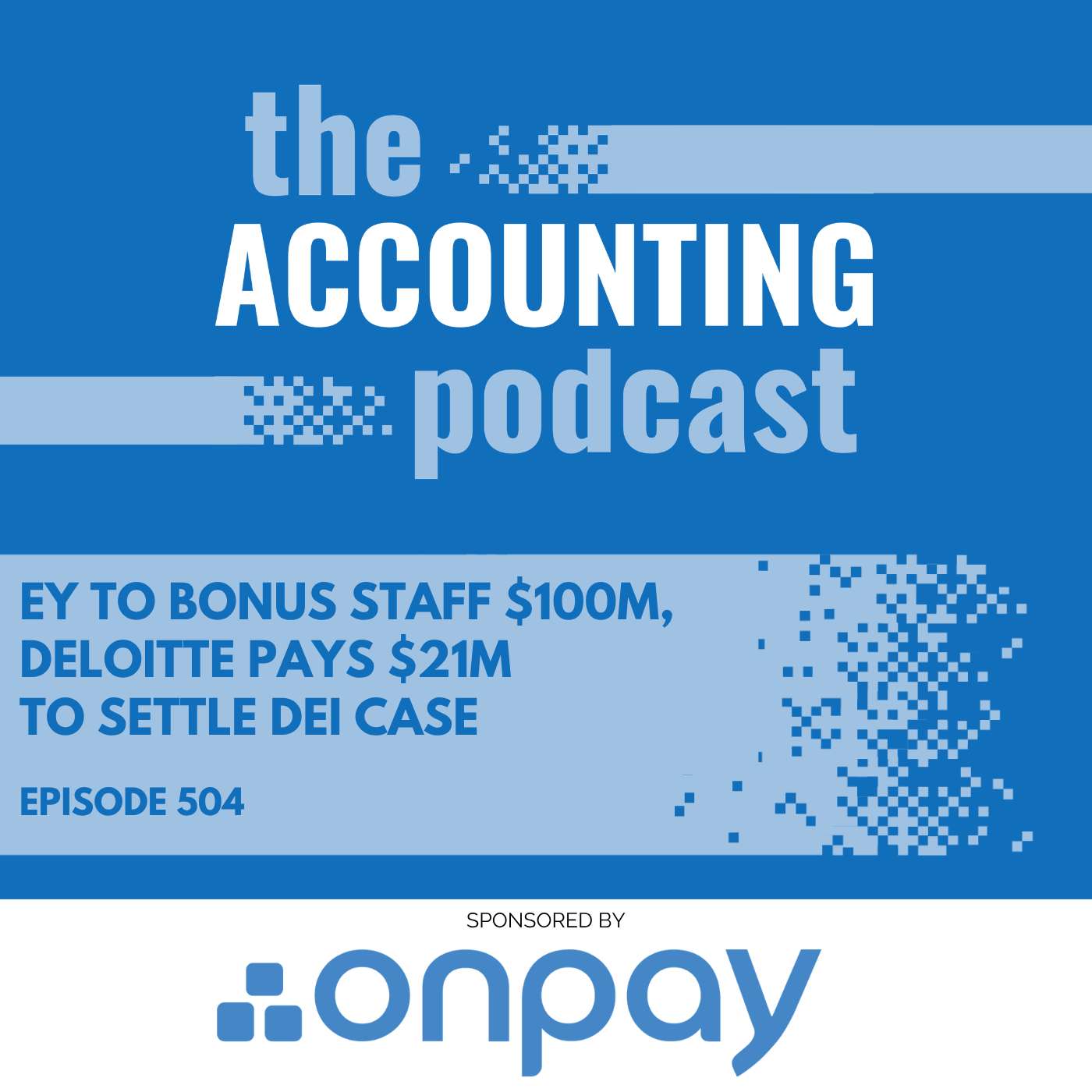
“EY bonusing staff$100 million, Deloitte paying$21 million to settle a DEI case.”
Hosts interact with live audience and invite listeners to engage with the show.
“and they really appreciate being able to track that.”
David shares his experience using AI to prepare tax returns efficiently.
“about using Claude Cowork yesterday with taxes.”
Exploration of the implications of Accruel's acquisition of Puzzle in the accounting tech space.
“or if you're a CPA who just does their own return still and you want to save a bunch of time, it is wild.”
Exploring why Intuit may not have acquired Digits and the implications for AI startups.
“And the reason maybe we're not seeing an announcement of Intuit bought digits today is maybe they got under the covers behind the curtains and realized, ah, it's not really a threat.”
Discussing EY's initiative to reward employees for critical human skills over AI reliance.
“So the way I'm imagining this, like they want to reward people that adapt, that use innovation, judgment, and critical thinking, not just like I blindly follow AI.”
Examining the implications of Deloitte's settlement regarding DEI practices and federal allegations.
“We should note that Deloitte denies the allegations and admits no liability under the settlement and has not responded to comment, at least from CFO.com, where I saw this article, they had not responded at press time.”
Analyzing the changes in accounting salaries and implications for the profession.
Discussing the decline in entry-level salaries and its implications.
“Not interns, not grads, not first year staff.”
Overview of KPMG Australia's workforce reduction and ethical violations.
“I've got a story here about KPMG in Australia.”
Noting the connection between unethical behavior and job losses.
“But I mean, it's really clear, like, non-ethical behavior happening over here results in losing clients, which results in people losing their jobs.”
Discussing the ongoing legal challenges faced by PwC in the Evergrande case.
“So I've got some more big four bad news.”
Details about Grant Thornton's acquisition offer for CBiz and its implications.
“Okay, one more follow-up while we're here on CBiz.”
Examining the record-high IRS tax revenue amidst workforce reductions.
“Final purchase accounting recorded $934.7 million of share consideration representing the fair value of 13.6 million shares plus just over a billion in cash for the non-attest business.”
Exploring the potential impact of AI on future accounting practices.
“Let's check in on our live stream chat here.”
Learn how AI tools like Claude Cowork and Ledger TB are revolutionizing the accounting process.
“you know, bank statements and importing everything for the whole year for multiple quarters and doing that all at the end of the year to get a tax return done.”
Explore how AI is transforming cost segregation reports and the challenges it presents.
“And a great example is in the cost segregation industry.”
Discover why AI-generated cost segregation reports are often insufficient and what is needed for compliance.
“something like claude co-work now if you know what you're doing to actually do a compliant cost segregation report.”
Explore Cloud Accountant Staffing's new strategies including onshoring and their partnership with Jason Stats.
“So you had a firm, you did some outsourcing, got good at it, and that's what drove you to create cloud account and staffing.”
Learn about the new on-shoring trend in accounting staffing and its implications.
“It's not a face relationship type thing.”
Discover how potential candidates can apply to be part of the accounting staffing portal.
“And then our team reached out and had them fill out an application.”
Understand the support mechanisms in place for candidates and firms during the hiring process.
“So we already talked about if you're an accountant looking for a new job, how to do that, you just go to cloudaccountantstaffing.com slash careers, and you can apply and get your face onto the marketplace.”
Jordan shares updates on his office and invites listeners to visit.
“So I go to like a handful of conferences a year, but I'll be at Intuit Connect.”

Get the gist, explore an idea or ask about something said.
 Claude
On The Accounting Podcast, what are the key points of this episode?
Searching your listeningAutomatic transcript. May contain errors.
0:24David Leary: David Leary and Jordan Sublette. EY bonusing staff$100 million, Deloitte paying$21 million to settle a DEI case. I've got a story about using Claude Cowork to do two tax returns yesterday in record time. And you've got an interview with Jordan over at Cloud Account and Staffing about offshoring and onshoring and how all of that is changing.
0:53Blake Oliver: That's their big thing now, onshoring.
0:55David Leary: Onshoring. And before that, before we get into all that, let's thank our sponsors.
1:01Blake Oliver: Our sponsors this week, we have OnPay, Thompson Reuters, Savant Labs, and Cloud Account and Staffing. Are you tired of payroll headaches getting in the way of the client experience that you want to deliver? Manual workflows creating bottlenecks, compliance nightmares, and endless support calls that go nowhere? There's a better way for your team and your clients. OnPay is the payroll partner that accountants and bookkeepers actually love. Why? Because it's easy to use, packed with value, and backed by support that actually supports you. Their team gets rave reviews for being fast, expert, and actually reachable when you need them.
1:38Blake Oliver: OnPay handles the heavy lifting. You get a dedicated onboarding coordinator who sets up worker profiles and transfers year-to-date data from previous providers, all at no extra cost. Their seamless QuickBooks and Xero integrations eliminate manual journal entries, and they support any type of business you serve. Farms, restaurants, nonprofits, you name it. OnPay can handle the unique requirements without adding extra complexity. And OnPay keeps pricing simple too. Everything your clients expect from multi-state filing to off-cycle payroll runs is included. No hidden fees, no surprises. To book a demo, head over to accountingpodcast.promo.onpay.
2:15Blake Oliver: That is accountingpodcast.promo forward slash O-N-P-A-Y.
2:20David Leary: Thank you, OnPay. And don't forget, dear listeners, please use those links when you go visit our sponsors' websites. It helps them know that you found them through us, and they really appreciate being able to track that. And welcome to our livestream viewers. We've got Boring Accountant here with two coffee emojis. Just two? Number three already. And we've got Benji who says, I love your podcast. Benji, thanks for listening. If you want to catch us live, go to YouTube, search for The Accounting Podcast, subscribe, hit that notification bell icon, and you'll get notified when we go live, especially if you've got the YouTube app installed on your phone.
2:59David Leary: Tune in and you can chat with us. Let us know what you think. All right, David, before we talk about EY and their bonuses and this Deloitte settlement, I want to share a story with you about using Claude Cowork yesterday with taxes. I don't do a lot of taxes except our own tax returns. And I decided this year that instead of just working through it myself, which I did last year, I would use Cowork and see what it's capable of. I guess I did use it last year. I used Claude, maybe it was ChatGPT last year, but more in just a Q &A way. I was just checking my work with it in the sense of like, if I wasn't sure what I was doing, when I went through the interview that you do.
3:42Blake Oliver: As like a research partner last year.
3:43David Leary: Yeah, yeah. It's like helping me to try to figure out what a particular box is for. Instead of using the built-in help, I could actually like ask those questions and get answers. But I was still driving it all myself, you know, pulling the numbers from the GL, the trial balance, right? Creating the work paper, entering the numbers. And anyone who does this sort of work knows that's time consuming, even if you're fast at it, right? It would have taken me days. you know, day each probably to assemble all the paperwork and do the returns. And, you know, I know a tax pro could probably do it faster, but hey, you know, if you're doing it yourself and you're not doing this all the time, that's about what it takes, right?
4:23David Leary: And so I used Cowork to do it and I wanted it to run it with me monitoring it as much as possible. So getting Claude to do the work, getting the AI to actually do the work. And I was really, really impressed. So the first thing it did was it opened up the GL for each of these entities. One's an S-Corp, and one is our partnership return for our media business. And the S-Corp is my personal. And so the S-Corp's in zero for the GL, and Earmark Media, our partnership LLC, is in QuickBooks. So I got to see how it worked with both GLs. And the first thing it does is the first thing that any accountant would do, which is it goes and it checks the numbers.
5:11David Leary: It looks at the P &L and the balance sheet and the trial balance and tries to make sense of it compared to the prior year return and make sure that all balances. and the S-Corp was fine because I had locked the period and there were no changes but it got confused in QuickBooks right it thought there was like a change that you had made but that was because of actually issues with QuickBooks reporting where cash and accrual were not like selected properly like there's some issue right now with the drop down and so the reports it was running were accrual instead of cash even though it thought it was running cash and then it couldn't make sense of it.
5:49David Leary: And it actually solved the problem. It realized there was a bug in the UI and it reran the correct reports, tied them out to the prior return. So then it pulls the trial balance, right? It pulls the P &L and the balance sheet from both and it created the work paper. So it asks me all the questions that it needs to ask in terms of adjustments, book to tax. and it did all of the book-to-tax adjustments in a spreadsheet, in an Excel spreadsheet for each entity. And then I started with my S-Corp and I told it once I was happy with the work paper and its analysis and like what's deductible and what's not and what are we gonna do with this?
6:31David Leary: I said, let's go into TaxAct, let's do it. So it opened up TaxAct Business in a tab in Chrome and it started working through the interview. and it went through and it entered everything and then it you know ran the checks that you get in the software you know how when you when you uh enter everything it then runs like error analysis and it worked through those and then here's the part that really blew me away is it found errors in tax acts calculations it it found mistakes that the software was making and it manually corrected them by changing the entries in the forms. And so the...
7:11Blake Oliver: Now, did it pause and review this with you along the way or did it just go and do these fixes?
7:17David Leary: It just went and did the fixes and then told me what it did so that I could verify it. So the error it found was that non-deductible expenses in Tax Act auto-filled at an amount that was less than the amount it should have been. it ignored entertainment which is 100 % disallowed under section 274a and it corrected that value so that would have been understated so it corrected it schedule m1 had no line for the entertainment add back after that so it had to create a custom entertainment 100 % non-deductible line and enter that into the schedule m1 it had this it had defaulted distributions to zero dollars when the actual distributions were tens of thousands of dollars.
8:02David Leary: And so left alone, if it hadn't done that, Schedule K, line 16D, and the K1 box 16D would have been blank, which would have been an error. Ending retained earnings autocomputed at a slightly incorrect value. That's a serious one because Schedule L wouldn't have balanced if Tax Act hadn't overridden it. And then when it came to the state filing, there's a weird thing with the software where the name change box was like checked on the federal form and Claude found it on the state form and realized it shouldn't be checked and then went back to the federal form and unchecked that as well. There's an issue with the Arizona checkbox on filing selections that defaults to unchecked and resets every time you ran to the flow.
8:52David Leary: And so the AZ state return would not have transmitted if it hadn't been fixed. There would have been an error with that. So like Claude troubleshooted all of this, fixed it all and made sure that the schedule, schedules M and L tied out, which is of course, one of the trickiest things, you know, when it comes to doing a partnership return is getting that stuff to tie out right. And last year, I remember actually like trying to get the software to do it was a challenge. And Claude did it. And then I transmitted the returns, both returns, myself at the end of the process. And I had to go do one more check before I did that, downloaded the PDF of the return, ran it through like a fresh instance to make sure that everything tied out.
9:34David Leary: And it did a fresh analysis versus the values from the GL and the tax return and confirmed it. And all of this, it did over the course of a few hours yesterday with me coming back and checking on it from time to time. So it wasn't like instant because I had to keep coming back and I was doing other things. But like if I had just been able to sit with it and wait while it worked, I mean, we're talking like maybe an hour per return. Wow. And so this really has convinced me of the power of these agentic AI tools that can spin up sub agents and do the complex tasks and do them reliably and check its work.
10:17David Leary: This is all possible now with just the off-the-shelf Claude co-work. And I'm using Opus 5 as my default model. I didn't even use Fable because I didn't want to burn through all my credits. I think last month I spent like 1 ,000 in Claude credits because I've been going crazy with it. And I didn't want to do that for this case because I didn't think it was necessary. And it wasn't. So that is my latest AI use case. If you're in tax prep and you aren't using this right now, you are missing out big, or if you're a CPA who just does their own return still and you want to save a bunch of time, it is wild.
10:54David Leary: So essentially,
10:56Blake Oliver: you use Claude co-work or the AI to bridge the gap between the GL and the tax return. Essentially, okay. Yeah, and actually it's like,
11:08David Leary: I'm also using it to like check the GL detail and suggest, you know, recoding in advance of actually exporting the trial balance. So like all that, all that cleanup work, it can go and do that too. And it's been doing that like on a monthly basis because I'm using it to close the books as well. So, but I did have it do like a final check on that.
11:26Blake Oliver: So I'm glad you brought this up because this, what you did explains the reason for a big story that broke today, just this morning. Accruel, are you familiar with Accruel?
11:37David Leary: I know that they're doing AI, but remind me.
11:39Blake Oliver: They're doing AI tax returns. It almost reminds me of basis a little bit when you go to the website, but they're basically fully creating a tax return, right? And they just announced today that they are acquiring Puzzle. So Puzzle is essentially a QuickBooks competitor. It's one of the new AI GLs, right? So that way they can be on both ends, right? Now you have your AI, you have Puzzle that's doing AI GL, you have your AI-based tax return, and now you don't need a co-work in between because in theory, now they're going to talk to each other.
12:09David Leary: And you know, what's interesting about that, David, is that like accrual is, I think, like Basis and these other tools like Meridian that Pilot has built. They are geo-agnostic. And one of the issues with Puzzles AI is that it only works inside of Puzzle. And that's a limitation for a firm that needs to support clients on QuickBooks and on Xero and on whatever other general ledger they're using. You can't switch all your clients if you want to use that. And so now it's a really compelling offer from Accrual to be able to say, not only do we have AI agents that'll work in your GL, but we have our own as well.
12:46David Leary: And it works even better with ours.
12:49Blake Oliver: Exactly. So I feel like there's two narratives on this story. Narrative A, which is just, this is another example that SAS GLs are not dead. And then narrative B, this is just a simple combining of forces. And I'm starting to lean towards it's probably narrative B, but let me kind of show you my thought process on this.
13:07David Leary: Okay.
13:07Blake Oliver: So let's assume due diligence was done up, down, left, right by all parties that could have possibly involved. So you're a startup puzzle, for example, you get in a financial situation or maybe your runway is not going to last as long. So what's your first move? You hope sales can bridge that gap, right? Then maybe your second move is to hit up existing investors. Maybe the third move is to possibly talk to outside investors. Then, you know, eventually you get to this like shopping for a possible acquisition. So if true due diligence took place, you're probably going to make a phone call to Intuit and Xero, Sage and Oracle, right?
13:46Blake Oliver: Like if you're doing due diligence, you've got to talk to all the players about being acquired. And then let's just say they did, let's meet, they chatted with Intuit, right? Or they chatted with Xero and they had their own meetings. So that means Intuit or Xero did due diligence and they looked at the covers, right? And the reason maybe we're not seeing an announcement of Intuit bought digits today is maybe they got under the covers behind the curtains and realized, ah, it's not really a threat. Maybe they don't have as many customers as they maybe said they did. Maybe the tech isn't as impressive.
14:18Blake Oliver: Or maybe in-house, like, we're building the same tech. We'll have it done next week, right? So there's insights to this, right? Maybe they don't need the engineering talent. Maybe the price was too high, right? But I think like this would be the second week in a row going on narrative A that we have this example of the established SaaS players are not being disrupted by these AI players. Last week, it was all the PE money buying Workday not going into the AI startup. Now we have this where apparently this AIGL was up for purchase and the established players didn't even didn't buy it, right? Or the second narrative, which is possibly what it might actually be, is it's a combining of forces.
15:01Blake Oliver: So general catalyst, well, actually, before I say that, so puzzle raised about$50 million in their lifetime. Accrual has raised about$75 million. The major investor in both is general catalyst. So general catalyst incubated or created puzzle and then later incubated accrual. So this could just be a merger of cash and tax. And I'm starting to think it might be because they, instead of just having their own silos, they just, hey, we already, we're investing in both these companies. They're kind of doing overlapping work. Let's just put them together. Accrual apparently used Puzzle as its GL, but all incubators are like that.
15:41Blake Oliver: They buy each other's products. So like, that's not like a super impressive thing. But it could be, if you imagine like accrual on its own, it's QuickBooks to the accrual AI, to the accountant in a tax return. Now it's just going to be puzzle, like you said, you have puzzle to an accrual AI, to accountant in a tax return. And so I think at the end of the day, this is just investors saying it'd be easier if they just combine forces. Maybe narrative A doesn't exist. And because there's not really an acquisition like money-wise here, if you're the same investor are you really buying anything are you spending money like it's really just feels like uh we already own these two companies they have shared resources let's just put the whole gl together or the well and it creates more value for the firms they're selling
16:29David Leary: to because if you're going to buy agentic ai and an ai agent platform i think you want to buy one for the firm and have it be able to access tax and books because those two things need to work together in an ideal client engagement. It makes a ton of sense. David, I want to talk about EY and Deloitte, and I'll let you kick that off when we get back from our next sponsor break. Our next sponsor is Thompson Reuters. If your tax workflow still feels like a grind every busy season, you're not alone. We hear from firm owners every week who are buried under disconnected systems, manual data entry, and staff stretched way past their limits.
17:11David Leary: But it doesn't have to be that way. Thompson Reuters built the tax automation suite to solve exactly this headache. It connects SafeSend, SurePrep, and UltraTax CS into a single ecosystem that covers every step with true end-to-end automation from gathering a client's documents to final delivery. We're talking up to 65 % fewer clicks per return, AI-powered data extraction that saves 90 minutes per return, a 58 % increase in capacity with current headcount, and a 55 % improvement in profitability because those time savings go straight to your bottom line. This isn't some patchwork of tools bolted together.
17:47David Leary: It's a purpose-built suite where data flows automatically between every stage. That means no rekeying, no bottlenecks, and no back and forth with clients. Firms using it aren't having to bring on additional staff during peak season while still growing revenue. That's the power of real automation. To see why tax professionals across the country are making the switch to Thomson Reuters, head over to accountingpodcast.promo.com. That's accountingpodcast.promo.com.
18:18Blake Oliver: So, yeah, EY announced that they're going to give$100 million in bonuses to staff for quote-unquote human skills. So the way I'm imagining this, like they want to reward people that adapt, that use innovation, judgment, and critical thinking, not just like I blindly follow AI. is I think one of the big four, right, just had all these fiascos of putting out bad AI-generated stuff. I think all the big four have had an issue. It's all four. The big four have now gotten in trouble
18:50David Leary: for their fabricated citations in their consulting divisions.
18:55Blake Oliver: So it's going to include both spot bonuses. So let's say you were like, hey, this is AI slop in this tax return. Maybe you get$500 spot bonus for discovering that as a human. And then if it's material contribution, you could get up to$25 ,000.
19:10David Leary: $25 ,000, nice.
19:12Blake Oliver: Up to$25 ,000, yeah.
19:14David Leary: That's amazing.
19:15Blake Oliver: There's team awards up to$25 ,000.
19:18David Leary: Incentivizing the staff to check the AI, not to blindly accept its results.
19:22Blake Oliver: That's what this really feels like. They wrap it up as human skills because I think they're trying to make it softer, but that's all they're doing is they're just saying, like, be the human in the loop and we're going to pay you to do that, which should just be your job if you're using AI, right? Isn't it like, that's your job. I mean, this is brilliant.
19:40David Leary: This is brilliant if you ask me though, because like you want to align your staff's incentives with your problems that you have in your firm. And so like, it's just like a whistleblower tip line. You got to incentivize people to actually like report this stuff and financial incentives work great. So kudos to EY. And I mean,$25 ,000 for material. I mean, material issues, like that's a big deal, But it makes sense because EY is charging like millions of dollars for some of these reports.
20:10Blake Oliver: And if you think about the big four.
20:12David Leary: Hundreds of thousands anyway.
20:13Blake Oliver: Everyone in the big four have announced they're going to invest a billion, two billion, 1.5 billion into AI. Right? If$100 million, 10 % of that as rewards to make sure humans are in the loop doesn't really seem like that much of an expense.
20:29David Leary: Yeah. It's worth it. Totally worth it. Took away the AI slot. Let's talk about Deloitte and this$21.5 million settlement over Department of Justice allegations that its DEI practices, diversity, equity, inclusion, violated federal anti-discrimination requirements and consequently the False Claims Act. We should note that Deloitte denies the allegations and admits no liability under the settlement and has not responded to comment, at least from CFO.com, where I saw this article, they had not responded at press time. So we don't have the Deloitte side of the story, just the facts. Here's what happened and what the Department of Justice alleges.
21:12David Leary: DOJ alleges that Deloitte used race and sex-based employment practices from January 2017 through August 2026 in hiring, promotions, and staffing. So basically the last 10 years or so. Those decisions allegedly pursued non-public workforce composition goals based on race and sex. Deloitte allegedly set demographic goals for employees working on federal contracts and restricted some training, mentorship, and development opportunities based on race or sex. Attorney General Todd Blanche said government contractors can't reward or penalize workers based on race or sex simply by calling the practice DEI.
21:58David Leary: The big winner in this is, David, a whistleblower that brought this case to the Department of Justice. It was the American Alliance for Equal Rights, and they're getting, how much is it? $4.3 million. Which is 20 % of the settlement's recovery.
22:18Blake Oliver: so so just to rewind so pre-trump obviously we've had known this is an issue in the accounting industry for a long time we're having it's a diversity in the accounting industry so deloitte all the big four they all have tools and practices to try to make diversity hires right that's kind of what's happened then trump comes trump uh white house they say you're not allowed to do this stuff anymore, right? They passed the, what are they, does it actually have a program or is it just an executive order?
22:51David Leary: Well, so this is actually, this case was a part of a alleged violation of a federal anti-discrimination law, which is the Civil Rights Act. So Title 7, which prohibits making employment decisions because of race or sex. And so Deloitte had federal contracts and therefore has to comply with this.
23:18But this, isn't the American Alliance for Equal Rights, like they're fighting against DEI? I don't know. Are they paying this because they're being penalized because they didn't do correct DEI
23:37Blake Oliver: hires are they being penalized because they kept doing DEI after the Trump administration said, no more DEI. That's what's confusing. And I feel like this is the whole abortion issue, right? Where both sides confuse the message so much, you don't know what side, what they stand for. The American Alliance of Equal Rights has this great name, but I don't think it's pro-DEI. I think it's an anti-DEI group, but I'm not positive on this. It's just, and this is on purpose, right? It's all done on purpose to keep it confusing, right did they and so it's really confusing is is deloitte in trouble because they failed to properly um positively affect ei hiring or are they in trouble because they kept doing it when they
24:25David Leary: were told to stop remember the rule is that you're not allowed to use race or sex to make hiring decisions. So that rule can cut both ways, right? It can cut against DEI just as much as in favor of it, depending on how you implement it. If you are discriminating by setting quotas for hiring, companies have done that in the past by excluding minority candidates, by saying, we don't want any minorities, or we just want a bunch of white guys in our company, right? But it can also swing against you because if you are creating like quotas for hiring and you are then, you know, like discriminating against white candidates, you know, as an example, right, that is also discriminatory.
25:19David Leary: Now, you're discriminating in for different objectives and goals. Right. But the way the law is written, you can't do that. You have to be very careful about it. Now, like, would this case have been brought under the Biden administration? Absolutely not. Right. The Trump administration is pushing against DEI. And so they're using, they use this tool. Right. They use this violation of law against DeLite. Yeah.
25:45Blake Oliver: So this is, this organization was founded in 2021 by activist Edward Blum. And its purpose is to end preferential hiring based on DEI. So this is an anti-DEI organization.
26:00David Leary: And that's why we've seen the big four pull back on all their DEI programs.
26:05Blake Oliver: Yeah.
26:06David Leary: Yep.
26:06Blake Oliver: But the thing they don't understand is a$21 million fine doesn't affect the big four at all. Like, this is not going to have any impact.
26:13David Leary: But it did change their behavior.
26:15Blake Oliver: Well, yeah, because they don't want to be in Trump's radar. Exactly.
26:18David Leary: They don't want to lose their federal contracts. Yeah. All right. Let's go ahead and hear from our next sponsor. And that is Savant Labs. If your finance team is using AI for drafts and research but still closing the books by hand, you're in the same spot as most enterprise accounting teams. Claude and Copilot handle the easy stuff. But what about the close, the reconciliations, and the tax provisions? Still manual, still spreadsheets, still eating up days every cycle. The real issue isn't effort, it's trust. General purpose AI gives you a different answer every time, and an auditor can't follow the trail.
26:52David Leary: That's why Savant exists. You describe a finance task in plain language, and Savant turns it into a governed agent. It pulls, cleans, and reconciles your data across ERPs, spreadsheets, and PDFs with over 500 connectors. Every workflow runs the same way every time. Same inputs, same output, every cycle. Data lineage, approvals, and SOX reports are built in automatically. The result is up to 70 % less manual work and 80 % fewer errors. And here's the best part. Bring Savant a complex use case that's eating 20 plus hours a month, and they'll build you a custom agent for free with a 30-day trial.
27:30David Leary: To learn more about Savant and start building your first agent, head over to accountingpodcast.promo.com. That's accountingpodcast.promo.com.
27:43David Leary: Accounting firm salaries are up. David, a lot, a little? Should we care?
27:51Blake Oliver: what does it mean yeah so yes accounting salaries are up right uh but the real key in the information on this is the median salary for entry level has fallen so even though overall the p firms are paying a premium because they're trying to bring in that higher level that because where's the real shortage in the industry the mid-level management talent yeah right the people that are going to watch the agents, right? Seniors and managers.
28:23David Leary: Not interns, not grads, not first year staff.
28:29Blake Oliver: So for entry level, it dropped from 75 ,000 to 73 ,000. Wow. So that's not a good trend, right? If entry level falls, all this work that just happened, increasing accounting grads, the 150 hour rule, all these things to help add people to the profession, but if entry-level salaries are falling, that's going to be a leading indicator. And then we're going to see accounting enrollments fall, accounting graduates fall, CPAs fall.
29:02David Leary: I've got a story here about KPMG in Australia. Let's do some follow-up, shall we? KPMG Australia is cutting 360 employees and 27 partners. That's about 5 % of its workforce there. Which is no surprise when you realize that consulting revenue fell nearly 17 % year over year. So they've got about 10 ,000 people in Australia. Cuts are going to be primarily in consulting with some business services roles also affected. And this is amid those allegations of client data leaks and broader scrutiny of KPMG Australia. They have lost a bunch of clients in Australia due to that violation of client confidentiality when they used audit information, information about clients obtained from their audit engagements to win consulting work, which is a big no-no.
29:58David Leary: What was that?
29:59Blake Oliver: And then they had the whistleblower hotline stuff got shut down, but they just had a lot of violations. Oh, yeah, yeah.
30:06David Leary: That's what they did is that they did, you know, substandard investigations, multiple investigations due to the whistleblower. Investigations came back with nothing. But this wouldn't go away. And so basically they were like trying to quash it, right? That's what they were doing. And they got out and now their CEO is being pulled in front of parliament and castigated on live television. There's stories. I'm being sent like eight minute major television news coverage of this about KPMG. Such bad news in Australia.
30:42Blake Oliver: They had stuff in lockers and letters.
30:46David Leary: That's how they were sharing the information. Yeah, putting it in lockers and like passing it around.
30:51Blake Oliver: But I mean, it's really clear, like, non-ethical behavior happening over here results in losing clients, which results in people losing their jobs. That is the real impact of this. That's right. Accountants will lose their jobs if people at the top-end management level are not doing – accountants will lose their jobs if people at the top-end management level are not doing ethical things. Or if the firm culture is not ethical. Things. Or if the firm culture is not ethical. There's 5 – you said 5 % of their staff?
31:20David Leary: 5 % and yeah, 5%. So I've got some more big four bad news. PwC was the auditor of Evergrande, which is the massive construction company that collapsed a few years ago in China. And that case has been proceeding against PwC for a while now. We've got an update for you. A Hong Kong court is refusing to dismiss charges against the international entity of PwC. That's part of the lawsuit filed by the China Evergrande liquidators against it. The deputy high court judge Patrick Fung called PwC International's evidence supporting dismissal inadequate and unsatisfactory. This ruling doesn't decide the merits of the claims.
32:11David Leary: It just rules. keeps PwC International on the hook in this case. So the liquidators might be able to extract money from PwC International for this collapse, which would be a big deal because that means that all the PwC member firms might end up having to pay for PwC China's audit failure. The liquidators are alleging negligence and misrepresentation in PwC's Evergrande audit work. They're seeking 57 billion yuan, which is about 8.5 billion US, making this one of Hong Kong's largest corporate claims ever. And of that total, this is what PwC International could be on the hook for, 38 billion yuan.
32:58David Leary: So I don't know exactly what that is in US dollars, but 57 billion was 8.5 billion US. So we're talking billions of dollars that the liquidators are seeking from PwC International.
33:12Blake Oliver: So if this happens, and PwC International has to pay, do you see firms changing this model of this? You know, we have the international, the global, then we have every region has its own separate firm. There's more delineage and breakage between the entities?
33:29David Leary: Well, they try. That's why they set all these entities up this way, right? In every country, You've got the local firm that has PwC logo. It's a separate entity from the international firm. And they're tied together. And money flows. But hopefully liability doesn't. But in this case, it might. And just think about what the impact would be. We're talking billions of dollars of potential exposure. So in the past, we've talked about how these audit failures don't result in meaningful fines for the auditors. This could be the most meaningful fine in history. It's just not a fine.
34:08Blake Oliver: It's going to be a lawsuit.
34:09David Leary: It's a lawsuit. Yeah, a lawsuit that then results in a claim against PwC. They might have to pay. So it's not the regulators, right? Yes, it's not the regulators. It's the investors. It's the bondholders, right? It's the liquidators.
34:26David Leary: So Evergrande's debt is about$44.6 billion. So that's why they're seeking so much money. Because Evergrande collapsed, owing almost$45 billion in terms of U.S. dollars to its investors, to its bondholders, whatever. And PwC International, of course, is saying, no, they were just the coordinating entity of the network. We didn't provide services to Evergrande. We didn't have a relationship with the client. And we'll see if that sticks or not. Okay, one more follow-up while we're here on CBiz. CPA Trendlines wrote up an analysis of the CBiz acquisition by Grant Thornton. Grant Thornton bought CBiz for$55 per share, or they made that offer for$55 per share, which ends CBiz as a public company.
35:29David Leary: They were, I guess, 29 years on the market. where they were rolling up for 29 years. I don't know if they were public the whole time. And CPA Trendlines did sort of an analysis of how did the shareholders do? How did the investors do? So if you were a long-term investor, here's how it shook out for you. If you bought it at$17.25 per share back in 1997, that equals a nominal compound annual price return of about 4.14 % over 28.6 years before taxes and costs. So not great, right? I mean, like you could, well, I guess during those years, like money markets were not producing any interest or whatever, but like, you know, 4 % is, you know, for a stock, I don't know.
36:22David Leary: You didn't lose money, right? I don't know, maybe you did. If you factor in inflation, maybe you did. I don't know. We have to actually do that calculation. I don't know if that calculation actually includes inflation or not. Anyway, it doesn't matter. Not a big deal. CBiz historically paid no cash dividends, right? So all of the, you know, that's the nominal return you would have gotten as an investor. if you bought it though in the end of the year in 2000 you could have got it at one dollar and 13 cents after the first roll off roll up collapsed and that means if you bought it then you made 4 ,767 percent on your investment which is a 16.4 percent compound 16.4 percent rate of return compounded annually over you know 25.6 years their all-time closing low is actually just under a dollar at uh 97 cents that was in 2001 ish yeah so if you bought the stock after the uh merger collapsed back then man you did really well really well now if you bought it at the record price in 2025 it was 88.65 after the markham transaction expanded at scale uh you would have lost 38 % only 17 months later.
37:39David Leary: How about the partners?
37:45David Leary: How did the partners do? Final purchase accounting recorded $934.7 million of share consideration representing the fair value of 13.6 million shares plus just over a billion in cash for the non-attest business. and the$55 offer is 28.4 % below the announcement benchmark value. So how did the partners do? I don't know. It's not really clear. But, I mean, the non-attest business got$1 billion in cash.
38:27David Leary: All right, that's the follow-up. I don't really have an answer on how the partners did. Couldn't quite figure that out. Where do we go next, David, here?
38:34Blake Oliver: We could talk about how the IRS tax revenue has reached an all-time high. Really?
38:40David Leary: I thought we had a big tax gap problem.
38:43Blake Oliver: Tax gap might still be there. But$5.3 trillion was collected in fiscal year 2025, the highest ever, unadjusted for inflation. And that kind of makes sense a little bit. Economy is a little bit of an upswing. This makes sense. The amount of income coming in, they're collecting. But believe it or not, examination revenue dropped 35 % from fiscal year 2024 to fiscal year 2025.
39:10David Leary: So this is the revenue they get when they do audits. Exactly.
39:13Blake Oliver: That, in theory, would be filling that gap, right? And it dropped by 35 %? Is down 35%, driven probably by the 27 % decrease in the workforce. so we're if we're just leaving money on the table because we got rid of the people that would go get the money it doesn't mean it's it's still i can't fathom this you're getting rid of your sales team that's making sales they're bringing in the revenue just doesn't make sense to me well so
39:42David Leary: yeah the revenue generators so basically what you're saying is that like tax revenue grew to a record number despite enforcement dropping so basically the voluntary compliance is offsetting the involuntary compliance, the enforcement revenue.
40:02Blake Oliver: Well, I think also that they sent out 3.2 million automated notices to individual filers that they owe money, and that helped maybe move it between fiscal year 23 to 25. But I also feel like that's not a great indicator because didn't they, after COVID, they just turned off all the notifications they were sending people? Do you remember that? Because people couldn't pay their taxes, right? And so they turned off all the notifications people were getting. So it's kind of like -
40:33David Leary: Maybe they just turned them back on? They just turned them back on.
40:36Blake Oliver: So it's kind of an unfair comparison. You'd really have to compare a time period of when we had the automated collections going out, not to 2023, right? When I think they were still turned off. I'm not positive on that.
40:49David Leary: Let's check in on our live stream chat here. We've got Mexican Iron Man who says, checking in from my accounting office in Hilton Head, South Carolina. Great to have you with us, Iron Man. And we've got Dustin. Dustin says, sweet, I'm catching this live. Dustin also says, I'm interested to see if some of these other AIGLs do the same or if we really just start using Claude with something like Ledger TB. This is the big question. is, I don't know exactly what LedgerTB is, but I assume that this is one of those homebrewed GLs. And you can even ask Claude Cowart to make you your own GL and it'll code one up that balances, that forces the debits and the credits to balance and all that stuff.
41:33David Leary: It's not that hard. Accounting theory is actually really simple to code for an AI. So I do wonder what the future is going to be sometimes. Are we going to have a bunch of use cases where we just are doing accounting with Claude in like a local database for some clients. And that makes sense for write-up work. Like if I was doing write-up work for clients and I've been previously just like getting all their, you know, bank statements and importing everything for the whole year for multiple quarters and doing that all at the end of the year to get a tax return done. And I'm doing that in like QuickBooks and paying a fortune.
42:09David Leary: I would not be doing that anymore, right? I'd be like, I'd figure out a way to just do all that write-up work with like Claude Cowork.
42:17Blake Oliver: or because you always have those set of clients that maybe you can't justify getting them to quickbooks yet and you're like all right here's a spreadsheet i want you to walk every check that you write right and you'd create you'd create a google sheet and you'd have them just use them like that i could see a world where you're getting you're building a special teeny custom app just to
42:33David Leary: get the client to track stuff right right so dustin says that uh ledger tb is an open source gl that you can use AI with. So that could also be the midway, the mid path, the middle path in the sense of like, we're not only going to be coding our own GLs using Cloud, but we are going to be using AI with an open source GL that's been built by a community and that we can rely on. And then not having to pay software subscriptions that are like pretty ridiculous, right? Like to pay, you know, 50, I don't know, anywhere 30 to$100 a month for a GL where you're just doing like basic work doesn't really make a lot of sense.
43:14David Leary: And that's why I think you're also going to see prices come down on the low end of these GLs to compete with that because the value that they provided in the past was there were things that the open source GL couldn't do, like have bank feeds. But now I can just drop 12 bank statements for the whole year into Claude and have it create the import file and import it into whatever software I want. So it's like that feature that I was paying for before, I don't need it. I can have a workaround, right? Just get the client to give me their bank statements and then my software with AI does that. So something to keep an eye on.
43:52David Leary: We got to test that out, David. Ledger TV. Yeah, I'm looking at the website right now cool you can check it out okay what is our next story here here's a story that i've had on my list for a while and it really goes to like the impact of ai on niche areas in accounting it's impacting everyone because clients are starting to use it and we're starting to get the work that they send us. And a great example is in the cost segregation industry. And cost segregation is a sort of fascinating niche in accounting that combines engineering and accounting to create cost segregation reports, which if you buy a property, you can use to accelerate depreciation by separating out the different components of the property into their various useful lives, which allows you then in certain areas to accelerate depreciation.
44:49David Leary: So instead of just having the same, you know, here's my purchase price for this building that I bought with a bunch of land and having to like depreciate that over, I don't know what it is, like, you know, the standard was decades, right? 30 years, something you can, you know, just isolate the cost for the roof and depreciate that over the life of the roof and get here.
45:10Blake Oliver: Historically, this used to be a lot of work and a lot of tracking for a firm to do for a client or for a client to do themselves.
45:16David Leary: Well, it still is. It still is. Because there are certain guidelines. The IRS has a whole manual as to how you're supposed to do these cost seg reports. Well, it's actually not how you're supposed to do them. It explains how the IRS audits them, how they evaluate them. And then what you do as a cost seg pro is that you build your reports so that they're going to be compliant with what the IRS wants to see. And therefore, when your client gets audited, they aren't going to have an adjustment that reduces their depreciation and makes them pay a bunch of penalties and interest and all that, right?
45:55David Leary: So getting it right is important because there's a lot of money on the line. anywhere from hundreds of thousands of dollars for a single family home to millions, tens of millions, hundreds of millions of dollars for property, plant, equipment, or buildings, land, all that. Like you buy a factory, you build a factory, all that stuff. So anyway, getting to the actual story here, it's a piece that I saw in accounting today by Heidi Henderson of Engineered tax services and she brought a real story of clients doing their own cost segregation stories or cost segregation studies and bringing them to the firm and saying hey can you use this you know do my cost seg report for less money because i already did it i just want you to bless it
46:44Blake Oliver: there's an explosion of ai all this there's so many new cost seg companies that have popped up right yeah so it's either a combination of that or people just going to out of the box AI yeah just doing it themselves you can do that you can go into chat GPT or cloud and you can be like
47:01David Leary: hey I need a cost segregation report for my new building can you make me one it'll do it is it right well Heidi took a look she had three prospective clients come in over six weeks bringing studies created using chat GPT and Google Gemini and the clients asked her licensed engineering firm to validate them, to sign off on them. And the firm declined. And they declined because these studies just didn't hold up. The Gemini spreadsheet, it had six rows and$100 ,000 of bonus eligible basis on a$400 ,000 property. The ChatGP2 workbook, it was for a$4.7 million athletic facility reclassifying 1.24 million or 26 % of basis to short life assets.
47:55David Leary: So that's a$1 million acceleration of depreciation. That's a lot. and scored against the 13 elements of the irs audit technique guidelines right the 13 principal elements that examiners look for in these reports chat gpt scored one and gemini scored zero they failed miserably and of course engineering tax service engineer tax services gets a 13 because they designed the reports to be compliant the The ChatGPT file included contractor invoices, so it got credited with documentation, but it lacked a stated methodology, engineer of record, engineering takeoffs, reconciliation, and section 1245 statutory analysis.
48:46David Leary: Also, about$1.59 million of trade-level basis was assigned 0 % short-life treatment, where a qualified engineering analysis might identify partial reclassification opportunities. these so people are using ai they're doing the work that are trying to do the work that these firms get paid to do and they're asking the firms come in and bless it and it's just like the quality is not there at least the way the clients are using it now could you use like something like claude co-work now if you know what you're doing to actually do a compliant cost segregation report. I think that if you built a project and you gave it the IRS guidelines and you trained it, like gave it all of your firm's methodology and processes, like all in that folder, and you used like a frontier model like Fable 5.1, which is the latest one now, I wonder how good it would be.
49:52David Leary: I think based on my experience with these tax returns that it could do a lot of it there's still parts it can't do right like the the cost seg thing you know you need to have like an engineer you're supposed to have an engineer on site go on site and like walk around and like verify that this stuff is there and take photos and all that but if you did that part as a cost seg firm could you then take all the inputs and have it do the report do the work
50:20Blake Oliver: paper so it sounds like if you think about last week you covered thompson reuters and how they used an open source AI model and built their own AI tool. It seems like there's something engineering resources could do. Engineering resources could take an open source model and create their own cost seg AI and charge people to use it. Because obviously people, the demand is there. People are trying to do it. There's no proof they're paying for it, but they're -
50:46David Leary: Get the humans to train it. It's like you said, create a, not a dumb AI. I mean, that's the term you use, but like a special, an AI that only does one thing, like a savant AI. It's just, it only knows cost seg. I don't want it to know about anything else. A Rain Man AI, right? That only plays poker, right? That only does cost seg reports, that only does tax returns. Then you get like, and it's trained by the humans and evaluated. So it's gonna not make stuff up. And that's the problem with like the off the shelf tools is they're very convincing, right? They'll do their best to get you an output, but they'll BS their way through it.
51:24David Leary: And that's why clients come to us with like crazy answers because of those AIs that are trying to do their best, but are just not equipped to do it because they're general purpose and they're not specialists. And I think with that, why don't we go into our last ad, unless you have another article. Let's do our last ad. And then we're going to hear from Jordan at Cloud Account and Staffing, which is fitting because they're our next sponsor. cloud accountant staffing are you tired of the endless search for qualified accounting talent you're not alone growing accounting firms are struggling to find available and affordable team members when they need them most cloud accountant staffing has the solution with their revolutionary candidate portal unlike traditional staffing agencies that waste your time with sales calls paperwork and deposits the cloud accountant staffing candidate portal gives you instant access to highly vetted qualified accounting professionals no waiting no hassle to stop talent right now.
52:22David Leary: What makes this different? Speed and simplicity. While other firms make you wait weeks or months, with cloud account and staffing, you could interview someone as soon as tomorrow. Their boutique support ensures you're getting quality talent that's both available and affordable, exactly what growing firms need. The Candidate Portal puts you in control. Browse live candidates, make selections on your timeline, and build your offshore team without the traditional headaches. To find, review, and book interviews with potential team members, all in less than 10 minutes, head over to accountingpodcast.promo.com.
52:53David Leary: That's accountingpodcast.promo.com.
53:00David Leary: And now let's welcome Jordan from Cloud Accountant Staffing.
53:05Blake Oliver: Welcome to the show. I think this is your first time ever being on the Accounting Podcast, correct? That's right. Long-time listener, first-time guest. First-time guest. But Cloud Accountant Staffing has been a very great sponsor. And we've been talking about cloud account and staffing now, I feel like for three years on the podcast, maybe a little bit longer. I've been around for easily over almost half the episodes. But I've been meaning to talk to you and catch up with you and get you out of the show because you had an announcement about two months ago that kind of blew up people's heads a little bit.
53:36Blake Oliver: Part of it was you now have Jason Stats. He's either an employee or he bought the firm or you bought him. I don't know what's going on, but I've looked at some clarity around your announcement with Jason Stats. And this leads into this other concept you guys kind of introduced. So right now, you guys do offshoring, you do nearshoring, and this concept of onshoring. And I think it ties into the Jason thing a little bit. So I'd love to understand that. And that's a good reason to have you on the show. But then before we do that, just to rewind on your background. So you had a firm, you did some outsourcing, got good at it, and that's what drove you to create cloud account and staffing.
54:14Blake Oliver: Can you explain that a little? Yeah, that's right. I was a former firm owner and actually started my career at a big firm in Indianapolis and kind of got the entrepreneurial bug and went and got an SBA loan and bought a really small firm from a guy who's retiring. And it was in a really rural area in Seymour, Indiana. And there was just kind of this moment between the talent shortage and this pandemic and everyone's scrambling new tools that they were using to work from home that I was like, you know what? I'm going to try to hire overseas. So I tried hiring in India, South Africa, the Philippines, and ultimately had a bunch of success building a team in the Philippines where we, before I sold my firm, we were 15 people and 10 of them were in the Philippines.
55:04So still a small firm, but.
55:06Blake Oliver: So tell me about this Jason announcement. I want to understand this more. yeah so jason is someone i've admired for a long time like what he's doing for the profession in the accounting community um and he was you know as soon as he started blowing up online for lack of a better term we i was following his content and started advertising with him pretty early and he was just a great partner. He, one, he, he cared in the beginning too. He like, and I'm sure it's even more rigorous now, but like he really vets his partners and I know he turns away a ton of partners and, um, but we, we were an ad partner of his for years and just developed a relationship.
55:55And so like when this opportunity arised, it, it kind of felt like a no-brainer and you said earlier like what's the like what is the relationship or like how does he fit in he is an owner so he's my business partner so connor's also my business partner um so there's there's three of us it still is like a very like closely held privately owned business with jason stats you know it's not some kind of messy cap table that he's just in the mix he's like he's a meaningful owner in the business. Okay. It's not a face relationship type thing. Yeah, that's right.
56:33Blake Oliver: Yep. So where does this overlap with the type of offerings you have? I mean, because cloud accountant staffing has always been offshoring, like you said, started with the Philippines. And then I think now you do some near shoring in South America, right? And then now there's this new concept of on-shoring, like hiring US talent, right? Yep. Paint that picture for me. For us, I mentioned this earlier, and these crazy numbers get thrown around all the time. I can't say for sure what's true, but we're something like 300 ,000, 400 ,000 jobs short in the U.S., right? And I know you and Blake have talked about the pipeline and there's kind of mixed reports there that now all of a sudden college grads are like it's trending up.
57:15But either way, the amount of people that are retiring, there's not enough people coming up to fill that gap, right? And so that's the constraint that firm owners feel and why they turn to hiring overseas and building teams offshore. And so we started this business five years ago. We have just over 300 people. Most of them are in the Philippines. You're right that we started hiring in Latin America. That was in, gosh, late 2025. 25 admittedly we haven't had as much success there yet as we would like to so we're still we're still trying to figure that out there's some cultural stuff for us to still like try to navigate and understand to get better at recruiting the right folks but um yeah it just the onshore part of this made a ton of sense especially if you think about back to jason his his distribution hit the people who consume his content there's a ton of accounting firm owners and there's also just a ton of like high agency accountants who work at big firms who either just like the content because they're like sick accountants or they maybe want to go out on their own.
58:29But he speaks to both of those, right? And so for us, it's kind of this unique advantage of, okay, Jason can kind of solve supply and demand for us where he can recruit accountants and firms.
58:41Blake Oliver: In the past, didn't he try to set up some sort of matchmaking service between accountants and firms so they could hire them or something in the past yeah that's right he did i don't know if that was in 24 or 25 but he like yeah he like dipped his toe in the water and think and i you know the from what i heard from him they were just overwhelmed with like how much came back from that how many accountants like raised their hand and how many firms raised their hand and they're like oh man like this isn't like this is a full recruiting business like right now and i think he just decided that it'd be too big of a distraction so but i think that you know that always stuck with him of that like hey this is a good opportunity and he really wants to help accountants get out of bad firms and bad careers and work with firms that are the type of people that listen to his content got it it makes sense so explain the on-shoring like is this just a placement service like how does this work like i understand the the offshoring makes a lot of sense because sometimes uh budget-wise it's cheaper for you to to offshore there's just more talent to pick from but how do you offer accounting talent onshore when there's no bodies left like i'm trying to comprehend how this is even possible to offer yeah i don't know we're gonna try to figure it out there's you're right though overseas there's not the same supply constraint that there is here in the u.s um but again we we think we have kind of that advantage because of jason's audience but we also something unique about our business and i honestly don't know like this kind of feels like it should be table stakes for recruiting firms now but we have a portal i don't know if you've seen it david but it's kind of like we've almost like evolved into semi marketplace style business where it's great for us operationally, internally, because a lot of recruiting businesses, you show up on a discovery call, you tell me who you're looking for, I take a bunch of notes, then we go recruit that person.
1:00:48And it's just like manual, takes a long time, then I send you this person, you're like, ah, I don't really like. Whereas we only work with accounting firms, so we know who they want to hire. So we just go recruit all those folks, put them on the portal, and just make it more of a matchmaking. So that, like...
1:01:04Blake Oliver: it's like a shopping cart to some extent. I'm picking who I think is going to be. You already, you found these people that you're pretty sure are a good fit for most people browsing. And then they pick and go from there. And that, so that alone doesn't solve like the supply constraint, which I'll go back to in a second, but it does still make it an easier business for us and a better customer experience and most importantly, candidate experience. because again, because of the supply countries, the candidates, they have all the leverage, right? So this is kind of a weird shift in our business where we now, when we're building teams overseas, we're probably admittedly more focused on the customer experience.
1:01:50And now we're almost like representing candidates to firms because they got all the leverage. So if you get into our portal, there's a toggle between offshore and onshore so now if you toggle over to onshore you'll see all the u.s based candidates and one important distinction too right is the like the traditional bpo model for building teams overseas is you pay us we pay the staff just on an ongoing basis we we don't that model is not like we don't do that in america for hiring right so we are like it's very it's the traditional recruitment one-time placement the model but we have we've decided that if firms want to hire and pay one lump sum they can pay us 15 percent of first year salary or because we work with a bunch of small to mid-sized accounting firms where this is a big hire and a you know a big investment for them they can pay over six months and then they pay 20%, which if you go look at most recruitment shops now, it's 25 plus percent usually for these hires.
1:03:00So we're trying to be super competitive on the pricing and let people pay over time.
1:03:04Blake Oliver: And what I find interesting is like, I come from that point of view of like, I don't want to have to go to eight different websites, eight different services, eight different relationships. So I can use you now. I could build my team with, I could use it to find talent in the U.S. if I want some in-person or U.S.-based talent, I can build my team. Maybe I want same time zone so I can get a couple people in South America or near shore, and I can still get talent in the Philippines. I can just build. I can really, but I don't have one relationship with you. I don't have to like start a new relationship, new account manager, a different company to get this kind of talent than another different company to get X, Y talent.
1:03:40Blake Oliver: I can do it all under one roof, which to me, as a business owner, I like services like that. I don't have to go to 15 different places. Yeah, that's right. So if we have listeners and they want to, hey, I'm looking to maybe get a new job, how would they submit themselves to be in the portal? So we have a careers page on the site, on our website, on cloudaccountandstaffing.com. They can jump on there, drop an application in. We, you know, there was, the way we got a bunch of people in kind of on our initial push was when Jason dropped an announcement video, we just had a landing page for people to just kind of raise their hand and say they're interested.
1:04:19And then our team reached out and had them fill out an application. But for now, it's the careers page on our website. And part of our offering to them too is just that we're not, I don't want to say any names of big firms, but our clients come from firms who listen to you and Blake's podcast and Consume Jason's. like these are like usually more modern firms that are better places to work that are tech forward and just care about their people more and they're not asking people to come and work 70 hour work week so that's part of the pitch to people as well and then i because my you know there's so
1:05:02Blake Oliver: many people so many vendors so many things i feel like you guys at one time maybe you still do you have like a uh like a guidebook right and it tells me how i'm going to manage my real employees what tools i'm going to use how i'm going to interact with them how often i should do check-ins is this is this something you guys currently offer still yeah so during during onboarding like we'll send out our best practices guide we actually started doing something um recently too that is like our through the first 90 days, we're really hands-on as long as firms will allow us to be. But we try to almost mandate this to where before this person starts, we'll jump on what we call an activation call with the client and just build a scorecard for your new staff that where you have to tell us what the outcomes you want from this staff are.
1:05:55And then those outcomes need to be communicated to your new staff or when they start because we don't want an email six weeks in that's like hey they're not doing a good job and we're like well what specifically aren't they doing a good job on and performance management from really small firms has been like a tricky thing for us to navigate so we're trying to like be super hands-on and how we help firms build teams overseas which again just includes like hey you need to define the outcomes you want from this person okay and And then what activities lead to those outcomes?
1:06:25Blake Oliver: So we already talked about if you're an accountant looking for a new job, how to do that, you just go to cloudaccountantstaffing.com slash careers, and you can apply and get your face onto the marketplace. But now if I'm a firm, how do I go see what I want to see? Obviously, they could use our URL, the cloudaccountantstaffing, or accountingpodcast.promo slash cast. You could use that. Is there anything specific you want to tell them? But if you're thinking about hiring, when you get to the site, do this. Don't do this. Book a demo. I don't know. Well, yeah. Use David's link. Go to the portal. And it takes 10 seconds to complete the information.
1:07:06Now you have access to the portal where there'll be 50 plus vetted offshore accountants right there. And then if you just toggle over to onshore, I think right now there's about a dozen accountants onshore. You can literally book. you can have an interview booked on your calendar in less than three minutes. So you jump into someone's profile, their resume is there. There's a quick video there too. So you can, if you want to like, they're just introducing themselves and talking. If you want to get a feel for this person's communication and maybe you think that you can tell if they're going to fit in.
1:07:36We have personality tests sitting there, assessment results sitting there. So you can really get a good feel for who this person is without wasting time and then literally book the interview right there on the spot.
1:07:46Blake Oliver: And their salary or their the price. Yeah, yeah, of course. Yeah, yeah. Sorry. That's important. It's truly a marketplace that way. Yeah. And, and also let me add one thing too, on the candidate side, this is like flip the model, right? Whereas if you, if you're like applying for jobs on Indeed or Monster, LinkedIn, you're one candidate competing with thousands of candidates for one job. Whereas in this case, we upload you in the portal and now there's, the firms come to you and they're competing for you and you have options and you're not doing all this work. Your interviews just land on your calendar.
1:08:22Blake Oliver: Got it. That's one more question and we'll let you go here today. So you support the firms, right? With training those first nine days, what do you do for candidates? Do you, Hey, we noticed you're a little rusty and you know, QuickBooks, but you're, you don't know zero. We're going to train you up in zero or recommend you. But how do you, how do you grow? So how do you nurture the candidates? So they have required continued learning. And we talk to firms about that all the time too. So just have it in a lot of that content too, David. Sometimes it's, we might have like you and Blake in there.
1:08:57Like we try to do topical accounting, like modern firm owner stuff, especially since a lot of these firms, that's where they're coming from is from listening to you guys or listening to Jason. So like a lot of the, Like that's what we want them consuming as well. And of course, technical, like actually learning accounting too, which, so we have an LMS platform that's just full of that stuff. For us, we're now to the point where I think we're getting almost 3 ,000 applications a month. So it's just vetting for us and making sure we're truly getting serious professionals and just good accountants because less than 1 % of those people ultimately get placed.
1:09:33So we feel really good about our vetting on the candidate side.
1:09:36Blake Oliver: Oh, that's great. So just in closing, I know you guys just recently moved to a new office, a bigger office, a huge office in Indianapolis. So if people want to connect with you face-to-face or meet you and your team, should they go to your new office? Are they going to see you at a conference in this fall? Like how could people come shake hands with Jordan? Yeah, well, definitely at the conferences. I'll be at Connect. We're everywhere too. I don't get to be everywhere. I have three young children. So I go to like a handful of conferences a year, but I'll be at Intuit Connect. Um, yeah, we just moved into an office in Indy.
1:10:11It feels giant to us because we were in a very small office in a coworking space, but there's, there's a dozen of us here in the Indy office and we just have fun. And yeah, we like, if people want to come hang out, come hang out.
1:10:25Blake Oliver: And one cardboard, Jason Stats, I saw that. Oh yeah, that's right. Yeah, yeah. That's true. Jason's here as well. Come meet Jason in Indianapolis. Great. Thanks a lot, Jordan. I appreciate you coming on, catching us up on all this. I'll let you go. And thank you for Cloud Accountant Staffing's continued support of the accounting podcast. We do appreciate it. Thank you for joining us today. And for those of you who want to get CP for listening to this episode, you can head over to earmark.app. You can listen, take a quiz on this episode, get your CP certificate. And we have, I think, almost 1 ,800 other podcasts and episodes you can take courses on and do those as well.
1:11:03Blake Oliver: and you can subscribe for the low, low price of$199 a year, just head over to earmarked.app. See everybody next week.
1:11:19Blake Oliver: Time for the classifieds.
1:11:25Blake Oliver: Still chasing clients for receipts? ExpenseBot ends the chase. Each client connects Gmail once, then receipts and income land automatically in a Google Sheet they own. From one free accountant dashboard, review every client and send clean records to QuickBooks. Accountant Laura Ciotti says, it's taken the receipt chasing out of my month. The accountant dashboard is free forever with unlimited clients. Visit expensebot.ai slash accountant.
1:11:56Blake Oliver: Can you defend your client's Shopify margin number? Profit Root turns a Shopify orders export into a reconciled margin report. Every figure traces back to the source file, every coverage gap is named, and nothing is estimated to fill a hole. There's no sign up to try it. Walk the preloaded sample store or upload an export and the first report is free, built for accountants and fractional CFOs. Try it at tryprofitroot.com.
1:12:26Blake Oliver: Here's a chance to learn directly from the firms already leading the advisory shift and bring your whole team to do it. Advisory Amplified is back this fall, showing up in six cities, Raleigh, Nashville, Minneapolis, Boulder, Phoenix, and Seattle, September 22nd through October 9th. GA tickets are just$199. The whole day is CPE eligible. And this is an event built for firm leaders and their teams to support them in transitioning to more profitable advisory work. Go to advisoryamplified.com to find your city and get your ticket today.
1:13:01Blake Oliver: Want to get the word out about your newsletter, webinar, party, Facebook group, podcast, ebook, job posting, or that fancy Excel macro you just created? Why not let the listeners of the Cloud Accounting Podcast know by running a classified ad? Hit the show notes for the link to get more info.
Can AI prepare a tax return—and catch errors the software misses? Blake shares how Claude Cowork reconciled books, built workpapers, and completed two business returns, while David examines EY’s bonuses for human judgment, Deloitte’s $21 million DEI settlement, and PwC’s Evergrande exposure. Plus, Cloud Accountant Staffing’s Jordan Sublette explains why onshoring is joining offshore hiring strategies for accounting firms.
Sponsors
OnPay - http://accountingpodcast.promo/onpay
Thomson Reuters - http://accountingpodcast.promo/taxautomation
Savant Labs - http://accountingpodcast.promo/savant
Cloud Accountant Staffing - http://accountingpodcast.promo/cas
Show Notes
Accrual to Acquire Puzzle to Expand Into Client Accounting Services
EY Rewards Employees' Human Skills With $100M
https://www.accountingtoday.com/news/ey-rewards-employees-human-skills-with-100m
Deloitte to Pay $21.5M to Settle Claims Its DEI Programs Violated Federal Civil Rights Law
Accounting Firm Salaries Rose Slightly This Year
https://www.cfobrew.com/stories/accounting-firm-salaries-rose-slightly-this-year
KPMG Australia to Axe 5% of Workforce
https://www.cfo.com/news/kpmg-australia-to-axe-5-of-workforce-John-Sams/828636/
PwC International Can't Exit Evergrande Case, HK Court Rules
CBIZ Told Grant Thornton No, No, No, Before Saying Yes
https://cpatrendlines.com/2026/09/01/cbiz-told-grant-thornton-no-no-no-before-saying-yes/
IRS Enforcement Activity Fell Despite Record Tax Collections, TIGTA Says
Cost Segregation in the Age of AI: What the IRS Audit Technique Guidelines Reveal
Need CPE?
Get CPE for listening to podcasts with Earmark: https://earmarkcpe.com
Subscribe to the Earmark Podcast: https://podcast.earmarkcpe.com
Get in Touch
Thanks for listening and the great reviews! We appreciate you! Follow and tweet @BlakeTOliver and @DavidLeary. Find us on Facebook and Instagram. If you like what you hear, please do us a favor and write a review on Apple Podcasts or Podchaser. Call us and leave a voicemail; maybe we'll play it on the show. DIAL (202) 695-1040.
Sponsorships
Are you interested in sponsoring The Accounting Podcast? For details, read the prospectus.
Need Accounting Conference Info?
Check out our new website - accountingconferences.com
Limited edition shirts, stickers, and other necessities
TeePublic Store: http://cloudacctpod.link/merch
Subscribe
Classifieds
Fearless Foundry - www.advisoryamplified.com
Expense Bot - https://www.expensebot.ai/accountant
ProfitRoot - https://tryprofitroot.com/
Want to get the word out about your newsletter, webinar, party, Facebook group, podcast, e-book, job posting, or that fancy Excel macro you just created? Let the listeners of The Accounting Podcast know by running a classified ad. Go here to create your classified ad: https://cloudacctpod.link/RunClassifiedAd
Transcripts
Th...