
 Ask ChatGPT
 The Angel Next Door
3 Sep 2026 · 30m · 13 chapters
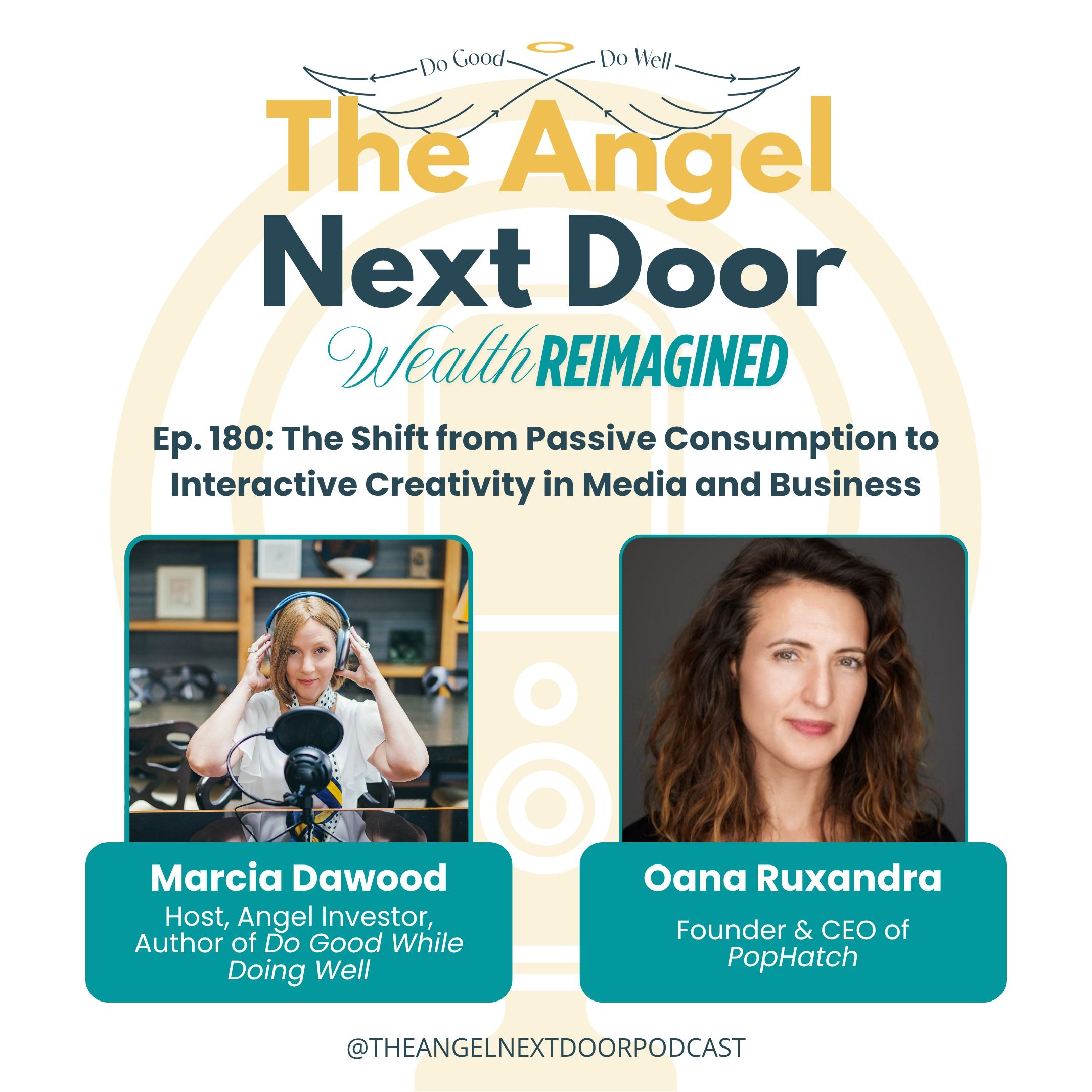
Shift from passive media consumption to interactive, experiential creativity; how AI will reshape intellectual property and monetization; and PopHatch’s goal to help entrepreneurs find users and product-market fit faster.
Juana Roxana, born in Romania and a refugee to the U.S.; studied pre-med, moved into finance, worked at BlackRock (opened India offices) and later became Chief Digital Officer at Warner Music Group (also worked at Universal). She spent ~15 years enabling people to make music, then left Warner to build PopHatch.
Adults have lost creativity; productized “content” replaced collaborative experiences; fans’ participatory creativity (comments, reposts, fan fiction, merch) should be enabled and monetizable; IP law and monetization will change toward engagement/community; traditional VC diligence won’t scale for mass entrepreneurship.
Star Wars fan fiction/merch; Taylor Swift’s emphasis on ownership; Netflix/Spotify vs TikTok/Instagram/YouTube participation; “boardroom creation” shifting to “desktop creation” via AI.
Written by AI. May contain mistakes.
Juana discusses her background as a refugee and her path to becoming a digital officer in music.
“Well, Juana, welcome to the Angel Next Door podcast.”
Juana explains how music has transformed and the importance of creativity for adults.
“And then I left Warner two years ago and started building PopHatch.”
Discussion on how COVID has shifted media consumption towards more interactive platforms.
“to engage with music in a way that's creative as opposed to just listening, just watching?”
Juana emphasizes the need to empower fans to engage creatively with their favorite IPs.
“Those types of creativity, I think, are extremely important and, by the way, monetizable in the future when we talk about great IP today.”
The future of IP and how community engagement will redefine artist-fan relationships.
“And I think a lot of industry is focused on disenabling it, right?”
Juana discusses the transition to entrepreneurship driven by AI and the changing job landscape.
“So because it seems like a lot of artists have tried to, Taylor Swift was very vocal about making sure that she owned her music and things like that.”
Discusses how AI is replacing entry-level jobs while creating new opportunities.
“And also a ton of entry-level jobs are being taken away.”
Explores how technology fosters creativity and entrepreneurship among individuals.
“I love this because so basically what you're saying is people, well, we're all creative in our own way.”
Addresses the difficulties entrepreneurs face in acquiring users after launching their products.
“Okay, somebody is thinking to themselves, I think I want to start a business, be an entrepreneur.”
Introduces PopHatch, a platform designed to support entrepreneurs in decision-making and user engagement.
“And so that's what our platform is focused on.”
Highlights the importance of human connections and collaboration in entrepreneurship despite technological advancements.
Discussion on supporting creatives and fostering success in the new era.
“I've always been supportive of people as creative and people as the winners in this world.”
Juana shares how to connect with her and details about PopHatch's offerings.
“So this is very exciting, what you're building.”

Get the gist, explore an idea or ask about something said.
 Claude
On The Angel Next Door, what are the key points of this episode?
Searching your listeningAutomatic transcript. May contain errors.
0:00Oana Ruxandra: Those types of creativity, I think, are extremely important and, by the way, monetizable in the future.
0:10Welcome to the Angel Next Door podcast, your gateway to the dynamic world of angel investing. I'm your host, Marsha Dawood, and together we will demystify what it means to invest in early stage companies, who's behind it, and how anyone can be a part of it. If you've ever wondered how you can affect the change you want to see in the world, then tune in to learn more. In this episode, I'm talking with trailblazing entrepreneur Juana Roxana, whose journey from refugee to chief digital officer at Warner Brothers Music is quite inspiring. We discuss how Juana is revolutionizing creativity for adults, advocating for the future of experimental media, and building PopHatch, a platform designed to empower the next wave of entrepreneurs.
0:51From behind-the-scenes stories in the music industry to bold predictions of how AI will reshape business and intellectual property, this conversation is packed with fresh ideas, actionable advice, and a contagious joy for building. Enjoy the show.
1:10Well, Juana, welcome to the Angel Next Door podcast.
1:13Oana Ruxandra: Thank you, Marsha. I'm happy to be here. Yeah, well, I am excited to learn all about PopHatch and all the things that you've been working on. But before we get started, tell our listeners a little bit about your background, because you have an interesting story about how you ended up doing what you're doing. Yeah, let's do the shorter version. But I was born in Romania, moved to the States when I was young. So we actually fled from the country right before the dictatorship was toppled. So I am a refugee to this country. And as any good immigrant kid, you don't grow up with much and your parents are pushing you very hard.
1:48Oana Ruxandra: And they wanted a doctor and a lawyer. My sister is the Harvard Law lawyer and I was pre-med and then I left that, moved into finance so that I could pay off my student loans. Was at BlackRock for seven years before BlackRock was BlackRock. So I opened up their offices in India, moved there for a couple of years, was running a big book of business when everything crashed. And it was a fun time. But my interest has always been in creativity. I think we as adults have lost our creativity over the last hundred years. There's been so many incredible things that have happened during industrialization, but also we have productized a lot of access and content.
2:29Oana Ruxandra: And I feel like we as adults, as we move into the workspace, have been asked to turn off our brains in a lot of ways. And so I moved into music because that was my language. When I first moved here, I didn't speak English, but my parents had already had me in violin. So I was playing in orchestras and music was my language. And so I moved into music and spent a lot of time, about 15 years there, really focused on what does it mean to enable people to make music outside of the confines of what was, which was very expensive, right? that used to take money and time and access to be able to make a great song.
3:09Oana Ruxandra: And then that changed over the last 10 years. And now everyone can make a great song on desktop and it's changing even more. Now it's moving to mobile. And I spent a lot of time helping people make great music. And then I left Warner two years ago and started building PopHatch. And it's really about how do you make great businesses? And so we're focused on helping the next generation of entrepreneurs build and be successful in the way in which they build. And it goes back to this idea of creativity in adulthood. It's not just about what we consume and being active and creative there, but also in what we build and how we enter the workforce.
3:46Amazing. So tell us a little bit more about the music side. Specifically, what were you doing? Were you trying to help artists be able to keep their rights to their music or how did that all work?
3:58Oana Ruxandra: It's more about what's the future look like. So I spent hours a chief digital officer at Warner Music Group, and I also spent a number of years at Universal. And what my focus was always on, where's the future of media and the media landscape? What I have seen is that music has been predefined as a three-minute song for the last hundred years. And so has movies, right? and film and tv and books all of these things because we productize them as industries we move them into a hard-coded piece of content songs will became music an album became music because that's what a vinyl could take and books became written and put on paper right there's so many things that now we understand as a definition of what these media types are but before there was the ability to put them on hardware and put them in front of us, people actually came together and experienced media together, right?
5:01Oana Ruxandra: You went to a play, you've listened to a concert, you were also a patron of the arts. The artist was making music for you. You were a part of the collaboration cycle. You were clapping your hands and stomping your feet. And these moments of experience were ephemeral. And then we started productizing them and making them final and making them and putting the fan below the stage and the artist above the stage and putting this wall between interaction, consumption and creativity. And we told fans they could no longer be creative, that they had to just sit there and listen and read and watch. And industries created the content for them.
5:42Oana Ruxandra: And I I think that's been a massive disservice to fandom and fans. I think all of us are inherently creative. I think we show that when we first get out of the womb, right? We're painting and drawing and experiencing and making noises and all of those things. And then as we move into adulthood, we stop creating in a real way. And that is changing. And I think new technologies like AI are enabling people to make great things that they're proud of. and that feels very exciting to me. And so that's really the basis of a lot of the work that I was doing at Warner. What does it look like to enable more and more people to engage with music in a way that's creative as opposed to just listening, just watching?
6:28Oana Ruxandra: So that's a lot of the work that we were doing there. And how are some of the ways? Give us some examples. Yeah, I think that the future of music ultimately and the future of media is experiential. Ultimately, and we're seeing a lot of that, right? People are transitioning into different forms and consumption patterns. And that was really pushed forward by COVID, where all of us were in front of our screens all of a sudden. And the experience of watching something passively like the Netflixes of the world or listening to something passively like the Spotify's of the world became less relevant than going on to TikTok and Instagram and YouTube and being participatory, right?
7:07Oana Ruxandra: What we saw was a big shift away from those kind of stayed platforms of castivity into platforms that were far more active. And in that, we saw fans wanting to take up the mantra of creativity. And I don't mean that they started creating a ton of songs that all of a sudden were making hundreds of millions of dollars, right? They weren't becoming the next Taylor Swift, but they were activating in their own right. whether that was commenting or reposting or sharing or creating content and putting their faces on great art. Those types of creativity, I think, are extremely important and, by the way, monetizable in the future when we talk about great IP today.
7:50Oana Ruxandra: Any of those great IP, and let's talk about Star Wars since it was May the 4th yesterday, so many people are creating fan fiction and their own merch and their own experiences and their own songs and their own films and their own snips and all of those things around Star Wars and the best artists of the world. And that to me is deep creativity that we should enable. And I think a lot of industry is focused on disenabling it, right? Because a lot of the enablement is through artificial intelligence. What does it look like to enable AI models of IP out there and allow fans to take that IP and make it all their own.
8:29Oana Ruxandra: And I would say that's a lot of the resistance right now in the industry to not enabling that transition of IP into fandom. So yeah, I think that's the future, enabling fans to take the IP that they love and use it in any way that they love in a way that's ephemeral but also experiential with other fans. So how are they allowed to do that if it's intellectual property that's owned by somebody else? Yeah, I think intellectual property is going to completely change. The rights around IP are going to completely change over the next number of years. And you're already seeing that, right? Before an artist was more precious about each moment, that was 10 years ago.
9:18Oana Ruxandra: Before the advent of 15 years ago now, the advent of social, each moment was more precious. If you wanted to get a picture put out into the world or a moment or a song, those things were highly, they had high approval cycles and you had to do it consistently. and now artists and IP are in front of people all the time and each one of those moments is not the IP anymore. It's the story and the narrative that is important to the artist and their community. I would say the future of anything that any of us do, the art is actually the community that you're building and the community that you're enabling.
10:02Oana Ruxandra: And so I'm very focused on people and networks and so I would actually say the future of art is community-based. and I actually think that IP law is going to completely change over the next number of years and it's going to be very hard to stamp down IP in a real way. That's interesting. Yeah. So because it seems like a lot of artists have tried to, Taylor Swift was very vocal about making sure that she owned her music and things like that. But you're saying that fans can now take that and build their own community around it? No. Yes, of course. And I think community is the thing that is going to be leading artist engagement.
10:41Oana Ruxandra: Again, this is not what I'm building in, but the future of media and the future of IP, I believe, is going to be fans and artists coming together in great communities and artists being able to monetize the engagement of their communities in a way that's far more robust. Today, IP is monetized in a very specific way, which is friction-based, right? You have access through an ad or through a paywall. And because of that access point and because of that limited nature of monetization, you have to have IP. Because the only monetization point is because you give access to IP. And so the IP law is completely subsumed by the way in which we monetize.
11:26Oana Ruxandra: I would say that the future of media is monetizable through engagement. And then you have to start to create moments of engagement. And the more engagement you create, the better the monetization and the better the community. And so artists will want to enable their fans to engage because there will be monetization opportunities. Oh, interesting. Yeah. Okay. So then how did you move from that and working in music to thinking about, hey, we need something and I think I'm going to create it and call it Pop Hatch? Yeah, it's in the same leaning. When I was in music, what I saw was a massive transition into activation.
12:06Oana Ruxandra: And so there were not as many artists back in the day because to be an artist was expensive. You needed a studio time and people to help you. and then that changed and ai came around and people talk about ai music today but ai music has been around for forever what happened was that we transitioned studio creation into desktop creation and then all of a sudden millions of people became musicians whether or not they were monetizing that music is another point but there were a ton of people starting to make music in a real way and now there's hundreds of thousands of songs being loaded up onto these platforms every day.
12:44Oana Ruxandra: And so that transition also opened up a world of new businesses. What we saw was all of these new businesses coming around a middle tier of artists and a long tail of artists. Before it was just labels and top tier global artists. Then all of a sudden a ton more people started making music and a ton of businesses came around to support those artists making music. And that's what is exciting to me about the future of entrepreneurship as well. I believe that we're moving because of AI from boardroom creation of businesses to desktop creation of music businesses, and that there will be millions of more entrepreneurs that come online over the next number of years, a mid-tier, a long tail, and the VCs will probably still handle those top-tier entrepreneurs that are building massive billion-dollar companies, right?
13:36Oana Ruxandra: But there is going to be this shift from traditional nine to five into entrepreneurship. And I think that there needs to be support systems. So the same support systems that I built in music, I'm building over an entrepreneurship. There's so many reasons to believe this. One of them is that traditional support systems are breaking down, right? You used to be able to go get a job, rely on that to get a house, to get a car, to support your family. And now that's extremely hard. And also a ton of entry-level jobs are being taken away. When I first started at BlackRock, I was staring at my screen for 20 hours a day.
14:14Oana Ruxandra: And that job is better done by AI today, honestly. And so a lot of entry-level positions are being taken away at the same time as these support systems are breaking down and the middle class is breaking apart, right? And so that's the first thing. Then you see a ton of opportunity to build, whether it's the lovables and cursors of the world, but also platforms like social commerce and Shopify and all of these other platforms that enable you to get to your audience more quickly. And then, of course, the last piece of it is, which is my thesis in life, that as we have more technologies, we tend towards more creativity.
14:50Oana Ruxandra: And so I think the future of work is entrepreneurial. I think the same thing that I saw in music is happening in entrepreneurship. There will be millions more entrepreneurs that come online over the next number of years. And for the most part, the support systems that support those entrepreneurs are still very traditional. It's the traditional VC, manual, long-term due diligence process. And that's not going to work for the scale of entrepreneurs that are coming online over the next number of years. Interesting. Wow. Okay. I love this because so basically what you're saying is people, well, we're all creative in our own way.
15:27So you're saying that now they're in lots of different industries, music, entrepreneurship, there's more access for people to use that creativity in order to do the thing, make the song, build the business, whatever it is.
15:43Oana Ruxandra: exactly there's because again i think we're fundamentally creative as we get more tools and technologies we turn towards that and so that's why i think all of this shift is happening so quickly and you feel it from the ground up there's a ground swell of people wanting to hustle and to grind and to do their own thing and opting out of the system that currently doesn't support them. But what is also true is that a lot of the people that don't have access to the right schools or the right networks or the right venture capital have to reinvent the wheel constantly. And there's an inefficiency to that, right?
16:23Oana Ruxandra: If you're starting to build a business, you don't have all the answers. You probably don't really know what you're doing, right? I went to quote unquote elite schools and it's only in building that I started to learn, but I'm grateful that I have the right networks to be able to rely on where I can call someone and say, have you done this before? Help me understand what the right way to go is. But a lot of people don't have that. And that's really what we're building behind. What is being built today outside of PopHatch is a lot of the tools to help people get to audience and build product and service, right?
16:56Oana Ruxandra: You can build, you can create shirts really quickly, or you can get to audience really quickly, or you can write something really quickly. all of these different spaces, it has become easier to do the work, but actually making decisions around the work, that's where we step in. And so what we're first focused on is there's a lot of people launching businesses. How do we help them find their users? And that's how do we help you find product market fit in a space that is rife with more, doing more, adding more features, posting more, et cetera? How do we help you get through all of that noise and really start to pinpoint a direction in which to find the right first user?
17:38Oana Ruxandra: So that's what we're focused on. It's really around decision-making. Okay, somebody is thinking to themselves, I think I want to start a business, be an entrepreneur. How would they, first of all, would they find PopHatch? And then how, what would be like one of the first things they would do? Yeah, so the very first group of people that we're building with are people that have already built an MVP. So it's people that have already built. We can, of course, support on the ideation phase, and that's the second level. But from the very beginning, we're focused on people that have already built something and they're coming into the market with maybe some noise or maybe they're entering into a void, right?
18:16Oana Ruxandra: So you've launched something and you're hoping a lot of people come support, come sign up, come pay. Maybe they're not paying, maybe they're not staying. That type of void post-launch and into finding users is a very tough place to be. And I think all of us understand that. And what tends to happen is that you'll go to ChatGPT or you'll go to Claude or any one of the other AIs and start asking questions. But those systems are built to keep you engaged, right? And so what they'll do is they'll give you a ton of stuff to work on. And then you'll keep working and working. And so what we found from our founders is that a lot of them are coming to us either not knowing where to start or having been doing quite a bit and just feeling burnt out.
19:07Oana Ruxandra: You're adding more features. You're adding more posts. You're starting to pay for ads. And it's just more because these tools that are there to support you are incentivized to keep you doing more and more. And so you end up in a place where you're just grinding, spending tons of hours. You don't know where to go. And of course, solopreneurship is difficult, right? Keeping everything in mind, keeping the momentum up. And so that's really where we sit. It is how do we help you take the first steps or take a step back into finding your right users? And we do that by first remembering everything that you're doing.
19:47Oana Ruxandra: And so our platform has total memory. There's a lot of context engineering. So every time you set up a prompt, there's a lot of engineering in the background to help you rewrite the prompts, a lot of special thoughts in the background so that every time you ask something, it comes with all of the context of what you have told us before. and then the focus is let's isolate let's experiment let's figure out how to find signals and all of this noise by running parallel tests to get to the next step and the next step and the test can be anything from your marketing language needs to change let's evolve that to are these future sets right when is someone finding value is this the right space is this the right user even back into, are you the right person?
20:36Oana Ruxandra: And is this the right market, right? Our goal and what we're incentivized by is not to waste people's time. It's to get you to the success that you can get to as efficiently as possible. Wow, that's interesting. I think that's probably where I know I see a lot of entrepreneurs struggle is they're like, hey, I know there's a need and I'm gonna build the thing. And then they're like, ooh, I actually have to get people to now pay for it. Yeah, it's what a lot of people don't talk about. It's that void, right? It's so exciting to build. And you see so many people building in public right now. And then somehow once you get to them launching, they're making millions of dollars in a day.
21:21Oana Ruxandra: That's all that's going on externally on X and LinkedIn and all of these other platforms. And really finding those first sets of users is a grind. And you need to keep everything together. And you need to not churn out and keep the momentum up and start to understand everything. And especially if you're working on your own, all of that is extremely difficult to keep together. And so that's what our platform is focused on. How do we remember everything for you so that if you've done something and a number moves and it was something you did three months ago, we'll remember it and say, hey, you did this three months ago.
21:59Oana Ruxandra: This, I think, is affecting this number. That's a good thing or a bad thing. Let's evolve from there. That's the type of context we want to help support people with. This is version one. And so there's versions of this on top of the build that we're focused on. But really, the first step is how do we make sure that you are the most successful that you can be and finding the right users for your platform? Wow. Yeah. Yeah, that sounds like something that's extremely needed. Why the name PopHatch? Yeah, it was. So my technical last name has Pop in it. I use my middle name as my last name. And so it's basically my hatch.
22:42Oana Ruxandra: when we were looking for names, we wanted to convey the joy of building with the platform. A lot of work these days, especially in that nine to five world, can be soulless. And I think that I get enormous amount of passion from building and being creative. And we want to imbue that into the users that we have. And so there's a lot of gamification that we're planning on adding onto the platform. The idea is how do we help you hustle and grind in a way that feels exciting to you? And a lot of people aren't just working on one thing, right? What I believe is that in entrepreneurship, a lot of us will have multiple jobs in the next few years.
23:25Oana Ruxandra: And so how do we help you work on one thing and then see if it's growing and then work another thing and see if it's growing? Those things are really exciting. But we wanted to imbue our platform with, I think, the joy of building and the joy of creating. Yeah. So pivoting can be easier. And if people aren't getting the results right away, they don't have to go through the pain and agony of months or even years of trying it and then realizing it's not working. Yeah, exactly.
24:22Oana Ruxandra: How do we help you be the best entrepreneur that you can be? So maybe this one project fails, but we'll get you to a place where you understand if it's going to go or not go as quickly as we can. And then you can take on a next project. The thing that we're also focused on in the two of our platform is how do we start to connect you with other builders in our platform? And so a lot of this is really the community aspect because it is hard to build on your own. But if you're building within our platform, we can understand how you build. and we can start to connect you with other people that can complement your building skill set.
24:53Oana Ruxandra: Today, what is out there in terms of networking for entrepreneurs tends to be focused on what you're building, right? A health and wellness person will be connected with a health and wellness person or FinTech will be connected with FinTech, but that doesn't mean that you're gonna work well together. And so in our platform, because you're making decisions, we can start to understand if you're a big picture person or if you are in the weeds or maybe you're a little bit more risk averse and need to work with someone that is really full guns blazing, right? And so we can start to understand how you build and what kind of builder you are, and then we can start to connect you.
25:27Oana Ruxandra: And so a lot of the second version of the platform is starting to connect people into teams of great entrepreneurs together. And so from our perspective, not everyone is gonna be successful in that first business, but as they build and as they grow, we're teaching you to be a better entrepreneur and we're also connecting you with other people that can help support you. And that's really exciting to us as well. Yeah, wow, that's a very unique feature. Usually, like you say, you're always, even people who seek out other networks, they're always thinking about what they're working on and talking to other people like that.
26:03But to actually be thinking about the type of person that you are and the type of person that you should be networking with that could actually help you grow.
26:13Oana Ruxandra: Yeah, I've been trained in decision-making for a very long time. In my job at Warner, I was a negotiator of multi-billion dollar deals, and I have managed a lot of people. And ideally, I would say inspired a lot of people. I believe I'm a great decision maker, but I've always wondered what that means. And so I've spent a lot of time over the last decade understanding what it means to make great decisions and what it means to complement your decision making with other people. And that's ultimately what we're looking to engender across the platform, which is this is what we're learning about decision making.
26:52Oana Ruxandra: This is what we're learning about great decision making. And also we don't want to exist in a loneliness epidemic, right? It is hard to be on your own and we want to be able to ensure that other people have connections in the right way. When I first started building, I was building alone and then I found co-founders and it's been such a better process. And I think that's important for a lot of us. Yes. Yeah. We see that all the time where either people are trying to do it alone and they need a co-founder or they don't have the right co-founder or whatever the story is. Totally. Totally. That co-founder relationship.
27:24Oana Ruxandra: And again, we want our AI is your co-founder, but there's so many people today that will say you no longer need a person to build a business, right? They'll just be a press of a button and then box companies will come out. and at some point you no longer need people to build businesses and that's the opposite of what i'm building for in music a lot of people said that too you don't need an artist anymore you can just create ai content and ai artists and virtual artists and put that out into the public and hope for the best and i think you can get a lot of really tiny wins in that space but for me I've always been supportive of people as creative and people as the winners in this world.
28:10Oana Ruxandra: And so we're building for helping people to build and helping support that in their thought process. And so we're not here to help people press buttons and say, here's your box business. It is, how do we help you learn? And how do we help you be successful? And how do we help you build in this new era. Yeah. Wow. So this is very exciting, what you're building. And it sounds like you have a lot of predictions for the future in a lot of different ways. Love that. Where can people find PopHatch and where can they connect with you? Yeah. So I'm on LinkedIn. It's JuanaRx at LinkedIn. And then PopHatch is PopHatch.com.
28:52Oana Ruxandra: We'd love to see you on. We have founder pricing right now. So super discounted. We're doing a lot of testing in beta and then we'll be launching in full at the end of June. Excellent. Yeah. Well, Juana, thank you so much for coming on to the podcast today and telling us all about this. And we'll make sure to put all that in the show notes so that everybody can connect with you. Thank you so much. It's been a pleasure. Thanks for listening. To connect with me, visit my website at marshaladalwood.com. And please subscribe, follow, and leave a review. It helps the podcast get seen by more people.
29:25and remember you can also find the angel next door podcast on youtube too and if you're looking to learn more about investing in the changes you want to see in the world sign up for ann and bill payne's aca angel university classes go to the angelcapitalassociation.org all one word to find out the schedule and classes are now available on demand many classes are offered everything from angel investing basics which include fundamentals risk due diligence term sheets valuations, returns and portfolio strategy, and even a class on group formation. There's even a deeper dive where you can get advanced classes, including capitalization tables, startup boards, and exit strategies.
30:03If you're not already a member of the Angel Capital Association, you can become one for a low price that will give you unparalleled access to discounts, free webinars, with a huge archive of content, networking opportunities, and much more. We'd love to have you join us.
What if the future of entrepreneurship isn’t just about hustle, but about reimagining how we build, connect, and create in an increasingly digital world? In this episode of The Angel Next Door Podcast, listeners are challenged to reconsider their assumptions about what it takes to become a successful entrepreneur—and how technology and creativity are breaking down old barriers in business and life.
Our guest, Oana Ruxandra, brings a fascinating background as a refugee from Romania who rose to leadership roles in finance and later as Chief Digital Officer at Warner Music Group. Having witnessed the transformation of music from an exclusive, costly art to an accessible, creative playground for millions, Oana now channels her passion for empowering people into Pop Hatch, a platform designed to support the next generation of entrepreneurs.
The conversation, led by Marcia Dawood, explores how new tools and technologies are radically democratizing creativity across industries, reducing barriers to business-building, and shifting how we think about community and intellectual property. Oana breaks down why now is a pivotal time to turn side hustles into real ventures, how AI is opening doors (while also presenting new challenges), and reveals how Pop Hatch aims to make finding market fit and meaningful connections easier for founders everywhere. This is a must-listen for anyone looking to understand the evolving landscape of entrepreneurship, harness their own creativity, and stay ahead in a rapidly shifting world.
To get the latest from Oana Ruxandra, you can follow her below!
https://www.linkedin.com/in/oanaruxandra/
Sign up for Marcia's newsletter to receive tips and the latest on Angel Investing!
Website: www.marciadawood.com
Learn more about the documentary Show Her the Money: www.showherthemoneymovie.com
And don't forget to follow us wherever you are!
Apple Podcasts: https://pod.link/1586445642.apple
Spotify: https://pod.link/1586445642.spotify
LinkedIn: https://www.linkedin.com/company/angel-next-door-podcast/
Instagram: https://www.instagram.com/theangelnextdoorpodcast/