
 Ask ChatGPT

 The Artificial Intelligence Show
1 Oct 2026 · 47m · 19 chapters
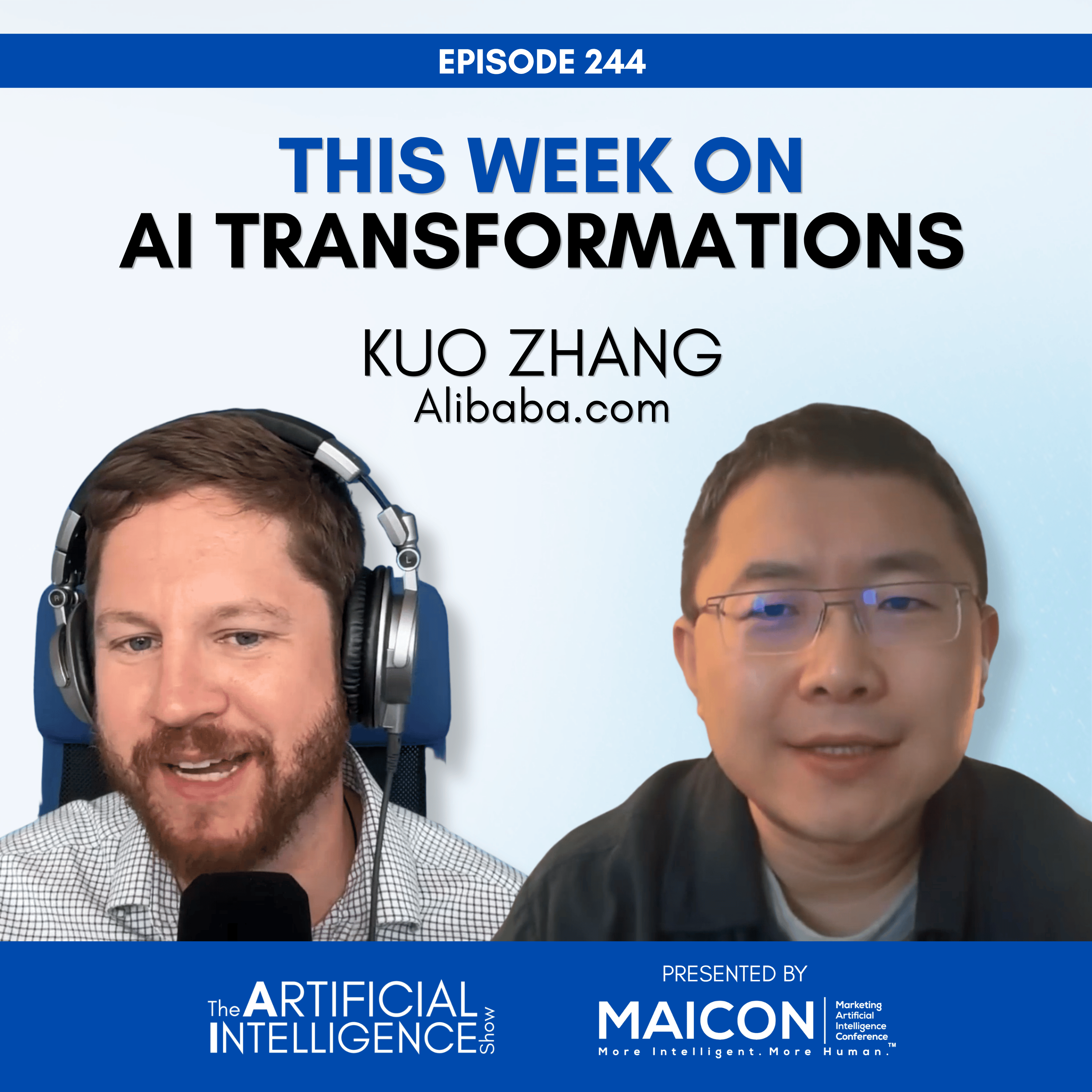
Alibaba.com’s AI transformation from an AI search/sourcing tool into Axio Work, a suite of specialized AI agents enabling end-to-end B2B commerce and moving toward agent-to-agent (A2A) commerce.
Kuo Zhang, president of Alibaba.com since 2017. Previously a computer scientist at IBM and Microsoft; at Alibaba since 2011 working on merchant platforms and tools for Taobao.
B2B procurement is too complex for humans to manage efficiently; it involves expensive, multi-criteria decisions and weeks/months of back-and-forth across time zones and languages. AI agents can reduce steps (described as ~60) and automate tasks like market research, design pack creation, negotiations, and e-commerce operations. Axio Work uses a model-harness-context system and is evaluated with a Commerce Agent Bench (107+ tasks) optimizing pass rate, time/steps, and cost for SMB affordability.
SMB sourcing a product for resale in the UK/US; agents match suppliers, generate RFQ/design packs, handle negotiations and contract terms, and support logistics/compliance. Agents also help sellers list once across platforms (Shopify/Amazon/TikTok Shop) and manage stores without spreadsheets.
Written by AI. May contain mistakes.
Overview of the AI Transformations series and its purpose.
“So join us as we accelerate AI literacy for all as part of our AI transformations series.”
Introduction to Kuo Zhang and his role at Alibaba.com.
“the 15th, right here in our home base of Cleveland, Ohio.”
Discussion on the Axio product and its role in transforming Alibaba.com.
“So today I am joined by Kuo Zhang, president of Alibaba.com.”
Exploration of how AI is changing commerce for small businesses.
“And also it's kind of the summon charm in Harry Potter.”
Learn how AI agents have evolved from product search to comprehensive e-commerce assistants.
“not only on alibov.com, but also on all your kind of storefronts as well.”
Explore the challenges faced by small businesses in using AI agents for sourcing.
“the tokens that are used by the users actually is six-fold for the past four months.”
Understand the differences in decision-making complexity between B2B and B2C transactions.
“So before we talk about B2B, we can do a kind of cooperation with B2C.”
Discover how AI agents can simplify the procurement process for small businesses.
“and there are going to be endless back and forth conversations, different time zones, different cultures and languages.”
Learn about the technological components that power AI at Alibaba.com.
“Nobody wants to be spending hours, days, weeks on these tasks.”
Explore the components that make AI agents successful in the e-commerce space.
“We've talked about agents kind of broadly.”
Explore how AI agents are transforming the e-commerce landscape, particularly through Alibaba.com.
“There's these three elements, it sounds like, working together to make all of this possible.”
Discuss the implications of agent-to-agent commerce for suppliers and buyers in global trade.
“both want to save their time and get efficient result as much as possible.”
Learn about the internal changes Alibaba.com underwent to integrate AI agents into its workflows.
“For example, I have hundreds of thousands of suppliers.”
Understand how Axio Work operates as a startup within Alibaba, focusing on rapid updates and integration.
“You can imagine that Alibaba.com has its own pace, has its own business model.”
Examine the challenges faced in transitioning from AI experiments to fully operational agent-based products.
“To start integrating there so you can incorporate agentic features more into the main business.”
Discover the Commerce Agent Bench, a framework for measuring the effectiveness of AI agents in commerce.
“So, you know, final question for you, Kuo.”
Explore how Alibaba.com is leveraging a commerce workbench to solve real business challenges with AI.
“So you use this model to solve mathematics.”
Learn about the significance of benchmarking AI models on crucial business tasks.
“to actually look at over 100 different tasks that are actually important to businesses, and you're able to benchmark the agent on those exact tasks from a Pareto Frontier perspective.”
Discuss the evolution and future potential of agent-to-agent commerce as shared by Alibaba.com.
“So, Kuo, thank you so much for sharing Alibaba.com's journey, for sharing all about Axia work.”

Get the gist, explore an idea or ask about something said.
 Claude
On The Artificial Intelligence Show, what are the key points of this episode?
Searching your listeningAutomatic transcript. May contain errors.
0:00Kuo Zhang: And there are going to be endless back and forth conversations, different time zones, different cultures and languages. In there, that AI can help a lot. So we believe that the B2B will go to A2A, the agent to agent. That will be the future. Welcome to AI Transformations, a special series from the Artificial Intelligence Show. I'm Mike Kaput, Chief Content Officer at SmarterX and Marketing AI Institute, and I'll be your host. Every business's AI journey looks different. In each of these episodes, I sit down with leaders who have lived through real AI transformation, including the actual stories, the pain points that push them to act, the moment things started to click, and the results they can point to today.
0:46So join us as we accelerate AI literacy for all as part of our AI transformations series. Welcome, everyone, to episode 244 of the Artificial Intelligence Show. I am Mike Kaput, co-host of the Artificial Intelligence Show and chief content officer here at SmarterX. Now, today we are continuing a special series that we've been running called AI Transformations. This is where we spotlight how real companies are driving real change using AI. Now, we actually launched AI transformations with this initial six episode run where we had some select stories we knew we wanted to tell. But there are far more than six transformation stories worth telling.
1:36So we are continuing the series and bringing you more of these conversations directly as part of the artificial intelligence show. Now, the premise here remains the same. AI transformation can feel abstract. Plenty of companies talk about it. Far fewer show what it actually looks like inside real organizations with real teams, real constraints, and real business outcomes. So in these episodes, we are talking directly to the leaders doing the work. We're going to explore their particular AI transformations, what AI work looks like inside the company, what got difficult along the way when it comes to AI adoption and innovation and what kind of results AI is starting to unlock.
2:19So today, the leader we are talking to is Kuo Zhang, who is president of Alibaba.com. Kuo is here to talk about how Alibaba.com is using AI and agents to rethink how entrepreneurs and small businesses participate in global commerce. So before we get into today's conversation with Kuo, this episode is brought to you by MECON, our marketing AI conference for marketing and business leaders happening October 13th to the 15th, right here in our home base of Cleveland, Ohio. We are expecting thousands of AI forward leaders here. We are less than two weeks away from MECON if you are listening to this when it drops.
3:01So if you've been thinking about joining us, this is the time to make it happen. We are going to bring together so many people for three days of keynotes, sessions, workshops, and conversations about how organizations are adopting, operationalizing, and scaling AI. So you'll hear real-world case studies, practical frameworks, and direct lessons from the people doing the work inside companies today. If you are a podcast listener, use the code POD100 at checkout for your make-on ticket to save$100 on your pass. Now, what's really cool is that using this code will also reserve your place at our private lunch for podcast listeners where Paul Reitzer, my other co-host, our CEO and founder, and I will spend an hour answering your questions about AI, your company, your career, whatever you're trying to navigate in the wide, wonderful world of AI.
3:56So seats are limited. The offer closes when the room is full. So use that code as soon as possible. go to macon.ai, M-A-I-C-O-N.ai to register. And we hope to see you October 13th to the 15th here in Cleveland. So today I am joined by Kuo Zhang, president of Alibaba.com. Now, when most people hear the name Alibaba, they probably think about the much larger Alibaba group. Alibaba.com is a specific part of that organization and it is where the entire company began. Alibaba.com launched in 1999 as Alibaba Group's first business. Today, it is a global business-to-business commerce platform that helps entrepreneurs and small and mid-sized businesses find suppliers, source products, conduct transactions, and manage different parts of international trade.
4:50For the fiscal year 2026, Alibaba.com reported that more than 47 million buyers from over 190 countries had used the platform to source business opportunities or complete transactions. It also had more than 240 ,000 paying members. Kuo has served as president of Alibaba.com since 2017. He began his career as a computer scientist at IBM and Microsoft before joining Alibaba in 2011, where he worked on merchant platforms and tools for Taobao. Now, since taking over Alibaba.com, he has helped lead its evolution from what was primarily a directory of business listings into a platform that supports transactions, payments, logistics, marketing, and other parts of global commerce.
5:36Now, he is leading what Alibaba.com sees as its next major transformation, the move towards AI-powered agent-to-agent commerce. That journey, which we'll talk about today, began in November 2024 with Axio, an AI-powered search and sourcing engine built for business buyers. It has since evolved into what you can think of as a team of specialized AI agents for entrepreneurs and small businesses. So rather than answering simply questions or recommending next steps, these agents can break a business goal into specific tasks and help execute them. things like market research and product sourcing to supplier negotiations, store operations, marketing, logistics, and compliance.
6:22Now, more than 10 million small businesses now use Axio Work to run their operations, collectively consuming 1 trillion AI tokens over a recent three-month period. Now, those are significant numbers, but the bigger story here is what they could represent. Alibaba.com is exploring now whether it can evolve from a marketplace that people navigate into an operating platform where agents increasingly help conduct commerce on their behalf and eventually interact with other agents representing buyers, sellers, and service providers. So, we're going to explore today how this transformation began, what Axio work actually does, how customers are using it, and what had to change inside Alibaba.com.
7:07Not to mention, we'll chat about what has been difficult along the way and what agent-to-agent commerce could mean for the future of global business. Kuo, welcome to the show. Thank you so much for being here with us.
7:18Kuo Zhang: Thank you for helping me. You did a lot of research. We tried. We tried. It gets a lot easier these days when agents can help you with the research, I think. We'll talk about that, I'm sure. That's true. Before we get into this broader story, this broader transformation, I have to ask about the name of the product. So Axio, A-C-C-I-O, is Latin for I summon. And Alibaba has actually said in interviews outright, the name is a reference to the summoning charm in Harry Potter. I'm just curious, why was this the right name for what you're building here? Yeah. So Axio, what it says is right, it's Latin for I summon.
8:01Kuo Zhang: And also it's kind of the summon charm in Harry Potter. It's just you kind of say the name and you can bring it to you. So we use this name because in the beginning when we design Axio, it's like you have a world or you have some thoughts and we can use AI and global supply chain to help you to make your dream come true. So it's some kind of Axio. And also in Axio, there's AI inside this term. And all the young guys in Alibaba.com, we get a vote and all the young guys love this name. So we just choose this as the new product name. I love that. That's so cool. So let's start off at a high level, maybe walk me through the AI transformation that Alibaba.com is pursuing through Axio work and maybe talk to me a bit about how this is changing the way entrepreneurs and small businesses participate in global commerce.
9:08Kuo Zhang: Sure. So we take step by step. So Axio first launched, I think, two or three years ago. And at that time, AI is not as today. And we're starting from the AI search. You can think about this like a Google AI model, AI overview. So when we feel that when the people using Alibaba.com, they are using user search a kind of different way than before. They tend to use more and more multimodal materials like images, like documentations. and they describe their needs in a kind of sentence, not only a few keywords or queries. And leveraging AI, actually, we have more power to understand the intention behind the scene of the users, the buyers on Alibaba.com.
10:07Kuo Zhang: I think that's the first step. And when we kind of launch the product, we are seeing people actually using this online agent, the online sourcing agent to do many other things other than search. For example, they are using this agent to develop their ideas. They have some ideas. They want to do a market research. They want to see if this product exists. Are there kind of shortcomings of the existing product and what are the opportunities? And then they will transform this idea into a design pack. So previously, when the buyers talked to the suppliers back and forth, many of the times that they cannot describe what they are trying to build.
10:53Kuo Zhang: And leveraging AI, actually, they can generate a very sufficient and professional design pack for the suppliers. When the supplier received the design pack generated by Axio, they said they never see a buyer actually is so professional. And then it reduced a lot of back and forth discussion and dispute. as well. So that is the beginning of the Axio. So we start from the AI search to a kind of a sourcing agent. And they're using that not only for inquiries, but also for market research, for customers or suppliers writing for the product design. And when the AI technology or power kind of moving on, we are using AI to do the negotiations part as well.
11:46Kuo Zhang: So the AI become a real agent, represents the benefit or the interest of the buyers. And you can imagine the seller side has its own agent as well, helping them to do the similar stuff. And for this quarter, we kind of expand the scope of this agent further, we found that it's not only used for sourcing, it can be used as an e-commerce workspace. Remember, the first job of mine is in Taubo and Timor, providing all kinds of tools for sellers. And we see that the AI for e-commerce actually has a lot of similarity of the sourcing. So you need to manage many stores. Like you have Shopify, you have Amazon, you have eBay, Etsy, and many of the sellers that we met, actually they manage stores across different platforms.
12:45Kuo Zhang: But they want to manage the business as well, not in different spreadsheets and send the P &Ls. Also, when they upload a listing on Shopify, on Amazon, on TikTok shop, or on social medias, they want to do it once for all, not kind of keep updating different product to different platforms using different images, videos, applying different rules. And this can be taken care of by the agent as well. and the last but not least is that Axio actually is aggregate all different agents and you can put them in a group helping you to do some kind of deep research from understanding the trend to understand your competitors opportunities and also helping you to dig actually who can make this and what's the P &L look like?
13:39Kuo Zhang: What's the margin look like? And this together for SMBs like in Los Angeles, you have some ideas. You want to source and you want to list your product in all different platforms and you want to manage your daily business. So this actual work actually can help you to manage your end-to-end work, not only on alibov.com, but also on all your kind of storefronts as well. So this is how this agent evolves. Wow. So it sounds like Axios started out as essentially product search, using AI for better search on Alibaba.com. But because of what you were seeing customers, users actually using the AI for, which wasn't just search, it was ideas, it was advice, that it expanded from there to actually become agents that could help with many different parts of the sourcing and e-commerce process when building a business.
14:36It sounds like then that evolved into Axia Work being a platform to essentially help you end-to-end run and build an e-commerce business. Do I have that roughly correct?
14:47Kuo Zhang: Yes. Since we launched Axia Work this April, the tokens that are used by the users actually is six-fold for the past four months. So that means that they are using these tools much deeper and complex than before. Yeah, that's an insane amount of tokens. So before you built Axio and Axio Work, I'm curious, where was the pain point? What was so difficult for entrepreneurs and small businesses? I mean, you kind of mentioned a little bit the agents are advocating or helping the buyers and the sellers, that they're helping communicate between them. I'm curious if you could drill a little more into why were agents, AI agents, the right answer here for the problems that entrepreneurs and sellers and small businesses were experiencing?
15:46Sure.
15:47Kuo Zhang: So before we talk about B2B, we can do a kind of cooperation with B2C. This is more easy for the audience to understand. When you buy something, So there are a lot of, I should say, the experiment or explorations for the B2C agent as well. But majority of them is not that successful yet because of the scenarios or the challenges. So when you are a consumer, buy some stuff. The first, the product is not that expensive. So decision is not expensive. The second is the decision, how to say, the dimensions that you need to make that decision is not complicated. It's in general including the image, title, price, delivery time, probably this is it.
16:39Kuo Zhang: And also many of the time when you buy something, you're killing time. Consuming actually is a kill time. Nobody is using agent to kill time. You don't send agent to cinema to see a movie for you. You want to kill time yourself. But in the B2B part, when we do the comparison, it's completely different. So the first, the decision is expensive. So on Alibaba.com, every order kind of in general is about$3 ,000. So the decision is expensive. And also the decision, the process of decision is complex. So you need to compare at least. You can think about there's a table with at least 20 columns, starting from the name of the product, price, and then go to the MOQ, then go to the certificate, and then go to the kind of delivery time, payment terms, inco terms, and a lot of things is other than kind of you buy something for your own use.
17:51Kuo Zhang: You want to buy and resell or you want to buy because it's part of your product. So it's evolved a lot of requirements that is far more complicated than the consumer side. And also it's a work. The B2B for both sides, they are in a working kind of environment. So the procurement because they need to kind of do a business. And suppliers are saying. So both parts want to use agent to save time. For human beings, we save time so that we can kill time. So agent is designed for save time part. So for the B2B, we think first it solves a lot of problems, can help you to save a lot of time. And also there are a lot of complicated decisions which requires back and forth, repetitive work that can be taken care of by an agent.
18:50Kuo Zhang: So taking a very simple procurement overseas as an example, in general, it takes around 60 steps from you have an idea until you get that product delivered to you. and there are going to be endless back and forth conversations, different time zones, different cultures and languages. In there, that AI can help a lot for both parties, buyer and supplier. So we believe that the B2B will go to A2A, so agent to agent. That will be the future. So I love that example. There's 60 full steps in that process. I'd love to hear maybe another example or two from you, just concrete ways. How are entrepreneurs and small businesses using something like Axio work today?
19:42I think that really hammers home for people just how much friction there is in this process that agents can help with.
19:50Kuo Zhang: Okay, sure. We actually shoot a video for that if you have interested questions. Yes. So just describe a kind of, if you are a guy who is leveraging global supply chain, SSMB. So in general, what's your daily life look like? So you have some ideas. For example, if you want to source a mountain back and resell in UK or in US, and then you need to describe what you need. like in an email or in an RFQ. And then you copy-paste this require to about 100 or 20 suppliers with your requirement back and forth. And don't mess up with name. And then you just wait for that reply. Some fast, some slow. And then you start to manage Excel to compare all the columns from MOQ to price to certificate to quality to weight, and you can name it.
21:03Kuo Zhang: And that kind of conversation back and forth probably for a week until you gather a spreadsheet with dozens of replies of suppliers. And then you select probably two or three or five of them. You start to further negotiate for further terms. And then you need to talk with them with how to kind of manage the incoterms, the deliveries, how to pay for them, and when you gather product, your back and forth on the samples. And these are the kind of daily work life of SMB, who is sourcing, let's say, overseas. And in general, that takes for weeks or sometimes for months. You just starting from an idea and then find the right guy who can make it for you and then get the results.
21:58Kuo Zhang: So with the help of AI, actually, what you need to do is you tell the agent what your needs look like and what you are kind of looking for. what's your budget look like. And then the agent start looking for the suppliers who specifically match your needs and help you to communicate back and forth with the suppliers. And they can generate the projects for you with all the columns that you need, probably just within a day, if you're lucky, in hours. And starting from there, that you can start to push forward other communications and agent can help you along the way to finish the kind of contract in the end.
22:44Kuo Zhang: So with the right MOQ, right price, and with the right shipment method, incoterms, and payment terms. And then we can leverage trader assurance as actual B2B payment help you to protect the entire order. So that kind of streamlined the B2B business a lot easier than before. So I just using sourcing as an example. There are many other examples as well. So you can imagine that for SMB in general, who don't have the global sourcing experience, very limited time and resources, and don't understand about the terms. And many of the cases, they don't know how to write a design pack for your product. The agent can help you to handle all that part and you're only focusing on the most important question, like what problem you are going to tackle?
23:40Kuo Zhang: Who are your customers? And that's agent to help you to manage the rest. I love those examples. That just shows there's so much opportunity here to dramatically streamline and speed up the trade process, especially in B2B with all these tasks that frankly, like businesses, entrepreneurs, even SMBs, or people who are very expert at sourcing. Nobody wants to be spending hours, days, weeks on these tasks. They want to get back to the business of selling. So it sounds like agents can really streamline that process. I'm curious, at a high level, with whatever you can share, what kind of technology is powering Alibaba.com's AI transformation, including Axio work?
24:26We've talked about agents kind of broadly. Can you maybe go into a little more detail there? Okay.
24:31Kuo Zhang: We have a formula, actually, in general to describe what the agent or axio is composed of. So agent equals two model times harness times context. So why is it multiplied? Because each element is zero. The entire equation is zero. So model actually is, how to say, the model includes a lot. is intelligence power. And we are using, we're leveraging all the frontier models in the world, including the queen. And also we do some post-training on the queen, small size model to make sure that it can have the same power of the big size frontier model because of the post-training that we use. And also we do a lot of serving stuff as well to make sure that we have better cash rate and we have a better performance of that model.
25:31Kuo Zhang: And the harness actually is the key as well. The harness contains all this logic, the loops, the gut rails, the tools that you need to connect. Like we managed to help the users to manage many platforms. Then you need to have tools to connect to all these platforms, to aggregate data, help you to upload listings, do the market research, so on and so forth. And the last but not least is the context. The context, including all the real business data, the conversations you have, and also the data from platforms. The broader the data is, the kind of more broader view our full understanding of the background and the trend and the category, actually you can have better decisions and the result out of that.
26:30Kuo Zhang: So this is the kind of the formula that we composed and we kind of keep improving on to get the better agents. And to make sure that we are continually improving this system, we invented a bench. We called Commerce Agent Bench. So you know there are all kinds of bench including mathematics, coding, so on and so forth. But when we talk about the business environment, a little bit messier than all the bench before. And we are kind of distilled from millions of conversations. I mean, the real conversation between the buyers and the sellers and different execution workflows as well. And we abstract 107 different tasks to make sure we cover all the categories where people are doing business on platform.
27:31Kuo Zhang: And we're using this bench kind of to test all the results using different models and leveraging our harness and using the real context of the real business to make sure that we can evaluate the result actually is measurable, is reliable, and most importantly is affordable to all the SMBs. I really like that framing. That's an elegant way to put it. So it sounds like you have your model, which is doing various different types of post training on some version of Alibaba's Quen family of models, which are extremely formidable. that's kind of your raw intelligence multiplied by a harness which is kind of the proprietary secret sauce bit of code logic guardrails essentially all the machinery or architecture around the model to help it be agentic in the way you want and then multiplied by the context all the business data the domain expertise Alibaba has etc that's a really powerful mix and it is why you cannot just duplicate something like this in a different business or a different context.
28:42There's these three elements, it sounds like, working together to make all of this possible.
28:48Kuo Zhang: Exactly. What we've talked about is amazing. There's really cool results by saying, applying agents to the e-commerce process, especially a B2B process through Alibaba.com, is producing awesome results and things for customers, for buyers, for sellers. But you alluded to this when you said, A to A, like agent to agent commerce. Stepping back a bit here, how do you think AI agents are actually going to be transforming commerce at large? It seems like there's some big implications here. How is this changing Alibaba.com's own business?
29:27Kuo Zhang: First of all, we think of in the future what it's going to look like. So we think A to A is the answer. Since the both party, I mean, the suppliers and the buyers both want to save their time and get efficient result as much as possible. So there are needs and also there are network effect. So when you get a network of suppliers and you have a network of fulfillment supply chains and you have all demands in the world. You know that every small and medium business all over the world, when you ask them, do you need global supply chain? Do you need kind of a genetic team to help you to save time?
30:18Kuo Zhang: I think it's a yes for all the companies that we meet. And why they do not use the global supply chain or do global business is because of their size, power, limited of resources. If we can give them this power to access, I think every small SMBs can unleash their full power since they understand the local business, they understand the local needs. And that means that we can have a more broader audience of our customers, the users. It always This comes first from the demand side. When the demand side is getting larger and larger, we can kind of aggregate the supply side all over the world as well.
31:06Kuo Zhang: So all the suppliers, they want to get more business. And the more that they review, actually encrypt by agent or provide their real business data, provide their real kind of manufacturer capabilities that is more easier for them to connect to this network. And when the agent-to-agent kind of working together is more like a multiply. It's not like I search engine. I recall some of the results. For example, I have hundreds of thousands of suppliers. I only give you one source and using this kind of ranking mechanism. And you can only talk to dozens of them since you don't have enough time. But when the A2A network work together, it easily helps you to kind of map with a much huge network.
31:57Kuo Zhang: And it's much easier for you to kind of get the best match with your requirement, with your budget, with your timing. And it's much easier for us to kind of get a better result out of the demand and supply requirements in the world. So I think if we think about that way, that is much bigger than what we are doing today using the search engine like business. So the technology is really one part of a transformation like this, both in the industry and with what you're enabling for customers. I'm curious about looking at Alibaba.com. What had to change inside the company as you moved from experimenting with AI to building and operating products and workflows entirely around agents?
32:50That probably has some implications for how your company operates, how talent works. I'm curious if you could unpack that for us.
32:58Kuo Zhang: Sure. I just tried to tell you as much as possible. But the first thing is that Axio operates as a startup team or company within Alibaba Group. Okay. You can imagine that Alibaba.com has its own pace, has its own business model. Also, since we are a public company, that it has its own plans as well. Well, Axio or AxioWork is a completely different creature For example, Alibot.com has a feature update by weekly or by month since that system already exists for 26 years, as you mentioned. It started from 1999. So every feature that you add on, you need to be compatible with the existing features and does not impact the customers who are not familiar with this.
33:56Kuo Zhang: you do need to have a lot of A-B tests and have a lot of kind of zone off for any feature go along. Axio and Axio work, it has a version by daily basis. So every day, it has a new version. Oh, wow. Yeah, every morning that I get up, the first thing is that I upgrade this software or this agent to see what's new there. Since the agent actually, many of the features they write themselves. It gathers all the information, the requirements from all this kind of daily execution environments and it's ranking. Actually, people help to add ranking and the fix box and kind of a lot of coding is written by itself.
34:43Kuo Zhang: So it's just evolved in a different pace. And also, what we need to integrate two together is think about Alibov.com. is part of harness of this agent, right? We need to get this website first to get it all this services client. It can be invoked. This can be used, leveraged by this agent easily. So it's not only designed for human, but it's also designed for agent as well. And these two toolkits need to work simultaneously. And now we are kind of integrating Axio back to Alibaba.com. We call it the AI mode, meaning that all the users can use Alibaba.com as an agent for them. So we started from a startup team to kind of create this business.
35:44Kuo Zhang: And also we are kind of using the existing engineering team to kind of give the whole platform an upgrade so that it's easy to be used by the agent. And now we are integrating the two products together. So all the users on Alibaba.com are easy to kind of assess to Axio as well. So it's a step-by-step approach within Alibaba.com. That's really fascinating. So it sounds like Axio Work is almost like its own innovation hub or lab or business within Alibaba.com where it sounds like Alibaba.com, because rightly so of the legacy and the history with customers and the need for continuity, is shipping updates at a biweekly or even monthly rate, whereas Axio Work is literally updating almost every day or a version every day.
36:40It sounds like it is also updating itself. And then you had mentioned CLI or command line interface to then it's actually starting to learn or you're implementing having it work to talk back to Alibaba.com, right? To start integrating there so you can incorporate agentic features more into the main business. Do I have that right? That's incredible. Yes.
37:05Kuo Zhang: And today, since Axio is integrated in Alibaba.com as AI mode, now Alibaba.com is upgrading daily basis as well. Okay. So it's made it possible to then ship faster based on what AI and agents are now enabling. Yeah, exactly. So a couple more questions here for you, Kuo, as we wrap up here. I'm curious, as As you've gone through this incredible journey with Axio work and Alibaba.com generally, what has been hardest or messiest about going from all these AI experiments to actually building agent-based products and operations? Anything jump out to you as a particularly big obstacle? I think the biggest challenge is everything is just moving so fast.
38:02Kuo Zhang: right? Previously, it's easy for us to predict what it looked like for three years. Like you have a three-year business plan, and you executed quarter by quarter. But now, in the AI era, three years means forever. So after three years, actually, nobody can predict what will happen. So think about three years ago, nobody can understand or can predict the AI actually can penetrate coding, let's say, for 95 % probably. I did not see any coder now don't use any kind of AI to do their coding in daily basis. And you can imagine that in all different business categories, the penetration will be same or even higher.
38:55Kuo Zhang: If we find out a way that using a genetic team is far more efficient than the way that you do business before. I think the adoption rate or speed is going to be faster than ever. And also the technology is evolving faster than we expected as well. From the hardwares to the models to all these kind of agent design systems, If you ask me the formula of an agent, let's say six months ago, probably I cannot answer that question. So now more and more we understand what's the kind of underneath technology with the key factors and how we measure the success of the agent. Actually, we now can answer your questions.
39:46Kuo Zhang: And if I have this knowledge, let's say travel back to six months ago, a lot of things that we can do differently. but yeah we just we don't know what we don't know and now i think there's a lot of things that we don't know yet and we just need to keep keep learning and keep on the pace of this kind of era to make sure that the thing that i think what we do right is we found the right problem to solve. If the problem is not a real problem, it's a fake problem, then no matter what you do, actually, in the end, it's not going to get any business impact. If it is a real business problem, and it can solve a lot of issues for those SMBs, we think that there are going to be a huge potential of this AI that is not unleashed yet.
40:45That's incredible. I love how you've broken that down. So, you know, final question for you, Kuo. I'm curious, I want to circle back to something you mentioned. You talked a bit about Commerce Agent Bench, and I'm curious, can you talk a little bit more about this? Because the kind of issue here is as agents actually start executing real business tasks across knowledge work, not just commerce. I'm curious, Alibaba.com has this kind of interesting, unique approach for measuring how or whether or not agents actually get the job done. So Commerce Agent Bench is this open sourcing benchmark that you had mentioned for evaluating AI agents.
41:24Can you just tell us a little more about that? And we'll kind of wrap up here just talking about how Commerce Agent Bench makes it easier to understand, are agents doing the right work and are they performing well?
41:39Kuo Zhang: Yeah, sure. So if you're familiar with this idea of Pareto Frontier. Yep, Pareto Frontier, yep. Yeah, everybody's talking about that. So think about this is a new system. is a kind of new framework for the commerce environment of Pareto Frontier. So you use this model to solve mathematics. It's perfect. But when you use this model to solve, let's say, the real problems in the business world, many of the cases fail. So this kind of a commerce workbench is just for you to mirror the real business scenarios with real business case and real business context and with the real harness which is Axio.
42:30Kuo Zhang: And using that kind of test, we have 107 tasks yet and that numbers keep evolving. If next year you ask me, probably it's going to be 300 and more. And we'll just keep evolving this worksbench to make sure that we can capture more and more complicated problems in the world. And now we actually see it in different dimensions. The first is the pass rate. So make sure that this agent can perform in each of the scenarios. If it cannot deliver or the result is wrong, the pass rate is zero. is only one or zero. And then we also consider about the time, how much time and steps that the agent can give the result with a certain model.
43:23Kuo Zhang: And also we consider about the price. So at what price that you solve these problems. So in the end, only the affordable AI is a useful AI for SMBs. So you will have the best model, but it's not affordable to do daily basis work. is not useful as well. So we are kind of rededigning the framework thinking from the business perspective for SMBs to make sure that we are routing to the best model fit for the right problem. So that's why we are kind of inventing this. And we are not only kind of competing or comparing model with model in the same harness. Like we put all the frontier models, including the Queen model, in a harness of the Axio.
44:18Kuo Zhang: And you can compare which model solves which problem more efficiently. And we can also use this to have a benchmark for the agent as well. For example, with the same 107 tasks, we're using Axio, we're using Codex, and we're using cloud code to solve that 107 same task. Axio actually can have a higher pass rate with less than half of the price. So meaning SMBs with the same budget, you can actually do twice of the job. So that's another way to see how we can leverage this workbench as well. So we're just to understand which model fit for which problems and we can help the SMBs routing through different models to solve different problems and get the best result.
45:16I love that. And just to kind of reiterate here as we wrap up, so when we talk about the Pareto frontier, this is basically where, just to kind of clarify for anyone who hasn't heard that term or if you want to connect the dots here, that's when we're really just trying to determine what are the best trade-offs among different qualities of an AI model, right? We all have encountered this in one way or another. You want to go use, say, GPT-6 Astra or Fable 5 or something. It is really good at certain things. It's bad at others, and it costs a lot of money. There's different trade-offs. It could be slower in some ways or faster in others.
45:51That's exactly what we're talking about here. Axio work, the reason this benchmark matters is because you actually sound like you have a way to actually look at over 100 different tasks that are actually important to businesses, and you're able to benchmark the agent on those exact tasks from a Pareto Frontier perspective. So it is the best tradeoff between speed, reliability, price, performance for those tasks. Do I have that correct? Exactly. Okay, great. Just for everyone listening, that is exactly what we're getting at is what's so important with these types of developments as we move into this agentic era is the ability to actually say conclusively, can this agent actually do the work?
46:41So, Kuo, thank you so much for sharing Alibaba.com's journey, for sharing all about Axia work. This honestly feels like looking into the future. I can't wait to see how A to A, agent to agent commerce evolves. Thank you again for being here and for sharing Alibaba.com's AI transformation story. Thank you for having me. Thanks for listening to our AI transformation series from the Artificial Intelligence Show. To keep learning, visit smarterx.ai, where you'll find on-demand courses, upcoming classes, and practical resources to guide your AI journey.
Kuo Zhang, president of Alibaba.com, believes B2B commerce is becoming agent-to-agent. He joins Mike Kaput to explain Accio, Alibaba.com's agent platform, and how it collapses a 60-step sourcing process into hours. They cover the Model × Harness × Context formula, the Commerce Agent Bench benchmark, what had to change inside a 26-year-old company, and why the future of global trade runs on agents.
Part of the AI Transformations series.
Show Notes: Access the show notes and show links here
Timestamps:
00:00:00 — Intro
00:7:30 — Why Accio
00:8:49 — Inside Alibaba.com's AI transformation with Accio Work
00:15:12 — The pain points Accio was built to solve
00:19:32 — Real examples of entrepreneurs using Accio Work
00:24:15 — The technology powering the transformation
00:28:50 — How AI agents will reshape commerce at large
00:32:26 — What had to change inside the company
00:37:26 — The hardest parts of shipping agent-based products
00:40:47 — How Alibaba.com measures agent performance
This week’s episode is also brought to you by MAICON, our 6th annual Marketing AI Conference, happening in Cleveland, Oct. 13-15. The code POD100 saves $100 on all pass types.
For more information on MAICON and to register for this year’s conference, visit www.MAICON.ai.
Visit our website
Receive our weekly newsletter
Join our community:
Looking for content and resources?
Register for a free webinar
Come to our next Marketing AI Conference
Enroll in our AI Academy


