
 Ask ChatGPT

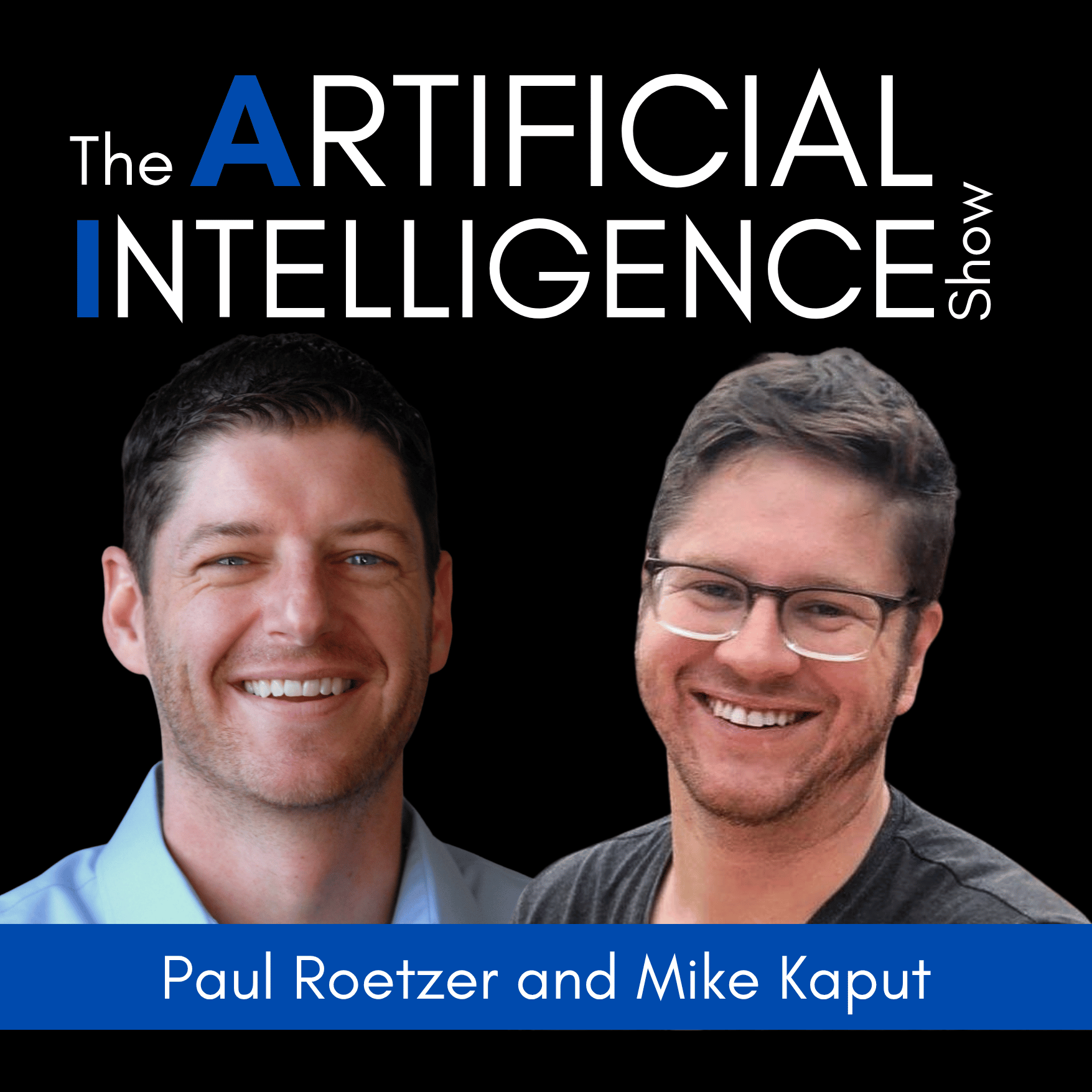
 The Artificial Intelligence Show
15 Oct 2026 · 48m · 22 chapters
Live Q&A from MAICON 2026 on AGI, AI education, enterprise adoption, AI costs/pricing, and what AI should/shouldn’t do.
Paul Reitzer (host; founder/CEO of SmarterX and Marketing AI Institute) and Mike Foote (co-host, filling in for Kathy).
Reitzer is an AI/marketing leader running AI education and workshops; Foote is an event/AI practitioner supporting Gemini-related business workshops.
AGI can be thought of as “B-player” worker performance; adoption in the “messy middle” requires change management and leadership buy-in; AI will generally get cheaper (frontier models cost ~10x less in 12 months) and model choice will be abstracted away by routing; personalization is essential for learning and for how AI communicates.
Claude connected to CRM unlocking thousands of marketing/sales use cases; GPTs being removed forcing teams to retool; GPT/agent “behavior and style” tailoring; using Claude to generate an AI product FAQ in seconds; unemployment policy ideas like universal basic income/high income discussed by Andrew Yang.
Written by AI. May contain mistakes.
Explore the concept of AGI and its comparison to team members.
“So I think tangibly for AGI, the way I think about it is when the model is roughly the equivalent of the B players on your team.”
Discussion of the MAICON 2026 event and keynote highlights.
“Welcome to episode 246 of the Artificial Intelligence Show.”
Sharing standout insights and challenges faced at MAICON 2026.
“Let's record a live podcast while we're sitting here.”
Discussion on the evolving roles in AI and community impact.
“So to kick things off, this first question is for both of us, actually.”
Exploring strategies to keep up with AI without burnout.
“I was interviewing Craig Karmazan at Good Karma Sports this morning on stage.”
How personalized learning paths can enhance AI adoption.
“do not exist on a job board right now that are incredible opportunities.”
Discussion on tailoring AI behavior to individual needs.
“and into your work, you're just insanely productive.”
Learn how to tailor AI tools to fit individual working styles and preferences.
“My point here being that mine is going to look completely opposite to someone like, I would suspect like Ashley who runs our events, who's extremely detail oriented.”
Discover methods for overcoming challenges to AI adoption within organizations.
“Someone asked, AI models can already do impressive work, but in my experience, the blockers are everything around them.”
Explore strategies for creating adaptable AI transformation roadmaps.
“an AI transformation plan or roadmap that you can actually stick to when a new breakthrough could change what's possible next month?”
Understand how to utilize AI as an effective thought partner in business.
“My point here is that it doesn't matter tomorrow if everything about Gemini changes, that concept is really, really important.”
Learn about the expected trends in AI tool pricing as companies evolve.
“so Mike's doing this Gemini, what do we call them?”
Reflect on the ethical considerations of using AI for various tasks.
“Like I said this publicly on the podcast.”
Explore when it's appropriate to rely on AI versus personal effort in work.
“How do you decide what's worth doing yourself even when AI could do it for you?”
Learn the importance of maintaining authenticity while using AI in professional settings.
“It is not to hear my personal opinion or our perspective on something.”
Explore what AGI means and how it can manifest in everyday life.
“Like, what would AGI actually look like in an ordinary person's life?”
Discuss the criteria for evaluating AGI against human performance in various tasks.
“Kevin Roos' new book, The AGI Chronicles, since I just sat through his talk, he actually went through this pretty entertaining thing about feel the AGI and what the hell is it actually?”
Examine the challenges AI poses to employment and potential solutions.
“AI researchers who were thinking about AGI then, today's models, they would be like, this is beyond it.”
Understand the need for governmental action to address the societal impacts of AI.
“So I think that, one, you need the will from the government to want to solve this problem, to accept that there is an emerging problem, to own that problem and to say we are going to proactively look for solutions.”
Discover how AI skills can transfer between jobs and the legal implications involved.
“And that's just lacking from politicians and from AI lab leaders.”
Learn about the implications of AI tool restrictions on employees and job seekers.
“Now, if you're stuck in a, like a neutered version of co-pilot within an enterprise that's turned off all like the most valuable features, you're screwed either way.”
Explore potential replacements for GPTs and their practical applications.
“Now, I want to kind of come back to this because we did talk about it a little bit on the podcast, but it's come up so many times already at Mekon.”

Get the gist, explore an idea or ask about something said.
 Claude
On The Artificial Intelligence Show, what are the key points of this episode?
Searching your listeningAutomatic transcript. May contain errors.
0:00So I think tangibly for AGI, the way I think about it is when the model is roughly the equivalent of the B players on your team. So if we're talking to marketers and you look across a team of people on your staff and you say, OK, like these people do these 20 tasks and I'm going to take Claude Opus 5.5 or 6.1 Astra from OpenAI. and I'm going to give that AI those same 20 tasks. Is it on par with like an average person on your team? Welcome to AI Answers, a special Q &A series from the Artificial Intelligence Show. I'm Paul Reitzer, founder and CEO of SmarterX and Marketing AI Institute. Every time we host our live virtual events and online classes, we get dozens of great questions from business leaders and practitioners who are navigating this fast-moving world of AI.
0:56but we never have enough time to get to all of them. So we created the AI Answers series to address more of these questions and share real-time insights into the topics and challenges professionals like you are facing. Whether you're just starting your AI journey or already putting it to work in your organization, these are the practical insights, use cases, and strategies you need to grow smarter. Let's explore AI together.
1:25Welcome to episode 246 of the Artificial Intelligence Show. I'm your host Paul Reitzer along with my co-host Mike Foote. We are for the second time in history I think sitting at the same table doing this. Is this the second time? I think so. I think the last MECON. So we are live at, well not for you when you're listening to this, but we are recording this live at MECON In 2026, it is October 14th, about three-ish in the afternoon. We just heard an insane keynote from Kevin Roos, who just dropped the AGI Chronicles, a new book you absolutely have to go check out. He literally just left the main stage.
1:59He's going to be signing books here shortly. So my brain is kind of like on overload, Mike. I mean, it's technically day one, I guess, for attendees, but this is day three for us. We did an AI council meeting on Monday, an AI for CMO Summit and workshops yesterday. Yes. And then... Opening night party. We did an opening night party at the Rock Hall, which apparently people shut down the Rock Hall. I don't know if anybody that's here live with us was part of that group, but apparently some of our attendees stayed past their welcome. But it's the Rock Hall, you know, you've got to be a little rebellious.
2:33Yeah, so we are here. It's been a pretty incredible week. But again, it's day one, but it feels like I've been here for at least a week right now. We still have a bunch of amazing talks coming. We have Andrew Yang is actually about to go on stage in an hour or so. I have to leave here and go welcome Andrew to the stage. So yeah, a ton going on, but we figured, hey, what the hell? Let's record a live podcast while we're sitting here. So we are in this amazing new podcast studio. We have overlooking the exhibit hall. And we're going to go through like an AI Answers format, it sounds like, Mike. Yep.
3:04You're filling in for Kathy on the AI Answers. I am. I am. I feel like Kathy needs to sub in here, but yeah, I'll do my best to live up to her. And this is dropping Thursday the 15th, right? It sounds like it is happening tomorrow. Okay. So you're going to be maybe listening to this while we are here at the final day of MAKON 2026. All right. With that, I'm going to stop talking and turn it over to Mike and he'll get a guide us through. Awesome. So thanks, Paul. I'm glad to have everyone in the live audience here that folks can't see at home, but super cool to be here doing this for Macon. Like Paul, you mentioned we're doing AI answers.
3:40And what we've had is our audience submit questions. People are attending Macon, submit questions. Claire and our team did a great job pulling those together. So I took a look at them and selected a handful that I think would be awesome to chat through. And I definitely have not seen these because, honestly, I wasn't even sure what we were doing when I came up here. Yeah. So this is raw. Let's go. All right. So to kick things off, this first question is for both of us, actually. So the question goes, Paul and Mike, what has been the standout insight or concept you've picked up at Macon so far that has challenged your thinking or has confirmed a hunch you have about the direction of AI in the next couple of years?
4:23you're going first i'll go i can go first if you want so so far i have been i would say i've challenged my thinking about what folks need from ai education so i have gotten to sit now in our council meeting with some very advanced uh marketing and ai leaders i've taught a workshop to an incredible audience, but many different levels of AI literacy in the group. And then just hearing how people are approaching AI in their sessions, on stage, hearing where companies are at. I was interviewing Craig Karmazan at Good Karma Sports this morning on stage. CEO. CEO of Good Karma. And hearing just the diversity of journeys makes me challenge a lot of my own thinking about how we as an organization at SmarterX need to be meeting people where they are and how to actually get to bring them along to the next level and what that looks like when it comes to AI education.
5:25So I don't know if I'm overturning anything I thought before, but I'm thinking a lot deeper about, I don't know if it's just a beginner, intermediate, advanced journey. I'm thinking about a lot more nuance, a lot more granularity of what the AI education journey looks like, I think. Interesting. That kind of hurts my brain right now um yeah i don't know like i there's one really cool thing i've seen which is i've had conversations uh at least three of them where it was someone who was here last year who was trying to figure out how to kind of get the transformation going for say their marketing team who is now either in the head of ai transformation for their organization or about to become and so what it's shown me is in these a lot of big companies we talked about this idea of like you just become the change agent, like be the person who's proactive.
6:14And what we're actually starting to hear is it's working. It's like the people, whether you're in marketing or ops or whatever, who just goes and figures this out. Then when everyone else, including the C-suite realizes, we don't know what we're doing, who's doing it. It doesn't matter if you were a marketing associate two years ago. It's like, you're the one that actually knows it. You're now in charge of this and let's go find five other people like you um ty good karma they told that story kind of around ty where it's like he heard craig say hey we're going all in on ai and ty's like all right let's go and all of a sudden ty's like in this role where he's having a massive impact across the organization um so i think that was kind of cool just to like you know every year we come back and we hear these stories about the impact not i don't think about it like the impact we've had it's the impact the community has had where people get together, they collaborate, they get inspired by each other, they go to all these talks and then they leave and they go do something.
7:11And a year later they come back and it's like, yeah, like I'm in this dream job. Like we created this role for me. And so I think it just, it's encouraging because it shows that we really can create these new career paths, you know, as a, as a business world, not saying we smarter X, but we have this ability to, to reimagine like what we can do. And the people who are proactive are going to be on the frontiers of it and have really cool opportunities. Yeah, that's a really good point. It makes me think of several people I've talked to who are just in these roles that frankly do not exist on a job board right now that are incredible opportunities.
7:46Okay, next question. How do you keep up with AI without feeling overwhelmed? How do you do it without burning out? Are there any specific tips or strategies you use? Any boundaries you have to draw to kind to stay sane? Yeah, I mean, I think like for me, I've become pretty disciplined just about my not non-AI time. Like, I definitely spend a lot of like ambient time thinking about AI, scrolling, you know, my AI feed on X is where the vast majority of my information comes from, for better or for worse. But it's like a highly curated list of probably four or 500 people. And so I monitor that all the time.
8:31A lot of times on walks or going to the gym or in the car, I'm listening to podcasts and you just never know when you're going to hear that one episode that triggers something. It's either like, I have to have that person as a speaker at Macon. Like I'm always on the lookout for those kinds of things. Or it's just like reinforcing something that, you know, I'll send a mic and like, we got to talk about this. Like this, it's just time to deal with this big topic. So I feel like part of my like role right now is to try and like connect the dots and just, you know, pay attention all times. But then I don't have any hesitation to be like, I'm just done for today.
9:06Like I'm going to go home and I'm going to like walk up and meet my daughter from school, or I'm going to just spend Saturday with my family and I'm not going to open the computer. And I think I've just gotten at peace with myself that we're so productive all the time. I mean, you and I is a good example. Like when you truly infuse AI into your life and into your work, you're just insanely productive. And I think you have to just accept that sometimes there's, you've made enough of an impact and like, it's okay to, to, to, you know, disconnect for a little while. So I would say it's, it's much more of a mindset and a mental thing than it is like some, here's the exact like workflow I follow to not do a thing it it really is just that mental permission for yourself to be okay like I've learned enough I've done enough now that being said like I'm exhausted last night like I'm you know on my deathbed this morning and I'm still scanning x and putting things in the podcast sandbox like it's just like your your mind like is wired to just what did I miss today what's important to talk about yeah you know I talked with someone last night and this morning about kind of the concept of running your own race, right?
10:14And I try to remind myself of that to avoid feeling overwhelmed. Like someone was telling me this elaborate story really great about how they had changed their career, their business by applying AI to their particular industry. They were seen as like an authority in their field now on it and were teaching around it, speaking around it. And they were like, yeah, but like that's just in my little corner of the world. And this, I won't name any specifics. It was a huge industry. It was like a significant industry. And they were like, oh yeah, but the speakers here are doing this with that. You know, they're using Muse or Instinct or Dots or whatever the flavor of the week is.
10:48And I was like, all that matters is like, did you transform your business, your life, your work? It doesn't, you don't get extra points for how many different types of agents. It's amazing if you're doing that, if you're geeked out about it, use a million of them. But like, I have to remind myself of that too, is like, you don't get extra points for it. You get extra points for the outcomes. And it's like, you're not a header behind if you're getting the outcomes you yeah and i i mean i guess it's some weird way we're like getting into the loss of the year but like mine was the mindset and i think that is like as an entrepreneur i used to deal with this all the time like people like well how many employees do you have what's your revenue run by it's like well i don't know like why don't we talk to each about how we're doing and like what the struggles are like why does it matter like why do we measure my success as an entrepreneur just purely on how many employees i've gotten to hire like but that was the thing it was always this like you felt like someone was trying to compare your ability to grow faster than it's like what do we care like we're both entrepreneurs let's just help each other and i feel like ai is in a similar boat it's like i'm not using muse i haven't connected to all my stuff and so you almost feel like inferior yeah exactly but it's like you don't you don't have to feel that way to your point it's just like but is it helping you is what you're doing making a difference in your business don't worry about what they're doing like go to a talk if you get inspired cool but like i've said that on the podcast before like you're doing all kinds of stuff with agents like i have no idea what you're doing like i wouldn't even know how to do the things you're explaining and like that's cool because that's your thing and like I'm doing my thing and it works out really well right all right this next question uh the listener said I keep coming back to the idea that how we learn is not how we live we can all be taught the same methodology or SOP but how it's applied differs from person to person so with AI how do you get someone from this stage of like I can follow the demo or framework or steps to I can actually figure out how to use this in my own work.
12:35I feel like teaching workshops is like a hundred percent I've been like struggling with. How do you like, you can give someone the plan on paper, even in a company, how does it actually get translated to their work? Like, how do you see that balance? Yeah. This is why I talk a lot about the personalized journeys, like, and not just, Hey, here's 10 courses you should take. And we suggest starting with these five, like that's not personalization. Personalization is like, well, where are you at today with your understanding? What is your like sentiment towards AI? Do you hate it? Like, are you afraid of it taking your job?
13:08And so from an organizational perspective, until we understand where people are really at, it's hard to diagnose or prescribe what a journey should look like for them and how we should adapt to their behaviors, their goals in their careers, things like that. So yeah, I don't know. That's why I think like the personalization becomes so critical and so few organizations are doing it really well right now. But that's like, we're trying to enable that a little bit better, I guess. Kind of related to that. It was funny. I was having a conversation with our friend, Jeff Colleton, who's helping sub in.
13:40He's everywhere in the makeup stage. And it reminds me of just how personalized AI can be because we're both similar in the sense where it's hilarious how bad of detail-oriented people we are. So we both have given Claude and Codex rules about how to talk to us and work with us because otherwise it can be a disaster. And I felt so seen because Jeff was like, yeah, I've got this whole working doc with Quad about all the things I'm bad at. And I was like, so do I, this is great. My point here being that mine is going to look completely opposite to someone like, I would suspect like Ashley who runs our events, who's extremely detail oriented.
14:16So the way you even work with AI, there's no one size fits all is kind of the point. It's so personalized and you have the beauty of, You can now personalize these tools to exactly how your brain works. So it's kind of what they're getting at. It's like the personalized learning journey is getting this hyper personalized to how you work, how you live your life, how you approach your work in your job. It's critical. In my workshop, the AI co-executive, we were building an AI assistant and that was one of the elements. There's like 13 components to it. And one of the items within it was the behavior and style, like tell it how you want it to talk.
14:48And it's a really good point because these things come out with some inherent traits that are given to it by the AI labs. They're trained to be specific way, talk to in a specific way. But increasingly, you can tailor how you want it to communicate. And so some people may need it to be stern with them. It's like, listen, just be super direct with me. And other people are like, you're going to hurt my feelings. Like, just give it to me a little bit softer, like explain it in a different way. Or I like to see it, you know, from a visual perspective versus text. So build it in charts for me. And so I think even that, like the personalization of how we experience the AI systems becomes really important.
15:20For sure. All right, next up. Someone asked, AI models can already do impressive work, but in my experience, the blockers are everything around them. Permissions, usage limits, organizational trust, etc. All these stories I hear are about either a CEO going all in or a small business owner who can accept the risks and move fast and get around some of these organizational challenges. But the question is, what about everyone who's in that messy middle? How do you get capable AI adopted inside an ordinary organization when things like access, budgets, and trusts still have to be worked out? That's like 95 % of people probably.
16:00Yeah, I think this is when we talk about the whole change management idea around this, all of that has to be factored in. So if IT is a blocker, legal is a blocker, procurement is a blocker, HR, you know, whatever, you have to have all those parties at the table. You have to understand what is it going to take to actually get people to drive adoption where they have, you know, a great example we talked about recently is we have Claude and we recently connected it to our CRM system. So until Claude was connected to our CRM, it was dramatically limiting what we could do with it. As soon as we gave permission to do that, it opened up thousands probably of use cases almost immediately for marketing, sales, customer success.
16:40And so that's why I'm just a big believer. It has to be driven from a change management perspective and it has to be driven from the top. You have to have buy-in from the leadership so that if Mike were to come to me or someone else in the other day, say, hey, really, I have this idea. I think it can generate millions of dollars or make this impact on our AI Academy members. But I'm not allowed to do this. IT is not letting me. You have to be able to go to someone who can say, all right, IT, just step aside. This is ridiculous. this is an enormously valuable thing. We have enough guardrails in place.
17:12We have to accept a little bit of risk. We're just going to do this. So for us, we're a small enough entity where obviously it's a CEO driven environment for AI that like you and I can just have a chat, like hang up from the podcast and be like, Hey, we got this idea. We should do this. And I'm like, all right, hold on. I'll message Tracy and tell her. And then Tracy, our COO will contact legal and say, Paul's going to do this. We have like 48 hours. And then legal figures out how to like make it work. I'm very curious about your answer to this next one. How do you make an AI transformation plan or roadmap that you can actually stick to when a new breakthrough could change what's possible next month?
17:54Yeah, I don't know. I mean, I think like, it's kind of like making a staffing decision when the model might be able to do what that person does in a month from now. I think the best we can all do is have some sense of, I used to call these like AGI horizon teams. Like I remember in like 2023, I was talking with a bunch of big SaaS companies and I told them like build an AGI horizons team, like build a team whose job it is to look at the next 12 to 18 months of model advancements and say, here's what we think they're going to be capable of doing. And here's the trickle down of what that means to our staffing, to our product, to the services we offer.
18:27And so I think that that's really the best way to do it is you just have to have some reasonable conviction about what the near-term future looks like by staying close to these model advancements and then have an organization that is flexible based on it. Now, we've all experienced, well, anybody who is building around open AI has experienced this recently. I think the best example is GPTs going away. We were having this conversation in our AI for CMO summit, and I know even during the council meeting on Monday, because there were people in the room who had built their marketing departments around GPTs, spent the last two years running hackathons to build GPTs.
19:04and now we have two months to figure out what do we do? The entire marketing team now runs on GPTs. So that's a good example. And I think maybe we can use that as a retrospective to go back and say, okay, if we weren't ready for that kind of change, what do we have to do now moving forward to be ready for that kind of change? Because they're gonna keep changing the names of the things. They're gonna keep introducing new tools like dots. And maybe it comes down to having evals of like when they make a change, Here's the ways we're using it. How does this new model affect it? What are these new user interfaces?
19:37Like I was talking to somebody last night, one of the parties, who was using sites from OpenAI. And I was like, what is it? Like it came out like a week ago or two weeks ago. I haven't even tried it. And it's just like, instead of asking it to build an HTML file, which is something we commonly do, is like, hey, turn this into an HTML file. You can publish the HTML file and share with people. It's like, oh, OK, well, that's pretty cool. that might change the way we do something. So I don't know, for us, it's about this dynamic learning idea. Like we're just gonna, we're gonna push a lot more into like regular weekly, monthly cadence of what is new in these models and platforms.
20:11What does it mean to us? How does it affect our work? And then we're gonna try and bring that to people through our AI Academy and make it more like real-time learning. Yeah, one thing that was really cool too that I tried to do in my workshop on Google Gemini, but you could apply this to any model is there was a whole segment on using this and approaching this more as a true strategic thought partner and going through like a measured kind of process-driven query or conversation with the tool because so many people just write a few words or don't converse back and forth or don't have a strategic discussion with it with really smart questions and get insights from it the same as they would as like a consultant or advisor or whatever.
20:52My point here is that it doesn't matter tomorrow if everything about Gemini changes, that concept is really, really important. So even focusing also on some of these more evergreen strategies, like our use case model, the problem-based model, innovation model. Which I created in like 2018. And we still teach based on it. It's still extremely relevant. That kind of thing is also really invaluable, I think. Teaching framework. Yeah, and a really good example of this is, so Mike's doing this Gemini, what do we call them? Gemini for business, Gemini for network? Yeah, Gemini for business, yeah. And so last week, Google holds an event like a week, not even a week ago from they were already.
21:28And what do they call it? Gemini. What's the new agent harness thing? It's technically just called Gemini, which if this is confusing to you, join the club. It's like a harness now or something. It's like kind of an agentic harness. Yeah. So they rebranded Gemini as something else. And so that was six days before Mike's workshop or four days before it. So I'm messaging Mike like, hey, you're going to change the workshop based on this. And then during your workshop yesterday, if I'm not mistaken, they released Argon model. The Gemini 4 Argon became like, so it's like even in a real time learning environment, Mike's doing a live workshop.
22:03You have in this four day span, two things that could affect what he's going to teach in the workshop. All right. This next question is fascinating, very relevant, I think, to several people listening. What, if anything, is going to happen to the cost of Claude or ChatGPT or insert whatever tool here? But those two, especially once Anthropic and OpenAI go public and they have to start turning a profit, are we going to see them start jacking up prices? How's that going to work? They can't. The price of the, so the Frontier model today, so take like an Opus 5.5, I think is that, that's probably their most popular.
22:43is Fable. I don't know what Fable version we're on. I think we're on Opus 5. All right, so let's say Opus 5.5 is it. It's been a busy week. It's going to cost 10x less in 12 months. And so at some point, like you're going to say as an organization, like, okay, this model is good enough. Like I said this publicly on the podcast. Like I thought Sonnet 4.6. Like if you told me this is the last model I'm ever going to have, I would have been ecstatic. And I'm like, great. Like we'll just ride with this. We'll build an entire company around this model. And I'm sure that model costs 5x less than it did when it first came out because now they're on whatever sonnet 5 point something.
23:21So I think the the vast majority of use cases for businesses, it's just going to get cheaper as long as you're willing to use the previous state of the art model. And so that's going to the competitive nature of these labs is going to force that to happen. They're not going to just keep making it more expensive. So what they're going to do is they have to sell the more advanced model to the companies that need the really, really advanced reasoning. But the key for them is they actually don't care. They just need to infuse agents and get everyone in companies using these things. So if you think about how, I mean, Anthropic and OpenAI are both going to IPO at somewhere between$1 and$2 trillion.
24:03dollars. And yet when you go around any major enterprise, there are almost zero of them that have full scale adoption of these tools to where everyone is infusing it into their workflow every day. So the amount of untapped market potential for these models is so vast that even if you're paying 10x less per token to do it, you almost have an infinite need for tokens as you expand the use of it across the company. I don't think they care. And plus, openweight models are going to be comparable. So they have to accept that and they have to think about what the business model is going to be. Anthropics IPO is going to be a really interesting look into what really is the business model.
24:47What is sustainable here? What are the moats that these companies have? Somewhat related too. It's been interesting, especially this year at Macon, everyone is obviously using things like muse or grok bot or instinct yeah dots and i realize we're still in the time where the model powering that matters but half the conversation someone's like well grok bot did this or that i don't even know what model grok is on i think they're using opus now i think the model products models the point is i don't know yeah and so it's more like if you it's almost possibly at least at the personal agent level going to kind of get abstracted away where it's like you kind of don't care it's just like my agent works and yeah i'm fairly confident that like this time next year at macon the the average user's experience you will not be choosing your model like i i think they've known for a long time that model choice is basically a developer thing and that if you give this to any director vp at any normal company and say hey here's your copilot here's your 12 models you can choose from when you're writing your emails or building your proposals or doing whatever they're like okay like i'll just use whatever what's turned on to i don't even know like sometimes i'll go into chat gpt and it's like 6.1 sole light medium high like i don't even know the difference anymore so i don't know i think the model choice is just like an artifact of you know four years ago that for some reason they haven't just ripped the band aid off i my guess is i don't know if google's gonna do it first like somebody's gonna do it first where you just don't know what you're using and they're going to route it based on your prompt.
26:23This next question is phrased, how should we be thinking about what AI can do versus what AI should do? So for instance, this is relevant to you, just because AI can write a book doesn't mean it should write a book. How do you decide what's worth doing yourself even when AI could do it for you? Yeah, I don't know that there's like one answer to this. So the writing example is always a good one that I use because like for me, writing is thinking. It's how I process information. It's like when I prepare for the podcast, it's why I actually read every article, listen to every podcast, watch every video myself, because doing the work itself is the whole point of it.
27:03Like my ability to sit here and just answer whatever question you throw is because for like 15 years, I've been studying the field and reading all these things and doing the work. If I'd spent 15 years asking Claude, had it existed, to just summarize everything for me and then spit out some bullet points that I could say and regurgitate to you, like you've lost the point of doing the work. So I think some of it is just like, well, why are you doing the work in the first place? Is the purpose literally just to create an output that's like information gathering? So I think I use the example in my workshop of for AI score, which we just put into public beta this week, I needed to create the product FAQ page.
27:43Nobody cares if like I actually wrote the product FAQ page, like from an authenticity perspective, they're not saying they're saying like, I don't think Paul actually wrote this page. One, my name's not even on it. So you don't even know that I'm the one who created it. Two, the whole purpose of that is to provide information to someone if they have a question about how the product works. It is not to hear my personal opinion or our perspective on something. So in that instance, it's like, that's an obvious use case. It's like, and it's how I did it. I literally went into Claude, my seven month project I've had with it, building AI score and said, take all seven months of context of our work together, developing this technology, take the public facing marketing page that we already created together.
28:25And here's 80 questions the team asked me about how the product works and what things people might turn it into a product FAQ page as though you were writing a best in class like SaaS product FAQ page and make it super approachable tone boom and nailed it like and it in like 10 to 30 seconds wrote something that I wouldn't have been able to write in 10 hours and so I think it's just like getting good at that judgment of when is something fine to just use AI because the expectation is I'm just trying to get information and facts and something from a brand for example, versus I'm reading a book that I'm assuming you wrote, that you put thought into this, like these are actually your words, then the expectation is that it's authentic.
29:09And so, again, there's no perfect answer, but I think it's important that organizations develop these frameworks and teach people on these frameworks, because especially with younger employees, they're not going to have that judgment yet of when is it okay to turn this in. So my boss asked me to come up with a strategic document and I was like, man, Claude's better at writing these than me. So you just have Claude write it and you hand it in. And the boss says, like, come on in, let's talk about this document you just created. Like, I don't agree with these three points. Why did you pick this?
29:35And the person's like, I have no idea. Claude wrote it. Like, I don't know why we picked it. You've lost the point. The point was to do the work. The point was to, like, be able to stand behind something you've submitted. It's funny you mentioned that example. Someone we know who I will leave unnamed was telling me and laughing as they told me a story about how one of their employees did exactly that thing except they didn't even get to the interview question because this person knew immediately this 20 page document was very clearly immediately out of the mouth of Claude and like not touched at all by a human and so they said hey give me five bullet points about these 20 pages and they were like about what and like literally anything in it any single thing and they're like well what do you mean and then they couldn't do it and they're like all right they need you to go redo this and like which page all of them you know so this the point is this stuff is happening already i don't know where that line is but clearly some line needs it has to be established and it has to be part of the culture yes okay next one what does agi artificial general intelligence really look like to the regular person some people say we have agi now but AI still struggles with tons of basic things.
30:51Like, what would AGI actually look like in an ordinary person's life? Like, how would we even know the difference? So going back to how we started this, Kevin Roos' new book, The AGI Chronicles, since I just sat through his talk, he actually went through this pretty entertaining thing about feel the AGI and what the hell is it actually? So feel the AGI is sort of like, OpenAI in particular uses, and he was actually saying that Ilya Sutskiver, who was a co-founder of OpenAI, used to go around to people's desks and just say like Yoda, like feel the AGI. Like, and that was it. And so Kevin interviewed Ilya and he's like, what do you mean when you say feel the AGI?
31:27Like what is AGI and how would we know if we're feeling the AGI? And so he told this hilarious story about like Ilya, who's basically like a philosopher when he answers questions. He's like, oh, you know, it's kind of like when you, you know, you see that, uh, you're zoomed in on earth, like someone on a beach or whatever. And then all of a sudden you're like zoomed out to the universe and you hear Bach playing in the background and and then he like that was the answer and Kevin's like I don't know what the hell that means like what are you talking about so I think tangibly for AGI the way I think about it is when the model is roughly the equivalent of the B players on your team it's kind of like the simplest most tangible I've thought about it recently so if we're talking to marketers and you look across a team of people on your staff and you say, okay, like these people do these 20 tasks and I'm going to take Claude Opus 5.5 or 6.1 Astro from OpenAI.
32:24And I'm going to give that AI those same 20 tasks. Is it on par with like an average person on your team? Under that definition, we had AGI like a year ago. Like there are very few tasks that most of us do where it's not already like b player level in terms of quality which means might need some edits might need a second draft you might need to iterate on the prompts but like it's generally capable of creating the work product that an average person across pretty much any department would create so i don't i mean kevin showed like the different definitions from open ai and anthropic which is like a data center of geniuses is like dario's infamous way of explaining it he showed Google deep mind and it like no one agrees, but that's how I always thought about it is the most tangible is equated to workers.
33:15And it's like, is it on par with your average worker? And then the next level of, you know, artificial super intelligence is, is it better than your best worker? Like, is it pretty much just superhuman? And I'm, I said on stage, I think this morning in my keynote, I'm kind of under the assumption that if you just fast forward 12 months, just assume the model that you've given it the right data that you're you're using the model in an intelligent way like you know how to work with these models the models we're going to have in 12 months are are going to be a player level and beyond it pretty much every task you would do in any department of a company and so like i have a hard time accepting that that isn't agi in terms of what it was originally meant to be like i think if you rewound 10 20 years ago and you gave AI researchers who were thinking about AGI then, today's models, they would be like, this is beyond it.
34:09Like this is so obviously super intelligence. And yet here we are just debating a term that's become basically meaning. Yeah, it seems like that yardstick is just moving too because I even think about going on a walk and using voice mode specifically with codecs. Voice mode alone, but like voice mode with like codecs where my computer back home is creating files, doing stuff for me on the internet people probably say this about personal agents too but like being able to talk and say go do these three things for me do this to that this to this slide deck go send this email it's like hey i'm working on that great okay it's all done what's next like if you sent that recording to somebody 20 years ago they would be like this is in sci-fi movies this way like it it feels like we're basically there and the key there is like you did that for a work product and it nailed it.
35:00But then like two minutes later, you're like, oh no, I forgot to do my taxes. Like, could you go in and like pull everything I need out of these files and, and fill out the PDF for me and have it ready for me when I get home? And, oh, I forgot I was supposed to send an anniversary gift to my wife. Could you like go, how is that not like what we initially thought AGI would be? It's a single system that can now do basically anything you ask it to do okay next question if ai can solve the world's most advanced math problems like it's been recently doing with the millennium prize why can't it solve also the problem of unemployment caused by ai so and this is a big question but obviously we cannot just click a button and solve unemployment but the point here is could ai help us solve problems like this that it might also end up creating i the labs think the answer is yes like the labs believe that if we just get to the end game i call it the end game it might be the beginning of the game but like if we get to the point where we truly have super intelligence then it'll fix all of this so if we go back like five years ago all the big ai labs the cloud companies the tech companies everywhere is going to be like net zero emissions.
36:17And so it was all about like, we're going to save the environment. We're going to like get rid of all the carbon that we're putting out into the world. At some point they're like, wait a second, we actually have to build like 10 ,000 data centers that are actually going to increase emissions, but don't worry about it because we're going to build super intelligence. And then by 2030, it'll actually figure out how to fix all the environmental stuff that we're going to create. And so a lot of what they're doing is truly, it'll figure it out for us once we throw enough compute at it and once it gets good enough.
36:49So the mathematics stuff that it's been solving is in part because you can prove if it's right or not. So there is like an obvious did this work or did this not in terms of having an answer. It's why you can train it in games a lot of times because there's a score. There's like a way to keep track. When you try and solve something messy like what do we do with economic policy and what do we do with jobs, there is no like we can work really hard and throw 100 ,000 GPUs at it for a week and get to the right answer. We don't know what the right answer is. We still actually have to test it and put it out into society and see if it works.
37:24So like Andrew Yang today at the closing keynote, I think he's going to talk about some of the things around like universal basic income or universal high income as one way that we can address the fact that people might not have jobs. That doesn't solve the fact that I also now have no purpose in my life. Like, uh, okay, thanks for my$5 ,000 a month. But like, I still have to go home and look at my family and be like, I don't have, I can't find work for two years. Like, so it's just a really messy thing that, that covers a lot of areas of society. And that's why you have other ideas like universal basic services.
38:03It's like, okay, let's provide healthcare to people too. And so there's a lack of really good ideas that are worth testing other than let's just give people money to be alive. So I think that, one, you need the will from the government to want to solve this problem, to accept that there is an emerging problem, to own that problem and to say we are going to proactively look for solutions. We are not in a current political climate that wants to admit that AI has any impact on jobs at all. um david sachs who's you know kind of a um a voice of the administration unofficially these days just go look at his x feed from the last four months and see how many times he's blasted people for implying that ai will take jobs so it and that is the that is the position largely of the administration so at least in the united states we are unwilling to acknowledge that it could go wrong because it would cost votes.
39:07So it's just like, first you have to have the will to do it. Then you actually have to bring the minds together who are willing to ask the hard questions to start trying to solve it. And that's what worries me is like, we're just, we're not even out of the starting gate doing that. And it's why I wanted Andrew here because he's one of the few people, whether you agree with his position or not, who has actually taken a position of here's something we could try. And that's just lacking from politicians and from AI lab leaders. They're not even offering real ideas. It's just, it'll just be abundant and it'll be awesome.
39:39And we'll see what happens when we get there. Okay. Next up, how, as people progress through their career, how do you see them traveling with AI? Like how much of what they do with AI will they be able to take from position to position? Legally, none. So, I mean, if you think about employment law and the contracts we all sign when we work for organizations, if you create something, that intellectual property belongs to your employer. So if you're an AI forward, you know, director within a company and you build, or you're an orchestrator, like you're building all this stuff, you're devising all these strategies and you build all these agents and, you know, all these workflows and everything.
40:19And you own none of it when you walk out the door. So that's, it's tricky, but that also exists within like, your likeness when you're at that company so i mean we could do this with you and i it's like who owns our likeness to if they wanted to turn it into like avatars like if they decide hey oh mike it was great having you humans but like we're actually going to spin up some digital versions of you guys and people ideas yeah i know we already have the baby versions of us i don't remember this is i'm already i already know this is going to result in something yes Yeah, sorry. But we've addressed this actually in our contracts.
41:00So, you know, again, it's about being AI forward and thinking this stuff through. And this is why you need your attorneys. It's why you need to have AI forward leaders who understand to ask these questions. Yeah, it's messy. But the short answer is nothing. Nothing you create for a company do you own when you leave that company. you know somewhat related to this was a follow-on question here of like have you seen companies consider how to retrain or integrate people who come from a company using different models like is there a big adjustment i've never really totally thought about this but i could see where this is coming from is there a big adjustment for employees coming from a co-pilot shop to claude vice versa etc i don't know i i haven't heard of that i mean i think it would just fall generally under the overall training as a whole.
41:49And my experience has been, and Mike, you can jump in on this one. If you know how to talk to AI assistants, and if you know how to build AI agents, if you're that far along, you can go model the model or AI system, AI system pretty easily. Like it's still prompting the same. Now, if you're stuck in a, like a neutered version of co-pilot within an enterprise that's turned off all like the most valuable features, you're screwed either way. Like it doesn't really matter. And that's the biggest concern. So if I was an AI Ford employee that I was making a move somewhere else, and let's say I was really used to Claude and I was going to have to use Copilot, I would be more interested in like, what am I going to be allowed to do with it?
42:30Do I have a limitation on my tokens? Because once you're used to using these tools as part of your work, that's going to be the biggest problem is if you now go to a company that limits your ability to use these tools. I think it's going to be a lot more of the other way where people who are trying to be the innovators within organizations who are using Claude on their personal account at nights and weekends, they're going to jump ship and go to a company that's going to welcome them in and allow them to use those tools. Yeah, I think that's exactly it. It's less about the nuances of each model most of the time and what you're actually allowed to do versus not allowed to do.
43:05I think for especially some top talent out there is going to become, if not one of the top thing, because we're very close to if you're using these tools and embedded with them day in day out, you can't live without them for one. But two, it's like the reason you're excited about your work. So giving that up is more than just something like a comp consideration or a career. Also, it's like a limiting career move, I would argue with how fast things move. You're hamstringing yourself if you can't do enough, whatever that looks like for you. Yeah. I mean, if I was interviewing for a job, I would say, can you share your AI policy with me or at least like the general frameworks of what's allowed?
43:45Do you have responsible AI principles? How are those kind of taught within the culture? What tools will I have access to? Are there limits? Do you have a connect? I'm looking for a job in marketing. Is your AI connected to your CRM or like, do you guys not do all that off? Those are the things I would be asking as an AI forward practitioner. It's like, I would want to know, am I going to be able to do the job you're asking me to do? All right. We have time for maybe one more question here. Now, I want to kind of come back to this because we did talk about it a little bit on the podcast, but it's come up so many times already at Mekon.
44:19Someone said, I trained people how to create GPTs in chat GPT. Now that GPTs are gone or going away, I don't know what to use now. Instead, Ed, what do you suggest as a replacement? So what they're suggesting are plugins for replacements at GPTs. My experience is that does not work. Like I don't, it was a one-off experience and it was not good. So it's certainly not as intuitive as I think they intended it to be. I think it depends on what your goal with it is. So if it is something you want to publicly share, then you're probably moving more in the direction of something like sites or something.
44:55I don't know. If it's an internal tool that you're going to use as an AI assistant, you might be building it as a skill or a project. If it's a repetitive action, you might be turning it into an agent. Like, I think we're just moving into the realm where it just depends on what the actual usage is. And you're probably going to need to audit any GPTs you built and said, what is it used for? Who uses it? Yeah. And then map it to what is the best thing to turn it into based on what OpenAI is currently offering that they might change in three months. Like, you don't know. Yeah, it's interesting. It's almost like you start to see a decision tree kind of manifest here.
45:35Unfortunately. Yeah, right. It's interesting. When I talk to people, it's like, if you're just using a GPT for yourself and you're not that far along and you just want repeatable instructions, go learn how to build skills and talk with AI about how to do it. That's going to become important in the future. But in the meantime, just put the instructions into a project and use that yourself. It's going to be roughly the same thing. It's not perfect, but it's the closest analog. Skills is the ideally, I think, the path you start moving down and they're not hard to build. They're hard to get right, but that's going to require a lot of iteration anyway.
46:09And then, yeah, if you're getting into you need people publicly to use this, good luck, because that's a huge thing that they pulled the rug out from under you. Maybe it's an app. Maybe it's projects you can share with your team, but then they can also edit the instructions. So it's like you don't want that. Right. So who knows where that is? Yeah, it's like they took a really simple, intuitive thing that anybody could be taught. And we've taught it. Like we ran workshops teaching people who were just starting an AI how to build GPTs. And it's like, oh, this is brilliant. Like, I get it. I see it.
46:37And now it's just like, just blow it up. Like the one thing that was super intuitive. Yeah. Yeah. All right, Paul, that comes to the end of our time, end of our questions. Appreciate you being game to answer all these, especially I'm sure you're getting tons of questions, have tons of speaking to do at Macon, but it's been an awesome event so far. Yeah. Thanks for doing this. Yeah, thanks everyone who's been here. I know we have a bunch of podcast listeners here. We're actually, when this is airing, we're probably going to be in our live lunch that we talked about on the podcast. So we've got a bunch of podcast listeners that joined us.
47:05We're going to do kind of an exclusive lunch Q &A with them tomorrow, which will be today for you all. But yeah, thanks everybody for listening. Thanks for being here if you're here. And if you're not here, we'd love to see you at Mekon 2027, which I would imagine we'll be announcing the dates for if we haven't already. Did we announce the dates? I don't think so. Okay, I won't announce them yet. Yeah, don't do it. I'm pretty sure it's next October though. All right, thanks everyone. Thanks, Paul. Thanks for listening to AI Answers. To keep learning, visit smarterx.ai where you'll find on-demand courses, upcoming classes, and practical resources to guide your AI journey.
47:42And if you've got a question for a future episode, we'd love to hear it. That's it for now. Continue exploring and keep asking great questions about AI.
When will we achieve AGI? Recorded live in the podcast studio at MAICON 2026, this AI Answers episode has Paul Roetzer and Mike Kaput answering questions submitted from our audience.
They dig into what AGI means for everyday work, whether Claude and ChatGPT get more expensive after the IPOs, how to drive adoption when you're not the CEO, what to use now that GPTs are going away, and who owns the AI work you build at your job.
00:00:00 — Intro
00:04:03 What MAICON insight has challenged your thinking about where AI is headed?
00:07:46 How do you keep up with AI without burning out?
00:12:09 How do you go from following a demo to using AI in your own work?
00:15:21 How do you get AI adopted in the messy middle of an organization?
00:17:41 How do you build an AI roadmap you can stick to as models change?
00:22:09 Will Claude and ChatGPT get more expensive after the IPOs?
00:26:23 What can AI do versus what should AI do?
00:30:35 What does AGI actually look like for a regular person?
00:35:25 Can AI solve the unemployment it creates?
00:39:42 Can you take your AI work with you from job to job?
00:41:19 Do you have to readjust when you switch AI models at a new job?
00:44:08 What should you use now that GPTs are going away?
00:46:42 Closing thoughts and a look ahead to MAICON 2027
This week’s episode is brought to you by MAICON, our 7th annual Marketing AI Conference, happening in Cleveland, Oct. 14-16.
For more information on MAICON and to register for this year’s conference, visit www.MAICON.ai.
Show Notes: Access the show notes and show links here
Visit our website
Receive our weekly newsletter
Join our community:
Looking for content and resources?
Register for a free webinar
Come to our next Marketing AI Conference
Enroll in our AI Academy


