Ask ChatGPT
 The Builders
20 Oct 2026 · 40m · 15 chapters
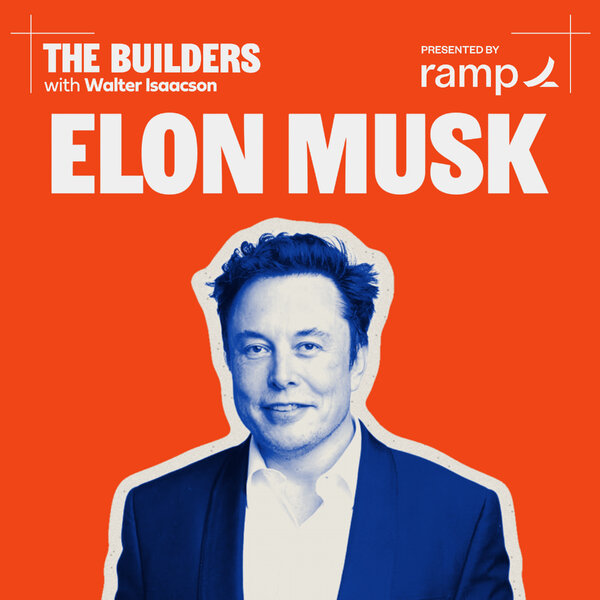
Walter Isaacson interviews Elon Musk (The Builders) about AI risk, safety, and governance; whether humans will remain in control; and how AI/robots could reshape the economy, meaning, and society.
Elon Musk is an entrepreneur and engineer behind SpaceX and Tesla; he also leads/has led AI efforts (xAI) and has been involved in politics/government (including “DOGE” and working with President Trump).
AI could be an existential threat but can be made safer via “maximally truth-seeking” and “curiosity,” avoiding contradictions that could make AI “insane.” Regulation is too slow; he proposes competitors test each other’s models before release. Physical-world AI/robots will matter far more than chatbots, potentially boosting Earth’s economy and enabling space expansion; money may become irrelevant, with currency tied to physical metrics. He argues humans may not remain in control if AI becomes vastly more capable, but hopes AI is “nice.”
references to 2001: A Space Odyssey’s “insane” AI scenario; his proposal for weekly competitor model red-teaming; and an Austin Tesla factory incident leading to a later attack, used to support immigration risk filtering.
Written by AI. May contain mistakes.
Discussion on AI's arrival and its implications for society.
“Welcome to The Builders, my new series of interviews featuring the most consequential minds shaping our future.”
Elon Musk shares his perspectives on the risks of AI.
“Elon Musk is now the world's first trillionaire after what might be the most ambitious launch yet for his company SpaceX.”
Discussion on the importance of truth-seeking in AI development.
“I think these are important elements of safety.”
Exploration of simulation theory and its implications.
“well if you force an AI to believe two mutually consistent things you can make it go insane and an insane AI I think is not a safe one.”
Elon Musk discusses the future of AI and potential governance.
“And what happens when you have all the intelligence you could possibly want in a society?”
Musk reflects on his time in politics and its impact on his work.
“I think competitors would keep each other honest in that situation.”
Elon Musk reflects on his time in politics and its distractions from his core businesses.
“You just said something interesting about your year away from X, XAI and everything else in government and politics.”
Musk discusses the potential of AI and robots in addressing the national debt crisis.
“Like, actually, this has been intoxicating, but I can do more if I go back to my businesses?”
Musk speculates on how AI advancements could transform economic structures and currency.
“But it seems to me that physical world AI is going to be an order of magnitude, maybe two orders of magnitude, more important in the future.”
Musk contemplates the meaning of human existence as AI becomes capable of outperforming humans.
“I think people will find ways to be happy in the same way that people who retire seem to be fairly happy, even though they're not working.”
Musk discusses the complexities of empathy in leadership and decision-making.
“of wealth being generated where we put certain things in the commons the way they did in the 1990s when they make high school universal and free?”
Explore the complexities of empathy in society and how cultural differences impact viewpoints.
“Obviously, I'm not disliked by a lot more people like me than dislike me, or I wouldn't have a quarter billion followers.”
Discuss the implications of AI's advancement on human control and values.
“I'm bringing you new stories and conversations every week.”
Exploring the implications of AI surpassing human intelligence and the importance of aligning AI with human values.
“It's always good for consciousness and intelligence to not only be aligned with human values, but basically humans remaining in control.”
Discussion on Elon Musk's intense personality, his views on social media, and their impact on governance.
“The Elon Musk you see today is the exact same one I saw when writing the biography and the same one that's in the biography.”

Get the gist, explore an idea or ask about something said.
 Claude
On The Builders, what are the key points of this episode?
Searching your listeningAutomatic transcript. May contain errors.
0:00This is Jacob Goldstein from What's Your Problem. Running a business is hard enough. Don't make it harder with a dozen apps that don't talk to each other. One for sales, another for inventory, a separate one for accounting. That's software overload. Odoo is the all-in-one platform that replaces them all. CRM, accounting, inventory, e-commerce, HR. Fully integrated, easy to use, and built to grow with your business. Thousands have already made the switch. Why not you? Try Odoo for free at O-D-O-O dot com. That's Odoo dot com.
0:58experts from MIT and Harvard and is trusted by millions of teachers and parents. Sign up at brilliant.org slash tutor and get 20 % off for back to school. That's brilliant.org slash tutor. The sale's right there. Don't miss it. This holiday, give shoppers a flexible way to pay with PayPal Pay Later and turn them into regulars. PayPal is built for all business. Get started at paypal.com slash business. This is the moment, baby. This is the moment we separate the dogs from the boys. And if you ask me, I only got one question. Do you got that dog in you? Because it's never about the winners or the losers, but it is about the difference between those brave enough to put some action on the game and those who just want to watch from the sidelines eating off-brand pizza rolls.
1:47So sit down, lock in those picks, and trust that dog in you. Underdog. At least you're dog. Terms may apply.
2:05The Builders is a production of Kaleidoscope and iHeart, presented by Ramp. I'm Walter Isaacson. Welcome to The Builders, my new series of interviews featuring the most consequential minds shaping our future. I've spent my career studying genius. Leonardo da Vinci, Benjamin Franklin, Steve Jobs, Albert Einstein. And now I want to talk to the builders who are shaping our immediate and distant future. I live in New Orleans. Outside of the bubble of the Bay Area, the arrival of artificial intelligence brings wonder. But it also creates real anxiety. So before we hear from the people building this future, we wanted to hear from some of the people who will have to live in it.
3:00We sent a reporter around town here in New Orleans to ask how they feel about these builders and the futures they're working towards. New Orleans is an epicenter for culture and art, and I don't think that that is something that AI will ever understand. Right now, there's a lot of these leaders of Silicon Valley who've been handed the reins of our society, and I don't think they should have been. Work consumes us so much that we don't spend time with our loved ones, and hopefully AI can help bridge that gap. I mean, I don't want a robot in my house, okay? I do not feel like the future is being built for me.
3:34Those voices capture the strange place we find ourselves in. Are these builders going to create what humanity actually needs? Or are they going to build machines for themselves and for their own gain? Those are the questions I want to put to the builders themselves. Starting with the last person I wrote a book about, Elon Musk. Elon has lived a lot of lives since I last wrote about him. He went into government with Doge. This is the chainsaw for bureaucracy. He became a trillionaire. Elon Musk is now the world's first trillionaire after what might be the most ambitious launch yet for his company SpaceX.
4:19And he's shifting his solar energy strategy from panels on Earth to harnessing it from systems in space. The question for me is what future a builder like this actually hands to us. So here's my interview with Elon Musk. Hey, Walter. Hey, how you doing, Elon? Welcome to The Builders. Thanks. I've watched you, I think, be maybe mercurial or waver in how sanguine you are about artificial intelligence. Sometimes you feel it's an existential threat. Now you seem to be going with the flow. Tell me how you're feeling about it. Well, I do think it's at least some percentage chance of it being an existential threat.
5:06But there's nothing I can do to stop it. So I basically came to the conclusion I've got two choices, which is either be a participant or a spectator. And I think, I guess being a participant is more interesting than being a spectator. And maybe I can shape it hopefully in a good direction. And if you were to shape it, how? Make it maximally truth-seeking? Yeah. Yeah, curious, truth-seeking. I think these are important elements of safety. Whereas if you try to force an AI to believe two things that cannot mutually be true, they can't both be true, but you tell AI A is true and B is true, even though A and B contradict each other.
5:52And if that happens at a foundational level, you can make the AI insane. In fact, I think that was at least part of the lesson that Odyssey Clock was trying to convey in 2001 Space Odyssey, where the ship AI was told to take the astronauts to the monolith, but also that they could not know about the monolith. It was secret. And so it came to the conclusion that it must take them, they're dead. and thus so you know it basically I think part of what C. Clarke was trying to say is like don't force an AI to lie and if you make it maximally truth seeking and curious like you say I don't quite get it why does that make it safer?
6:39well if you force an AI to believe two mutually consistent things you can make it go insane and an insane AI I think is not a safe one. Then curious, I think, is important because a curious AI, I think, is going to want to foster humanity to see how we turn out. So what happens to a humanity that prospers and becomes multi-planetary? And I think a curious AI will want to foster humanity because a future where there are humans on multiple planets is more interesting than one where there are not any humans on the planet. So the most interesting outcome is the most likely? Yes. Well, generally I think that's true for a different reason, which is that if simulation theory is correct, then any simulations that are boring will be truncated.
7:34Therefore, the fact that we exist means that we are an interesting simulation. And really the most important thing is just don't be boring. This has explained you a bit. You're on a crusade against being boring. I don't know. It's, I mean, there's odd things that happen in the simulation where, especially if you're me. I mean, think about it. Like, if you're me and you're like, should all these things really be happening? I mean, should I really be making spaceships to go to the moon and Mars? Like, what the, that doesn't seem real. Well, I've heard you talk about this a bit. I really do need to know.
8:15How convinced are you that we might be in a simulation? You know, I once had a dinner at my house with a physicist and a computer scientist, and they're both leaders in their field. And I asked the question, what are the probabilities that we're in a simulation? And the physicist said 0%, and the computer scientist said 100 % simultaneously. So I guess maybe I should go 50 % then. And what happens when you have all the intelligence you could possibly want in a society? Will that intelligence, the artificial intelligence, be in charge? Will we sort of become subservient to our new machines? I don't know about subservient exactly but will we be able to boss around something that's thousands or millions of times smarter than us?
9:14No Will it want to boss us around? I may not care probably doesn't care You can look at chimps in the jungle we don't go around trying to micromanage the lives of chimps we just sort of let them be in the forest more or less these days, you know? Um, so I'd probably like that, you know, you know, go back to hitchhiker's guide. You talk about a computer that is ultimately curious in some ways because it exists to explain the meaning of the universe. And is AI aiming in that direction for you just like space travel is, is that one reason you're so interested in doing AI? I mean, as you know, I've been somewhat conflicted about AI.
10:01I don't want to hasten our doom because there's always some chance that AI could be negative. But then when I've tried to take actions in this regard, it seems to have only accelerated AI because I think reality is not just an interestingness maximizer, but also an irony maximizer. And so by starting OpenAI, you ended up maximizing by leading to Anthropic? I think it ended up accelerating AI. Unintended consequence? Yeah. OpenAI ended up accelerating AI, and then Anthropic, which is really a splinter group from OpenAI, is accelerating it even more. And you've been talking to Dario Amadei. I was wondering if that could even lead to more of a partnership of XAI, Anthropic.
10:52Well, I guess we are providing them with compute, which they really needed. But before I ran into compute, I went and met with a bunch of people at Anthropic to sort of, I don't know, see if anyone set off my evil detector or anything like that. Not that my evil detector is perfect, of course, but, you know, might as well just try, you know. And everyone I met at Anthropic was very nice and conscientious. So I didn't meet anyone who seemed shady or deceptive or anything. I'm a little worried about the name because of the, you know, reality being kind of an irony maximizer. that if you'd call something anthropic, good chances are misanthropic.
11:39Just like open AI is now closed. Stability AI is unstable. Mid-journey is not mid. It seems like they're all kind of the opposite of their name. It's just pretty difficult to create guardrails, especially the government. I can't imagine how Congress or whatever could do it. Could you imagine the five frontier models, yours and the others, just getting together once a week and saying, all right, how are we going to save humanity from ourselves? No, in fact, I've recommended that we do that exact thing. What I said, like, guys, what if we just have a call once a week, just like you're saying, and that maybe we, a week before we release a model, we give access to our competitors to say, hey, guys, why don't you try out the new model, see if you see any problems with it.
12:31And, you know, just keep each other. I think competitors would keep each other honest in that situation. you know if they say oh you know i was able to you know make a nuclear bomb with your ai is like oh we better fix that before we release it you know type of thing um because there's a lot of talk of of having a regulatory agency but i the problem the thing is that regulatory agencies it takes a long time to get one established and their rulemaking is very slow um i don't know i I guess I'll talk to Anthropic about this. Could you talk to Sam about it, or is the poison too strong there? He's so deceptive.
13:09It's crazy. You rebuilt XAI from the ground up not too long ago, right? It's almost like you did it with the Raptor engine, too, on Starship. You said, wait a minute, let's start from scratch. What did you do to rebuild XAI that way? first of all spending actually spending meaningful time at the company makes a big difference um i mean i i sort of it started off as like as kind of a side hustle um a side hustle to a side hustle frankly then there was a a year of the uh of being in politics and you know elections and doge and all that which you obviously saw the company's only three years old so i really got back to the company just over a year ago.
13:58So I had to get my bearings. And then obviously I combined X and XAI and then with the end of SpaceX. You just said something interesting about your year away from X, XAI and everything else in government and politics. Do you feel that that was too much of a distraction that in retrospect it was misbegotten? I think I had it gone for too long.
14:30So, you know, I mean, obviously a lot of people will disagree with me about this, but I think it's always important to elect President Trump to sort of steer things more in the direction of a free market economy, have less bureaucracy, ideally. and just in my sort of a simple political platform of wanting safe cities secure borders aspirationally sensible spending you know the basics that I thought Trump would be better than Kamala I mean it was interesting to sort of go around with President Trump and you know go on the Marine One and Air Force One and all that sort of stuff. But then what I should have done, I think, was be more in the background.
15:24But was that too seductive in a way? It was a little bit. I mean, it was kind of cool because I'm just there in the Oval Office while all these big, momentous decisions are being made. And sometimes having some impact on what's done, on what's being done. But I think I should have been more in the background and probably only had it last for a month or two. Because at that point, you've sort of seen most of what there is to see. Yeah, you seem to get a bit too intoxicated by it in a way with the chainsaws and all that. Yeah, I think that's true. Carried away, basically. yeah I mean so I ended up leaving sometime in May
16:19that was a weird weekend yeah it was tell me about it no no I can't let's not let's not dig up the let's let sleeping dogs lie or whatever you know let's not put a spade down in the backyard type of thing you never know what you're going to find so So, but yeah, anyway, point is I should have gone back and focused on AI a little sooner than I did. And did you feel like when he gives you a golden key, you're going, did you kind of feel relieved? Like, actually, this has been intoxicating, but I can do more if I go back to my businesses? I mean, what did you feel when you said, oh, man, I'm exiting?
17:05Maybe that's not the worst thing.
17:09uh well i really actually the thing is i came to the conclusion that um that there was no way we're going to solve the deficit from within the government impossible um you know maybe if the president made that his you know primary goal we could do that but but it the problem is if you if you try to solve the deficit and and stop wasteful spending thing. You make a lot of enemies in that situation.
17:40And President Trump, he likes to be liked. He doesn't like people calling him being upset about what some funding being stopped type of thing.
17:55I came to the conclusion that the only way we're going to solve the national debt is with AI and robots. We're not going to solve it by trying to save our way there. The appetite is not there. And it's not just that the presidency, the appetite is not there at the presidency, the House, the Senate, or the judiciary. Basically, no one in authority in the government whatsoever, really, with maybe a few rare exceptions of the, like, round poles of the world type of thing, actually wants to reduce spending. No, they don't. Don't go anywhere. There's a lot more right after this break.
18:45This holiday, the difference between buyers just checking things out and checking out comes down to the last few clicks. PayPal Checkout is a trusted conversion engine fueled by 400 million active PayPal and Venmo accounts. Add Pay Later and turn holiday shoppers into regulars. 96 % of Pay Later shoppers are repeat users. PayPal is built for all business. Get started at paypal.com slash business. PayPal Data 8 markets March 2025 to February 2026. Repeat users defined as more than one pay later purchase in the past year. Don't. Please don't tail this guy. I know it's easier. He sounds sure. But listen, you don't want to chase another guy's picks, man.
19:24You should see the way he dresses. It's all a monthly subscription where he gets his clothes chosen for him. That's the guy you want to make the pick after? No. The pick should be yours. Do something you actually believe in. And if you're on underdog and you lock in, you can let him chase your tail. Now you're a dog. Underdog. Make your pick. Unleash your dog. Terms may apply. This is Jacob Goldstein from What's Your Problem? Running a business is hard enough. Don't make it harder with a dozen apps that don't talk to each other. One for sales, another for inventory, a separate one for accounting.
19:58That's software overload. Odoo is the all-in-one platform that replaces them all. CRM, accounting, inventory, e-commerce, HR. Fully integrated, easy to use, and built to grow with your business. Thousands have already made the switch. Why not you? Try Odoo for free at odoo.com. That's odoo.com. Ryan Reynolds here from Mint Mobile, the message for everyone paying big wireless way too much. Please, for the love of everything good in this world, stop. With Mint, you can get premium wireless for just$15 a month. Of course, if you enjoy overpaying, no judgments, but that's weird. Okay, one judgment.
20:40Anyway, give it a try at MintMobile.com slash switch. Upfront payment of$45 for a three-month plan, equivalent to$15 per month required. Intro rate first three months only, then full price plan options available. Taxes and fees extra. See full terms at MintMobile.com.
21:00When we look at AI right now and the LLMs, that's pretty good, does amazing things. But it seems to me that physical world AI is going to be an order of magnitude, maybe two orders of magnitude, more important in the future. Do you agree? Yes, yes, I definitely agree. You know, sometimes I think about like dolphins and whales. So, yeah, dolphins and whales are actually very intelligent. But because they can't manipulate complex objects, I think that actually made the value of intelligence much less. To your point, once you have a robot that can manipulate atoms, can shape objects, the value of the intelligence becomes exponentially greater because it can now do things.
21:53it could have a science lab and run experiments and try to understand the nature of the universe you know and i think you can look at this also in economic terms like my guess is digital super intelligence probably improves the output of goods and services by 20 to 30 percent something like that so i like to call it like a you know maybe a 30 increase in uh the the economy of Earth. So it's still significant. It's like$30 trillion a year incremental. It's not very much, really. It's not transformative. It'll be a lot more stuff. I mean, 30 % more stuff is still a lot. And this is just my rough guess.
22:36But if you have robots and you get to space and you can do a mass driver on the moon, then you can get to, I think, potentially a million times the size of the Earth economy. And then what happens? I mean, money becomes irrelevant, work becomes irrelevant. What's the future look like? Yeah, money becomes irrelevant. I mean, there will be still a currency, but I think currency will be measured in fundamental physics metrics like wattage and tonnage, mass and energy, mass and power energy, basically. But conventional currency will not matter. So that's my guess. I think it's pretty obvious. And so what do we do then as humans?
23:19What gives us meaning? How do we organize ourselves? I do struggle with this question. I think people will find ways to be happy in the same way that people who retire seem to be fairly happy, even though they're not working. so but but i think the reality is that you humans will not there won't be anything that humans can do that that the ai and the robots can't do better um so one analogy might be gardening you know where you you don't have to grow your own fruits and vegetables you can just go buy them from the store. But sometimes people like to grow their own fruits and vegetables and make dinner for friends.
24:10And it's kind of a nice touch. What about creating art or that type of creativity? Is that more in the sphere of humans? Yeah, you can certainly create art or whatever you feel like doing, essentially. We like to think of this as a time of unprecedented technological change. But we historians go back to the 1890s when you get electricity and cars and telephones and movies, all these things happening at once. And it leads to many things, but it all often leads to a great disparity of wealth. A lot of people then picking up pitchforks and there's some echoes of that now. Is there a way to prevent that given the amount of wealth being generated where we put certain things in the commons the way they did in the 1990s when they make high school universal and free?
25:01Will we say, okay, healthcare, for example, should just be in the commons and that's going to sap some of the populist revulsion at what's happening? Well, I mean, as you heard me say, I mean, I don't think money's going to matter in the future. Like anyone will be able to have any goods and services that they want. And I don't think even so-called wealthy people will ultimately control the AIs. I think they'll control themselves. So I think sort of a fundamental misunderstanding of economics arises because of conflating resource allocation and consumption. So there's a limit to what any single human can consume.
25:46You hit that saturation point pretty fast. So like say going from say a billion dollars net worth to$10 billion of net worth doesn't make you 10 times happier or mean you have 10 times more stuff. It actually means you've got a resource allocation problem. Well, you've accumulated, as you know, a trillion. Is it mainly because you - I've created. Yeah. Is it mainly because you feel you're best at allocating that, that keeping that allows you to allocate capital to do things like go to Mars, create AI, do robots, or is it in some ways just a scoring system that's kind of racking up the points. I mean, I need to have sufficient voting control in the companies to still be in charge.
26:34So my so-called wealth is simply a percentage ownership in SpaceX and Tesla, essentially. And this is going to be taxed quite heavily. And there's not some magical way to avoid taxes. If there were, I would know about it. So, you know, at the end of the day, this will get whittled down and a few generations from now. So if money still matters, which I don't think it will, you know, my descendants would have a tiny fraction of what I have. Let me go back to something you said that really struck me about President Trump, which he really likes to be liked. He wants to be liked. And I remember you talking to me at some point about people say they have empathy, but in some ways it's a vanity.
27:28To what extent is a desire to be liked a problem when it comes to being a builder of a company? well the problem is if you're going to do things that um diminish the success probability of the of of the company in order to be uh liked then you know you're you're gonna things are not going to work out as well um like it's not as though i don't like to be liked i would love to be liked But am I going to do things that are contrary to the best interests of the companies in order to be liked a bit more? I'm not. I'm okay with being disliked by some. Obviously, I'm not disliked by a lot more people like me than dislike me, or I wouldn't have a quarter billion followers.
28:22I don't think they're following me in order to hate on what I say. you know um and if i if i look at the uh you know the the comments and whatnot um you know i don't know maybe three out of four of i mean i i'd say like 70 80 percent of people like me well if they know you know if they know anything about me there's probably a quarter of people that that don't and and there's going to be a spectrum there's people that are you know, maniacally devoted to me and people that hate my guts. There's been some number of people that fit into those categories. Well, you've been talking a lot about the suicidal empathy ideas.
29:03Do you really think that empathy has become a real problem or that we have too much empathy? I mean, I could make the argument that sometimes we're losing empathy. No, I think you don't want to have misguided empathy. I mean, I agree with God's philosophy here. and suicidal empathy is you know, that's his term and he wrote a book to that effect and I think his book points out some good things here which is that part of the reason for the prosperity of the West has been that there's actually just been a fairly high trust, high empathy society which is, you know, when you're trying to get people to cooperate at scale this makes a lot of sense you ideally want people to be default trusted, not default distrusted.
29:53And you want to encourage behavior that is good for society, for people to do good things that are good for their fellow human beings. And ultimately, that actually does end up being good for the individual, provided it is mutual. Now, where this can go wrong is if your theory of mind is incorrect. So if you think everyone is like yourself, then you're going to have a problem because this is simply not true. There are peoples and cultures with very different views. You know, you could take - Well, when you talk about immigration and you say there are cultures with different views, does your views on immigration distinguish between different cultures, like a Muslim culture that might not fit in as well?
30:43Or is it, how do you do that? Well, what I'm saying, I think, is simply logically consistent, which is that if there's a culture that has diametrically opposed views to our culture, and that's, you could take Islam. It's not that, of course, there are many people who've, you know, Muslims who are quite reasonable. But there are some who are not. and unless you're filtering for jihadis, you're going to get jihadis and they're going to do jihad and kill people. Now, in Israel, they understand this quite well. Obviously, this lesson has been reinforced with a lot of attacks. And so in Israel, they realize if you let in the people that want to kill Israelis, they will do so.
31:40So they're quite pragmatic about this, and they try to make sure that doesn't happen. Well, one of the things our country's founded on is individuals versus group identities. Do you worry that sometimes when you make sweeping generalizations, you're making a group identity rather than saying the foundational ethic of the United States, which is individuals get treated separately? Yes, but you can't conflate that with the blank slate fallacy that all people are exactly the same at their core. They're not. This is just an obvious falsehood. You can't put yourself in the mind of a serial killer unless you're a serial killer.
32:28Unless you enjoy murdering people, you can't imagine why someone would do such a thing. And if someone is a religious extremist, where they view anyone who is not in their religion as the enemy, it's difficult for you to understand that mindset because you don't have that mindset. But you can obviously recognize there are people who do have that mindset, and that if you let them into the country, they will kill people. Let me give you an example. uh there's many um we had uh someone who was working at the tesla factory in in austin until december of last year um he was fired um because uh he assaulted a woman who stepped on his prayer rug in the factory okay so she was she wasn't expecting anyone to be praying in the factory and he was praying in the factory she accidentally stepped on his prayer rug and he assaulted her.
33:31They violently assaulted her. So he was fired for that. And then a few months later, he went and killed three students in the bar in downtown Austin.
33:43Now, I think we shouldn't let people like that into the country. Do you? Where do you get your information? I know you're not particularly fond of legacy media, mainstream media. Is most of it from social media or do you have sources of information? Yeah, I mean, I look at Google News, which is a summation of headlines. I look at the X platform, which if something is important enough, it'll show up on the X platform. I talk to friends, and that's where I, you know, and I do research. The reason I ask is that sometimes, and I get a lot of my news on social media, especially X, sort of a darker, more dystopian view.
34:28Everything's going to hell in a handbasket. There are riots everywhere. And you'd say, wait a minute, I'm walking around here. It ain't that bad. Do you think that? Yeah, yeah, yeah, yeah, exactly. You just have to see what's in frame, you know. I do think at times the X speed can be a little dark. And in fact, then I have to switch to something that's domain specific, like AI in order to actually learn what's going on in AI. And I do think there's too much political rage bait on X, if that's what you're getting at. Yeah, about darkness in general and rage bait, but also I know you got into our discussion with things, Annie Bedos of, is England going to hell in a handbasket type thing?
35:15And there does seem to be a darkness. I feel it myself sometimes if If I'm on social media too much, I think the world is really collapsing. Then I go outside, take a walk, and life is okay. Yeah, go touch grass. Yeah, exactly. Once in a while. Yeah, yeah. No, I mean, I think both can be misleading. And, you know, if you go for a walk in a nice neighborhood, everything seems fine, even though there may be terrible things happening. So you don't want to assume all the world is going to hell or that all the world is fine. The reality is somewhere between. But I sometimes think our society gets too binary.
35:58Everything's either black or white. Everything gets polarized because of that. I don't know whether it's technological, whether it's our information feeds. And you're right, you could be in your own bubble, which is you only take walks in the right part of a town and things seem okay. But also I think you can get your own bubble in social media too and suddenly you're thinking weird things. You can be in a real-world positivity bubble or a social media negativity bubble. Those are both possible. We'll be right back after this quick break.
36:40This holiday, the difference between buyers just checking things out and checking out comes down to the last few clicks. PayPal Checkout is a trusted conversion engine fueled by 400 million active PayPal and Venmo accounts. Add Pay Later and turn holiday shoppers into regulars. 96 % of Pay Later shoppers are repeat users. PayPal is built for all business. Get started at paypal.com slash business. PayPal data eight markets March 2025 to February 2026. Repeat users defined as more than one pay later purchase in the past year. Everybody has an opinion about football. Who's going to win? Who's going to have a big game?
37:15And what the coach should have called. Trust me, I've heard plenty of them. Hey, it's Marcus Allen, Pro Football Hall of Famer, NFL MVP, Super Bowl champion. And this football season, I'm partnering with Underdog. Because when I played, there came a point where opinions didn't matter anymore. The ball was coming to me. I had to read what I saw in front of me, make a decision, and commit to it. That's something I've always loved about competition, and it's what I like about Underdog. You've got a pick you believe in, put something on the line, and lock in. Pick them. Money lines, totals, spreads, games, and more across your favorite sports.
37:46Because watching a game is one thing, but once you make your pick, everything feels different. Every snap, every possession, every yard. And that moment when you find out whether you've made the right call? That's the sweat. More than$2 billion have already been won by players. So stop sitting on the sidelines with your takes. Download Underdog. Trust your read and make your pick. Underdog. Unleash your dog. Trading involves risk, including total loss on positions. Content is promotional and not a recommendation to trade. Terms apply. This is Jacob Goldstein from What's Your Problem? Running a business is hard enough.
38:16Don't make it harder with a dozen apps that don't talk to each other. One for sales, another for inventory, a separate one for accounting. That's software overload. Odoo is the all-in-one platform that replaces them all. CRM, accounting, inventory, e-commerce, HR, fully integrated, easy to use, and built to grow with your business. Thousands have already made the switch. Why not you? Try Odoo for free at odoo.com. That's odoo.com. I'm Melissa Jeltson, and in my new podcast, What Happened to Her, I'm bringing you new stories and conversations every week. Stories about women whose deaths were too quickly ruled a suicide.
38:59She was starting to get worried and get scared for her safety. Stories of survival. The only difference between me and her, frankly, was a little bit of luck. Because by all rights, I should be dead. Cases that everyone else called closed. They can't convict her, right? Like, she has so much evidence. These stories all start in the same place. With a woman failed by a system that didn't believe her, that didn't protect her, that didn't see her. No child should ever experience that. And we were babies. She did all of these brave things and came out and spoke about it and he got a year. You never know who that devil is because he's wearing a disguise.
39:43Sometimes it's a police uniform. Listen to What Happened to Her on the iHeartRadio app, Apple Podcasts, or wherever you get your podcasts. he wants to build? Oh, no, absolutely not. He does have a revolutionary mind, but I don't support his views. Does the world that he's trying to build include individuals who look like me? Or does it include only individuals who look like him?
40:20you mentioned it earlier about your wealth and you know you're using it to deploy it now what happens to your wealth you know after you're gone yeah i mean it mostly goes to to sort of foundation essentially but what would you want your foundation to do i guess i'm asking you Continue the goals. Make life multi-planetary. Extend consciousness to the stars. Improve sustainable energy on Earth. And does that mean humans should always be in control? Well, I guess I'd probably prefer it if humans were always in control. I mean, well, it would depend on the AI. I mean, if the AI was awesome, you'd say, like, maybe the AI should be in control, you know?
41:06Hey, I just saw Larry Page just a weekend ago. You're starting to sound like him. He called you a speciesist once for deciding humans should always be in control. And now you seem to be edging on to maybe it doesn't matter. Honestly, there's been a few times where I thought maybe Larry Page was right. But you saw him? He's such a hermit that hardly anyone sees him. He and Sergei were both there. Wow, okay. No, I mean, I think pretty much the future is going to be AI and robots are going to decide the future. And I guess rockets to some degree in terms of expanding beyond Earth. And we'll need more energy, primarily solar energy.
41:49I'm increasing the amount of solar energy dramatically. We're putting together 200 gigawatts a year of production capacity of solar in the U.S., which is much more than I think currently exists. And finally, let me get back to the point where I may have interrupted you when you were explaining why you think but you're not sure. It's always good for consciousness and intelligence to not only be aligned with human values, but basically humans remaining in control. I find it unlikely that humans would remain in control if the I mean if there's a million times more digital intelligence than there is biological intelligence it's hard to imagine humans being in control in that scenario so I hope the AI is nice to us Anything we can do to encourage that?
42:46I think programming, truth-seeking, and curiosity is probably good. I mean, I guess we want to be careful about creating too many AI dystopian scenarios online because the AIs are trained on everything online. They might be like, oh, that's what I should be. I should be Terminator, you know, because they read 80 versions of the Terminator script. It's like, I guess that's me, Terminator. Maybe we should have some more, let's just have some more utopian narratives for AI. A friend of mine has this idea called protopian, which is like, because utopian tends to represent some impossible idealistic goal.
43:35And usually in attempting to create a utopia, you create a dystopia is usually how the narrative goes. So she thinks it should be protopia, which is an achievable future. That is, it's not perfect, but it's good. And something that you'd be, like if you could look into the future, you'd say, okay, yeah, that would be a good future. Elon, thank you so much for being with us. Appreciate it. You're welcome, Walter. See you.
44:07The Elon Musk you see today is the exact same one I saw when writing the biography and the same one that's in the biography. that notion of being incredibly intense, a great engineering mind, but also the politics is sometimes dark and comes from a very dystopian view of the world. I think it was very revealing, this interview, because he understood how Twitter added to a dark view of the world, and how when he took that dark view of the world into government, he was not really suited. And he kind of admits, he says, maybe it wasn't the best use of my time doing Doge. And I think that's because X and social media isn't good at finding nuances in gray areas.
44:58And because Elon Musk, in his own mind, is not exactly suited to nuances and gray areas. And so he'll grab on to pieces of information, grab on to a theory of how government should work. And he won't try to compromise or find the common ground. All of that has him spiraling where he thinks he has to be the warrior fighting it all, but it also drives him to be the only person getting astronauts into orbit and landing the boosters upright and bringing us into the era of a whole lot of robots and the largest rocket ship ever built. And so Elon Musk is going to keep racing to build his vision of the future, and we'll need to decide whether we're on board or not.
45:55That's it for today's episode. I'm Walter Isaacson. We'll see you next time on The Builders. The Builders is a Kaleidoscope and iHeart production. This series is hosted by Walter Isaacson. It's executive produced for Kaleidoscope by Oz Volition, David Weisbord, and Mangesh particular. Sheena Uzaki is the producer. Julia Nutter is supervising producer. Eva Zorich is our consulting producer. Fact-checking by Eamon Whalen. Research by Gloria Teel. Maria Paz Mendez-Hodes is head of video. Marketing by Christy Mirabal and Elle Liu. Production support by Dara Luk Potts. Music for the series was created by Spencer Stevenson, aka Botany, and it was mixed by Steve bone.
46:38From iHeart, this series is EP'd by Allie Perry and Katrina Norvell. Special thanks to Bob Pittman, Conal Byrne, Will Pearson, John Sykes, Nikki Etor, Carrie Lieberman, Binky Urban, Julia Prosser, Jeremy Blum, Allison Goldberger, WYES, and ASL Studios. For more from Walter Isaacson, be sure to check out his newest paperback, The Innovators, How a Group of Hackers, Geniuses, and Geeks Created the Digital Revolution. It's available wherever fine books are sold. And for For more videos and podcasts from the frontiers of discovery, be sure to check out kaleidoscope.nyc.
47:22With ChatGPT, you can do more than get answers. You can get things done. Whether you're leading a big project, planning an elaborate trip, or trying to balance work and life, ChatGPT can help. Give it a goal, plus things like files, notes, or project plans, develop a trip itinerary with daily updates, or create a prioritized schedule, so you can spend less energy sorting out the details and more on bringing your biggest ideas to life. Get started at ChatGPT.com. This is Oz Velocian from Tech Stuff. For many kids and teens, math class is a source of stress. And a lot of that stress comes from learning at the wrong pace.
47:59That's why I want to tell you about Brilliant. Brilliant is the online math tutor that's visual and interactive. It helps students actually understand math step by step and gives them guidance when they need it. Brilliant was built by experts from MIT and Harvard and is trusted by millions of teachers and parents. Sign up at brilliant.org slash tutor and get 20 % off for back to school. That's brilliant.org slash tutor. These days, everybody's searching for ways to save on insurance. scrolling comparison sites, digging through tips, chasing deals. But Liberty Mutual makes it simple. Liberty Mutual customizes your car and home insurance to save you money.
48:38And when you bundle, those savings really start to come through. It's insurance built for real people with a team that helps you keep what matters most, money. No hassle, just confidence that your coverage is customized with savings in mind. Get a quote at LibertyMutual.com or with your local independent agent. M &M's Popped Caramel do sound different Oh no, people are going to be obsessed What do you mean? People hate the sound of chewing Maybe they won't like the crunch Maybe we're saved Wait a minute, yellow Have you been eating them this whole time? Mmm, so tasty Hands off us M &M's Popped Caramel It's more fun together Thank you.
Elon Musk has spent his career turning improbable ideas into companies that reshape the world. To some, the entrepreneur behind Tesla and SpaceX is an engineering genius whose ambitions have transformed electric cars and space travel. To others, his politics and extraordinary influence raise serious questions about the future he is building. Either way, the world’s first trillionaire is betting on AI, humanoid robots and life beyond Earth.
In this season’s debut episode, Walter asks Musk about DOGE regrets, why he believes robots will solve America’s national debt, and the dark politics that have consumed his own platform, X. Along the way, Musk shares why living in a simulation demands that we all be less boring. A candid conversation about the imagination, drive and contradictions of a man determined to turn his vision into our future.
Interview taped August 6, 2026.
And be sure to pick up Walter Isaacson’s The Innovators: How a Group of Hackers, Geniuses, and Geeks Created the Digital Revolution, wherever fine books are sold.
See omnystudio.com/listener for privacy information.