Ask ChatGPT
 The Builders
22 Oct 2026 · 58m · 23 chapters
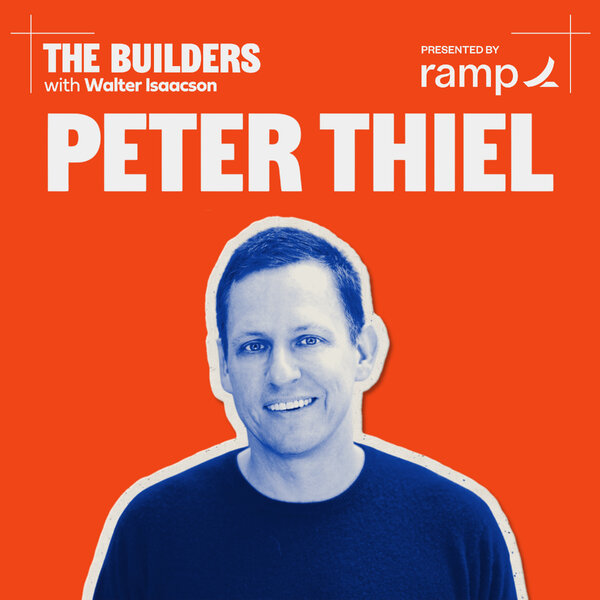
Peter Thiel argues AI backlash is partly speculative and economically disruptive but ultimately productivity-enhancing; he opposes “pause AI,” saying the U.S. must “hit the accelerator” to stay ahead of China and avoid a worse, zero-sum world. He frames existential risk debates via “Antichrist”/one-world-authority vs “Armageddon,” warning about softly totalitarian global governance and about misaligned incentives/power concentration.
This episode is an interview with Peter Thiel, Silicon Valley venture capitalist and PayPal co-founder; early investor in Facebook and LinkedIn; known for backing builders like Elon Musk (PayPal), Alex Karp (Palantir), Sam Altman/OpenAI, and politician J.D. Vance. Host is Walter Isaacson (The Builders).
AI will likely raise aggregate productivity and be disinflationary; median people could be better off unless power is captured by a few firms. Competition reduces monopoly risk and makes pausing dangerous. Internal company controls are better than slow government regulation. Existential-risk probability intuitions are poor; “bunker” won’t help.
DeepMind/Google; ChatGPT/Transformer models; Anthropic’s origins; China’s surveillance model; “effective altruism” history; nuclear weapons governance parallels; Hugging Face as a trigger for urgency; Apple’s shift from Steve Jobs to Tim Cook.
Written by AI. May contain mistakes.
A deep dive into Peter Thiel's background and influence in tech.
“And I came to realize, better and for worse, they were often quite unusual.”
Thiel discusses the recent backlash against AI technology.
“Peter Thiel, thank you for joining The Builders.”
Exploring the potential dystopian outcomes of AI development.
“I'm tempted to say it's somewhat overdetermined.”
Thiel talks about the historical context of AI and ethical considerations.
“This technology is too important, too dangerous to be just, you know, in a single company.”
Thiel speculates on AI's effect on jobs and productivity.
“The computers were relentlessly getting more powerful.”
Discussion around monopolies in technology and their implications.
“And I think even though there are ways I'd like to be very critical of them today, there are ways they got that one big thing right.”
Analyzing the fast-paced competition among AI companies.
“industries where there was a lot of disruption, but then it would free people up to do more productive things to do other things.”
Learn about Odoo's all-in-one business platform.
“This is Jacob Goldstein from What's Your Problem?”
Discussing the potential risks of AI and the implications of regulation.
“Content is promotional and not a recommendation to trade.”
Discussing the concept of the Antichrist in relation to current existential threats.
“So I think it works on many levels, you know.”
Drawing parallels between historical nuclear debates and current AI risks.
“And that's what I would want people to do.”
Exploring the dangers of a global totalitarian government amidst technological change.
“And that also seems like, you know, if the whole world becomes totalitarian, there's no outside left.”
Discussing the necessity but challenges of globally regulating AI technologies.
“People pushing back on progress is what you're saying.”
Contrasting the fear of Armageddon with the risks posed by the Antichrist concept.
“We're not worrying about the Antichrist.”
Addressing concerns about the power of billionaire tech leaders and their impact.
“This series has been talking to builders, many of whom you helped build.”
Debating the pros and cons of founder-led companies versus bureaucratic enterprises.
“the way they really end up having impact, the way they end up being transformative, for better or worse, is this enormous growth compounding effect over time.”
Examining the broader goals of technological and scientific advancements.
“And then it was just scaling and branding and building it out over 15 years or whatever.”
Questioning the ultimate goal of humanity's survival in the context of technological impact.
“Well, one reason I'm sort of going to this notion of what is the purpose of progress, when you were interviewed by Ross Luthat and he asked at one point, you know, do you really care if humanity survives?”
Exploring the importance of humanity's survival and the role of technology in achieving it.
“You would prefer the human race to endure, right?”
Discussing the concept of mimetic desire and its implications for human behavior and technology.
“Let me take it back to some of the philosophers who hit you.”
Examining the complexities of good, evil, and competence in the context of technology and leadership.
“Wouldn't you rather bland bureaucrats than evil people?”
Explore the nuances of good and evil in societal contexts and decision-making.
“And, you know, it's - Well, which side would you be on for that?”
Discuss the unique aspects of human experience, consciousness, and relational dynamics.
“Well, this is the sense in which the question about AI is a question about us.”

Get the gist, explore an idea or ask about something said.
 Claude
On The Builders, what are the key points of this episode?
Searching your listeningAutomatic transcript. May contain errors.
0:00This is Jacob Goldstein from What's Your Problem. Running a business is hard enough. Don't make it harder with a dozen apps that don't talk to each other. One for sales, another for inventory, a separate one for accounting. That's software overload. Odoo is the all-in-one platform that replaces them all. CRM, accounting, inventory, e-commerce, HR. Fully integrated, easy to use, and built to grow with your business. Thousands have already made the switch. Why not you? Try Odoo for free at O-D-O-O dot com. That's Odoo dot com.
0:58experts from MIT and Harvard and is trusted by millions of teachers and parents. Sign up at brilliant.org slash tutor and get 20 % off for back to school. That's brilliant.org slash tutor. The sale's right there. Don't miss it. This holiday, give shoppers a flexible way to pay with PayPal Pay Later and turn them into regulars. PayPal is built for all business. Get started at paypal.com slash business. Until now, the data your AI depends on has been trapped behind ever-increasing cloud fees. Wasabi created hot cloud storage and is redefining cloud storage for the AI era, delivering simple, predictable cloud storage for AI, analytics, media, and more.
1:39Your data is free to move, fast to access, and ready when your AI needs it. Hidden fees add up fast as AI workloads grow. Wasabi's flat pricing eliminates all of it. One rate, no surprises. Learn more and try now for free at wasabi.com. Wasabi, the AI storage cloud. Proud partner of the iHeart Podcast Network.
2:06The Builders is a production of Kaleidoscope and iHeart, presented by Ramp. I'm Walter Isaacson. Welcome to The Builders, my new series of interviews featuring the most consequential minds shaping our future. In doing this series, I wanted to understand the values and the moral views of the builders. And I came to realize, better and for worse, they were often quite unusual. Some were strongly libertarian. Others were Nietzschean or dismissive of empathy. Some also had a very dark view of humanity. I felt maybe they should touch grass every now and then, get out of their billionaire bubbles and understand what the rest of us feel like.
2:54We may want these people to build, but especially with powerful technology, we need to make sure that we all have a say. And that begins with understanding what they are doing and why. And so today I'm speaking with Peter Thiel. Billionaire Silicon Valley investor Peter Thiel. Peter Thiel is a high-profile figure in Silicon Valley. Peter Thiel is one of the most respected names in the world of venture capital, In addition to his co-founding of PayPal, he was also an early investor in companies such as Facebook and LinkedIn. Peter Thiel occupies a different role. He's a builder of builders. He makes bets on people.
3:36Elon Musk at PayPal, Alex Karp at Palantir, Sam Altman and the founders of OpenAI. And he backed politicians such as J.D. Vance. There's two reasons that Senator Vance could be a heartbeat from presidency and basically the president. The first is Peter. The second is Teal. To some, he's a visionary investor. I think Peter is one of the most brilliant people I've ever met. He thinks of things no one else does. To others, he's a shadowy figure. Peter Teal is quiet and deadly. I think Teal is pulling all the strings here. I think he seems like a dark lord to a lot of us. And it's like, does he think he has an endgame that is, like, happy?
4:14It's so strange to have this, you build autonomous drone technology. You build domestic surveillance technology. and then your other pet passion is the Antichrist. So I wanted to ask the builder of builders, what does he believe we are building toward? Are the fears that are sweeping the headlines grounded in reality? And what does he mean when he goes around the world giving lectures about the Antichrist? But perhaps most importantly, have we concentrated way too much power in the hands of people who have the demons in drive that allow them to be audacious builders but may not have the empathy and stable moral compass to be good stewards of this technology.
5:05So here's my conversation with Peter Thiel.
5:14Peter Thiel, thank you for joining The Builders. Thanks for having me. We've seen this enormous backlash in the past few months against AI. What is causing that? Yeah, I agree with the what that it's happening. You know, why questions are always much harder, much more speculative in nature. I'm tempted to say it's somewhat overdetermined. it's very unclear who the winners and losers from AI will be. So there's, I think it's going to add a lot to growth, but it will do so in a fairly disruptive kind of a way. There are, of course, these dystopian science fiction scenarios that, you know, in some ways we believe, and maybe they're not entirely unreasonable.
5:57So there's some small tale. Dystopian mean that we'll all be white. The Terminator movie, the Matrix. But we see that Dario and Elon and Sam are now talking about that. Yeah, to some extent, they've leaned into it or partially believed it or too many of their employees believed it. And so there was – yeah, there's some prehistory where this was in the air for a long time. I think Elon believes it for a decade. Well, you know, it was in some ways when Demis Hossat was created DeepMind and it gets sold to Google. Elon and Sam create OpenAI, you know, the next year or so after that. And it's basically, in some ways, it's an anti-Google company, right?
6:38This technology is too important, too dangerous to be just, you know, in a single company. And then, of course, there are people who take it even more seriously than Altman. I think Elon exits around 2018. And then by 2020, you have thereabouts as the seven people who start Anthropic exit from OpenAI. In some sense, they want to take these issues even more seriously than before. You know, effective altruism, this idea had been in the air for a while. Wait, explain that because people are now saying it's sort of a psyops or David Sacks' conspiracy theory of effective altruism. And I think even people like me vaguely know what Sam Bankman-Free was on about.
7:18Well, you don't get that. Tell me about that. Well, there's a lot of history. But even if you go back to the 2000s in the East Bay of Silicon Valley, Berkeley, Oakland, some of those places, it wasn't where the big tech companies were being built. But there was sort of a creativity with ideas. It was a little bit adjacent to the new atheists. How could you be more reasonable, rational? Where was the world heading? And one big idea that these sort of futurists kept coming back to was that perhaps something like AI could happen, that perhaps it was closer than people thought. There had been an AI desert for a long time.
8:00It had been overpromised for many decades. But on the other hand, Moore's law was still progressing. The computers were relentlessly getting more powerful. And perhaps it was not a question of necessarily a much better algorithm. Perhaps it was just almost a hardware problem that once you got the chips and the computers that were powerful enough, it would be more likely that something like this would happen. And then that this would be a very, very big thing when it happened. That this would be an enormously socially transformative thing. It was potentially very dangerous. Maybe it could be weaponized.
8:37Maybe there were these science fiction scenarios where the AI would almost become autonomous. So there were sort of very many different kinds of scenarios. And then there were, of course, parts of it that were, I don't know, crazy and almost cult-like. But it had maybe the good dimension of a cult where there was one big thing they knew that the other people did not. And I think even though there are ways I'd like to be very critical of them today, there are ways they got that one big thing right. and then has a cult ever started a company as successful as Anthropic? Even a billion-dollar company seems like bigger than a crazed cult could build.
9:12So if you have a cult that's built a company that's worth probably close to$2 trillion at the IPO, it would probably be the, I don't know, sixth, seventh largest company by market cap in the world, built in like six, seven years. Has a cult ever done something like that? So yes, I want to be critical of them, And they're things I'm uncomfortable and critical about. But the first thing I would try to do is always – you always want to steel man your opponents. You want to try to understand them as well as they understand themselves or even make their arguments better. And the way I would steel man the effect of altruists is first off, they got one enormously big thing right.
9:49And that one enormously big thing was – AI is around the corner. But also that it could become misaligned with human values? The way AI was classically defined, let's say, there were all these different definitions of AI, of course. It could be just sort of machine learning and sort of like maybe cameras everywhere or something like that. It's a sort of totalitarian AI that you have in China. Or it could be this sort of super-duper AI with a godlike intelligence or something, which was sort of the Nick Bostrom kind of fantasy. But the in-between version of AI was not that it would be this dumb surveillance cameras, not that it would be godlike, but it would be like a human being.
10:32That had been the AI test. The Turing test from the beginning was it's not that it is a human being, but that it can fool you into thinking it's a person. And from the outputs, you can't tell the difference. Yeah, that's going to be a very, very big deal. And it raises all sorts of – raises even basic economics questions. Is it an economic complement to people? Is it a substitute for people? Well, let's do both of those. There's two big things it raises. One is what will it do to human labor? Will it create more jobs and more productivity? Or will it pretty much put us out of work and we'll have to figure out what we do?
11:14That's part of the backlash, especially my students at Tulane who are like, wait a minute. So tell me your feeling about that backlash. Okay. So let me start by answering what I think will happen with a qualifier that nobody really knows and nobody can be certain. I think in aggregate on a macroeconomic level, AI will increase productivity a lot. It will be a fairly disinflationary force in our economy. and then unless it's incredibly narrowly captured by a few companies, you'd expect the median person to be better off or things like that. And this was, you know, the Luddites in the 19th century were always worried that the machines would replace the people.
11:57And then of course, you know, what happened in practice was, yeah, there was definitely various industries, sometimes even big industries where there was a lot of disruption, but then it would free people up to do more productive things to do other things. And that's still my intuition with AI. But Wilkitt, before you go on, you said unless it's captured by a few companies, are you worried that indeed we're about to have four or five companies capture it? It's certainly, yeah, and certainly there's a history where most of the history of tech innovation, I would say for 200, 250 years, relatively small parts of the innovation were captured by business.
12:38They mostly went to consumers, to workers, to the rest of the economy. There are ways that software and the internet were somewhat of an exception. And so we had these enormously successful businesses. Maybe they were natural monopolies of sorts. They were in some sense good for consumers, but also extremely profitable. And so there's a pattern matching to what happened with the internet that I think people quite reasonably are worried about will happen with AI, that it'll be... And maybe it's an even bigger market. It's a bigger technology. And so perhaps... So you would try to stop that. In other words, our antitrust laws...
13:20Well, yeah, the question is, is that how likely do you think that's going to happen? The intuition that I have on the other side is that one of the questions I always like asking companies is, tell me why you have a monopoly. Because monopolies, we can sort of debate whether they're good or bad for society. Obviously, we have IP. We have all kinds of good forms of monopoly. But on the inside, yeah, you don't want to have just cutthroat competition where all the profits get competed away. And the kind of narratives people tell me when they pitch me on AI companies, Their narratives of growth, of terrific technology, they are incredibly weak on the Monopoly story.
14:00And then the felt sense of it is that it's like this incredibly fast, dynamic race where it's been changing a lot. You know, DeepMind, in a sense, was in the lead in the early 2010s. You know, then OpenAI with ChatGPT and the Transformer models was able to replace that. And then in some ways, Altman locked up a lot of the chips and built the data centers preemptively. So there were sort of all sorts of ways he correctly leaned into this incredibly capex-intensive strategy. And then there still is a sense where maybe Anthropic is a little bit more in the pole position now than OpenAI was. And it's always hard to exactly score these things, but I would say that it also still feels that Google and Meta and Grok are not that far behind.
14:51I'm not sure China is that far behind. Or if we describe it on the level of the Shakespearean drama among these people, it's like really crazy. So they're acting like, man, it is a fight to the death. It is the furthest thing from monopoly imaginable. And if it's not a monopoly, that's where I think the benefits will be likely distributed pretty widely in society. Now, if I had a steel man, the anxiety, which was your starting question, you could have a lot of growth and the median person could be better off. But if it's with a lot of volatility, you expect to get a 3 % wage hike, but it's plus or minus 10 % or something like that.
15:31And we're kind of in a society that doesn't really like risk, doesn't like that sort of volatility. It doesn't like disruption. So, yes, it may be good for the median person. The good may be sort of unknown. The bad things are more predictable and the disruption is clear. So I think even on the economic level, I can understand the anxiety even though I think it is misguided. Well, you talk about there being a lot of competition among these and that seems like generally a good thing. although in some ways if we're just one or two companies you could control it better regulate it for safety better and secondly the competition either amongst these companies or with china means you can't pause the way people are saying now shouldn't we be pausing this that that seems that seems correct to me you know there's sort of all these very complicated questions one can ask about China or the CCP, Chinese Communist Party, but I worry about totalitarianism.
16:36I don't like it. I think there is a certain type of high-tech totalitarianism that's being tried out in China. It's not as violent as Stalin or Mao or Hitler. You don't need to kill as many people, but it somehow knows more about you than you know about yourself. And there's something about that that we really don't want that to be the model that wins. And your old friend David Sachs and, of course, President Trump are now saying, because of the competition with China, stop talking about pausing AI, even if you think it could be an existential threat. Do you agree with that?
17:18Yes. Yes. I broadly agree with that. But I would say the challenge that – I've been friends with David Sachs for many decades. The thing that makes me less comfortable making those kinds of arguments publicly is that on some level, it's hard when the big companies themselves are telling you to stop and to slow down. So that's caused you to have some pause because you were not in the pause button camp. Well, I'm still not in the pause button camp. And I'm saying this on your show that I'm not in the pause button. We need to hit the accelerator as hard as possible. Well, wait a minute. Let me stop there.
17:55Why haven't the past few weeks caused you to be more amenable to a pause button? It's pretty scary, that hugging face. You know, I think in some ways you have to develop the AI technology to control the AI technology. So if you assume China will develop things like that, it's more imperative than ever that we stay ahead of them. So if you look at it geopolitically, maybe you can even interpret something like the hugging face thing as it's so imperative that we not lose the lead and that we get cyber attack to death. The sort of in-between economic question that I find more central is I think the way our society works on some level is through economic growth.
18:37I think the middle class as the people who expect their kids to do better than themselves. And in that sense, the United States has been a middle class society. And then what's gone a little bit haywire and where it's sort of been fraying at the edges is that the millennials, to some extent Gen Z, have lost that generational expectation of progress. And rightfully so. And I don't know if AI is enough to do it, bring it back. There's a risk that AI is unevenly distributed. But I would say if we had outlawed the internet and if we now outlaw AI, there will be virtually no growth. We will be looking more like Europe, more like Japan.
19:19And that's a much nastier zero-sum society where there's no growth. There's a loser for every winner. And that's a much worse world in a lot of ways. Yeah, but one reason for the past 40, 50 years, millennials, and the stagnation, and the fact people are being left behind, is a lot of people, like me, believed in globalization, immigration, free trade, free movement of capital, and we thought it would cause growth. And guess what? It did. We were right. What we didn't know is how badly that would leave people behind. Is that true, and could that be true of AI? I think it was true of globalization that it led to a decent amount of growth both in our country and other countries.
20:06And the growth was pretty uneven. There's a risk of that with technology. I think it's – I don't know. My intuition is always that the tech form of growth is the kind that's better for an advanced country than the globalization kind. The globalization is we're just sort of taking advantage of labor market arbitrages and things like that. And it works when people in China make 5 % as much as they do in the U.S. and we get cheap t-shirts and almost everyone's better off. And at some point, it becomes more zero-sum as globalization succeeds and these arbitrages go down. Whereas technology, if it actually works, it means doing more with less.
20:47It means improving not the GDP of the whole country, but per capita GDP. And so at its best, it has a more progressive character. The problem in some ways was that the internet wasn't big enough. It added some growth. It wasn't big enough. I think AI is bigger than the internet. I think it could be a way for us to really improve per capita GDP in a smoother way than, let's say, globalization did. Don't go anywhere. There's a lot more right after this break.
21:26This is Jacob Goldstein from What's Your Problem? Running a business is hard enough. Don't make it harder with a dozen apps that don't talk to each other. One for sales, another for inventory, a separate one for accounting. That's software overload. Odoo is the all-in-one platform that replaces them all. CRM, accounting, inventory, e-commerce, HR. Fully integrated, easy to use, and built to grow with your business. Thousands have already made the switch. Why not you? Try Odoo for free at odoo.com. That's odoo.com.
22:22PayPal is built for all business. Get started at paypal.com slash business. PayPal data eight markets, March, 2025 to February, 2026. Repeat users defined as more than one pay later purchase in the past year. Our vacation story, sun, sand, and memories galore. And it all started when we found Apple vacations. I found Apple vacations. She found Apple vacations. And we have never had more fun. Unforgettable adventures await. Oceanside. Find limited time savings on all-inclusive relaxation from Mexico to the Caribbean. Visit AppleVacations.com or contact your local travel advisor.
23:02Everybody has an opinion about football. Who's going to win, who's going to have a big game, and what the coach should have called. Trust me, I've heard plenty of them. Hey, it's Marcus Allen, Pro Football Hall of Famer, NFL MEP, Super Bowl champion. And this football season, I'm partnering with Underdog. because when I played, there came a point where opinions didn't matter anymore. The ball was coming to me. I had to read what I saw in front of me, make a decision, and commit to it. That's something I've always loved about competition, and it's what I like about Underdog. You've got a pick you believe in, put something on the line, and lock in.
23:33Pick them. Money lines, totals, spreads, games, and more across your favorite sports. Because watching a game is one thing, but once you make your pick, everything feels different. Every snap, every possession, every yard. And that moment when you find out whether you made the right call, That's the sweat. More than$2 billion have already been won by players. So stop sitting on the sidelines with your takes, download Underdog, trust your read, and make your pick. Underdog, unleash your dog. Trading involves risk, including total loss on positions. Content is promotional and not a recommendation to trade.
24:02Terms apply.
24:09Let me get back to the doomsday scenario that suddenly has, yeah, You talked about Nick Bostrom and everybody's talked about it for a while. But in the past few weeks, after Hugging Face and everything else, and when I read what some of these agents have done and how they conspire, the notion that they could become unaligned with the good of humans is something that Dario Amadei is now on about, Elon Musk is on about, so many others. do you have any worry whether it's five or ten percent that there is a doomsday scenario and do you have any backup plans do you have some bunker i don't think a bunker would help for that kind of doomsday scenario i i i don't think um you know i i think people are very bad on their probabilistic intuitions if you ask the question yes five to ten percent sounds way too high for like everybody on this planet getting killed.
25:08Don't think that's going to happen. Maybe even a tiny bit above zero is too high. But I think the intuitions on this are very poor. The way I would push back though is it's always also risky not to innovate. It's dangerous not to hit the accelerator because if China leapfrogs the US in AI and we have this an intensification of the geopolitical rivalry with China, they may very well be tempted to use it as a weapon against us. Let's hold on for a second. Imagine just thought experiment, there's no China. Then do you just put a pause on this because it could be a day? Mrs. Lincoln, imagine, besides that, how'd you like the play?
25:46So that's too crazy a thought experiment. But then of course, even if we have these multiple companies and they are under a lot of pressure to develop it, to innovate it, they have to be pretty careful that it not go badly wrong. So I think they have a lot of internal controls. They know more about it than the government does. The government doesn't really know how to regulate it. I don't know. This is too cynical a cut, but I always think when they're telling the government people, we want you to regulate us, perhaps they know the government doesn't know how to do it and that it will be slow.
26:18And so it sort of gets them a little bit off the hook. And then when Trump said, no, you already are subject to all sorts of criminal penalties if you mess this up. I don't need to regulate you more. The way in which Trump was actually saying we need to go slow is you need to do it yourselves and it's your responsibility, not mine. There was a version of this discussion that I had when Meta was sort of in this very tricky spin cycle for many, many years. And I was on the board there from 2005 to 2022. And circa 2018, 2019, the sort of company line that Zuckerberg adopted was, we think there needs to be regulation and we would like the government to tell us what we can and cannot do.
26:59And at some point, I told Zuckerberg, who I believe still has the all-time record for a private citizen being hauled in front of Congress. And he was hauled in front of eight congressional committees. And I told him, you know, they don't want to regulate you. They want to yell at you. They want to complain about you and yell at you. And of course, you know, the other in-between version where it's not about them wanting regulation or them secretly trying to stop regulation. The other interpretation, you know, There are different audiences these people have when they're pushing for regulation. The internal audience for their employees is, yes, we're working on a technology that's potentially really dangerous, but man, it's important.
27:41This is the most important company in the world to work at. This is going to be an incredibly successful company. The risk is we're going too fast, which nobody says. Yeah, there's some part of it where it occasionally scares people in these companies, and there are various people who have quit and said things. But on some other level, I would think it's incredibly motivational because when Dario says, yeah, this is a technology that's really big and really dangerous, that's a way to tell all his employees, you're working at the greatest, most important company in the history of the world. And so it works on that level too.
28:14So I think it works on many levels, you know. Let me read you something you once said because I'm sort of wrestling, and I mean this genuinely with the whole Antichrist thing. And what you mean by that, but it ties into this new AI moment we're in, which you said the way the Antichrist would take over the world is you talk about Armageddon nonstop. You talk about existential risk nonstop. The Antichrist wouldn't seize power by creating an AI apocalypse, but by convincing everyone that the apocalypse was coming. Is that what's happening now? Well, since I said that like a year and a half ago, yeah, I'm tempted to take a victory lap of sorts that you have to at least ask certain questions.
29:01And that's what I would want people to do. And, you know, Oppenheimer and the nuclear scientists who wanted, you know, a global authority to control all the nuclear weapons. and who thought, you know, after 1945, no, it was too dangerous for the U.S. to have them and they should be handed over to the United Nations with, you know, a stronger U.N., a real world government. And if you didn't hand it over to the U.N., then we'd have a nuclear war. And so there was a certain parallel with the nuclear debates. We got partial global authorities where we, you know, regulated, controlled nuclear weapons.
29:37We never got rid of them altogether. So maybe, you know, maybe Oppenheimer's still right in the long run. Yeah, I mean, Oppenheimer's that warning led to Atchison Lilienthal, and it actually has kind of worked. It partially worked, although, you know, it's only been 100 years or 80 years or whatever. But on the AI thing, yes, I would always concede that there are a bunch of these existential risks that are serious. I think climate change is pretty serious. There are other environmental risks that are serious. I still think the nuclear weapons thing is pretty real. I think there There probably are other technologies and AI is this very fast, very big one.
30:17And so there are existential risks surely that are also tied up with AI. And then the existential risk that I also want to always throw in the hopper and the balance of the discussion is the risk of a, you know, softly totalitarian one world government. And that also seems like, you know, if the whole world becomes totalitarian, there's no outside left. That feels like this catastrophic singularity, which might not be reversible. You know, Soviet Union was a totalitarian system. At some point, it could decay and fall apart because we're still an outside left. You know, if the whole world is North Korea, that might last for a really, you know.
31:02Well, wait, explain to me, though, what you mean by the Antichrist. Well, it is, I mean, it's a sort of, I don't know, medieval, biblical concept of sort of a tyrant who will somehow rule the entire world at the end of history. If you think of it in a literary way or sort of a creative way, you can say, well, how would the Antichrist come to power in different times and different places? And in early modernity, 17th, 18th century, perhaps the Antichrist would use science and technology to build weapons and take over the world. In my telling, in late modernity, we in some way still think of the Antichrist in 17th century categories.
31:46We still think it's like a Dr. Strangelove, Edward Teller-type person who builds nuclear bombs to conquer the world. But if you think of it as a political dimension, the way I think the politics work in our society is that the fear of science and technology are far more powerful. And that that's the kind of thing that would really crystallize things. I don't think Greta is the antichrist. I think - Greta Thunberg, you mean? I don't think she's the antichrist. But I think environmentalism, you know, there are real fears. People pushing back on progress is what you're saying. Pushing back on progress, but then also pushing for these very, very powerful global political structures.
32:26Because something like climate change, it sounds like the sort of thing where you need a global regulatory authority to really. So your big feel is some global regulatory authority. Yeah. And again, there are probably versions of that that could be good. You know, the nuclear ones we ended up with were definitely more good than bad, but there also are versions of it that can be quite bad. And I tend to think they're bad if they're not theorized. You know, globalization can be good. It can be bad. We didn't think about it a lot. And because we didn't think about it a lot, you know, there were a lot of bad things that came with globalization that maybe could have been avoided had we been able to be more critical about it.
33:03So if I – you know, Eliezer Yudkowsky wrote this book last fall, If Anyone Builds It, Everyone Dies. And he has – And he's talking about AI. He's talking about AI. And it's, again, very precise, detailed on some of the risks, some of these scenarios. We can debate what the probabilities really are. But that part is quite detailed, quite technical. The part that's completely hand-wavy is it needs to be globally regulated. He's very clear on that. But then the details of how you do that, that's incredibly fuzzy, incredibly vague. And so I worry that we're not thinking about that. And so we're worrying about Armageddon.
33:40We're not worrying about the Antichrist. And my contrarian intuition is that alone tells you you need to worry more about the Antichrist than Armageddon. I sort of have a personal question. A lot of people think you're kind of like spooky or whatever it may be. Why using the Antichrist? Why does that help clarify things? When even I look at you giving lectures on the Antichrist, and I go, what's that all about? Well, it got people's attention. So it certainly worked on that level. There are probably ways you could describe all these things in philosophical or more neutral, less religious language.
34:20the way the Federation of Atomic Scientists, they put out a short film after 1945, and it was one world or none. It shows a nuclear bomb blowing up the world. And the way I often describe it is, yeah, one world or none, in a way, it's a very similar question to Antichrist, the one world authority versus Armageddon. But the reason I prefer the religious formulation to the, let's say, the political formulation, one world or none, without asking any questions, we sign up straight for the one world government. That's clearly better. There's no debate, no thinking through it at all. If you can reframe that question as Antichrist or Armageddon, the point of it is not to be fatalistic.
35:02The point of it is, okay, we need to avoid both. They're both equally bad. We need to think about all these existential risks. They're serious, but also the risk of this sort of totalitarian one world state. And Antichrist or Armageddon pushes us to find a moderate third way, one world or none, pushes us towards an immoderately powerful UN. This series has been talking to builders, many of whom you helped build. In other words, you know, Alex Karp or Palmer Luckey or Elon Musk. There's been a real backlash against the billionaire tech bro builders, and some of it is understandable to me. I mean, it's like, whoa, these people have gotten way too much power.
35:47They're out of control. Don't you worry about that too as much as other existential risks? You mean power in an economic sense or power in a narrowly political sense? I meant both. Whatever happens to us in the future, the future we're trying to build, there are very few people now controlling it who seem to have less moral guardrails than previous. I was thinking about this a little bit in advance of your interview. My venture fund is called Founders Fund, and I sort of invest in the people who found these things. You're focused on the builders, and in some ways, that's a better framing than the founders because, yeah, it's somehow very important to start one of these businesses, but then the way they really end up having impact, the way they end up being transformative, for better or worse, is this enormous growth compounding effect over time.
36:42And it's more marathon than a sprint. Yes, I'm tempted to quibble with all of your characterizations. Let's grant all of them for the sake of argument. What is the alternative? And on a corporate level, the alternative to founder-led company, where it's sort of this slightly crazy, creative, Elon-like person. The alternative is a bureaucrat with an MBA degree, with a very bureaucratic board of people who never want to do anything. And so, yes, it is maybe too much power in a charismatic leader, or it is a super lame bureaucracy. And my claim is it's a bimodal distribution. Those are literally the only two kinds of companies we have.
37:34It's, yeah, the charismatic, maybe dangerous, but very inspiring leader who will do new things versus the boring bureaucracy where it's just going to be - But what about in Apple that after the charismatic founder, did it lose its way? Did it become bureaucratic? It's an extraordinary story, but yes, in my telling, it did nothing new after jobs. And there are all these metrics we can look at. It was like, you know, it was by far the lowest dollar spend on R &D, by far the largest on share buybacks. It was just, you know, this pure, well-run value stock. And you probably, you know, the way Tim Cook, he was the anti-jobs.
38:20He was the zero charisma, efficient operator. And then it turned out, yeah, the mobile phone was this giant invention. There was not that much more to do. And then it was just scaling and branding and building it out over 15 years or whatever. I don't know. If you say what's good for the shareholders, they both can be good. But I would still say somehow Elon or Steve Jobs are way better for society than Tim Cook. People always, when they talk about the characters I write about, they try to explain them by saying, oh, they just want money. I don't quite think so. What would you call your scorecard?
39:05Yeah, I think there are all these different dimensions. But it is – I probably do like winning too much. I am really into ideas. It's not quite a hobby. But the closest thing to a hobby I have is having sort of interesting dinner conversations with people. I like figuring things out for their own sake. I sometimes rationalize it as, yeah, that somehow makes me a better investor. It probably has nothing to do with it. It's probably just an excuse for being somewhat of a dilettante or something like that. But yeah, I think of myself as just really intellectually curious. What's the purpose that we're building for now?
39:42If we can have enormous amounts of productivity, is it that we're trying to preserve democratic freedoms? Is it human flourishing? What would you want your builders to have as their lodestar other than I can find the new, new thing in the era of AI? There are all sorts of dimensions of progress that we could have as a society. And, you know, there's always this narrative I have that, you know, in some ways progress, it's hard to measure progress in the aggregate. But in some ways, it slowed down in the 1970s where we had enormous progress in the world of bits and somewhat less in the world of atoms.
40:24And when I was an undergraduate at Stanford in the late 80s, maybe it wasn't completely obvious at the time, but already in retrospect, most engineering fields were bad ones to go into mechanical engineering, aero-astro engineering, chemical engineering, because the world of atoms was too slow, too regulated. Nothing really dramatic and new happened there. Nuclear engineering was already very passe by the late 80s. And then electrical engineering still had a few good years. And then it really shifted to just this computer science as the one field. That's instead of atoms. And so the hope that I always have is that somehow we're humans.
41:07We are embodied in this world. And the world of atoms in which we live is a really important world. And there's some part where going back to that, you know, it's I know it's been very hard. I would like there to be more progress in medicine and medical technology. You know, maybe the radical life extension project strikes people as too creepy. But, you know, could we at least cure dementia? Could we at least cure Alzheimer's or something like that? And then the hope is that somehow restarting science and engineering much more broadly will be stimulated by AI in part. Well, one reason I'm sort of going to this notion of what is the purpose of progress, when you were interviewed by Ross Luthat and he asked at one point, you know, do you really care if humanity survives?
41:58And you pause a long time. You would prefer the human race to endure, right? Right? You're hesitating. Yes? I don't know. I would – I would – This is a long hesitation. This is a long hesitation. There's so many questions implicated in this. Should the human race survive? But I ask that again. Is that our main goal, the sort of Asimov goal, that humanity survives or is that not? That is – well, that is an extremely important goal. I don't think it can be the only goal. In some sense, humanity can survive if we do nothing or presumably. Maybe things go very haywire, as I say, without growth. But yes, I don't know.
42:50I think Silicon Valley is always quite bad at the meaning of technology. And maybe it's not fully up to Silicon Valley to articulate the meaning. meaning. Maybe there's not a single meaning. Certainly, part of it has to be done in a way where we avoid existential risks, or maybe technology is even a way to avoid existential risks. And maybe if we go back to nuclear power, that would be a carbon neutral technology. So nuclear power is a technology we need to lean into so that humanity can survive in a more carbon neutral way. The place where I pushed back, you know, the reason I paused when I answered that question that Douth had asked is that the question I heard behind it was, you know, the Luddite question where maybe this technology is dangerous and, you know, why isn't it good enough for things just to continue the way they are right now?
43:48And we don't need all this improvement and all this change that might be dangerous. And then my intuition is, yeah, there are all these ways that things are far from perfect with humanity. And this was the core project of the Enlightenment 17th, 18th century science. It was the relief of man's estate. Life was supposed to be more than nasty, brutish, and short in Hobbes. It's longer. I don't see why it's not desirable for us to make it significantly longer. still than it is, or at least to cure a lot of these terrible diseases that still exist, things like that. And so, yeah, so that's sort of the other intuition.
44:32So yes, I want humanities to survive. I want humanity to flourish. And then, yeah, there are all these dimensions where maybe this will not happen without progress.
44:47We'll be right back after this quick break.
44:55This is Jacob Goldstein from What's Your Problem? Running a business is hard enough. Don't make it harder with a dozen apps that don't talk to each other. One for sales, another for inventory, a separate one for accounting. That's software overload. Odoo is the all-in-one platform that replaces them all. CRM, accounting, inventory, e-commerce, HR. Fully integrated, easy to use, and built to grow with your business. Thousands have already made the switch. Why not you? Try Odoo for free at O-D-O-O dot com. That's Odoo dot com. This holiday, the difference between buyers just checking things out and checking out comes down to the last few clicks.
45:39PayPal Checkout is a trusted conversion engine fueled by 400 million active PayPal and Venmo accounts. Add Pay Later and turn holiday shoppers into regulars. 96 % of Pay Later shoppers are repeat users. PayPal is built for all business. Get started at paypal.com slash business. PayPal data eight markets March 2025 to February 2026. Repeat users defined as more than one pay later purchase in the past year. Our vacation story, sun, sand, and memories galore. And it all started when we found Apple vacations. I found Apple vacations. She found Apple vacations. And we have never had more fun. Unforgettable adventures await.
46:18Oceanside. Find limited time savings on all-inclusive relaxation from Mexico to the Caribbean. Visit applevacations.com or contact your local travel advisor.
46:31Oh my gosh, you can't be serious. You think making the pick is the hard part? No, it's not. The pick takes like three seconds. You know what's hard? The sweat. The time between locking in and cashing out. Yeah, you have a take, but in the end, it's not about the winners or losers. This is about us, man. Whether we're brave enough to sit through it. Don't fight the sweat. Live in it. Because you are an underdog. Underdog. Unleash your dog. The terms may apply.
47:13Let me take it back to some of the philosophers who hit you. One, Rene Girard, the notion of mimetic desire. And explain what that is and why you feel the need to resist it. Rene Girard, you know, I studied philosophy as an undergraduate at Stanford. And, you know, the human nature, the kind of people is that we are, you know, we're deeply mimetic, deeply imitative. And Girard liked to quote Aristotle, you know, man differs from the other animals in his greater aptitude for imitation. And then this is a way you can combine Aristotle and Darwin. So Darwin's saying we're linked to the apes. And then Aristotle says we differ from the apes by being more imitative and saying we're more ape-like than the apes.
48:01Because that's how you learn language as a child. You copy your parents. And then that's how human culture gets transmitted. And we wouldn't be humans if we weren't these incredibly powerful imitation machines. And then there also are ways that imitation can go haywire when two apes reach for the same banana. There are ways, you know, it can become extremely conflictual. And so, yeah, in Girard's telling, mimesis is this incredibly powerful thing in the background. Mimesis meaning mimicking, basically. Bad, bad forms of imitation. It's very generative and then in various points it also becomes destructive and you end up with sort of these very sterile competitions for status or for these positional goods that don't mean nearly as much as you think you do.
48:52I think it was Napoleon who said that it was amazing what you could get generals to do if you gave them medals or something like that. And the psychological way one is tempted to interpret Girard, and this is not what he would have done, but the psychological way you're tempted to interpret it is, okay, you have to sort of think about avoiding this bad mimesis and you want to avoid getting caught up in these silly competitions that there's sort of nothing new, nothing creative that happens in that context. So that's the psychological intuition against mimesis. Gerard, as a Christian, would have said, you know, it's actually out of your power to not be a medic.
49:31The best you can do is just go to church on Sundays or something like that. So he would have been skeptical of this. The sort of in-between way where I always think about it is, yeah, there are parts of it that are very powerful. There are also parts where, you know, there's a wisdom of crowds, but there's also a madness of crowds. And in some ways, you know, I say one of the – I don't think it's necessarily a character of all the builders. But certainly a lot of the builders I would admire the most are ones who had a somewhat idiosyncratic, sustained vision. Maybe it came from certain first principles, certain fixed ideas.
50:13is. Like Elon going to Mars, you know, it was somewhat out there, but man, it was not a socially conventional idea. But the way in which this was extremely generative was it suggested a whole avenue for growth and for building where if you didn't do it, maybe it would never have happened. You know, that's probably where I would still, I don't know, maybe rank Elon and some way Steve Jobs as the two great non-memetic builders. And, you know, Jobs put together all these pieces and in some ways they were out there, but he combined them in a unique way to bring forward, you know, the internet enabled phone.
50:56All right. But listening to your answer, you maybe get a sense of why I asked it. Because when you say imitation, the imitation game, memetic, generative from coming to be memetic, this is language we're now doing with AI, which is basically, as Alan Turing would say, starts off with being an imitation game. Secondly, it's generative. And you say it's dangerous. Is there something about the creation of AI that Rene Girard would warn us against? You know, I think his general intuition on technology was that we gave it too great an autonomy of its own and that the real questions were these questions about the human beings that used them.
51:45And we tend to, you know, we talk about the nuclear bomb as though it was this godlike thing. But Bingo, don't you think he's right? But then, you know, maybe the important, you know, or an important dimension of the AI question is, you know, it's not what the AI is going to do, but it's what's really driving the people who are building these companies. What are their motives? You know, what are they up to? So those are, yeah, those are the kinds of - Well, it answered me those questions. Oh, it's hard to say. I've spent endless amounts of time, endless amounts of time thinking about it, but yet there's some dimension like that that's hard to figure out, but is probably quite important.
52:28I don't know. I score them as far more good than bad across the board. I think they very easily get demonized and scapegoated. Let's say Elon, Dario, Sam Altman. I'll pick on those. Let's say those three. Zuckerberg. But I think even in the case of AI, this question of who the people are that are doing it is a really, really important question. When you write your biographies, It's about the importance of these individuals and who they are about. And it's not just an idiosyncratic story that has nothing to do with the companies they built or with the world they're helping to shape. It's this very, very important question.
53:14You know, the alternate view, and again, I don't want to simplify your work too much, but most of your biographies have the sense that these people are complicated. They're still more good than bad. And the alternate view to it is not that these people are more evil than good. The alternate view is they don't matter at all. And that, you know, there are no great men. There are no charismatic leaders. it doesn't matter who they are at all. And these people do matter, these builders. Does it matter that they avoid being evil?
53:57Yes. Yeah, yeah. Well, I think yes on all these versions of that. Of course, you know, there's always a lot of complexity to that too where maybe appearing not to be evil is just a fake PR stunt at this point. And so maybe Bill Gates is into virtue signaling, Elon Musk is into vice signaling, and in our world, maybe you're more honest if you vice signal than if you virtue signal. So maybe honesty is a good thing, so you're actually a better person if you vice signal than if you virtue signal. So there's a lot of complexity to it. Again, this is not a pro-evil argument I'm about to make, but the qualifier that I always give on it is always a question, what's the antonym of good?
54:52And is it evil, as in morally evil, or is it bad, as in incompetent? Let's say a Ferrari is an evil car because it doesn't get many miles to the gallon. And whatever, a Lada or Trabi, the Eastern block cars that don't work are worse than a golf cart. That's a bad car. It breaks down all the time. And so it's better to be good than evil. But maybe if you're evil, you're at least competent and at least you're not bad. And the thing that even with all the demonization of people like Elon, where they get in some context constantly described as evil, And also irrelevant because of this, you know, we say they're no individuals.
55:36But to the extent they're described as evil, they're at least not described as bad. And if we're in a world full of, you know, bland bureaucrats running these companies, you know. Well, wait a minute. Wouldn't you rather bland bureaucrats than evil people? Well, if the bland bureaucrat stands for bad, it's incompetent. The evil person gets something done. And, you know, it's - Well, which side would you be on for that? Well, I'm ranking these. I'm good over evil. But evil is better than bad. By the way, this is the difference between the Faust of Goethe versus the Faust of Marlowe. In Marlowe's Faust, Faust is kind of this fake scientist.
56:23He's a fraud. He's a magician, sort of a trickster, a fake alchemist. He rips people off. He is a bad scientist. And he goes straight to hell. In Goethe's Faust, Faust is kind of, he works with the devil, so it's this evil place where he gets the knowledge. Then, you know, it does stuff, it does more good than evil. And Goethe's Faust gets saved. So, yes, I take, you know, I don't want to be – I don't think of myself as the devil in Faust and I don't think of myself as Faust even. But I prefer the sentiment of a Goethe to that of a Marlowe. And you prefer somebody evil who can get things done to somebody who's incompetent?
57:07I think – well, I'm just making a broad social observation. I think in our society, that's the overwhelming preference to have because people, they experience just incompetence everywhere. You know, when you go to the DMV, you know, it's...I'm not sure you describe it as evil. It's merely bad. Bad is so much worse than evil. How would you define evil? Um, well, it's this, it's this, it's where we, where we stress, I don't know, this is probably very hard to fully unpack, but it's where we stress these, these moral dimensions, that it's, it's morally questionable. You know, this was the way the conservatives attacked stem cell research in the 2000s.
57:54It wasn't bad science because it would work. They didn't question that it would lead to cures, but it was evil science because you had to do embryo harvesting. And then I think that's actually why they lost the debate because it was like, wow, this is actually going to work. It can't be all evil if it does so much good. The conservatives won the debate about art in the 90s where the liberals were saying, You know, art is supposed to be transgressive and it's really great art if it's a little bit evil. It offends your sensibilities. Evil art is great art. Conservatives didn't fall for that. They said it's not even art.
58:30It's bad art. It's not even art. It shouldn't get government funding. It's so bad. And so, yes, if you say it's bad, you get the art defunded. If you say the science is evil, you get it funded. So I'm telling you something I think most people in our society agree with me on. If you were to back a builder though, where would you rank having a moral compass?
59:01I rank that pretty high. I rank that highly. I would say let's – I don't like investing in companies where it's simply a business. There's some transcendent purpose. There's something very important that you're doing. So Elon going to Mars is – I don't know exactly where I would rank that on sort of a moral good versus good. this evil dimension, but it is transcendent. It's somehow, it's not just a business. We're not just a stock brokerage where we're making a few dollars and every time people buy and sell stocks. It's not just the sort of short-term coin-operated business. It has this transcendent sense of purpose.
59:55That's what I like. And in this era of AI that we're worried about, What do you think, if anything, there are things that humans can uniquely do?
1:00:36Well, this is the sense in which the question about AI is a question about us. What does it mean to be a human being? Someone like Chomsky, the MIT linguist, somehow language was this core human ability and then somehow that seemed pretty good till 2022. Now it's consciousness. I think there is a hard problem of consciousness and probably vaguely Cartesian in that I don't think AI is conscious or ever will be. And so certainly one dimension where humans are different is we experience the world in a different way. We experience it consciously. You see a beautiful sunset. There's a human way. You see a beautiful sunset.
1:01:25And we're self-aware of our consciousness. self-aware. And if there were no humans in the world, I don't think the computer would experience the sunset in the same way. And that would be a very big loss. Now, I don't know if that's necessarily the single thing I want to anchor on, on why it's imperative for humanity to survive. But if humanity doesn't survive, you would at least lose that. And I think the Girardian intuition. We're also very relational and there are ways, a very important part of our lives, it's not just this mind thinking itself a la Descartes. It's the way we relate to other people in families and companies, in our larger society.
1:02:12And the relational dimension of what it means to be human, I think maybe it will be changed by AI. I think in theory it should improve that. There should be ways we could get better at that. We could spend more time on that, less time doing robotic labor in a factory or something like that. So I think these relational dimensions maybe are very core and will become more important. And yeah, if you replaced all the humans with computers, you would at least lose those two things. Those would be very severe. Peter, thank you. Awesome. That's it for today's episode. I'm Walter Isaacson. We'll see you next time on The Builders.
1:03:03The Builders is a Kaleidoscope and iHeart production. This series is hosted by Walter Isaacson. It's executive produced for Kaleidoscope by Oz Wolition, David Weisbord, and Mangesh Hetikadur. Sheena Uzaki is the producer. Julia Nutter is supervising producer. Eva Zorich is our consulting producer. Fact-checking by Eamon Whalen. Research by Gloria Teel. Maria Paz-Mendez Hodes is head of video. Marketing by Christy Mirabal and Elle Lueb. Production support by Dara Lok Potts. Music for the series was created by Spencer Stevenson, aka Botany, and it was mixed by Steve Bohm. From iHeart, this series is EP'd by Allie Perry and Katrina Norvell.
1:03:43Special thanks to Bob Pittman, Conal Byrne, Will Pearson, John Sykes, Nikki Etor, Carrie Lieberman, Binky Urban, Julia Prosser, Jeremy Blum, Alison Goldberger, WYES, and ASL Studios. For more from Walter Isaacson, be sure to check out his newest paperback, The Innovators, How a Group of Hackers, Geniuses, and Geeks Created the Digital Revolution. It's available wherever fine books are sold. And for more videos and podcasts from the frontiers of discovery, be sure to check out kaleidoscope.myc.
1:04:27With ChatGPT, you can do more than get answers. You can get things done. Whether you're leading a big project, planning an elaborate trip, or trying to balance work and life, ChatGPT can help. Give it a goal, plus things like files, notes, or project plans, develop a trip itinerary with daily updates, or create a prioritized schedule, so you can spend less energy sorting out the details and more on bringing your biggest ideas to life. Get started at ChatGPT.com. This is Oz Velošin from Tech Stuff. For many kids and teens, math class is a source of stress. And a lot of that stress comes from learning at the wrong pace.
1:05:05That's why I want to tell you about Brilliant. Brilliant is the online math tutor that's visual and interactive. It helps students actually understand math step by step and gives them guidance when they need it. Brilliant was built by experts from MIT and Harvard and is trusted by millions of teachers and parents. Sign up at brilliant.org slash tutor and get 20 % off for back to school. That's brilliant.org slash tutor. We know kids don't hold back, and I wouldn't want them to. Get in there, make a mess, slide for home, bring on the stains. I've got OxyClean Versatile Stain Remover. It works on over 100 stains, and it's America's number one stain fighter additive brand.
1:05:43It's color-safe and chlorine-free. So I use it on whites, colors, and dark fabrics. And OxyClean isn't just for laundry. Mix it with water for use all around the house, kitchens, bathrooms, and even floors. When my kids go all in, I say go for it, because I've got OxyClean to get the stains out. It's not clean unless it's OxyClean. This is Jacob Goldstein from What's Your Problem. Running a business is hard enough. Don't make it harder with a dozen apps that don't talk to each other. One for sales, another for inventory, a separate one for accounting. That's software overload. Odoo is the all-in-one platform that replaces them all.
1:06:19CRM, accounting, inventory, e-commerce, HR. Fully integrated, easy to use, and built to grow with your business. Thousands have already made the switch. Why not you? Try Odoo for free at odoo.com. That's odoo.com.
Peter Thiel has become one of the most mysterious and controversial figures in tech. He’s a visionary investor who recognizes transformative ideas before everyone else. But he’s also seen as a shadowy figure whose network has accumulated extraordinary influence across Silicon Valley, national security and politics– proven by his bets on people like Elon Musk, Alex Karp, Sam Altman, and even Vice-President JD Vance.
Walter invites the “builder of builders” and co-founder of PayPal and Palantir, to explain his warnings about the Antichrist, discuss the current moment of AI co-founders speaking out about safety, and to ask Thiel his philosophy on preferring evil founders to incompetent ones. An illuminating conversation with the man whose bets are reimagining tomorrow’s tech and politics.
Interview taped September 16, 2026.
And be sure to pick up Walter Isaacson’s The Innovators: How a Group of Hackers, Geniuses, and Geeks Created the Digital Revolution, wherever fine books are sold.
See omnystudio.com/listener for privacy information.