
In short
Podcast Summary: The Business Acquisition Podcast with Bruce Whipple
Episode Title
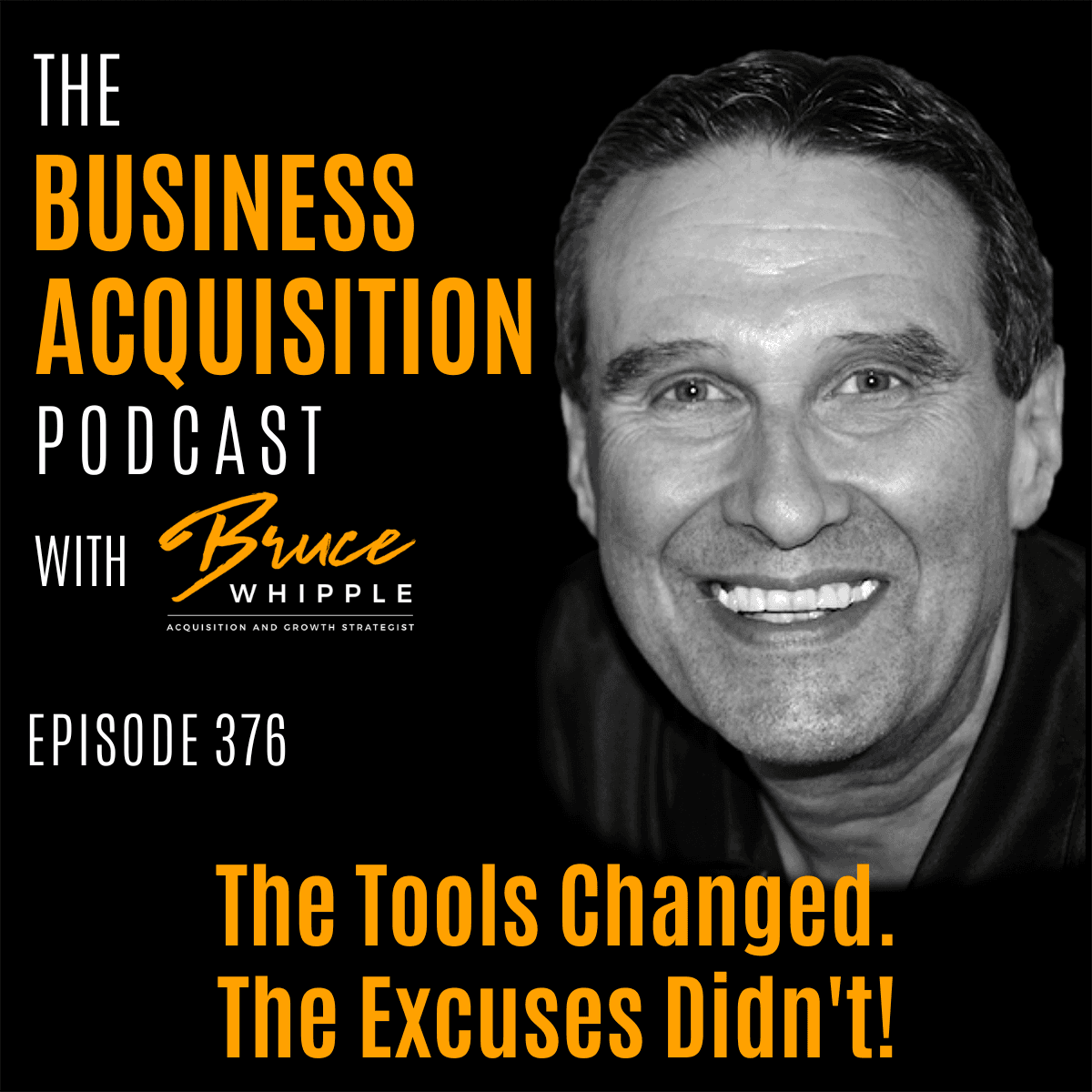
376 - The Tools Changed. The Excuses Didn't!
Episode Overview In this episode, Bruce Whipple discusses the common excuses that hold entrepreneurs back from taking action in business acquisitions. Drawing from his extensive experience, he emphasizes that while the tools available for acquisition have significantly improved over the years, the mindset and excuses of individuals looking to enter this space have largely remained unchanged.
Key Topics Discussed
- Historical Context of Business Tools
- 1990s Tools vs. Today:
- Communication relied on fax machines, phone calls, and in-person meetings.
- Research involved networking and contacting professionals directly.
- Tools such as Zoom, AI, and social media platforms have made processes faster and more efficient.
- Common Excuses for Inaction
- Individuals frequently state:
- "I'm not ready to pull the trigger."
- "I'm still researching."
- "I'm waiting for the right moment or person."
- "I don’t know who to reach out to."
- Bruce admits to experiencing similar excuses, highlighting a universal challenge in overcoming inertia.
- Fear as a Driving Force Behind Excuses
- Many excuses boil down to a fear of rejection or failure.
- Highlighted that rejection is a part of the process and that successful sales often require multiple follow-ups.
- The Importance of Action and Discipline
- Bruce stresses that having the right tools is not enough; consistent, disciplined action is required.
- Emphasizes that many people fail to follow up or take the necessary steps to engage potential leads.
- Case Study Example
- Bruce shares a recent interaction with a potential client who expressed interest in his VIP Mastermind but had not taken any action since 2020.
- The individual had not engaged with the program or sought help, signifying the importance of taking action rather than remaining passive.
Key Takeaways
- Tools vs. Mindset:
- The tools for business acquisition have evolved, making resources more accessible, but the mindset of waiting and making excuses persists.
- Action is Key:
- Successful outcomes are a result of proactive behavior rather than waiting for ideal conditions.
- Follow-Up is Essential:
- Most successful deals occur after multiple interactions. Persistence and follow-through are crucial in establishing connections and closing deals.
- Understand Your 'Why':
- Knowing your motivation is vital for enduring setbacks and challenges in the acquisition process.
- Utilizing Existing Resources:
- Leverage available tools and networks effectively to make the acquisition process smoother and more efficient.
Conclusion Bruce Whipple encourages listeners to reflect on their own barriers to taking action and to recognize that the landscape for business acquisition offers more resources than ever before. By overcoming excuses and taking disciplined action, entrepreneurs can set themselves up for success in acquiring profitable businesses.
Call to Action Listeners are encouraged to subscribe to Bruce’s YouTube channel and podcast for ongoing insights and strategies on business acquisition.
Written by AI. May contain mistakes. Listen to the episode to check what was said.
Transcript
Automatic transcript. May contain errors.0:00Yesterday I put up a video which was entitled, Are You Stuck in the Past? and if you go over to my YouTube channel, you can get there through brucewhipple.com or just do a search for Bruce Whipple. You can watch that and I encourage you to do that. It's really striking the difference between when I first started to do this in the 1990s and today. But today I want to talk about something I hear all the time. Not once in a while, but basically every week. And it usually sounds something like this. I'm still not ready to pull the trigger. I'm still researching. I'm waiting for the person to get back to me.
0:41I'm waiting until I'm more prepared. I sent one message, but I didn't hear back. Now, there are different words, but it's basically the same excuse, and I would be lying if I didn't say that I suffered from this on occasion as well. But the tools that were in the 90s versus today, the tools have changed significantly, but the excuses haven't. So let's take something simple like reaching out to board members. In the 90s, there was no way to quietly research someone online like there is today. You ask lawyers, accountants, other contacts, basically networking, maybe other CEOs. You called receptionists.
1:25You waited, sometimes weeks. Meetings meant that you had to get on flights or take trains and oftentimes took a full day to have one meeting. It's so different today with Zoom and tools like that. Nobody said, I'll wait until I feel more confident. You either made the call or you didn't move forward. Today, people say, I don't know who to reach out to. And that's simply not true. You can search by industry, geography, experience, even retired executives. The information is right in front of you at a keyboard's touch. And the real excuse is fear of reaching out. So what about professionals? Back in the 90s, you used printed directories or the yellow pages.
2:13You may not even know what that is. You left voicemails. You played phone tag. Engagement letters went back and forth by fax. My chairman and I communicated almost every day back in the 90s via fax, handwritten notes and a fax machine. But now I hear I haven't found the right firm yet or that I'm still looking for the firm that will give me the right terms. And the translation is you haven't scheduled enough calls. This is a numbers game in part. Zoom, Calendly, AI research, none of that removes the need to raise your hand and say, I'd like to talk. Then there's the acquisition targets where the excuses really show up.
3:03In the 90s, you mailed letters. I still am a fan of letters, but that's one of the few things you had. You cold called without caller ID, you faxed LOIs in hopes the machine didn't jam, you didn't have an email address. I know that's crazy to even think about. I got my first one in 1995. Today I hear, well, the competition's better than me. I don't have experience. I haven't done this before. I don't want to be rejected. Guess what? You will be rejected more than half the time, but salespeople recognize that. or I'm still refining my message. Meanwhile, you can generate target lists in minutes, send thoughtful outreaches, and follow up automatically.
3:50The problem isn't access, it's hesitation. And finally, how do you stay organized? Back in the 90s, organization meant legal pads, file folders, paper calendars, and a Rolodex that could knock somebody out if you dropped it near them and it hit them. Now people say, I forgot to follow up. I lost track. I didn't realize it had been six weeks. That all happens. And I've had experiences with all of those things. But it's not a tools issue. It's a discipline issue. And what is really different today is we have CRMs that remind you. You have follow-ups that remind you so that you can have the ability to forget and have technology remind you.
4:36But people still respond to confidence as they did in the 90s. They still want to know your why. They still care about your integrity a lot. And they still respond to those who follow up and follow up multiple times. Most deals still happen after multiple touches. 80 % of the sales happen after at least four follow-ups, but most people stop at one, and the truth of the matter is most people never follow up. They send a letter, no response, that's it. So when outreach feels hard, ask yourself this. Is it hard because the tools aren't there, or is it uncomfortable because it requires action, repetition, and follow-through?
5:23People built businesses with a phone, a Rolodex, and shoe leather. And now you have AI, LinkedIn, Zoom, and a smartphone. The tools certainly have changed, but the excuses didn't. And as I frequently say, never ask, never get. And I want to give you an example from yesterday. I got a text from a person who said he wanted to talk about the VIP Mastermind. And so I said, okay, well, let's have a discussion. And I went back and looked at him in my database. Didn't have that in the 90s, but do today. And he was joined to my database in April 17th, 2020. He unsubscribed on April 27th, 2020 to my emails.
6:19So he didn't want any emails. He was on my system for 10 days. He never bought anything. He never watched my emails. He did comment that he was very impressed with my YouTube content. Don't know even how that happened. And so he asked a couple questions. He's Muslim. He asked if there was a way to do this process of being a Muslim because there's a problem with taking interest. And there are ways to do that if you're a Muslim. He then started to ask a bunch of questions about should he raise a fund, and I told him the difficulties in doing that. And this process was put together for people who didn't have capital originally put together by my mentor.
7:08And so he had a bunch of questions about that. Ultimately, he asked who had been successful. We talked about that. He asked about me. And I told him that don't worry about all these other people. Worry about yourself. Worry about what you're doing. And the fact that you looked at this in 2020 and almost six years later, you are still at the point of not doing anything, tells me the problem isn't I need to believe this is possible by talking to other mentees or success stories. You ought to know by now that this process works and has worked successfully for 30 plus years. Whether it works for you, I don't know.
8:01Whether it works for this person, I don't know. But I told him that based on your past actions, the likelihood of you doing anything unless you change is extremely low. Have I had people that haven't done anything for four, five, six years, and then a spark happened? Absolutely. But that spark wasn't in this person. He didn't like what I told him. I told him I didn't think we were fit to work together, and he agreed with that. He didn't know the steps. He didn't do any of the work that was required to understand how to do this and more importantly, once you know that, to take action. There is no substitute for that and sitting for almost six years on the sideline and then wondering why other people are successful and he was not is a really interesting point.
9:00So I would take away from that, know what to do, know the steps, but consistent disciplined action, hopefully with someone who can help you, whether that's a board, whether that's me, there's no substitute for that. And there's absolutely no substitute for understanding your why, because this will be difficult. You will have rejection, but if this is important enough, you won't care about that. You'll say, okay, that didn't work. What do I need to change or what do I need to do more of if it did work? So I hope that's helpful. I hope it's helpful to remember that there are plenty of tools out there.
9:43There's plenty of resources out there. There's plenty of people more successful than you that can help you in this journey and in building a board. Certainly when people say, I don't have any experience, the board's credibility in large part becomes your credibility because guess what? You were successful in having them join. So hope that helps. I hope you take action. And if you haven't already, subscribe to the YouTube, subscribe to the podcast. I do this every week.