
 Ask ChatGPT

 The CFO Playbook
24 Sep 2026 · 41m · 16 chapters
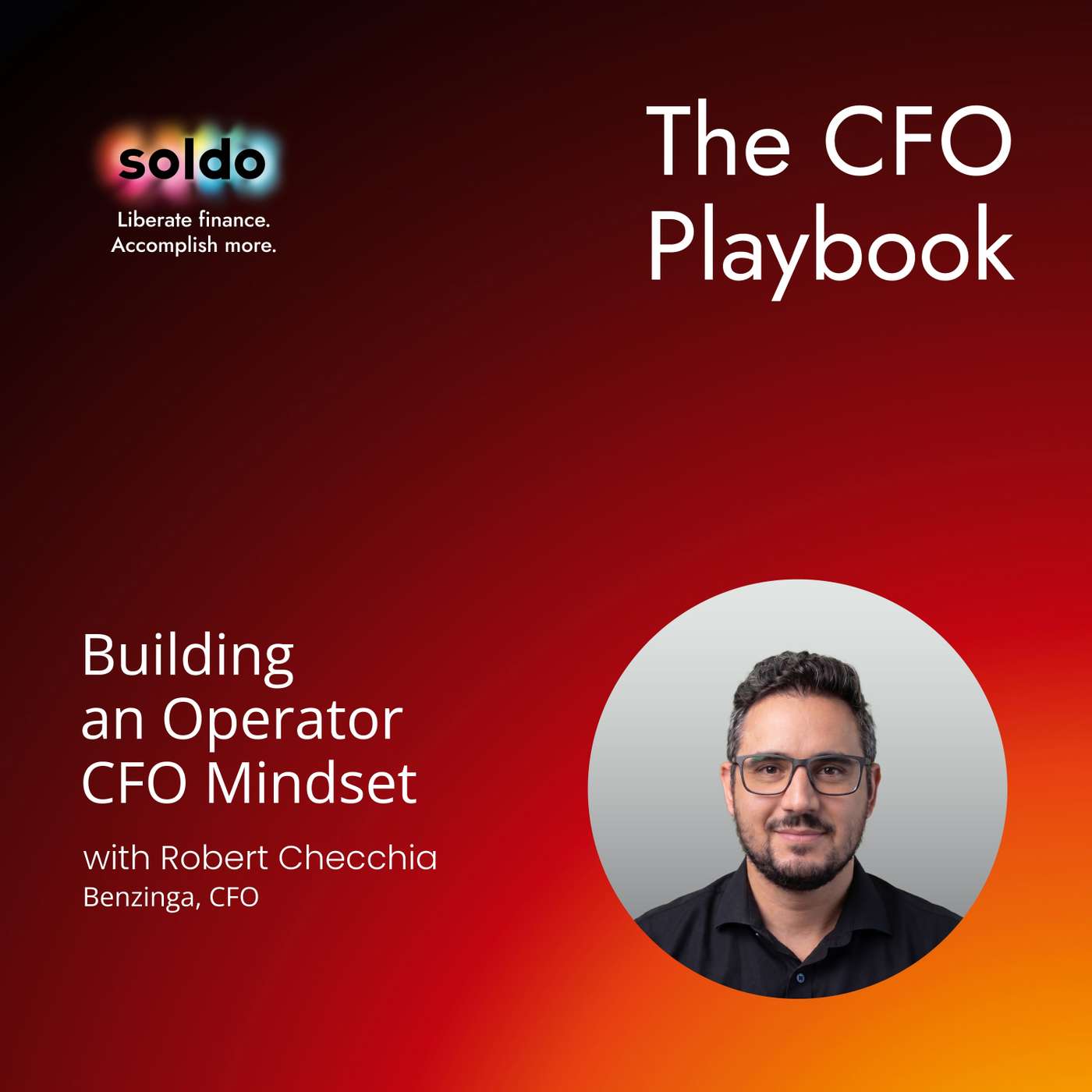
Robert Checchia, CFO of Benzinga, explains the “operator CFO” mindset and how finance should drive growth, margins, and transformation as a media company pivots into fintech. He discusses building scalable processes, empowering P&L owners, using AI for productivity without replacing people, and prioritizing cash generation.
Robert Checchia is CFO of Benzinga (financial breaking news provider). He previously worked across investment banking, private equity, and M&A, and spent time in Brazil after moving there at age 11. Benzinga was acquired by a PE group in 2020; he joined via the sponsor to professionalize growth from “1 to 10 to 100.”
Good CFOs are operators in the trenches with clarity, communication, accountability, and empowerment. “If your company isn’t selling at margin, everything else is for nothing.” Say no to good ideas to focus resources on higher-enterprise-value opportunities. Success is becoming a true fintech within 12–24 months.
A “CFO digest” bot emails daily contract status and collections; P&L owners receive the same monthly margin data pack on the 9th; HR built incentives aligned to growth targets; AI adoption is decentralized with guardrails, and no headcount has been fired due to AI.
Written by AI. May contain mistakes.
Discussion on the key responsibilities and mindset of a successful CFO.
“The CFO's job is also to be a good communicator, an effective communicator.”
Robert Checchia shares insights about Benzinga and his role in its growth.
“Robert Kekia, CFO of Benzinga, welcome to CFO Playbook.”
Discussion about the challenges of maintaining growth and scaling operations.
“I had a small passage through FinPub, financial publishers, but my career prior to that was all in different industries.”
Exploration of how a CFO can drive operational efficiency and team collaboration.
“And that will change, particularly given the rate or change with AI and all the other tech stuff that's happening at the moment.”
Strategies for integrating financial insights across the organization.
“It's a topic that we've spoken about a lot on CFO Playbook, and it's that shrinking of the gap between the back office, typically where the finance function sits, and the front office.”
Robert shares his experiences growing up in Brazil and how it shaped his worldview.
“small tweaks and adjustments, but it's really clarity, communication, designing, holding people accountable and empowering them.”
Robert discusses the important business lessons learned from his father's tech business.
“you become more resilient and adaptable to change.”
Robert reflects on the difficulties faced during his career transitions, including moving back to the U.S.
“then I don't think anyone can have any beef with you about that.”
Robert emphasizes the significance of owning one's results and being accountable in business.
“But at the same time, I think that today I'm much more held accountable for my analysis, my recommendations than I was before.”
Robert explains how the company is evolving from a publisher to a fintech business.
“It's not that desperately old a company.”
Learn how industries are pivoting towards fintech and the role of the CFO.
“When you are at the forefront of providing them breaking news, immediate data that they can act upon, that is value.”
Explore the balance between analytical tasks and business development in CFO duties.
“The pathway there was, you know, being, being creative and, and analytical.”
Understand the importance of investing in human talent alongside AI technologies.
“married, everybody's tied together, the business delivers results, they get their their fair share as well.”
Discover what success looks like for a CFO in a rapidly changing industry.
“Yeah, it's about humans taking advantage of AI, not the AI taking advantage of humans.”
Insights from rapid-fire questions on automation and communication tools for CFOs.
“First of those is, if you could automate one part, just one part of your role tomorrow, what part would it be?”
Empower your team and maintain ethics for long-term success.
“So what is a top piece of advice for a finance leader that you would like us to enter into our CFO playbook on your behalf?”

Get the gist, explore an idea or ask about something said.
 Claude
On The CFO Playbook, what are the key points of this episode?
Searching your listeningAutomatic transcript. May contain errors.
0:00Robert Checchia: Hello and welcome back to the CFO Playbook podcast with me, David McClelland. And here on the CFO Playbook, we get under the skin of how world-class finance leaders leverage technology, set goals, make plans, manage teams, and much, much more. My guest today is CFO of Benzinga, the market data company taking on Bloomberg and Reuters with a background across investment banking, PE, and M &A. he's now spending his time trying to turn a media business into a fintech one.
0:32David McClelland: What differentiates a good CFO from a bad one is the good CFOs are operators as well. They understand everything. They're in the trenches. Clarity, communication, designing, holding people accountable and empowering them. The CFO's job is also to be a good communicator, an effective communicator. I have a bot that tells me every day across all the businesses what contracts were closed, were signed, how much we collected, what's pending. Every morning I have a CFO digest. This is what's happening based on your internal communication and what's happening in the market. You can have the best analysis templates, whatever.
1:09David McClelland: If your company isn't selling at margin, it's all for nothing. Get off the soapbox, get down from the high horse and really assist with the operations, improving operations. You know, cash is king. So if you're not selling, bringing it in, delivering with a good margin, everything else is in vain.
1:24Robert Checchia: The CFO Playbook podcast is here every month with exclusive finance leadership insights. So make sure you subscribe, browse through our back catalogue and get in touch. As many of you do, your suggestions really do help to shape our show. Right. Let's meet today's guest.
1:42David McClelland: This episode of the CFO Playbook is brought to you by Soldo. Trusted by over 25 ,000 organizations across 31 countries, Soldo combines pre-programmed cards, an intuitive app, and a powerful management platform to replace manual processes with efficiency and control. To find out more or to book a demo, visit soldo.com.
2:10Robert Checchia: Robert Kekia, CFO of Benzinga, welcome to CFO Playbook.
2:14David McClelland: It is my absolute honor and pleasure to be here, David. Thank you for the invite. And I was really looking forward to talking to you.
2:20Robert Checchia: For listeners who may not know Benzinga, give us the short version and we'll expand on it in a bit more length in a minute. What does the business do?
2:29David McClelland: Benzinga is at the heart. We are a financial breaking news provider. We're a team of journalists covering financial markets, mostly focused in the US. and our moat, our reason to exist is to level the playing field in terms of data between institutional investors and retail investors. That's the core.
2:49Robert Checchia: I mean, media as a whole is an interesting space. When you start to bring together technology and media, that becomes even more interesting. Disclosure, I used to work for one of those companies that you are disrupting. I spent a long time working with Reuters. So that was a long time in the past though. So don't worry, no feet that I'm treading on now. Give us some insights into why you were first brought into this role, what, three or four years ago now.
3:18David McClelland: Benzinga started, again, it's a relatively new company and it started from nothing out of Detroit. And again, amazing job that the founder and the original management team have done. And they ultimately got acquired by a private equity group in 2020. And things continued to grow parabolically. It was a super accelerated growth. I came in through the private equity group. And my mission was to not let us lose the original secret sauce of why the business was so successful, but also apply more discipline and more professional management techniques. Right. So we can go and then take that big next step.
4:00David McClelland: Right. And I've I've had a lot of great support, not only from the team, but also from our private equity sponsor, because it's it's one skill set to go from zero to one. It's another skill set to go from one to ten and then from ten to one hundred. Right. So we really want to supercharge everything that the company does well and implement and increment on, you know, on the culture, on everything, on that secret sauce and bring the company to the next level. So that's where I was brought in. And it's been a journey. I had a small passage through FinPub, financial publishers, but my career prior to that was all in different industries.
4:38David McClelland: So it's been really interesting, great learning opportunity for me.
4:40Robert Checchia: Sounds fascinating, the journey that you are on there. And so private equity obviously had come into Benzinga, seen the opportunity to grow. It was already on quite a steep curve at the point at which you came in, though. So has it been a challenge to maintain that curve? Or is it really about maturing the processes, creating that foundation for that next stage of growth, that next stage of transformation?
5:09David McClelland: That's a great question. I think it's been a little bit of both. Because ultimately, as with any private equity play, the idea is to grow the enterprise value of the business. So a big part of that was coming in. And one of Benzinga's superpowers was we were very scrappy, very dynamic on attacking new markets, developing very quickly new products, new geographies, new clients. And that is what we did very well. But between that mix of different portfolios, of profiles of products, there's obviously some that perform better, some that perform worse in terms of margin, in terms of replicability, scalability, and ultimately what are those that add higher enterprise value.
5:56David McClelland: OK, so a big part, a big part of the project here, the work is saying no to good things. So we have capacity, bandwidth, even resources to say yes to bigger and better things. OK, so it's it's really being, oh, my gosh, does this look like a good opportunity? Yes. But is it the best use of our time and resources and energy? Maybe not. So we have to shift the focus there. So it has been challenging in terms of adjusting that little piece of culture, which is OK, hey, you're really going to say no to this good project? Yeah, I am, because something bigger and better is on the way.
6:30Robert Checchia: And I guess, you know, given the characterization of Benzinger and the market in which it operates, it's been a fast-moving business. It's relatively young. It has created a real hole for itself in the market. So I bet there are an awful lot of new ideas for the products, for markets, for, I guess, anything really that would move the business forward. and it's up to somebody and you are part of that conversation to know what to say no to, but also what to go all in on. And that will change, particularly given the rate or change with AI and all the other tech stuff that's happening at the moment.
7:06Robert Checchia: Those decisions need to be made in the moment right now, not with a view to 12 months away or what happened 12 months ago.
7:13David McClelland: That's absolutely correct. And a big part of Benzingo's DNA, Benzingo's culture, and something that I learned a lot about here too is a lot of the products and solutions that we've developed came through direct feedback from our partners and clients. But it's at the same time, okay, is this something that one person is asking for? Or is it something that there's a material volume, a critical mass there of people asking for? And what's the size of the opportunity at hand, right? We want to be the best and the fastest partners and providers of solutions, but we also have to measure, okay, let's let Pareto principle, right?
7:51David McClelland: Let's start with something that has more critical mass, that has more potential marketability, and then we go down from there. So it has been interesting, but also it's been very fun because you get to analyze a bunch of different ideas. There's not a lack of ideas, Dave. It's really selecting the best ones.
8:13Robert Checchia: It's a topic that we've spoken about a lot on CFO Playbook, and it's that shrinking of the gap between the back office, typically where the finance function sits, and the front office. So my question to you is, as a CFO, how do you get close enough to the business, to sales, to product, to engineering, to be able to ask the questions, kick the tires, so that you know the decisions you're supporting the business in making are the right ones and not being made just by the sales and engineering teams?
8:41David McClelland: What differentiates a good CFO from a bad one, and I've tried to emulate the good ones that I've encountered throughout my career and even learned from the bad ones, which what not to do, is the good CFOs are operators as well. They understand everything. They're in the trenches. Benzinga's headquarters is in Detroit. The first two years, I was in the office every other week for the full week to really understand everything from the ground up. OK, and that's not only for for knowledge, you know, my knowledge to make better business decisions and share the information and communicate better with the other executives and our private equity sponsor.
9:20David McClelland: But it's something that you earn the respect of everybody who's done in the trenches. When you're when you're shoulder to shoulder with people, we have this problem. This is urgent. We've got to fix it. And then you OK, how can I help? How can I adjust this? What what little piece can I do? I'm not an engineer. Right. But is there something that I can do to simplify to make your life easier here? You earn the respect, you earn the buy-in of the entire team. So I think that that's a part that was crucial for my development here and growth as a CFO, but also for us to maintain, us to keep that knowledge in-house and really be more selective.
9:56David McClelland: We can distill better now through the sea of ideas and data points. We can shift through that and say, okay, these things are what matters. Let's use these to make better decisions. So I think that's important, not only for your personal developments and growth of the business, but to earn the morale and the respect of the team. And it's going to serve you better when you're making better informed decisions.
10:20Robert Checchia: It's easy to think of a finance function. I'm sure in some places that I know in some places that has been the case. There's an element of gatekeeping as well. It's like, yeah, we're the finance team. Don't you worry about that. We will look after it for you. so my question therefore is when you come to something like under helping the rest of the teams the product teams the sales teams the engineering teams understanding things like margins you know we spoke about how profitable and and the growth that ben zinger has been on um how do you when obviously you're trying to shape the products and trying to shape the services that you provide to make sure that you are able to grow margins as best as possible how do you make sure that the rest of the business understand something like how the finance works, how the margins work.
11:05Robert Checchia: So it's not just the finance leaders who have a grip on the numbers, the rest of the business does as well.
11:12David McClelland: The source of truth for financial information, margins, profiling, everything is the finance team. But really, Dave, it's built from the bottom up. So the first layer of the pyramid is you have to have all your accounting in order. You have to have all your books straight. And then what that involves is what that entices is you have all your processes, you know, when closing is going to be, you know, when every report, the forecast, the updated review, the updated margin breakdown, all of that, you know, when it's going to be within the month. So what that does is it occupies less mental real estate.
11:48David McClelland: Okay. The next part of the pyramid is for you to have a more financial planning visibility. Okay. So, Hey, I want to have, you know, still centralized maybe in finance, but a profile of margins within the business, you know, of each business within the company or, you know, some specific other specific analysis. But once you get to that stage, okay, then what you do is I, you know, we, it started with the org structure. So we redesigned the org structure to have real P &L owners for each part of the business. Okay. And within our reporting calendar, within our reporting and planning calendar, we empower each one of those P &L owners with all their breakdown of data, okay?
12:29David McClelland: The same day, every month, the same template, same format, same breakdown and everything. And then we can increment on that, right? We can build up and improve it. But they know that on every ninth of the month, they will get their data pack with their margins, by products, by team, everything broken down, what was commissions, what were their expenses, what were their allocated costs and expenses from corporate. So I feel like when you bring people to the table, empowering them with more information, more data, what happens is you multiply. You're not only your eyes and ears and mouth, everybody's speaking for you, rowing in the same direction, seeing things that you aren't seeing when you aren't present and reinforcing the same message.
13:12David McClelland: When you can show, hey, we have to get, the company needs to get to these targets. That means that your P &L needs to get to this. And then they understand, oh, that's the importance of my profile, my company. It's not just revenues. It's revenues at a certain margin, right? It's, hey, this product mix, I can't just push this one because the margins or the profile is not as good as the other one. So I feel like when you bring people to the table, when you empower them, when you celebrate the victories, right? And not only that, because it can't be just the stick. There has to be the carrot too.
13:48David McClelland: And it is important to celebrate the wins. You multiply your efforts exponentially, you know, so it's, it's a, that's, that's my, that's my, my playbook that I've used repeatedly throughout my career, but I feel like it, it's always worked or, or, you know, and obviously small tweaks and adjustments, but it's really clarity, communication, designing, holding people accountable and empowering them.
14:11Robert Checchia: Go back into your professional background, Robert, because U.S. based, as you've said right now, U.S. born, but a formative part of your upbringing and well, maybe business industry grounding as well was spent outside of the U.S. was spent in Brazil, I think. What can you tell us about that?
14:32David McClelland: Yes, yes. When I was, I grew up in Queens. When I was 11 years old, one day my father came home and said, hey, pack your bags, We're all moving to Brazil. And that was, yeah, that was fun. It was in 1997. I lived in Brazil for 20 something years. So all my, my, my education and a big chunk of my professional life was abroad. But at the same time, you know, I've always kept ties with the U S I've always come back and, and, you know, uh, just knew what was going on. And then one day I did this, I did the opposite, right. I woke up one day and I told my wife, listen, we're moving back to the U S and we we did it i i best decision i've ever made as as with everything in life dude i think there's pros and cons i think that it brought it having lived abroad for a long time in a different culture and having come back you always you always have a measuring stick you know you always have something to compare but i feel like it really you know traveling in general opens your eyes right?
15:34David McClelland: Expands your, your, your mind. Imagine living actually abroad, not for a short amount of time, but really, you know, consuming the culture. And I, and that culture is not just entertainment or lifestyle. It is how management is done as well. Okay. I feel like when I moved back to, to New York and New York is a, is a melting pot, I can identify like the profiling of, Hey, this, this type of culture values this in, in the business context, and this type of culture values something else, you know? Um, me personally, I'm very direct and very, uh, uh, straight to the point. And I've, I've acknowledged and know that there are certain cultures that don't appreciate that.
16:12David McClelland: Right. So it's, it's, it's knowing where, where and when to apply the differences and that, that really opened my eyes. Okay. So, uh, uh, to, to, to answer your question, it was, I think it was very rewarding at when, when I, you know, when I moved back, went, oh my God, what's going to happen? Nobody knows even the companies, despite them being, you know, listed in the New York Stock Exchange. Nobody is as familiar. But today, looking back and connecting the dots, I really do feel like that is my superpower, okay? It's having lived through different cultures, work cultures, and it gives you, you become more resilient and adaptable to change.
16:50David McClelland: You know, you have at the same time thick skin and doing changes, but you also know where to apply pressure and where not to. and sort of you can you you just get a different sense of empathy okay for different uh contexts
17:04Robert Checchia: that sense of perspective that you speak of there that kind of uh empathy cultural context really really useful particularly in international organizations the business side though something that i want to just delve into a bit further there because when you moved over to brazil your father built a tech business. And that was a journey for him. And I'm sure the whole family as well. So my question then is, what did seeing entrepreneurship and business so close up teach you? And what impact has that had on what you thought about building a business career of your own?
17:42David McClelland: What I learned, one of the main things I learned, obviously ethics, your word is your bond. Okay. Cause when you, when you're starting something from the ground up, um, you depend, you're not always going to have a formal enforceable contract with everything, right? So business ethics and, and, you know, just relying on, on having good partners and honoring your word, even if there's a short term, you know, gain from swaying away from that, from what I've seen in the long run, it's not 90%, it's a hundred percent. It pays out. And so I think business ethics and, and, and, you know, growing together with partners.
18:20David McClelland: That's the, that's number one. Number two, I would list as you're never going to have the complete data, you know, everything, all the context, all the data points. So making the best decision in a timely manner with the information you have, that is, at least for me, it was a learning exercise. Okay. My, my, my background is in, is in physics. I love science. So you, you come from an, you know, academia, you'd say, okay, I know all the conditions here. It's given in the textbook, right? But real life doesn't work like that. And guess what? You're going to have to make a million decisions with imperfect information, and you're going to have to make them on the fly sometimes and keep everybody informed and explain why you had those decisions and be held accountable for them.
19:03David McClelland: It's not for the faint of heart, right? Because sometimes you will make bad decisions inevitably, but it's honoring that. And on average, you're making good decisions, right? you're building that muscle. So that's a big lesson that I learned as well.
19:17Robert Checchia: You can only make a decision based upon the information that you have with you at the moment. And sometimes we make the wrong decisions, but for the right reasons. So as long as you have confidence and you've got your framework, your principles about why you made that decision, then I don't think anyone can have any beef with you about that.
19:36David McClelland: You can have the best analysis, templates, whatever. If your company isn't selling at margin, it's all for nothing, right? So, and I'm saying this to myself as well. It's get off the soapbox, get down from the high horse and really assist with the operations, improving operations. You know, cash is king. So if you're not selling, bringing it in, delivering with a good margin, everything else is in vain. So, you know, many other smaller lessons, but I'd list those three as the main ones. Business ethics, decision-making with imperfect information, and always, always, As always, cash is king. The operation is king.
20:13Robert Checchia: So you mentioned you actually started off with a physics career, I guess, or at least physics education. Then your career has crisscrossed between banking and consulting and fintech and M &A. Obviously, some PE experience, which maybe helped to bring you into your current role as well. Which career transition have you found the most challenging? and, you know, for example, moving from one industry to another, one type of role to another, or maybe even the transition out of where you were in Brazil back to the US. Which are the lessons that you've learned from those career transitions that you take with you today?
20:51David McClelland: Wow, this feels like just having beers here with my friends. It's good to reflect on the story, right? I think there were a couple that were hard. The first hard one was going into consulting slash banking with a different background because it's a very tight-knit community, you know, and they are always looking for the exact cookie cutter background, you know, profiling, age, everything. So it wasn't only about networking myself in. It was about proving myself in, okay, that I think I was successful in. But that was, I'll put that as a medium challenge. I guess the hardest challenge was, as your example, was moving back to the US.
21:36David McClelland: I moved here with, I didn't have any job. So I started, you know, I took some steps back. I started my life back again from zero. So that was a big challenge because it's, you know, I have to convince everyone, oh, you know, I have a master's in Brazil. Okay, what is that? Oh, where did you work in Brazil? And not everybody's going to be familiar. So you have to win, you know, you have to cross that initial gap and then earn your way in, you know, network yourself in and prove yourself in again. So that was another one. But after that, I want to say breaking into consulting banking, moving back to the U.S., it's all been, quote unquote, easy from there.
22:17David McClelland: Okay. Every, every other challenge has seemed a lot easier. Um, I think from comparison, but also, you know, it's, it's, uh, there's a lot of prestige in, in banking consulting, but it, it, it teaches you a lot. You've developed thick skin, you know, and those, that skillset is replicable outside of that, you know, space and industry. Um, another point that I wanted to make here is, you know, nobody invited me to go into banking consulting. Nobody said, Oh, move back to the U S it's, it's what I, one thing that I'm very proud of is I saw the trajectory that my life was going in and I said, no, no, no, I want to change it.
22:52David McClelland: You know? So it's, it's something that I invite everyone is, is if you're not happy, if you're not fulfilled, if you don't feel like it's for you, you can always pivot, you can always shift away. Okay. And, uh, you know, and rebuild and start again. And so it's, that's, that's something that despite being scary, I was, you know, I was very comfortable in many situations, uh, um, in Brazil, in banking and, you know, to say no to something that's assured and quote unquote comfortable for the unsure is a big leap. Um, but today I look back, I'm like, Oh my gosh, that's the best thing I could have done professionally and personally.
23:31David McClelland: Okay. So, uh, I invite everyone to reflect and change their trajectory if needed. A big part that I want to, I want to mention here too, you know, unsolicited, they've, but they've, it is, there's a lot of prestige in banking, in consulting, right in that, you know, corporate controversial here, hot take. There's a lot of stuff that, that, you know, again, there's a lot of pros, but after leaving that and, and diving in and becoming an operator, you, you create, you know, a different view of things and, and you take what's good. But at the same time, I think that today I'm much more held accountable for my analysis, my recommendations than I was before.
24:14David McClelland: And I feel that's thrilling and empowering, but it is also scary because you don't just have to make the recommendation. You have to, a year from now, explain what went well and what didn't. You've got to own them.
24:27Robert Checchia: Yeah.
24:28David McClelland: You've got to own your results. That's exactly it. And maybe it was the first company I worked at was a portfolio of the 3G Capital Group. They would drill into us. You own your results. Whatever you do, big or small, you own it. You own it. And I've carried that with me. Everyone I train, everybody that works with me is, I don't care if you work extra hours or weekend or if you work less, you want to take this time off. It's all doable. You just let's schedule accordingly, make sure everything's covered. But what matters to me are the results that we deliver, okay? And being held accountable for those.
25:05David McClelland: And, you know, not shying away. Oh, it didn't go well. Okay, let's fix it together, right? Instead of pointing fingers or anything like that. I think that's something that I've carried with me my whole professional and even, you know, sunk into my personal life as well is always own your results for your processing.
25:24Robert Checchia: Well, you owned your journey back to the US and I'm sure you're owning your role now in Benzinga. And let's come back to where you are at the moment. And the company is, and we touched on it earlier, it's going through an evolution. It's not that desperately old a company. And it's evolving with the times, as frankly, most media companies are having to do. So evolving from a financial and kind of market data publisher into a fintech business. First of all, what does that actually mean? Make that feel real for us. And then what does that change mean kind of inside the business and also inside the finance function?
26:07David McClelland: I just came back this week from an ad tech event in Florida called Digiday. And we were together, publishers, with everyone, every vendor from the ad tech side. And a common theme was for across the board with with AI, LLM, everybody's traffic, site traffic is down between 20 percent all the way. I heard numbers between 16, 70 percent. OK, so that model, which today, you know, or as of recently was already a lot smaller than from seven, eight years ago. You know, it's a lot harder for you to make consistently constant money on through digital advertising because the CPMs have come down. Because people, you know, they go to less, they go, people are visiting less websites because they just go to Google.
26:55David McClelland: And even less, they don't even use Google anymore. They just go to AI, the Gemini say, hey, what's this? They don't even go to the source page, right?
27:02Robert Checchia: AI summary right at the top that's promoted means you're not clicking through to the websites anymore, which, like you say, is a real challenge for anyone who's relied on clicks on the internet.
27:12David McClelland: That's exactly it. So with that, you know, the more traditional publisher model, we have to shift now into a fintech. And what that means is, okay, how do we monetize this amazing content? You know, how do we monetize all this knowledge that we have from our 100 plus team of journalists? So, number one, we have to find off-site traffic and monetization mediums, right? But also, how do we continuously add more value? So that becomes how do we create and develop and improve all our B2C subscriptions products, okay? Where you can have an in-depth view of everything that we produce, okay? Another point is we partner with brokerage firms, with asset managers, with really anybody who hedge funds, anybody who manages assets and makes investment decisions.
28:02David McClelland: When you are at the forefront of providing them breaking news, immediate data that they can act upon, that is value. OK, so it's being trustworthy at a decent time frame. Right. And at a good cost. And again, in a format that it's already chewed up so they can just process easier. That's when that's where we were developing and turning into a fintech. So partnering with all these players in financial markets, hedge funds, asset managers, brokerage firms and developing our subscriptions business. Right. That's a big part of the of the pivot in becoming a fintech. And away from the more traditional publisher model, which, you know, newspapers dead, they had to reinvent themselves.
28:48David McClelland: So I feel like the industry is going through the same phase.
28:51Robert Checchia: so as you are uh helping the business to re-nose readjust to this evolving model should we say um what are the kind of problems then that you are that you see the problems challenges opportunities could call it what you will as a cfo that you anticipate you're going to be tasked or asked to solve as you go through this transformation that's that's a great point because
29:20David McClelland: nobody tasked me with, with this, the specifics that what they task was grow, right? Grow, get to this number. The pathway there was, you know, being, being creative and, and analytical. And like we mentioned before, being an operator. Okay. So, um, when, when, when, you know, I, cause we have to be, we have to, you know, be careful with the nomenclature in words, CFO, right? And in my view, CFO is also entices a lot of the COO role as well, operations, business development. Okay. So that's the main point. You know, I'd say more than half my time is business development, meaning growing the businesses we have and expanding either into new geographies or the new product development, new roadmap thing, new roadmaps, things like that.
30:09David McClelland: Okay. So, um, that nobody sat down and said, Oh, here you go, you know, go develop a new product that it's the opposite. We, the executive team and myself also, okay. These are some ideas we have out of the 10, three have potential. Let's run with these three. Okay. I think that's, that's the biggest challenge again is, um, saying no to the good ideas. So you can say yes to the amazing and great ideas. Okay. But it's, it's also finding the path. Okay. Cause when, when, private equity sponsor comes in and says, hey, this is your guidance. This is where you have to be. Revenues, margin, profile, cash generation, et cetera.
30:45David McClelland: Shoots. It's a long stretch from where we are, maybe in the business, we have to develop. So what are we going to do? Organic growth and organic growth. Within organic, how are we going to expand? Is it geography? Is it a new sales team? Is it a new structure? And then once you start drilling down, one thing I'm very proud of is I installed and built the HR function. Why? It's not to do payroll. It's because to build incentives that align with our growth targets. Okay. And I took that, you know, to myself, because that's, again, empowering people. You have to identify your talents, empower them, and reward, you know, when they're rowing in the right direction.
31:27David McClelland: And, you know, when you're married, everybody's tied together, the business delivers results, they get their their fair share as well. Cutting through the noise and doubling down and pushing and learning, right? So you can make informed decisions and put the right people in the right places, okay, to get things done.
31:43Robert Checchia: It's really good to hear people playing such a central role in, you know, as you start to look towards what's next and about transformation, because in so many, so many conversations, particularly with tech companies at the moment, it's AI instead of people. So to hear you talk about investing in people, building up the HR function there, as you mentioned, too, and then being the key to unlocking the growth, organic, inorganic. That's pretty great to hear.
32:10David McClelland: Yeah, don't get me wrong, though. I have a lot of friends still in banking and different roles. And when they tell me their usage of AI, it's very centralized. You can only use one tool and not the other. we have, we, you know, our CEO was our CTO priorly. So that's, there's no weather we're putting our money where our mouth is, you know, so, so, uh, um, the CEO was our CTO and we empower everyone to start and build their own tools in AI in, in, you know, we, we, we give them licenses and usage and tokens on many different platforms. And once they achieve a certain part of maturity, then we centralize it, we optimize, we build upon it and make it more scalable.
32:59David McClelland: So one thing that we do super well is the adoption and usage of AI. One thing I'm very proud of as well is we have never fired a person, oh, we'll just replace them with AI. It's different. The bar raises. So everybody is incentivized and kind of mandatory for them to use AI to increase their productivity. but we have not replaced any headcounts due to AI. We also keep the guardrails, you know, so nobody can go rogue with the tools. But I feel like we've really hit a good point where they test it out, they bring it to our centralized data analytics and science team, we identify the winners, and then we scale up on that and disseminate it across the company for everyone to use our improved tools, AI tools.
33:45Robert Checchia: Yeah, it's about humans taking advantage of AI, not the AI taking advantage of humans. And it sounds as though you are getting the balance right there and empowering the humans to use AI to create new value within the company and supporting them as they do that. Great to hear. Robert, just as we start to wrap up our conversation on Benzinga right now, in a nutshell, what would you say success looks like for you? What kind of time horizons are you able to look at? You know, five-year plans, probably not, but, you know, 12, 18, 24 months. What does success look like for you in whatever time horizon you feel is a useful horizon to look at?
34:27David McClelland: Gotcha. Now, I guess success for me professionally today is for us to make that growth and change that view of us being a true fintech. And I don't think that's too far away. I'd say the next 12 to 24 months. And really taking the company to the next level. You know, it's we didn't mention this, but I've worked in different industries, different countries. This is something I'm very, very passionate about personally, being on the publisher side. And because you there is a real, you know, tangible utility to to our consumers. Right. And I take that to heart. So as long as we're delivering good products and helping people make better investment decisions, that's that's what success looks like for me.
35:13Robert Checchia: Robert, before I let you go, there are some quick five questions that we put to all of our guests on CFO Playbook. First of those is, if you could automate one part, just one part of your role tomorrow, what part would it be?
35:29David McClelland: There's a lot of ad hoc analysis requests that take time for you to sit down and do. That's the human side that AI can't replace because you have to have the stylistic and, hey, I want to communicate this. how do I get there, right? That you have to turn off your phone, you know, turn everything off, your alerts and sit down and do things and say, okay, these sources of data, this is what I want to communicate. How do I chew this up, right? But that piece in answering questions, I've used a lot of AI. I don't want to mention any tools specifically, but there's a lot of that, that, you know, the first steps can be done if you're organized and you feed your second brain in AI accordingly.
36:08Robert Checchia: Maybe related. I'll let you decide that. what emerging tool or habit or idea do you think every CFO, whether they are emerging or established, that they should be paying attention to right now?
36:23David McClelland: I think there's a lot of budgeting AI tools out there. One ad hoc contract controlling management tool or things like that. I think those are all good, but they, you know, they're small additions. They're, they're, I don't want to say niche, but they're, they attack one little problem. Um, the CFO's job is also to be a good communicator and effective communicator. Okay. So one tool that I recommend everybody using is, is, um, they create their second brain in whatever, you know, Gemini perplexity, where Claude, wherever they want, and feeding that through email, their emails to that tool, feeding their Slack, feeding their internal teams, whatever it is.
37:11David McClelland: And, you know, creating an agent to maintain a steady communication tool that is effective. The other part too is it's our job to be good communicators. And a part of that too is to maintain the emotional and financial discipline within the company. Because sometimes everybody's running around with their hair on fire. You could guys, let's calm down. Let's be pragmatic. This is how we attack it. So having that, you know, instantaneous feedback of, hey, how is this going? Hey, help me with this. And not I have to go to my analyst and say, how is this going again? Oh, well, can you remind me of that lawsuit or of this thing that we're looking into?
37:50David McClelland: Right. So I have I have a bot that tells me every day across all the businesses what contracts were closed, were signed, how much we collected, what's pending it goes through my email gives me like a digest every morning i have a cfo digest this is what's happening based on your internal communication and what's happening in the market okay so i i feel like you know you just scale you're much more productive with that okay and you know you have to be a little bit tech savvy but it takes some time to set everything up but i think that's a crucial to everybody's productivity very long-winded answer i'm sorry
38:25Robert Checchia: And which finance leader, past or present, would you most like to see sitting in your CFO Playbook podcast hot seat?
38:35David McClelland: I would love to see, I would love to invite some colleagues, again, from the consulting world to have this experience of operating and seeing from recommendation all the way to implementation and being held accountable. Because I like to see the novel experiences unwind and their reactions and responses to that. That would be one. The other one I would love to sit down with is, you know, there's some of my old colleagues and bosses that you lose touch with, but there's always war stories and reminiscing. I'd love to catch up with them, too.
39:12Robert Checchia: And finally, Robert, here on the CFO Playbook podcast, we are building an actual playbook. Yes, a collection of top advice from finance leaders that we plan on turning into a resource for the community. So what is a top piece of advice for a finance leader that you would like us to enter into our CFO playbook on your behalf?
39:37David McClelland: Value and empower your team. That's crucial. I'd say that one. And again, with ethics. Ethics pay off in the long run. So don't fall into a short-term gain. Focus on the long run and let your ethics drive that. Empower, trust, but verify. and lead with example, you know, earn the respect from your team. So people are the drivers and ethics. And I can't not say cash is king. Please always keep that to heart. You know, that's the most important part that sometimes some people forget.
40:10Robert Checchia: It has been great to speak with you today. Thank you very much for joining us on CFO Playbook.
40:15David McClelland: It's my pleasure, David. Thank you.
40:17Robert Checchia: And thank you all for joining us too. Don't forget to join us every month here on CFO Playbook for more insights from finance leaders, But for now, from me, David McClelland, and all of the team here, bye-bye.
What does it take to become the kind of CFO who can turn fast growth into disciplined, sustainable progress?
Want more insights from finance leaders? Subscribe to Progressive Finance, Soldo’s new newsletter featuring practical leadership insights, finance trends, and conversations with CFOs and industry experts: https://substack.com/@progressivefinance
Is there someone you’d like to see on The CFO Playbook? Email us at: [email protected]
In this episode of The CFO Playbook, David McClelland is joined by Robert Checchia, CFO at Benzinga.
Robert shares his perspective on the modern CFO as an operator: someone who gets close to the business, understands how teams work, and helps turn an ambitious growth plan into clear priorities, accountable ownership and sustainable margins. Drawing on his experience across banking, consulting, private equity and operating roles, he explains why the best finance leaders are not gatekeepers—they empower others to make better decisions.
In his conversation with David, Robert explores the discipline required to scale a business under private-equity ownership. He discusses how to distinguish good opportunities from the few that deserve real investment, how to give P&L owners meaningful visibility into their numbers, and why finance must connect revenue growth to margin, cash generation and execution.
Robert also reflects on building a career across countries and industries, the importance of making decisions with imperfect information, and why leaders must own the consequences of their recommendations. He shares practical advice on using AI to improve productivity without losing human judgement, including how to encourage experimentation while maintaining effective guardrails.
In this episode, you’ll learn: