
 Ask ChatGPT


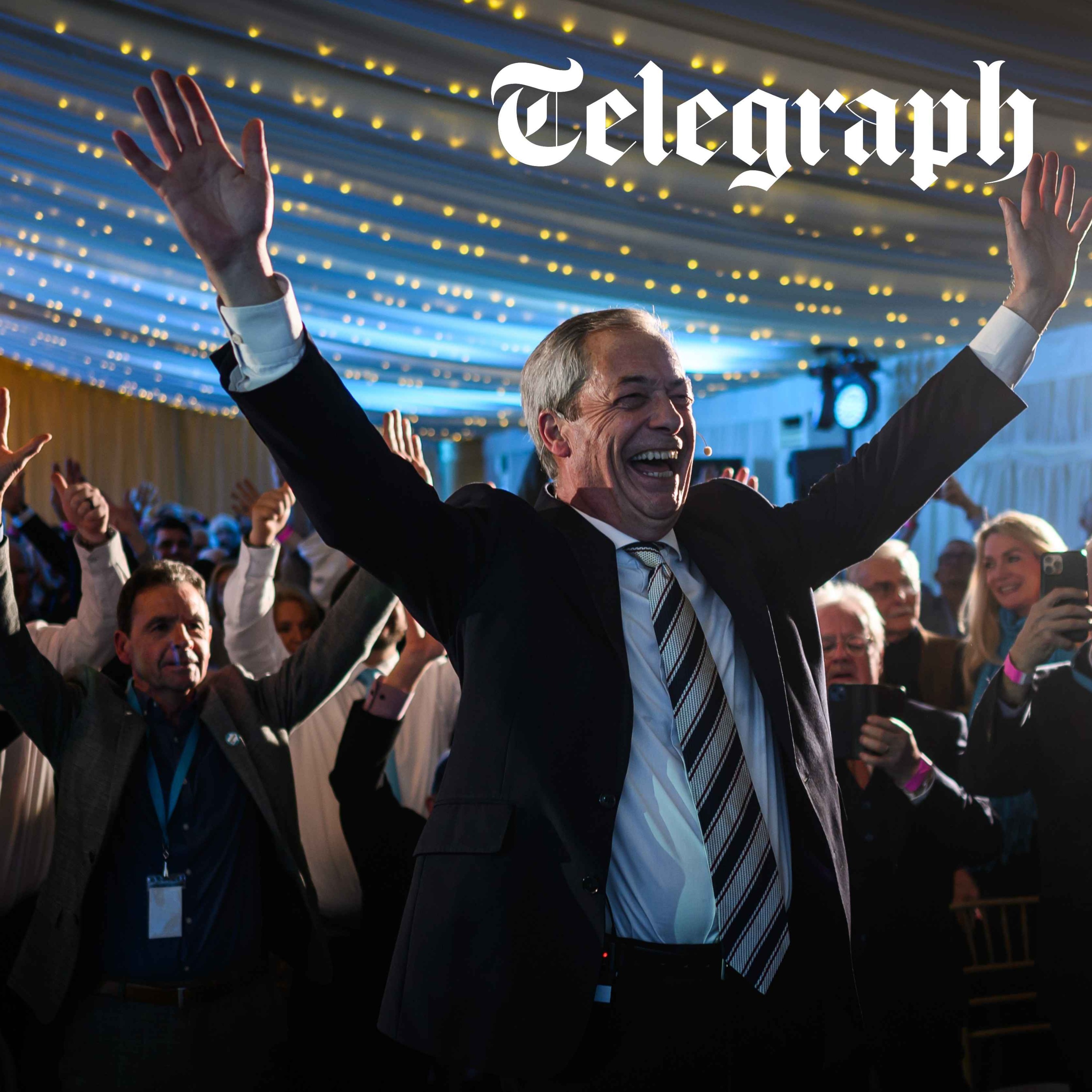
The episode argues that the Conservatives’ only route back to power is a possible post-election right-wing pact with Reform, despite current denials. It focuses on the mood ahead of the Conservative Party conference, Kemi Badenoch’s “Act 2,” and whether Reform’s Nigel Farage can be stopped via tactical voting or coalition/confidence-and-supply arrangements.
Tony Diver (political editor; discusses Conservative strategy, polling, and the electoral math). Nick Tyrone (British-Canadian journalist/author/political analyst; wrote The Rise of Reform).
Badenoch has shifted Tory policy on migration, ECHR, and net zero and is polling above the Tory brand. Reform’s anti-establishment appeal unites “red wall/blue wall” voters, and immigration remains Reform’s strongest issue. A pact is politically unsayable pre-election because it would lose anti-Farage voters.
2019 Boris Johnson coalition of “red wall” and “blue wall”; Labour’s Andy Burnham pushing a second referendum/rejoin; Reform’s internal tensions after Tory defections; Reform’s two-child benefit cap policy reversal.
Written by AI. May contain mistakes.
Discussion on the mood and strategies of the Conservative Party as they prepare for their conference.
“Hello, this is Chris Winterbauer from What Went Wrong?”
An analysis of the relationship between the Reform Party and the Conservatives amid upcoming elections.
“on the eve of the Conservative Party conference, what is the mood?”
Exploration of the strategies the Conservative Party might employ to regain power and the implications of their choices.
“and are saying they won't do a pact, still not enough to take on a progressive coalition.”
Discussion on Nigel Farage's impact on the political landscape and how it affects voter mobilization.
“It happened because of the promise to deliver Brexit.”
Insights into potential tax policies from Kemi Badenock and their implications for the Conservative electoral strategy.
“and he announced all of this massive stuff.”
Discussion on the Tories' struggles, economic challenges, and potential strategies for appealing to voters.
“They have been damaged by the experience of the Boris Johnson years and the Boris wave.”
Nick Tyrone shares his experiences and findings about the grassroots support for the Reform party.
“Yes, I would say that's absolutely the case.”
Discussion on the potential future leadership of the Reform party and its impact on their political trajectory.
“I think the problem would be, the thing with Nigel Farage is he sort of unites the tribe a little bit.”
Analysis of the Reform party's economic strategies and their political identity amidst changing voter dynamics.
“Because in the polls, at least, I mean, they had this extraordinary high last summer where they were kind of like topping 35 percent.”
Discussion on missed opportunities for reform and its stance on populism.
“And you talked about in some parts of the country, they tend to draw from ex-Tories, some from ex-Labor.”
Exploration of Nigel Farage's potential post-electoral pact and its implications.
“Finally, Nick, how pragmatic is Nigel Farage when it comes to some kind of post-electoral pact?”
Analysis of the future landscape of right-wing parties and potential shifts in power.
“But mind you, politicians change their minds with a win, don't they?”
Debate on the potential revival of the Conservative Party amidst shifting political dynamics.
“No, no, I don't mean reform necessarily.”

Get the gist, explore an idea or ask about something said.
 Claude
On The Daily T, what are the key points of this episode?
Searching your listeningAutomatic transcript. May contain errors.
0:02The Telegraph.
0:3020 % off your first purchase. That's B-O-M-B-A-S dot com slash audio. One purchase equals one donated. Always. Hello, this is Chris Winterbauer from What Went Wrong? TCM and Criterion joined forces for the plot thickens Stanley. This season's podcast traces Stanley Kubrick's journey from a curious Bronx teenager, first inspired by a camera gifted to him by his father, to a revolutionary filmmaker who rewrote the rules. Featuring a never-before-heard audio interview with Kubrick himself, go behind the camera with some of Kubrick's closest friends and collaborators to examine his legacy, including Katerina Kubrick, Steven Spielberg, Sofia Coppola, Matthew Modine, and many more.
1:10Available starting now wherever you get your podcasts.
1:18Can the right beat Andy Burnham? As the Tories gather for their conference in Birmingham, the two parties, Reform and Tory, are not competing for first place. They're competing for second. What is the Blues' blueprint for claiming back power and will it involve a pact between Kemi Badenock and Nigel Farage? The thing that Reform has got, shall we say, that the Tories can never have is they have this kind of anti-establishment vibe to them. They have anti-establishment rhetoric and that is what has allowed Farage to unite what would otherwise be quite a difficult coalition of blue-collar voters, voters, white collar voters, the red wall, the blue wall, whatever.
1:56He's managed to find enough people who don't buy the hype. You know, they don't believe in a two party system.
2:10We're now joined by our political editor, Tony Diver. Tony, can I begin by asking, on the eve of the Conservative Party conference, what is the mood? Do they think they can win? will come second? I think the mood's cautiously optimistic, actually. I think what we're about to see at this conference is kind of the second act of Kemi Baden-Ock. The first act being her attempt to wrestle control of the party, move it to the right on a lot of issues, try and take on reform. Now, if she's right and the general election's going to happen before 2029, this is her chance to really put the boosters under her party, try and get a slim lead in the polls, and that gives them the best chance of winning the next general election.
2:52So it seems like a lot of people in their team think that's possible. Okay, has she taken control of the party? I think it's fair to say that certainly on policy terms, she has dramatically changed the Conservative Party from where it was after the last general election on things like migration, on the ECHR, on net zero. There have been some pretty significant policy changes. And I think the thing that she has behind her all the time is these poll numbers that show that she's more popular than Conservatives' brand. Yes. So we haven't actually seen much plotting. It's like a Conservative Party without any plotting.
3:26It's a bizarre situation. Not a lot of criticism from MPs either. She hasn't really faced any big rebellions. How can they when they look at the polls and they see that she is the most popular thing about their party at the moment? I mean, what basis could you possibly launch a leadership challenge? Yeah. Is any of this rhetoric around they can win actually credible? We've had MRP polls that suggest that they might win around 130 seats. One put them ahead of reform slightly, one put them behind. When you add up reform in the Conservatives, notwithstanding the fact that they seem to hate each other and are saying they won't do a pact, still not enough to take on a progressive coalition.
4:06You've then got them trailing behind Labour now that's been given a bit of a boost by Andy Burnham and indeed possibly, we haven't got the numbers yet, but that speech to the Liverpool conference. So I get this whole, they're not dead and buried. There was a period after 2024 where you could literally look at them and think, oh my God, existential crisis. And then people said, oh, they haven't been the most successful political party in all history for nothing and that there's no way that you can get rid of them altogether. And they are kind of cruising along on that 19, 20 at times 21%. but the idea of them winning the next general election Tim?
4:45Well let's ask Tony Tony! Okay well there's loads of questions on there the first one is we don't know when the next general election is going to be and it's currently in the Conservative interest for Burnham to go as long as possible go right out to 2029 which is what he says that he's going to do although of course there's a lot of scepticism about that and a lot of people in his cabinet who think it'd be better to go early so there's the first question that we don't know the second question is what happens to reform and what happens to Nigel Farage now they've obviously had an extremely difficult six months or so and they've suffered in the polls because of that and so if that continues for the remainder of this parliament or if there is an early election and they have to go based on their current numbers then it will be more difficult for them but I think even notwithstanding all of that most people think that there is going to be some form of coalition or confidence to supply deal required after the next general election on the current numbers and that is why this question is whether or not there's going to be a deal on the right is so salient.
5:40But why won't anyone be honest about that? That's what we get so frustrated by. We keep saying to Tory politicians, reform, but you're going to work together, aren't you? Why don't they say now, yes or no? They say no, but why wouldn't they say yes? Well, because the day of next general election is kind of judgment day, isn't it? Up until that point, up until the point that we have the results, we see the exit poll, BBC reads it out at 10pm, Labour and the Tories are battling it out, each to be the anti-Farage party. And it depends what constituency you're in, obviously, but there are so many three-way marginal constituencies now, or constituencies where reform is doing very well, where both of the two other main parties are trying to become the anti-Farage vote.
6:18Now, obviously, if you're Kemi-Badenault and you start talking up the idea of a Tory reform pact, you're not going to get any of those votes. And so up until the point that we get the results, everyone is trying to position themselves as the most anti-Farage candidate or the people who are most likely to stop a reform government. But once the results are in, you then have to work out, well, who's the largest party? Who's got any chance of forming a majority? And at that point, the calculation totally changes. So yes, of course, everyone's going around now and saying that they won't do a deal with reform because you immediately lose the vast majority of the electorate who hate Nigel Paraj if you say that.
6:51So the Conservatives lose the lefties in their midst. Reform lose the righties because they hate the Conservatives as much as Zia Yusuf right now. And so nobody can really say anything. But at the same time, when we look at that extraordinary majority won by Boris Johnson in 2019, obviously it was the uniting of two very distinct and very contrary caucuses, the red wall and the blue wall. And we know why that happened. It happened because of the promise to deliver Brexit. it. Have the Tories given up on the red wall? And if they have, and they're aiming for the blue wall, that criticism that Kemi has still got liberal Democrat tendencies, perhaps not personally, but within the party, that's going to be writ large, isn't it?
7:36I mean, we on previously podcasts have discussed this extraordinary position that Ed Davey finds himself in as kingmaker. By definition, if he's kingmaker, then the Tories need some of his voters, and quite a few of them actually not just some a lot of them and just to say they did well in the local elections in sort of suburban southeast areas right where you might normally think the lib dems would do well yeah so that's a very that's a classic blue wall middle class vote yeah well this is the debate that's going on at the moment but in the conservative party is how what is your electoral strategy because you can't really do both at the same time and the great genius of the boris johnson campaign of course is that he managed to do both but he didn't have the threat of reform in the same way.
8:15So it was a lot easier to do then. Now, the question is, among Kemi's advisors, the question is, do you run an essentially defensive political strategy based in the South and the Southeast with one eye on some seats that you might pick up from the Lib Dems? Or do you run a very aggressive campaign against reform, not just in the Red Bull, but also in the East, where actually you have a very similar kind of marginal, bizarrely, you know, in Essex, you now have a similar kind of marginal to what you might have been looking at in places like Hartlepool, but just without the existence of Labour. But for the Tories, it's then versus reform in both places.
8:48The sort of more aggressive people within the Conservatives think that you should go back after that great sort of Boris Johnson majority. Others think that's unrealistic. And actually, the best thing that you can do is try and stem your losses in the South while trying to be a good alternative to reform for tactical voters. Because it's not just the lefties in the Conservative Party who would be put off by a deal with reform. You also want to try and attract the genuine left-wing voters who ordinarily would vote for Labour but perhaps don't live in a Labour marginal. That blows my mind. And could tactically vote for the Tories.
9:20That blows my mind that while we keep discussing an alliance between reform and the Tories, many voters are thinking about the alliance between Labour voters and the Tories in order to stop Farage. Are you really saying that the biggest issue of the next election is going to be Farage, not necessarily Burnham? At the moment, that's how it's felt. It has felt like that for a while. Right. It obviously depends on what happens to reform. Yeah. And Burnham is trying to seize back the mic, and he did that at the Labour Party conference this year, and he announced all of this massive stuff. I spoke to someone from Number 10 this morning who said to me, look, the main point of this conference is that we're opening up a massive debate on a lot of these controversial topics.
10:03We're not fiddling around the edges. We're not scrapping over the bits of policy detail. We're trying to seize control of some of the debate here and have a proper conversation with the public. But if we went back to 1979, if we want the other person who led the Conservative Party by uniting blue collar and white collar voters, Margaret Thatcher, then really we're talking about a battle between the reds and blues, notwithstanding the yellows and the teals in the background. between people who want to go back to the 1970s and people who want to go back to the 1980s. That's what we're really talking about here, aren't we?
10:40And you could get quite a few working class people agreeing with the analysis that Britain's economy is broken. These could be sole traders. These could be white van drivers. These could be aspirational homeowners. They're certainly what Farage describes as alarm clock Britons who think that there are too many people on the take, that they're getting up at 5am to basically pay benefits to people that don't deserve them. They're upset about mass immigration. They think it's taken British jobs. It sounds like a reform offer, but it's also a very thatch right offer. These are people who aspire to own a bigger home, who aspire to pay off their mortgage, who aspire to pass down their inheritance to their children and their grandchildren.
11:22They might even aspire, shock horror, to send a grandchild to a private school that's now been clobbered by Labour with the VAT hike. So she could capture that audience, but that audience might more naturally lean towards reform were it not so fearful that reformers had no experience of government whatsoever. I mean, this is the other thing, isn't it? If you're in big business, particularly with the donation scandal, if you are the ultimate sort of somebody working in financial services who is white collar, why would you necessarily back reform Tony? You can be very right leaning but you might think oh I don't know Farage and his lot they're a bit spivy for me.
12:03Then she can mop that lot up. I'm wondering whether she could also mop up people who are a bit more kind of like not quite on the factory floor but like more middle managerial than top management. Well yeah I mean I think that you're completely right there is a kind of tension there and if you're I mean the thing that reform has got should we say, that the Tories can never have, is they have this kind of anti-establishment vibe to them. They have anti-establishment rhetoric. And that is what has allowed Farage to unite what would otherwise be a quite difficult coalition of blue-collar voters, white-collar voters, the red wall, the blue wall, whatever.
12:41He's managed to find enough people who don't buy the hype. You know, they don't believe in the two-party system. And perhaps they're looking ahead to the next general election and looking at tactical voting and thinking, well, that's exactly why I do want to vote for Farage. Because the idea that the other two parties are conspiring to stop him from getting into number 10, you know, is something that's going to motivate me to get out there. But actually, if Burnham is committing to a second referendum and is saying he wants to put rejoin in the next manifesto, do we then limp forward to 2029 and re-litigate Brexit, Tim?
13:12Well, no one wants to do that. I'm not sure anyone cares about it. That's the thing. I'm not sure. It's not a mobilising issue. Okay, there'll be some remainers who will be thrilled by that. But one thing that worries me is pro-Brexit people, we've just mentally and emotionally moved on. So I just don't feel excited about that. I would vote against it, of course, but it's not something that mobilizes me in the way that it did in 2019. PR isn't something that anyone would be mobilized for or against necessarily, is it? The great right-wing issue that unites all parts of the right right now is immigration.
13:46Yes. Not Brexit. And reform is better than that. Yes. Right? Reform still owns the immigration issue, Tony. Yeah. I mean, that's what the polls say, anyway, at least. I mean, the Tories have put out a lot of policy on this. They're clearly trying to seize back the narrative on immigration. They have been damaged by the experience of the Boris Johnson years and the Boris wave. And Nigel Farage has been talking about immigration for the last 20 years. So he has an inherent advantage on this. And you look at the issue-by-issue polls and reform is always streets ahead of every other party on immigration.
14:15It's hard to see how that's going to change in the next two years. Quickly before you go, Tony, when it comes to her speech next Wednesday, which we'll be covering with Bells on, do we think there's going to be a scrap inheritance tax pledge in there? We had scrap stamp duty last year. She's going to have to do something pretty headline grabbing, not least to compete with, you know, Andy Burnham's tearful, not tub thumping, but very socialist oratory last week. Well, it certainly sounds like it. I've heard that. It's not been confirmed by anyone, but I have heard that something on inheritance tax is coming.
14:51Inheritance tax is often one of the least popular taxes when you poll people, but it does affect a relatively small number of people. And so to our earlier point, this probably gets at what the Kemi-Badenok electoral strategy is for Act 2. Is it to target the wealthy and people who would normally be hit by inheritance tax and try and persuade them? Or do you look for something more broad-based? And if you're going to cut taxes, something like income tax thresholds would be something which would hit a lot more people. It doesn't look like they are looking at that. They are focusing on inheritance tax as a specific issue.
15:23So Griffith seems to have ruled out so far a suggestion that they should reverse the increase to employers' national insurance, which I thought was interesting. But again, they're dealing with the same economic pie that Labour are. I mean, it's not like there's loads of free money to throw around, is there? No, and winning elections is all about appealing to groups, isn't it? You have to decide who groups are and what you can do for them and how expensive it is and how many groups you can afford to win over at the same time. That really is going to be the story of this conference, is have the Tories finally worked out who they're for and who they're against?
15:54Tony Diver, we'll see you in Birmingham at the weekend. Thank you very much for joining us on The Daily Tea. Thanks for having me. Coming up next, we're going to be discussing the reform side of the bargain with a author who's written a book about Nigel Farage's party, Nick Tyrone.
16:32and use code audio for 20 % off your first purchase. That's B-O-M-B-A-S dot com slash audio. One purchase equals one donated. Always. Hello, this is Chris Winterbauer from What Went Wrong? TCM and Criterion joined forces for the plot thickens Stanley. This season's podcast traces Stanley Kubrick's journey from a curious Bronx teenager, first inspired by a camera gifted to him by his father, to a revolutionary filmmaker who rewrote the rules. Featuring a never-before-heard audio interview with Kubrick himself, go behind the camera with some of Kubrick's closest friends and collaborators to examine his legacy, including Katerina Kubrick, Steven Spielberg, Sofia Coppola, Matthew Modine, and many more.
17:14Available starting now wherever you get your podcasts. Your call has been forwarded to an automatic voice message system. A missed call doesn't feel like anything. No red flag, no notifications screaming at you. It just disappears into your call log. And nine times out of ten, that was someone ready to hand you money. That's why today's episode is brought to you by Quo, spelled Q-U-O, the business phone system built so you never miss a call. Here's what I like about it. All your calls, texts, and voicemails live in one place, so anyone on your team can pick up a conversation, see the full history, and respond fast.
17:51No more, wait, who talked to this customer last? And if you're worried about after-hours leads slipping through, Quo's optional built-in AI agent can answer questions and even book appointments while your team's offline. It's the number one rated business phone system on G2, and over 90 ,000 businesses already trust it to stay reachable. Money is on the line. Always say hello with Quo. Try Quo for free. Plus, get 20 % off your first six months when you go to quo.com slash tech. That's Q-U-O.com slash tech.
18:29Nick Tyrone joins us in the studio now. You are a British Canadian journalist, author, researcher and political analyst, and you've written a new book, The Rise of Reform. Let me just get this right. You self-described as a metropolitan liberal Remainer. You delved into Nigel Farage's party and you quite liked what you saw. Yes, I would say that's absolutely the case. So I travel around the country. I didn't just speak to MPs or donors or people at the very top of the party. I spoke to hundreds and hundreds of activists around the country, loads of local candidates, and they weren't what I expected them to be in lots of ways.
19:03What did you expect? I wasn't sure, but to some extent, I sort of bought into the, well, there's going to be a lot of, you know, racists, there's going to be a sort of far right tendency. There's probably going to be a lot of football hooligans, that kind of thing. And it wasn't like that at all. Most of the people who I met were very civically minded. They tended to come from backgrounds where they were nurses or ex-nurses or NHS in some sense. Ex-military was very prevalent, ex-police. And they were just people who were very, very concerned about their communities and the future of the country.
19:41Whether I agreed with some of the things that they thought or not was a different story to them being fundamentally kind of decent people. Was there a pattern to how they had voted before reform? It depended on where it was in the country. So, you know, if you were somewhere like Lincolnshire, a lot of people tended to be ex-Tory. They tended to be people who voted for the Tories, who voted Brexit, voted for the Tories, voted for Boris, felt let down by that for various reasons, usually around immigration. And so they have gone to reform. But if you went to, say, the Northwest or even the Northeast, Teesside, you'd find people who actually, a lot of people come from labor backgrounds.
20:17They were either labor voters or at least their parents were. They came from a family where voting labor was the norm. I met some people who had been Labour councillors who had then become reform councillors. And why they had crossed that divide was always very interesting to me. Was there, I know that what you're saying here is that we can't generalise. Yes. But would you say there was a typical narrative of why they had crossed from the party they'd supported for so long to reach? Yes. A feeling like the system is broken, like Britain isn't working, Britain's going in the wrong direction, and they just don't see things getting better.
20:56They feel disappointed by both Labour and the Conservative Party and they want something new. I'd say that's probably the closest I could... So this is not an astroturf movement, as we sometimes say. No. It's not something that really just exists online, that's funded by a few billionaires and is all just about Nigel. Wherever reform has come from, it has become a serious functioning political party with a committed grassroots. Absolutely. The grassroots are real, definitely. That was another thing, you know, in terms of expectations. I thought that that was a possibility. And in fact, if I go back to sort of the local elections 2025 and some of that, the ground campaign was so nascent compared to where it was a year later.
21:39The growth in it is amazing. So it's not just that it's a real thing. I think it's still growing. And could this party continue to flourish without Nigel Farage as its leader? Because that's a real test, isn't it? That's a real test. It's a great question. There is something real there, but it's a question of whether that real thing manifests itself in like 14, 15 % of the vote, again, without Nigel Farage there, or whether someone could come in and take over Robert Jenrick or whoever, and then either keep it going or actually take it to the next level. Huge question. I think the problem would be, the thing with Nigel Farage is he sort of unites the tribe a little bit.
22:17Everybody can kind of see what they want in reform through the prism of Nigel Farage. that doesn't become possible. And you could have a very fractious leadership contest, for instance, where what reform is has to be defined in a way that it hasn't been before. And I think that could be troublesome for them. But if I think they could navigate that, I think they could keep going up. Isn't it amazing that Nick has cited Robert Jenrick first and foremost as somebody who could replace Nigel Farage? That's the first name you mentioned. You did it. Zia Yusuf probably doesn't agree with that. Neither does Richard Tice.
22:48Why did you pinpoint generic there? I think he's someone that, in terms of the people that I met, I think, he was probably one of the more impressive people, I think, in terms of his vision for the future of the right in Britain. I mean, I think Richard's great, and I think he does lots of things. I had a great interview with him in the book that's fantastic, but I think he's sort of, I think Richard sees himself, like he did his bit. You know, he really, I think people who don't know enough about the history of reform don't realize how absolutely instrumental Richard Tice was to the whole project.
23:22Again, he gave me a great interview where he outlines it all. And he really kept the party going for several years. And he basically had to take a massive step back when Faraj announced that he was standing in Clacton-on-Sea. And that perhaps did cause some internal divisions. What did you pick up about some of this information we hear about the reformed conservatives, let's describe them as that, being at war with the original reformers? I think it's slightly overblown. I think there was some tension with the grassroots in terms of how many Tories were coming in in such a short period of time.
24:02So it did slightly become like, why are we taking so many people? I remember Nadine Zahawi, I think just had nothing to do with Nadine particularly, but just the fact that it was just like one Tory too many. He hasn't got a seat. He's not a big enough name. Why are we taking someone who hated us five minutes ago and suddenly rocks up and says, I want to be on your game? Also, he hasn't been given a spokesman role for anything. No, which is interesting. He's very much kept in the background, hasn't he? That is interesting. But you've called your book The Rise of Reform. Forgive me, Nick. May you have to retitle the paperback The Fall of Reform.
24:40The rise and fall. Because in the polls, at least, I mean, they had this extraordinary high last summer where they were kind of like topping 35 percent. That's almost been halved in seat projection terms. And they're now down to the mid 20s. Why has that happened and how do they cope with it? And why do you therefore think that they can still form the next government? I think there are several opportunities for reform. I mean, I think they're going through a weak period because you've got the combination of the Burnham bounce and the fact that they've just had these sort of series of crises over the summer.
25:13But I think if you get past that, if Burnham has real trouble with the budget, which I think is a real possibility, problems start to happen in the economy, how Burnham deals with that. Again, maybe he rises to the challenge. Maybe he doesn't. I think that offers opportunities to reform. And I think one of the things as well that's come out of Labour Conference is Burnham's stance on the EU. I actually think that really offers something to reform. I think if Burnham can make the whole thing somewhat, at least in part about Brexit, the next general election, I think that really offers something to reform because reform can be the strongest sort of Brexiteer party.
25:49I think it's really tricky. I mean, I think Labour would go into that sort of saying, on the EU at least, you know, Brexit's failed. We tried it out. Really sorry. But the only way to correct the problem is to go back in. Really sorry. Maybe some of you had hopes in it, but the Tories screwed it up. The only way we can fix it is rejoin. Reform can say the Tories screwed it up, but actually there's still life in Brexit. And do we really want to go through 2019, all that chaos, 2020 again? No, we don't. Let's stay out. What you need is a leader who really believes in Brexit, which we haven't had so far.
26:21And I don't really, that really squeezes the Tories because what's the Tories' message on that? Well, I don't know because some people might say, actually, for all of his rhetoric and his kind of front man role in the campaign, It was Boris Johnson that delivered Brexit in the end, inheriting a hospital pass in the Chequers deal from Theresa May and turning it, with Dominic Cummings' help, into something vaguely passable. Of course, the Tories would be blamed for not capitalising on our Brexit opportunities. But I think people associate the delivery of Brexit with Boris Johnson, not with Nigel Farage.
26:53He's not in politics anymore. But Brexit aside, if the big issue next year is the economy, do you, from what you've seen, believe that reform has evolved an economic theory? Does it have a strategy? I mean, essentially, it comes from generic and it is essentially sort of Thatcherism, really. It's quite a traditionally right wing economic platform, as in we're going to massively cut spending. You know, you've seen it laid out in terms of things around the benefits bill is just going to be massively slashed. That's their plan. Yes. So I don't think you can see it in any other way. And I think, you know, thinking about what you were saying before about how Thatcher managed to unite, you know, sort of a interesting group of people around her platform.
27:43Reform could do the same thing, I think. They're not there yet, but I do think that they could do it again if they sort of don't become their own worst enemies, as they sort of have done, I think, over this summer. You mentioned that if they had leadership contests, the tribes might go at it. Yes. And you talked about in some parts of the country, they tend to draw from ex-Tories, some from ex-Labor. I personally feel an opportunity was missed for reform to become a distinct populist party on economics, which might mean something a little bit more left-wing. Yes. And it's a path they didn't choose to take.
28:21No. Are there some people in the party who agree with me and think it's a pity they didn't take that path? I haven't. I'll put it to you this way. Yes, in a sense, but I haven't heard anyone really put forward a real intellectual counter case about what that would look like. When you say like, oh, because I understand exactly what you mean, a sort of a much more traditionally populist right. Well, I'll give you an example. It was the fight over the two-child benefit cap, which Farage originally supported lifting the cap, limited to British people. And then they dropped that policy because it looked like Jenrick had won the argument for saying, no, we need to be anti-benefits and we need to be all about fiscal prudence.
29:00And that, for me, was a real turning point in where the party chose to be Thatcherite rather than something populist. I'd agree. Yeah, absolutely. I think they are kind of where they are. It would be difficult to see them doing a big lurch towards the economic left to a more statist platform. I guess you never know. But I think at this point it would seem a bit strange. And again, I think what you have is someone like Jenrick who's really got a really coherent idea of what he wants to do. I don't think there is a counter. I don't think there's a person in reform that has a sort of counter sort of vision of what a sort of right leaning on immigration cultural issues but left leaning on the economy, what that would actually look like.
29:39Okay. Finally, Nick, how pragmatic is Nigel Farage when it comes to some kind of post-electoral pact? The argument would go as follows. If he wants to position himself as the kind of politician of the people, the prime minister of the people on the right, he cannot cut off his nose to spite his face and not do a deal with Kemi if it would result in Labour being in power for four more years or something even progressively worse in his mind. Yeah. What do you think? Well, I mean, so in this scenario, is Nigel Farage the prime minister, I guess is the question. Because if he is, then I think it's fine.
30:13I actually just do think it's fine. Because I think a large... Well, hang on. I mean, he wins an outright majority. This isn't a conversation worth having. He gets the largest number of seats, but he needs confidence and supply or some deal with Kemi. You think Babenock's going to be the junior partner to a Farage premiership? Well, that's a whole other question. So I'd say what Kemi would do in that situation, I'm not really sure. or what the Tories would do in that situation, I'm really, really sure. But I think from a reform perspective, yes, they would say, well, here's our platform. Surely you agree with all of this.
30:42I mean, surely you agree with everything we want to do on immigration, everything we want to do on the economy. Where are the major differences really when it comes right down to it? Faraj would do this, but Yusuf isn't going to do it. And how does Jenrick play this? I think at that point, I think a lot of this stuff falls away. I mean, a classic example would be 2010. Yes. You know, I mean, the idea that the Tories and the Lib Dems would ever come together and form a government seemed totally ridiculous. But then needs must. Or did it? I mean, it was Cameron and Clegg. I mean, they were basically cut from the same cloth.
31:13Everyone, Cameron himself said he was heir to Blair. So actually, that's not, it wasn't, if you look back on it, not that unlikely. There wasn't as much vitriol between the pair. I think some of the language around reform trying to kill the conservatives and Bade not ruling out PACs makes it very, very difficult post-election. But mind you, politicians change their minds with a win, don't they? If you're looking into the face of some sort of Labour, Lib Dem, Green, SNP coalition of some sort, I think that that will probably focus some minds. Yes, it will. I have a final question. I do want to just go back to the very beginning.
31:49Your experience of following reform around, has that changed your mind? And Farage sees himself as a last roll of the dice to save. He's not about destroying Britain. He's about trying to save Britain, either from the left or the even further right. Is that a narrative you've been sold on, that actually reform is a chance to reboot and save the system? Yes, because one of the things I can include in the book is that for all the faults, and I do lay them out in terms of what I think some of the faults of reform are, I think that we're sort of in a situation whereby you have a uniparty thing that we end up with, or you have some sort of coalition of the left, which I think will be a total disaster.
32:29Or again, an actual possibility is you have a coalition of the left, which falls apart after a couple of years. And actually at that point, Farage is gone. You end up with a sort of much further right party, which suddenly becomes very attractive. Why is it a much further right party if Farage is gone? No, no, I don't mean reform necessarily. I mean, it could be restore or... I just mean something takes that space in British politics. Yes, okay, fine. If reform fails, basically. It's likely that a lot of the energy will just... He will go to America and all the energy will fall out of it and then the space opens up for an even more radically right-hand party.
33:04What happened to the Tories in that scenario? Well, presumably they've been discredited if reform comes second. The Tories no longer look like the main party of opposition. Yes. So... And may cease to exist. I know we're playing 3D chess here. I mean, because Nigel is operating on the right, because he meets people who are angry, he can see what's happening at the periphery. And he can see how the people on the periphery think and feel and that they are growing. And so he feels, I have to do well to stop that from happening. I know, but then equally, if the Conservatives did fall away and something more harder right emerged, then righties who were more moderate would be seeking an alternative and with reform not there, you then see a Tory revival to bring it back to your homeland.
33:52Germans were having this conversation in 1933. Absolutely. No, that could actually happen, actually. And actually, that could open up the space for a revived Conservative Party. So it could get worse for the right before it gets better, I think, is the conclusion here, Nick. But frankly, it's not a gamble you want to take. Yeah, but I would say that I think there is a possibility opening up for the right here that I don't think enough people are talking about, which is it is sort of forming into a place where you see where the Tories are strong in the southeast, other parts of the south of England, and where reform are really very strong in the Midlands, the north of England, Wales.
34:26If that worked out the right way, that could actually, that could be something, I think. It's basically going to, with two parties, repeat Boris Johnson 2019, potentially. Correct. Yes. I think that's a good way of looking at it. Nick Tyrone, thank you very much indeed for joining us on The Daily Tea. Thank you for having me.
35:07Hey, it's your ceiling vent. So, I'm dripping. Could be the rain. Could be the upstairs bathroom. Yikes. You could hire the guy your neighbor recommended, but I'm pretty sure that's just his cousin. Do we know if he's licensed or does he just stone a ladder? Listen to your home. Go with Thumbtack. Upload a photo or voice note and we'll diagnose your project and match you with the right pro for the job. Thumbtack. We know homes. Hire the right pro today.
In Sunday’s episode of The Daily T, Camilla Tominey and Tim Stanley discuss the Conservative Party conference with Tony Diver, the Political Editor.
They look at where the Tories stand in the polls and discuss what it needs to do to claim back its position as the opposition party in the eyes of the public. Tony outlines the tactical dilemmas facing Kemi Badenoch and her party, and whether a post-election deal with Reform UK may prove necessary to claim a majority at the next general election.
Meanwhile, Nick Tyrone, the author of The Rise of Reform, joins Camilla and Tim to examine the party’s influence on the Conservatives in the run up to the 2024 general election and beyond. Mr Tyrone identifies Robert Jenrick’s Thatcherite economic vision as the party’s driving direction, and suggests that a strategy of targeted campaigning in Conservative and Reform heartlands could recreate Boris Johnson’s 2019 election win.
► Get more exclusive Daily T content from The Daily T+ membership! Join here
► We want to hear from you! Email us at [email protected] or find @dailytpodcast on TikTok, Instagram and X
► Sign up to our most popular newsletter, From the Editor. Look forward to receiving free-thinking comment and the day's biggest stories, every morning. telegraph.co.uk/fromtheeditor
The Telegraph is the Publisher Podcast Awards' Podcast Publisher of the Year 2026
Producer: David Levene
Senior Producer: Emma Williams
Social Producer: Nada Aggour
Video Producer: James England
Executive Producer: Charlotte Seligman
Editor: Camilla Tominey
Highlights:
Hosted on Acast. See acast.com/privacy for more information.


