
 Ask ChatGPT


 The Daily T
14 Aug 2025 · 43m · 15 chapters
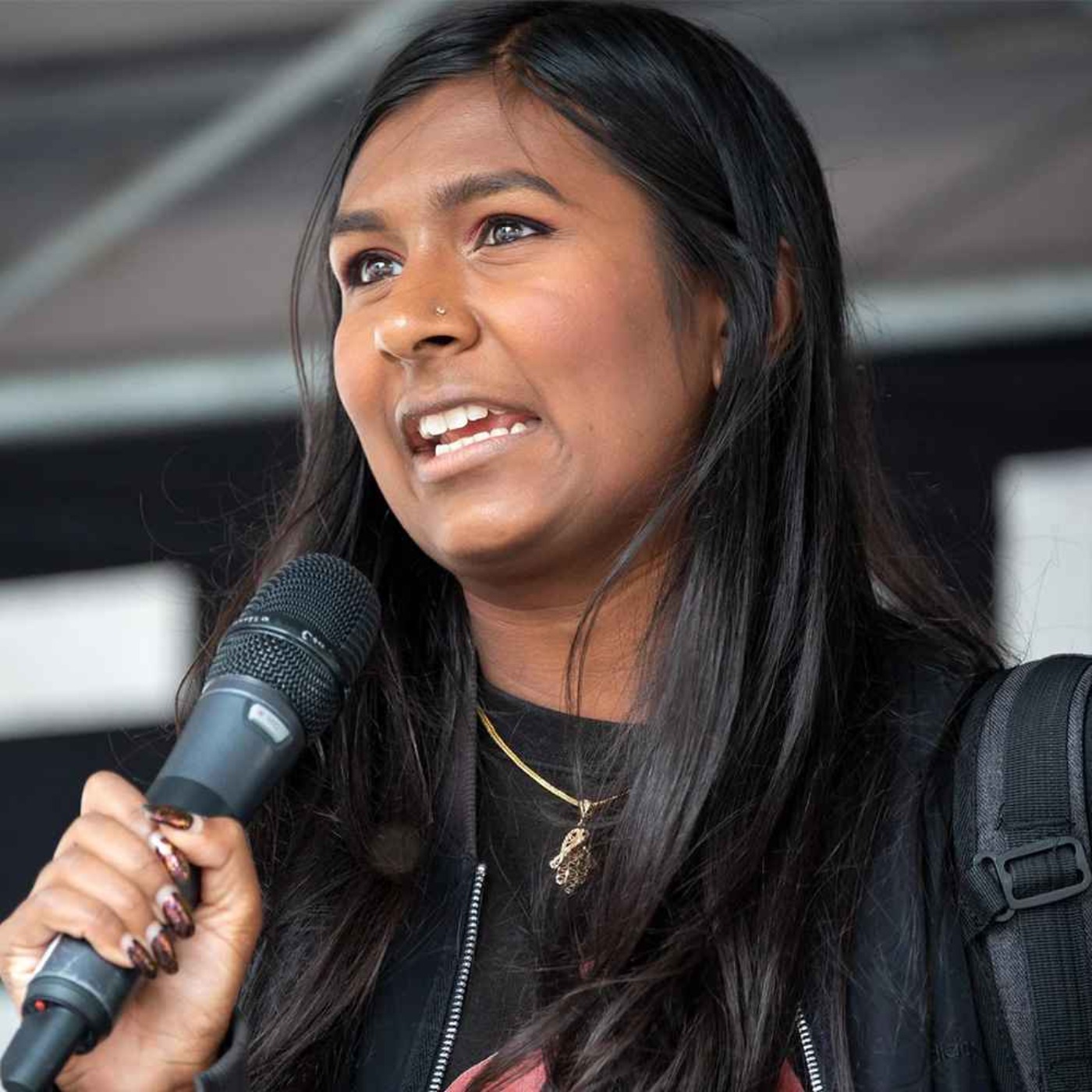
Left-wing critique of UK politics, focusing on Ash Sarkar’s views of Keir Starmer/Labour, Jeremy Corbyn’s new party (with Zahra Sultana), and Nigel Farage/Reform; plus her broader arguments about communism, Marxist analysis, and the harms of liberal identity politics and commodification (including weddings/marriage).
Ash Sarkar is a left-wing commentator and senior editor at Navara Media; writes for The Guardian and The Independent; teaches at the Sandberg Institute in Amsterdam; author of Minority Rule: Adventures in the Culture War. She identifies as a communist (in a “libertarian communist” tradition) and has a viral 2018 debate clip about protesting Obama/Trump.
Starmer governs with “computer says no” bureaucracy; Labour avoids “Corbyn-coded” policies like Thames Water public ownership and more council housing; Starmer’s Gaza stance (Israel “has the right” to cut off food/water/fuel) reflects fear of being seen as “soft on terrorism.” Reform is outflanking Labour by adopting left economic populism (public ownership rhetoric on water/steel). Liberal identity politics is “victim status” discourse policing that paralyzes the left and gets commodified.
Thatcher dismantling unions/council housing; Kerala’s electoral communism (education/healthcare); Pinochet-backed coup in Chile; BLM-era influencer “transfer me money directly” reparations; Nike BLM advertising; wedding “industrial complex” and Zara £15 dress anecdote; Tottenham (David Lammy) and Ilford North (Jonathan Streeting near-loss to independent Leanne Mohammed); Green Party urban vote strength and leadership elections.
Written by AI. May contain mistakes.
Discussion of Ash's viral debate moment with Piers Morgan and her identification as a communist.
“Ash Sarkar is known to many people for this viral moment.”
Ash explains the distinctions between socialism and communism and her vision of the latter.
“What was funny about that clip is that I think people expect me to be really different now and to have moved on from it.”
Exploration of how Ash envisions a communist society in Britain and the implications for commodification.
“Before we get on to that, I'm sure we will do.”
Ash discusses the importance of Marxist analysis and the challenges of implementing it in policy.
“I think we see that with communication even, with WhatsApp and social media platforms.”
Ash critiques Keir Starmer's leadership style and the current government's effectiveness.
“it's always ended in shooting lots and lots of people.”
Ash reflects on Nigel Farage's evolving political stance and the implications for Labour's position.
“Well, I think how to answer that question.”
Explore how Nigel Farage influences major party policies and the complexities of his political strategies.
“Do you think they've changed their mind or is this some bourgeois tactic?”
Discuss the strengths and weaknesses of Keir Starmer's leadership and his political maneuvers.
“He knows that that's not permissible within international law.”
Analyze the potential electoral strategies of new parties emerging from the left.
“Where they were coming second, it's very much in terms of those urban constituencies.”
Understand the criticisms of liberal identity politics and its impact on marginalized groups.
“And also the elections themselves go on for a really, really long time.”
Discussing how political movements and personal events like weddings have become commodified.
“So I assume by that one means taking things that ought to be natural, free exchanges between human beings, love, anger, argument, debate, and turning them into consumer products.”
Analyzing the role of marriage in community and familial relationships.
“And you're saying to your community, we need you.”
Examining the significance of religion in understanding human value and community.
“And that our division of labor within the household is not very gendered at all.”
Reflecting on future ambitions and the desire for honest conversations with historical figures.
“for what secularism has done to us in some ways.”
Explore the hypothetical dialogue between Henry Kissinger and Kendrick Lamar.
“And if I could sit him down and get him to talk about his creative process, I would love that.”

Get the gist, explore an idea or ask about something said.
 Claude
On The Daily T, what are the key points of this episode?
Searching your listeningAutomatic transcript. May contain errors.
0:04The Telegraph.
0:09On today's Daily Tea, we are joined by someone who is literally a communist. It's not Gordon, don't worry. No, it's Ash Sarkar, one of the best-known left-wing commentators at the moment. And we're going to be talking to her about what she thinks Jeremy Corbyn's new party will do to Labour, and where she thinks Keir Starmer has gone right and wrong. And there's not a lot of right, is there, Tim? No, there isn't. Welcome to The Daily Tea with me, Tim Stanley. And me, Gordon Rayner.
0:47Ash Sarkar is known to many people for this viral moment. If you feel so strongly about it, Ash, where was your protest march against Obama? If you found that unconscionable too, where was the march? I would actually encourage you to maybe check out some of the other work that I've done where I've been intensely... Tell you what I'd do, Ash. I'd go and check out some basic facts about your hero, Obama... He's not my hero! I'm a communist, you idiot! You didn't plan any protest against him, did you? What I try and do is be fair about Trump. What you do is be relentlessly anti-Trump and relentlessly pro-somebody like Obama...
1:20I'm not pro-Obama! I've been a critic of Obama! I'm a critic of the Democratic Party because I'm literally a communist. That was Ash back in 2018 debating with Piers Morgan on Good Morning Britain whether or not one should protest Donald Trump's then visit. And I think the reason why it caught so many people's imagination is one, because she had the cojones to call a man an idiot on his own show. And secondly, because she was willing to call herself a communist, despite Stalin and Pol Pot, etc. I have to note that Navara Media did then market a T-shirt that read, this is Navara Media, the media company that Ash is a senior editor for, that read, literally a communist and went for£25.
2:05pounds. Ash writes for The Guardian. She writes for The Independent. She teaches at the Sandberg Institute in Amsterdam. Her latest book is Minority Rule Adventures in the Culture War. And to the right, Ash is one of the faces of the woke loony left. But I have got to know Ash better than that as a panellist on the moral maze. And I have discovered her to be a very nice, very intelligent person who I'm convinced is on a long march to join the Reform Party. So my first question is, Ash, are you really a communist? Yeah, I am really a communist. What was funny about that clip is that I think people expect me to be really different now and to have moved on from it.
2:48And I think in some ways I am. I probably wouldn't lose my rag in the same way. It just so happened that Piers Morgan really got under my skin that morning. He does everyone, don't worry. And I think now I would like to be a bit more emotionally regulated, but I'm still a communist. And this was the point of the book, which is I imagined it being a conveyor belt towards Marxism. So I wanted to start people out by thinking about the media, thinking about the liberal identity politics that they might be familiar with from TikTok or Instagram and shunt them towards Marxism bit by bit. And I actually think that communism as a politics which is distinct from merely being, oh, I'm on the left or I'm a progressive, I think it's more important than ever.
3:33I just want to ask quickly, to those who might not understand then, is saying I'm a communist one step beyond saying as many Labour Party supporters would I am a socialist or a social democrat? I mean, this is a big debate within Marxism. Is there really a difference between socialism and communism? Is socialism stage one of the revolution and communism is stage two? The reason why I use the term communist as opposed to socialist is because I first think that there is really important work to be done, not just in terms of national ownership and public ownership, but returning things to the commons.
4:12So lots of things which have become commodified. I do think there needs to be some kind of process of decommodification. I don't know what that would look like, but I think that's something that's really important. And the second thing is, is that I think that many socialists are content to just take things into public ownership and not change the structure of it very much. That was a big tradition within the Labour Party, you know, particularly in the 1940s. And I think that communism is once more, it's something which is distinct from that. And then the last thing is that I think that if I was to kind of fall back from communism and stop calling myself one, my husband might divorce me.
4:49So it's important to hold the ground. It was a red wedding. It was a red wedding. Before we get on to that, I'm sure we will do. Can you just explain perhaps to people what your version of communism is? Because people might be listening to this thinking that you would support everyone having the same wage and no capitalism whatsoever. but as we know there are sort of different shades of communism. China has state-controlled capitalism, for example. So do you believe in a society where the state controls everything and everyone's paid the same wage, or is it a different version for you? No, so it's a different version in lots of ways.
5:23The first thing to say is that someone who was a really big political influence, not just on me but Navarro Media as a project, was Franco Berardi. He would call himself a libertarian communist. So many of those political freedoms, freedom of conscience, freedom of expression, freedom of assembly, freedom of publication. These are all things which are really, really important within this particular tradition. There's something else which is, I think, important to point out, which is capitalism isn't the same thing as a free market. And I actually think that the stage of capitalism that we live in is defined by the lack of open, fair and transparent exchange.
6:00So I don't think that communism should replicate the worst things about this stage of capitalism, which is the lack of freedom, the lack of options, the lack of variety. I don't think that a state monopoly is much better than a private monopoly. No, but I guess just to simplify it, what would Britain look like under the type of communism that you would like to see? I mean, this is something which I talked to Andrew Neil about, which is, you know, Mark said, I don't write recipes for the cookshops of the future, and neither do I. I've tended to dedicate a lot more time to my analysis of the present than thinking about what the future would be like.
6:36I think for me, one of the really important things about what Britain might look like is that you would no longer have a free-for-all to turn the things which are really valuable about human interaction into commodities. I think that we see that happening with sex and romance through dating apps and OnlyFans. I think we see that with communication even, with WhatsApp and social media platforms. So one of the things that would look very, very different is that we would be able to connect with one another without profit coming in in the middle and saying, right, it's got to go through this machine called commodification.
7:11Do you understand that, Tim? I'm not sure that... I do. So what do you have to say? It sounds more like an analysis than a program. It is, it is. And like I said, I'm much more comfortable with analysis than presenting a program. That's not something which has ever really been in my work. And as you know, the British are a very pragmatic people. And their first thought is you say to them, I have an ideology. And they say, OK, well, what's the policy and how does that change my life? But I do think that Marxism is really important as an analysis. And I think it's valuable to everybody as an analysis, even if you don't consider yourself a Marxist.
7:46And I tell you how to really good Marxist analysis was Margaret Thatcher, because she understood that the politics that you get is a reflection of the class forces that you have in society. So that's why I think she dismantled the trade union movement, council housing, broke up working class communities organized around heavy industry in the North and the Midlands. It's because those were machines that produced socialists and she wanted machines that would produce neoliberal Tory voters. So that's one of the points about my book. And again, I think that one of the criticisms lots of people have is that it's not programmatic enough.
8:22It's much more about analysis. Is that I want to demonstrate to people that even if you're not a Marxist and even if you're listening to this podcast and you think, this girl sounds mad, that there is a value in a Marxist analysis, even if you're a liberal, even if you're a conservative. And there might be. But is one of the reasons why whenever we've elected a Marxist government, almost whenever? Well, have we had one? OK, but in history, whenever anyone has had a shot at doing it, it's always ended in shooting lots and lots of people. Not true. It's because, just for a second, it's precisely because works as analysis, but when you've got to actually turn it into effect, people have to make it up as they go along.
8:57And invariably, they have to use compulsion to achieve the kind of freedom that Marx wanted because it requires such a dramatic transformation of life and the economy. First thing, not always true. There are places in the global south where you actually have a really strong tradition of electoral communism, like in Kerala in the south of India, where you haven't seen the kinds of purges and violence and coercion that I think you're identifying with Soviet Russia and with Maoism. That tradition of electoral communism has actually really delivered on things like education and healthcare for some of the poorest people in Indian society very, very well.
9:33So there is a different tradition that exists. The second thing is if we want to start talking about the body count of capitalism, I'm more than willing. Firstly, is that I think that you have huge degrees of coercion. That's what the prison industrial complex is. That's what poverty is. That's what destitution is. You've also got the coercion of, you know, say Pinochet's Chile, which was a coup that was backed by the UK and the US. You know, you had an American warship off the coast of Santiago when Allende was being deposed and people being rounded up and shot in football stadiums. So capitalism has a much higher body count than communism does.
10:14We just never seem to apply the same metrics for counting up the fatalities to capitalism than we do for communism. I'm going to have to come in there. I'm pretty sure Stalin killed more people than capitalism's killed. First of all, on the point about the communists in Kerala, they are operating within the context of a country which is essentially capitalist, so they can afford to do what they're doing. During the 70s, when India attempted agrarian socialism under Indira Gandhi, it didn't go very well. So that's one reason why those governments can operate well in those regions. But in terms of body count, are we going to call slavery capitalism?
10:50OK, well, let's concede that. Are we going to call starvation and hunger and child employment capitalism? OK, we'll concede that. Would you call colonialism and colonial expansion capitalism? I'm willing to concede all of that. My point is those are all unintended byproducts of economic development. What Stalin and Mao did was very deliberately set out to eliminate whole groups of people for political reasons. Firstly, when it comes to colonialism, if we accept that as part of the history of capitalism, there were deliberate exterminations of whole people. Fair point. One of the reasons why we're discussing this is because we want to understand, we want our audience to understand, a left-wing critique of Britain's current situation, right?
11:32because we have a Labour government. And there's always an assumption, our politics is so partisan, that you must be really happy right now that we have a Labour government. But I don't think you are. And if you're not, why do you think things aren't going well? Well, I think how to answer that question. The first thing is that Keir Starmer and Rachel Reeves, they have a style of government that I can only describe as computer says no. And I think that that's something which people on the left like myself find infuriating. People on the right find infuriating. And people who are maybe neither on the left nor right, but who are attracted to the eat-my-short style populism of Nigel Farage, they also find it infuriating.
12:12Because I think one of the things that we can all agree on is that we want some kind of effective government that's capable of dealing with social, political and economic crises. And this government seems to have as a badge of honour, sorry, we can't do anything about that. And I think that everybody finds that completely infuriating. What's interesting to me about reform, and I think that I'm somebody who in the past really underestimated Nigel Farage, and I'm trying to take him a lot more seriously now, is, of course, they are, you know, way to the right of labour on issues like immigration and crime.
12:53And at the moment this summer, they're playing the greatest hits. You know, London is a hellhole. Immigrants are everywhere to be expected. But they're also doing some stuff which is really unexpected. And I think that's because there has been an absence in that left economic populist space. So I first realized something was up when a friend of mine who works for a campaign around public ownership spotted Richard Tice at the launch of a trade union report into water ownership. That was the first time. He was like, something's kind of up here. And then you've got reform saying, you know, we'd take Thames Water into public ownership.
13:32Labour haven't done that. Same with British Steel. They outflanked Labour to the left. And there's a real at least change in rhetoric from Nigel Farage, who wrote in the Daily Mail this year, we want to be a friend to the trade union movement. Very different from what he was saying, you know, just a few years ago. So I think they've worked out that there is a hunger for some degree of lefty economic populism. And reform have said, we're going to take up that space, which is very clever positioning. And do you believe them? Do you think they've changed their mind or is this some bourgeois tactic?
14:05What I call a bourgeois tactic, it's really hard because, of course, Nigel Farage is untested in power. What he's been able to do very effectively is by being an electoral threat to one of the two major parties is then shaping their policy by kind of stealing their lunch. Right. So forcing them to shift position. We haven't really seen ever what he would do if he had power. So my instinct is to say this is all a crock of nonsense. You know, this is just because he wants to be able to take votes off of Labour in Labour seats. He can't just do that using Brexit anymore because it's a settled issue.
14:45But the honest answer is I don't know. We've never seen what he's like in power. You were a Labour Party member when Jeremy Corbyn was leader. I think you left Labour in 2021, not long after Starmer got in. I think you voted green last year, is that right? So you're obviously not a supporter of Keir Starmer. Do you think there's anything that he is doing right? Or do you think that he has just gone far too much to the centre slash to the right for your type of left wing politics? Initially, I thought that one thing that he got right was settling public sector pay disputes really early. That was one of his first priorities.
15:25It was we're not going to be beset by the kind of strike wave that really hobbled the Conservatives in the last couple of years of their governance. now we're seeing that start to come back particularly with the bma so who knows if that's something that they were able to quell and settle for good what else has kistama got right i mean i think the polling really says it all there was some word cloud polling where basically there are focus groups run and interviews run with people and the most frequently used words get the most prominence in a word cloud. In huge block letters right in the middle, when people were asked, what has Keir Starmer achieved with his first year in power?
16:07They said nothing. So that's not, you know, rabid reds under the bed like me saying that. That is just your average Brit. But they would say free school meals. They would say they've got their workers rights bill coming through. They've got housing. They're trying to build more houses. And they would say they've also cleared a lot of NHS appointments. Again, I suspect a Labour MP would have a fiercer argument with you than many Conservatives would, because they would say, you're typical of the kind of person who's very based on analysis and utopian thinking, but we're actually in there trying to get stuff done.
16:41And you know what, sometimes that requires compromise and doing what the public wants on things like immigration law. Well, let's look at the compromises they're willing to make and the compromises they're not willing to make because one of the things which I think really defines what Keir Starmer is willing to do or not is, is this thing Corbyn coded? So it doesn't matter whether or not it makes sense. Is this thing Corbyn coded? So the reluctance to say, all right, Thameswater, it's a complete basket case. Let's take it into public ownership because right now we're just throwing good money after bad.
17:12They don't want to do it because it's Corbyn coded. Similarly with house building. I think that building lots of new housing is welcome and good. It is going to have some effect on prices, but not as much as I think Labour are hoping it will. We've never built that quantity of housing in this country without substantive amounts of council housing being built. And again, I think one of the reasons they don't really want to do that, don't really want to go there, is because it's a bit too Corbyn coded. So I think that there are all sorts of things that they're not willing to do because of their own sense of...
17:42Israel is a huge one. I mean, I think that in 2023, when what I believe is a genocidal war on Gaza first began, you had Keir Starmer being asked, does Israel have the right to cut off food, water and fuel to the entire population of Gaza? He said, I think Israel does have that right. Emily Thornberry backed him up on it. He's a human rights lawyer. He knows that that's not permissible within international law. He could, for whatever reason, think it's morally justified. I mean, I think it's an abomination, But that's not the answer he gave to us. I think Israel has that right. Why? Because he didn't want to be seen as, you know, soft on terrorism, too sympathetic to the Palestinian cause, too Corbyn coded.
18:26you obviously were a fan of corbyn's 2017 manifesto which was let's face it very popular very popular with a lot of people he got a lot of votes is there anything from that manifesto looking back now that you think was was a bad idea or that you've maybe moved on from anything you've changed your mind about oh i would say probably not 2017 but 2019 and so i write about this in the book, which is the time spent between 2017 and 2019, for lots of people like me on the left, we thought, okay, what the task is, is to make the 2019 manifesto as reflective of our politics as possible. Compare it to Boris Johnson's strategy, which was, right, get Brexit done on the back of a napkin and go, there you go, that's a manifesto.
19:12So it was, I think, completely out of touch with what was happening more generally politically, which they wanted a really solid, clear message. This is the one thing we're going to do. And secondly, it was just, it was so internal. It was a process of turning inwards and having fights as the left amongst the left and within the Labour Party, rather than thinking about what's going on outside of it. So there are lots of things which ended up in that manifesto, which I don't think needed to be in there. But more than what was in the manifesto, what I personally regret doing is turning inward so much during that time.
19:52If Labour had been better disciplined, better united, you think he could have won? I think that there are a few things that would have needed to happen. And I think that there were some real lost opportunities in 2017. 2017 would have been the time, I think, to introduce what was being called open selection. So basically, if you're a Labour MP in a safe Labour seat, you have to, every four years, convince your party that you're still the right person for that seat. Because I mean, come on, we can all think of MPs, not just in the Labour Party, we can all think of MPs who've just got a big runny egg where a brain should be.
20:27And they're going to be returned to the Commons time and time again, because they're in a safe seat. And I don't think anyone, regardless of whether in the left or the right, thinks that we're getting the very best people for the job of political representation. And I think that having a more open system of selection gets you better candidates. The other thing that does is that there's a bit of a disciplining force on it. Because who was more critical of Corbyn than right-wingers within his own party who had tried to get rid of him in 2016? What was known as the chicken coup, this choreographed series of resignations, who then realised that they'd...
21:04Am I allowed to swear on this? Not really. Not really. No, it'll be edited. screwed up maybe you could say? Shegged it. Okay. They'd completely shegged it in terms of the rest of their careers. No one was more hostile to Corbyn and no one put more time into trying to defeat Corbyn than these individuals. And so if in 2017 when you're riding high off of that result you go, all right, discipline time, I think that that could have made a difference. Well, those people now control the party. They have kicked out critical MPs. Some MPs have walked away. Zahra Sultana has formed a new party. First of all, does the left, the proper left, now just have to give up on Labour because it's under the control of those people?
21:43They've got control of the machinery. Nothing you can do to change its policies. Diversity of tactics, comrade. I would never say you should put all your eggs in one basket. And one of the things that's interesting to me is the fact that this new party doesn't actually have to be particularly successful to do a lot of damage to Labour. This is Jeremy Corbyn and Zahra Sultana. Jeremy Corbyn and Zahra Sultana. When you say your party, that's what they're calling themselves at the moment without saying it's Ash's party. I call them TBC. I think they should be called New Labour, but hey. New New Labour.
22:19They don't have to do particularly well to inflict quite a lot of damage. You've also got what's going on in the Green Party at the moment. So Zach Polanski is running against Ellie Chowns and Adrian Ramsey. You're forgiven if you don't know who those individuals are. tend to be quite low profile MPs. And he's running on a more left wing economic populism platform, because I think that there is some frustration within the Green Party about this very slow way of doing politics that they've got very deliberative. Where you look at where the Greens came second in 2024, really, really interesting data.
22:57You don't have as many Herefords as you do, you know, Tottenham's and Bristol's. What do you mean by that? So you have far more urban seats than you do rural ones. You know, the Greens were having to ride two horses at once for a while, where there were sort of rural conservationists and, you know, downwardly mobile graduates and ethnic minorities in cities and trying to work out how you please both of them was really difficult. Where they were coming second, it's very much in terms of those urban constituencies. Those are also the constituencies where Jeremy Corbyn and Zahra Sultana's party would be likely to do well also.
23:32So how the Green Party and this new party work out their electoral strategy, again, super duper important. So what direction are you headed in? Because you voted Green last time, as we said. Are you sort of still tending towards sticking with the Greens? Are you tending towards Jeremy Corbyn's party? I've got no political affiliation at the moment and it's great. But you've got to vote. Do I? Well, you will have in a few years. Do I have to vote? You've got to vote. Not you must vote. You have a vote that you will be able to use at the next election, the same as the rest of us. So where will that vote be going, do you think?
24:07I live in Tottenham, which is David Lammy's constituency. I would rather boil my own head than vote for him. So I would work out what was most effective in the particular seat that I live in. I think probably move. I'd probably move. I don't think you'll unseat David. You may not, but some interesting things in the waters in Haringey. Let me tell you. One is that there was a fairly big dent in his majority last year. The Greens ran a paper candidate. No one ever saw this person campaign. He's still got thousands of votes. Second thing is somebody called Rory Payton, happens to be my housemate.
24:45He is the Green Party's first ever councillor in Haringey. First ever. And when he was out canvassing, and obviously because he's my housemate, talked to him a lot, he was saying people were really, really angry with Labour over housing, over the winter fuel allowance, over two-child benefit cap, and also Gaza. Right. So you don't know yourself necessarily who you'll vote for next time, but I'm very interested in what you're saying about how much the new Jeremy Corbyn party and the Greens might damage Labour at the next election because I think that's what a lot of people are interested in. Everyone wants to know what's going to happen in the next election.
25:23Will reform win? Will the Tories completely collapse? Can Labour hang on? Will Keir Starmer be the leader of the next election? And a big part of that is going to be to what extent these other parties, the Greens and the Jeremy Corbyn party, take votes away from Labour, isn't it? So is that going to be a big thing, do you think? Because they don't have to take away a lot to have a big impact. And so, you know, it might not be the case in Tottenham so much. They'd have to work really, really hard because of the size of David Lammy's majority. But there is a sign that there's a lot of dissatisfaction in my particular constituency.
25:57You then look at Ilford North, where's Streeting's seat? He came within a whisker of losing his seat to an independent candidate called Leanne Mohammed. Now, if she was part of a party led by Jeremy Corbyn or if she was part of some kind of alliance with the Greens, if they really, really went for it again, when you think about how much dissatisfaction there's been with Labour in office, Streeting might not keep that seat. It looks really, really tough for him to find a pathway through. Could you see the Corbyn party and the Greens doing deals in some seats? They might do. I think that it would be best for both parties if they did.
26:32I think that if you are a progressive voter, you probably don't see a huge difference between those two parties. What I would say is that the political cultures in the Green party and potentially this new party are very, very different. Now, there's lots of different people involved in this new party, come from lots of different bits of the left. And it's all to play for in terms of what's going to win out. But there probably will be this very strong strain of Labourism, a way of doing things which is kind of opaque, a bit backroom. You know, that's what it's like in the Labour Party. And that's where a lot of these people cut their teeth.
27:15It's where their political skills were honed. Whereas the Green Party, I think, are democratic sometimes to a fault. They've got leadership elections every two years, which is mental. There's too many leadership elections. And also the elections themselves go on for a really, really long time. Their party membership is basically sovereign on matters of policy. And what you saw with the Scottish Greens is that then when there is something that the party membership are unhappy about, for instance, with the Scottish Greens, it was to do with the implementation of the Cass Review recommendations. they've basically got the chance to pull the plug very very different political cultures how those things could work together i'm doing the shrugging emoji for people listening on the podcast
28:08can we talk about the book because in the book you are somewhat critical to a degree that some found surprising of liberal identity politics. Before we go on to the alternative, I guess a class-based alternative, I suspect. Why do you think liberal identity politics has made so many mistakes and wound so many people up the wrong way? So the first thing about what is liberal identity politics? Liberal identity politics is a form of identity politics where it's all about victim status. So marginalised people, there's an obsession with discourse, the policing of language, and there is a tendency towards what on the left is known as prefigurative politics.
28:50So if you're part of a left-wing group or campaigning organisation, you've got to get your internal culture exactly right. There are no harms being reproduced within your group before you can then go out and do anything. For me, the rules and principles of liberal identity politics, it may as well have been invented by the CIA. It's so damaging to actual left-wing practice because you're constantly looking for offense, looking for reasons to mistrust other people. You're saying that our experiences are so different, we can't work together. And then in fact, something like solidarity, the idea that just because we're different, we experience different things doesn't mean we can't work together.
29:28That's looked at as some kind of trick. So I think it's been incredibly damaging to the left. Why do I think it's been so dominant? I think there are two reasons. One is that the left has been a lot more dominated by people like me, graduates from an arts and humanities background. If there's one thing we like doing, it's picking over language. And the second thing is social media. I think one of the things that social media does is that it makes the self an object of fascination because you are creating all these images of yourself, which kind of has a life of its own and people are attacking that and you become self-obsessed.
30:06So I don't think that we just became spontaneously worse at doing politics. You know, I think 40 years of neoliberalism will mean that you start absorbing some of that individualism, that hostility or suspicion towards collective form of politics. But what we've seen in terms of what it does to the left is that it's paralyzing. We just can't get anything done. And also a great embarrassment is that it has been, to use your word, commodified. So I assume by that one means taking things that ought to be natural, free exchanges between human beings, love, anger, argument, debate, and turning them into consumer products.
30:43So someone makes profit out of them. And one of the embarrassing things about work politics is that business has cashed in on it. Oh, yeah. I mean, Nike, right? Nike with its sort of BLM era advertising with Colin Kaepernick and Serena Williams. What was embarrassing is that there were lots of people kind of looking at that and being like, see, you know, this is a moment we've arrived. Look how seriously our politics is being taken. And then the minute that stuff falls out of fashion, I bet the same marketing executives are like, how can we get Sydney Sweeney on this instead? She's got great genes.
31:16She's got great genes. to get the blonde with, you know, a fantastic rack in there. It's funny how it switches so radically and quickly from multiculturalism to Nazi. I mean, I wouldn't say that it was Nazi. I think it was... It has Teutonic vibes to it. Well, definitely. I think they were trying to work out how do we monetise this anti-woke moment. Yeah. I think that's what they were trying to do. Yes. And how do we outrage bait? Because, you know, if you've got lots of people on the left being outraged about it, it means that this is getting coverage on the news, which is basically an advertising spot you don't have to pay for.
31:47Win, win, win, win, win. So yes, I think that liberal identity politics is primed for commodification. I mean, I remember during the Black Lives Matter protests, you had influencers of colour saying, transfer me money directly as a form of reparations, which I think is disgusting. Right. You didn't see Angela Davis doing that. No. You've written about the commodification of marriage as well. You recently got married or you had a civil partnership. Do you say marriage? Yeah, you know, I switch between the two. It's legally a civil partnership. I say marriage because that's something people understand.
32:26I said husband, sometimes I say partner. Yeah, okay. Well, I mean, I'm glad you did. Not precious about it. I really like the article you wrote for Vogue magazine about your own civil partnership and the fact that you didn't want it to become just a sort of spend-a-thon. I think you said that you bought your dress from Zara. It cost£15. £15. Well done. I mean, I didn't think even Zara sold dresses for only£15. Did you get it in the sale? It was in the sale. OK. And you talk about the wedding industrial complex, which made me laugh. But there is a lot of that, isn't there, I think, that the wedding industry has become this sort of monster, hasn't it, that people don't seem able to resist.
33:02£20 ,000 is the average spend on a wedding. wedding in the UK, which is cuckoo bananas. And look, if you feel that you can't possibly celebrate your lifelong commitment to someone by spending thousands of pounds on a dress that you're only going to wear once, fine. I'm not here to police you. But I think that what's beautiful about weddings and marriages and any kind of commitment ceremony, even if it doesn't have the legal status of a wedding, is that it is a moment that you are inviting your community and the people you love into what was already a private commitment between you and someone else.
33:35And you're saying to your community, we need you. In order to be good to one another and in order to stick it out for life, which is what we aspire to do, we need you to support us. And I think that that's the best thing about weddings. Yeah, and you make a very good point as well about the difference between having a boyfriend and having a husband is that your mum doesn't think anything of asking your now husband to come and help around the house, whereas if he was just your boyfriend, and she wouldn't feel that she was able to ask. And so it is a different type of relationship, not just between you as a couple, but between you as a couple and your respective families.
34:13Oh, God, yeah. And I think, I don't know what you guys think about this, but one of the things that really framed that article was that it really wasn't long after we got married that my stepdad, whom my mum had been married to for 20 years, died. and my partner was really there for the worst of it, really, really there. And I tend to find it quite difficult to ask people for help or to rely on other people because I've internalised the sense of I need to be able to do it all myself. And seeing him operate not just as somebody with whom I have a romantic connection, but someone who I can rely on to look after my family, to be strong for my family, to carry out functions for my family that in that moment I couldn't.
34:58It's so difficult to imagine that being the case before we got married. Maybe it would have been, and maybe he would have stepped up and been brilliant because he's still the same guy, but maybe I wouldn't have let him do it. See, this is why I'm convinced you're on the road to conservatism. I think you're this generation's Janet Daly, and I think you'll have a Telegraph column in 20 years' time. I'll tell you why, as you know, real conservatives say capitalism is a revolutionary and destructive force. That's what Marx said as well. That's what Marx said, and he's absolutely right. Real conservatives like pre-capitalist institutions, a great example of which is marriage and the family.
35:32And what you are saying there, and I've heard you say it on the moral maze, and I glow every time I hear you say it, is that some of these things that the left dismisses, like marriage, like family, like religions, I would say even things like monarchy, pre-capitalist things, they actually are a bulwark against the radicalizing experience of capitalism, against the anarchy of economics, that at the end of the day, even if you lose your job, even if you're thrown out of work by the man and because the government's screwed up or whatever, you have this thing called a marriage, which is a bond based not upon money but upon love.
36:05You have a priest to go to who is there not because of money but because of love. You will always have a king because of money but because that's the way we do things. So I see... Kings famously have nothing to do with money. Yeah, OK, fine. Maybe he's a bad example. But you take my point that conservatives want to preserve things that the left have tended to smash up But what I think some of the left are discovering is that some of those ancient institutions are actually good for people. So the first thing is that I think this is the war within the left between communists and liberals. Right.
36:35I think that, you know, it's a very liberal thing to be like, we don't need marriage. We don't need structures. We don't need things to hold us together. It's just the sort of free association of individuals. When we get sick of each other, we can sack each other off. That's a very, very liberal position. And I am not a liberal. The second thing is, this is what I think is different about my view of marriage from a conservative, is that I think that it's possible for me and my partner, you know, I'm a woman, he's a man, he's white, I'm not, to look each other eye to eye as equals and to have a partnership of equals.
37:05And that our division of labor within the household is not very gendered at all. Maybe that would change if we had kids, right? Only one of us could carry that sucker for nine months and it ain't going to be him. and maybe that would change things. But unlike a conservative view of marriage where there is a highly gendered distinction in roles, I don't think you have to have that. But there will be if you have kids because just the biological reality of the two different gender roles will shape your social roles. But biology is also more complicated than we like to think. So sure, the pregnant mother starts with a much higher level of oxytocin, right?
37:48That's the love hormone, the bond hormone. But whoever plays the role of the caring parent, interacts with the baby, cares for the baby, feeds the baby, changes baby's nappies, their levels of oxytocin very quickly match. And that is regardless of gender. That's regardless of whether or not they're the biological parent. Because you see this with adoptive parents, IVF couples, heterosexual couples where they're both biologically related to the kid. You see that the oxytocin really, really catches up. So what's interesting is that in some ways our biology will follow what we're doing socially. In other ways, biology will determine what's happening socially, but in some ways it will follow.
38:27Okay. Was there any religion in the ceremony? No. No. Are you at all religious? I believe you are a little bit. Ah, poquito, poquito. I come from a family where everyone's had a mixed religion and or mixed ethnicity marriage. Absolutely everybody. So my grandma was a Hindu, converted to Islam to marry my grandfather. Mom, Muslim, who married and divorced a Hindu and then married a Church of England, raised atheist. Sister Muslim, married Hindu. Me, Muslim, civil, partnered a communist atheist with vague Catholic backgrounds. I mean, we just really like, I think, having the option of eating everyone's cuisines.
39:07I think that, you know, I'm not a student of scripture. I'm not somebody who can quote chapter and verse on anything. But I think that one of the things that you find in every religion is something about the inherent value of a human being, something that you can't commodify, you can't sell. It doesn't matter what someone's done in their life. They can't get rid of that value. They have an inherent worth. and I think that that's an idea that's really important to hold on to. I don't think religion is the only source of that idea but it's a really important one and I think that one of the reasons why politics can be so weird or culture can be so weird is because we're trying to compensate for what secularism has done to us in some ways.
39:59Well, what's next for you, Ash? You ever fancied becoming an MP or even starting up your own party? Where do you go next? You know, I've got no idea. I think that I might want to write some fiction. Okay. Okay. People always ask me if I want to be an MP. I had too much fun in my youth. And so when that is on the front page of the Daily Mail and I'd have to act sorry about it. I'm not acting sorry about it. I had a great time. Anything in particular you want to confess to? Get off my chest. No, man. My mother might be listening to this. My final question is one we ask many people, because it's the Daily Tea, when I remember to ask it.
40:35I don't think you've had any because Gordon doesn't drink tea. I was on Diet Coke and I'm not sure what you've been drinking. Rum. No. It's rum. But if you could have a cup of tea with anyone in history, who would it be? Anyone in history? Okay, but can there be some conditions attached? Okay. We haven't attached them. That's so Marxist. They would have to answer any question I put to them with 100 % honesty. Okay. Because what's the point if they're just going to bullshit you, right? Okay. But if it's somebody who is famously a liar, then you can't expect them to change their personality just by meeting with you.
41:14No, but I'd want to be able to ask them what really happened here. Okay, okay, okay. Who is it? Kissinger, probably. I'd really want to ask Kissinger some questions. No, Karl Marx? No, I mean, he wrote a lot. You know what he thinks. You know what he thinks. What do you want to ask Kissinger? I think that I would really like to know about the extent of CIA involvement, security services involvement in anti-communist movements around the world. Either that or I think the other one would be Kendrick Lamar, the rapper. OK. Because I think he's a genius. I truly think he's a genius. And if I could sit him down, because I did my master's thesis about his first album, because I thought that it was a masterpiece of writing and of narrative.
42:00And if I could sit him down and get him to talk about his creative process, I would love that. Well, we don't normally do this, but anything's possible in the world of communism. You can sit down with both Kissinger and Kendrick Lamar. Can you imagine that? What would they talk to each other about? I can't know. Ash Sarkar, thank you very much. Thank you. Thank you.
With Keir Starmer proving as unpopular and unpalatable to the left as he is to the right, Jeremy Corbyn’s new - and as yet untitled - political party joins Reform UK in presenting a very real threat to Labour’s chances of re-election in 2029.
In this episode of The Daily T, Tim Stanley and Gordon Rayner talk to Ash Sarkar - journalist, Corbyn-supporter and co-founder of left-wing media organisation Novara Media - about how that new party could form a potentially fatal electoral pact for Starmer by teaming up with the Greens in 2029.
As well as her dissatisfaction at Keir Starmer and Rachel Reeves, she also talks about how Reform have outflanked Labour on the left with talk of nationalising utility providers like Thames Water, and why she “previously underestimated Nigel Farage” but is now “taking him a lot more seriously”.
We want to hear from you! Email us at [email protected] or find @dailytpodcast on X, Instagram and TikTok
Producer: Lilian Fawcett
Senior Producer: John Cadigan
Planning Editor: Venetia Rainey
Video Editor: Will Walters
Social Producer: Ece Celik
Studio Director: Meghan Searle
Executive Producer: Louisa Wells
Hosted on Acast. See acast.com/privacy for more information.


