
 Ask ChatGPT


 The Daily T
9 Jun 2026 · 37m · 16 chapters
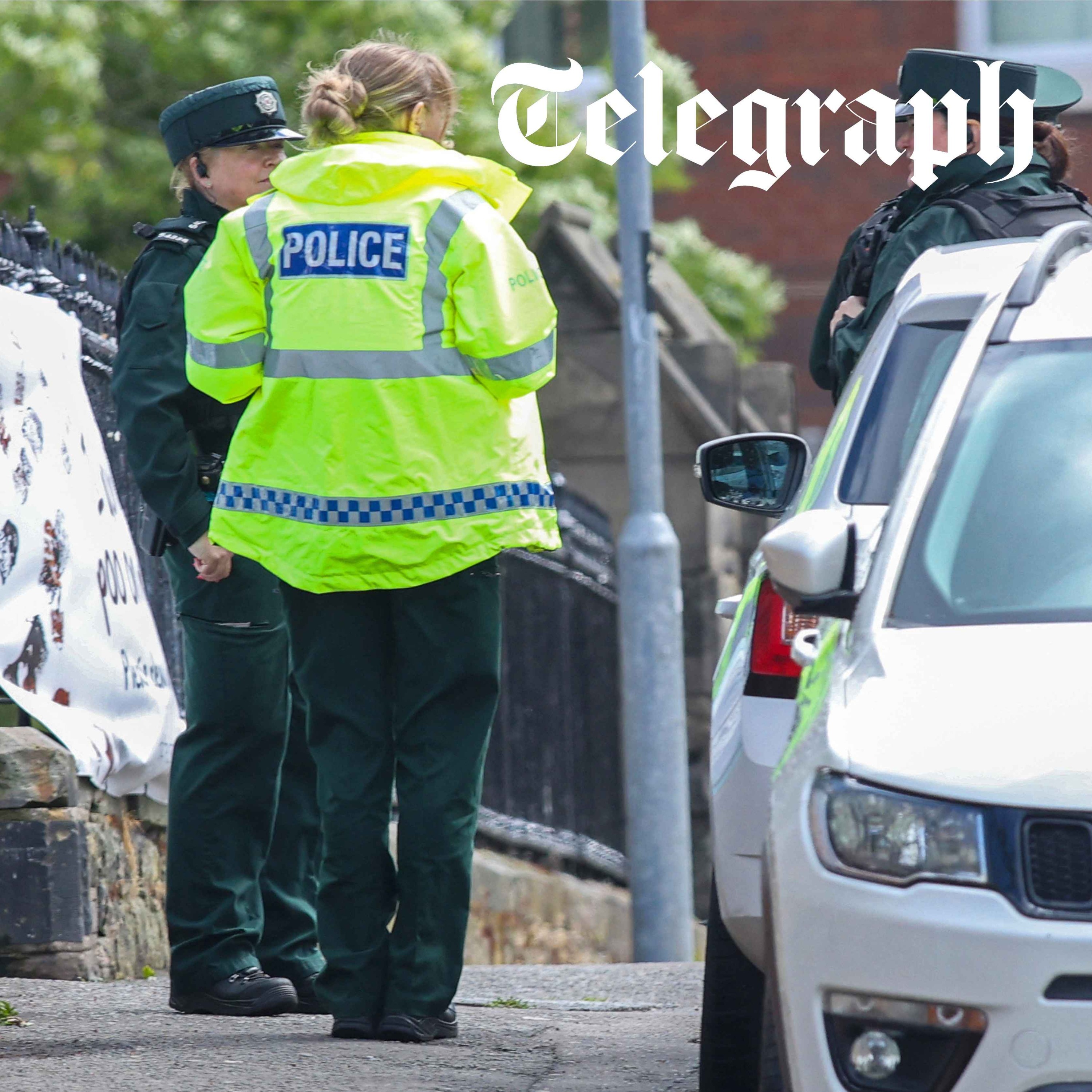
The episode reacts to horrific footage from North Belfast of an attempted beheading, linking it to wider claims that Britain is becoming lawless and “falling.” Hosts discuss political responses (Starmer, Badenoch, Farage) and argue social media makes violent incidents feel immediate and universal, shaping public perception beyond crime statistics. They also connect the incident to recent high-profile cases (Lee Rigby, Henry Novak body-cam footage, Southport, and victims’ families’ claims of state failure). Key claims include: politicians must address public disgust; policing and anti-racism training may have influenced how Henry Novak was treated; and DEI/identity politics are driving polarization. Notable examples cited: Henry Novak, George Floyd (as a contrast), Lee Rigby, and the Belfast attack.
Michael Knowles, an American conservative commentator/YouTube host of The Michael Knowles Show and author of “Reasons to Vote for Democrats” (2017).
Written by AI. May contain mistakes.
Discussion on the recent violent incident in Belfast and its societal impact.
“Hey there, it's Wayfair here, where delivery and setup are as easy as a few taps on your phone.”
Discussion on the recent violent incident in Belfast and its societal impact.
“We're making a special for Friday about the by-election.”
Examining how media and social perceptions shape reactions to violence.
“And then of course we've got the narrative coming in from America suggesting that that is the case.”
Analysis of political reactions to the Belfast incident and public feelings of insecurity.
“And I think as well, because we are so, our senses around this are so heightened, because we watched the body cam footage of Henry Novak last week.”
Setting up the interview with Michael Knowles and discussing its relevance.
“This is going to upset people because it is just so horrendous to watch.”
Setting up the interview with Michael Knowles and discussing its relevance.
“Hey there, it's Wayfair here, where delivery and setup are as easy as a few taps on your phone.”
In-depth discussion with Michael Knowles on UK politics and contemporary issues.
“who tells us who he'd vote for if he were British.”
Discussion about the controversy surrounding a pro-Palestinian speaker at Oxford.
“She is coming from a very resolutely pro-Palestinian, pro-Islam point of view.”
Analyzing the political implications and reactions following Charlie Kirk's murder.
“I really have no problem on the grounds of free speech absolutism, say, with a country saying that they don't want some foreigners to come into their country.”
Exploring the boundaries of free speech and the necessity of standards in discourse.
“There was a Democrat strategist on MSNBC as Charlie was dying who blamed Charlie for his killing.”
A look at historical figures advocating for free speech and their conditional limits.
“That's really interesting because I sense a shift in thinking among some Americans away from a more libertarian position 10 years ago among the podcasters.”
Discussion on how identity politics affects the right and its reactions to social issues.
“But the moment that they got their way and the moment they had power, what did all those free speech movement people do?”
Examining how misinformation in public health has fueled conspiracy theories.
“see left-wing radicals go completely off the reservation.”
Analyzing the racial implications in police responses to violent incidents.
“So in the killing of Henry Novak, obviously the crime itself was bad enough.”
Debating Trump’s role and rhetoric in changing conservative values and norms.
“Whites are reacting in their mistrust of the police how blacks and other people of color were reacting back in the 70s and 80s.”
Learn about the contradictions in Trump's approach to conservatism and its implications.
“about has Trump let down conservatism, isn't part of conservatism civility and manners, a restraint of emotion?”

Get the gist, explore an idea or ask about something said.
 Claude
On The Daily T, what are the key points of this episode?
Searching your listeningAutomatic transcript. May contain errors.
0:04The Telegraph.
0:09Hey there, it's Wayfair here, where delivery and setup are as easy as a few taps on your phone. You're relaxing in an old hammock, scrolling Wayfair's app, when you spot it, a brand new patio set. Next thing you know, Wayfair delivers it right to your patio and sets it up. Oh, you need a new grill too? Alright, Wayfair's got you covered. With Wayfair's Room of Choice delivery and fast experts set up on qualifying orders, life gets a little easier. Visit Wayfair.com or the Wayfair app. Wayfair, every style, every home.
0:40Is Britain falling? It was a debate we were already having before this horrific footage emerged of an attempted beheading in Belfast. American politicians say that Britain is coming apart. We speak to one of their most popular Conservative commentators, Michael Knowles. Welcome to The Daily Tea with me, Camilla Tomini. And me, Tim Stanley.
1:12Tim, we're in Makerfield. We're making a special for Friday about the by-election. And when we arrived here, suddenly our social media feeds began to be filled with, I think, one of the worst videos I've ever seen in my life of an incident that's occurred in North Belfast. Proceedings are active in the case. A man is on the floor being very, very horrifically stabbed, almost beheaded by another man. for legal reasons we can say no more because there has been an arrest. We don't know more about his background. But it is relevant to this by-election, isn't it? Because as we've been going around the streets here in this town near Wigan, we've been speaking to people who are voting for reform, we've been speaking to people who are voting for restore, we've been speaking to people who are voting for Andy Burnham for Labour.
2:02People are disgruntled. And those on the right side of the divide, of the ideological divide, are talking about this idea that Britain isn't what it used to be. And while we're here discussing all that, this footage emerges, which frankly I think is alien to any of us. What is happening? What is going on on Britain's streets? Are we becoming increasingly lawless? And then of course we've got the narrative coming in from America suggesting that that is the case. Let's consider some of the reactions from politicians. Keir Starmer said, The horrific attack in Belfast last night is sickening. I have absolutely no tolerance for abhorrent scenes of violence like this on our streets.
2:39My thoughts are first and foremost with the victim, and I thank the first responders. Kemi Badenoch described it as horrific and called for clarity about the incident. Nigel Farage also described it as horrific and said the authorities must reveal the identity and status of the attacker immediately. But one thing that's interested me about our few hours in Makerfield so far is the restore person who we spoke to. Chris, yes. He was very cogent, very intelligent, not mad at all. And we were trying to get to the bottom of why might someone support Restore rather than reform. And I would just draw your attention to Rupert Lowe's response to the attack.
3:18He's photographed a letter he's written to Keir Starmer that reads, Prime Minister, we have all seen the sickening video from Belfast. Full details of this savages' nationality, immigration status and religion must be made available to the public as a matter of urgency. Now that kind of language, savage, it won't appeal to a lot of people, but it will appeal to some people, because some people will look at those images and that's exactly what it says to them. It's a sense, we're used to violence, we're used to disorder, but this looks different because it seems savage, something we're unused to and which is out of place and almost out of time.
4:00And my mind went back immediately to 2013 and the killing of the soldier Lee Rigby. Yes. Which in my memory is one of the first times that we were really confronted, not just with this variety of violence, but also with the ease with which it could be seen. Yes. Because that killing occurred really at the beginning of the social media age. And back then it was a question of if you wanted to see the material you could, now you can't escape it. Yes. So whatever the statistics are on knife crime, and there's a debate, the government tends to argue that crime is actually under control in this country.
4:37The right says it's out of control and people just aren't reporting it. The point is, is that our culture is saturated with images of it, which are impossible to escape. And I don't think you can be all actually about this and say, look at the statistics. They're what matter. No perception does matter. And I think as well, because we are so, our senses around this are so heightened, because we watched the body cam footage of Henry Novak last week. Yeah. And then because we have heard from Emma Webber and the other families of the victims of Valdo Calacane, who gave a press conference yesterday, where they basically made a case for abject state failure at every turn, which let down the victims Barnaby Webber, Grace O'Malley-Kumar and Ian Coates.
5:20We also have fresh in the memory, not too far from here, what happened in Southport. And I think the video footage, the sort of the keeping of receipts that we can all can see, hits this home rather harder. And all of those things you described, they all happen in different times in different places, not within the same week. And if you roll in the rape gangs as well, that occurred almost a couple of decades ago. But the thing with social media is it keeps things timeless because those images are always on your timeline. So it feels as though it's happening right now all at once. I'm not saying people shouldn't feel alarmed.
5:58I'm just saying that that is part of the issue here is that social media adds that immediacy and almost feeling of universality to crime. Sure. The Prime Minister's response to this, by the way, is going to be key critical in the coming days, because you and I spoke yesterday about this idea that he can contain our rage. And this is going to anger people. This is going to upset people because it is just so horrendous to watch. But it's also going to add to that anger. I'm not saying for one minute that that then should lead to anything more sinister on the streets or whatever. But can politicians please get a sense of how the nation is feeling?
6:35Yes. And there's an irony here to link to the interview we did last week with Michael Knowles. So we're going to play that out in this episode because we're here in Makerfield. But there are some who think that the Americans wading in on all this, that the comments made by Elon Musk and J.D. Vance and Pete Hegseth and others are completely out of kilter. And why are you commenting on what's going on in Britain? But yet there are figures on the right who are increasingly concerned about the so-called fall of British civilisation. And they're saying that from the perspective of America looking at us as a shining beacon of decency, diplomacy and democracy.
7:09And that's why it is so startling to them. Should they be waiting? And this is something we asked Michael Knowles. We could reply America, of course, has school shootings. Yes, indeed. Which are overwhelmingly white young men. Yes. But we've got to get politicians have got to move beyond this Keir Starmer. The process is ongoing. Yes. Things are happening. I can't comment on them. Let's have a review. Yeah, but he cannot with this one just say, I'm going to leave this up to the police and the courts. You have to comment. You have to touch upon how people are feeling because I come back to, we can see those images.
7:41OK, maybe it's now with the police and the courts and we should respect that. Of course, we don't do anything to undermine a case. But we can't unsee it. We can't unsee it. So when you're formulating your political reply, you've got to capture the sense of disgust and horror that people feel. And of course, something Americans can't get their head around is the way in which the British are so reserved about talking about this sort of thing Because when a crime occurs in America, what do you immediately have? A press conference by the police And they're far more open about it, they talk you through things, whereas we tend to retreat behind closed doors And by the way, the response to the public, you can hear it in the footage, that's the other horrifying thing about this You can hear the screams of onlookers And can we just have a moment to just praise the people that ran towards this and tried to help The bravery that was displayed in Belfast last night was really pretty humbling.
8:29So, listen, that has happened. Legally, it's difficult to discuss more. We're here in Makerfield. We're going to put this special together and we're going to put it out on Friday. Everything you need to know about the by-election. We've had some really interesting conversations so far and we're going to continue to have them. But we did think we needed to just pause and reflect on what we've all seen this morning. And we are going to now play out this interview with Michael Knowles, who is probably one of the most respected commentators on the right in America with literally millions and millions of YouTube followers.
9:07Hey there, it's Wayfair here, where delivery and setup are as easy as a few taps on your phone. You're relaxing in an old hammock, scrolling Wayfair's app, when you spot it, a brand new patio set. Next thing you know, Wayfair delivers it right to your patio and sets it up. Oh, you need a new grill too? All right, Wayfair's got you covered. With Wayfair's room of choice delivery and fast experts set up on qualifying orders, life gets a little easier. Visit Wayfair.com or the Wayfair app. Wayfair, every style, every home.
9:44We're joined by the YouTube star Michael Knowles, an American, who tells us who he'd vote for if he were British. Has Britain fallen to pieces? And has Donald Trump lost his marbles? Welcome to The Daily Tea with me, Camilla Tominey. And me, Tim Stanley. Tim, a quick disclaimer before we get into this fascinating interview with Michael Knowles. We did speak to him last Thursday because that was the only day he was in town to do The Daily Tea. So we make an occasional reference to a speech he was about to give at the Oxford Union, which he has now given. It's a delight today to be joined by Michael Knowles, who, in my opinion, is the best living American Catholic apologist.
10:19It's quite a narrow field, but you're the best in it. I'll take it. Yeah, thank you very much. I appreciate it. You have a podcast with The Daily Wire, the Michael Knowles Show. But you're perhaps most famous for a brilliant book you wrote in 2017. My magnum opus. Yeah. It should be available in all libraries. Reasons to vote for Democrats, a comprehensive guide. And it was completely blank. Yes, there were no words. Now, there's a caveat. I did include an epigraph from Thucydides where he writes, this is not an essay to win the applause of the moment, but a contribution for all time. And I believe that my thesis has held up over these 10 years.
10:59Well, we might test it in the course of this program. You're here to talk at the Oxford Union. Yes. What's the subject? There are actually two events tonight. I look forward to writing one of my speeches before I arrive there this afternoon. Great. The first will be an event where it's just my giving a speech. And I've had to rewrite it because I'll be speaking, of course, about the killing of Henry Novak. It seems to be of the moment. And then the formal debate this evening will be on the resolution. This House believes that Trump has betrayed conservatism. Right. I will be speaking in the negative.
11:28And there's a very fun panel of people who will be debating. I think Brett Stevens is in the affirmative. Okay. And we've got some colorful characters on our side as well. Well, we can test some of those propositions too. Now, you're lucky to get in because some people wanted to come to Britain from America who have been banned by this government. And what's interesting is that right-wingers have been banned in the past, and we're used to that. We expect that. But the two prominent people recently banned are on the left, Hassan Paikah and Senk Uyghur, who are both banned for things they have said in relation to Israel.
12:04Now, is there a part of you that thinks, what's wrong with me that I didn't get banned? I did. I was wondering, as I was checking in for my flight, I said, surely my ETA will be revoked before I take my seat. Because as you point out, what's unusual about this, two aspects, one, that left-wingers would be banned and two, that they would be banned over comments about Israel. Because I don't think I'm out of turn when I point out the labor government is not exactly the most friendly toward the state of Israel. And oddly enough, an ardently pro-Israel Zionist American girl, Valentina Gomez, was just banned about a month ago for her comments.
12:39This is a woman who was eating popcorn, filming herself watching the Israeli bombing of Gaza. So no ambiguity about her views. Furthermore, we know that the UK has banned the finance minister and the defense minister of Israel. And I think they've said that they would enforce the ICC warrant against Netanyahu if he were to come here. So there's no question that the Israel issue played some role into the banning of Hassan and Cenk. But it does seem to go deeper than that. And I've broken rank a little bit with some of my fellow right wingers in that I like Cenk Uygur. If I were to be in the position of the home office, I probably would have let him in.
13:16I have a moderate affection for him. But I certainly would ban Hassan Piker. Hassan Piker has called for the murder of conservative of politicians in America, two senators, Tom Cotton and Rick Scott. He said that America deserves 9-11. He's a very undesirable fellow who is certainly not good to have in any civilized country. And so if I'm in the position of the home office and they say that Hassan Piker's presence is not conducive to the good of our country, I can't help but agree with them. Now, here's another curiosity, because you will have been invited by the president of the Oxford Union, a woman called Awa El-Reyes.
13:49Now, I've been familiar with her because we actually helped her a little bit a few weeks ago. She had wanted to platform Tommy Robinson. And her theory was that you need to test his arguments out on a stage in order to debunk them. She is coming from a very resolutely pro-Palestinian, pro-Islam point of view. She stressed that to me on the phone. And it was actually Jacob Rees-Mogg who sometimes steps in and presents this podcast with us. who made the point that he was quite happy to go against Robinson, that they should have this debate. And of course, she was then rounded on by the left. Do you have any problem now doing this debate, knowing what you know about the woman who's invited you?
14:28Knowing who's platforming me, yeah. I don't think the Home Office is going to be kicking her out anytime soon. Maybe they would if they could. Coincidentally, I was with Jacob last night on his program on GB News, and he mentioned that he was going to take the other side of this debate. So I'm delighted to be able to debate those ideas among many others with the president of the Oxford Union. I don't think we'll find a whole lot of common ground. But a distinction I think ought to be made between someone who is a Brit and someone who is a foreigner who wants to come here. And I do think that the threshold is quite a lot higher for a foreigner who wants to come here.
15:02I really have no problem on the grounds of free speech absolutism, say, with a country saying that they don't want some foreigners to come into their country. I do wish that they took a little firmer stance on standards and norms within the country as well. And I certainly wish that were the case in the US. But it is curious that this president of this very august and prestigious debating chamber at Oxford has run into controversy. We previously spoke to a former president, George Aberonnier, who got into trouble because he appeared to have glorified the death of Charlie Kirk. So what's going on do you think, Michael, and you've got the same problem in the US with UK universities?
15:41You're right. The terrifying thing that happened in the aftermath of the killing of Charlie, who was a friend of mine of a decade. Coincidentally, Charlie and I were scheduled to do an event together 12 days after he died. And I continued to do the event with an empty chair on stage and we carried on with it. The event itself was obviously horrific. What we learned after was that huge swaths of the mainstream left, not just the fringe radicals on the Internet, but the mainstream left, people from Augusta institutions, people in public office and in the media, minimized, excused, justified, even celebrated the murder of Charlie Kirk.
16:16That was a change. I think a lot of people were not expecting that. There was a Democrat strategist on MSNBC as Charlie was dying who blamed Charlie for his killing. He said something to the effect of, well, you know, if you spread hatred, this is what you're going to get. This is a major political problem. And this ties into the question about platforming and free speech and open debate, which is that Charlie was an ardent proponent of the marketplace of ideas. He was as civil and generous in the marketplace of ideas as anyone could imagine. However, people after Charlie's killing wanted to say, well, we must now double and triple down on the free marketplace of ideas.
16:54You know, we must debate these ideas openly. I don't think that's the right lesson to take. Obviously, we want a robust exchange of ideas, but no marketplace, whether it's a marketplace of ideas or of commodities, can function if bandits keep coming in and shooting up the marketplace. So it seems to me crucial to restore order. And this is a point that I made in my book from about five years ago, Speechless, the book that I wrote with words, the only one, which is that this debate between free speech on the one hand and censorship on the other, I think is illusory. I don't think that's really what we're looking at.
17:28All societies have standards. All societies have norms and taboos. And so really the debate is between competing sets of standards and norms. And I think we need to reassert those. And people who call for the murder of perfectly civil political opponents simply on the basis of their views, those people should be excluded from the marketplace. That's a use of free speech that actually undermines the very idea of free speech. That's really interesting because I sense a shift in thinking among some Americans away from a more libertarian position 10 years ago among the podcasters. I would associate with someone like Joe Rogan, just speak your brains, say whatever you think, towards a view post-Charlie Kirk of actually, no, ideas have quality to them.
18:11There are some good ideas and some bad ideas. And as you say, we actually need to discriminate between them and say what's good and what's bad. But the downside of that is you have a government making the choice and it will make a choice based upon its own partisan or intellectually limited understanding of what's good and what's bad. And the result is that we end up banning speakers on a very arbitrary basis because a bureaucrat has decided they have heard that that person's really controversial. When the power is totally consolidated or monopolistic, that's a great threat. And so we have to be careful of that.
18:43However, I think the standards and norms are enforced by other institutions as well. by universities, by corporations, by civil institutions such as they still exist, and of course by the government. You know, this view of 10 years ago, the more libertarian, say whatever you like view, I don't think that ever really had any home on the right in any deep sense. And I don't think it really finds itself in the Anglo-American tradition. I think in many ways that was an op that was propagated by the left, especially in the 1960s. You look at something like the free speech movement at Berkeley. The purpose of the free speech movement was not to open up all debate for everybody, all men are speaking.
19:24Really, it was advanced by communists and it did so to destroy the standards and norms of the prevailing society. But the moment that they got their way and the moment they had power, what did all those free speech movement people do? They erected new standards and norms and censorship. And in a way, that's how society always operates. I mean, you go back to the great defenders of free speech. John Locke in the letter concerning toleration or John Milton in Areopagitica. Notice, as these guys are advocating free speech, they do put limits on it. In Milton's case for Catholics, in Locke's case for atheists, I'm glad that the Catholics have made it through.
19:59Otherwise, I probably wouldn't be sitting here today. But the idea that there is a certain kind of speech that undermines speech, that we have to agree on something in order to communicate it all, that I think is obviously true. And we have to remember not to put the cart before the horse, not to make an idol out of free speech. Free speech is great, but the whole purpose of it is to arrive at the truth. And we arrive at the truth politically so that we can have a good and flourishing society. So we don't want to turn an instrument into an end unto itself. And so then the question becomes, who decides?
20:30And I guess my answer, especially in a free society is, well, we do. That's the purpose of self-government is to have some sense of what is good and what is bad and be circumscribed within limits. But if we cannot come to those decisions, well, somebody will, and it's probably not people that we want setting the standards. But we should be acknowledging, I think, and we discussed this yesterday, and let's get on to Henry Novak, that the right also has an astonishing capability of eating itself. So when we talk about Trump derangement syndrome, and we see left-wing radicals go completely off the reservation.
21:04We have observed that phenomenon with some commentators on the right. OK, we can say Candace Owens has gone slightly mad, so arguably as Megyn Kelly. You know, you have this situation of speaking your brains where actually your brains stop operating properly. You start just propagating complete and utter nonsense, maybe out of some sense of desperation. Maybe they've got Democrat derangement syndrome. I'm not sure. They might be right about one in 10 things. And listening to your argument for governance by consensus will say the consensus under coronavirus was we all need the lockdown. Yes. And the lunatics who also say that Jews run the world and the Queen is a reptile.
21:39Well, they might have one in 10 good ideas or reasonable ideas, which is lockdown went too far. That's right. But I think the public is always calling for some degree of consistency and actually civility. I think people want if we're going to make an argument for free speech, we must also make an argument for civility in public discourse. And that then brings me on to the example you cited yesterday of where perhaps the analysis by the right of the Henry Novak murder has been slightly skewed. Because we have this huge row breakout between Nigel Farage in reform and Kemi Badenok in the Conservatives.
22:13Two people who I think probably agree with each other on the fundamental problem at the heart of this case, which is unfortunately the police taking anti-racism more seriously than an actual stabbing that happened before their very eyes. We then have this debate over Black Lives Matter, White Lives Matter, All Lives Matter. And you made the very, very cogent and characteristically intelligent point that actually reform in their response to that become what they hate about the left. They hated when the left say only black lives should matter. We've got to focus on black lives, not white lives. And if you say that white lives matter, you're a racist.
22:50They then inverted it and started saying to Badenock, a black woman, you're saying that white lives don't matter. And in doing that, you're being racist. You know, can we all just keep our heads here? Why does it happen like this, Michael, that just people go slightly doolally? Well, because people are reacting to a real phenomenon. In defense of some of my colleagues in the podcasting world, many of whom say things that are quite off the reservation, in their defense, we have to recognize we have all experienced in the West, well, around the whole world, a massive conspiracy over the last six years, which is that our public health officials lied to us.
23:29They didn't just get things wrong. They lied to us about COVID. They locked our whole society down. They kept changing their story. We now know in the years after that when they told us that the hanky we put on our face would protect us from the virus, they knew that there wasn't good evidence. They made up the six feet of distancing arbitrarily. They kept making up their story about the vaccine, which we were first told would stop people from contracting the virus, then stop them from spreading the virus. Neither of those things was true. And so then they said, well, anyway, it'll be a lot better if you get it.
23:58So there were lies. There was perfidy. And I think in that context, when the public officials are lying to you, it exacerbates conspiracy theorizing. People take that to all sorts of bad directions, but they are reacting to something that was real and that really was traumatic. So in the killing of Henry Novak, obviously the crime itself was bad enough. But in that police response, you saw a major political dynamic, which is that this boy is saying, I've been stabbed. The killer, with his whole family around, the family that knew exactly what he had done, he said, oh, he hasn't been stabbed. And what does the police officer say?
24:30I know, but we just have to check anyway, don't we? I don't think you've been stabbed, mate. This automatic denial, obviously, I think, based on the race of the victim and the fear of being called a racist in dealing with the perpetrator, that is a political dynamic here. And when I watched that horrific body cam footage, it occurred to me that Henry Novak really is who the left tried to make George Floyd out to be. One can say that the killing of George Floyd was very sad and maybe the officer should have done something different. But there's no question. George Floyd had just been committing a crime and he was resisting arrest for a very, very long time before the police officer put his knee on his back and on his neck.
25:11They tried to make that into the story of a racist white cop killing an innocent black man because of his racism. None of that was true. It was completely fabricated. In this case, however, the treatment of Henry Novak and the treatment of the killer clearly was based on racial guidelines. In fact, racial guidelines that we've now seen come from the political authorities to the police. One almost has, almost I say, pity for the police in this circumstance because it was the authorities who said you need an equality of outcomes in policing. You need to watch out for anti-racism. And so that's a real political dynamic.
25:43You can say that the right wingers who are reacting to this are going too far, painting it with too broad a brush, engaging in identity politics. But again, they're dealing with a real political phenomenon that is grounded explicitly on those identity politics. So one has to acknowledge the problem in order to fix it. I know, but Mr. Farah just said basically in his address the other morning, Henry Novak was killed by DEI. That's not quite right, is it? I mean, Henry Novak was killed by. He was dying. That's actually a very important point. he was dying and he probably couldn't have been saved.
26:16Yes. But this notion that this obsession with diversity, equity and inclusion has killed someone. No, a criminal killed Henry Novak. But clearly the DEI background to all this and the amount of training that's been basically rammed down police officers' throats. We've got a story right now with police officers saying, you know, they're sitting in these training guidelines, let alone the public. and the white officers are being made to feel racist if they don't swallow it all hook, line and sinker. I mean, this is how whites are now reacting. Again, you made the point this week. Whites are reacting in their mistrust of the police how blacks and other people of color were reacting back in the 70s and 80s.
26:59Of course, or in the 2020s for that matter. But the circumstances, I think, are a little bit different here in the sense that, to use at least the recent example in the United States, there really is no evidence whatsoever that the police treat black people unfairly. There is no evidence of that whatsoever. Perhaps there was in the past, there simply isn't today. And so I think there are plenty of black people in the United States, plenty of white people for that matter, who really do believe that, but it isn't true. And it's exacerbating injustice. It's creating injustice, really. A lot of people who are attempting to argue against the DEI view here are pointing out a technicality, which is Henry Novak would have died.
27:37The injury, I think under his rib, was fatal stabbing. To me, that seems like a little bit of a technicality though, because even had that stabbing wound not been fatal, the police were not administering first aid. They were watching this guy bleed out on the ground. And so I suppose it might help people sleep easier at night that there was nothing to do for poor Henry Novak, but it doesn't change the problem. And you might have a slightly different circumstance in which DEI really is responsible for the killing of someone. In terms of how we react to the problem, to link Farage to Trump and the debate you're going to do about has Trump let down conservatism, isn't part of conservatism civility and manners, a restraint of emotion?
28:17And one thing that's changed on the right, which is where I do feel Trump has betrayed conservatism, not in many of his policies. I quite like many of the policies. It's the man himself. It's the fact that he always raises the temperature and uses unconservative language and behaves in an unconservative way that radicalizes society, winds up the left, and sometimes feels like it actually willfully pushes things towards a near-revolutionary situation. Trump is a paradoxical figure in this way because he uses provocative language like no one else. He's very, very good at that. And yet you'll notice sometimes when the rubber meets the road, he's actually much more conciliatory.
28:58He's much more open to compromise. He might be tough on Rosie O'Donnell, especially tough, But notice he's a little more conciliatory sometimes with the Iranians. He clearly wants a deal here rather than a fire and brimstone to rain down on Tehran. And so you get a little of both with him. I've wondered these same things myself because I consider myself a conservative in the tradition of Edmund Burke, Michael Oakeshaw, Russell Kirk, the little infusion of Catholic conservatism in there as well. And so I said, OK, well, what is conservatism? Is it policies? Conservatives disagree on all manner of policies.
29:30Some are protectionists, some are free traders, some want immigration restrictions, some want more immigration. I don't know if it's that. And is it restraint? Is it behavior? Temperament. Temperament. You know, I don't even know that it's really temperament. I don't think that Trump is sitting at home at night, sipping his port, steaming his top hat. You know, he cares about his hair too much and he doesn't drink. However, when I think of some of the most conservative figures in the pantheon of conservatives, some of them were pretty rambunctious fellows. To use a local example, Mr. Churchill obviously was a fan of drink from breakfast until bedtime.
30:05And some of his comments to Lady Astor and Bessie Braddock probably are on par with whatever Trump has said to Rosie O'Donnell. Alexander Hamilton, one of our most famous, prominent conservative founding fathers, he is the perpetrator of our nation's first sex scandal. And then I go back all the way into classical antiquity. Maybe the most conservative figure in the history of our civilization, Cato the Younger. Had a little bit of a checkered marital life. He did, of course, lend his wife out to his best friend for quite some time. So I say, I don't know if it's entirely personal comportment.
30:37Obviously, I like restrained comportment, but I think it's something deeper. And to get back to someone like Oakeshott or Burke, I think that conservatism is not an ideology. I think it's an anti-ideology. It arises in the case of Burke against ideology. He was writing in reaction to the French Revolution. To the French Revolution, exactly. And for Burke, conservatism really came down to prescription and prejudice. Now he uses it in a better way than we use it today. But it came down to tradition. And Oakeshott says, to be conservative is to prefer the tried to the untried, the actual to the possible, the convenient to the superabundant, present laughter to utopian bliss.
31:14And this is what I find in Donald Trump. He's certainly not ideological at all. He is sometimes restrained, sometimes not. but he clearly has a gut feeling of love for the country. I mean, one of the most famous images of him is him hugging and kissing the American flag. Here's a clear example. When he was asked in 2015, 2016, what he thought about the transgender bathroom issue, which was just then coming up, he did not give an ideological answer. You know, well, biology says such and such, we need to protect the rights of women or such and such. He said, what were we doing before? Leave it the way that it was.
31:49There were never any complaints, which is... Conservation. Conservation, it is. You know, many on, even ideologues on the right, but certainly on the left, they would say that's anti-intellectual, that's not learned, that's uneducated. Fine, fair enough, perhaps it is. But that is deeply conservative. And I think his preferences, his inclinations are deeply, deeply conservative. But is he tanking in the popularity stakes because of Iran? I mean, how do you think the midterms are going to play out? Well, by all rights, we should be clobbered in the midterms, even if Trump were doing everything totally perfectly right.
32:21That's just historically how it works when one party wins the presidential election. Because the Supreme Court and the Virginia State Supreme Court have gotten rid of racial gerrymandering from the Democrats, I actually think Republicans could stand to gain 14 seats. We might still get blown out in a 20-seat or 30-seat election. But nevertheless, things are looking a little better than some of the doom and gloomers are suggesting. The Iran war is unpopular. There's no question about it. I would have advised against it had I been on the NSC, but no one invited me. However, even the way Trump is speaking about this, I think you're seeing a man who is very eager for a deal.
32:58I do think the threat of a nuclear Iran is a pretty serious issue. Whether or not there was proportionality or a reasonable probability of success toppling the regime, I think that's a little more dubious. But I think he wants an off-ramp here. If he is able to secure a deal, which will inevitably be unsatisfactory, irritate a lot of people. If he gets a deal, if the strait is opened, if energy prices decrease again, I think we might do reasonably well in the midterms. If the strait remains closed for months and months and months, perhaps his legacy is on the line. I'd like to ask how you perceive this country because you'll be here in the middle of the row about free speech, the death of Henry Novak.
33:37But also you may have had some trouble getting to the studio today because there's a tube strike on in London. I noticed that. It always happens on days with a day in the name. From an American perspective, how does Britain look? Do we look broken to you? I'm deeply Anglophilic, so I'm grading on a curve. The mass migration problem is quite real. And I'm sensitive to it because we have a similar problem in the United States. And it doesn't even have to be a knock on the migrants. It's just that phrase, social solidarity. It erodes trust in government because the government is just not doing what the people have repeatedly asked for it to do in many elections and the Brexit and so on.
34:15So I fear that the UK is suffering from some of the same social pathologies as the US. And I do think that racial politics is unfortunately one that we might have sent back the other way over the ocean. We've gotten so much from the UK and our institutions and our language for now at least. but I do fear that that that wokeness which is the apotheosis of these racial and sexual ideologies I think we sent that one back to England and I really wish we hadn't because uh it's not necessary the the historical circumstances of the UK are quite different from the US I was reading an article reading a book actually some years ago in which it was a British writer said well you know plenty of other countries in the world are founded on a people but that's not true of the United States or England.
35:03And I said, hold on, that perhaps you could say that about the United States. It's a relatively new country. We've had lots of newcomers from all over the world. But it seems to me there is an English people, isn't there? You know, that seems to be a distinction to me. And I fear that the English, at least in the political authority, have forgotten that. If you were a UK citizen, who would you be minded to vote for? Nigel Farage, Rupert Lowe, Elon Musk's bestie, or Kemi Badenok on the right? Because of course, we are in this unique position And maybe it's a good thing, although I've just written a column saying the right must unite, otherwise the left will win.
35:37Unlike in America, where there's just one choice for righties, we seem to have three or four. Oh, we are spoiled. Aren't we? Aren't we? This is problematic, though. We have two right feet. But who would you be minded to vote for? The situation reminds me, when I was at school, there were about seven conservatives and about 15 conservative organizations. We each had two. I don't know. And the parties in the UK are kind of like that. I don't know Rupert Lowe. He's made a lot of waves in the United States. I love a lot of things that he's saying. Well, Elon, I think, has helped that out a bit. He's got a megaphone on X.
36:07And he seems to be more based. He seems to be more right-wing. He seems to, and we like that stuff. Especially our... He talks like an American. And he does talk like an American. He doesn't talk like an Englishman. I read his letter to the BBC saying, I'm going to defund you. And he writes in his very short AIS sentences, I'm not putting up with this. I see through you. All this sort of, it's not civil. Yes. That certainly does appeal to an American. And also you have to remember our participation in British politics is as spectators. So, you know, we want whatever is the most entertaining. I know.
36:41But I want you to pretend you can be a participant. Yes. Well, so Rupert Lowe maybe. Farage? No, no. If I were a participant, if I were a Brit, I would vote for Nigel. Yeah. And I would vote for Nigel not only because I've known him for some time and because he's got a pretty proven track record. But for the point that you make, which is that the right is so divided in a million different ways. We have that in the media landscape in the United States, but not actually in the political party. Here it's in the political party too. And I want the person who can win, who has an infrastructure, who has an organization, who has a bit of time.
37:17Even if Rupert Lowe says something that I prefer, even if, I don't know, he cuts a nice video that I think is better than one of Nigel's videos. You know, I think of politics as the art of the possible, the art of the second best. I prefer the convenient to the super abundant, as I just mentioned. And it just seems to me that Nigel, with greater time and a party organization, has his act together a bit more than some of the other people on the right. And for that reason alone, I would, to quote William F. Buckley Jr., I would vote for the most right, viable candidate. Michael Knowles, it's been a pleasure speaking to you on The Daily Tea.
37:48Thank you. Thank you for having me. Pleasure's all mine.
38:03Hey there, it's Wayfair here, where delivery and setup are as easy as a few taps on your phone. You're relaxing in an old hammock, scrolling Wayfair's app, when you spot it, a brand new patio set. Next thing you know, Wayfair delivers it right to your patio and sets it up. Oh, you need a new grill too? Alright, Wayfair's got you covered. With Wayfair's room of choice delivery and fast expert setup on qualifying orders, life gets a little easier. Visit Wayfair.com or the Wayfair app.
After a knife attack in Belfast, allegedly by a Sudanese immigrant, Camilla Tominey and Tim Stanley react to the news and ask what it means for the safety of our streets.
Elsewhere, Michael Knowles, an American political commentator, joins The Daily T. He examines the murder of Henry Nowak, the crisis in policing and the state of free speech. Plus, Mr Knowles explains why he would back Nigel Farage, the leader of Reform UK, in an election.
We want to hear from you! Email us at [email protected] or find @dailytpodcast on TikTok, Instagram and X
► Sign up to our most popular newsletter, From the Editor. Look forward to receiving free-thinking comment and the day's biggest stories, every morning. telegraph.co.uk/fromtheeditor
Senior Producer: John Cadigan
Executive Producer: Charlotte Seligman
Video Producer: Will Walters
Studio Operator: Meghan Searle
Editor: Camilla Tominey
Highlights
Hosted on Acast. See acast.com/privacy for more information.


