
 Ask ChatGPT



Ben Wallace discusses the Trump-Zelensky summit and argues it was largely “theatre,” with no real US pressure on Vladimir Putin, plus broader critiques of European/UK defence spending and what a workable Ukraine settlement should not concede.
Ben Wallace is a former UK Defence Secretary and former Secretary of State for Defence.
Trump has not applied meaningful pressure on Putin (no confirmed sanctions escalation); security guarantees remain vague and lack detail; Putin made no movement toward peace and continued missile attacks; Europeans and the UK are not acting with sufficient independent military capacity; a ceasefire is the “true tell” of Putin’s willingness.
Zelensky’s improved Oval Office reception; European leaders flanking the US; discussion of “Forest Belt”/Donbass carve-up; warning about a Balkan-style frozen conflict; Wallace’s proposed alternatives: tighter secondary sanctions on the shadow fleet, continued military aid, and reinforcing Russia’s strategic vulnerabilities.
Written by AI. May contain mistakes.
Discussion on the public nature of modern diplomacy and its implications.
“President Zelensky, you look fabulous in that suit.”
Analyzing Trump's interactions with European leaders during the summit.
“And then we have this strange scene with the European leaders, including our very own Kirstana.”
Evaluating Prime Minister Starmer's role and messaging at the summit.
“And when he was finally introduced at the very end, I was braced for him to say, can I get anyone a cup of tea or coffee?”
Ben Wallace critiques Trump's strategic approach regarding Ukraine and Putin.
“Reports about Rachel Reeves taxing us till the pipsqueak.”
Exploring the contrast between the public perception of the summit and the underlying tensions.
“And President Putin has been constant and consistent, to be fair to him, in refusing to make any movement towards any compromise on this issue.”
Discussion on Trump's lack of pressure on Putin during his presidency.
“And basically, we have yet to see Donald Trump put any pressure on Putin.”
Analyzing why Zelensky appeared positive despite the situation.
“And yet you're saying they're getting nothing.”
Examining European countries' military spending and reliance on the U.S.
“I totally agree with that point that, you know, I've been writing in my columns for nearly a year that ultimately Britain and other companies have to put their money where their mouth is.”
Discussion on the political implications of defense spending in the UK.
“and matching growing threat, we would not be in this position we are today.”
Outlining the worst-case scenarios in Ukraine's geopolitical landscape.
“But I'm afraid we've returned back to the world of hollowing out, which is of great concern to our armed forces and indeed to our security.”
Discussing the risks of security guarantees in the context of Ukraine.
“You know, America doesn't have a right to stop Britain telling people they can or cannot join Ukraine.”
Debating how Trump could have better managed his relationship with Putin.
“We all saw what happened to the UN in the Balkans, and I wouldn't want to see a repeat of that.”
Analyzing the effectiveness of sanctions and their impact on Russia.
“I have yet to see an example, a single example, of Putin being under pressure from the United States.”
Ben Wallace outlines what he would do if he were president to tackle the war in Ukraine.
“I guess the million dollar question here is, Ben Wallace, if you were president, what would you do?”
Discussion on how President Zelensky must balance political pressures and the hope of EU membership for Ukraine.
“On day one of the invasion, the mission was always to give Ukraine hope that they could resist.”
Exploration of the current stance on Ukraine's NATO membership and the implications of Russian veto power.
“But he's also got to balance a very deep held view that I would agree with, that Putin can't be trusted.”
Analysis of the UK's current position and leadership within NATO and concerns over defense spending.
“I mean, Keir Starmer likes to be abroad a lot.”
Discussion about the challenges of negotiating with Putin and the moral implications of making concessions.
“We had huge gaps in our army's ability to be enabled to deploy.”
Exploration of Trump's foreign policy views and whether his approach to conflicts is effective or merely theater.
“We're asking a load of questions, basically saying, well, how else do you negotiate with a Russian tyrant, dictator, murderous zealot?”
Explore Trump's viewpoint on America's role in global conflicts and the implications for Ukraine.
“with my MAGA supporters and rebuilding Rust Belt America.”

Get the gist, explore an idea or ask about something said.
 Claude
On The Daily T, what are the key points of this episode?
Searching your listeningAutomatic transcript. May contain errors.
0:02The Telegraph.
0:30So leave it to the pros who will get your jobs done well. Angie, the one you trust to find the ones you trust. Find a pro for your project at Angie.com. Quick question. When was the last time a display ad changed your mind? Now think about the last time a friend told you about something they loved. Different feeling, right? That's how podcast advertising works. A host who's built real trust with their audience talks about your brand in their own words, in their own voice. It doesn't interrupt the experience. It's part of it. With Acast, you can access the world's largest podcast marketplace. Choose the right shows, the right audiences, the right format.
1:07Then watch the data tell you it worked. You're not buying impressions. You're buying influence. Learn more by visiting acast.com slash advertise.
1:22President Zelensky's meeting at the White House yesterday with Donald Trump certainly went better than the last time he was ambushed at the Oval Office. But is there actually any substance to the talks right now or indeed Keir Starmer's coalition of the willing? We speak to former Defence Secretary Ben Wallace, who says that Trump is yet to actually put any pressure on Putin and that what we saw was really just theatre. Welcome to The Daily Tea with me, Tim Stanley. And me, Camilla Tomini.
2:00Tim, the thing to say about Donald Trump 2.0 is that diplomacy, the stuff that used to go on behind closed doors, is now happening before our very eyes, the cameras roll, President Zelensky arrives, OK, not in a tie but in a black suit. President Zelensky, you look fabulous in that suit. I said the same thing. Yeah, you look good. I said the same thing. Yeah, that's the one that attacked you last night. I remember that. No, my first question for you, President Zelensky. In the same suit. And we get to watch it. Something's happened whereby world affairs have become box office, popcorn-chomping major events that you can't help but watch.
2:50Yeah, and we also get to see the extraordinary change in the Oval Office. he's filling that thing with so much guilt that it looks to me like Marie Antoinette got kicked out of Versailles and had to put all of her belongings in one small one-bed flat. Yes. The room is so packed with gold and guilt. So many people. Including now a gigantic model of an airplane on the table which almost dwarfed Zelensky. So I find the visuals of these things compelling. Everything feels very claustrophobic. It feels as though, as you say, history is happening right in front of you and anything could take place. Also, like that feeling when you're watching it, should we really be watching this?
3:32Yes, exactly. Why is he allowing us to be partied to this? Why don't you do this behind closed doors? But I suspect that it still is a performance. It's Trump's version of a performance and it's a performance of authenticity. That's what Trump has always been about, acting authentic. But it is widely reported and known that behind closed doors he's a very different kind of person. is both more amenable, but also when it comes negotiating, probably more tough. It was a more comfortable watch than the last time Zelensky had appeared at the Oval Office, that's for sure. I noted that J.D. Vance didn't say anything at all.
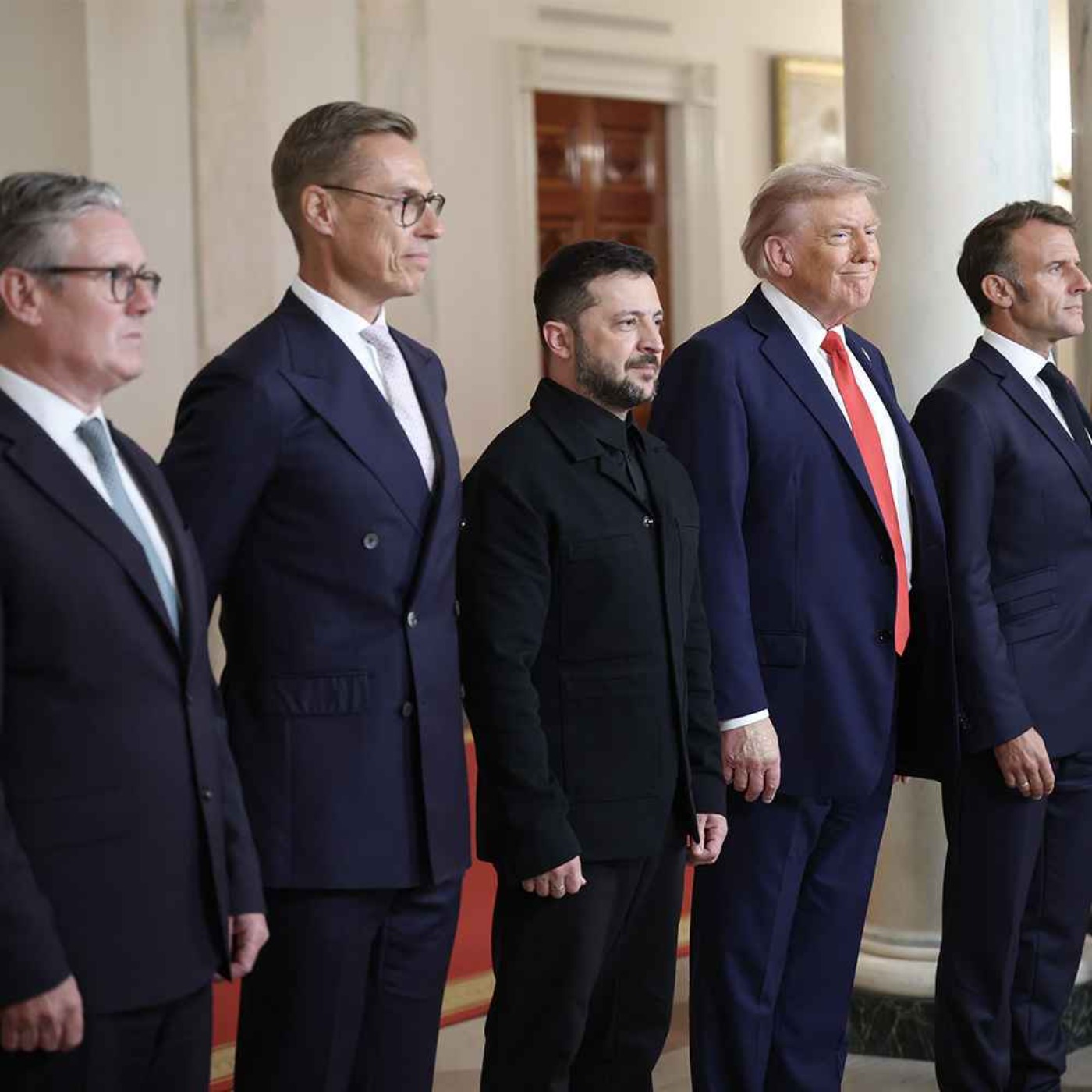
4:05Trump's in full command. And then we have this strange scene with the European leaders, including our very own Kirstana. The hottest thing I've ever seen. He made them sit around a big table, the eight, so it was Snow White and the eight dwarfs of Europe. And he made them sit around You always said that because the Albanian guy wasn't there. He is super tall. He was enormous. But he sits them around the table and he introduces them one by one as though they're his crew. I'm honoured to welcome NATO Secretary General Mark Ruta, who's a great gentleman, great, great political leader in Europe. Prime Minister Starmer of the United Kingdom, our friend and my friend, and doing really well.
4:46And people like him a lot. We all like him. Everyone knows... As though each has, like, a special talent in a heist movie or something. He's really good at walls. And until he came to the Finnish guy, he clearly didn't know who he was or what he was doing there. President Stub of Finland, and he's somebody that... Where are we here? Where? I'm right here. Oh. You look better than I've ever seen you look. But you've done a great job, I love that Maloney just rolled her eyes throughout the whole thing. Every time someone was speaking, she's just sitting there like, when will this end? It goes on too long.
5:27And then, of course, at the far end, with his little brill-creamed grey hair, looking like he's attending a corporate board meeting, is Keir Starmer. And when he was finally introduced at the very end, I was braced for him to say, can I get anyone a cup of tea or coffee? He does give sort of middle manager at Dixon's vibe. sort of delivering a monthly sales meeting. Yes, if you could all turn your attention to the PowerPoint now. And he's so keen on his coalition of the willing. Yes, and he shows it in his chin. He stiffens his chin whenever he's talking about it. Because he thinks that that's his baby.
6:01There was a bit of vying, I felt, there was a bit of competition, wasn't there, from Macron and Mertz. Yes. Trying to claim ownership of the coalition of the willing. Who's leading this coalition of the willing? And sort of a slightly sort of trans-European dogfight. Which was not facilitated by Macron's very strong accent. And I could see Trump turning off. He was overdoing the French. She felt he was laying it on thick. Sort of like somebody trying to get through a GCSE French oral. It almost tipped over into Clouseau. Or hello, hello. I think while all that was going on, I think Trump had just blanked out and was just imagining that he was somewhere else.
6:37Afterwards, Keir Starmer did a sort of, sort of a slightly sort of from the armchair video about how he thought it had gone. Back at the British Embassy now after a long day, but a good day and a productive day because both of the outcomes that we, the United Kingdom, most wanted, we've moved forward in a material way. a breakthrough when it comes to security guarantees, with now the coalition of willing countries, that's the 30 or so countries that we've been coordinating for some months on security guarantees, now working with the US at pace to work up those security guarantees. These guarantees will ensure that if there is a peace, if there is a deal, then we hold to it and there isn't further conflicts.
7:21The second is that there will now be a bilateral meeting between President Putin and President Zelensky after a phone call by President Trump during the course of this afternoon to President Putin, followed by a trilateral meeting with President Trump as well. So that was a little dispatch from the prime minister to let the public know where he is right now. Never here, Keir. For those of a certain age, the videos remind me of Wish You Were Here. There's a Judith Chalmers quality to his Twitter feed. Today I am in Spain. Yes. Yesterday I was in Alaska. Next week I'll be in Washington. Where he isn't is dealing with any of the domestic flak coming his way.
8:05Reports about Rachel Reeves taxing us till the pipsqueak. Protests outside migrant hotels. Gangs not being smashed. You're probably better off in Washington. But also isn't that the other weird thing about these press conferences? President Zelensky is sitting there and then there's a number of planted questions on domestic matters. So he's going on about how much safer he has made Washington in four days. And now all of his friends, including Democrats, shock horror, he has Democrat friends, apparently, President Trump. Are ringing him up and saying, thank you, thank you. And also mail-in ballots.
8:35They can go out at night. Total fraud. There isn't a country in the world that has postal ballots. And of course they're thinking, we do. Hang on a minute. We all remember Tower Hamlets. Some lessons there for the president. But to be fair, I actually thought that Trump was probably at his most amenable yesterday. He's not ruling anything in. He's not ruling anything out. Very much trying to play the role of the global statesman. And the Europeans served a purpose, right, which is to remind Trump that there are other people involved in this. There is indeed a coalition of willing people across the world who don't want to see Ukraine completely rolled over.
9:14and they are there to just draw him back from going a little too far and giving away a little too much. Well, let's speak to former Secretary of State for Defence Ben Wallace to ask what he thought about it. First of all, Ben, what did you make of the Prime Minister's presence at the table? Well, the plus side was one of the few things that makes Putin question what he can do in the future is an international united front. One of the major things he underestimated before he went into Ukraine was he calculated that the international community would flake and it would all be over in a few weeks.
9:49And he got that wrong. So I think the plus side that the European leaders of the major countries were all there at Washington alongside Zelensky, I think was an important message both to Donald Trump and indeed to President Putin. But I think it really all stopped at that point messaging. I'm not sure anything really got progressed of anything solid. And And they all tried to make their chip-ins, as you notice, in a way that flattered President Trump. And really, we didn't see what went on in private. That's obviously what often happens. People are always cautious when the cameras are in the room.
10:27But ultimately, I think nothing really came of it other than to say we're all united. And the one thing that's important was Donald Trump might have realised, and I wrote in my Telegraph column a few months ago, that unless the people with skin in the game is in the room, whatever you agree with Putin turns out to be relatively pointless. You know, you have to have the stakeholders around that table. So we got there. That's not a bad thing. I can't really see what any of them offered. Well, hang on a minute. Let's refer to your latest But One Telegraph column, which is headlined, and it came after the Alaska summit.
11:04Putin played Trump like an agent handler plays an asset. You've been really critical of the US president. Hasn't there been some progress under his watch? Because we now have security guarantees and even actually Trump failing to rule out US troops on the ground to protect the future of Ukraine yesterday. And we have him pushing Putin into a trilat or a meeting of three different parties now, the US president, the Ukrainian president and the Russian president. And actually, if Putin turns around and tries to block that, he'll look like he's the one trying to prolong the war. So actually, strategically, Trump has played it rather better than you had suggested after Alaska.
11:50No, I totally disagree. We haven't got any security guarantees. We've got the potential of a security guarantee with absolutely no detail. We also don't know what security we're supposed to be guaranteeing. If, as Donald Trump had suggested, the swapping of land and witless Wyckoff had suggested handing over land that hadn't even been taken by Russians, effectively, we could be in a position of guaranteeing President Putin's plan and security, which involves the most strategic part of the Donbass region, which would allow Russia to further invade Ukraine from a position of strength in the future.
12:32So we have no detail of any of that. I can say the one thing that we know after yesterday is President Putin, yet again, has made absolutely no movement whatsoever towards peace. In fact, he was firing missiles into Ukraine yesterday. And President Putin has been constant and consistent, to be fair to him, in refusing to make any movement towards any compromise on this issue. He ruled out yesterday the possibility of European or NATO troops in Ukraine, which is going to be vital for a security guarantee. So unless President Trump turns around and says to Putin, well, lump it, we're going to do it.
13:16There is no security guarantee of note or of detail that's been trailed, I'm afraid, Camilla. So I couldn't disagree more with your proposition. He hasn't actually confirmed the trilateral of Putin. he suggested it the Kremlin has said nothing at all on that subject and I think we still have a long way to go what we do know from the White House was a briefing that the Ukrainians lucky old them going to be allowed to spend 100 billion euros of European money on American equipment that isn't really going to help the broader security of Europe I think that that shows that a lot of this was more about going.
13:57I think they went over there to try and buy Donald Trump. And basically, we have yet to see Donald Trump put any pressure on Putin. Hasn't changed, Camilla, since Alaska. If you saw it in Alaska, Putin went nyet. Donald Trump very quickly moved away from a ceasefire requirement, if you remember, which was really important originally. Chancellor Mertz made that clear yesterday. And as soon as Putin went nyet, Trump turned to Zelensky and basically said, I think, you need to do something. Ben, if I may, how do you explain to the casual viewer then why the atmosphere at yesterday's summit was so positive?
14:37If indeed Ukraine is being sold out, why did Zelensky behave as though he had a win, as if he was delighted to be there and America was backing him to the hilt? Why did the Europeans sitting around the table all say, Mr. President, thanks to you, we have made steps towards peace? The casual viewer looking at that will think it looks like the allies are very happy with Trump's leadership. And yet you're saying they're getting nothing. Well, I think what they're trying to do is bring President Putin, you know, get some pressure put on President Putin and bring President Trump away from his drift towards the Russian lines and the Russian view of this war and bring him over to their side.
15:20And I think turning up and shouting at him is not going to help, and turning up and trying to pick a fight wouldn't help. And at the very least, that didn't happen yesterday. But if we look at any solid measures that will bring Putin to the table, they have not been achieved as yet. And I'm allowed to throw bricks and mortar at Donald Trump because I'm not in office or in government. But I don't actually see any actions to date that have been anything other than avoiding putting pressure on President Putin, and in turn, returning some of that towards putting pressure on President Zelensky, I'm afraid.
16:01In which case, if the Europeans were grovelling, does that not just remind us of their failure to act independently of America? You make an important point in your Telegraph article today that actually it's incorrect to say Europeans have not spent money on this war. They've spent a lot of money and given a lot of material. And much of what's being done now is being purchased from America rather than America donating it. The president has it in his head that America just gives stuff away. It's not true at all. But for whatever reason, the Europeans have failed to come together as a coherent independent military force.
16:35And that's why they have to turn up and grovel to the president, because they still rely on America to guarantee Ukraine's future. I totally agree with that point that, you know, I've been writing in my columns for nearly a year that ultimately Britain and other companies have to put their money where their mouth is. And to be fair, there are a few countries in Europe who really are. Germany, Poland, Scandinavia are really spending money now on defence and increasing their capabilities. Britain, on the other hand, has had an SDSR that's more hollow than a Swiss cheese and where the money isn't actually due to increasing defence spending to roughly 2028, 2029.
17:17and all we've got was treasury tricks where they have tucked under the intelligence services budget to artificially impress Donald Trump at that summit in The Hague with these wild claims of 2.6 % of GDP growing to 5. At the moment, if you ask people in the armed forces, they are going through cuts at the moment. So I totally agree on that. And it's been like that since 2014 when President Obama was very clear that Europe had to step up. And if we'd all acted on that, and that includes my own party who continued to cut defence, 2015, George Osborne imposed a cut of 7 % on our defence budget. If we'd actually been spending money properly and matching growing threat, we would not be in this position we are today.
18:05I was going to raise that political point just because there is going to be a great irony here if by the end of this parliament, Labour ends up spending more on defence. Keir Starmer, a man who propped up CND-loving, peace-loving Jeremy Corbyn for four years, ends up spending more on defence than the Tory government? Well, I think, first of all, if the end of this government is in 2028, and you remove the tucking unders, that's the folding in the MI6, MI5, GCHQ budget, and indeed the Ukraine spending, which under my day, I wouldn't let be tucked under, as we call it. I think it is unlikely there'll be spending like for like in the real terms, what I handed over, which was£30 billion more, or£24 billion more in my term.
18:56However, it certainly won't be the step change that is required. But it is also the case that the last time a government genuinely spent 3 % of GDP, 3 % of GDP on defence, it was a Conservative government. But that doesn't let any of us off the hook. Both Conservatives and Labour have hollowed out defence basically since 1991. There's been a few spikes, but overall, you cannot escape that fact. And the very first time we had a real turn of that corner was Boris Johnson giving me the£16 billion growing to£24 billion increase, genuine money, not hocus-pocus efficiency savings and all the other stuff that we have seen in the past.
19:39But I'm afraid we've returned back to the world of hollowing out, which is of great concern to our armed forces and indeed to our security. What do you think is the worst case scenario in terms of a geographical carve-up of Ukraine? What must they absolutely not allow to go? The worst case scenario is that they concede Putin's ambition of the whole of Dushank and Donbass, and he gets the very strategic part of the Donbass that is important for any future invasion, which is, I think they call it the Forest Belt up in the northwest of the country, very, very important area. And they give him ground that he hasn't already taken.
20:22And Putin concedes nothing at all. I think that's the first. He doesn't give anything back at all. That would be very, very wrong. And he would walk away Putin knowing he can change borders by force and win. I think the other thing that would be very, very bad is if we publicly concede that, you know, Russia gets a veto over membership of things like NATO or Europe. You know, one country like America can say we will never let Ukraine enter, but other countries should be allowed to continue their support for a Ukrainian membership. You know, America doesn't have a right to stop Britain telling people they can or cannot join Ukraine.
21:03Of course, as its unanimous decision-making body, any country, including Hungary, could veto new entries. That's just the reality of it. But remember, the principle here is Russia shouldn't be telling other sovereign states what they can and can't do. And in fact, Russia and Putin has signed up to numerous agreements where they respect those rights, allegedly. And then I think lastly, what we shouldn't do is make security guarantees the beginning and the end. What the security is we're going to guarantee is as important as the guarantee itself. And there will be a danger in the sort of day-to-day media to say, look, we've got a security guarantee.
21:41And then what we end up doing is finding ourselves in a Balkan situation where we get stuck. Thousands of troops are stuck, effectively policing Ukraine in a front line that suits Russia, allows Russia to go off and rearm and pose threats elsewhere on the European continent. while we're stuck, as they say in military terms, we are stuck in a strategic dilemma with our forces fixed. And then Russia does what the Bosnian Serbs did so well, which is use militia, non-aligned armed groups to effectively humiliate, provoke and snatch along that border without us being able to make any action in return at all.
22:21You know, are we going to trigger an Article 5 over what Russia used with little green men coming into Crimea? Are we going to see the humiliation of Western troops who, let's say, get sniped at from a position that's apparently occupied by militia, not Russia? I mean, what are we going to do in that situation? That could be very dangerous. We all saw what happened to the UN in the Balkans, and I wouldn't want to see a repeat of that. How else, though, could Trump have handled Putin? I mean, we had the discussion about Alaska. You were very clear about how you felt that the whole scene was humiliating and that Putin had been playing the US president like a fiddle.
23:01We then had Boris Johnson saying that the red carpet being rolled out and Trump referring to Putin as the boss was vomit inducing. But there needs to be a degree of pragmatism, surely. I mean, Putin would not have entered into the talks if the red carpet wasn't rolled out, for instance. If you have to engage with a murderous war criminal, you have to do it in a manner on the world stage to presumably slightly inflate their ego so that they are willing to enter into the talks in the first place. How better could Putin have been managed at that point? Having a meeting is just a meeting, red carpet or not.
23:36But the fundamentals here was you've got to have a meeting for a purpose, right? So was that purpose of that meeting in any way to put pressure on President Putin? None. And what we have seen all the way through, and unless you can point to an actual occasion where Trump has followed through on his threats to increase sanctions. If you remember, it was all going to be done by, I think, the 18th or whatever. And if it wasn't, there were definitely, definitely going to be secondary sanctions and sanctions on everybody. That hasn't happened. And time and time again, you know, if you're a parent and eventually you tell your children don't do this and they still do it and nothing happens.
24:17Well, we all know what happens. People just continue to do what they were going to do. I have yet to see an example, a single example, of Putin being under pressure from the United States. Maybe you can give me some examples, but I haven't seen any. How would they apply more pressure? I see what you're saying about sanctions, but what, until the point of dropping bombs on Moscow? How do you force somebody like Putin? President Trump could have followed through on his sanctions. He threatened sanctions on numerous occasions. if we didn't get a ceasefire, remember? I mean, so give an example. At the Alaska event, Trump basically accepted the removal of a ceasefire being a prerequisite, only, what, five or six days since he said it was a requirement.
25:03And if there wasn't a ceasefire, he was going to follow through with sanctions. So he could have said at that meeting, thanks for coming, Mr. Putin, but if you're really not interested in even having a ceasefire, And remember, the night before the summit, Putin sent more drones into Ukraine. Thanks for coming. But unless by the end of this meeting we have some ceasefire agreed, I will be imposing those sanctions. I know, but then one wonders whether sanctions would ever work. You know, you've still got loads of European nations, the very ones that are appearing in the room next door and arriving by car to great fanfare, literally freebasing still Russian gas and oil.
25:43I'm not sure which ones are in that group. The Hungarians are, the Slovakians are, but there is certainly an issue where, you know, don't think that Russia isn't finding it hard, all these sanctions. You know, if you look at the direction of its arrows and its economy, there hasn't been a catastrophic collapse, but it's sending its oil and gas at a discount to India and China. You're seeing all revenues down by about 30%. You're seeing inflation going up, interest rates going up. and it's had to go on a total war footing, there are sanctions that could be brought to the United States could do more sanctions, especially around secondary sanctions.
26:23And you're right. I mean, you know, Hungary would not like secondary sanctions on it by the United States. But it's a legitimate point to say early on in these years. Years ago, the Germans were busy buying gas and doing pipeline deals with the Russians at the very time Europe was expecting America to spend more on defence. And I think Trump said that in Trump 1, and he was right.
27:11pros for nearly 30 years, so we know the difference between done and done well. Angie, the one you trust to find the ones you trust. Find a pro for your project at Angie.com. You've got social dialed in. Search is doing its thing. So why do your marketing results look the same as six months ago? That's because you're fishing in the same pond as everyone else. Podcast listeners are a different audience entirely, more engaged, harder to reach through traditional channels, and ready to act to when someone they trust makes a recommendation. We're Acast, and we put them right in front of you. Browse thousands of the world's leading podcasts, book host reads or run your own ads, and track every conversion in real time.
27:52Same skills you already have, brand new results. Acast. Acast.com slash advertise.
28:09I guess the million dollar question here is, Ben Wallace, if you were president, what would you do? Considering that the war is now three years long, it's in some sort of state of deadlock. We are well away from the era of Boris Johnson talking about taking back all of Ukrainian territory. Crimea is gone. What would you do in that circumstances that can realistically get a better deal out of Putin than what Trump is trying to pursue? Well, first of all, I wouldn't have stopped the military aid from the United States to Ukraine. or elsewhere, I would have continued to do that. Secondly, what I would have done is I would have been far more robust with the sanctions and stricter on the shadow fleet of oil tankers around the world.
28:53As we know, Russia have been using that. And you can do all sorts of sanctions around the insurance industry and around secondary sanctions on people who are found to be trading and using loopholes to get through that. Thirdly, I would have been prepared to make sure that I reinforce further with my military other borders with Russia, create a strategic dilemma for Russia rather than the other way around. Where is Russia vulnerable? It's vulnerable in its navy. It doesn't have an army at the moment that isn't other than focused in Ukraine. I would have created a strategic dilemma. But what I would have done, which wouldn't have cost me anything at all, which is what I think, sadly, Donald Trump did on day one of his second term, was I would have taken away hope from Putin that we aren't going anywhere.
29:42You know, hope is really important in all of this battle. On day one of the invasion, the mission was always to give Ukraine hope that they could resist. They had that hope because the international community was strong. As soon as Donald Trump walked into the White House the second time around, all his language, all his talk about berating Ukraine, taking the line that somehow they were provoked, gave hope to Putin that just a few more months and he'll get his way. Hope. I would have reinstalled hope that I ain't going anywhere, Mr Putin, and nor is the international community. You know President Zelensky quite well.
30:19You've met him on a number of occasions. Where do we think he is at right now? Clearly it went a lot better at the Oval Office yesterday than it had on the previous occasion. Take us inside his mind right now, Ben Wallace. Ukraine is a democracy. He's got to balance different political voices. There'll be those, there'll be hardliners, there'll be hawks, there'll be dubs, just like any other political system. He will be trying to recognise the difference between maintaining the principled position that we shouldn't reward the invader, that we mustn't be seen to give away Ukrainian land that hasn't been fought over or indeed hasn't been taken, but finding a way to get some form of peace and balancing the short term with the long term.
31:07Now, the long term hope for Ukraine is that it gets to join the EU or that it gets to become economically powerful and successful. And that's the best way to defeat Russia and Putin, is to say, one of your neighbours now looks, you know, with a GDP per head and a wealth, it now looks like Scandinavia, or it looks like countries that people want to be part of, rather than your country. That's the long term way of demonstrating to Russian people, that the Western way of life is the better way of life than the corrupt, crooked, criminal, gangster state of Russia. So I think that's the first thing that he's got to balance short term versus long term.
31:49But he's also got to balance a very deep held view that I would agree with, that Putin can't be trusted. I mean, he just breaks every agreement he ever makes. How can anyone trust him, whatever piece of paper he signs? And that's why making sure he navigates the right security guarantees and the right security endpoint with, you know, what he's going to try and have to sell to his people, because a lot of them have given their lives to defend their nation. And I think that's why, you know, there has to be some form of carrot and stick that he's going to have to craft. And it's not going to be easy because President Putin is going to be sitting there bombing most days.
32:34And that's why Chancellor Mertz and the Europeans, and while we didn't hear Keir Starmer say it, the European position is strong. You have to start this with a ceasefire. I think the ceasefire is important because it also is the true tell of whether Putin wants peace. We hear Donald Trump say, stop the killing. Okay, let's stop the killing. Let's start with a ceasefire. And the one person who isn't interested in the ceasefire is President Putin. I suspect Trump would say he doesn't want a ceasefire because he doesn't want it to become a frozen conflict. But do we all accept now that the security guarantees you refer to...
33:10Hang on. I thought Donald Trump wanted to stop the killing. Yeah. I mean, a frozen conflict would stop the killing, right? I mean, North Korea, South Korea. I mean, it's not the best solution. But if he keeps saying, my number one aim is to stop the killing, stop the killing. Mr. Putin, let's stop the killing. Nyet. OK, right, let's go do something else. But you can stop the killing for good if it is a long-term peace agreement. Let's just stop the killing. A short-term ceasefire. But anyway, do we all now accept that this future will not mean membership of NATO? It will mean some sort of defence agreement?
33:45And is that why the summit was so vague? Precisely because you're not going to come out of it with, and Ukraine will be in NATO, because it's too provocative to Russia. Russia will never accept it. And even the Ukrainians now acknowledge that formal alignment with the West is now off the table. It's off the table for now, simply because one nation can veto anybody else joining NATO. And that's just that is the real politics. You know, Britain, Estonia, Scandinavian countries can say as long as they like, we want Ukraine to join. But as long as either the White House says no or, you know, Orban says no, there's nothing we can do about it.
34:24Well, that's just the fact. And I think everyone knows that fact. It does mean also that we can all maintain our positions independently, knowing that the truth is it can be vetoed. It's not what I would want. It doesn't mean, say, you're breaking your principles. And Ukraine know that. They've known that since that Romania-NATO meeting all those years ago, if you remember, where some nations were keen and France and Germany weren't, which was about 15 years ago. I think, you know, memory serves me right. So it's been a reality of the simple structure of NATO. But it doesn't mean to say, you know, Donald Trump or any other president of the United States cannot bind his successor any more than British prime ministers.
35:07And that is a reality. So I don't think people can use the word never. You know, it wasn't that long ago that Putin had apparently muted to Lord Robertson his interest in joining NATO himself. Final question, Ben Wallace. Have we lacked leadership here? I mean, Keir Starmer likes to be abroad a lot. He likes to be on the world stage. Downing Street announced with great fanfare that he was going along to Washington without actually saying he was going to be joined by other European leaders. How's your analysis of how our own prime minister has been handling this? Well, on the plus side, he's been consistent on his support.
35:40But, you know, words have to be matched by action and soft power has to be matched by hard power. and what we've seen is Britain is now tumbling down both the spend level and the leadership in NATO I think we're about ninth now I think when I was in we've got up towards second highest spending in NATO Germany Poland you know Poland's not far on track for overtaking us if it would certainly by GDP it already has we're starting to lose our leadership both within NATO and indeed within, I think, the international community about our role both in Ukraine, but also in being able to deliver something.
36:20I mean, you know, this thing about, oh, the coalition of the willing and we could all deploy troops to Ukraine. The answer is what troops, right? I mean, we're stretched. We've got a battle group in Estonia. We had huge gaps in our army's ability to be enabled to deploy. I remember getting told off by number 10 for admitting we couldn't actually deploy our division. We were massively short of trucks and things like that that you need. And we're back to that old, old sort of habit of number 10 promising things, but not being able to fund or refusing to fund it properly. I remember a very, very senior NATO officer from a country in Europe said to me, why does Britain constantly write checks it cannot cash at NATO.
37:05And we're being found out. And that's really sad. And we need to, if he puts his money where his mouth is, we start to invest. Rachel Reeves is told to stop mucking around and tucking under. I mean, I'm told two things. I'm told, first of all, that there was a decision that they would fund from the reserve, I'm not sure we actually have a reserve, Ukraine. And then the Treasury has stood in and said, oh, but hang on, we need to do a value for money test on that, which is one of the Treasury tricks to long grass something. And I'm also told that John Healy is refusing to ask for more money. So he's neither being a defence secretary first, he's being a politician first, and the Treasury isn't funding it anyhow.
37:51So we'll just drift further down the tables, lose our leadership, pose around, but not really make a difference. And I can tell you who's going to take the leadership in Europe on defence. It will be Germany, closely followed by Poland. Ben Wallace, thank you very much.
38:10I can understand where Ben Wallace is coming from there. We're asking a load of questions, basically saying, well, how else do you negotiate with a Russian tyrant, dictator, murderous zealot? On one hand, he's saying, well, Putin wouldn't obey a ceasefire anyway and he wouldn't accept any terms. And he's making an extremely compelling case, frankly, for the Ukrainians not to give away the Donbass when they've spent the last three years successfully defending it against all the odds. The calculation Wallace makes is that it would cost the Russians two million more casualties and take four and a half years to actually seize the Donbass region, the mineral rich.
38:51So we're giving him something he's not winning. And also, by the way, I do agree with Wallace. I know there's this whole kind of like sort of Peter Hitchens argument, the hawks are just warmongering maniacs and they want this war to go on and on. But I don't feel comfortable conceding anything to Putin. Do you? No, of course, no one feels comfortable doing that. I'm sure even Peter wouldn't. And so what Wallace is saying is the summit was pure theater. It was vague. Nothing was properly agreed. People were just more there to keep Trump involved than they were actually to come up with a concrete solution to the crisis.
39:31And the proper pressure has not yet been applied. The full sanctions haven't been applied. The full weaponry hasn't been given. And Europe has not raised its economy. It's not militarized its economy such that it can fight the war, that it rhetorically claims it wants. But what I keep coming back to, listening to all of that, is, but we don't want to fight that war. The fact that no one has been fighting that war should tell us that no one wants to fight that war. And it is cruel to Ukraine to keep saying, Slava Ukraine, you keep fighting, when we're not willing to do the things that would be necessary to help it to win.
40:07All that means is that more and more Ukrainians die, and Russians die, And it is a tragedy when Russian soldiers who are fighting, most cases against their will, I assume, die as well. It is tragic to compel those people to do that when they're not going to win. And it is reported, for instance, that the average age of the average Ukrainian soldier is gradually rising more and more. Why? Because they've got through their stock of young men and they're now forced to recruit people who shouldn't be fighting. But we overstate Russia's military and economic might, don't we? Its economy is the same size as Italy's.
40:43If the European nations and America really did club together... But Italy's economy can cover nursing, pasta, nice holidays, red wine. Russia's entire economy has been redirected towards the war. That's the difference. They're spending about 10 % of GDP on the fence. It's a question of will. It's not just a question of wealth and material. It's that Russia is acting as though it wants to win and therefore it is negotiating from a position which is far stronger than it really deserves. Yeah, I mean, but then is Trump just engaging in the theatre of all this and being the sort of peacekeeper because he has got a Nobel Peace Prize on his mind?
41:23He wants to add that to the CV along with, you know, Apprentice and two Oval Office terms and doesn't really care at what cost it comes at, provided that he can be the big man on the world stage leading trilats. But if a president of the United States, his one vanity is he wants peace, then I welcome that. That's kind of rare in the annals of presidencies. But a peace that basically says to Russian dictators or North Korean ones or any other baddies out there, if we're going to talk in those basic terms of goodies versus baddies, that they can just invade a sovereign territory, take a load of land and actually just get away with it because, oh, by the way, I'm a bit too busy.
42:04with my MAGA supporters and rebuilding Rust Belt America. But he would say they can't just do that because they didn't do it under him. That's why he emphasised this again yesterday. He regards this as Biden's war and he has a point. The Russians didn't do it. OK, the rise of Nazi Germany from 1933 onwards didn't happen under Churchill's watch. But when he was finally in power, he turned around and said, all right, enough's enough, Nazi dictators. You can't just march into Poland and get away with it. Yeah, but I guess Trump's point is that he believes in a peace through strength strategy whereby no one messes with you because they're terrified of what you might do to them.
42:40But he's inherited this situation and he wants to bring it to an end so he can withdraw from those parts of the world where he thinks America is overextended so that America will be stronger in the long run. And he's chiefly interested in America's defense, not in Ukraine's borders. This is in keeping with Trump's personality. You mentioned North Korea when Ben was saying you don't just meet with someone with no point. That's precisely what Trump did in Singapore with Kim Jong-un. in his first term. But this is also in keeping with America. America has a habit of cutting and running. It tells foreign countries, fight, we're on your side, we'll give you the money and the means to do it.
43:12And then it gets exhausted and it runs. It did it in Vietnam. It did it in Afghanistan. It's going to do it again in Ukraine. The world has to deal with it. And if Europeans are sick of them doing that, Europeans should come up with their own united defence force that can carry out these wars. And also I thought it was interesting when Wallace said, look, North-South Korea isn't ideal, but what's he suggesting there? That you have this sort of border? Yeah, what is better? I don't get what the alternative is. It's like shades of East and West Germany or something. Because victory is no longer on the table.
43:41It probably never was. And survival, I was really struck by what Francis Durnley said in a podcast of ours last week. Every day Ukraine survives is a victory. OK, well, take that victory. It looks like we're getting to a point whereby Ukraine will live and will come under Western protection so that hopefully this can't happen again. That to me sounds like a win. All right. Speaking of Francis Dernley and our colleague Don Nichols, they're, of course, podcasting on Ukraine, the latest. And do check that out for getting into the weeds of the issue, particularly when it comes to the geographical sort of negotiations that are taking place when it comes to land in Ukraine.
44:19And we'll be back tomorrow, 5pm.
44:57We'll see you next time. and when that voice talks about your brand, it doesn't sound like advertising. It sounds like a recommendation from a friend. Acast gives you that trust at scale. Digital precision, post-read authenticity and performance data that proves it worked. Don't fight for attention. Buy it with Acast. Learn more by visiting acast.com slash advertise.
Yesterday’s much-anticipated summit in Washington, which saw a host of European leaders accompany Volodymyr Zelensky to The White House for talks with Donald Trump about achieving peace in Ukraine, has been talked up optimistically by all who were present.
However, with Donald Trump today ruling out American boots on the ground as part of any security guarantees for Ukraine, and Zelensky ruling out Vladimir Putin’s offer of a bi-lateral meeting in Moscow - two of the key takeaways from the meeting - was anything really achieved in Washington?
On today’s Daily T, former UK defence secretary Ben Wallace tells Camilla and Tim that the summit was “relatively pointless” and “nothing really came of it”. He makes the point that Donald Trump has never applied serious pressure on Putin - such as through the increased use of economic sanctions - to bring him to the table, as well as outlining his worry that Trump will end up rewarding Putin with “ground that he hasn’t already taken”.
Producer: Georgia Coan
Senior Producer: John Cadigan
Executive Producer: Charlotte Seligman
Planning Editor: Venetia Rainey
Video Editor: Will Walters
Studio Director: Meghan Searle
Production assistance from Antoinette Omole
Hosted on Acast. See acast.com/privacy for more information.


