Ask ChatGPT


 The Daily T
3 Aug 2026 · 40m · 11 chapters
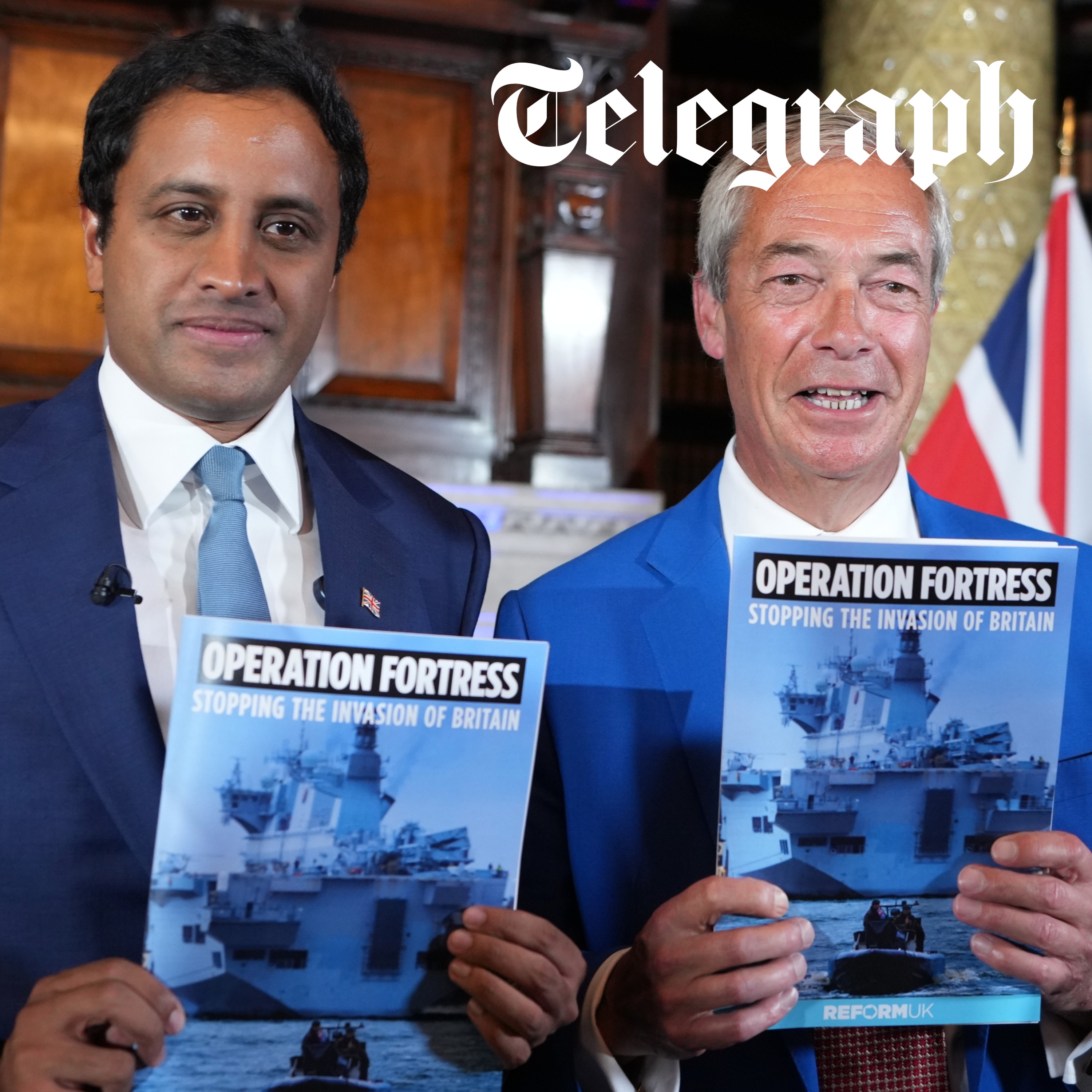
The episode debates Reform UK’s “Operation Fortress/Hard as Nails” plan to stop Channel small boats by using Royal Navy vessels to intercept and bring dinghies alongside, framing it as a humanitarian rescue rather than “pushbacks.” It ties the proposal to the Suta/Sueta border crisis: nearly 60,000 mostly young men crossed from Morocco; a legal change reportedly ended sea turnbacks, contributing to deaths (around 70). Spain and France then suspended Schengen and returned people quickly, allegedly by saying asylum claims can’t be made just by being in Spain.
the Navy can do this routinely (Horn of Africa anti-piracy; Ireland precedent), coercion would occur only if migrants resist, and courts/lawyers will be the main obstacle.
Australia’s “Operation Sovereign Borders” (2007–2013) allegedly led to zero deaths.
Zia Yusuf (Reform UK Shadow Home Secretary) and Nigel Farage; the hosts discuss also Rupert Lowe/Restore.
Written by AI. May contain mistakes.
Discussion of the Reform press conference and the new proposal.
“Just mention you're in for another week because we still haven't found Camilla.”
Exploration of recent events in Suta and the reasons behind migrant influx.
“Well, actually, at this press conference, Nigel had his own way of saying it.”
Analysis of Spain's actions regarding the influx of migrants and legal implications.
“Then comes a complete flood of people coming through and you see them running across some land, scaling border fences, and it really does look like an invasion.”
Details on how the Royal Navy would operate under the new policy.
“But having said that, I'm not sure they have rolled out this policy because of Souter, given that the document they put out is so well made.”
Discussion on whether the operation is humanitarian or military-focused.
“But Poppy, you were listening to all of this and thinking, reform's insistence that this is a humanitarian mission, not a military one, didn't convince you.”
Examination of potential legal challenges facing the proposed operation.
“You know, look, we all know our armed forces have been hollowed out by the Tories and by Labour.”
Discussion on the feasibility and implications of Operation Isotope and the role of the Royal Navy in managing small boat crossings.
“I don't think there's the detail there which actually explains how this is going to work.”
Discussion on the evolving relationship between Reform and Restore UK.
“And to help you better manage your health, we're coordinating care between your doctors and your technology.”
Overview of Nirav Modi's story from success to infamous fraud.
“whose jewellery was worn by Hollywood stars like Kate Winslet.”
Analysis of the contentious political breakup between Rupert Lowe and Reform UK.
“Is there hope of reconciliation happening?”
Debate about the viability and implications of coalition governments in the UK.
“Restore would say that's because reform is just copying us now.”

Get the gist, explore an idea or ask about something said.
 Claude
On The Daily T, what are the key points of this episode?
Searching your listeningAutomatic transcript. May contain errors.
0:04The Telegraph. Britain is being invaded and reform wants to send in the Royal Navy to reverse the small boats. But will it stand up in the courts and will the French just say non? And is Nigel Farage really flirting with the idea of getting back into bed with Rupert Lowe? Welcome to The Daily Tea with me Tim Stanley and me Poppy Coburn.
0:35Poppy, we've just come running back from the Reform press conference to announce Operation Fortress, or Operation Hard as Nails, as I like to call it. Just mention you're in for another week because we still haven't found Camilla. Yes, she's lost in a boat somewhere off the coast of Morocco, apparently. Apparently she's trying to get into Spain. There are quick ways of doing it. Before we discuss reformers' proposals, the background to this obviously is the events in Suta over the last few days. Now, question one is, how do you pronounce Suta? Well, actually, at this press conference, Nigel had his own way of saying it.
1:12Sueta. Sueta. Sueta, like sueto. Yes. But I've heard BBC is sueta. ITV has been seuta. And of course, I have heard from the Spanish suetititit. A reminder that despite all of Franco's best efforts, they remain the most effeminate nation in Europe. But the bigger question is, what actually happened? Because no one has quite, 60 ,000 almost entirely young men went into the enclave of Souter from Morocco. Why did they go in? That's the first question. Yes, and I think you addressed this in your column. I do. So there are lots of people having various reasons why they've been blaming it. You start your column with a very, very funny aside, which is, of course, the way that the left has responded to this, because it makes them very uncomfortable whenever mass migration becomes a very visual issue.
2:02And this really was visual. They said it was just the Jews. Oh, the Jews did it. It was the Israelis and the Zionist Americans. Who are in league with the Moroccans. Of course. Because Israel occupies the disputed territories and because Morocco occupies or has a claim on Western Sahara, occupying powers like birds of a feather flock together. Yes. And they just have each other's back. I don't know about you, Tim. This seems very complicated when, I mean, maybe I'm wrong. Maybe I'm a paid up agent of the regime. But I thought that maybe the reason they came over is because there was some legal ruling which said that suddenly actually doing turnbacks at sea was no longer legally allowed.
2:41And so this ruling came down. And potentially, we don't have complete confirmation of this, but there have been reports in the New York Times that the Moroccan government may have played some role in allowing some of the people to cross over the border or at least offered some kind of encouragement. and it was a perfect storm with the weather being very nice to see loads of people suddenly just rush past. And the reason why so many people have drowned, by the way, at sea, I think the death toll is now in the 70s, is because of this ruling, apparently. You can't turn people back at sea. Then comes a complete flood of people coming through and you see them running across some land, scaling border fences, and it really does look like an invasion.
3:18I mean, that's kind of what it was. In which case, the final question about Sutta is, Then where did they all go? Yes, because within 24 hours of crisis talks, having Georgia Maloney saying that she was going to suspend the Schengen zone with the Spanish. This is so the Moroccans couldn't go from Spain then into other countries. With the French doing the same thing. Lots of EU commissioners suddenly raising their hands up in the air in complete inversion of what happened in 2015 when Angela Merkel said, oh, we'll manage it. Please come over. This is fine. Everyone's freaking out. It looks like free movement within Europe is dead.
3:52Spain somehow manages to return almost everybody who had crossed over from Sueta back. So how? How have they done this? That's the big mystery. And I guess part of the answer is they made it clear there's nothing for you here. Spain, which is very pro-legal migration, has still been working with Moroccans to stop illegal migration. And it just said you do not have the right to claim asylum by being here. So there's just nothing for you. And they've also deployed some soldiers and they have helped people to return. So in other words, we discovered, and this is really a revelation when it comes to asylum, because the narrative around asylum is you have to consider everyone who enters your territory.
4:37You have to treat them as though they are a legitimate asylum seeker and you have to process their claim. That's what it says under international law. And of course, Europe has been saying to Britain for a long time, If anyone lands up on your shoulder, hey, your problem, you've got to deal with them. We might have some agreement to take one here and we'll send you one or whatever. But again, the overarching narrative is you have to treat everyone who enters your territory as a potential asylum seeker. At Suta, we discovered this is not true. Yes. You apparently are allowed to just say, no, go back.
5:08And the other revelation is that tens of thousands of people will then just go back. Without them having to fire any shots, without any kind of contracted military problem. No, they've just left voluntarily. Yeah. So that is the background to Operation Fortress Stopping the Invasion of Britain, which reform unveiled at a press conference today. But having said that, I'm not sure they have rolled out this policy because of Souter, given that the document they put out is so well made. I mean, clearly a lot of thought's gone into this. A lot of legal research, they've got quotes from people associated with the Royal Navy.
5:45So they've got some high level endorsements. In other words, they've clearly been planning Operation Fortress for some time. Got some beautiful graphs in here. They've got some lovely graphs. Really fantastic graphic design work done. So good job, Reform. And of course, they already have a policy on what to do about people who do get into the country, which is essentially to remove them. So this is the bit about how they police the channel. I think the easiest thing to do is let reform explain it themselves. So we spoke to Zia Yusuf, who is their Shadow Home Secretary, and began by asking, just tell us what happens if a dinghy meets a Royal Navy vessel in the Channel under Operation Fortress?
6:27The first point to make is that the vessel that the Royal Marines will be in will be a highly maneuverable, pretty small vessel called an RHIB, a rigid hulled inflatable boat. So it's not some big, I know people may or may not know this stuff, but this is a very maneuverable small vessel. It will go right up alongside and they will be on a rescue mission. It's a humanitarian mission, given that almost 100 people making this journey are tragically dying, okay? Including, I think four last week, including three women. Now, the second point to make is that there's clear precedent for this. It happened in the Horn of Africa in the anti-piracy missions.
7:05conducted by the Navy. It happened in Ireland during the troubles. So this is actually a pretty routine thing. Then the argument is, well, what about the tides in the channel? Absolutely fair point. The tides in the channel can be extremely severe. The good news is they're extremely predictable, as the people smugglers themselves have used to their advantage. So that creates highly foreseeable windows for interception. All of which is to say that our plan is absolutely viable. In fact, as we've actually published, so there are many former senior members of the armed forces who are delighted with this plan, have endorsed it, some of whom we have actually published public.
7:41They're willing to go public with their endorsements. The plan itself was devised by former senior, particularly former senior naval commanders, but other people in armed forces too. So it is absolutely viable. And actually, as Nigel said up there, what on earth is the point of His Majesty's Royal Navy if not to repel an invasion of this country? So that's Zia Yusuf explaining the policy. But Poppy, you were listening to all of this and thinking, reform's insistence that this is a humanitarian mission, not a military one, didn't convince you. Yes. And this was a very strong line that Nigel actually took within the press conference, the main press conference.
8:17He was asked a question about pushbacks, the word pushback was mentioned. And he goes, no, no, no, no, no, pushbacks are happening here. this is a humanitarian rescue effort. We are simply helping the French to do their job properly with the billion pounds that we sent over to help stop the boats from crossing. We're simply helping to save lives in the Channel. Now, that's a very nice way of framing it, but that's not quite what this really is. And so we did ask Sia, you know, is this a humanitarian effort or is it a military one? And he did respond, honestly, I think both. There is no way of doing these pushbacks without some degree of coercion.
8:55which then raises the question of, well, how much coercion is actually going to be involved here? Well, if they are actively resisting and engaging in violence, for example, and they're using force against our Royal Marines, well, they will respond by ensuring that those people don't get to do that, right? But again, there is a direct historical precedent. Everything in our plan already has precedent. So if you look at what happened in the Horn of Africa, those are anti-piracy missions. And, you know, that was actually definitely at least two categories above of difficulty in terms of boarding those vessels, taking people on board, detaining them for a short period of time, making sure that they were healthy, treating them if necessary, and then returning them back to shore.
9:38There wasn't a single death during those operations. Likewise, there were similar things that happened during the Troubles. So, again, this notion, and I think a lot of your viewers know this in their bones, the notion that His Majesty's Royal Navy, our armed forces in general, are incapable of boarding or firstly intercepting and repelling a, you know, basically a fleet of dinghies of unarmed people is for the birds. But also, again, to answer your question directly, they will go right up alongside on highly manoeuvrable boats, which are one of the smallest vessels the Navy has at its disposal, and they will bring them on board.
10:16And they've done that before in scenarios where they were up against Somali pirates. I think they'll be quite OK doing it against Afghans and Syrians who are coming across unarmed. Is it a humanitarian mission? Is it a military mission? Is it both? It's both. Yeah, yeah, yeah. The military has frequently been used. That's it. You know, look, we all know our armed forces have been hollowed out by the Tories and by Labour. We know that. No one is more aware than I that we can put a destroyer in the theatre battle during the Iran war. It took weeks for us to do it and had to go back. No one's more acutely aware of that than I.
10:47This is very different. We are not taking on Russian warships. We're not taking on the Iranian government directly. This is a humanitarian mission. The military, including His Majesty's Royal Navy, they have an exemplary track record. And I want to point out again, you know, you've had a lot of talking heads today pushing back saying this won't work. Well, actually, the evidence points to the opposite. It's the only thing that has worked. So Operation Sovereign Borders, that was Tony Abbott's policy in Australia. And between 2007 and 2013, 1 ,200 migrants died trying to get to Australia by boat.
11:19They had a small boats crisis similar in magnitude of hours. And the thing that stopped it was a joint military operation where Tony Abbott declared no unauthorized vessel would make it to Australian shores. And do you know how many people died during that operation? Zero. Do you know how many boats were coming across within weeks? Zero. So again, I want to reiterate. And by the way, that was some years ago. As much as our Navy is depleted, they are more than capable of executing this mission flawlessly. So one reason why this debate matters, is this pushback or is this a rescue operation, is because if you say it's pushback, the lawyers are really going to come for you.
11:59And the rest of the world is going to say you're breaking all sorts of treaties. and reform acknowledges that in its document on page 15 it notes that in august 2020 the home secretary had approached french officials for quote cooperation in using the royal navy and border force boats to block the path of refugees and migrants attempting to reach the uk in small boats this reform says was an attempt to establish pushback where you physically push people back to the other side. And what's striking is that, as the document says, these events were short-lived, the Navy turned down these suggestions and ruled out any use of pushbacks in the future.
12:43Further, a Navy source was quoted as saying, I'm not sure pushback would work. It's not part of our ethics. Quite. So that's where I think the main point of contention is raised here between this tension between is it a military operation or is it a humanitarian operation? Because you can frame it in any way you like. Perhaps that is something that will help reform if there is a legal challenge. And let's be frank, there will be legal challenges. There's no way they're going to be able to dodge that. But will it actually convince the Navy that this is operationally different from what has been tried before under Robert Jenrick's Aegis?
13:18And I'm just not convinced entirely that that's going to be the case. Because let's say that someone does resist. What do the Royal Navy do then? Do they treat them as enemy combatants? Do they sink the ship? What happens, and you ask this, if there's a medical emergency? Do you just dump them on a beach in France and say, well, we've done our job, we've given you some medical attention, we've given you a blanket and a cup of tea, but that's all we're going to do, we're not going to bring you to British soil? That tells me that it's not just a humanitarian mission. This is not medicine without borders, going into the English Channel and rescuing people.
13:49It is a border operation, which is perfectly legitimate. We clearly need something at the border. But I think trying to thread the needle between those two things, which actually have very, very different objectives and very different ways of actually being carried out. I don't think there's the detail there which actually explains how this is going to work. Because surely the Royal Navy would just say that, well, we've already said no to doing this. You can't compel us to do this unless you say it is an invasion and you compel us on military grounds that you have to intervene in the channel. I don't think you can just say we're getting you to do charity work.
14:21Mm-hmm. Zia made the point elsewhere in the press conference that the objections to what was called Operation Isotope, that's the August 2020 pushback idea, that the objections were not actually tested in court. So we don't know if it would fail in a court. And he argued that the thing with lawyers, and he said, I'm sure everyone in this room has experience of lawyers. I'd say I don't. I don't. I'm quite sure what he's referring to there. I've managed to go through my life without having to sue or be sued. I don't think we're ultra high net worth individuals. We all work in these kind of spaces.
14:56That's my charitable interpretation. We've all dealt with butlers and valets, you know. But so he made the point that lawyers will always come up with a reason why something cannot be done and you have to test it. OK, fair enough. But the other aspect of this that we put to him is the French reaction. What will the French think of this plan? And what happens if they don't want to play ball? So as you'll see in the document, we envisage two scenarios. One in which the French consent and assent to this process, which would be vastly preferable. It's more dignified. It's better. And by the way, all we are actually doing is helping them comply with the very agreements that are being paid a billion pounds of British taxpayer money to stop the boats from coming.
15:41However, of course we acknowledge there's a very good, there's a certainly non-zero, meaningful chance that the French are not happy about this. The way in which they would express that is in a diplomatic row, potentially a big diplomatic row with Prime Minister Farage in Britain. Okay, we'll have that row. If we're not being willing to have a row with the Elysee Palace about the invasion of our country coming from France, then what on earth are we willing to have an agreement on? If you were going to put to me, and this is what I was asking on the morning, well, somebody asked me, what if the Navy, what if Macron orders the French Navy to open fire?
16:15OK, so now you are putting to me the notion that the French would either use their gendarmerie or their Coast Guard or their military, even worse, to open fire on a boat full of innocent civilians, chaperoned and escorted by a handful of Royal Marines and either open fire on them or even just push them back into the channel where people are dying. Make no mistake, that would be a crime against humanity. And look, I'm not Macron's biggest fan. I do not believe Macron or any other French head of state would ever, ever deliver that instruction to their people. I think that's a hypothetical that isn't even worth considering.
16:55And by the way, if they did or even briefed that they did, I think the French people, the lovely French people, certainly the ones that I know, would never tolerate it. So maybe you can get the lawyers to buy that this is a humanitarian operation and ergo what you're doing is not a pushback. I think it's going to be a lot more difficult to convince the French state, which will then have to deal with this problem. Because these people who came over because they wanted to cross the channel, I think it's completely true when the French authorities say this problem is partly being created because of the pull factors into the United Kingdom.
17:27Well, OK, suddenly these people can't come there. There's going to be a delay in information when people realise the jig is up and you can no longer get into the United Kingdom. Do they just stay in French territory? What are the French going to do about this problem? I see very little incentive for a, let's say, a nationalist French government that wants to win elections on the basis of being hardline on immigration, cooperating any serious and sustained way with this operation. It just doesn't benefit them. Why would they do it? We're not raising all of these questions, by the way, because we're saying this cannot be done.
17:59No. And the frustrating thing sometimes about interviewing some reform people is they always think that if you ask a question, it's because you're trying to destroy them. Yes. And it's not. It's just that we're asking the questions that voters will have who want to be certain that a plan will work. Who actually want a solution to this problem. Who may want to see something like this done, but they want to have the certainty that, like with the Rwanda plan, you're not going to make us go through a couple of years of very expensive experimentation for something that there was a legal case against it and you couldn't stop it from being blocked.
18:31Or, heaven forbid, it goes horribly wrong and someone dies. I mean, we don't want that to happen either. But also, European countries do do these sorts of things. I mean, there is arrangements between Mediterranean countries and Morocco and Tunisia, for example. But I think a key dimension of that that's missing in the case of Britain and France is, well, one key dimension, of course, is that the migrants are passing through France, whereas they tend to come from Morocco and Tunisia. Although they are also getting a lot of sub-Saharan migrants as well. And that was obvious from the footage of Souter.
19:05I mean, it's creating a lot of tension all over North Africa. I mean, just look at Libya. Libya is an incredible state of internal combustion because of people who were travelling through eventually on the route to Europe. Right. So they don't want that either. So they have a stake in policing this. But a critical difference with France is, say, Tunisia or Morocco are poor. So what Europeans are basically doing, what the EU's whole approach is, is it is offshoring its asylum problem. it's trying to get poorer countries, pay poorer countries to process its refugee claims on their territory instead.
19:46And this is even happening within Europe where Italy is attempting to pay the Albanians to process their asylum claims. I mean, it is a quite insane system that's been set up. It's basically, I mean, it's something that the Europeans have said, we don't want to get rid of our human rights doctrine because that would make us feel icky. But also this is a really big problem for us and it's making all my voters hate me. And so what if I just outsourced it to a nasty country that has completely authoritarian laws, it's totally okay to torture people, kill them in the pursuit of trying to stop them from coming into Europe?
20:21That's problem solved. That's basically what Frontex is. Yes. So they will punish countries within Europe. I mean, you can see this from Greece. Greece has been punished on multiple occasions for what they call illegal pushbacks in the Mediterranean. And yet when those pushbacks are being done by, say, the Libyans, well that's just part of the plan. It's a very weird system. It's basically if you get to a certain point in your migratory journey you're free from consequences. You've made it. Congratulations. You're in Europe. You're now abiding by European laws and you cannot be removed. So this is almost part of this conversation with reform.
20:52This is great. How interesting. They finally come up with a plan for the channel. But by the time people get to the channel it's kind of too late. It is something you need to collaborate on ironically for the Brexit party the people who brought Brexit to the United Kingdom They are going to have to work with Europe. They are going to have to work with Europe. I also find it intriguing that Faraj made reference to the refugee crisis of 2015, which is when Angela Merkel said to the mostly Syrian people crossing Europe, we can do this, you can stay, and around a million were allowed to remain. The world just looks very, very different.
21:26It does. 11 years later, we're more savvy about immigration being used as a political weapon. I mean, some people are also saying that the reason why Suta happened is because the Spanish were cozying up to the Algerians and the Moroccans don't like that. But the Poles routinely accuse Russia of using migration in order to undermine Europe. Yes, this is coming through the Belarus border, ultra-militarised now. There have actually been people who have died when they've been sending migrants over. I mean, it's a very serious situation. Right, and Reform has cited possible examples of Iranian terrorists crossing the Channel as well.
22:00Not quite sure why they need to do that. I'm not disputing it's happened. I'm just rather surprised because I thought if you're running a really good terrorist operation, you probably don't need to come in that way. Probably by a flight. Just by a flight. But anyway, but in that time, Europe has elected many very right-wing governments, which, as you say, are coming up against European human rights law. But nonetheless, those governments have instituted some policies, which we here in Brexit Britain, a revolution that was moated in large part by opposition to mass migration, kind of left us behind.
22:30I mean, if you look at the change in Denmark, where they are demanding integration of people, even to the point of demanding that ghettos be broken up and people move within the country. If you look at, say, Sweden, where there is a law now that shows that you have to be living an honest life if you're going to remain. That is, you must not have been involved in benefit fraud. You must have paid all your taxes. You mustn't have broken a single law, all these sorts of things. And the asylum applications to Sweden have crashed from highs of around 160 ,000 10 years ago down to about 6 ,000 today, which is back to where it was in about 1985.
23:10five. And of course, those countries have very liberal political cultures, Scandinavian countries, and they pride themselves on being non-hierarchical societies that, okay, I know they tax a lot, but they broadly leave their citizens alone. And instead, they've had to become very intrusive states, which are effectively managing their populations, and which are encouraging certain groups of people to please leave. Yes, we will pay you money if you just leave. Yeah. I mean, I mean, that's really what they're doing. I mean, I do actually think this is probably where Nigel was at his strongest in the press conference, because he did start by not just saying, look at what's happened in Sueta, look how Spain has responded.
23:48He actually took it back further to that. He did take it back to the Brexit referendum. He said, we left the European Union, but we did not leave the ECHR. And what I think was kind of implied by that is we didn't pull out of all of these treaties that actually would have allowed us to take back control of our borders. So the ironic thing that's happened to Brexit Britain is we are now an island of liberal ideology. As Europe is moving very, very strongly to the right on migration issues and frankly, a host of other issues. And we're the odd one out now. Yeah, because we've retained the European political culture at a time when Europe has elected governments which are moving in the other direction.
24:25And the ultimate mark of that is Pedro Sanchez in Spain, who is making moves to grant up to a million illegal migrants the right to stay in his home country. Sure, he is. He believes in that. But at the same time, he's also somehow magically managed to persuade nearly 60 ,000 people to leave Spanish territory. There is a feeling of, well, if he, a socialist who Donald Trump hates, if he can do this, then isn't it strange that Britain can't? Just a couple of factoids that came out of the press conference. Farage said that we've given the French over£1 billion to patrol, and it's clearly not working.
25:02Zia said the total number of illegal immigrants in this country now stands at well over a million, which he described as an invasion. I mean, that's another curious part of this. I just noticed the language around immigration has changed so significantly. In the past, I sense that policy aside, the language that reform is using would itself be a major talking point in the media. And there is a feeling that I think we've moved on from that. People now accept that this is something akin to an invasion. I think people do accept it. Although, again, it puts in tension the humanitarian argument for why they're doing this.
25:37Yes, we need to help the invaders who are breaking into our country. It doesn't quite work. I think if you just count, you almost can see that they want to come out and say, look, we know that you know that this is an invasion and it's a major problem. But we've got to tell those guys over there, the lawyers who are listening, that it's a humanitarian aid mission for us. Do you personally conceptually buy that it is an invasion? Oh, completely. Right. I mean, I think the numbers are now high enough and it's so unrestrained and it is being weaponised by foreign states. I mean, it's not just what's happened.
26:09It's better. You're literally seeing groups of tens of thousands of people pouring over into a different country's border, which is, I mean, kind of the definition of an invasion. Yeah. But yeah, I think I think that language is totally organised now. It doesn't even stop me until you brought it up that it would be. No, I know. I know. But I think partly going back to 2015, the image of millions of people just walking across the continent. I think a lot of people still have in their heads this idea that mass migration is literally the poor people of the world. Well, I think it's contact. Fleeing a war or a totalitarian regime and just walking across the continent and then just getting in a dinghy and going.
26:47The reality is it costs money to do this. There is agency in this process. In some regards, it's quite admirable. But nonetheless, it's surprising how expensive it is to get into that dinghy. and the people smugglers who are a criminal enterprise and you can be invaded by criminals as much as you can be invaded by a foreign power. We call someone breaking in a home invasion. The criminals, according to the Telegraph, have actually been lowering prices on the dinghies because they calculate that they can get more people, more bums on seats, which will make up for the loss in them cutting the prices.
27:20So my point is this is very cynical. This is a business. This is a capitalist enterprise. Don't you think people have become so much more pragmatic, which is why they're happy with the language that reform uses now, or at least they aren't as outage as they once would have been. No one can now say with a straight face that the people who are crossing over the channel are like Malala. You know, they're just girls who are walking all the way from Afghanistan so they can get an education. You can see that, as you pointed out, it's people having a go because they see an economic opportunity and that possibility is open to them.
27:50And if you actually do interviews, I think every single frontline right-wing politician has now gone to Calais. So they're all going on holiday there and interviewing people. but they'll tell you quite openly like i want to come to the united king because i like manchester united and there's money and i keep seeing people having big cars i want to know where the tories are going to send chris philip next to libya it's extraordinary yeah i think he's going to crop up in sudan whichever is the bad sudan he's going to crop up in the bad sudan being shot at by by pirates now one thing that came out of the press conference we're going to discuss next Next is the future of the relationship between reform and restore, where I think Faraj said some wonderful and very surprising things.
28:53And to help you better manage your health, we're coordinating care between your doctors and your technology. We believe better, simpler health care is always possible. That's healthy optimism. That's Optum. Visit Optum.com to learn more. What makes a great pub? Is it the beer, the hospitality, the history? I'm Will Hawks, journalist and co-author of The Telegraph's Guide to the UK's Best Pubs. I've visited thousands of them and enjoyed a few pints along the way in my search for pub perfection. Now I've had the job of whittling down the best of what the nation has to offer. Enter your postcode to see if your local made our list or filter to find your new favourites.
29:32Visit telegraph.co.uk forward slash best pubs today.
29:41Nirav Modi was a billionaire diamond tycoon whose jewellery was worn by Hollywood stars like Kate Winslet. But in 2018, he was accused of masterminding one of the world's biggest ever bank frauds, and he disappeared. This is the extraordinary story of the rise and fall of Nirav Modi. And of how we caught him. He was in the news all the time. Where is Nirav Modi? Why can we not find him? He's one of the most sought-after criminals in India. You owe a lot of people a lot of money, Mr Modi, who would very much like to know where you are. Sorry, no comment. The Indians will think we're a laughingstock.
30:22Here we are seven years later still speaking about this case. They think it's a sham. The Diamond King, a new podcast from The Telegraph. With me, Mick Brown. And me, Robert Mendick. Out now.
30:41So after a very contentious divorce, I think that's fair to say, a contentious divorce between Rupert Lowe and Reform UK. Rupert got the children. Is there hope of reconciliation happening? I think our jaws dropped to the floor when we saw Nigel Farage being asked a question about a potential reconciliation with Rupert. So Rupert yesterday had put out a pretty extraordinary video, basically seeming to offer an olive branch, saying that he was willing to work with Reform and Nigel Farage, the man that he has insulted, I think, in every single interview he has done since the quite contentious breakup between the two.
31:18and basically said, I'm here, you have my phone number, come speak to me. And Nigel appeared to say at this press conference that he was open to having a, not a pact, he was very, very clear about that, but having a conversation with Restore and with Rupert Lowe. Look, I mean, if you want to do a political deal with somebody, you know, you would contact them privately and not do a 12-minute video. That said, that said, I did actually reach out back yesterday to him. I did say, look, should we have a call? I haven't heard back yet. So I don't know what the sincerity of this is.
32:00But it seemed to me that he was sort of, more than anything, perhaps putting out this gesture, saying, look, I'm the good guy, Nigel's the bad guy. Well, that's not the case. So it seemed for a moment like we might be on the brink of bringing back the band, right? Reunited at last, Butch, Cassidy and the Sundance Kid, Thelma and Louise. It was really moving. But then Rupert Lowe replied online and said that it is just a lie for Nigel to say that he reached out asking for a phone call but didn't receive a reply. Rupert says, yesterday at 10.30, Nigel messaged me saying the following three words, Will call later The evidence is below I have received no call Oh wow You really does sound like a jealous ex-girlfriend You're not meant to do this stuff in the open That's the key thing If we're talking about a negotiation It's meant to be behind closed doors Can I just throw out a theory And maybe I sound completely nuts here I don't think Rupert Lay Actually wanted A reconciliation with reform I think this was planned from the beginning that obviously reform was going to come back and make some kind of vague statement about having a relationship with them and that this message was basically ready to go from Sunday night.
33:19I'm not entirely sure that there was ever going to be a restoration of the relationship between these two people, particularly not coming from Rupert Lowe. Because I think he may look titrally after the result of the Manchester Maryland election and say, well, why do we have to give up now? Yeah. Well, he did quite well. We're doing well. Approaching 10%, which could make a huge difference in a general election and could cost reform the election. And his argument would be that we're reaching out because we can see that the right is divided. We can see there is a new prime minister who has the capacity to attract the Greens.
33:52So we don't want an even more left-wing government in the future. We want to beat them. So we're happy to do a deal. but he set as his price that Nigel Farage would have to sack Rob Jenrick and Suella Braverman because they are former Tories. He also had some policies that he thinks Nigel would have to sign up to, including tougher rules on legal migration, ban on halal and kosher slaughter. You're never going to get that. Ban on the burqa, ban on cousin marriage and Sharia courts, mass deportation of illegal migrants, including women and children, and a referendum on the death penalty. It had to be, didn't it?
34:31It had to be something mad. I'm surprised which burning didn't appear in there as well. I mean, the thing is, half of those things, I think, were formal degrees with, particularly on the immigration front. I mean, this is why I think it was slightly cynical. I do believe that there are lots of people within Restore who do feel that there would be some kind of deal done with reform. They're not personally angry at Nunchal Farage. They're not personally angry at reform. They just feel that Restore is a better vehicle for getting the kind of politics they want done. That is not the case for the people who are actually behind the Rupert Lowe project.
35:04I think Rupert Lowe personally despises Farage. I think the people who run his social media accounts personally despise Farage and reform. And I think that was basically done as a perhaps cynical, perhaps politically wise, depending on your view, way of saying, well, look, I tried. I tried to reach out to reform and they weren't interested. Well, what reform says privately and increasingly publicly is Rupert is just a Tory stooge. He's just there to divide. That was at the press conference. It's a black op. Everything's a black op. And they also reminded us of their accusations that he's mentally unhinged, that he was screaming and shouting when he was working for reform and threatening people.
35:45And on that point, a journalist asked Zia Yusuf directly, if Rupert Lowe was brought back into the party, given that you have accused him in the past of threatening you, would you feel safe with him back? And this was Zia's answer. Well, look, specifically, because I was asked this already, I think this morning, my feelings towards Rupert are not remotely relevant relative to the fate of the country and the millions, tens of millions of British people around this country who want secure borders, who want an end to illegal immigration, who want mass deportation of illegal immigrants, who want the upholding of law and order, want taxes to come down, all of the things that I know restore voters, a lot of conservative voters and reform voters all want.
36:27That is what matters. This is the problem, isn't it? If you've had this very public falling out, if you've made these damning accusations against someone, just to then kiss and make up. It's kind of unconvincing and I don't believe it's going to happen. Yeah, well, that's the problem with divorce. It's very, very, very difficult to say back to you. And even if you do get back together, does anyone really believe the marriage will last for a second time? The underlying problems that removed Rupert Lay from reform or made him want to leave reform, depending on your interpretation events, are still there.
37:01Their personalities do not gel. I am not sure this is entirely a conflict between policy because, again, I think reform and restore have been moving closer and closer and closer together. Oh, yes. A lot of decisions may be not allowed. Restore would say that's because reform is just copying us now. But I mean, whenever politicians use that line, it's always rubbish. Whenever Kemi says someone's copying me, I'm like, OK, well, we're not at school anymore, so it doesn't really matter. You should be grateful that your brilliant policies are being copied by other parties. But there's not that much different about them, really, when it comes to substance and policy, from what I can tell on the major issues.
37:34What it is is framing. How do we frame our political movements? I think Restore has a more radical framing. It sees itself as a more radical force in politics. And it does not like the kind of mass politics that Nigel Farage is chasing. He actually wants to form a government. He's really trying to form a government. I think for Restore, it's more important to keep the ideology pure, to keep those questions that you were laughing about the death penalty debate. But that's something that they really care about. They're not willing to dilute their message for mass appeal at this point. And so that's the reason they're never really going to be able to work together.
38:07Because on the big issues, they do agree, but that's not enough to bring them together. It's a totally different framing. And so they're never going to be able to make that work. We privately asked Zia Yusuf what he thinks about working with Restore or working with other parties in general. And this was his answer. I will say this, a coalition government delivers absolutely nothing of any value, delivers nothing anybody wanted. It basically disappoints everybody. And the stakes are so high, it is my view. You look at what would need to be done by the next government, whether it's us or anybody else on the right.
38:40It would be the most, I'm actually, I think what Margaret Thatcher did, she did many incredible things. but I think what is at stake now and what would need to be delivered in terms of what a government would need to execute is actually even on another level even to that people might disagree but I sincerely believe that okay so that being true the notion that some coalition government would be able to deliver that is for the birds it sounds like he's not just ruling out coalition with restore but also with anyone yes which presumably would include the conservative party and of course reform has to have that message in going up to a general election.
39:18It has to say, if you want rid of Labour and you want all these good things done, you must not only vote for us, but give us a big majority. Of course it's going to say that. But the reality is, if you look at the numbers, especially since Burnham became prime minister, reform would now really struggle to form a government by itself. It's going to have to have conversations with the Tories. This is what frustrates so many of our listeners and followers. It's just the refusal to acknowledge that fact when we all know it's coming down the road. I mean, Kemi's been guilty of this tea. I mean, she sometimes seems to say things that quite strongly suggest that some kind of partnership, even if not a formal partnership, might be coming down the line if there is a prospect of another Labour government.
39:57And then immediately comes out and says, no, no, no, I never said that. I would never have some kind of connection to Reform UK and Nigel Farage. So I get why they say the things they do. But it's true. If you want a majority government, which is what Zia has just said, he doesn't want coalition governments. Well, maybe that's just not going to be a possibility for you. You know, maybe that's not going to be the reality. If there is an early election, either you don't get a government at all or you have a coalition government with either Restore or the Conservatives. Well, we will be back tomorrow at 5pm.
40:39Thank you.
In this episode of The Daily T, Tim Stanley and Poppy Coburn dissect Reform UK’s “Operation Fortress”, as the party pledges to use the Royal Navy to reduce illegal migration through Channel crossings.
Zia Yusuf, the party’s home affairs spokesman, discusses the policy and addresses what Reform would do if France were to reject a returns agreement.
Tim and Poppy also examine whether a reconciliation between Nigel Farage and Rupert Lowe is possible, after the Restore Britain founder urged Reform UK to join forces to align the Right of UK politics.
We want to hear from you! Email us at [email protected] or find @dailytpodcast on TikTok, Instagram and X
► Sign up to our most popular newsletter, From the Editor. Look forward to receiving free-thinking comment and the day's biggest stories, every morning. telegraph.co.uk/fromtheeditor
The Telegraph is the Publisher Podcast Awards' Podcast Publisher of the Year 2026
Studio Operator: Meghan Searle
Producers: Emma Williams and David Levene
Video Producer: Will Walters
Social Producer: Nada Aggour
Executive Producer: Charlotte Seligman
Editor: Camilla Tominey
Highlights:
Hosted on Acast. See acast.com/privacy for more information.