
 Ask ChatGPT

 The Daily T
19 Oct 2026 · 25m · 10 chapters
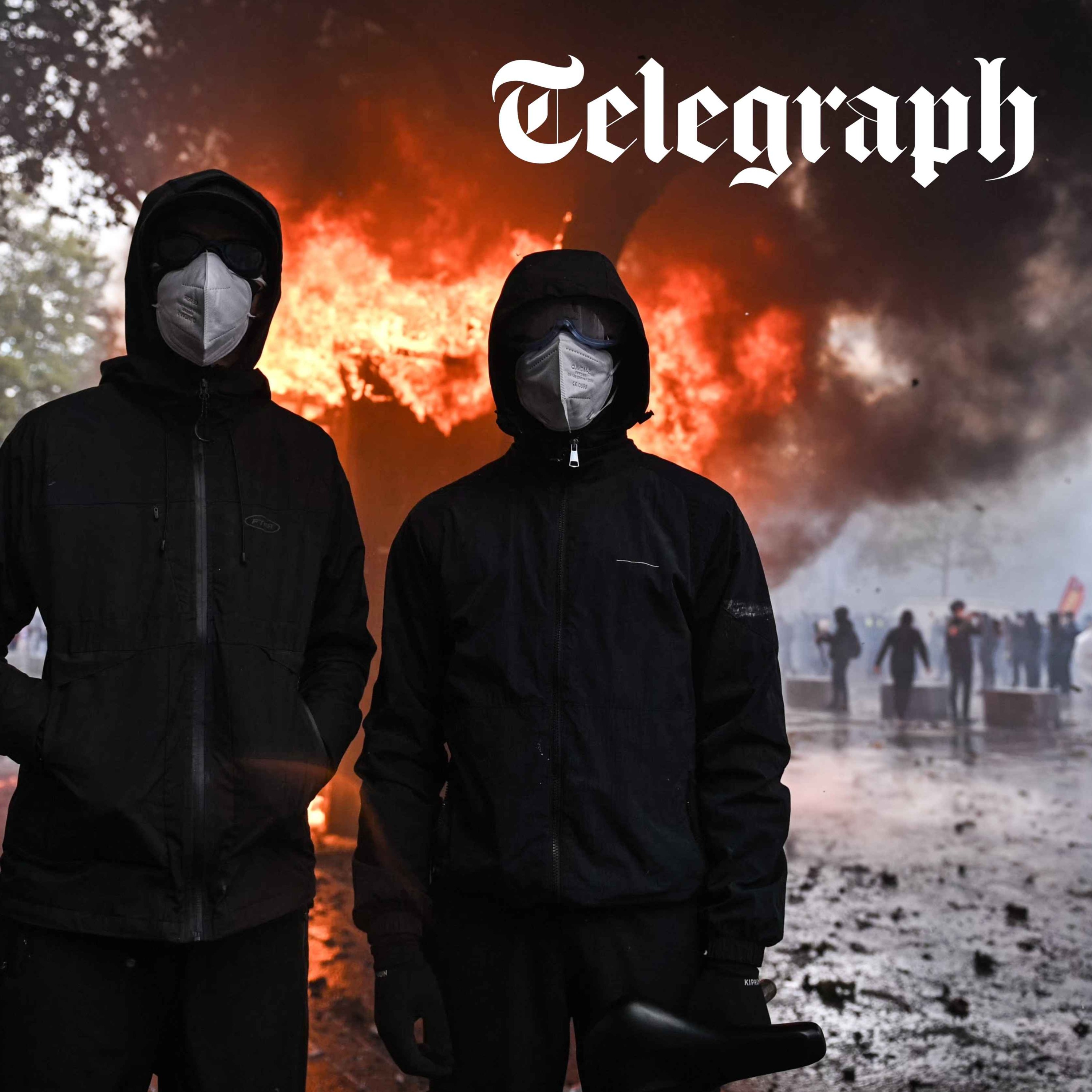
The episode argues that unrest in France (riots, looting, arson) reflects deeper social and political breakdowns—youth unemployment, inequality in education, alienation from the state, and rising extremist politics—so the same dynamics could plausibly emerge in Britain, especially if politics becomes increasingly organized around ethnicity.
Lizzie O’Leary (host of Slate’s “What Next TVD,” a tech/power/money-focused podcast host). Tim (co-host/guest; appears as a regular conversational partner, discussed via jokes about jackets and “game show host” style banter).
EU rejoining won’t automatically fix Britain’s problems; France’s centralized system and oppositional politics leave people feeling unrepresented; immigration and identity politics intensify ethnic polarization; youth want fair competition, not “free stuff.”
Paris burning; arson at a 19th-century chapel in Limoges; references to France’s 2023 riots; Bastille Day in Paris; a Turkish barber saying he “doesn’t recognise France anymore”; comparisons to UK riots under Cameron/Boris.
Written by AI. May contain mistakes.
Discussion on the socio-economic issues in France and potential similarities with the UK.
“They just need it to change for minutes.”
Exploration of the historical context of protests in France and their implications for the UK.
“It's reminding me a little bit of my GCSE French oral with some of the protestations I need to make.”
Analyzing Emmanuel Macron's presidency and the challenges he faces amidst social unrest.
“And indeed, there was a massive nationwide riot under David Cameron.”
Discussion on how social inequality in education has fueled protests in France.
“And what their political system does is it pits a very powerful centralized presidency in Paris against an assembly which really exists in order to block the policies of the president.”
Examination of migration patterns in France compared to the UK and their social implications.
“And it has then snowballed into everything else.”
Explore the complexities of French identity and its relationship with mass migration.
“So over the course of the last five to seven years, you've had around 300 ,000 people in gross, about 200 ,000 net.”
Discuss the challenges faced by France in integrating diverse communities and historical perspectives.
“we follow the conflict from every angle.”
Analyze the generational factors contributing to social unrest and entitlement among youth.
“And the Turkish barber says, I've been here since de Gaulle.”
Examine the impact of ethnicity on political identity and social cohesion in Britain.
“Not an uncontroversial concept, algranchi.”
Discuss the nuances of ethnic identity and the importance of participation in national culture.
“at GB News on Sunday, and we were trying to do this whole, well, if you're black and you're English and all that.”

Get the gist, explore an idea or ask about something said.
 Claude
On The Daily T, what are the key points of this episode?
Searching your listeningAutomatic transcript. May contain errors.
0:03The Telegraph.
0:09ACAST powers the world's best podcasts. Here's a show we recommend. In 1926, you had the Rockefellers. In 2026, there's a new kind of billionaire overlord. The important thing about Elon Musk is how he exploited flaws in our psychology and flaws in our political and economic system. This is Lizzie O 'Leary, host of Slate's What Next TVD. We're a tech podcast that isn't just a tech podcast. We're a show about power. We start from almost nothing and we wind up with, you know, a whole civilization. A show about money. They don't necessarily need the prediction markets to believe that for a long period of time.
0:50They just need it to change for minutes. And a show about the real people fighting back. Some people are going and destroying these cameras. They're cutting down the poles. They're driving trucks into them. This is straight up a meme at this point, and I did not expect that. Listen and subscribe wherever you get your podcasts.
1:25as Emmanuel Macron. Debt, disaffected youth, mass migration. So why wouldn't it happen here? And why on earth does Andy Burnham want to rejoin the EU with all this going on in Europe? In the Remainer's imagination, Europe is this beacon of stability and we are the crazy ones for having walked away. But these are reminders that it has all the same problems we do and sometimes at a factor of 10. So rejoining is not an automatic solution to our problems. Tim, that is possibly the greatest jacket you own. You're wearing dark blue velvet. Yeah. Is this because I made that comment last week about you maybe being a game show host at some point?
2:08You think I'm going to start subtly auditioning on this show? But do you know, I've also got a navy blue velvet jacket. So at some point during the Christmas period, the pre-Christmas period, should we both present this podcast with velvet jackets on? Imagine the electricity between us, the static it would let off. You know, the problem is, is all my clothes are 20 or 30 years old and they've finally worn out and I've hit the autumn season and realised I don't own a nice brown or grey jacket. So you've got into your game show era. I've started wearing party clothes. Also, by the way, you're lucky I'm not here dressed as Batman.
2:40Well, there's always time, but we don't over yet. You've also pointed out to me that that has got a nice little St. Michael's label on it. Now, doesn't that make you feel old and warm? St. Michael's. I've just remembered. That's M &S for people who don't know. I've got a black velvet jacket that I inherited from my mother with St. Michael's on it. Right, I'm bringing it in. At some point, tell me when you're wearing that again. By the way... I inherited this from a dead person via Oxfam. Great. Did you know that our Daily Tee Plus membership is up to three figures? Fantastic. So now we've broken a ton.
3:11Oh, excellent. We'll be getting a birthday card from the king. I hope so. Does he still do that, by the way? I think he does. There's nothing novel about it anymore. He does people being married for 60 years, if that counts. Oh, lovely. Shall we talk about France? Mon Dieu, quelle catastrophe! It's reminding me a little bit of my GCSE French oral with some of the protestations I need to make. Yes, if the riots could happen in La Rochelle. Yeah, that would be great. I would do really well. Oh my God, do you remember Tricolore? Anyway, for the uninitiated, that was the, I think one of the syllabuses for the French GCSE involved us listening to different events.
3:44You must remember the oral tests with the strangely sexual French voices. Je veux dire. Yes. Dark yet. Right. Mais oui, monsieur. You'd go into French orals going, je joue au table tennis et je ski. And people would be going, what? What are you talking about? You're skiing in the middle of rural Hertfordshire. You're talking nonsense. Anyway, let's be serious for a minute because to be fair, Paris is burning. Paris is burning. And when that lovely, lovely chapel, 19th century chapel, came down in Limoges, there were shades of Notre Dame, which obviously was an accidental fire versus an actual, it's been started by protesters.
4:26Yes. On Notre Dame. Yeah, I'm not going to say any more than that. Oh, yeah. I have no insight. This is your Catholic spidey senses. No, no, I have no insight. I just, why not? Why not? Okay. Given the horrors that we've seen in the last few days. But there's protest and there's protest. right? I mean, you've written an extremely compelling column basically saying what's happening in France is coming to a town near you in Britain. And I'm evaluating that and wondering whether the great British public here, I mean, I appreciate that we've got similar problems to France. A lot of this was initially caused by young people leaving school and university and finding that there were no jobs combined with, I mean, years, decades, centuries of sort of uprisings in that particular country, combined obviously with a huge amount, I think it's probably too nice a way to put it, of ennui with Macron.
5:17I mean, the irony of somebody leading a movement called En Marche and then having this happen on the streets of Paris and beyond. So there are echoes with our own economy, youth unemployment at a record high, a million not in employment and education. But Tim, this puts rejoin the EU back into a different category, doesn't it? Let's go in with the French. And all of these European nations that are so happy with their association with Brussels that they're now setting stuff alight on their own doorsteps. Yes. Of course, if we join the EU, I'm not saying that immediately all of that would cross via the Eurostar into Britain.
5:51But the point is that in the Remainer's imagination, Europe is this beacon of stability and we are the crazy ones for having walked away. But these are reminders that it has all the same problems we do and sometimes at a factor of 10. So rejoining is not an automatic solution to our problems. But do you think we'd have people here setting fire to 19th century chapels? Yes, I do. And I would remind people that there already have been riots in this country. And indeed, there was a massive nationwide riot under David Cameron. Yes. You may remember that. Yes, of course I do. Boris Johnson had to fly back from his holiday in Canada.
6:33There's always a temptation when there are riots in France of saying that's just what they do. because since 1789, there's been an understanding that the street has a legitimate role to play in democratic politics. But France has a tradition of orderly protests. There are a lot of them. They rarely, very rarely end like this. They're very well policed and well organized. It was unusual for this one to spill over into arson, but it has happened in recent history. I was there in 2023 when there were big riots in France. Unfortunately, I didn't see any of them. But the point is that the social tensions are getting much greater within that country.
7:12Secondly, they do not just happen within France. As I've mentioned, there have been ugly protests. There have been racist protests. There have been rolling pro-Gaza protests in this country. But there were simultaneous protests this weekend in Belgium, Italy, Portugal, and Albania. So it's not just a French problem. Another thing worth bearing in mind is Emmanuel Macron has not been that bad. France stumbles along. He has maintained the country's lead on things like tourism, but also surprisingly AI, nuclear generation of energy. He is a very effective diplomat. He is very respected on the world stage.
7:55And he's carved out a kind of a Gaulist, non-American alliance on issues like Ukraine. So you're pulling a face. I'm pulling a face because I think that Macron and indeed now the sort of French system since the disaster of calling that snap election and it's slapping him in the face in 2024, he's the kind of archetypal trying to be all things to all men and women and ending up being nothing to anybody. Yes. And so in 2023, you have the pensioners writing over him putting up the retirement age from 62 to 64. I mean, wouldn't we be so lucky? I think we can't retire until we're 106 at this rate. Second of all, you have the whole gilet jean thing with the eco tax.
8:38So that then alienates another group of people. Of course, you have got that kind of historic Viva la Révolution type atmosphere on the streets. but you've got kind of like a sort of centrist soup that then explains the rise of both Mélenchon on the left and Le Pen on the right. It's like this dissatisfaction with a centrist not really achieving very much, not really taking a position. I'm going to disagree with that. I see what you mean on diplomacy. I'm going to disagree with that. He has got that reputation as well, by the way, of like, you know, Napoleon syndrome and small man syndrome and just being a bit of a ridiculous figure.
9:15You know, he isn't de Gaulle, is he? And people are exhaustive with him. That's absolutely true. But I would remind you that Macron was elected as an alternative to everything you've described. Yes. They broke away from the traditional bloc voting of left and right, the Socialist Party or the Gaulists, and voted for Macron in order to cut through all of the structural problems of France. The idea being that you hand a mandate to, okay, a centrist, but a centrist populist who was going to do things like raise the age of retirement, grow the economy, shift away from welfare and back towards capitalism.
9:51He was supposed to do all of this. The problem is that the French changed the governing party by creating a new one. They didn't change their political system. And what their political system does is it pits a very powerful centralized presidency in Paris against an assembly which really exists in order to block the policies of the president. Yes. And the result is that you have an oppositional politics where factions constantly are against each other. And it's impossible both to build a consensus because there's no electoral value in it, but it's also impossible for the president to just say, right, that's it.
10:36This is my decision. That's what we're doing. Consequently, the population feels unrepresented. They feel like it's all meaningless. If you've got a government in that kind of stasis, why not take to the streets? Because you just can't get anything bloody well done. Well, what they're doing, what the voters are doing is they are increasingly choosing extremist options which reflect increasingly ethnic division. So it's very likely that the next presidential election will be between a nationalist, Le Pen, who, let's say, crudely represents French white bourgeoisie, versus a communist, Jean-Luc Mélenchon, who, broadly speaking, represents disaffected youth, the poor, and crucially, minorities.
11:18Something like 14 % of France's population is now foreign-born. Much of that comes from Algeria, Morocco, Tunisia. So the United States, Donald Trump, has of course said these riots are all about immigration. And you can't dispute that's an element of it. It's obvious from watching the video. You can see the ethnicity of the rioters. But to go back to what we were discussing, what you were saying at the beginning about the social tensions within France, this actually began as a protest against conditions in schools. Yes. Now, why? Given that this is the most generous welfare state in Europe and given that public debt now stands at around 120 % of GDP.
12:07So you might say, come on, France is borderline socialist. So why are people protesting about the condition in schools? Well, the answer to that is partly that there's a very uneven distribution of resources that tends to favour Paris and the Parisian elite. And all this begins to sound familiar to those of us who feel this country is dominated too much by London. But also, this is a social system in which it is widely believed that the only way to get on in life is to go to university, and particularly the Grand École. So if your local school in a crappy suburb outside Paris has holes in the wall, shared textbook, crowded classes, that's not just, oh, I had a bad education.
12:52You and I recognize some of those conditions from schooling in the 1990s. Rachel Reeves was always going on about that. Didn't harm her much. It didn't harm her, it didn't harm me. But the point is, they feel they are being denied access to higher education and therefore to social advancement. So the whole thing kicked off in part as an argument about inequality. Yes. And it has then snowballed into everything else. Okay, but then that does reflect badly on Macron because there is a problem with authenticity there. That he is somebody who claims to be a man of the people, but is known as the rich president.
13:28It's as if his own background doesn't quite back up his own policies. And therefore people look at him and say, you're not quite who you say you are, which then explains the rise of these characters on both left and right. Because there's a bit of, I don't know, equivalence as far as Macron's concerned. What are you, a globalist, a sovereignist, a rich boy, a poor boy? What's going on with you? Are you Trumpian? You know, you deal with him out, you're having a handshake off outside the Oval Office. Or are you not? Are you a Gaulist? Whatever. whatever there's confusion there and that clearly if there is this degree of kind of class warfare or kind of blue versus white collar that is reflected in the president himself because it's unclear who this guy is and what he really believes because as I said at the beginning this kind of like trying to be all things to all men second of all on immigration I did look up the stats because I thought well how does French there is this perception in this country isn't there I mean just people are flooding into France the whole time you look at gross and net migration is lower than the UK.
14:26Right. So over the course of the last five to seven years, you've had around 300 ,000 people in gross, about 200 ,000 net. Nothing like the post-pandemic high of 945 ,000 into this country under the Boris wave. So I just think that's quite interesting for context. But I think historically, they've had a lot of people coming in over decades, whereas mass migration into the UK only really started post-Blair. Whereas for the French, This is now embedded and presumably causing some resentment.
15:23and military strategy to the reality of life in Russia and Ukraine, we follow the conflict from every angle. Listen daily, wherever you get your podcasts.
15:41I think part of the issue here is the question of definition to tie together the issue of Macron himself and mass migration. Remember when the En Marche revolution happened and when he was elected? We actually thought this was turning a new page. It's now obvious that Macron was the last roll of the dice for the old French identity, which is based upon a civic nationalism, which is tied to the mythology of the French Revolution, of the secular republic, where everyone is equal and everyone defines themselves through French identity and culture. what we're now seeing is a new generation emerging be they migrants or young people who have been taught that all of French history is evil and wicked who do not easily integrate and I'm not talking here just about North African descent French I'm talking about French French Yes, no I don't do not easily integrate into their own national culture but then this is interesting and we're doing better than that I just want to say we're doing better than that in this country And I think we talk ourselves down.
16:49Part of the genius of Englishness, dare I say it, it does exist, is it's relatively light touch in terms of what it demands of people. It's also relatively easy, therefore, to buy into and participate in it. it's a collection of behaviours, politeness rituals, like tea making, and cultural and participatory forms such as democracy and business. But in the minds of the British and maybe this is just a hangover from Hello Hello, there's a very strong sense of French identity when you think about people outside looking in. I mean it might be the kind of quite ridiculous caricature of the man with the onions around his neck on a bicycle with a beret on.
17:32But here is my very point. So in 2023, I was there on July the 14th and I watched in Paris their celebration of Bastille Day. And it occurred to me that a country that is defined that narrowly by a moment in history, very difficult to ask people to buy into that. Here are all these people celebrating this one moment in French history. If you're living in a slum and you come from Tunisia and Algeria, why would you say 1789 defines me? No. That's very strange. Having said that, there's an amazing quote in our colleague Henry Samuels' piece, From the Scene, and it's a Turkish barber. And the Turkish barber says, I've been here since de Gaulle.
18:20His shop was clearly looted, raided, set on fire. Yes. And he turns around and says, as a longstanding immigrant to the country, I don't recognise France anymore. And I kind of looked at that and I thought, no, but I thought actually that then mirrors the British experience. If you have an immigrant shopkeeper who in the middle of a riot sees his shop raided, then he is quite rightly asking himself, what has happened to the country that I moved from my own homeland to pursue a better life? And don't we also have to talk about the sense of entitlement of some of these younger protesters? Is there something generational here?
18:57Clearly, you're going to have riots probably exacerbated by sharing knowledge on social media and other people just piling in. I mean, some of the people looting and raiding shops are just opportunists. I want to nick some stuff without getting into trouble for it, don't we think? In every riot, there are those people. But is this a Gen Z thing? Is this, you know, we can do what we like and take what we like because we feel resentful to a government that hasn't given us enough. Yeah. And we are the entitled generation that expects things to be handed on a bloody plate. And by the way, we lived through the pandemic and we're still not over it.
19:33There's an aspect of that, Tim. Well, I pointed out in the piece that the boomers did exactly that in 1968. And not just in Paris, but there were also riots in the United States. So this is something that the young tend to do. And I think that's to do with psychology and that's to do with age. You don't own anything yet. If you're 18, you don't own anything. It's other people's stuff. You haven't yet figured out why it's valuable. You haven't yet figured out how difficult it is to replace it and why you'll miss it when it's gone. You've got nothing to lose, basically. Exactly. It's part of your thing.
20:04The other thing to point out is what young people are often asking for is not free stuff, but the right to compete fairly. So my point about the school system in France is if you believe you're being locked out because privileged students in Paris can get into these Grand École and you cannot, Yes. You're not competing. You're not demanding that you be given a good job and wages. You're just demanding that you have access to stuff. And it's the same in this country where we have to appreciate that from the point of view of someone in their early 20s, it looks like many of the signifiers of middle class British life are now completely beyond their reach.
20:38Owning a house, getting married because dating is so difficult and having kids because it's now unaffordable to have kids. So I think it's silly when older people say to younger people, you just want free stuff, when the reality is they actually just want what we have. Yeah, they just want a level playing field. Exactly. But my point about this question of will this happen here is all of the problems that we have listed in France exist in this country. Yes. And because we have already had rights and because we have the emergence for far right and the far left, which are ethnic in the same way that France's are.
21:16And that's partly what's happening over there is if you keep saying to people ethnicity matters, they will eventually start voting along ethnic lines. I think that was a big mistake of what they call woke one, was going around and making people conscious and think about color. Because if you do that, why don't you think white people will think that way too? And that's what's happening. But what I'm sort of debating in my head is, do we have the cultural wherewithal to survive this period of social tension? And I think we do in the sense, as I say, that British culture has lots of things that are easy for people to opt into.
21:52For example, the monarchy. Yes. Not an uncontroversial concept, algranchi. But the presidency in France, because it is political, means that if you don't vote for the president and you don't like the president, you think the whole state is against you. There is no element of the state that you can approve of or that you can feel sympathetic or sentimental towards. By contrast, in this country, we have the king. We have the church. We have elements of the establishment that people can opt into and feel part of. The problem is that for a very long time we have not activated and made the most of those institutions.
22:32In fact, they have become self-corroding. They have lost their self-confidence. So I do believe that we have all these things lying around that we could pick up and use in Britain to avoid these social problems. But we're not in part because they're run by morons. Well, or that we have, a little bit like the French, spent far too long in recent times self-flagellating over the existence of these very organisations. Exactly. So we should get a copy of Nigel Bigger's book, Our Island Story. Yes. Things to be proud of about Britain. We should deliver them to every school in the UK. Yes. And we should actually invigorate some sense of collective purpose in this country and instill it into young people.
23:10So the material tensions that drive people into the streets are real. And we mustn't say they're not real. But the thing that defines what side people choose to be on increasingly is ethnicity. Yes. because we've injected ethnicity into our politics, because of mass migration, because of woke. Yes. And the way they behave, so burning things down, is shaped by a shift in culture towards nihilism. That's right. And towards saying, you have no relationship to this country. How can we expect young people to love Britain if we tell them Britain is unlovely? Or if we tell them, by the way, on the ethnic line, that they're not British or they're not English.
23:56It doesn't even exist. Ridiculous. It doesn't even exist. By the way, I was discussing this with a colleague of colour at GB News on Sunday, and we were trying to do this whole, well, if you're black and you're English and all that. And, of course, everyone thought back to the World Cup, a unifying moment for this nation, whether or not you like football. If you're going to start turning around and saying Bokoyo Saka and Duke Bellingham and Raheem Sterling and all of these players, they're in England shirts, everybody, aren't English. Don't expect the youth of today to react positively when you have a call to arms to do the right thing by your country and by your crown.
24:37And that's another problem here. So the ethno-nationalists, it's totally self-defeating because you're actually breaking up the very communities that you already say are broken and should come back together and properly integrate by alienating people, by telling them that they're not who they think they are. But you can have an English identity which is linked to ethnicity, which is about ethnicity. For heaven's sake, we've been here for a thousand years. It's ridiculous to me to deny it exists. While saying at the same time, and this is my point, that people can buy into or participate in that identity.
25:09I'm saying that's the one. The Victorians, read my book, Whatever Happens to Tradition, right? I should read it. We basically did this in the 19th century. we turned British culture into almost like a commodity that people could buy or purchase or play a role in so you can have both the English identity of my my ancestors go back hundreds of years plus you can have arrivals looking at and marrying into it and participating into it because a culture is defined not just by being but also by participation in it you know when someone when we talk about someone betraying their country, what we're talking there is about either a refusal to participate in or acting against the interests of.
25:50So in other words, people can cease to be that thing by stepping out and working against it. But I would warn those who insist with equal rigidity that Englishness is not an ethnicity, it is quite insulting to say to people, you don't exist. You think you exist. You don't really exist. how do you expect to take people with you how do you expect to persuade people onto the side of law and order and the light if you're saying to them and also i don't really think you exist especially in a culture which bangs on all the time about how marvelous it is to be nigerian or bangladeshi or we'll have you know we'll have a special festival for that we'll put a special ad on the bbc celebrating that well okay so where's the english well moment for that it can be found in morris dancing perhaps in May polls.
26:39But on that note, because we have to leave it there, who better to debate all this with than the woman that started this row in the first place? We've got Suella Braverman coming into the Daily Tea studio tomorrow, and that will go out at 5pm.
27:19A-Cast powers the world's best podcasts. Here's a show we recommend. More than 1 ,000 episodes. For nine years, Creepy has been delivering you horror stories every week. Dark tales from the internet, urban legends, haunted places, and horrors that feel a little too real. And this October, we're taking things even further with our annual 31 Days of Horror event. For 31 days, we're releasing two stories a day, every day, in the run-up to Halloween. That's 31 chances to find something that gets under your skin and refuses to leave. This is creepy. Acast helps creators launch, grow, and monetize their podcasts everywhere.
28:09Acast.com
In Monday’s episode of The Daily T, Camilla Tominey and Tim Stanley discuss why the riots and looting have unfolded across France over the past few days, and how Emmanuel Macron, the French president, has reacted. Camilla and Tim debate whether Prime Minister Andy Burnham’s proposals for closer ties with the EU make sense considering the political issues and state of unrest in some of its member countries. Our presenters also weigh up the issues French protesters have been demonstrating against and how the UK is facing similar challenges. The pair further discuss how Andy Burnham, the Prime Minister, could prevent such civil disruption taking place.
The Telegraph is the Publisher Podcast Awards' Podcast Publisher of the Year 2026
► Get more exclusive Daily T content from The Daily T+ membership! Join here.
► We want to hear from you! Email us at [email protected] or find @dailytpodcast on TikTok, Instagram and X
► Sign up to our most popular newsletter, From the Editor. Look forward to receiving free-thinking comment and the day's biggest stories, every morning. telegraph.co.uk/fromtheeditor
Producer: David Levene
Senior Producer: Emma Williams
Studio Operator: Meghan Searle
Video & Social Producer: Nada Aggour
Executive Producer: Charlotte Seligman
Editor: Camilla Tominey
Highlights:
Hosted on Acast. See acast.com/privacy for more information.


