
 Ask ChatGPT


 The Daily T
18 Jul 2025 · 46m · 20 chapters
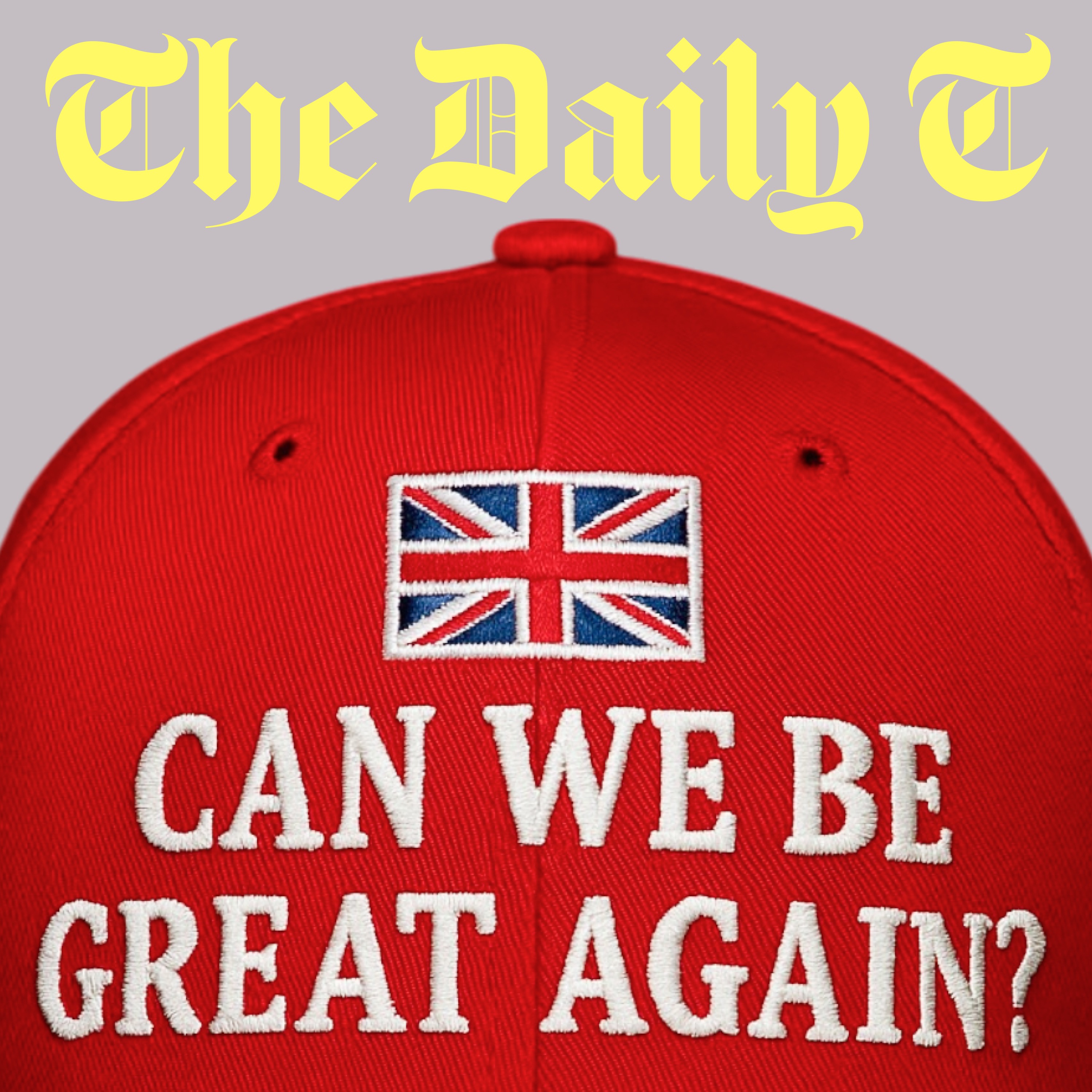
How the UK and its allies should respond to China, framed as the “big issue of the century” and tied to threats involving Russia, Taiwan, Hong Kong, trade, technology dependence, and the need to “win the argument” for liberal democracies.
Jeremy Hunt (UK politician; former Foreign Secretary; author of the discussed book). John Bolton (former US National Security Advisor; former US Ambassador to the UN). Sir Simon MacDonald (former head of the UK Foreign and Commonwealth Office diplomatic service).
China is the principal long-term threat; Xi Jinping rejects democracy and promotes autocracy; China is “calling the shots” in an emerging China-Russia partnership; Western policy should combine strength with engagement rather than “war of words”; avoid vassal status and reduce strategic dependencies (especially tech and critical infrastructure).
Jeremy Hunt’s China trip faux pas (calling his Chinese wife Japanese); Huawei/5G and “technological dependency”; Hong Kong’s breakdown of the 1984 Sino-British communique; Taiwan’s likely “unfinished business” and CCP influence efforts; AUKUS as an Indo-Pacific security model; BYD vs Tesla and concerns about software/electronics control.
Written by AI. May contain mistakes.
Jeremy Hunt introduces the topic of China as a significant global issue.
“Now is the time to make a real change in your life, career, and community.”
Jeremy Hunt shares a humorous and embarrassing story related to his diplomatic experience in China.
“Just so we know, you do reference it in the book, so I felt I could poke some affectionate fun.”
Discussion on the evolving partnership between Russia and China and its implications.
“A month into being foreign secretary, a very important visit to China.”
Jeremy Hunt reflects on the changing attitudes towards China within the UK and his own views.
“I mean, where do you sit in that, Jeremy?”
Analysis of Xi Jinping's leadership and its effects on democracy and global power dynamics.
“But the idea that China is the most evil country, I don't think is a particularly helpful one to organise when organising our foreign policy.”
Explore how UK attitudes toward China shifted under Theresa May and Trump.
“A couple of other points first, Camilla.”
Discuss the implications of China's trade practices and technology policies.
“It didn't really open up its internal markets the way that it promised.”
Delve into China's intentions regarding Taiwan and its implications for democracy.
“But I think we took too long to recognize the dangers of technological dependency.”
Delve into China's intentions regarding Taiwan and its implications for democracy.
“In a world where AI is changing every role in every industry, knowing who actually has deep expertise matters more than ever.”
Examine the UK's economic position and its response to China's rise.
“I think from the public's perception, they think that China has always had its cake and eaten it.”
Discusses China's significant contribution to global carbon emissions and its implications.
“Perfectly cogent demand, to be perfectly honest, not least of a left-wing party.”
Explores the historical success of the global order and the need to win the argument for liberal democracies.
“And that's all now starting to go wrong.”
Examines the perception of China's influence over energy and diplomatic relations.
“Because I mentioned energy specifically.”
Analyzes the ongoing security challenges in UK-China relations and the significance of the AUKUS alliance.
“I mean, can we just discuss this super embassy?”
Discusses strategies for addressing China's economic practices through collaboration with allies.
“the theft of intellectual property and other aspects for decades and join together.”
Critiques the impact of Donald Trump's policies on America's standing and relationships with China.
“And that's why I think a more united front, certainly on the economic space and with various different combinations in the Indo-Pacific, it's a much more complicated region, much more diverse than Europe.”
Discusses the impact of cheap Chinese goods on the UK economy and consumer behavior.
“benefits our adversaries like Russia, China, North Korea and Iran.”
Explores the implications of economic dependencies on China and the future of production.
“they're wrapping themselves with more machinery around them, there's more output that leads to higher productivity, higher living standards, higher salaries.”
The hosts discuss the challenges posed by China and the importance of economic strength and innovation.
“I may be being economically idealistic here, but I mean, there's a contradiction there with Trump's rhetoric and then homegrown US companies and their own behaviour.”
Jeremy Hunt emphasizes the importance of self-confidence and collaboration with allies in addressing global challenges.
“Now, what we're going to do is your final observation to summarise this great series of great podcasts about Great Britain.”

Get the gist, explore an idea or ask about something said.
 Claude
On The Daily T, what are the key points of this episode?
Searching your listeningAutomatic transcript. May contain errors.
0:02The Telegraph.
0:39This message is brought to you by today's sponsor, Walden University. Set a course for change. Now is the time to make a real change in your life, career, and community. At Walden University, we give you the support and flexibility to get the W. Walden's online programs are designed for working professionals like you. You'll gain hands-on skills to take on real-world challenges and succeed. Your future is waiting, and Walden is here to help you achieve it. Take the first step to make your impact. Visit waldenu.edu. Walden University. Set a course for change. Certified to operate by Shev.
1:28Can we be great again? Why a dangerous world needs Britain. Jeremy Hunt joins me again. This is our final foray together. It is, but it has been a pleasure and you have done a brilliant job, Camilla. And we've had some pretty meaty discussions, actually, on things that maybe don't make it quite the same way onto the Daily Tea. So it's been great. That's good. And we're going to be discussing China. Why are we discussing China of all countries? Because it is the big issue of the century. I know we're all talking about Trump and economic growth, but, you know, this is the elephant in the room. And China is not just growing stronger economically, but it wants to upend our system of government and open societies and liberal democracies.
2:12And you can't ignore it. And before we bring in our wonderful guests to discuss all this, can you just confirm, is your wife Chinese or Japanese? Just so we know, you do reference it in the book, so I felt I could poke some affectionate fun. Yes. Well, this is going to be my biggest plug of the book for Daily Telegraph readers, because the book actually explains how I came to make this appalling mistake of calling my Chinese wife Japanese, which this is probably a bigger reason to buy the book than any of the lofty things we're going to talk about when it comes to China policy. I'm embarrassed to say this in front of John and Simon.
2:49Let me introduce John and Simon first. So John Bolton joins us, former US National Security Advisor and former United States Ambassador to the United Nations. And we're also joined by Sir Simon MacDonald, former head of the diplomatic service at the Foreign and Commonwealth Office. You're both giggling because you are familiar with this faux pas that Jeremy made as Foreign Secretary in China. Was it just a senior moment? It was not a senior moment. Simon was the most senior civil servant in the Foreign Office when I was Foreign Secretary. John was President Trump's national security advisor. So this is why it is quite an embarrassing thing to have to retell the story in front of these two very eminent people.
3:27I disagree. I'm now going to have to tell it just to preserve what's left of my shredded reputation. And here is what happened. A month into being foreign secretary, a very important visit to China. I am nervous. And I do the thing you often do when you're nervous, which is I overprepare. And I think these are the three big things I want to talk about with Foreign Minister Wang Yi, you know, democracy in Hong Kong, trade barriers, etc. And then I'm going to prepare a couple of points of small talk just to break the ice. And my two points of small talk were, number one, we both speak Japanese because I lived in Japan and he was Chinese ambassador to Japan.
4:09Number two, my wife is Chinese. and in a moment of nervousness right at the top of the meeting I muddled these two facts up and I said it's absolutely wonderful to be here because my wife is Japanese and I thought I'm sure the media have gone by now and then I turned around and there was this wall of TV cameras Well it was a wonderful moment It was as good almost as that moment where that bell came off when you were ringing it I mean you have gone viral on a number of occasions and there's no shame in that Jeremy Hunt No but they're not the moments I wanted to go viral No. Well, we're going to get into very serious fare now.
4:43And it's a perfect week to be discussing China because we have just had Donald Trump make that threat to Vladimir Putin and Russia, saying that if you do not agree to a ceasefire in Ukraine, I'm going to slap 100 percent tariffs on you. And we also know that the Russian foreign minister, Sergei Lavrov, a man who many think is kind of Russia's version of comical Ali, he has been meeting with Xi Jinping this morning. So there's this perception, I think, in the Western world of this axis of evil between Russia and China. And John, I mean, who do you think is the most evil in that partnership? Well, I think China is clearly the senior partner.
5:23I mean, it reminds us of the Sino-Soviet alliance of the Cold War, but the driving forces are very different, and Beijing is calling the shots. It's certainly not a perfected axis yet. It's still emerging. There's still a lot of disagreements. But I do think China is the principal threat that the West faces for the rest of the century. And I think an axis with Russia, which could help make China an Arctic power, which could open up the vast, largely untapped mineral resources of Russia and Asia to China and the ramifications, whether it's the war in Ukraine today or possible conflict over Taiwan tomorrow, this emerging partnership is a real threat to us.
6:04Simon, in the UK, the opinions about China just within the Conservative Party range from Sir Ian Duncan Smith sanctioned by Beijing, thinking that they're listening in at every given opportunity, that they are exploiting slave labour in Xinjiang, that they aren't to be trusted at all, all the way to the sort of Cameron and Osborne golden era. I mean, where do you sit in that, Jeremy? I'm just thinking, where are you on that spectrum? I've actually come full spectrum. I started off as a child of the golden era and I was someone who worked really hard to build closer and more friendly relations with China.
6:48But I have concluded very sadly and reluctantly that under Xi Jinping, China has changed. And this idea that it's just trying to become a giant Singapore if it was ever true, is certainly not true now. And I think we need to wake up. Simon? Well, you won't be surprised as a former diplomat. I'm at neither end of that very extreme spectrum. I agree strongly with John Bolton that China's relationship with Russia is very important. I agree even more strongly that China is calling the shots. Russia has noticed this and I think one thing that gives us room for manoeuvre is Russia is very unhappy about that and won't be prepared long term to settle into something which is conspicuously a junior partnership and the long term they may have no choice but I think at some point Moscow will throw over the traces they won't be happy to reconcile themselves to such a junior role.
7:55As for the UK, the golden era always rang a wee bit hollow. We are too small to aspire to equal standing in the relationship with China. But the idea that China is the most evil country, I don't think is a particularly helpful one to organise when organising our foreign policy. China is a huge power, the biggest manufacturer in the world. All countries need a relationship with China. I think it's key for the United Kingdom that we don't allow Beijing to boss that relationship, that they don't dictate terms to the United Kingdom. But if we preserve our room for manoeuvre, if we avoid vassal status, I think we can have a constructive relationship with China.
8:47Okay. I mean, we'll get on to what relationship we can have with China in a minute, but I am intrigued by you saying that the tide turned with Xi Jinping. John, I mean, I think when it comes to our sort of communist despots of the world, we know who and what Vladimir Putin is. Ex-KGB likes to pose bare-chested on horses, seemingly bad, mad and dangerous. We also, I think, have got the full measure of the North Korean dictator Kim Jong-un. What's your analysis of Xi Jinping? Well, I think he's principally a member of the Chinese Communist Party who wants to maintain power for himself and for the party.
9:28I think if we look back historically, we all misinterpreted what was actually happening in China beginning in the mid-1980s. I mean, hindsight's always 2020. So I confess I was part of the problem in the 80s and 90s as well. But we heard Deng Xiaoping, survivor of the Cultural Revolution, succeeding Mao Zedong, say things like, it doesn't matter whether a cat is black or white as long as it catches mice, meaning if you can get rich being a capitalist, go for it. And we thought China had really abandoned the communist ideology. I think, again, in retrospect, we can see it's not true. And it was actually something Deng Xiaoping said that carried China along for many years without really arousing people's suspicions.
10:16He had this mantra translated into English was hide your capabilities and bide your time. I remember hearing that probably in the 90s thinking, well, how modest of the Chinese to say that. But what he really meant was hide your capabilities and bide your time. And when the time came, expose the capabilities. And I think that's what we've begun to see over the past 10 years. And And we're still in various stages of experiencing how to react to it. I think we're coming closer to an appropriate line, but it's taken a long time in the United States. I think it's taken longer in Europe. I mean, I remember the state banquet when Xi Jinping came over.
10:55Jeremy Corbyn, then the Labour leader, famously attended it in white tie, which we all found quite funny. Oh, he's willing to entertain palace officials if he's alongside a communist. at the time it was you know the end of the golden era or look we must work with the chinese and aren't they very good educationally and they produced all of these entrepreneurs and they're investing heavily in actually key national infrastructure in the uk so we must have this great relationship with them because of their financial power really more than anything else got lots of chinese tourists coming to london buying up gucci handbags and all the rest of it Why has it changed in your mind?
11:37Because Xi Jinping has made it completely clear that he doesn't agree with democracy as a way of human beings governing themselves. He thinks, and he can point to quite a lot of evidence of this, that democracies are incapable of taking long-term decisions and they only elect leaders who want to get re-elected. And he thinks that autocracy is a better model of government and he is quietly encouraging non-aligned countries in Africa and South America to see the world through that prism. And I think the paradox we have here is that there's lots of comparisons made about the 1930s to today. And I think that in many ways it's misconceived because I think we are very awake to the dangers of autocracy today in a way that perhaps wasn't the case certainly in the early part of the 1930s.
12:35But there's also a kind of facile comparison with the Soviet Union and the Cold War. I mean, we won the Cold War not just because of the brilliance of Ronald Reagan and Margaret Thatcher, but also it was a trial of strength in which we won both economically and militarily. And when it comes to China, the Chinese economy has been going through a difficult patch, but it's not going to go away. They are going to continue to grow. They are going to continue to get richer and richer. And we are going to have to think of a different approach to dealing with a threat from China because we're not going to bankrupt them in the way we did the Soviet Union.
13:14And the argument I make in the book is that the only way to do this is a combination of strength and engagement. We do have to talk to them. They are a big power. They are not, as I say, going to go away. but we need to do so from a position of strength. And I think we've been getting exactly wrong, 180 degrees wrong. We've been not thinking about how we can get stronger economically, so that we can avoid economic dependency on China. But also, we've been closing down engagement by having a sort of war of words at various moments with China, which have meant that cooperation where we need to have it has become more difficult.
13:55And I think in both those areas, We need to do things very differently. Well, war of words, Simon. Are we talking about Liz Truss's rather anti-China rhetoric here? What are we talking about? A couple of other points first, Camilla. One, you asked what changed. I think there was always some scepticism about China in the British system. So what changed first was on the British side, because Theresa May became prime minister. And Theresa May immediately switched the attitude of the British government from one where we had prioritized economic relations to one where security concerns featured larger.
14:36So that happened quite some time ago. The second thing is that I take issues slightly with Jeremy about the Chinese view of democracy. OK, they don't want it themselves, but they don't mind what other countries have. It's just that no other country must impose their way on China. And so I think that they're pretty well established now. But I do not think China is trying to assemble a formal global empire, although I do agree that they are seeking to be the preponderant economic power. So how we pick our way through is our challenge. Another key factor here is President Trump. President Trump is a controversial character, but what fascinates me are the policy positions he takes, which then become the consensus position.
15:32And his first administration was when the United States reassessed China. And I think across the US political spectrum, including the Democrats, people quickly agreed that he was and his administration were onto something. So it's this sort of more balanced view towards China rather than a hostile view is, I think, the correct place to be. John, I mean, I associate Trump with being completely hostile to China. He's almost obsessed with China. Well, it depends on what day of the week you ask him. I mean, I think what happened in really the beginning of the end of the Obama administration, then in Trump, is that a number of factors came together that were not as obvious as they had been.
16:20But China's trade practices have gotten completely out of control. It's been stealing intellectual property from almost everybody else for four decades. It subsidized and supported its companies in international competition in ways that the West, the OECD countries had rejected. And China said it had rejected, but didn't follow along with. It didn't really open up its internal markets the way that it promised. But maybe most directly of all, we began to see that some Chinese companies like Huawei and ZTE were not commercial telecoms companies. They were arms of the Chinese state intent on taking over fifth generation telecoms.
16:59And I have to say, from the US point of view, we were awakened to that, not by information we were uncovering, but what our friends in Australia and New Zealand were telling us about their experience with Huawei and ZTE and the troubles that they had uncovered that we found on our own. So I think this explanation for the bipartisanship in the United States is simply, which is obviously very rare these days, is simply the overwhelming evidence that we saw simply on the economic side. I'm just leaving the political military side apart for a moment. Just on the economic side, that was enough. And just one quick word on Trump.
17:37What he really wants to do more than anything else is make the biggest economic deal in history with China. That's what he really wants. He tried that and failed in the first term. His hostility to China recently has been because he thinks that The COVID virus cost him the 2020 election. There's a good argument for that, given the effect on the economy in the US. And he believes it came from Wuhan, which it did. And he blames it on China. That's where the hostility comes today. Jeremy, can you just take us briefly inside the Huawei U-turn? Because it's interesting, there was a huge hullabaloo about Huawei.
18:12But we now know that China is heavily invested in our telecommunications anyway. It's heavily invested in our power systems. It's heavily invested in our rail systems. It's heavily invested, as I said earlier, in key parts of our critical national infrastructure. So it's almost like we were closing the stable door after the horse had bolted. I think in truth, our trade policy towards China over the last decade has been very confused. I think we took too long to come to the right decision on Huawei. but we understood that you can't have a technological dependency on a country that you could have a higher degree of confidence, might use it for diplomatic or military purposes in a different situation.
18:58So I think in a way the Huawei decision is easy. I think on the other side of the scale, no one thinks there's any problem at all in buying Christmas tree baubles or toys from China. But when it comes to things in the middle, things like, you know, Chinese investment in our energy infrastructure, which is essentially a financial investment rather than any kind of operational control, I think it's as clear as mud what the British policy is. And I think we do really need to clarify that because we need to know whether we can accept investment and where we can accept investment. But I think we took too long to recognize the dangers of technological dependency.
19:41I wonder if I could just come back to Simon's challenge about China's intentions globally. And then I think I'd be really interested to hear John's view as to, you know, what are China's intentions when it comes to Africa or South America? I think that, Simon, you're absolutely right. On one level, China's supremely indifferent to what happens in other countries. And they're very focused on, as they would see it, the Chinese hemisphere. But I think there is an exception to that. And I think perhaps the best example, funny enough, is Ukraine. I mean, one of the reasons why Putin moved over 20 years from saying that Ukraine was a sovereign, independent country to saying it has to be part of the motherland is because it is a standing rebuke to his one party rule in Russia.
20:32if you have a successful Slavic democracy right next door. And that's why he couldn't allow that to happen in his view and he had to find a way of getting Ukraine into his orbit. And I think the same is true with Taiwan. If you have a successful Chinese multi-party democracy, then that is a standing rebuke to the CCP who continually tell the Chinese people that this is the best system for you and it's the only system that can work for you. So I think that there is a bigger purpose in terms of preserving CCP power and its monopoly on power to be able to win the argument globally that democracies really don't work.
21:15And that's why I think we've seen a huge effort from the Chinese state in terms of its influence over social media, its cyber attacks, to try and work out the best way to disrupt democratic processes. Simon? I think the key here is Taiwan is not a foreign policy issue for Beijing. China regards Taiwan as a renegade province. So I agree with everything else Jeremy said, but I think Taiwan is in a category all by itself because it's unfinished business from the 1940s. So it's vital. It's a vital national interest that, in their terms, China is reunited before the 100th anniversary of the communist takeover in Beijing.
22:05So you think that an invasion of Taiwan is inevitable? No, no, I didn't say that. No, clarify that then, Simon. It made me think that it was. It's to absorb Taiwan. We have no problem with the aspiration as long as it is the free choice of the Taiwanese. As time goes by and as democratic institutions bed in in Taiwan, I guess that looks less and less likely. But formally speaking, the British government has always acknowledged the legitimacy of the aspiration to have peaceful unification between mainland China and Taiwan. But peaceful unification, John? I mean, we've seen what's happened to Hong Kong.
22:54We obviously took a great many Hong Kongers here in the UK who couldn't operate as they had been in Hong Kong once it was returned to the Chinese. What's your analysis of the Taiwanese situation? Well, I think what happened to Hong Kong is a good example of what could happen to Taiwan if we're not careful and shows exactly what China thinks of its solemn international legal obligations. If you look at the joint Sino-British communique of 1984, I think it was, the Chinese have broken that deal. They broke it seven or eight years ago when they suppressed Hong Kong, and they've gone downhill from there.
23:31You know, the Taiwanese don't think they're Chinese anymore. This is a very important point. There have been surveys in Taiwan for many years asking people, are you Chinese, are you Taiwanese, or are you Taiwan-Chinese mixed? 30 years ago, probably 25 % said Chinese. Today, it's like 2 % or 3%. The number who say they're Taiwanese is 60%, 65%, and then the rest is Taiwanese, Chinese. It's a very strongly held feeling. It doesn't mean they want independence. It means they think they're different. People say, oh, but they speak Chinese. Really, they're part of China. I'd just say in 1776, people could have said, you people are English.
24:10You speak English. You look like you're English. You're not Americans. You belong to the British Empire. Stick with it. We didn't feel that way. And guess what? That's not how the Taiwanese feel either. So I don't think there's a compromise here. I think the famous one country, two systems model was originally intended for Taiwan. Taiwanese rejected it. It was applied to Hong Kong. And we see what the Chinese did with it. I just say one more word. I don't think China is going to invade Taiwan. I don't think they want to destroy the incredible manufacturing hub that Taiwan is, particularly the manufacturing of computer chips.
24:45I think what they want is for it to fall under their lap like a piece of ripe fruit. And I think the way they would try and do that would be under the pretext of some political crisis, throw a blockade around the island and see if the United States breaks it. And under the Trump administration, I'm not sure we would.
25:10This message is brought to you by today's sponsor, Walden University. Set a course for change. Now is the time to make a real change in your life, career, and community. At Walden University, we give you the support and flexibility to get the W. Walden's online programs are designed for working professionals like you. You'll gain hands-on skills to take on real-world challenges and succeed. Your future is waiting and Walden is here to help you achieve it. Take the first step to make your impact. Visit waldenu.edu. Walden University. Set a course for change. Certified to operate by Shev. In a world where AI is changing every role in every industry, knowing who actually has deep expertise matters more than ever.
25:53Upwork connects you with the highly skilled freelance professionals with proven track records. so you can hire with confidence. Upwork gives your business fast access to highly skilled specialists with deep expertise so you can fill critical skill gaps, launch projects faster, and scale support up or down without committing to full-time headcount. With Business Plus, you can access the top 1 % of talent on Upwork. AI-powered shortlisting delivers a curated shortlist of top freelancers matched to your goals in under six hours. No endless searching required. Thousands of growing businesses already trust Upwork to hire highly skilled freelance professionals for everything from one-off projects to ongoing support.
26:32It's free to sign up and posting a job is easy. Visit Upwork.com right now and post your job for free. That is Upwork.com to connect with top talent ready to help your business grow. That's U-P-W-O-R-K.com, Upwork.com. Back to school is busy enough. The last thing you need is shopping that makes it harder. Whether you're moving into a dorm, your first apartment, or just getting organized for the semester, Wayfair makes it easy to get everything you need in one place. Furniture, bedding, storage, decor, study essentials, all at prices you'll love with fast shipping before move-in day. Get everything you need for back-to-school season.
27:12Shop wayfair.com today. Wayfair, every style, every home.
27:25Jeremy, you're very optimistic about the role Britain can play in all this. I think from the public's perception, they think that China has always had its cake and eaten it. Let's look at the energy situation. We've now got Ed Miliband running around, wanting us all to convert to electric vehicles, to put solar panels on our roofs and to have wind farms left, right and centre. There was some argy-bargy in Parliament recently, again engendered by the likes of Ian Duncan Smith, saying, well, you have to guarantee that the components for all of these green measures aren't made on the backs of slaves, Uyghur slaves in Xinjiang.
28:04Perfectly cogent demand, to be perfectly honest, not least of a left-wing party. The public just looks at it and goes, is we're chasing this net zero dream. It'll often be said, you know, China accounts for more than half than all of global carbon emissions. They're building coal-powered fire stations. They're cashing in on our quest to be more environmental. Britain's just a minnow in this whole global economic game that China is leading. Well, we are still the sixth largest economy. And, you know, in 15 years' time, will still be broadly the sixth largest economy. Of course, we're not an economic giant like the US, China and India, which will continue to soar away from everyone else in the decades ahead.
28:51But it's not just optimism. It's actually what I think we ought to do. Because I think if you look at what happened since the Second World War, we have had lots of problems, lots of things have gone wrong, but by and large, it has been the most successful global order in the history of humanity with more prosperity, more freedom, fewer deaths in conflict than nearly any other comparable period in human history. And that's all now starting to go wrong. And the two great architects of that global order were the UK and the US. And my argument is, as we worry about our economy, as we have our debates on climate change, as we try to grip the global migration crisis, let's not forget there is a bigger argument taking place about whether open societies, whether the kind of liberal democracies that we're used to actually work the best.
29:51And you've got Xi Jinping quietly telling people, actually, they don't. And your governments are incapable of taking long term decisions. Now, what I'm saying in my book is, we need to win that argument this century, just as we needed to win it in the last century. We need to build alliances. I'm not convinced that President Trump is particularly interested in leading that alliance from an American standpoint, but Trump is not America and he won't be America forever. And as soon as we can get America back into being prepared to take global leadership when it comes to thinking about the future of democratic values, we should want it to come back.
30:27In the meantime, there are countries like Australia, Japan, European countries that all share these values. And the democracies between themselves, even excluding India, are still around half of global GDP. And by the way, around half of global military might. So we've got a lot going for us. And I just think we need to get a bit of self-confidence back and recognise this is a big argument that we need to win. I totally accept what you're saying. But there's a feeling, isn't there? Because I mentioned energy specifically. We have these COP summits. The goodies all go, if we can call us that, and have these talking shops.
31:05China just does whatever it wants. There's this perception, particularly on energy, just look at energy alone, that the likes of China and Russia have got us all over a barrel. And therefore, Simon, I mean, you've been at the sharp end of diplomatic relations. China doesn't really listen to what the UK has got to say about any of these issues. Just does what it pleases. China listens to its own population, Kimber. When I first visited Beijing, it was about 25 years ago, the main mode of transport was bicycles, shoals of bicycles all over the city. Then going 10 years later, it was cars and the place was horribly polluted.
31:45And that lasted quite a long time. But then the people of Beijing really, really objected to the fact that they couldn't breathe the air safely and so put pressure on their own government. They saw that the government could turn off factories. The Beijing Olympics was strikingly pollution-free. And internal pressure has caused China to rethink a lot of its energy policies because their own people don't like consequences of pollution and carbon. So I don't think we're useless at this. I don't think we're without influence. What I'm saying is that when we are aligned with their interests, we can get a long way.
32:30The other strange thing that the UK government is doing, John, right now is seemingly sanctioning a super embassy to be built in the shadow of the Tower of London, despite protestations from the police and our own security services. I mean, there's been a debate over this, but the timing, I mean, can we just discuss this super embassy? John, what are your thoughts? Well, you know, the United States made the same mistake in the Cold War and allowed the then Soviet Union to build an embassy on a thing called St. Albans, one of the highest spots in the District of Columbia. And I suppose we've paid for that ever since.
33:06I just think the relationship with China is going to be increasingly fraught over a range of issues in a range of different places across the world, but certainly in the Indo-Pacific. And that's why to come back to what, for example, Britain's role can be, I think one of the most positive developments of the past couple of years was the development of the AUKUS program, the Australia-UK-U.S. joint project to build nuclear-powered attack submarines for Australia, which would be modeled in many cases on British designs for British submarines or American designs for ours. And it would give us a combined increased presence in the Indian Ocean in particular that's going to be very significant.
33:51I think there are other examples that you could think of for Britain to be involved in the security space in the Indo-Pacific for all kinds of historical and contemporary reasons. And I also think the way to deal with China is an economic power, unlike the way Donald Trump did it by declaring trade war on the whole world. Get together with your friends and allies and your major trading partners who have been victimized by China, the theft of intellectual property and other aspects for decades and join together. because China, of all the problems that Trump identified in the international trade system, the only one that really rings true at a significant level is the disruption caused by China and the unfair trade practices.
34:35So instead of tariffing our friends, if we had all gotten together to try and change China's behavior, we'd have a much better chance of doing it, acting in a united way rather than just complaining about it individually. Jeremy, let's get onto the cheap goods issue in a moment. But what do you think of the proposed super embassy? Well, I think we should follow security advice. If you are prime minister and you're getting one piece of advice from the security establishment saying that this is a big risk and another piece of advice from the Treasury saying this is important for economic growth and it'll encourage human investment, you should follow the security advice.
35:12You say that as a former chancellor. I do. Indeed, I said it when I was chancellor. And I do think that it's very important that we're not naive about this. But I wondered if I could just ask John a question, because you've been very honest about your differences with Donald Trump. But if you had your dream candidate as president today, or indeed if it was you as president, and you're thinking not just about the next two or three years, but the next 20 or 30 years, what is the correct way for the United States to manage the threat of China? Well, I think it's important to make clear to them that the very aggressive posture they've taken, they call it a cross-society approach, exemplified by their wolf warrior diplomacy, exemplified by their intimidation of many countries in the broad Pacific Ocean, as exemplified by the way they've used the Belt and Road Initiative, you mentioned earlier, in Africa and Latin America, basically to try and consume the natural resources that are produced there and bring those countries under their economic control, that that course of action is not going to be successful for them in the long run.
36:27And that's why I think a more united front, certainly on the economic space and with various different combinations in the Indo-Pacific, it's a much more complicated region, much more diverse than Europe. NATO is the model we all think of. NATO is not replicable in the near term in the Indo-Pacific. But there are a lot of things that we could do. It doesn't mean stopping buying our Christmas toys manufactured in China or anything like that. It doesn't require that. But it does require recognizing what they have been up to and countering it and making clear that we will continue to counter it. And just one more, if I may.
37:03Is your judgment that what Trump is doing is actually going to make America weaker when it comes to dealing with China over the years ahead? I think the combination of many of his policies is going to do just that. I think it's wrong to think of Trump having a philosophy or a national security strategy. He is transactional, ad hoc, and episodic. But I think in particular, the way he's approached the trade issue, the way he approached Ukraine, at least for the first six months. Maybe there's a change now, maybe not. But it has ripped up decades of effort by Americans to build relationships of trust, reliance, confidence in the United States.
37:45And although I hope and believe that the next president, Democrat or Republican, can repair a lot of that, I don't underestimate the damage that Trump is doing. And damage to the West and damage to the US place in the West inevitably benefits our adversaries like Russia, China, North Korea and Iran. It's a huge self-inflicted wound in many respects. Simon, how high up is China in the list of diplomatic priorities for the UK? The Chancellor Rachel Reeves has been out there. I've mentioned Ed Miliband. There's talk of Keir Starmer planning a visit. It's the biggest straightforward old-fashioned diplomatic challenge.
38:25But there are challenges which we've touched on, which I think are just as important for the UK for the rest of the century. The challenge of the planet, particularly climate change and the challenge of technology. But when you're looking at geopolitical challenges, China is number one. And how does it play out? Just explain it to us, because obviously there's a leader to leader relationship. But briefly, Simon, what goes on in the background? I think geography still matters. I think the fact that China is on the other side of the world from the United Kingdom means that we should be able to manage some sort of cooperative, wary but warm enough relationship.
39:09If you're sitting in Tokyo or Delhi, it feels much more threatening. And Jeremy, just with your former Chancellor hat on, this issue around cheap goods flooding in from China, I mean, it's good for the consumer, if not the British manufacturer. It's not good for James Dyson if people are knocking off his air wraps over in China and they're flooding the market on websites like Timu. I grant you that is a problem. But then this has been happening for decades. And actually, British shoppers quite like cheap stuff. Well, in principle, if things are cheap because there's a lower cost economy, the principles of free trade say that is a good thing for British consumers.
39:50and it means that they have more money to spend on other things. And in terms of the future for the British economy or indeed any advanced economy, it's actually by moving up the value chain to jobs where people are producing more, they're wrapping themselves with more machinery around them, there's more output that leads to higher productivity, higher living standards, higher salaries. So I don't think we should be worrying about buying cheap goods from anywhere. But where I think you have to be particularly careful with China is creating unintended dependencies. So I think we need to really have our eyes open, for example, when it comes to electric cars.
40:32Now, I think that there's no doubt that BYD is giving Tesla a real run for its money in terms of quality. And from an economic point of view, the ideal thing would be just to allow BYD and Tesla to fight it out in the British marketplace and allow British consumers to buy whichever they think is best. And the fiercer the competition, the better. But we also have to just understand, and I don't think we really do, whether you're creating a dependency if a fifth of your cars have electronics and software that you don't really understand that's made in another country that in a hostile situation, they could choose to control.
41:12Now, I don't know the answer to that question, but that seems to me the kind of very obvious question. If you are Chancellor or Foreign Secretary, you would be saying, look, in principle, we believe in free trade, but we've just got to make sure that there isn't a kind of backdoor here to an outcome that's undesirable. John, we spoke to one of the heads of Microsoft in a previous Daily Tea, talking about how the technology of the future would involve robotics and such like. Like you've mentioned the Taiwanese producing most of the world's microchips. The criticism of America might be why on earth is Apple contracting this out to China?
41:49Why has it done that for so many years? If the technological advances of the next 30 years are going to completely supersede what we've seen in the last 30 years, you know, can the likes of Apple and Microsoft and all of these great American companies please just start making stuff in the US rather than China? That might help my niche on. I may be being economically idealistic here, but I mean, there's a contradiction there with Trump's rhetoric and then homegrown US companies and their own behaviour. Well, I think a lot of American companies now and companies really around the world are looking at the extent to which their supply chain is dependent on China.
42:28Apple tried to move significant amounts of its production to India and Trump complained about that saying, they ought to come to the US. Look, I'm a free trader too. I'm a conservative Republican and don't believe that government interference in the economy is largely a good thing, particularly when it's Donald Trump on random neuron flashes day by day of what he thinks the economy ought to look like. But dealing with China in a systematic and strategic way is something I do think we need to get serious about. And I think that doing it, as I said before, with our friends and allies would be a lot better than doing it on an ad hoc basis while we're willy-nilly imposing tariffs on our biggest trading partners.
43:08All right, some final thoughts then. Xi Jinping presumably outlasts Donald Trump 2.0. He's not going anywhere, Jeremy. What's your prediction for the next decade of Anglo-China relations? I think that we have to be very clear-eyed in our thinking on this. We have to make sure that ultimately we do win the argument for open societies this century so that my kids and your kids can grow up confident that they're going to be in a free society and with all the privileges of civilization that they bring. But I think, funnily enough, a lot of this is going to come back to something we haven't talked about too much today, which is economic strength.
43:56I think in the end, if we want to make sure that we prevail in that argument, then we have to, particularly when it comes to technology, make sure that the West, not just the US, but as John rightly says, the US and its allies don't lose the tech race. Because if I was going to be catastrophic in my thinking, I think the one thing... Heaven forbid, you're never that. I'm an optimist. But if I was going to be catastrophic, I think the one thing that would really tilt the global balance of advantage against us was in if in 20 years time, the world's best smartphones, the world's best cars, the world's best air conditioners all came from China.
44:40And I think that is something we've just got to be really careful about. Now, in that respect, I would say that our biggest asset that we probably need to think much harder about than we do is our universities, because the US and the UK have the leading universities in the world. And indeed, Simon runs Christ in Cambridge, which is where Charles Darwin was at. It's one of very many examples of extraordinary thinking that has emerged from our academic institutions. It seems to me that that is going to be the key. It's going to be innovation and technology. And alongside being prepared militarily, alongside trying to win the argument in Africa and South America and Asia, we need to think about the economy.
45:27Simon, that's an interesting point just on education, really. Are the graduates that you're seeing through Christ as good as the Chinese students that come over? Christ prides itself on its extremely high academic standards. We always have a small group of Chinese each year, undergraduates and postgraduates, and they are of astonishingly high quality. So I think this, as Jeremy says, is a reason to hope that when China is sending the very best of the next generation to places like Christ or Harvard or Stanford, and they're going back to China, having had a great experience of the United States and the United Kingdom, that builds a link which will matter for decades to come.
46:17I mean, John, maybe this is generational. Maybe the Gen Zs of China are going to have a different approach to their predecessors with Western education, perhaps. Yeah, but their predecessors had Western education, too. It hasn't done them a lot of good. I do think that once the idea of freedom is loose in a place and it is loose in China, it's not going to go away. The Chinese Communist Party is strong today, but I think underneath there's a lot of discontent. I think what the West needs to do, I certainly agree with Jeremy that focusing on our economies is critical, but I also think that we've got to finally put to rest the view that occurred when the Soviet Union collapsed and the Cold War ended that some people said we'd reached the end of history and that we could have a peace dividend and globalization would take care of everything.
47:09I think 35 years later, we can see that wasn't the case and that we need generally more strategic thinking about how to deal with people who didn't get the memo that the war is outdated. Ask Vladimir Putin who invaded Ukraine twice in the past 15 years. Iran unleashing the ring of fire strategy against Israel in the Middle East. China coveting Taiwan and who knows what else in the South China Sea. The world's still a dangerous place. And I think this is where the UK has a long position of leadership on these kinds of issues. Certainly, now free from the European Union, it can help rally its fellow NATO members to a stronger NATO position while we spend the next three and a half years dealing with Trump in this country.
47:55I really think this is an opportunity and something that I hope you don't miss. Simon MacDonald and John Bolton, thank you very much indeed. Jeremy, we have to part company. Now, what we're going to do is your final observation to summarise this great series of great podcasts about Great Britain. Take it away, Jeremy Hunt. We've got so many big challenges that sometimes we just forget that we've got a lot of things going for us as a country. And if we're going to confront these big challenges in the world, whether it's the challenge of migration or China or Putin or whatever it is, the biggest mistake is to lose our self-confidence and sometimes even that loss of self-confidence turns into self-loathing and yes we need to be honest about the challenges we have and calmly try and fix the problems we face at home but let's not forget that actually with our friends and allies around the world we built a system that has made mankind more prosperous and freer than ever before in the history of humanity.
49:03And that's something to cherish and be proud of and defend. Jeremy Hunt, it's been a pleasure. Thank you very much indeed. And we'll be back on The Daily Tea on Monday, 5pm.
49:57We'll be right back. move-in day. Get everything you need for back-to-school season. Shop Wayfair.com today.
50:09You've been searching for the right foundation since forever, but now finally you can find your match with Sephora. With so many options from the best brands, you can pick the shade, coverage, and finish that's just right for you. And don't worry, it's easy to find your match with help from our expert beauty advisors and shade matching tools, plus free samples to take home and try. Visit Sephora in-store and online to find your match.
As Donald Trump threatens to increase his tariffs on China to 100%, how should the UK approach the second biggest economy in the world? Jeremy Hunt is joined by John Bolton, former US national security adviser and former United States Ambassador to the United Nations, and Sir Simon McDonald, former Head of the Diplomatic Service at the Foreign & Commonwealth Office. Has Trump got the right idea? Will the UK’s actions make any real difference? And ultimately, can China be trusted?
In this special Daily T series inspired by his new book, Jeremy Hunt pitches his optimism and ideas to leading experts on how the UK can change the world for the better. From mass migration to leading the AI revolution, we ask, can we be great again?
Producer: Rosie Stopher
Executive Producer: Louisa Wells
Video Editors: Andy Mackenzie and Will Walters
Studio Operator: Meghan Searle
Original music by Goss Studio
Hosted on Acast. See acast.com/privacy for more information.


