
 Ask ChatGPT



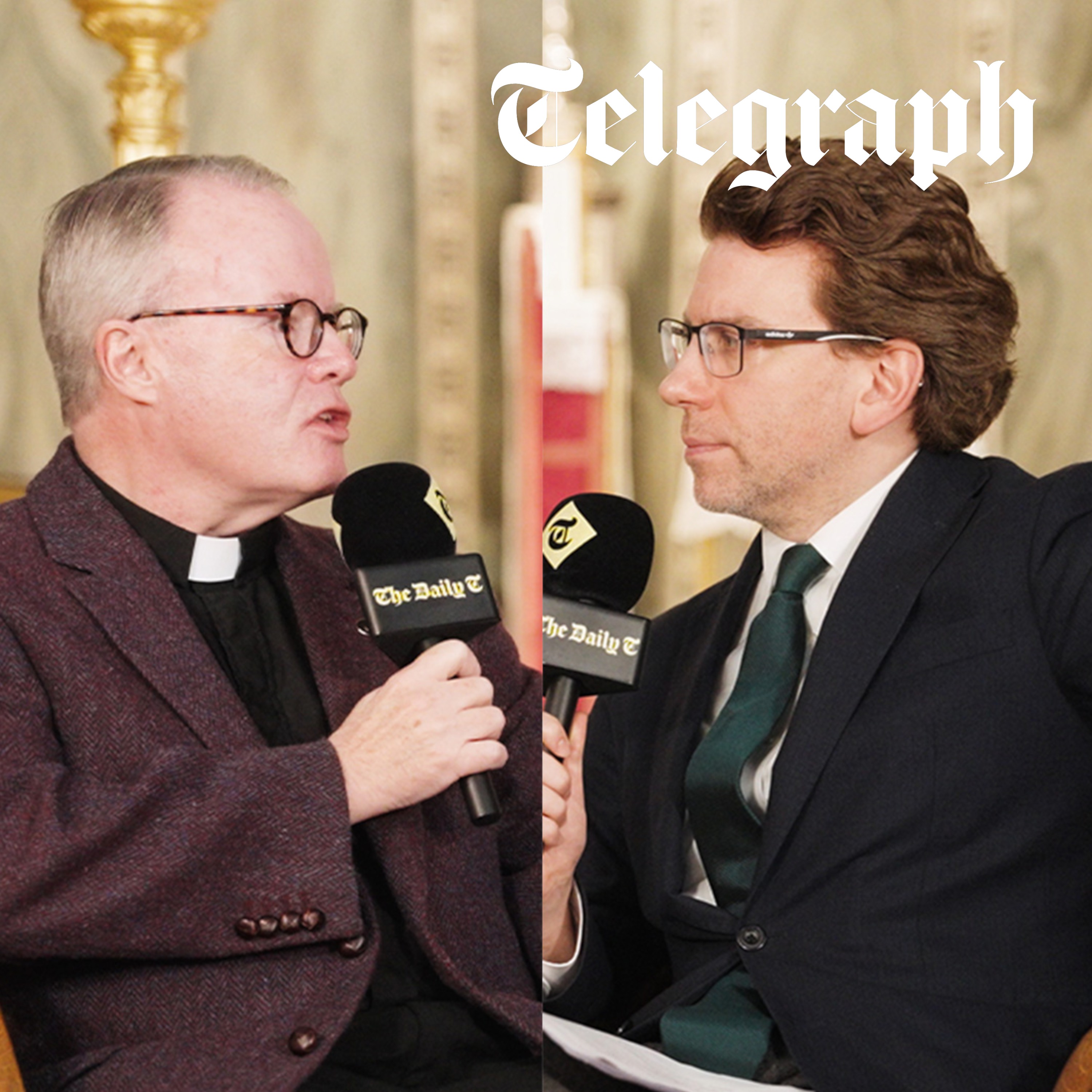
In this episode of The Daily T, host Tim Stanley engages in a poignant discussion regarding the persecution of Christians worldwide, highlighting the alarming rise in violence against Christians, particularly in Nigeria. The episode features Father Benedict Kiely, who runs the charity Nasarean.org, which advocates for persecuted Christians and supports their ability to remain in their homelands through micro-financing start-ups.
Written by AI. May contain mistakes.

Get the gist, explore an idea or ask about something said.
 Claude
On The Daily T, what are the key points of this episode?
Searching your listeningAutomatic transcript. May contain errors.
0:02The Telegraph
0:10Around the world this Christmas, millions of Christians face persecution and thousands have been killed for their faith. The King has acknowledged it, Donald Trump has acknowledged it, but many Westerners refuse to do so. So what really is happening to Christians in the world today and why won't we call a genocide a genocide? Welcome to The Daily Tea with me, Tim Stanley.
0:41I am here at the beautiful, ordinariate Catholic Church of Our Lady of Assumption and St. Gregory, that's quite a mouthful, in London off Golden Square. And I am joined by my old friend, Father Benedict Keeley, a priest who works on behalf of his organization Nazarene.org with Christians who are persecuted overseas to help them to actually stay in their own countries by setting up businesses through Seed Capital. My first question to you, Father Benedict, is are Christians being persecuted because they are Christians? Absolutely. Thank you for having me, Tim. Absolutely, because all over the world, for example, in Nigeria, just two or three years ago, for example, Christians were at Pentecost Sunday Mass, Catholics were at Mass, and Islamists, jihadists stormed in, shot, murdered 40-plus people, men, women, and children.
1:36And a few months, a month or two later, the president of Ireland, Michael Higgins, who's a little fellow, hobbit size and lacking the intelligence of a hobbit, but he said this was because of global warming. I was with the bishop of that diocese a short time later who said my people were not murdered because of global warming. They were murdered because they were Christians. So the answer is yes. All over the world, they are being targeted specifically because they're Christians, believers in Jesus Christ. Okay, so let's start with Nigeria because it's a very good case study. About 4 ,500 Christians were killed for their faith in 2024, and of that, about 70 % were Nigerian.
2:20This is according to Open Doors UK, the charity. Now, what people will say is those people weren't killed because they were Christian, but rather they were killed because they were almost in the way. They happened to be Christian. They are living in an area where there is desertification because of global warming. This has triggered a war between herders and farmers, and people are turning to banditry by kidnapping people and holding them to ransom. And it just happens that the people who are being killed in many places are Christian. It's not specifically targeted at them. There is a small element of truth in that, but the major reason is because they're Christians.
3:00For example, there are two offshoots of ISIS now working in Nigeria. So they are offshoots of ISIS. They're children, as it were, of ISIS. ISIS in Africa, and another one, I can't remember the acronym. But all across Africa, ISIS is growing hugely. We hear about the death of the destruction of the caliphate. yes it was defeated in Iraq but it's growing all across Africa and so in Nigeria Christians why do you have to burn down people's villages and destroy their churches and burn them alive in their churches if it's just about claiming land no there's a small part a small bit of truth in this but it's mainly Muslim violence against Christians some Muslims are also killed that's fact as well, but the huge number of deaths, which has hardly been reported until, as you mentioned in your introduction, Donald Trump started to talk about it.
3:57This has been going on for years, thousands upon thousands. It's the most dangerous place in the world at the moment to be a practicing Christian. North Korea is the most dangerous because you can't even have a Bible, but in order to live your faith, it's the most dangerous place in the world to be a Christian in Nigeria. Let's talk about your life and your witness as a Catholic priest. What I find fascinating about you is you started out as a diocesan, that's a regular priest, in Vermont. And then one day you decided that you needed to work with persecuted Christians. How did that come about?
4:31It happened for a very specific reason. It was in August of 2014. I was, as you said, a parish priest in Vermont, in Stowe, Vermont, a skiing town. Where it snowed all the year. It snowed for six months of the year and I didn't ski. I like the Apres ski, but I didn't ski. That's a sign of madness going down a mountain on two sticks. And I remember hearing in the news that on the Feast of the Transfiguration, all the Christians had been driven out of Nineveh, the Nineveh plain where Jonah, those who know their Bibles, Jonah preached in Nineveh. We've been together to Nineveh. This is in Iraq, northern Iraq.
5:09Yes, Mosul is Nineveh. Jonah's tomb was there. ISIS blew it up. So I heard on the news that all the Christians had been driven out. And I remember thinking, how terrible. They've been there for 2 ,000 years. There would be no mass that weekend in Mosul for nearly 2 ,000 years, first time. I thought, we must do something. I happened to have in my parish a man who made promotional materials. So we started making those rubber bracelets and the lapel pins with the Arabic N, the nun. Explain the lapel to us. Well, it's the Arabic N, the Nun, as it's spelt like a nun, but N-U-N, Nun. And it's what ISIS and Islam has marked Christian believers for centuries with.
5:51They sprayed it on the houses, which meant it's like the Star of David for Jews. They sprayed it on the house saying, a Christian lives here, convert, leave or die. So it became a very powerful symbol of identification with Christians and a sign of solidarity. You don't have to be a Christian to wear it. In fact, the very first person who wore it in public in a big way was a Lebanese newsreader, a Shia Muslim lady. She wore it on her T-shirt. She got sacked for it. So it's a sign of solidarity. So we started producing these, raised the money to do that, started sending money to house and help or feed the Christians.
6:32and then from then I went to Iraq for the first time in 2015, early 15, with all the thousands and thousands of refugees and slowly but surely I felt a call that I must devote my priesthood somehow to helping, speaking, writing, talking about persecuted Christians and then the idea came to help them to stay there. No charities were really doing that. They were feeding and housing but once ISIS had been pushed out there we were able to start mini microfinancing small family businesses so that Christians can stay, which of course answers the migration problem as well, because most people do not want to leave their homeland.
7:13So if you help them have a job, then they stay. And so now, nearly 10 years later, we've got at least 70 businesses in Iraq, and we're in five other countries as well. So it's small, but it's practical, because often when you hear about persecution, people say, oh, it's terrible, what can we do? What can we do? Well, there's something you can actually do. Help start a business and people won't leave and they'll stay in the country that they've been in for 2 ,000 years. When we visited Mosul, which was held by ISIS, then liberated, and is today controlled mostly by Iranian militias, I remember you telling me that when you had first gone there, there was something particularly horrific that occurred at a convent.
7:54all the churches in Mosul were used by ISIS as torture centers and areas for target practice we walked into the churches and the altar like this beautiful altar here the altar was riddled with bullet holes and burnt and there was also the the Dominican church which has just been restored although there's no one there the Dominican church there was a noose and they hanged people in the Dominican church, the Dominican convent there. But also in another of the towns, ISIS captured one of the convents of the nuns. The nuns had all left, but they found one of the nuns' cell phones and actually called her.
8:35She was in exile in Erbil in Iraq. They actually called her and said, where are the guns? They thought the nuns were hiding the gun. Nuns with the guns, they thought they were hiding them. But they desecrated everything they could. But we saw with our own eyes, again, every church we went into, every cross was scratched out. Every image of Our Lady, of the Virgin Mary or of Saint, their faces were scratched out. It was iconoclasm of the most extreme kind. And we must note that, of course, they did this to other religious minorities too, particularly the Yazidi people. And, for instance, the Taliban did this with the giant Buddha statues in Afghanistan.
9:10An element of genocide is not just killing people, but actually eradicating their culture. Eradicating their memory. When I first went, not when I first went, but when the year before we went together, we got close to most. ISIS was still there, so we were about nine miles away. Could hear the coalition bombing. We were in the town of Karam Lesh with the priest there, and he had just returned. And he took us into the graveyard, and ISIS had dug up the graves of the Christians and thrown their bodies away. Now, why did they do that? Yes, desecration. However, that was about destroying memory, pretending that Christians had never been there.
9:52And this is, again, a very powerful weapon, the destruction of memory, to say, well, they were never there, which is a lie. Explain to us who the shrine is for in this church. which is a very beautiful shrine here. We're not an NGO. I'm a priest. And so prayer is obviously extremely important. It's not just about housing or feeding or keeping the businesses going. It's first and foremost to pray for Christians. Christians believe in prayer. It's not a last resort. It's a first resort. And so I realized we needed to have that as a sort of centerpiece. So we've established now seven shrines as an icon of the Virgin Mary called Mother of the Persecuted written in Aramaic, the language of Jesus, which is still spoken in parts of Iraq where we've been and in Syria.
10:40It's quite amazing when you hear someone on their cell phone talking Aramaic. The language of Jesus. Yeah. It's not just for the liturgy. So it's Mother of the Persecuted in Aramaic. And the idea is that it's blessed by the bishop and put in a church, a cathedral or a church. And so people can come and pray for the persecuted. many people from the diaspora, wherever they're from, but also for us in the Western world to pray for our own fortitude and perseverance. I just put a shrine in Kazakhstan just in the summer, in Astana, Kazakhstan, which of course Stalin sent a million and a half people to Kazakhstan, giant gulag.
11:21And the bishop there, the assistant Bishop Schneider, was born in the gulag. And when I offered it to him, he said yes immediately. He said, this is the perfect place to have an icon to pray for the persecuted. Imagine growing up, he was baptized by his mother because there was no priest. He was, remind me, he was a German, of German descent, German Catholic. Exactly, German exile. Most of the Catholics in Kazakhstan were people who'd been sent from the Soviet empire, but he was confirmed by a martyr priest who was then killed, martyred. And so he really understood the need to pray for the persecuted.
11:58So this is what part of the work to do is to pray for them. Now, I think one reason why Westerners do not think there's a genocide going on is because they hear Middle East and they think, oh, that's the land of Muslims. They don't think any Christians were living there. That's not true, right? It was a tapestry of ethnicities until quite recently. It was Christian until Islam. There were other religions, of course, but I mean, you think of the great saints of the early church, Augustine from Hippo, one of the great fathers of the church. Where's Hippo today? Hippo's in Algeria, all Islamic now.
12:36Christianity came from the Middle East. We are a Semitic religion. As you said, people say that. I'm often asked in America, when did we bring the gospel to them? The other way around, you know, So this is very, very important because the gospel came from Africa to us. From the Middle East to us and Africa, that whole area. And St. John Paul II, Pope John Paul II famously said that the church has two lungs. It breathes with two lungs. And he was mainly talking when he was saying that about the church in the East, as in Eastern Europe and Russia. But of course, it's true. The two lungs of the church, the lung of the East is the lung of the cradle of Christianity.
13:18The Christians now who still speak Aramaic, who still worship in Aramaic, they've been there for 2 ,000 years. They brought the gospel to us. Saint Theodore of Canterbury, who was an archbishop of Canterbury in the 7th century, was from Tarsus, where Saint Paul was from. I mean, imagine if, well, we won't talk about the archbishop of Canterbury, but imagine if the next cardinal archbishop of Westminster was appointed from Mosul. He might actually be quite good. It would actually be really excellent. But that's actually the Catholicity of the church, that they bring in a Syriac to Anglo-Saxon England.
13:55So this is our heritage, and we're very impoverished if we don't realize that we're only breathing with one lung. So that's part of my work, again, also to help Western Christians understand our roots. As I say, I think a lot of commentators just feel Christianity is a European thing and that it's spread by empire. but let's talk about some cases where the church has been flourishing for centuries and is now being destroyed. One is the Coptic Christians in Egypt. I know that you've visited Cairo where they live in great poverty and really have a second class status. The Copts are amazing. They're actually in a sense the healthiest of all the Christians in the Middle East in terms of numbers.
14:37The Egyptian government doesn't like to admit the numbers but there's probably about 20 million copts. The Egyptian government says there's 11 or 12 million. There again, they are the ancient Egyptians. They worship in ancient Egyptian Coptic, but they are second-class citizens, completely second-class citizens, always oppressed. Martyrdom is still going on. Just a couple of years ago, there was a church bombing in Cairo. I think it was 2016, either 16 or 19. About 40 people were killed in one church, mainly women, all blown up. But they have a tremendous strength of faith. They're very, very impressive.
15:15And interestingly, they are also doing quite well in the diaspora. The Copts seem to have found a way when they go to places like Australia or here in England. Bishop Angelos, the Coptic bishop here in England, is a close friend of the king. They seem to have found a way of keeping their faith. That's one of the great worries of many of the bishops in the Middle East, that when their people leave, they will lose their faith. But the cops somehow have, I suppose, again, perhaps being persecuted for so long, they found a way of just sticking to it. When you visited, you sent me a video of some of the living conditions of working class cops in Cairo, and it's not pretty.
15:53They actually are working in the rubbish dumps of Cairo. The Zabalin, they are the people who literally do all the rubbish work. I saw an article once in Vogue or Condé Nast magazine about how fantastic this is. This is the green answer. Now, these poor people are picking through rubbish day and night. They live in the rubbish. They pick through it. Yes, it's very green because they pick everything they can out of it. But they're living in really terrible conditions. However, they've got parishes there. They've got priests there. They've got people working there full of joy. And when you go into their houses, they're very, very clean.
16:33They're very clean inside, but outside, yeah, they're living in rubbish. Armenia is a curious example. This is actually the oldest church, am I right? The oldest Christian country in the world. Right. 301, it became a Christian country. And they have both a border war with Azerbaijan, which has seen thousands of Armenians had to flee when the territory was taken back by Azerbaijan. But also their own government is cracking down on the Armenian Apostolic Church. The Azerbaijanis, who are Turkic, Azerbaijan is really greater Turkey, and remember the Turks martyred, murdered a proper genocide, the very first official genocide, a million, a million and a half, two million Armenians, Assyrian Christians, Orthodox Greeks, never accepted by the Turks.
17:24So they drove all the Armenians out of Artsakh, the area, and yes, and now though they're The prime minister of Armenia seems to be some sort of a quizzling of some kind, cooperating with the Azerbaijanis, giving up territory, and arresting bishops who are protesting. A half of local archbishops are now in prison in that country. Because they're protesting against... He's effectively a dictator. There's going to be an election, I believe, in a year or so, but who knows if it will happen. but Armenia once again is poor in the sense of no one really supports it. It's in the middle of a global battle because, of course, the Turks are against the Iranians.
18:10The Iranians are supporting the Armenians. The Israelis are supporting the Azerbaijanis. Christians are always, when I went to Iraq, the first time a priest said to me, he was running a clinic at that point for the refugees, he said, we're so weak. He said, we're so weak. No one really supports us. And that's actually true when people talk about the West being Christian. And Islamic jihadists always talk about us being the crusaders, etc. Well, we're not. I mean, it may not be politically correct, but it would be kind of a good thing, perhaps, if we were crusaders. Because we might be able to protect them.
18:46But we're not. The West is a secular notion now, completely. And so the Christians in Armenia are struggling because there's no major power helping them. That's an interesting point you make because there's an assumption in the liberal West, which is politically liberal. I don't mean that in a pejorative way. That's what we are. I'll be pejorative. But we are an enlightenment people. We believe in reason and constitutions. And so we are politically liberal. There's an assumption that states must be impartial. But other societies don't feel that way. So Islamic countries will act in defense of Muslims specifically.
19:24And here in this country, we've had the recent experience of Muslims rallying around the persecuted peoples of Gaza. They want to call them persecuted or caught in the middle of a war or whatever. My point is, there is no embarrassment at partiality on the part of British Muslims. But there is this embarrassment when one suggests that we should show particular concern for Christians. The motto of my charity is straight from the scriptures from Galatians, chapter 6, verse 10. St. Paul says, let us do good to all men, but first to the members of the household of the faith. So obviously we take care of our own family first.
20:07It doesn't mean we don't take care of anyone else. But first we look after our family. And then it's a bit like in the airlines. You know, when you fly, they say, put your own oxygen mask on first before the person next to you. Look after your own people first, because if you don't look after them, how can you look after anyone else? It's all that leftover, boring, colonial, it's just a lot of nonsense, basically. We need, if we're Christians, it doesn't matter, I suppose, about the governments, But the church in particular, and those who claim to be Christian, must have an active care and interest for their brethren.
20:43Otherwise, how can you claim the name of Christian? When people hear that, that you should look after your own creed, people think that's a racist thing. And they couldn't actually be more wrong, because being part of a church means you're part of a universal communion, which means you're interested in the life and death struggles of people in Nigeria or China. It's got nothing to do with racism at all. Christians say that we're brothers and sisters. That's not just something nice to say on Sunday. Through baptism, we actually believe, or we should believe, because there's an article of faith, that we are closer, in a sense, than even blood brothers and sisters, because we are brothers and sisters in Christ.
21:26And racism? Who's being killed in Nigeria? I think the color is black, but apparently black lives, black Christian lives, don't matter. Thousands are being martyred in Nigeria every year. There are no marches. There are no Je suis Nigerian Christians. None of this is happening. It's first, I would challenge first. It's the church's job first to be making a noise about this. But then challenging governments as well. So it's not racism. Do you think the churches are making enough of a noise about this? No. No. Quite clearly, it's not making enough noise. And I've heard that with my own ears in places like Iraq and Syria.
22:00they've said deep down, when you question them privately, quietly, they say, we don't really think the church in the West cares about us very much. Right. Would that include Roman and Anglican? I think so. I mean, certainly under the last pontificate, some of the statements of the Pope, some of the statements he made were quite extraordinary. Sort of comparing Pope Francis, comparing, talking about Muslim violence, but then talking about Christian violence, which was virtually non-existent. He was sort of equating these things, and that caused deep distress. Pope Leo, the new pope, actually in his first week, he made a very good discussion about the Church of the East, some of what I said about its importance.
22:43So I think things hopefully will change a little bit, but the language of the Vatican is also very diplomatic, and sometimes when Christians are being actually martyred, are being murdered, diplomacy isn't really the right language we need. To be fair, some churches feel that they have a responsibility not to stoke up tensions. One recalls that Pope Benedict gave a famous speech in which he talked about the difference between Islam and Christianity, and a nun got murdered in angry reaction to it. So some are just careful not to get involved. That's a good point, and it's a true point, but sometimes you have to just speak out.
23:23Silence, as they say, often equals consent, but sometimes silence is just unnecessary and it's also dangerous because it allows these things just to continue and perhaps to get worse. So it's a good point. The trouble is the massacres happen anyway. Yeah, yeah. Speaking of which, what is taking place in Sudan right now? Sudan is not really a persecution of Christian conflict. It's really Muslim upon Muslim, but it's political, tribal. The Sudan war that went on from the mid-80s to the early 2000s was quite anti-Christian. South Sudan, which is now a separate country, is a majority Christian country now, 60%.
24:12But Sudan itself is, I think, 70-plus or even more Muslim. It's terribly ethnic violence. It's two different groups, the government group, the militia group fighting, lots of slaughter. But there are a lot of videos and things on ex-Twitter a few months ago alleging that these were martyrdoms of Christians, killing of Christians. We have to be very careful sometimes when we see stuff on that sort of social media because a lot of the commentary is incorrect. Most of those things were not. They were Muslims killing Muslims. That's interesting, the nuance there, that we do have to be careful not to mislabel something because it would not just be false, but it would also undermine the cause.
24:57And it happens, unfortunately, that this is the problem. Social media has great advantages because we can find things out very quickly and reports come very quickly. But as I said, that Sudan stuff, a lot of stuff was going on, especially coming out of America, people saying Christians are being martyred by the thousands. well, they really weren't. Christians are being killed, but they're sort of horrible term, they're sort of collateral damage as well.
25:34How much good or harm has Donald Trump done to this cause? he's done it's he's done a lot of good because he's raised the issue in a big way as i said earlier on i don't know why for years the this persecution of christians in nigeria has been going on thousands and no coverage at all no political coverage and then apart from to be fair when about many years ago a group of girls were kidnapped then there was a great deal of coverage the girls yeah and then they were forgotten but somebody i don't know who got to him somebody some of his advisors uh have managed to alert him to this and this has been very encouraging because for the first time the nigerian government's having to react and one of the things i always say when people say well what can we do practically what can legislators do trade and aid this is something we can actually do do we give huge amounts of money to countries that are actively persecuting, actively persecuting any religion.
26:36But if they're actively persecuting Christians, why do we give them aid and why do we trade with them? Trump's, of course, threatened them with attack, a military attack. I think that's part of his bravado that he's well known for. But he's raised the issue, and that's very important. Yeah, yeah. It might be the one thing that would actually unite Nigeria. And it's a rich country. It has a vast amount of money through oil. It has a flowering middle class. It has Lagos, which is sort of the Paris of West Africa. It's a country I've been to. It has a lot going for it. There's also a great deal of corruption.
27:07Parts of it are effectively a failed state. The north is becoming increasingly ungovernable. And whilst it is true that the president, a Muslim, is married to a Christian, so there are some serious attempts at building bridges here, the country is clearly failing to protect its Christian minority. And if you look at the proportionality of deaths, it's not just about the numbers, It's about the proportion of Christians who are being killed. At my parish church, recently we had a visiting Nigerian priest who said, bluntly, it's a genocide. And I thought, how sad that even he has been affected, infected, by fake news from Donald Trump.
27:47The Nigerians, those Catholics in Britain and in America will know that so often now in our parishes are being staffed by Nigerian priests. And they're usually very quiet. but I'd encourage people to ask if they have a Nigerian priest ask the priest what he knows about this because often they know someone themselves who's been martyred they have brother priests who've been killed they're quiet possibly because they think they shouldn't talk about it but it's really the suffering church in Nigeria is extraordinary and yet it's a very it's a booming church if they can send their priests here they have vocations we don't have vocations perhaps we may need to be persecuted.
28:30It's like we were talking about St. Augustine of Hippo. It actually feels like we're going back to the early years of Christianity where much of the energy and the numbers are actually coming out of Africa. Well, you look at also, for example, in the communist times in Eastern Europe, even though the church was being heavily persecuted, the faith was extremely strong. There's that old sort of saying that the blood of the martyrs is the seed of the church. And it doesn't mean we encourage persecution. No one wants that. But when you're given the choice, as we talked about with ISIS, if you're given the choice, leave your house, convert or die, that really sort of asks you, is your faith real?
29:15And we've met, you know, when you were in Iraq, we've met people who they were given that choice and they chose to leave. They left everything, almost to the point of the clothes they were wearing, but they left everything rather than convert. I remember once I was in Iraq and we talked to two old ladies. ISIS came into the house. For some reason they got left behind in their village. They were asleep. And ISIS came into the house, these two old sisters, and the man came in with the big beard and he said, convert, convert or die. And the lady said, this is verbatim, I heard it. She said, no, I'm not going to convert.
29:52She said, I've been a Christian all my life. She said, I love Jesus. I love Mary. There's a picture of them on the wall. She said, I'm not converting. So he didn't really know what to do, so he left. He came back the next day with another ISIS man with a bigger beard. And same thing, convert or die. She said, no. Kill me now. I mean, that's really encouraging. And she got away. Well, then they made them all leave. They told them, in fact, they said, if we find your wedding, they had to give everything. Even if we find your wedding ring, you'll be shot. She put her wedding ring in her shoe. But the funny thing was another journalist I was with asked her, thinking he'd get a very sort of gentle response.
30:33He said, well, so now what would you like to do to these people now? Will you forgive them? And she said, I want them dragged behind a truck in chains. A bit of muscular Christianity there. You know, who are we to judge, to quote somebody? Yeah, make her Archbishop of Canterbury. When we were there, we were given hospitality by one Christian family who were forced to leave, and then when ISIS was beaten, they came back, and they found the floor of their house covered in beard hair. Why was that? I was with a friend, another journalist, Edward, and he said to me, there's hair on the ground. What's this hair?
31:12And I said, that's not hair, it's carpet. it. And then we went into another room and it was hair. It was beard hair. And I asked our guide, our friend, what is this? And he said, yeah, they shaved the beards off. The ISIS fighters shaved their beards off so they wouldn't be identified. So there were these clumps, clumps of beard hair. It was one of the most bizarre things to see. And even though it's something they were told they shouldn't do, shaving, they did it to save their lives. They wanted to get out. They wanted to escape, which is so striking. I think a key difference between fanatical killers and martyrs is the fanatics murder, but martyrs die.
31:55Islam has a saying, they call their martyrs the Shaheeds, they call them Shaheeds, but they blow themselves up to kill themselves. Christian martyrs are willing to die for their faith, but they don't kill themselves. It's a completely different conception. Christian martyrdom is witnessing. It's the very meaning of the word. You witness to the truth of the faith to the point of death. You will be tortured. You will die rather than deny Christ, but you don't blow yourself up or you kill anyone else. On a spiritual note, because this is Christmas, let's bring some theology in. Suffering and martyrdom is a part of Christian identity.
32:34And I think this might be one thing the West has lost, is an understanding that some people, I won't say, will gladly die, but they feel they are following the example of Christ. It's true. As I said earlier, we're not meant to seek martyrdom. We're not meant to enjoy suffering. We're not meant to seek persecution. But we were warned, in a sense, by Christ from the beginning. We will be persecuted. He told us. It's a promise. We will be persecuted. What they did to me, they will do to you. It doesn't mean we don't help those because we're the body of Christ. No, of course. But it's the ultimate form of witness.
33:13Every Christian, every Catholic is called to be a witness, a man or woman to speak in the name of Jesus, to witness to Christ. And the ultimate form of witness is martyrdom, that you will die rather than deny Christ. And it's actually that weird paradox of persecution that is beautiful. when you read the stories of the martyrs, usually, strangely, they seem to be very happy. They have incredible confidence. Some of them, in England, the history of the English martyrs, they have great senses of humor. The English martyrs are known for their humor. And they're meant to encourage us. This is one of the reasons Catholics canonize saints, not just because they're holy and because they pray for us, but they're meant to be exemplars.
33:57They're meant to be models. We can see that this man did this. this woman did this, this child did this. This is meant to encourage us and to give us, as a Donald Trump phrase, guts, to give us intestinal fortitude when we're challenged. Yeah. When I've traveled with you, I've thought, is he frightened right now? Because we've been to some very strange places together. Are you nervous? Not usually, and that's not because I'm particularly gutsy either. I don't want to be martyred. I particularly don't want to have my head chopped off. But most of the time, it's fine. There've been a few tricky, tricky incidents.
34:34But strangely enough, again, also, even some of the Muslims are very, very respectful towards the priest. I did get into a bit of trouble in Lebanon once, and people were very respectful. In fact, a Sunni family gave us, I was with a driver, gave the driver and I shelter for the night, a Muslim family, a Sunni family, which is beautiful. Although the grandfather did say, we're ISIS, you know. I think he was being silly, which did make me a little bit nervous. But we were in Iraq one time and in Mosul and came back and the Westminster Bridge attack happened. And we both said, a friend of mine, we said, we were safer in Mosul than London.
35:15Finally, Father, how can people support Nazarene? Thank you. Well, pray first and foremost. But it's an American charity, so unfortunately you can't donate and get taxed back in England. but you just go to the website. You can donate in pounds, Nazarene.org with an S, not a Z with an S. Thank you very much for joining us and Merry Christmas. Thank you, Tim. Bless you.
35:56You
King Charles has spoken out in support of persecuted Christians around the world after attending a service at Westminster Abbey dedicated to those facing violence and discrimination for their faith.
It comes amid renewed international focus on the treatment of Christians, after Donald Trump threatened action against Nigeria over killings, and comedian Bill Maher described the situation there as a “genocide”.
Tim Stanley is joined by Father Benedict Kiely who runs Nasarean.org, a charity that advocates on behalf of Christians and helps them to stay in their countries by funding start-ups. They talk about the Middle East, what is happening in Nigeria and the status of Christians today.
We want to hear from you! Email us at [email protected] or find @dailytpodcast on TikTok, Instagram and X
► Sign up to our most popular newsletter, From the Editor. Look forward to receiving free-thinking comment and the day's biggest stories, every morning. telegraph.co.uk/fromtheeditor
Producers: Venetia Rainey and James Keegan
Executive Producer: Charlotte Seligman
Video Producer: Andy Mackenzie
Social Producer: Nada Aggour
Editor: Camilla Tominey
Hosted on Acast. See acast.com/privacy for more information.


