
 Ask ChatGPT



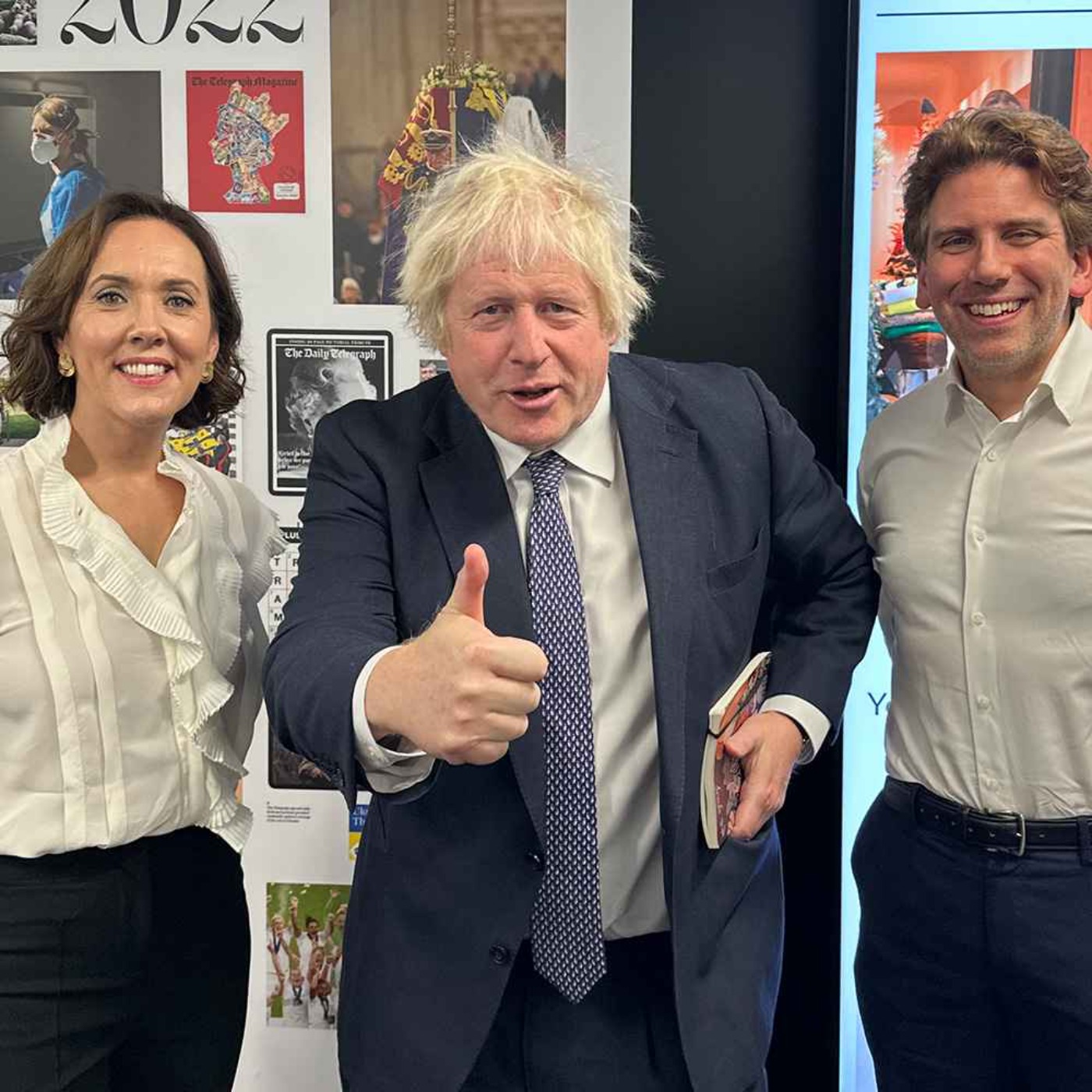
In this episode of The Daily T, hosts Camilla Tominey and Tim Stanley interview former Prime Minister Boris Johnson on the centenary of Margaret Thatcher's birth. The conversation covers a broad range of topics, including Johnson's approach to COVID-19, his views on immigration, the current political landscape, and insights on key figures like Kemi Badenoch and Keir Starmer.
Written by AI. May contain mistakes.

Get the gist, explore an idea or ask about something said.
 Claude
On The Daily T, what are the key points of this episode?
Searching your listeningAutomatic transcript. May contain errors.
0:09On today's Daily Tea, Boris Johnson here in the studio to discuss a hundred years of Margaret Thatcher. In what way did he try to emulate the Iron Lady? What did he get wrong? And what does he think of the current state of British politics? Welcome to The Daily Tea with me, Tim Stanley. And me, Camilla Tomini.
0:37Boris Johnson, former Prime Minister of this great nation, welcome to The Daily Tea. Tim, great honour to be on your show. How long have we got to last for? How long is We give as long as you've got. Until security come in and end it. We normally ask you whether you want a cup of tea, but you've already got something in your lady tea mug. It's fantastic. You asked for coffee. We serve tea. You asked for coffee and you got cocoa. I asked for coffee and I got hot chocolate. Thank you so much. Would you like a cup of tea, Tim? I would really like a cup of tea. We can just serve ourselves. Things are really, really going up.
1:10You ask for coffee and you get hot chocolate. And you get it in the Maggie mug as well. We're going to call it the Mrs Tea today, not the daily tea, because it's in homage to the great lady. And while we pour this tea... She was wonderful. You ask the question, Tim. We always ask everyone, if you could have a cup of tea with anyone in history, who would it be? I think... Alive or dead? I always give the same answer to this. I would always like to go back to Periclean Athens to understand how they really spoke the language and just see it happening. I would love to... I don't think they drank tea in Athens in the 5th century BC.
1:54So is it Pericles you'd want to sit down with? I want to see Pericles, the son of Xanthippus, married to Aspasia of Miletus. Who is your favourite Greek playwright? Aeschylus. Okay, right. Okay. Euripides. Well, Euripides... I'm going to... Aeschylus has the grandeur, right? Oh, he does. He's the boss. Aeschylus is more daily total. Euripides is the enfant. Euripides is more daily male. Euripides is more daily male. I'm more guardian. No. Medea is a pretty feminist. I may need to take a grip of this conversation. No, no, no, no. I think Euripides is like the daily male in that he understands the incredible importance of the female readership.
2:34Yeah, very good. Are you saying that we don't? Not that the telegraph doesn't. That's very good. There's a kind of grandeur in Aeschylus. Yes. and, you know, he's fantastic. A bit baffling sometimes, but... Is there a grandeur about Donald Trump, who, as we speak, you were just asking as we walked up the stairs to the studio, what's going on over in Tel Aviv? And there are suggestions, Boris Johnson, that the US president should win the Nobel Peace Prize, snubbed last week in favour of a Venezuelan. You know, I think it was very good that Machado won the prize. She's terrific. Did you see the clip of her being told by the head of the Norwegian committee that she'd won and her sort of genuine, unfeigned humility and wanting it to be for all the resistance in Venezuela, all the opposition, all the suppressed opposition.
3:21She wasn't allowed to stand. Maduro wouldn't have her on the ballot. And that was a great thing that she won. And look, I think that Trump will win when he applies to Putin the same pressure that he's put on Hamas and indeed on Netanyahu. And then he will have an absolutely unanswerable case. I think at the moment, I don't know the ins and outs of the Norwegian committee very well, but they will try to find reasons still to make life. He does deserve it. Yes. He does deserve it. You know, he's got those hostages out. He's got a deal going. You know, we're in a totally different place, aren't we?
4:09Doesn't it feel better? Yes. Yes, it feels miraculous. It feels miraculous. You know, the two years, 737 days, it kind of been like a huge raging toothache in the skull of the world, right? Whatever your views about Gaza, it's been a nightmare. It's been a nightmare seeing what happened on October 7th, the hideous things that Hamas did. Appalling to see what's been happening in Gaza. agonizing to think about the hostages waiting. Now they're coming home. And it feels like we're in a different logic now. It feels like there's a real prospect of sorting things out in the Middle East in a massive way.
4:54Do you think Peter Starmer might get the Nobel Prize? Does he deserve any credit for what's happened? Starmer, this great human pollard. the snore fest I don't know I think he'd no I mean of course I do know I think he'd be totally ludicrous what has the UK contributed to this as far as I can see sadly not a lot I think that all we really did was we interjected this meaningless commitment to recognise the Palestinian state did nobody any good didn't do the Palestinians any good just looked to Israel like a reward for Hamas's terror And now I don't think that Starmer will get or deserves a big being, frankly.
5:40But, you know, I think it is a great moment. But there's a lesson for everybody in this. And on Thatcher's centenary day, which is the point of why you've invited me in. Yes. I think the lesson is that success comes to those who are willing to be strong. Yeah. And Starmer, you know, what was his, you know, gesture? What did he do? Nothing. Recognition of Palestine. Nothing. But it made no difference. It was a fart in a gale, right? It made no difference. What Trump did, by contrast, was to say to Hamas, either you take this deal now or you're going to be wiped out. And symmetrically, though we don't know the details, clearly he put the hard word on Bibi, Netanyahu, somehow, you know, in the way that only the US president can.
6:43And so I think the lesson for our times from Thatcher is all about that strength, right? You go back to, you know, you both are too young to remember, actually, the Cold War in the way that I do. I doubt very much that you remember when the tanks rolled into Poland in the way that I do under Brezhnev. When did the tanks roll into Poland under Brezhnev? They did, in 1980. Right. Oh, solidarity. Right. OK. Right. Yeah, I was only two. Polish tanks, but yes. Yes, I see what you mean. Yeah, absolutely. And I think that people have forgotten how clear Margaret Thatcher was. And she basically wouldn't ever accept this argument that, you know, we had to be wary of provoking Russia.
7:37And I remember provoking Moscow, provoking the Warsaw Pact. I vividly remember in the mid-80s how people used to see, you know, I doubt if you remember any of this at all, but the argument against the deployment of the cruise and the Pershing missiles in Europe by the Americans was that it would be provocative to Moscow and it would wind them up and it would escalate things. and Thatcher said no, no, no. It's their fault. They're the ones who are putting the SS20s into Europe. We've got to be strong and I think what we need today is her sort of clarity about the threat that we've got from Russia, from Putin and from the whole lot of them.
8:32How much did you... I think that's the lesson. We want to ask you about your sort of relationship, loosely termed, with Thatcher. As a young man, you're observing Thatcher, obviously the first female prime minister. How much did you later come to model your own premiership on hers? Because obviously you're also closely associated with Churchill, of whom you've written a very compelling biography. Well, I'm not worthy to be compared with either of those individuals, as I'm sure our listeners will immediately point out. But I think that what I wanted to do was, I mean, my mandate, I was really hired by the Tory party because they'd run out of better ideas.
9:11And my job was to deliver on the mandate of the people and to get Brexit done. But you must have had the great lady in your mind when it came to being an international statesman. You didn't just come in to do Brexit. You must have had a philosophy. I did. I did. I still do. And I think that what both of those leaders had was what Churchill called the virtue that leads to all others. And that's courage, right? And so he did, you know, if he hadn't been in the hot seat in May 1940, things would really have been very different. And I also think, you know, if Thatcher hadn't been there, I think that we would have really struggled to tame the unions.
9:59And I think we would have we would have struggled to hold the line in the Cold War. And she really did. I mean, I think what she did with with Reagan was incredibly important. I think that and I get back to my point. I think that's what's missing today. It's that it's that moral clarity about about the difference between our side and their side. And did you have that kind of courage moment in 2019 with the proroguing of parliament? Is that one of those flashpoints in history? Yeah, well, look, I think the proroguing of parliament, you can read all about it in my book, Unleashed. The point of that was really just to remind the electorate that we were determined to deliver on their mandate and to show that nothing would stand in our way.
10:42I mean, with the proroguing of parliament, the problem was that the parliament that I inherited just wasn't doing anything to deliver Brexit. And we had to get it done. And it was clear that the MPs were going to be thoroughly obstructive, as obstructive as they could possibly be. And they weren't going to deliver on the promise that all politicians had made to the people, that whatever they voted, their views would be honored. And parliament was obstructing that. So that's why we, I didn't think it was wrong to prorogue because we only lost five sitting days if you actually looked at it. That parliament wasn't getting anything done.
11:24And then when we were overturned on appeal by the Supreme Court, or rather when the Supreme Court decided to overturn the decision of the government, which actually to be fair I was not then an elected government. It was before the election, wasn't it? I thought it was totally wrong. Yeah. And ultra-varies and not what the Supreme Court should be doing. I mean, that's my view. I don't think – I thought it was – the whole creation of the Supreme Court was a bit of a – Do you think she would have agreed with you on Brexit, Mrs Thatcher? I think she would, though clearly what everybody will point out is that – She campaigned in 1975.
12:03In 75, she campaigns to stay in and she signs a single European act in 85, 86, which gives up the UK veto over a lot of areas. But so I think in 75, I'm sure what she would now say, and you should ask her biographer or something like that. She was really campaigning for a yes because she envisaged a very different arrangement. Yes, economic union, but not political. And I think in the mid-80s, again, she would defend it as an economic, I think, as an economic decision. And I'm pretty sure that she would say that, you know, she had some pretty brilliant civil servants who were telling her to, Hannah and Williamson and all those people who were telling her to sign up.
12:55And I don't think she fully, I think she regretted the surrender on qualified majority voting. So the short answer to your question is, I'm fairly certain that in 2016, faced with the choice that was posed to the people, she would have been on the side of leaving. Yeah. Absolutely. I think Nigel Lawson was, right? Yes. Nigel Lawson, who was her most influential chancellor, and by the way, at the time, one of the great proponents of the exchange mechanism of the European monetary system. So, Nigel, who came for Brexit, as did several of her ministers, who had previously occupied ostensibly pro-EU positions.
13:49Yes. Because the choice in 2016 was very different from the choice that I think she faced in 86 or 75. This is the flattering part of the interview. I'm suggesting that you're in a league with Thatcher and Churchill in this sense, that they both faced moments in which they had to confront their own parties and the wets within their own parties. Yes, that's absolutely true. Is that something which has really bedevilled the Conservative Party historically, that it's often contained people who want to negotiate with the other side, be it the Germans in 1940 or the miners in 84. Yes, and that's why I think, I mean, I think, you know, Kemi is on exactly the right lines now, but I think our party, my party, traditionally has had much too much of the vice of wanting to find consensus, the word that Mrs Thatcher hated, where it can.
14:41And if you look at the history of the Tory party, Thatcher was in many ways an aberration. Yes. In her radicalism and her willingness to confront people, she was very, very unusual. But this has led some people to speculate that she might have disagreed with you over a very important policy, which is COVID and lockdown, that because of her scientific background, because of her reluctance to expand the state, she might have been one of the dry people saying in 2020, no, let's follow Sweden's lead rather than shutting everything down and paying everyone off. I don't know. I think that we'll have to leave it to Dame Heather Hallett's inquiry to work out what she thinks about the lockdowns.
15:24I think that, you know, I'm sure there are plenty of arguments for doing things in a different way. I think Mrs. Thatcher, Lady Thatcher, her scientific background might have led her to that conclusion. On the other hand, it might have led her to a different conclusion. the overwhelming majority of the scientists. I really did try. I had these sessions in Number 10 where I tried to get the scientists to say lockdown was a bad idea. It was very, very hard. I led the witness as much as I possibly could. I tried it, by the way, on climate change as well. I tried to... They were very, very uniform.
16:03And so even when I had... Prime ministers decide you could have gone against... You went against your own liberal instincts with lockdown, didn't you? and you went against your own instincts with net zero. I hated it. I think the trouble with going against your liberal instincts on lockdown is when you've got a novel disease that's killing a lot of people. Including nearly you, actually. Right, well, it wasn't much fun. But, you know, you have to be very, very sure of yourself, which is, you know, I didn't do science beyond O-level. You have to be very, very sure of yourself to go against the scientific advice and the medical advice that you're getting and to say, well, no, I think that everything they're saying is rubbish and we should leave it to individual responsibility.
16:49And I understand why people see it that way, and I particularly understand why conservatives say we should have just left it to people to decide how they wanted to behave and to run their own lives. And it's a very respectable point of view intellectually. The trouble with it is that if you look at the history of pandemics for hundreds and hundreds of years, the population themselves have never really accepted that. And I just happen to have been looking at the plague in early modern England, right? When Shakespeare's time, most of his career, the theatres were being shut for years on end. And that was when they were having sometimes 50 deaths a week in London, right?
17:33Now, admittedly, it was a much nastier disease, the bubonic plague, but we were having like a thousand deaths a day. Yes. And we were still trying to keep the theatres open. Yes. Okay. And they were shutting the theatres for a year at a time. And this was a period when the idea of government control was much less developed. But people, you see, telegraph readers, telegraph podcast listeners, are all, no doubt, people who will behave with great responsibility and restraint when it comes to the spreading of a contagious disease. Yes. But what they worry about, and this is what we discovered during COVID, what they worry about is how their neighbours will behave.
18:15But the British are well behaved, aren't they? That was the thing. Well, they are. We cue, we say please and thank you, we say excuse me. We do, but it's so interesting. Well, historically, we haven't always done that, by the way. And over the centuries, you know, it's true that over the centuries, is we have required that even if we believe that we ourselves are going to be good, we want to make damn sure that fellow next door with his several homes of multiple occupation in his flats that he's going to be well. Because we're not at all sure that he is. And so we see the virus incubating in that place and then spreading.
18:53And if we think that we're being responsible and we think that the other fellow isn't, then who do we blame? We blame the state for failing to protect us from the irresponsibility of others. And that was the problem. And frankly, if you look to what happened with the first lockdown and the first measures that we announced, the problem we had was that some people were, and readers of this paper or conservative-minded people or whatever were very punctilious. but others weren't. Yes. And that was the difficulty. I guess the thing is... And so, you know, I didn't have the confidence as a non-scientist to say, well, you know, to hell with all this advice I'm getting, to hell with the history of pandemics.
19:46You know, my gut tells me it'll all be all right because there was a risk that it wouldn't be, a serious risk. Boris, it comes back to when you were elected, when you put in by the membership and then you're elected in 2019 by the people in a landslide, historical great win and victory. We expected a certain kind of government that might be like Mrs. T's, and it felt like we got the opposite. And perhaps the starkest contrast between the two of you is on immigration. Now, between 1975 and 1976, net migration to this country ran at an average of 7 ,000 a year. But this was an era, Tim. In September 2020.
20:23Hang on. This was an era when people were fleeing. In September 2022.
20:30In September 2022, under you, it hit 780 ,000. The previous year, of course, it had been the lowest level for migration. Which was because of what? Because of COVID? Because of government policy. And it is exactly the same reason that we had a large number of EU students coming back in after the pandemic restrictions were lifted. But the point stands that migration under conservative governments has been running many, many times what it ran under Margaret Thatcher. There's a reason for that. Go ahead. And that is that, you know, you mentioned the 1970s. And that was a period, you're both far too young to know what it was like.
21:14But it was unutterably ghastly. I know, but it was still 80s and 90s. It was 7 ,000 a year up until 1996. Can I tell you, nobody much wanted to come here. On the contrary, people were fleeing. And actually, the only thing that is to be said in favour, I mean, Starmer is so bad that he's actually started to produce the same sort of syndrome. You've got the wealth creators, the dynamic people actually fleeing this country. And whatever you say about the government I led, I'll make two points. We restored full democratic legal control over our laws and our borders. And so if we choose, if the people choose, we can have zero immigration into the UK.
21:56But you didn't choose to do that. And we thought you would. That's why we voted for you. Because we thought you would drive immigration down. As you said, take back control of our borders. Yes, I did. The number you identified, I think, was 250 ,000 a year in 2009. If you look at what we did, that's exactly what we did. We took back control. We took it fully. Under the previous dispensation, you will recall, it was impossible for the British government to stop anybody coming in and living in the UK from the entire EU, where you've got about 450 million people and the people living there. So we took back legal control.
22:33Yes, it's true that if you look at the immediate post-COVID year, we had several things coming together at once, the Ukrainians, the Hong Kong Chinese, and a load of EU students coming back in to finish their courses. What people don't look at is the previous year when we had the lowest ever. Hang on, let me give you some stats. Let me just give you a stat. Can I just throw a stat into this? Hang on, Boris Johnson. What people fail to remember is what it was actually like in that immediate post-COVID period. I agree. Yes. But can I just give you the stat? People don't actually remember what every single government department was saying, which is that they couldn't be sure that the crops were going to be picked in the fields or the pigs were going to be slaughtered in time for the pigs in blankets for Christmas because it wasn't, or the fuels station.
23:22Do you remember this? Yes, but can I just give you... Has it been blotted from your memories? No, no, hang on. Do you remember this? Can I say, Boris Johnson, but those people brought dependence. Let me call time on this a minute. Let me just give you the killer stat. We also had, as a result of COVID... Wait a second, wait a second. Just because we need to... I appreciate what you're saying about that uniqueness of COVID and then what subsequently happened. And I appreciate also what you're saying about the caveats around Brexit, taking control of our own sovereignty and borders in that respect.
23:51I get exactly what you're saying. But just in terms of raw numbers, between January 2021 and June 2024, 4.3 million migrants entered, including 3.8 million long-term visas. And you've previously said on a rival podcast that you are proud of that Boris wave. And that would be surprising to me. First of all, I left office in, I think, July 2022, right? Okay, so you can't take credit for the latter. And what had happened... Well, you can't take credit for the fall because it then fell in the next two years. Of course, because if you talk to people like Kevin Foster, if you talk to people like Kevin Foster, who is the minister, as soon as we...
24:32Because we didn't know the numbers because of the system that we'd inherited. We didn't know how many had come in. We didn't know how many EU students had come back. And we didn't know how many people were going to take up either the Ukrainian scheme or the Hong Kong scheme. And those numbers were very high. But we now have a system that enables us to have zero. That was not legally possible before. Should we now have zero? Would you actually like to have zero? I'm very proud of that. And look, I think that there will be some areas where you're going to need skills and some where you're going to have to argue much more strongly.
25:09I think one of the great issues with Brexit and one of the reasons I was in favour of it was because I thought that we'd spent far too much time on the Ponzi scheme of mass immigration and not on skilling up people in this country. The problem we had with the back end of COVID, though, was that it looked as though, and we couldn't see the numbers, we were flying blind, and we couldn't see how many were coming in. All we could see... Which is weird. The Home Office should have the numbers. No, they're not in real time. They don't. No. And so all we could see was inflation. So by the end of 2021, beginning of 22, inflation is suddenly getting into double figures.
25:54And you know what? That's a very, very bad. And I think the Treasury basically believed that that was being caused partly by the labour market seizing up and people couldn't get a pair of hands to do the jobs that they needed done. And there had to be a fix for that. Otherwise, I assume, I mean, I'm just trying to analyze it in retrospect because this was not something that the government set out to do. And we certainly didn't set out to have 200 ,000 Ukrainians. We simply set out to be as generous as we could. I remember at the time, actually, we were coming under attack continuously for not being generous enough.
26:38All parties, including reform, attacked us for not being generous enough. But there's an irony because now Nigel Farage, you told me when I last interviewed you, you pointed out to me that when you were in power, how many percentage points was Nigel Farage on? Zero. And then one of the main reasons why reform are flying high in the polls and actually the Tories are once again facing an existential crisis is because of mass migration. Well, I think that actually that's not true. Some of that must be your responsibility. No, I think that if you look at what we did, we took back full legal control.
27:08We had, look, COVID was extremely difficult, right? We had, the numbers went right down. Then they went up when they were boosted by returning youth students and Ukrainians and other things. But we were then able, once we'd seen what was happening, and this was, and I was sadly on my way out by then, And once we'd seen what was happening, we were able to change all the rules on dependence, all that. I think they were changing in the beginning of 22. But the funny thing is, it wasn't, you should talk to Kevin Foster or something like that, but the changes we put in to fight it weren't implemented fast enough.
27:43And so that's why it went on for the years that you mentioned. But I think what the public, what enrages the public is the scale of the illegal immigration. And yes, I think, you know, legal migration, historically, I think you can make the case that it went too far, too, you know, it was too big and we must now crack down on it. But I think that the illegal migration, the cross-channel boats thing, was totally nightmarish for people. I think they were enraged by the tens of thousands pledged never being kept. Hang on, with great respect, did you ever hear me say that? No. That has haunted the Tories ever since Cameron came out with it.
28:30Did you ever hear me say that during the Brexit campaign? Did you? I don't know. No, you didn't. I heard 10 ,000 police officers, 20 ,000 police officers, 10 ,000 nurses. Yeah, you heard all that. You heard all that. You heard all that. But my mandate was to take back control, and that's what I did. Yes. Okay. And I also think that Rwanda was the right policy. Rwanda was the only way to get people back on the volley, right? Yes. So that – and we would be riding – you talk about the Conservatives. I don't know why we didn't just implement Rwanda. I don't know either. Why did we go to the country before we got that done?
29:06Well, your nemesis Rishi Sunak didn't do it. But why? I don't understand that because I think that wasn't his a very good policy. Well, it was plagued by lawfare. It would have fixed the small boats thing. And if you look at what Starmer is doing, that would have got it done. Is there a certain point in Britain at which the number of foreign born is so great that the country ceases to be Britain anymore? Look, so the other thing we should do is stop being mealy-mouthed about what people must do when they come to this country. If you go to the United States of America, if you come to America, you've got to become American.
29:46And when I was running London, it was disgraceful that there were parts of London where in the Bangladeshi community or wherever, people, second or third generation people not speaking English. And that is insane. Well, apparently if you say that these days, you're a racist. No. Well, that's rubbish, isn't it? And so there should be a much, much higher insistence on conformity to our basic values. And if people are going to win the first prize in the lottery of life by coming to live in this country, then they should become... And they get a British passport. They should become British. and they should be proud of it.
30:32And that's what they have in America. You have people, you know, they become positively American and we don't have that. And I think that that has been a real mistake. So do you think some people coming here don't embrace British Valley? So I think cultural assimilation, and this is, yes, I do think that. And I think it's wrong. And, you know, I've told you all this before. My great grandfather was a Muslim, came to this country. You could not say that his descendants didn't make an effort to conform or to speak English. We do. And that's what people... Some might say you're the best argument against migration they've ever seen.
31:22What do you mean kick out? Hang on, what do you mean? Are you saying that you would have actively repelled my poor great grandfather? No, no, no. Absolutely not. No, I'm not Rob Jenrick. No, honestly, so, well, this country has welcomed an awful lot of people from abroad. Yes. I think what is probably right is that now is the time for a period of assimilation and, you know, acculturation, right? Everybody needs to... The obvious way of doing that is to put a ceiling on the numbers and say... Yeah, yeah. But which we couldn't do before. We had a legal obligation under the Treaty of Rome, under basic single market principles of free movement, to allow a completely unlimited number of people to come in.
32:05And by the way, Starmer is under huge pressure to allow even more and to trade concessions on steel or whatever for free movement of young people. Coming up next, Boris Johnson on Starmer, the politician he doesn't like to name, Nigel Farage, and whether he will be making that Cincinnati-style comeback.
32:38On Starmer. I mean, how do you view him now? Because obviously you're opposite him as he was opposition leader, accusing you of all sorts of things, lying, deceit, you were a monster. I know. You had some nicknames for him too. He's making our government look absolutely squeaky clean and wonderful. He makes us all look like complete models of sleaze-free, probity and, I mean, honestly, the whole thing is disgraceful. Well, what are his biggest crimes? His willingness to take freebies. You like the odd freebie. Holidays at, I don't know, the Goldsmith's place in wherever or? hospitality here and there, maybe Six Nations tickets.
33:18That was all declared. And, you know, even Mrs Thatcher, who we celebrate today, we used to go every year to stay with some friends in Switzerland. All right. You know? I mean, don't know what and break, right? You know, it was good enough for Thatcher. It was good enough for me. I think the point is that Starmer got elected because he was the anti-Boris in many people's minds. And it's turned out that he's committed some offences, which I'd say are far worse. Well, hang on. Do you think that my suits look as though they've been given to me by some pootocrat? It's absolutely ridiculous. But what do you make of the spying scandal?
33:53Because it does sort of make Partygate look like a piece of cake by comparison. Well, it goes back to our initial, you know, what we were saying. We're in a state now where Britain looks very, very weak. And we did nothing to help with the Palestine problem. You know, that was Trump basically pushing. we did nothing to help get those hostages back and it's clear that we're being pushed around by China I don't know why they dropped this case allegedly because Jonathan Powell wouldn't give the CPS the information it needed on the government judging China to be both a threat and the enemy and therefore they didn't have enough evidence to prove their case under the Official Secrets Act so Powell has clearly intervened the question is whether the Prime Minister knew or not If he didn't know, why didn't he know?
34:41And if he did know, why did he let it happen? Well, I don't know. Why are you asking me? I'm not a prime minister. I wish I was. How big a scandal is this? Is China an enemy of the UK? Look, what I do know is that you don't need all that rigmarole. If you've got people banged to rights, passing sensitive information to any foreign power, whoever they are, you can prosecute them. You can prosecute them. I don't know what the hell this is all about. It's nonsense. Could it bring down the government? I think there's something very wrong going on here. And I think that when you feed in what happened with Chagos, it all does look like a bit of a pattern because the Chagos decision is so bad, it's virtually inexplicable, except in the context of some kind of pressure from China.
35:30Who are close to Mauritius. Who are very close to Mauritius. The British taxpayer is on the hook for about£37 billion for this thing, or whatever the number is. It's huge, absolutely huge. Why has this happened? And there is a nexus of individuals. Mandy, Peter Mandelson was one, very closely connected to the current national security advisor, Jonathan Powell, who are close to China. And they take a particular view about the UK's long-term economic interest, which means that China will be... Well, they take a Cameron and Osborne view, let's be honest, that there's some kind of golden era and golden relationship.
36:08But it's a disaster because it makes us beholden and continually subject to Chinese pressure. So I think there's more to run on this. And I think more will come out. So the body called Global Council, which Mandelson ran, if I was still in this great paper, I think the thing I'd be looking at... Do you want to shift on the investigations team? What was the... Because it might be useful. The Labour government had this... That's a very, very bad place for us to be. Off the back of this sort of thing, the Labour government's had this spectacular historic collapse in its support. But the Tories are not picking up.
36:42In fact, they remain very unpopular around 16 percent. Is that still true? I thought Kelly had a very good conference. She did, but she hasn't had a bounce from it yet. She's speaking and she's saying the right things, but is anyone listening? Yes, they will. They will. So my anxiety about reform, I've said this to you before, my anxiety about the party I never normally mention by name. I have two. One is that there's no credible economic strategy. We need Thatcher now because the country's got terrible employment law now being passed by Labour. We talk about the 1970s when people were fleeing the country.
37:22You know, immigration statistics in the 70s. They make the point. People were leaving. It's happening again. We've got inflation stubbornly high. We've got interest rates much higher than they should be. Business confidence is on the floor. And we need a totally different approach to public spending. And you need somebody of Thatcherian clarity and vigor to come and tackle that and explain to the British people why the bill for mental health care, now 56 billion or whatever it is, vastly higher than it was under COVID, is completely unsustainable. Nigel Farage thinks he's that person. But he's telling them that he's going to get rid of the cap on benefits for families with more than two children.
38:13And that is absolutely no damn good. Can he win, though? Can he win? Do you think Nigel Farage could win? Concern number one is we are going to have to think about the way we spend money. and we're going to have to have a radical reduction in welfare spending. And the leader of reform seems to want to push it up. Why are you so reluctant to say his name? One of the things I learned when I was running for mayor of London was try to avoid mentioning your opponent's name as far as possible. Fair enough. Well, your mate Nadine... Elementary political strategy. But the second thing is that the big issue, which is the one we began with, is the state of the world.
38:56And the way I see it is very clear. We're back almost to it's not quite a Cold War, but it's getting pretty bad. The democracies are lined up against the autocracies, all those guys who appeared in that sort of Adam's family collection of people in Shanghai, bar scene from Star Wars, sort of murdering corporated people. All those guys, we're up against them. And we have to be very strong. And honestly, I'm not convinced that what I've heard from Farage on Putin has been particularly inspiring. He thought Putin was great in the way he handled Syria. You just said his name. You just said his name.
39:38Yes or no, can he win? I think that mathematically it's very, very difficult. But, you know, I think that the best thing is for him not to. The best thing is for conservatives to recover and people to listen to. So when Nadine Doreen... So that's my saying. I'm very, very worried about the economic strategy. I also think that anybody who says that the Ukraine war was caused by NATO's expansion and NATO provocation is out of their tiny minds. So did you say all of this? That's really, really worrying. Did you say all of this? Britain has played a leading role in trying to rally the world in support of Ukraine and against Putin.
40:22How is that going to work? If you have a reform-led government that thinks that Putin is a kind of all-right stand-up guy. So when Nadine Dorries and Jake Berry defected and they asked you, what should we do? Did you say all of this to them? All of them, yeah. I think I've told them both. I think it's the wrong decision. Some people say reform is essentially the 2019 Boris party in a different form. Well, because a lot of the same people who supported you, especially in the Red Wall, have subsequently joined it. Look, we've got a real problem with Stana. He's a nightmare and he's taking the country in completely the wrong direction.
41:07and somehow we need to put back together the coalition that won as big a share of the vote since Margaret Thatcher. I think that was 44%. I don't think anybody's got as much as that since, I think, whenever it was. Was it 87? Yeah. And that coalition, that was built up of sensible middle Britain that didn't want crazy Labour tax rises, which we've now got under Starmer, and aspiring Britain from across the whole country that thought, sod this, excuse my language, but Labour no longer speaks for me. They don't believe in my country anymore. They're not going to help me and my kids get better opportunities.
41:53I like what the Tories are saying. And we put together a vast, vast coalition of people and got a huge number of votes on that prospectus. But also on the basis of Farrah, she's standing down his candidates, though, isn't it? My view is it is much to be regretted that my party in the immediate aftermath of Covid had a kind of nervous breakdown about things and unfortunately dispensed with the duly elected leader. But the other problem was you didn't... That, in my view, was the cardinal goof. Yeah, but you didn't have the Farrah. As they did to Maggie in 1990. But, I mean, they did that to her after...
42:30Rather long. along... They gave her a fair run. Though, to be fair, I mean, I think the problem we had by 22 was we had been in office for 12 years. Yes. And you start to get a bit of mental fatigue then. Also, you didn't have the Farage factor because you had made that agreement before the last... Before the 2019 election. That is not true. Well, you said he should stand down Brexit Party candidates. He did, and then he says that you squandered your majority. Well, you know, I looked at the... I read that somewhere about this deal. I did no deal, right? What? But I looked at the... Well, you must have done a deal because he stood down Brexit party candidates.
43:08No, but his party... Well, that was because we were going to deliver his agenda. Yes, exactly. We were going to get Brexit done. But then he says you didn't, so you lied. No, I'm sorry. That's what he says. Camilla. That's what he says. You know, this is meant to be an easy, nice podcast with my friends who are dead. Don't shoot the messenger. You're a former journalist. I'm just telling you what he says. Are you saying that... He said that you... No, no, no, no, no. Are you saying that we didn't deliver Brexit? Are you saying that I didn't take... I'm not saying that. Are you saying that I didn't take back legal control for this country?
43:38I'm not saying that. Which I did. And by the way, and by the way, and so back to your point... I think he thinks that you didn't control immigration. Yeah. Sorry, we took back... We had a difficulty with COVID. We've gone over that. We've gone over that. But we have the perfect legal freedom. I'm just telling you what he said. Don't shoot the messenger, Boris Johnson. I'm not... I'm just saying what he said. I'm telling you what I'm saying. And thanks to the government I led, we did something that was thought to be impossible, which had eluded the country for three and a bit years, which was to deliver Brexit.
44:11And we delivered a full, proper legal Brexit. So we came out of every EU institution, including the Medicines Agency, which allowed us to have the fastest vaccine in Europe, et cetera, et cetera. and if you look back at the history of the previous three years, that was not the official position of the Conservative Party because even though the people had voted for it, as you rightly say, the previous government was going to deliver something very, very different which would basically have kept us in regulatory alignment with the EU. We would have been a vassal state and it would have been a complete and utter humiliation and a disaster.
44:56What I really regret, and the thing I regret now, and obviously I regret not being there, and I feel a sense of absolute frustration every day when I see the mistakes that Starmer is making. I see the failure to make use of Brexit and to stand up for it. And I see the weakness and the vacillation of the government. Brexit was a massive opportunity for Britain to do things differently and to be self-confident. And so, you know, when it came to Ukraine in 22, because we were out of the EU, we were able to take a position on that issue, which was completely novel for the UK. Because we'd hitherto been sort of tailing behind France and Germany in this odious Normandy process and all this bollocks.
45:48And the Minsk agreement. It was completely craven stuff. Because the Foreign Office was saying this is what the Europeans want. But Brexit gave us a chance to do things differently. And I think reform voters do understand that. And if you speak to them, most of them will say, I will credit Boris for this. I've got loads of reform voters. But they're angry not just about that. They feel that you were given that opportunity, historic opportunity, and the power post-Brexit. And what happened, immigration went up and the state went bigger. And you will scumb back to COVID. And that's fair enough. But you must understand, politics is unfair.
46:21People don't tend to go, oh, but to be fair to him, he had to deal with COVID. We are where we are because of a judgment that many voters have passed on your government that they feel it wasn't true to the spirit of Maggie and traditional conservatism. What happened with my government was I left office in 22. The government then had two years to run. Yes. Two years to run. No, that is worth it. Of course. We're not holding you responsible for your successor's mistakes. No, more exactly two years. No. And in that period, I'm afraid, absolutely nothing was done either to point out what we'd already achieved, the fastest vaccine rollout in Europe, coming out of lockdown faster than any other European country, delivering Brexit in its entirety, helping to protect the independence of a free European country.
47:15Nobody said anything about that because they were all too busy campaigning on compulsory maths A-level. and banning cigars. Can I just say... Okay? That was the agenda. Can I just say, we're telling from this interview... And you're blaming me for what happened in 2020. Give me a break, mate. Another name is not mentioning in this podcast. And there is still such bristling resentment towards Rishi Sunak. I can feel it. It's sort of bubbling off you. You haven't forgiven your former Chancellor, have you, for knifing you? I can just tell you're annoyed still. I'm frustrated. I'm suffering from gentle...
47:56He did shaft you, didn't he? I think what Starmer is doing is very wrong for this country. He's taking it in completely the wrong direction. And I think conservatives need to come together. Will you join them? Come back? No, no. Look, I'm very, very happily and occasionally profitably engaged in writing and speaking and doing things I enjoy and painting and drawing and trying to pay for my wife's kitchen. So I've got a lot. Fair enough. I've got four children under five, which is a lot. I know. Are you all right? How much Peppa Pig are you watching right now? Peppa. I don't know. Pokemon. Is it exhausting?
48:40Genuinely, is it exhausting? Doing all this second time round. as an older man. Pokemon? Pokemon, that's quite old now, I think. I know. But can I just ask, are you exhausted? Are you all right? I'm having great fun. I'm just very frustrated when I look at what's happening on the scene at the moment. And back to your point, I think what is needed now is not the party that we've been discussing, regurgitate, review, whatever, renew, reform, because I think they're wrong on the economy. they're wrong on public spending and they're wrong on Putin. Those are, for me, the big things. Kemi, on the other hand, is right on all those things.
49:21And the more people can listen to her and just remember, you know, the facts of life, as Chris Patton said, invariably do turn out to be conservative, we will come back. I think younger people are increasingly disenchanted with socialism. They want to own their own property. We've got to show them how it can be done. And they're increasingly disenchanted with very high rates of penal rates of taxation. And young people want to be able to run their own lives more. And conservatives traditionally have offered the way. I think on the economy, on crime, on cultural assimilation, on foreign policy, the answers to all Britain's current problems are conservative answers.
50:17And that's where I hope the electorate will be. We've got a long time. Can we finish with a little quickfire round? No, no, no. No, we don't want you to go. I've been here for hours. I know you have. And it's also very hot in here. Can we have some fun, Boris Johnson, at the end of this podcast? Let's just have a bit of fun. We'll ask you one and the other. It's just quick fire. It requires a quick answer if you don't mind. I'll start, shall I, Tim? What are the top three words you'd use to describe Keir Starmer? Well, I think it's a crash-a-rooney snooze fest is what I call him. I think he's a hypocrite.
50:50I think he's a whited sepulcher. You know, that's the real problem he's got. I think people don't believe him anymore. What words would you use to describe Kemi? Brilliant, superb, original. What do you think of Corbyn and Sultan as your party, or whatever it happens to be called this week? I think it's promising. I think it deserves active encouragement, I'd say, but I don't know much about it, to be honest. What do you miss most about being Prime Minister? It's being able to fix things. All the things that you've laid, the charges that you've laid at my door in the last hour or so, they're either misunderstandings or they're things that would have been readily fixed by the time of the next election.
51:30We would have defeated Starmer.
51:35And I'm sad to see the way things are going right now. But the Tory party will recover. What's the thing you least enjoyed about being prime minister? Hmm. It was a massive, massive privilege. Do you dye your hair? No. No, I wish I had no. If you go grey, will you dye your hair? How do you know I haven't? Well, that's what I'm saying. Do you dye your hair? Yeah, that's the question. No, my beard. So my beard, I grew, well, it didn't grow a beard. It grew on my face. And it was really quite troubling. Did you want a blonde beard and it went grey? The moustache is a sort of dark, gingery colour.
52:17Right. But then it's got a bit grizzled around. I need an answer to that question. So you've never dyed your hair, but I'm saying If you went grey and you lost your blonde bombshell appeal, would you consider getting some peroxide? I doubt it. I doubt it. Are you binge-watching anything at the moment? Yes. Carrie and I have been watching Slow Horses. Yes. Watched all that. I love M, whatever she's called. Yes. Scott Thomas. Yes, she's fantastic. Inscrutable. Ice maiden. She's very good. I met her the other day. She's rather maddening. She's married an old friend of mine. Can you believe it? It's what happened.
52:57A Frenchman? No, an old friend of mine. No, he's not French. He's called Micklethwaite. What are you reading at the moment? I'm reading a huge amount of stuff. Do you have several books on the go at any given time? Do you want to read one of those? Yes. Okay. Just a fish book by John Guy called Elizabeth the Forgotten Years. You know John Guy? He's very, very good. Brilliant. I mean, it's not my period at all, but I'm really getting into it. Brilliant book. Miguel de Cervantes about Don Quixote. Oh, really? Yeah. I read a sort of a bridge version years ago. I'm wading through the whole thing now.
53:37It's brilliant. Henry VI, part three. Oh, because of your Shakespeare. Which is really hotting up, okay? So I've just got to the bit where Margaret of Anjou, Margaret of Anjou has, first of all, she's got York, the Duke of York, and she's dipped a napkin in the blood of his dead youngest son, Rutland, and she gives it to York and says, mop your brow with this. And she stabs him. That was Margaret. We thought the current Duke of York was bad. And when I first went to see that play, guess how they staged Margaret? This was in the late 1980s. Go on. With a pineapple-coloured wig. Oh. Oh, yes. Like Margaret Clashford.
54:25This is not quick fire, by the way. She was a terrifying term again. I mean, there's just no possibility to do quick fire with Boris Johnson, I've concluded. Final question. I do want to know this one. What's your dog situation at the moment? You've got Dylan. Have you got one other? No. So we've got Dylan. Right. OK. My mother-in-law, who comes to stay quite often, had another dog. But sadly, Lettuce has gone to the way. Lettuce. And how is Dylan? How is Dylan doing? Still peeing on everyone and generally causing mischief. No, actually, it's very interesting you mention that. He's much better behaved these days.
54:59He's matured. He's very much settling down. You take the dog out of Downing Street. Dylan the dog. You were once nicknamed Big Dog. What a moment. He's a lovely little dog. Anyway, listen, I think I've got to go. You better go. Boris Johnson. We could talk all day. Thank you so much. Thank you very much. My pleasure.
55:22Thank you.
On today's Daily T, we bring you an exclusive interview with former Prime Minister Boris Johnson.
Boris joined us in the studio on the 100th anniversary of the birth of Margaret Thatcher, and he makes the case for why he was right to follow the science over Covid lockdowns, why Kemi Badenoch is the best person to lead the Conservatives and how the current Prime Minister has "made no difference" over the war in Gaza - comparing his recogntition of a Palestinian state to a "fart in a gale".
Camilla and Tim also grill him over the record levels of immigration during his premiership, ask whether the China spy story could bring down "hyprocrite" Starmer and he explains why he's worried by Reform leader Nigel Farage's previous warm words about Vladimir Putin.
We want to hear from you! Email us at [email protected] or find @dailytpodcast on TikTok, Instagram and X
► Sign up to our most popular newsletter, From the Editor. Look forward to receiving free-thinking comment and the day's biggest stories, every morning. telegraph.co.uk/fromtheeditor
Producers: Georgia Coan and Hugo Verelst-Way
Senior Producer: John Cadigan
Video Producer: Will Walters
Studio Operator: Meghan Searle
Executive Producer: Charlotte Seligman
Social Producer: Nada Aggour
Editor: Camilla Tominey
Hosted on Acast. See acast.com/privacy for more information.


