
 Ask ChatGPT


 The Daily T
14 Aug 2026 · 26m · 9 chapters
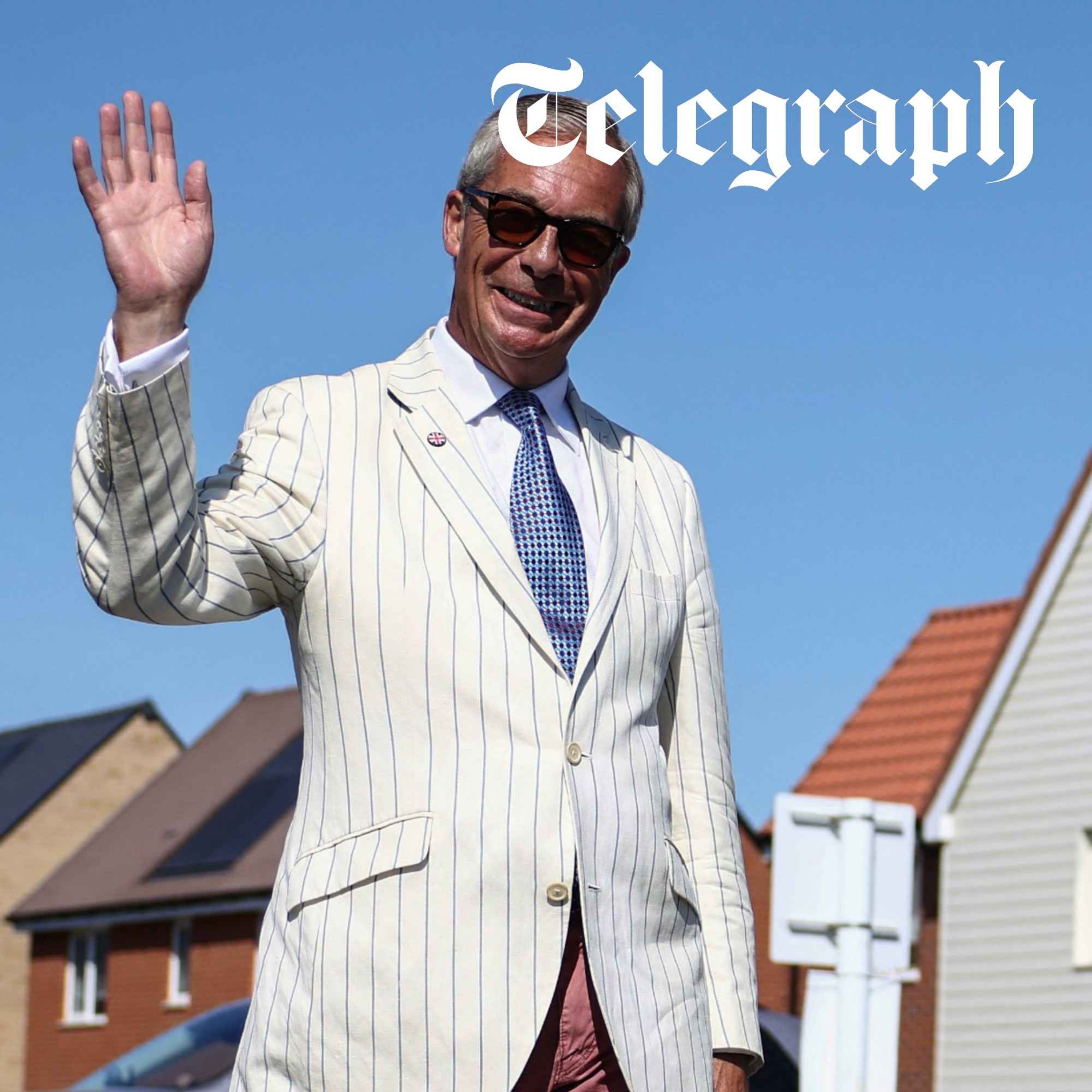
Nigel Farage wins the Clacton by-election and increases his parliamentary majority, but the episode argues Reform’s problems remain unresolved.
Farage’s absence from the count (citing police advice about an organised disruption campaign) sparked a dispute between Essex Police and Reform over whether he was warned not to attend; the controversy may overshadow the result.
Tony Diver, a Telegraph journalist covering the election and Westminster politics.
reporter for The Telegraph.
Count Binface (a novelty candidate) won nearly a third of the vote; turnout was about 43%. The episode links the result to possible “voter fatigue” and to the next by-election risk from an ongoing Parliamentary Standards Commissioner investigation into Farage’s £5 million donation from crypto billionaire Christopher Harbourn (and possibly further funding from George Cottrell). It also discusses rumours of Andy Burnham calling a snap election next year.
Written by AI. May contain mistakes.
Discussion on Nigel Farage's recent by-election win in Clacton.
“So why do your marketing results look the same as six months ago?”
Analysis of the implications of Farage's election results and the controversies surrounding it.
“He's still being investigated over the donations, and Britain is still being dazzled by its new prime minister.”
Discussion on the future of the Reform Party and the challenges it faces ahead.
“Tony, you've been covering it all night.”
Exploration of the democratic implications of Farage's political situation and opposition dynamics.
“But if you're in Clacton and you've had this by-election, only having recently voted for him in 2024, let's be honest, that's comparatively recent.”
Discussion on the implications of Nigel Farage's by-election victory and the left's tactical responses.
“And it's an irony, really, Tony, because we've spent a lot of the week talking about the danger posed by restore.”
Analyzing how media coverage has influenced voter awareness and tactical voting in elections.
“What's happened here is that voters went into that ballot station apparently aware that if you wanted to embarrass Nigel, you voted for the Bin.”
Exploring the ongoing investigation into Farage and the possibility of future elections.
“the investigation by the Parliamentary Standards Commissioner continues into Farage's£5 million donation from the crypto billionaire Christopher Harbourn.”
Examining the national standing of the Reform party and the challenges they face ahead.
“why was reform busing in activists from all over the country to knock doors in this by-election?”
Discussion on rumors surrounding potential snap elections and the implications for Labour.
“But Tony, what do you make of the snap election rumours?”

Get the gist, explore an idea or ask about something said.
 Claude
On The Daily T, what are the key points of this episode?
Searching your listeningAutomatic transcript. May contain errors.
0:02The Telegraph.
0:30I can hire a top-rated pro that knows everything about interior paint, easily compare prices, and read reviews. Thumbtack knows homes. Download the app today. You've got social dialed in. Search is doing its thing. So why do your marketing results look the same as six months ago? That's because you're fishing in the same pond as everyone else. Podcast listeners are a different audience entirely. More engaged, harder to reach through traditional channels, and ready to act when someone they trust makes a recommendation. We're ACAST, and we put them right in front of you. Browse thousands of the world's leading podcasts, book host reads or run your own ads, and track every conversion in real time.
1:10Same skills you already have, brand new results. ACAST. ACAST.com slash advertise.
1:20Nigel Farage has won the Clacton by-election and even managed to increase his parliamentary majority. But what has changed? He's still being investigated over the donations, and Britain is still being dazzled by its new prime minister. Where are we? So we've got Farage still popular in Clacton, Farage still being investigated by the Parliamentary Standards Commissioner, the prospect of another Farage by-election, and the left all ganging up on him. As May might say, nothing has changed this morning. Nothing has changed. Tim, Nigel Farage has won the Clacton by-election, probably quite predictably, and he's even managed to increase his parliamentary majority, but he didn't attend the count, saying this instead.
2:03I had to say that after 33 years of being a candidate in active politics, I've been advised tonight by Essex Police that there is an organised campaign to disrupt and degrade the result that will take place in a few hours' time.
2:25And once again it shows you the sheer intolerance, the sheer loss of fundamental democratic principles that those that went before us fought in world wars to fight for and preserve. And this shows you why the battle that we're engaged upon in this great party, in this great movement of ours, is to get this country back to the values that it needs to be.
2:55And so I regret to say... And by the way, I'm not scared of these people. Far from it. But I'm damned if I'm going to stand on a stage having won a resounding victory, a ringing endorsement of all that I've tried to fight for and you've tried to fight for and be demeaned and humiliated by nobodies. And I will not, sadly, be attending the Count, which means... ..which means... ..I'm going to be here all night!
3:33CHEERING AND APPLAUSE
3:42So that would be the first candidate to not attend a count since Bobby Sands in 1981. And now a row seems to be breaking out between reform and Essex police over the threats that were received and the nature of them and whether or not Faraj was told he could or couldn't attend the count. We're going to analyse it with Tony Diver, who joins us from The Telegraph. Tony, you've been covering it all night. Are you okay? Do we need you to get some ProPlus and perhaps some caffeine and give you a slap around the face? I'm absolutely fine. I'm raring to go. But it is a very interesting result, this. The question, obviously, is how it's perceived back in Westminster, whether this is seen as a win for Farage, or whether it's just seen as a kind of meaningless, pointless sideshow that's taken up everyone's time during silly season, during the summer.
4:30But this point about him not attending the count has caused a bit of a stir. There's actually some confusion about what exactly happened. Essex Police are saying that they didn't warn him not to attend the count. Other people in reform are saying actually it was Farage's security team that suggested he shouldn't go. It sounds like what actually happened was that the other candidates were preparing some kind of stunt to make him look silly on the stage rather than a genuine security threat, which we know Farage has faced many times before. But yeah, there's a bit of mudslinging going on now between the police and reform.
5:02It has turned into, dare I say, a slightly classic reform-style row, which is threatening to overshadow the result this morning, I would say. To play Nigel's advocate here, I think this by-election was quite good for him, in fact, especially as we were all sort of laughing about it, and some people were getting high on predicting that Count Binface might come close or even beat him. And all of that was proven nonsense. None of the other parties ran against him. He took around two-thirds of the vote, which is very impressive. Essentially, he won the classic Tory reform vote, so he united the right, which is what everyone says he needs to do.
5:37Count Binface did well. This is the best performing novelty candidate in history. And he approached nearly a third of the vote. That's impressive. But nonetheless, Nigel won a stonking victory on a pretty good turnout. So turnout here was about 43%. If you take Gorton and Denton as a comparator, that was around 47%. And given, again, that everyone was saying this election was pointless, it was just a stunt for Nigel, for that number of people to turn out and for such a high proportion to support Nigel Farage suggests that the people of Clacton said we actually do believe him and we want him back in Parliament.
6:15Now, of course, he was running in what is really his backyard. Clacton, the place that Douglas Carswell won in 2014 for UKIP. It is solid reform, solid right wing. If you can't win there, you can't win anywhere. So his critics are going to say, I'm sorry, we don't feel you've proven anything. But if you take a step back and take a look at the national polls, again, we were all saying a few weeks ago, is this the end of reform? Has Nigel made a strategic blunder by calling this by-election? Will he be embarrassed? And will it coincide with Andy Burnham, another national leader returned in a by-election?
6:52That's historically of note, by the way, the leader of the main party and the leader of the opposition, both running in by-elections a few weeks apart. That's quite extraordinary. And so we were all saying, could this mean that Andy Benham is just going to take off and totally replace reform. Well, no, not only has Nigel been returned, but actually, if you look at the polls, Labour is ahead, but not by much. And in some polls, reform is still ahead. So actually, in what could be a very difficult summer for reform, he's held his ground, he's been returned, and he's doing okay in the polls. The problem is, is this does not resolve the question of the donations.
7:29Exactly. It can still be an investigation. And literally, as we speak, the Commons has updated its website to say that the investigations will be unpaused so we could face another by-election in a few weeks' time. I agree with your analysis as to him comprehensively winning. And in fact, I think it was the Tories who said that if he didn't surpass the number of votes he got in 2024, then it would be a failure. Clearly, he has done that. So that's a tick in the yes box for Nigel Farage. But Tony, I mean, I woke up this morning, looked at the result, thought it was entirely predictable and wondered what on earth we've just gone through when, as your piece of analysis points out, and it's on the Telegraph website right now, we could have to go through this whole, as I've been calling it, not a farrago, but farrajo, again in a few months' time.
8:17And then will the good people of Clacton again turn out and say, yes, you know, we've got to protect Nigel from this establishment stitch-up? Yes, well, as I wrote in that piece, I think the mistake that people are making is that this by-election is not actually about this by-election. It's about the next one. And I think for reform here, and this is reforms telling of it, and there are alternative views available. But for them, I think the strategy is you run a by-election in which you're almost certainly going to win, which has, of course, now happened. That gives you a bit of ballast. it allows him to say, oh, well, these sort of commons bureaucrats are trying to investigate me.
8:57But, you know, the real people, my own constituents don't believe it. He will not be allowed to say that in the meantime. But what it also does is it creates this kind of sense of voter fatigue, I think. It does contribute to the idea that Farage is always fighting his enemies. You know, he's taking on the people who are challenging him and he's winning. And how many more investigations will there be? How many more elections will there be? Of course, that is to slightly ignore the point that this by-election was triggered by Farage himself. It wasn't brought against him by his opponents. It was triggered by him.
9:26But the idea, I think, is that by the time we get to the next by-election, and there may well be one if the Commons authorities fight against him and we go through all the various stages of ethics investigation, which we can discuss if you want, if there is another by-election, he will be able to stand there and say, look, I've already won this seat. I've already done it just months ago, and now they're coming at me again. and that contributes to this sense that he is genuinely an anti-establishment figure, that it is his enemies in Westminster that are trying to take him down, whereas his own constituents, real people, want him in there.
9:59That is the argument he will make at the next by-election. So really, yes, of course he's won this one, and everyone thought that he was going to. The numbers are a bit interesting, but what's really interesting is whether or not this shifts the dial in terms of public opinion when he gets to the real fight, which is the one that's coming up. But if you're in Clacton and you've had this by-election, only having recently voted for him in 2024, let's be honest, that's comparatively recent. You then have a second by-election triggered by the Parliamentary Standards Commissioner, possibly. And then Nigel Farage himself is saying that he expects Andy Burnham to call a snap election, not this year, but next year.
10:33You're sitting in Clacton, basically turning into Brenda from Bristol and saying, no, another one. I mean, I just... Yes. I think the electorate might rightly look upon all this and say this is just a giant Farage-ian vanity project. Maybe you're right, but let's ask ourselves what are the opposition parties thinking as well? They've just seen Farage win nearly two-thirds of the vote. Do the Tories or Labour really want to take him on in another by-election? I wouldn't wish to because he's already had the referendum and he's already won it very clearly. Now, there's a case for saying that the thing about Nigel is he's happiest when he's campaigning and he's even happier when he's winning.
11:14And reform have had a stretch of by-election defeats that have been very disappointing. So what does he do? He calls a by-election in which he can run and which he's almost guaranteed to win. But he can, again, we were laughing at him at the beginning when no one ran against him and we thought it made him like a fool. But he can now today say, well, you people didn't run. If you think this investigation is so important, you didn't stand against me. You left a bin to stand against me and I defeated him comprehensively. He also defeated about 2 ,000 other candidates, some of whom were on the really right wing.
11:49And it's interesting that none of them got traction and all of the opposition vote went to a stunt. So I think you can almost discount the Count Binfei's vote because it wasn't a serious philosophical opposition. He was running on nationalising Adele, right? Yeah, he was running on moving the air dryer in a particular restaurant to a different position. It's very funny. And I watched your interview and I was laughing so hard. I think it's a good joke, but it is a joke. So in a sense, he kind of won 100 % of the vote. And to bring it around to this question of why didn't he go to the count? Well, again, there's a sympathetic and an unsympathetic interpretation here.
12:28The sympathetic one is the Reform Party has just buried someone who was killed in what some people are speculating might have been a politically motivated murder. Right. So Reform is incredibly sensitive right now to any threat of disorder or physical threat to Nigel Farage himself. And I think we should respect that. So if they got any whiff that this count could turn nasty, I would understand why they didn't go. the less sympathetic interpretation is he didn't want to stand on a stage with 10 ,000 loony candidates all ganging up on him and making him look like a fool when he just won and might say well that's democracy you've got to do it it's your own fault because uh the other parties thought this was a discredited illegitimate election so they didn't run against you this is your vanity so you've got to own the comedy but I think he probably made the right call either way because right now we're talking about percentages had he stood on that stage we'd be talking about the hilarious moment that a joke candidate pulled down his trousers right yeah no i get that i get that but then is it democracy is it democracy to have this constant situation where it's nigel farage against the rest of the world all ganging up that doesn't strike me as being particularly democratic and it's kind of a harbinger of what might come where we're going to have inevitably the Greens, Labour, the Lib Dems, anybody else remotely on the left, all trying to form some kind of progressive alliance against reform.
14:01I mean, this is the problem, isn't it, for Nigel Farage? And it's an irony, really, Tony, because we've spent a lot of the week talking about the danger posed by restore. You know, the lefties are worried about Nigel Farage, who is now comparatively looking like a pretty moderate figure on the right. You know, why aren't they directing their eye at him? Well, they're not directing their eye at Rupert Lowe, because they know he hasn't got much of a chance of being the next prime minister whereas faraj has but all this ganging up and let's all plot together to humiliate a party leader on the stage of his own by-election win doesn't seem to me to be particularly sporting or indeed dare i say it very british i don't know about that i think there's something distinctly british about having joke candidates and by elections who who turn up with bins on their head and uh and i get that but not all ganging up against another candidate.
14:50Well, that is democracy there, isn't it? We see tactical voting in all aspects of Westminster politics, especially now we have a kind of five-party system. And I think, you know, the serious point here is that there is a genuine expectation from reform and others on the right that the left is going to coalesce into a kind of block, possibly led by Andy Burnham, probably led by Andy Burnham, at the next election. The Greens and the Lib Dems probably will fall in behind Labour. And actually, even if we do have a five-party system, they're going to have to form something like a left versus right race at the next election up because people just don't think that otherwise you end up with a with a solid government and no one thinks they're going to get a majority so um the question for for our and for the tories and possibly for restore if they can hold their share of the vote uh until the next general um is what they do about that uh and do they try and form some kind of block i mean the question is you know if you're if your uh enemies are ganging up against you then do you try and get some friends of your own uh and probably what we're going to see is an approximation of something like the traditional left-right system at the next general election.
15:51And the question is just whether or not the right can catch up to that, because it's certainly happening on the left. I know, but just quickly on that, here's the irony. So Andy Burnham might end up getting into bed with the Greens, who have got an illustrious history of anti-Semitism. Conversely, Nigel Farage has said he will not get into bed with Rupert Lowe because Restore are now becoming anti-Semitic, at least in some of its supporters. So Nigel Farage is the bad guy on the right. he's the bogeyman because he is, quotes, not tolerant. And then we're probably going to see a progressive alliance of lefties, some of whom have no tolerance at all.
16:27I mean, t 'was ever thus, Tim. Yeah, you said, is this all democratic? I think we've seen a beautiful exercise in British democracy. In fact, Nigel Farage put an issue to the voters. The voters turned out in surprisingly large numbers to say, we support you. And at the same time, a block of people coalesced around one candidate to oppose him, which, as we've discussed, may well be the pattern at the next election when progressives will be looking not so much at who should form a government, but who can stop Nigel Farage. And what I find, I think Binface's result was therefore as historically significant as Nigel Farage's, because what we might have expected in past by-elections is lots of nutty candidates to all get similar share of the vote.
17:15What's happened here is that voters went into that ballot station apparently aware that if you wanted to embarrass Nigel, you voted for the Bin. And I'm not sure that in the past, voters would have had that degree of awareness. What's given them that is a combination of intense media coverage of the campaign and tinternet. The internet, that evil thing that has slipped out of Pandora's box, has transformed British democracy. and in the past we always spoke of people voting tactically and it did go on but I don't think we've seen it as concentrated and coherent as we're seeing it now and what you saw in Clacton therefore is a wave of the future which is people seat by seat looking up online who do I vote for to beat the candidate I hate yes and that is why Count Binface did so unusually well
18:18Quick question. When was the last time a display ad changed your mind? Now think about the last time a friend told you about something they loved. Different feeling, right? That's how podcast advertising works. A host who's built real trust with their audience talks about your brand in their own words, in their own voice. It doesn't interrupt the experience. It's part of it. With Acast, you can access the world's largest podcast marketplace. Choose the right shows, the right audiences, the right format. Then watch the data tell you it worked. You're not buying impressions. You're buying influence.
18:51Learn more by visiting acast.com slash advertise.
19:03Tony, what happens next then? So as Tim said earlier, we've got the website cranking up again. the investigation by the Parliamentary Standards Commissioner continues into Farage's£5 million donation from the crypto billionaire Christopher Harbourn. Do we have any timescale on that? How's that going to play out over the coming weeks? We're obviously heading out of silly season into conference season, Tony. And as also previously discussed, there are mounting rumours about a snap election, aren't there? Yeah, there are. So I mean, to start then with the investigation, it does work in kind of a black box in Parliament here.
19:39It's very difficult to find out what the timelines are. The Standards Commissioner, Daniel Greenberg, he doesn't speak to journalists. He doesn't release statements generally. He just gets on with his investigation and drops it when he's finished. It does seem like this is quite a complex one. There's, you know, financial records are involved. We're expecting that at some point Farage himself will be interviewed for that investigation. And it's also possible that the investigation could be expanded or supplemented by a second investigation into financial support reform received from George Cottrell.
20:09So there's a lot going on there, basically. Either way, once the investigation is concluded, if it does recommend a punishment for Farage in the form of a suspension from the Commons, then that can go to MPs to vote on in the House. And then there is the prospect of another by-election being called. if the suspension is long enough, then it opens up a process called a recall petition, which means that voters in Clacton can decide whether or not they would like to have a by-election, a kind of mini sort of vote on a vote. If 10 % of people in that constituency sign the recall petition, then another by-election will be held.
20:48And one of the interesting things about the result last night is if you look at the number of votes and the share of the vote that Count Blinface got, which is, you know, about a quarter of the vote and almost 10 ,000 votes, It suggests that there is enough anti-Faraj sentiment in that constituency that if there was to be a recall petition, it's likely that it would be successful. But all of these stages take a long time. So I think we're probably looking at a period of months before we've got a firm answer and certainly before a by-election is triggered. That said, there is a bit of a health warning on that because we simply don't know how quickly Greenberg wants to move on this and what the response will be.
21:24Of course, Faraj could take matters into his own hands, as Boris Johnson did, who faced a very similar process. He faced a process where his suspension was recommended to the Commons Privileges Committee, who then had to produce their own report, who then had to recommend suspension. And just before the end of that process, when it became clear the writing was on the wall, Boris resigned his seat because he didn't want to go through this process. So it's possible that Farage could do the same thing he's just done, trigger another by-election himself, because he doesn't want to go through the motions, or he could stand down, or probably the most likely option, he cashes his chips from this by-election, uses the kind of sense that he's the anti-establishment figure and tries to fight another by-election and win it, at which point he will be able to say, I fought this, I won, there was an investigation, I faced my punishment, now we all need to move on.
22:13And that really for Farage is the optimum outcome. And so if you ask yourself why, if it was so obvious that Farage was going to win this election, why was reform busing in activists from all over the country to knock doors in this by-election? The reason is because they need people to have experienced Farage's style of campaigning. They need them to not just vote for him in this by-election, but to vote for him in the next one. And so that's why they've been fighting it so hard. My conspiracy theory is that Nigel Farage is not being bankrolled by Russia or by shadowy billionaires, but by the Clacton Tourist Board.
22:44Yes. Because this way, they're guaranteed every few months that several hundred journalists will show up and buy ice cream and go on the rides. That's true. And in fact, our former colleague Chris Hope got stuck on that Ferris wheel that I think you and I travelled on last night at the Nigel Farage rally, which was covered by his new employer, GB News. But then finally, chaps, OK, so a good personal victory for Farage. But I think our colleague Annabel Denham has written this piece. It's not looking great nationally, the picture for reform. They have been going backwards since that extraordinary peak of the summer of 2025.
23:19We had that first YouGov poll in a long, long time putting Labour ahead of reform this week. So nationally, the picture isn't looking great. I think it's looking as good as you can expect for a brand new prime minister who has got great communication skills, who is changing the game. And although he's not really doing anything, he's signalling lots of new policy that will distract from reform. As I have said, he has won his by-election. They're doing OK in the polls. they're at least holding second against the Tories. Plus, what are we all talking about when we're not talking about the bins? We're talking about mass migration.
23:55And that is reform's strong point. Until Labour fixes that, it's still fighting off reform for support among its working class base. So accepting the new challenge of Andy Burnham, I don't see that the dynamic of the last 18 months has yet decisively changed. But Tony, what do you make of the snap election rumours? The theory goes as follows. He's having a bounce. He may as well call an election during a honeymoon. That would actually suggest that he would call it this year. Faraj said in a press conference that we attended on Monday, no, he thinks it will be next year. And then somebody in the Tories was theorising in the week that actually, what's Burnham got to lose?
24:36Well, I said, well, a couple of hundred seats. And he said, yes, but to bring the conversation full circle. But he knows he can still form a progressive alliance with anybody on the left that wants to join him. So, yes, it's a risk and he can lose some Labour seats, but he knows he's still got a very strong chance of leading something into the next four years. So why doesn't he just take a punt? I don't know. It's a huge punt. I mean, it's worth saying, firstly, that Burnham himself has ruled this out. But, of course, you have to rule out an election up until the point that you call it. I think there are two kind of key things for him to look back in British political history to kind of advise him on this one.
25:12The first one is the example of Gordon Brown. who of course famously didn't call the election and suffered for it. And, you know, the whole Bottle of Brown narrative that was established after that in the lead up to the 2010 election, there's a lot of people in the Labour Party, including people who served in Gordon Brown's cabinet, and those people include Andy Burnham, who think that that was what ultimately did for him. But then you also have the instructive example of Theresa May, who called a snap election thinking that she had the numbers, and then saw that throughout the campaign, things went disastrously wrong, and she only just held on to her majority.
25:44So I think it is a huge risk, actually. I'm not sure I totally agree with that analysis that it's fine because he'd be able to lead a progressive alliance anyway. Burnham is already facing division in his own party. He's taken over a pretty divided and pretty unhappy Labour Party that he's now trying to unite. I think adding other parties to that mix and trying to rely on the votes of the Greens or the Lib Dems to get things through would basically leave him as a kind of lamed-up Prime Minister, and that would put him in a very difficult position when he comes to fight the next election. So I don't know.
26:15I mean, is Andy Burnham a gambling man? It's a question you need to ask yourself. I personally think it's probably too much of a risk. But he's a man who likes to be liked. And this is possibly the moment that he's got the most support, given the kind of honeymoon thing that you described. It depends how high he is on his own supply right now. I don't know if he's a gambling man. Tim, he goes to Gregg's. Does he go to gambling shops? Who knows? It's funny you mentioned Theresa May, Tony, because it was her mantra that was going around in my head this morning. Where are we? So we've got Farage still popular in Clacton, Farage still being investigated by the Parliamentary Standards Commissioner, the prospect of another Farage by-election and the left all ganging up on him.
26:54As May might say, nothing has changed this morning. Nothing has changed. Except the taxpayer is now short of£250 ,000 because of this by-election. So it's a very expensive kind of stasis. Tony Diver, Tim, great to speak to you on this sunny Friday morning. We'll be back with the Daily Tea, won't we, Tim, on Monday for more fun and frolics in Westminster.
28:04We'll see you next time. post-read sponsorships, or run your own ads all from one platform. Transparent pricing, real-time data, complete control. Start advertising on podcasts by visiting acast.com slash advertise.
In today’s episode of The Daily T, Camilla Tominey and Tim Stanley react to Nigel Farage’s victory in the Clacton by-election, where the Reform UK leader increased his majority while skipping the count, prompting a fresh row with Essex Police over security threats and alleged political stunts.
Joined by The Telegraph’s Whitehall Editor, Tony Diver, they unpack the fallout from a bizarre election night in which novelty candidate Count Binface finished second. They discuss whether Farage’s comprehensive win changes anything or merely tees up yet another by-election, as the Parliamentary Standards Commissioner restarts its investigation into his controversial £5m crypto donation.
Plus, with rumours of a snap election swirling, is now the best time for Andy Burnham to call the country to the polls, or would it offer no benefit to the Prime Minister?
We want to hear from you! Email us at [email protected] or find @dailytpodcast on TikTok, Instagram and X
► Sign up to our most popular newsletter, From the Editor. Look forward to receiving free-thinking comment and the day's biggest stories, every morning. telegraph.co.uk/fromtheeditor
The Telegraph is the Publisher Podcast Awards' Podcast Publisher of the Year 2026
Studio Operator: Meghan Searle
Producer: David Levene
Video Producer: Will Walters
Social Producer: Nada Aggour
Executive Producer: Charlotte Seligman
Editor: Camilla Tominey
Highlights:
Hosted on Acast. See acast.com/privacy for more information.


