Ask ChatGPT


 The Daily T
5 Oct 2026 · 36m · 15 chapters
Jacob Rees-Mogg at the Conservative Party Conference argues the Conservatives must “re-establish” their philosophy (small state, individual control, lower taxes) after losing elections in 1997, 2001, and 2005; he attacks “soft-left” legal frameworks (Human Rights Act, Equality Act, Climate Change Act, Constitutional Reform Act) and says Brexit opportunities weren’t fully used. He claims Andy Burnham has engineered a “socialist coup” by moving Labour far left and making/then reversing Europe promises. He also discusses “ethno-nationalism,” youth anger, and Zionism/antisemitism debates, including the Green Party motion defining Zionism as racism.
Camilla Tominey and Tim Stanley (hosts/journalists) and Jacob Rees-Mogg (guest). No other named guests; audience questions are anonymous or attributed (e.g., “Barwan,” “Anonymous,” “JoannaOz24”).
Tucker Carlson mocked “strong must be willing to fight and die,” but Rees-Mogg says Carlson later sought an interview; he argues Carlson’s viral incentives drive bad-faith arguments. He cites Russia’s economy as smaller than claimed and calls Russia a nuclear “failed state.” He says Israel is the Middle East’s only democracy and a UK intelligence asset (Mossad links). He argues illegal immigration removals must happen within 48 hours (examples: Rwanda/El Salvador; Trump stopped US illegal entry).
Written by AI. May contain mistakes.
Discussion on the Conservative Party's loss of direction and Kemi Badenowicz's influence.
“We're going to be discussing Jacob Rees-Mogg versus Tucker Carlson.”
Examination of failures in Conservative policies and the impact of historical decisions.
“Not that she's copying her policies, but rather she's going back to that period after the 1974 election when the Tories were in the doldrums.”
Exploration of the political battle between contemporary left and right ideologies.
“taxes, allowing the economy to flourish.”
Analysis of Tucker Carlson's career and his controversial takes on international issues.
“those who want to go back to the 1980s and those who want to go back to the 1970s?”
Discussion on the morality of war and the failure of political invasions, focused on historical examples.
“And that means it must have people who are ready and willing to fight and die for their country.”
Explore the clash between Jacob Rees-Mogg and Tucker Carlson on ethnonationalism.
“Let me ask two questions from the audience on Tucker Carlson.”
Discuss the complexities of English identity and its historical context.
“Englishness, and this is another point I made, is used by the English anyway to mean United Kingdom-ish.”
Analyzing the leftward movement of the Green Party and its implications.
“Ban the use of the term gaslit as a starter.”
Discussing the rationale behind Britain's support for Israel through a familial lens.
“Yes, I think the Conservatives lose very few votes to the Greens.”
Exploration of the concept of racialism and its implications in political history.
“And I was wondering, is this something that runs in your family, a commitment to opposing racism?”
Analyzing the challenges faced by the Conservative party with emerging factions.
“There'll be many conservatives in the room who may entertain the notion of a pact with reform when the time comes but certainly not with restore.”
Discussion on potential alliances and the challenges of party unity.
“What is the point of voting for Rupert Lowe?”
Critique of the economic policies advocated by rivals and the implications for the Conservatives.
“The same is true of parties working together.”
Exploration of immigration policies and the societal responses to migration.
“because they're usually decent people trying to do their best.”
A lighthearted discussion about personal fashion and heritage.
“As Donald Trump showed, he has managed to stop illegal immigration into the United States by removing people.”

Get the gist, explore an idea or ask about something said.
 Claude
On The Daily T, what are the key points of this episode?
Searching your listeningAutomatic transcript. May contain errors.
0:02The Telegraph.
0:30Visit telegraph.co.uk slash newsletters today.
0:37We are with Jacob Rees-Mogg at the Conservative Party Conference in Birmingham.
0:49We're going to be discussing Jacob Rees-Mogg versus Tucker Carlson. Can we reunite the right? And is Zionism racism? Welcome to The Daily Tea with me, Camilla Tominey. Me, Tim Stanley. And me, Jacob Rees-Mogg. What happened is we lost three elections in a row, 97, 01 and 05. And we lost sight of what we really believed in, which is the small state, the individual being in control of his entire life, lowering taxes. I'm being gaslit into thinking that I and my family don't really exist. It's just a figment of my imagination that we're English. I do not want people to be here and carry on being foreign.
1:28Did Jacob out-mock Tucker Castle? I think we know the answer. You're very kind. It's such a pleasure to be on the Daily Tee.
1:47We're joined here today by a beautiful audience of young conservatives. At heart, at heart. And for this Tory conference, I just want to establish what we're all really doing here. I'm holding here a copy of Kemi Badenowicz's new book, The Right Way. If last year's Tory conference, has anyone actually read it? It's not very long, and the sentences are short, and it's very clear. I approve. It's a model of writing. And if last year was about introducing Kemi Badenowicz the person, this year is about introducing Kemi Badenowicz's philosophy to the country. And as it's been explained to us, this is partly an electoral strategy.
2:25Her model is Margaret Thatcher. Not that she's copying her policies, but rather she's going back to that period after the 1974 election when the Tories were in the doldrums. And the way in which they dug themselves out of a hole was to begin by establishing what their philosophy was. But as I say, that's not just about winning votes. It's also so that if the Tories enter government at the next election, or the one after that, or in 100 years' time, they will enter it with red lines. Kemi's argument is that one reason why we got the Boris wave, one reason why we made mistakes on taxes, or maybe we locked down a bit too long, was because the Tories hadn't established in their mind what they really stand for.
3:09So when we met with party bigwigs last night, we very politely discussed the right way, but what many of the journalists want to talk about is what does it mean to be English? I don't know where this question is coming from or why we're talking about it. Suella Braverman. Suella Braverman. But suddenly everyone wants to talk about ethnicity. And for that reason, I think that next to Kemi, we've got the most important and interesting person with us at this conference. Yes. Described as the most interesting person at last night's con-home party. I should point out after the party leader had left, just to tick that box.
3:47Jacob, the right way is needed because for a long time the Tories were following the wrong path, weren't they? Yes, that's absolutely true that what happened is we lost three elections in a row, 97, 01 and 05. And the hierarchy of the Conservative Party came to the conclusion that it could only win if it embraced Blairism. And so you get all this stuff about sharing the proceeds of growth, hug a husky, and that approach to governing to get us into office. And we lost sight of what we really believed in, which is the small state, the individual being in control of his entire life, lowering taxes, allowing the economy to flourish.
4:31And particularly in the coalition years, we adopted policies that weren't that dissimilar. And of course, we have the Lib Dems with us from what Labour would have done. Bear in mind, we get in in 2010, and we carry on with the implementation of the Equality Act, which has had endless difficult complications for government since and the functioning of government and decision-making in government. And we didn't make a case for why the soft left structures that had been put in place, so what am I thinking of? I'm thinking of the Human Rights Act. I'm thinking of the Equality Act, the Climate Change Act, the Constitutional Reform and Governance Act, all tied us in with slightly left-wing defaults.
5:15and we didn't challenge them. And we then didn't, once we left the European Union, make the most of the opportunities that we've got by getting rid of European Union law. And there are a number of reasons for this. Initially, we were in coalition, then we have a small majority, then we're taken up with Brexit, then we're taken up with COVID. And so things don't happen. But also, I'd never been much of a green. I'd never really bought into the green analysis. But in 2010, the whole country was in fact green because they thought it was free. And people only become un-green when they realized there was a price to pay.
5:55So yes, we failed, but partly because we were going with where the nation was at the time. And if we'd started saying, don't be green in 2010 or in 2019, we'd have cost ourselves votes without anybody thinking, oh yes, they're right, because it still seemed free. So only as we've got closer to some of the deadlines, the initial deadlines and then the subsequent deadlines, and we realise that our electricity is four times out of the United States, that people have started saying, well, this is all nonsense. We had Liz Truss in the studio last week, and she actually made quite a compelling case for Britain's problems having been caused by Brown and Blair, and that that is the legacy that the Conservatives now need to unpick.
6:40Obviously, she tried that and it didn't go particularly well for her. We've now got this Andy Burnham analysis, which is we actually need to unpick Thatcherism. Is it too simplistic to say that this is now a battle between right and left, those who want to go back to the 1980s and those who want to go back to the 1970s? Well, I think it's very interesting that Andy Burnham, by his complaints about the last 40 years of government, He's not very good at maths because he actually means the last 50 years of government, but we'll brush over that. He has made talking about Thatcher a relevant thing to do again.
7:16We have been doing it in party conferences, I confess, for many, many years. But it's been a quite sentimental thing to do, hasn't it? We refer back to Margaret Thatcher and you think, we've got to move on from that. But now he has brought her back to the forefront of politics, and it's a battle between ideas of the right and of the left. that Andy Burnham has had a socialist coup, that he has taken the reins of power with not so much the buy or lead from the wider electorate. He's promised things to the base of Makerfield on Europe, which he has then U-turned from within a few weeks. And he has grasped power, moved far to the left of the last Labour manifesto.
7:54And we are now responding in kind by saying, well, actually, all this has been tried and failed. What works is conservatism. What was it, Marit Satchel said? the facts of life are conservative. And her other great line, the problem with socialism has ultimately run out of other people's money. Both of those things remain true. And therefore, this is a much more fundamental conversation than we had between, say, Blair and Cameron, when we were all within the same blobbish consensus. Now, one consequence of institutional failure, both Labour and the Tory, is that left and right are fractured. And we've seen the consequences in the Greens, which we'll come back to with their motion about Zionism is racism.
8:37But there's also been a fallout on the right, embodied by Tucker Carlson and the podcasting right. Now, for those who don't know, Tucker Carlson was a Fox News host. He left that channel. He went independent on Twitter. He is huge. He's probably the world's biggest political podcaster. and he's an example of someone who's been detached from the sort of the discipline of intellectual conservatism and in taking an anti-war America first stance he has followed it to its logical or it's a kind of an Alice in Wonderland logical basis all the way through to stay out of all war Ukraine is a waste of time Israel controls everything etc etc now he latched on to a video which you had recorded in which you were arguing, I thought quite sensibly, that for a country to stay safe and to maintain the peace, it must be strong.
9:33And that means it must have people who are ready and willing to fight and die for their country. He saw this and ridiculed it. But at the time he was ridiculing it, he was actually contacting you and asking if he could interview you. Is that so? Yeah, that's all completely accurate. Yes, you sent me the ridicule, but I didn't watch it because I thought my conversation with him would be better if it hadn't been colored by knowing that he thought I was a complete idiot. Yes. Many people think that, by the way, but I try to avoid it. But I think this is important because in the interview, he is very aggressive and abrasive, but he wasn't like that in person, was he?
10:08In person, he's very charming and seems perfectly sensible. I do have a theory about this. I think, Camilla, you were just asking everybody to become members. And you can become members of my YouTube channel, too, if you want. But once we're into this business of getting members and clicks and revenues, you're always thinking about how do I do a video that does better than the one I did last? And you've got to be very disciplined not to become increasingly outlandish because the more outlandish you are, the more clicks you get. But then the less seriously you are taken. And I think Tucker Carlson, who was a perfectly serious commentator, has been sort of absorbed by his own vortex that he now says increasingly foolishly controversial things to get a reaction, to get his millions of clicks.
11:04He will have made a fortune out of the interview I did with him because on every social medium, it has gone like hotcakes, viral. I don't like being called a virus. I try to avoid the term viral. and this every click will have made him money and so from his point of view this is quite a success at least financially but it makes him look ridiculous I bumped into you just before you did it on a train yes and I I warned you be careful because I know how he works because I do watch him I find him utterly compelling and when the trailer landed as they say I thought oh no this has gone disastrously because the trailer is composed of the one or two clips in which Tucker is laughing and looks as though he's scored a good point.
11:49But when you watch the whole thing, and everyone really should, however much money it makes Tucker, it's really instructive because he puts forward so many bad faith arguments and you shoot them down either by asking a much better question or with facts, such as his claim that Britain cannot fight Russia because Russia has an economy that's very much larger than Britain's, when in fact... The Russian economy is about two thirds of the UK economy. Russia is a failed state. It's dangerous because it's a failed state with nuclear weapons and a large population to whom it has given arms. That's a very high risk.
12:27But you challenge that by being strong and by having your own defences, not by being bullied by it. What was going through your head when he said to you that it wouldn't have made much difference if Hitler had won the Second World War? At least Britons would be speaking a European and language. Well, I thought it was a fundamentally silly point that there is a morality in politics that has sometimes to override things. And look, we could have a discussion here about whether the First World War was sensible to fight or whether the Napoleonic War was right to fight. But there is no question in my mind that the Second World War was right to fight because it was good against evil.
13:05And you may then go back to the Versailles Treaty and say, well, we were too aggressive. that doesn't excuse the subsequent behavior. And the same is true in my view of the apologists for Putin who say, well, NATO did this and the EU did that and America interfered in Ukrainian elections. None of this matters once you invade sovereign territory because there is one absolute of making any sense of international affairs and that is if sovereign nations are not going to be frivolously invaded. And we should land that too because the second Iraq war was a frivolous invasion of a sovereign country and had disastrous consequences from which we are still suffering.
13:52So it's not just a rule for the Russians, it's a rule for us too that invading sovereign territory simply puts you outside the bounds of normal international behavior. Let me ask two questions from the audience on Tucker Carlson. The first one is from Anonymous. Did Jacob out-mog Tucker Carlson? I think we know the answer to that. I think he underestimated you. I think he thought, oh, well, here's this British toff who's acting like he's the kind of spawn of Montgomery. He's a warmongerer. He's not going to be able to make the cogent arguments, and actually you just appeared much, much cleverer than Carlson, I think.
14:28You're very kind. It's such a pleasure to be on the Daily Geek. Thank you.
14:35And the second question, I think, is a pertinent one, and it's from Barwan, who asks, after your recent clash with ethno-nationalists, including Tucker Carlson, why do you think this new right is gaining so much ground, particularly among young people? Is it a temporary reaction to political failure or a deeper shift away from traditional conservatism? And I think also there's a need there to reflect on Rupert Lowe's restore there. I'm very worried about ethnonationalism because I think it's a polite way of saying racism. And I think that's a very unpleasant emergence in British public life, which we haven't had before.
15:10But I think it is a response to a failure of government and a longstanding failure of government. You see two things, and they're definitely related. You see ethnonationalism and you see young men expressing their masculinity. And I think you get both of these because the state has been saying for some time that if you are a white young man, you don't get a free hotel when you've arrived in a boat, that positive discrimination must act against you. So MI6, MI5, the Bank of England, have internship schemes that can only be applied for by ethnic minorities. I mean, I think there's outrageous racism.
15:50I think it's unforgivable this happens. I represented a constituency with some very, very poor but invariably white people living in it. And they're excluded from all of this. And I think this type of positive discrimination has created a feeling of being a second-class citizen for others. And they're reflecting that, and they've got an anger about it, and they see illegal immigration and nothing being done about it. And they see the rules that are designed to stop them getting ahead as they see it. And they're angry. And this can come out in unpleasant ways. And the answer is not to become an ethno-nationalist, but is to say we must have a very simple law in terms of equalities, which is that everybody is equal under the law, full stop.
16:34No Equality Act, none of the other bells and whistles, just a really simple, basic English constitutional principle. And I say English not to upset my Scottish friends, but you can trace it back to the English constitution before we became a union. Now, but having said that, let me put the counter case to you, because some of the online right are angry with you personally, not just because of what you said about the importance of fighting for one's country, but because of a video that came out before it in which you argued that the English do not exist as an ethnicity. And what they said was, you're telling us on the one hand, we don't exist.
17:09And on the other hand, we must be willing to die for the state. That's the tension you've got to explain to those young people. They don't exist, but they must die for the country that doesn't exist. First of all, it's for the country. A lot of people get confused and think it's dying for the current government. Now, nobody would want to die for the current government.
17:34Not sure many people wanted to die for Asquith. It's never for the current government. It is for this country, this great country of ours. But it is not an ethnic issue. it is a nationality issue. And you see how ridiculous the people who are having go at me are when they suddenly say that being English means actually being broadly European. But these are all the people who fought like the billy-o for Brexit. So they, ten years ago, thought that being European was something we wanted to be disassociated with. And now they say, well, if you're European, you can be English, but if you're non-European, you can't be.
18:09And they draw a line as to which bits of Europe you're included if you're English. And I think Suella Braverman has said that it's five generations to be English. Okay, well, on that basis, I am not English. Now, if I'm not English, I think there aren't many people who are. I am definitely, definitely English on my father's, father's, father's, father's side. We've been moldering about in Somerset for hundreds of years, and it's been a nice place to molder away. But my grandmother was American, my father's mother. My mother's father was Welsh. You know, it becomes a ridiculous narrowness. Englishness, and this is another point I made, is used by the English anyway to mean United Kingdom-ish.
19:01The English, and this may be an intolerable arrogance, use England to mean the whole of the UK. And I know it upsets our Scottish wealth and Irish friends, but we do. And so to try and say there's Britishness because you've got a passport and then Englishness, this is not how the English have used the word English throughout their history. Because we're, what, 83 % of the population of the United Kingdom. We think being English and being British is a synonymous thing. So there is a point that they have, which is that to be English, you want to want to be English. So if you come here and you get a British passport and you want to be English, I think it is open to you.
19:40If you're born here and you want to be English, wherever your parents came from, it is open to you. And we should encourage that. I do not want people to be here and carry on being foreign. No. And I don't like that element of multiculturalism. I think it is a mistake and undermines the unity of the nation.
20:06I'm Dominic Nichols. I'm Francis Dernley. We're hosts on Ukraine The Latest from The Telegraph, the world's most listened to podcast on the war in Ukraine, with more than 120 million downloads. Every weekday since the full-scale invasion began, we've brought you on-the-ground reporting, expert analysis and the biggest interviews. From weaponry and military strategy to the reality of life in Russia and Ukraine, we follow the conflict from every angle. Listen daily, wherever you get your podcasts.
20:44But being English can be both, it can be both an ethnicity and a state of mind. I mean, someone wittily said it's actually a sexuality. But I just, I mean, to me, my view on this is I don't care because I'm a Christian. And therefore I think everyone's equal in the eyes of God and we're all made in the image of God. And so it doesn't bother me one way or the other, but it does sound to me a little like when people say the English don't really exist because they've only been around for a thousand years. To me, it's treading into the territory of, well, gender is just a state of mind. I just don't think one can deny the reality of we have been around for a long time.
21:23We've not had a lot of immigration for a long time. And if you cut us, you know, we are English. I am English. I just don't see what evidence there is for saying that against sex, that people are either a man or a woman. And they can't change it. That's it. There is not a blood test that you can do or a color test that you can do that shows that somebody is... Well, there is a DNA test. I mean, you can... The DNA tests on all of us show that we are enormously more mixed. I'm not saying it's the same scientifically. My point is that we've gone through a period in which we have been gaslit. into thinking that men and women don't really exist.
22:07And this whole debate has sounded to me a little bit like I'm being gaslit into thinking that I and my family don't really exist. It's just a figment of my imagination that we're English. It's not. I don't care about it, but I am English. Gaslit is one of my banned terms for GB News because it's being used by everybody the whole time to say that I'm frightfully wet and people can't say something to me without me having a nervous breakdown because of it. Ban the use of the term gaslit as a starter. that nobody's saying that you're not English. They're saying that other people can be English too, but subject to conditionality.
22:43Yeah. You were saying more than that, Jacob. You were saying we don't really exist. It's a figment of the imagination that we've come from all over the place and you can't really talk about us being here. I was saying that we are a mongrel nation. We are mixed as to who we are. We are mixed in our bloodlines. And it's so different. I think you're almost buying into the gender argument because comparing it to Englishness... Do you know what it is? It's because we've had like 20 years of PC of being told what we can and can't say about other people, perhaps quite rightly so. And then when you start saying mongrel about my people, there's a part of me that thinks, hang on, I thought this was the way we weren't supposed to talk about anyone.
23:26And yet for some reason when it comes to the English, I didn't even want to talk about this, but it does start to irritate me. We can tell you're irritated. Why can't the English be English? I'm English. I am going to self-identify as English. I was born in England, albeit to Irish, Italian, Welsh grandparentage. But I was born in Harpenden. It's a very English town. I wrote about it in Pride of Place in the newsletter this week. Ergo, I'm English. Shall we move on to an issue of sovereignty in another country, and that's Israel? So you'll be familiar with the fact that the Green Party has approved a controversial motion defining Zionism as racism.
24:03That's led to Deputy Leader Zach Polanski, who skipped the vote because he's busy campaigning in Holborn and St Pancras, from being banned from entering Israel and critics labelling the Greens as, the first openly anti-Semitic party in the UK. Now, I must say I find this deeply troubling, notwithstanding the fringy, nutty nature of some of the Greens that come up with this. but it was approved. The Greens are not a cuddly, friendly party that want to protect rural England. They are a vicious anti-Semitic party of hard left tendencies. They are, I suppose, in a way, the Corbynista side of the Labour Party.
24:51And I think they are moving further left, partly in relation to Burnham taking their previous left-wing position. I hope that they go so far left they fall into complete irrelevance but they are a really nasty and unpleasant party and the rise of antisemitism in this country is something that should worry us deeply because it's something that this country has not had in recent times and it seems to be becoming commonplace on the left and indeed if you take some followers of Tucker Carlson it's coming on the right as well and this is very bad for our society I remember when we had a discussion before the 2019 general election and I was saying to you, what were you hearing on the doorstep down in northeast Somerset, which isn't an area of the UK that is particularly associated with having a Jewish population.
25:41And I remember vividly you saying to me that you were knocking on doors and people were saying, I'm worried about Jeremy Corbyn and what he's saying about the Jews. yes now since then we have had quite a large flirtation from tories for the greens because they think it's about cleaning up the rivers and the sea it now seems to be about from the river to the sea whatever that's problematic isn't it i mean i remember going to an event in whitham priti patel invited me to and some of the councillors in essex are saying that there was a threat from the right for reform and the left from the greens and i mean that speaks into some of the polling for today for the Conservatives.
26:18I mean, there's still a lot more work to be done with these challenges left and right. Yes, I think the Conservatives lose very few votes to the Greens. I think if you look at the Herefordshire seat that the Greens won, what happened there was that Labour and the Lib Dems voted Green to get the Greens in. And the left would rather have had an anti-Semitic Green elected, though I don't speak particularly of that MP who I know absolutely nothing about. I don't want to libel. I don't even know there's a man or woman, actually. I don't want to libel that MP, but they were happy to vote for the Green Party, regardless because it stopped at Tory.
26:53I think as people see more about the Greens, you will find that they find it harder to get votes. And the interesting thing to remember on the opinion polling is that the block of left-wing votes and the block of right-wing votes has remained remarkably consistent. It's the division within the two blocks. And Burnham is actually being quite successful at consolidating the left block. And the Greens are making this easier for him by becoming nastier and nastier. We have a question from Anonymous who says, what benefit does Britain get from its continued support of Israel? Well, I'd first of all say that it is the right thing to do.
27:33I mean, it is the only democracy in the Middle East. It is a functioning, prosperous democracy. It is enormously helpful to us in terms of intelligence. Part of our intelligence network depends on Mossad. And there was a feeling, quite rightly in my view, after the war that something needed to be done to help the Jewish people after what had happened to them during the war. So I think it's morally right, but I also think on a pragmatic basis, the state of Israel is helpful to us. We were discussing just beforehand that some people since your interview with Tucker Carlson have been resharing a leader that your father, William Rees-Mogg, wrote when he was editor of the Times after the Enoch Powell Rivers of Blood speech, in which he said that it was an evil speech.
28:20And I was wondering, is this something that runs in your family, a commitment to opposing racism? Yes. When my father read the article, it was called racialism. The word has slightly changed and it's become racism. I think we should bring back the word racialism. I think there is right and wrong. I think there is right and wrong in all sorts of ways and one shouldn't be afraid to talk about it. And there are certain things that are wrong and if you think they're wrong you should try and stop them and you can't compromise on it. You can't say that we should have made peace with Hitler because it would have helped our GDP a little bit.
28:57you know Munich was wrong because we were dealing with a man who was so dangerous so dishonest and so wicked it may have brought us a year to arm and that may be a justification for it but dealing with Hitler was wrong can we just talk about uniting the right because our colleague at the telegraph Gordon Rayner has done quite a lot of reporting on Rupert Lowe's restore revealed that there are white supremacist neo-Nazi supporting backers of his party makes it rather problematic that the conservatives decided to give him a seat on a select committee. There'll be many conservatives in the room who may entertain the notion of a pact with reform when the time comes but certainly not with restore.
29:44I've got an interesting question here from Ben who says how many times has Farage been in touch asking you to defect? Nigel's never asked me to defect. I see him day after day after day and I view Nigel as a friend. But he's never asked me to defect. But you are acting as a kind of bridge, aren't you, between the Conservatives and Reform because you've got friends on both sides. Yes, but there are some in Reform who are less sympathetic than others, let's put it that way. But we have had the recent rather lunatic scenario of a by-election in Blackpool being won by Labour because Restore polled at 7 % and Cost reformed the seat.
30:25And Rupert Lowe's party celebrated this, like it was a great thing for a form to lose in Blackpool of all places, and it go to Labour. Now that's probably a vignette of things to come. What is the right going to do about this, frankly, abject madness? I think as we get closer to an election, we now have a real and clear and identifiable hard left opponent. And when you look at the polls and you think the choice is to have five years of socialism that could potentially ruin the country or you could not vote Restore but you could vote Conservative, surely the sensible thing to do is to vote Conservative.
31:03What is the point of voting for Rupert Lowe? It is the least effective type of protest vote that gets you the precise reverse of what you want. I think because of the ethno-nationalism, the conservatives can't possibly do a deal with Restore. I think they have put themselves beyond the pale of normal political discourse with that and failing to do anything about it. All parties occasionally get people who are unsound, but it's how they deal with it that matters. The Tory party's had these problems over the years, not very often, but it happens to them. Nigel Farage has always been very careful to avoid this type of approach and these type of people.
31:45And therefore, I think reform is in a very different category from Restore. Although, as Johnny asks, Jacob, you want to reunite the right, but Reform UK wants to destroy the Conservative Party. So are you being realistic? It's like when you ask the governor of the Bank of England, when you've got fixed exchange rates, is he going to devalue the pound? Until the moment he does it, he has to say he will never do it and that devaluing the pound would be a terrible thing to do. The same is true of parties working together. Think back to Nick Clegg and David Cameron in the garden in Downing Street in 2010, when Nick Clegg was reminded that David Cameron had said he was the biggest joke in political history.
32:25Parties have to argue their own case until they do some sort of deal, if they do a deal. Because what's the ideal world? The ideal world is that Nigel stands up and says, well, actually, I've been a Tory all along, and I'd like to rejoin the Conservative Party, which he left in about 1990. I don't know, Maastricht, I think, so probably 1992. That may not happen, and therefore you may have to evolve. But obviously, this distance from an election, we want to be making our case, and we are making it extremely well, and we are putting forward Conservative policies to attract people from reform to us.
33:05And we then need to see how far that can go. But Clegg and Cameron, that was two different parties coming together. Whereas what's happened here is essentially one family has split in two. And things have been said and done. I noticed that in the very amusing tapestry, which the conservatives have got up, which is a parody of the Bayeux tapestry, Robert Jenrick appears in it as a tiny, tiny little man. I think it's life size. and in it he's in it he's weeping and he's running away and you've got chemi triumphantly sweeping him out of the party recollections may vary my point is having been that rude to someone you can't possibly expect him ever to come back and deal with you as an equal uh no i wouldn't um i'm very worried about robert's economic policy which i think he has gone back to his cameroon ways and is advocating the sort of economic policy we had when David Cameron was in charge, where you keep the ABR, you don't cut inheritance tax.
34:06What is the point of reform's economic policy? It's basically rehashed left-wingery. So I'm not sure that he would make a great contribution to a conservative government. Nigel Farage remains a big figure, and I think we should be polite about our political opponents. Heaven's sake, I'm endlessly polite about Ed Miliband. I've always polite about my political opponents because they're usually decent people trying to do their best. Whisper it quietly, I actually rather like Zia Yusuf. And by the only person in the country who does, other perhaps than his mother. I think Zia Yusuf quite likes Zia Yusuf.
34:41Well, possibly. But I think he's an intelligent man who wants to do the right thing for the country, but he's going about it in the wrong way. We have a YouTube member question from JoannaOz24 who says, I would like to hear your thoughts on the migrant protests happening across the country and the possibility of civil war. How can we find a solution to this problem? We've got to leave the European Convention on Human Rights. We've got to pull out the Refugee Convention. But that doesn't solve the problem in and of itself. That just gives you the ability to take steps that will solve the problem.
35:11What do we have to do? When people arrive illegally, they must be removed from this country within 48 hours. And once you do that, the problem stops because people think that they won't be able to stay and they've paid thousands of pounds to get here. Where do you remove them to? I don't really care. You send them to Rwanda, you send them to El Salvador, you send them out of the country, send them home. That lots of them are not refugees, the vast majority are not refugees in the sense you think of refugees, they are economic migrants. Now, I admire economic migrancy in and of itself, but it's a noble and conservative thing to want to better your life.
35:48But if in so doing you break the immigration laws of the United Kingdom, we have no obligation to keep you here. You must stay in France or you must go back home. And it goes back to my question, the question we were asking on ethno-nationalism and on young men in this country. And to the point of civil war, I don't think we'll go to civil war, fortunately. But there is anger because people feel the politicians don't care and they're not doing anything about it and they pay lip service to it without taking the actions that are necessary to solve the problem. The problem is eminently solvable. As Donald Trump showed, he has managed to stop illegal immigration into the United States by removing people.
36:31Do you know how many is removed? I think 25 ,000, a tiny number, but it's stopped people coming in. We're going to go to questions. I like this sartorial one. Shall I ask it on behalf of Athena? Oh, yes, go on. Jacob, silly question, but how do you develop your fashion sense? I think that was a question really for Camilla, who has an impeccable fashion sense. I don't really have a fashion sense. I just wear the same sorts of suits my father used to wear. And it sort of carries on like that. Indeed, I've got one or two of his old suits that I wear from time to time. Sir Jacob Rees-Mogg, everyone.
37:09Thank you very much. Thank you.
37:21Thank you.
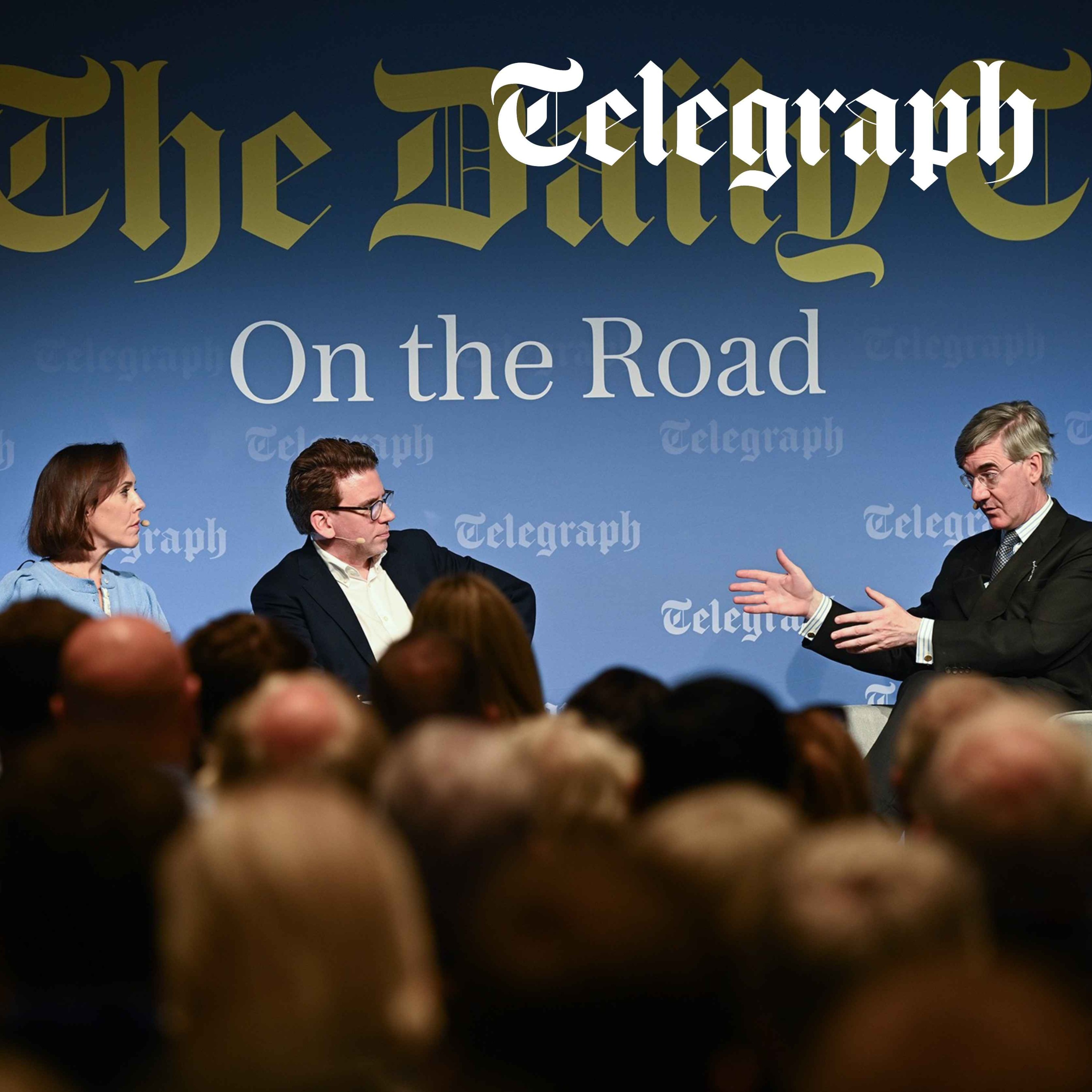
In today’s special Daily T: On The Road, Camilla Tominey and Tim Stanley speak to Jacob Rees-Mogg about day two of the Conservative Party conference in Birmingham. Speaking to Camilla and Tim in front of a live audience, Mr Rees-Mogg reacts to his viral interview with Tucker Carlson and argues the Prime Minister has brought Margaret Thatcher back into relevance by mentioning her in his speeches.
He criticises Burnham for “taking the reins of power” and about-turning on his promises on Europe to the people of Makerfield, and accuses the PM of grasping power and moving “far Left” of Labour’s 2024 manifesto. Camilla, Tim and Jacob also discuss: their definitions of Englishness in light of Suella Braverman’s comments on her national identity, the Green Party’s motion defining Zionism as racism, and how Britain benefits from supporting Israel.
► Get more exclusive Daily T content from The Daily T+ membership! Join here
► We want to hear from you! Email us at [email protected] or find @dailytpodcast on TikTok, Instagram and X
► Sign up to our most popular newsletter, From the Editor. Look forward to receiving free-thinking comment and the day's biggest stories, every morning. telegraph.co.uk/fromtheeditor
The Telegraph is the Publisher Podcast Awards' Podcast Publisher of the Year 2026
Senior Producer: Emma Williams
Social Producer: Nada Aggour
Video Producer: James England
Executive Producer: Charlotte Seligman
Editor: Camilla Tominey
Highlights:
Hosted on Acast. See acast.com/privacy for more information.