
 Ask ChatGPT



Warning of “another summer of discontent” in the UK, with potential riots linked to social-media-fuelled unrest, flashpoints around migrant housing hotels, and tensions over alleged sexual assaults; plus a separate focus on a planned pro-Palestinian demonstration that could test Yvette Cooper’s ban on Palestine Action.
Martin Evans, Telegraph crime editor covering demonstrations; Cleo Watson and Gordon Rayner, Telegraph hosts (Cleo formerly worked in Downing Street).
Sir Andy Cook (HM Chief Inspector of Constabulary) says ingredients for riots remain; protests at migrant hotels (Canary Wharf “pink” conga hijacked by masked men; Epping Bell Hotel) may escalate; Robert Jenrick claims links between migration and sexual crime; Angela Eagle disputes data quality and argues “colour-blind” justice.
Southport unrest last year; alleged RAF base vandalism by Palestine Action; 83-year-old retired Church of England priest arrested for “I oppose genocide. I support Palestine Action”; Warwickshire Police allegedly told officials not to reveal ethnicity in an alleged rape case.
Written by AI. May contain mistakes.
Discussion on the possibility of civil unrest this summer based on past events.
“Welcome to The Daily Tea with me, Cleo Watson.”
Exploration of recent protests and public concerns about migrant housing.
“I respect those people who are peacefully protesting outside hotels this weekend.”
Analysis of crime statistics related to migration and political responses to protests.
“Their activities have increased in gravity in recent months.”
Discussion about planned pro-Palestinian demonstrations and potential legal implications.
“And we had these terrible scenes at Basra Airport of our allies trying to get on airplanes and cats and dogs making it instead and that kind of thing.”
Learn about police strategies and considerations for managing large protests this weekend.
“Just to go back to Martin on what's happening this weekend.”
Explore the factors contributing to fears of rioting and the police's response strategies.
“saying that there is, in his words, every possibility of rioting this summer.”
Discuss the political implications of Angela Rayner's controversial proposal regarding allotments.
“That started with disorder in Tottenham following the shooting of Mark Duggan by police.”

Get the gist, explore an idea or ask about something said.
 Claude
On The Daily T, what are the key points of this episode?
Searching your listeningAutomatic transcript. May contain errors.
0:03The Telegraph.
0:09Are we in for another summer of discontent? Sir Andy Cook, the HM Chief Inspector of Constabulary, has said there's every possibility of rioting this summer, as we saw last year following the Southport murders, because he says the same ingredients that fuelled that disorder are still very much in place now. Three months on from the Prime Minister's now infancy, The infamous island of strangers' speech. Is the gap between national and local in policing, media and politics widening more than ever? And are there people taking advantage of this? We're joined by Martin Evans, the Telegraph crime editor, who leads the coverage in today's paper of the demonstrations from over the weekend.
0:48Welcome to The Daily Tea with me, Cleo Watson. And me, Gordon Rayner.
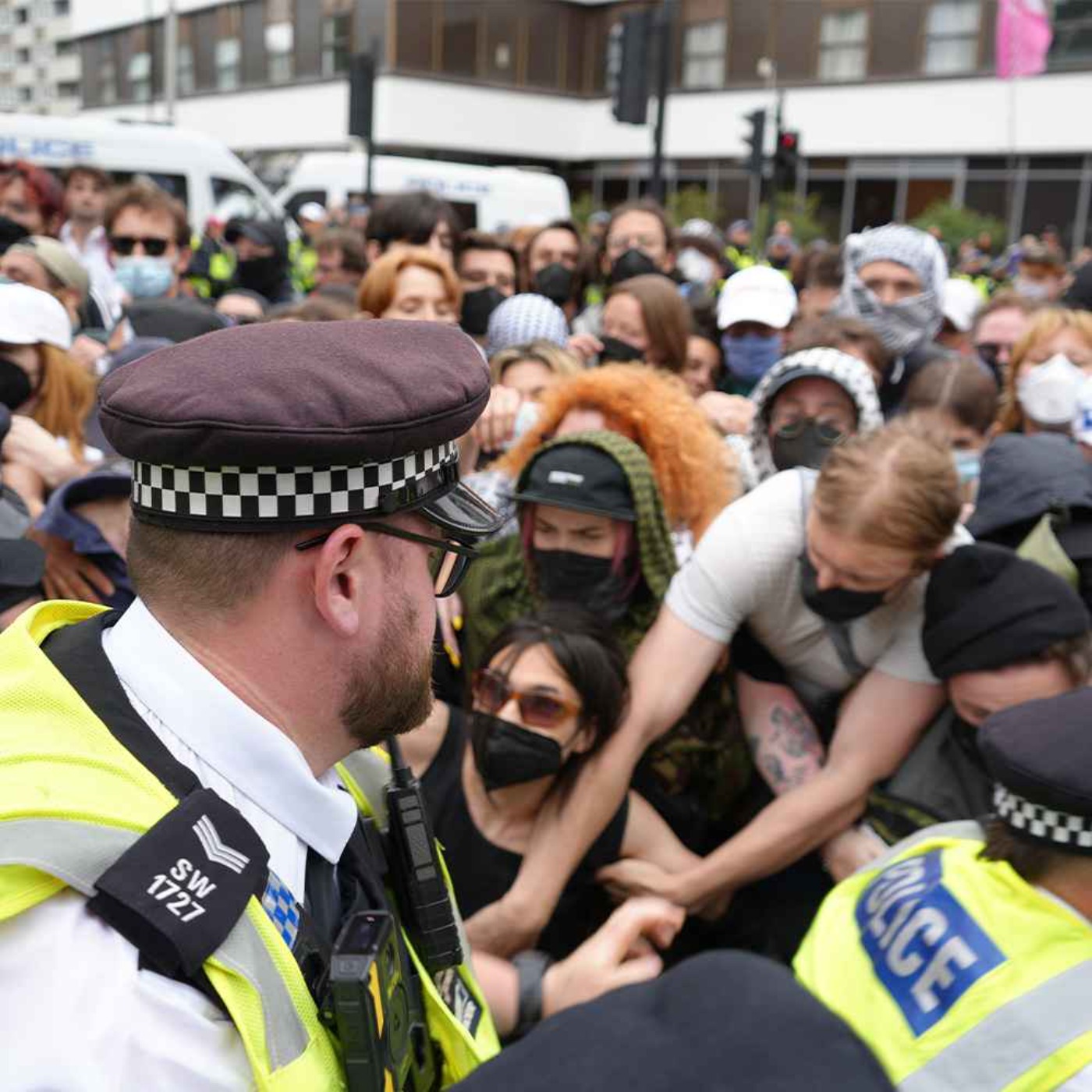
1:03Well, Cleo, over the weekend we saw quite a striking scene, didn't we, from Canary Wharf in London. There was a protest that began with mothers and children dressed in pink. They were dancing a conga peacefully in opposition to a migrant housing hotel. And then masked men turned up and hijacked the event. We saw clashes with the police. Only a few weeks ago, of course, there was a largely peaceful demonstration outside the Bell Hotel in Epping, which began after an asylum seeker was charged with allegedly attempting to kiss a 14-year-old girl. Well, Sir Andy Cook, who's His Majesty's Chief Inspector of Constabulary, he's issued a stark warning saying there's every possibility of riots similar to last summer's Southport unrest erupting again.
1:47And in fact, I was thinking about this earlier, Gordon, because I was rereading some reporting that a friend of mine, James Johnson, who's a pollster, did for Channel 4, where he was talking about he mainly works in America now and he came back to a few places in the UK to do some focus groups late last year, early this year. And he said that without any prompting, the idea of civil unrest, civil war, violence in quite small communities, places like Grimsby, were very clear to people. And it seems to be on a quite anecdotal level that people are expecting unrest in some way, shape or form. Yeah.
2:30And there are these flashpoints already emerging around particularly migrant hotels in towns and cities. We've had Norwich, Newcastle, Epping, Leeds. And that's combining with coverage of ever higher small boat numbers. So lots of people are asking, how much longer can the public patience hold? Yeah, and then we've had Robert Jenrick. He's been on the media rounds today saying that there's increasing evidence of a link between migration and sexual assault. So let's just hear what he had to say. I respect those people who are peacefully protesting outside hotels this weekend. I understand why they feel so concerned.
3:10They're seeing their communities damaged. And I'm afraid there is increasing evidence of a serious link between illegal migration, migration generally, and crime, particularly sexual crime, against women and girls. In London, 40 % last year of all of the sexual crimes were committed by foreign nationals, despite the fact that they only make up 25 % of the population. and some of the data that we're seeing, we don't have good data at the moment, but some of the data we're seeing is very striking. Afghans and Eritrean nationals are 20 times more likely to be convicted of a sexual crime than a British national.
3:53These are very shocking statistics, and I understand why mums and grandmothers would be out on the streets in places like Epping and Canary Wharf voicing their legitimate concerns. But meanwhile, Labour's Angela Eagle, who's the Border Security and Asylum Minister refuted those claims? I don't mind having debates about anything, but I think we haven't got good data on this and I think that we've got to look at the principle and that is that we've got to deal with all sexual criminality, whoever perpetrates it in that way, in an almost colour-blind way. If a girl has been abused by somebody or has been subjected to a vile sexual crime, it doesn't really matter what the colour of the skin of the perpetrator is.
4:42We've got to bring that person to justice and look after that victim. OK, well, we're joined, as we said earlier, by Martin Evans, our crime editor. Welcome again to The Daily Tea, Martin. Thank you. Stalwart of this podcast. So you wrote a piece today, didn't you, about a plan for pro-Palestinian demonstrations this weekend and there are some problems brewing over that. Just tell us what that story is. Yeah, so what we discovered is that there is a plan for Saturday, August the 9th, for pro-Palestinian supporters to hold a mass demonstration. So what this will be will be a test for Yvette Cooper's recent banning of Palestine action.
5:23It was quite a controversial decision by the government. This is a group of people who in recent months have essentially been committing vandalism. They've been spray painting banks. Their activities have increased in gravity in recent months. And last month, we saw an alleged attack by some Palestine action activists on the RAF Bryce Norton site in Oxfordshire, where they allegedly damaged two aircraft. And following that incident, Yvette Cooper announced that she was prescribing Palestine action. And that essentially means she was declaring them a terrorist organization. Now, following that decision, there were a number of demonstrations, particularly in London, where supporters of Palestine action took to the streets and essentially declared that they supported Palestine action.
6:15Now, that in itself is a crime under the Terrorism Act. To declare support for a terrorist organisation is a criminal offence. In fact, the infamous Anjem Chowdhury, when he was first jailed, that was the offence for which he was sent to prison. He got five years for that. He's one of these so-called hate preachers who's been around a very long time. Yeah. And so it's a serious offence to declare support for a terrorist organisation. But what we saw after the prescription was a number of people who you wouldn't imagine could be considered to be terrorists. One was an 83-year-old retired Church of England priest.
6:58And what supporters did was they essentially held up banners in the street. It was a very peaceful protest. They held up banners, which read, I oppose genocide. I support Palestine action. And for that, they were arrested. Now, nobody has yet been charged because there is a legal challenge going through the courts at the moment over the decision to ban Palestine action. And I think prosecutors will probably wait to see what happens with that challenge before they decide whether to charge anyone. But in the background, supporters of Palestine Action and those sympathetic to them have decided that they're going to actually challenge this head on by getting thousands of people to take to the streets and do exactly the same thing.
7:45Hold up banners saying, I oppose genocide. I support Palestine Action. And that creates a real headache for the authorities because you've potentially got thousands of people breaking the law en masse. What do the police do? Do they try and arrest everybody? That in itself is difficult, creates a headache. In London, there are a finite number of cells available to haul people. And then if eventually these people are charged with these offences, we already know that the criminal justice system is at absolute breaking point, completely overwhelmed, backlogs in the courts. Cases are being listed for 2027, 2028, 2029 even.
8:28So if you potentially get thousands of people who are charged with terror offences, what does that do to the criminal justice system? Can you process them? So this is really going to be a challenge for both the police and the government as to how they work this out. OK. And what do we think this is going to look like? What are we going to see on Saturday? Is this going to be a one demonstration happening in, I don't know, London? Or is it going to be all around the country? Or what can we expect to see? Well, from what I've seen so far, the plans suggest that there will be a series of demonstrations around the country.
8:59But I think the main one is likely to be in Westminster. Obviously, from their point of view, it will be more effective if you can concentrate it in one area because that puts more pressure on one particular police force. If you were to do this across the country in a series of small demonstrations, it probably wouldn't create quite as much of a headache for the police. So I think it's likely that there will be demonstrations in towns and cities across the country, but it seems as if the main one will take place in Westminster. OK. Cleo, you used to work in Downing Street. Yes. What sort of conversations will be going on among politicians and in Downing Street to try and brief the police to try and decide how they're going to handle this if, as Martin says, literally thousands of people turn up and effectively all break the law at once?
9:46Yeah. So there's a few different issues happening at once. The first one is it's August and Whitehall traditionally shuts down and all kinds of mistakes happen. If you remember, Dominic Raab was on holiday when we decided to withdraw from Afghanistan. And we had these terrible scenes at Basra Airport of our allies trying to get on airplanes and cats and dogs making it instead and that kind of thing. So the last summer that I was in Downing Street was 2020. So it was COVID. And if you remember, in the wake of George Floyd's death in America, there were Black Lives Matter protests in the UK. and actually to Martin's point they they happened in groups of sort of 250 across the country there weren't people in their thousands but it was a big problem because we needed COVID rules complied with and in some ways it was better for the police because they had permission to be incredibly draconian to slap fines on people and actually however you feel about COVID and social distancing and rules at the time, a£1 ,000 fine per person if people weren't socially distancing was quite compelling.
11:03And obviously that is not a piece of the puzzle that Yvette Cooper has when dealing with a potential terrorist organisation in this sense. So you have ministers away, you have senior civil servants away, it's hot, the cricket's on, people are quite distracted and coming in late, and then you will have a flashpoint. You generally respond to things rather than prepare for them unfortunately. Lots of the political people are thinking about September, October and party conference and the budget. And they're not necessarily picking up what's happening on a really local level in places like Epping and Norwich and so on.
11:42So they're relying on kind of what they're hearing from the Home Office and from the police and making some kind of political decisions. And everyone, in my experience, slightly hides behind each other here. So if you've noticed that Warwickshire police today have said they have responded to this attack a couple of weeks ago by following national guidelines about not producing the ethnicity data. So this is the incident where there is a... An alleged rape of a 12-year-old girl by Afghan asylum seekers. Yeah. And the leader of Warwickshire Council, George Finch of Reform, he's the 19 year old, people will have seen him in the media.
12:23He's accused the police of covering up the alleged rape of this 12 year old girl. He says that Warwickshire police advised local councillors and officials not to reveal the details of the suspects for fear of, as they say, inflaming community tensions. So yeah, sorry, carry on. Well, I think this is the crux of the issue, essentially. And it'll be interesting what reform decide to do, who've obviously announced this sort of summer, talking about crime and lawless Britain and so on. Whether you are the prime minister, whether you're an MP, whether you're from an opposition party or not, understanding where large swathes of the country are on this and where their supporters are and what actually helps and what inflames these tensions.
13:08And I think the point that has been made repeatedly today about Warwickshire Police not revealing the ethnicity of the two alleged perpetrators in this case is that a couple of weeks ago with the Liverpool car crash, police were very quick to reveal the man in that case was white. Yeah, that was the car that ploughed through a crowd. Correct. And so, again, we're getting back to this idea of two-tier policing and where do politicians sit here? Is it better to try and point these things out in every instance and, to be honest, make some hay with it if that's where they think voters are? Or do you have a responsibility to try and – I want to use the term squash, which slightly makes it sound like things are being hidden.
13:56But do you have a responsibility to try and take a beat and talk about this in sort of moderated tones?
14:14Just to go back to Martin on what's happening this weekend. Presumably, Martin, Yvette Cooper will have been speaking to police chiefs, will she, about what their response should be this weekend. Are the police saying anything about what they intend to do to police these events or this event, depending on how many there are? Not officially at this stage, but I spoke to a retired Met officer who worked in public order policing for 30 years. He's an expert in how the police handle things like this. And he had some quite interesting points to make practically. So he said if an event takes place in London where there are thousands of people who need to be arrested or hundreds of people who need to be arrested, there are ways of managing that, clearly.
14:58So in terms of a couple of years ago, there was a weekend where a lot of Just Stop Oil protesters took to the streets and closed roads. And there was a large number who were arrested and taken into custody. and that weekend a contact rang me and said there isn't a single police cell left available in London. Now I put this to him yesterday and he said well there is a contingency what you would do is you would contact force areas outside the M25 and say we need some cell space so there are ways to handle it and the police will certainly have in mind what they would need to do if there There were not just a demonstration like this, but large scale disturbances where they need to arrest and detain lots of people.
15:46So, yeah, I mean, the police will certainly have contingency measures. They will no doubt be speaking to the Home Secretary. I mean, this issue is particularly interesting because I'd imagine the vast majority of people who may take part in this plan will be doing so peacefully. Yeah, and they're probably fairly ordinary members of the public. You may not even know about the terrorist link either. They won't realise that. Well, I think it's, so from what I understand is that this plan, quite a lot of thought has gone into it. And what the organisers are asking is for a minimum of 500 people to sign a pledge saying they will be willing to do this next Saturday.
16:29And the reason that they're looking for that sort of critical mass is they think that number is what the minimum that they need to create this headache for the authorities. Are we getting into the realms then of arrestables? I think with Just Stop Oil, they had a thing, didn't they, where people would sort of say whether they were willing to be arrested and they'd be the ones that would sit down in the street or whatever and then there'd be other people who would be supporters but who would be classed as non-arrestable. They were people who maybe had a respectable life, didn't really want to have a rap sheet.
17:01Are we getting into that territory? Absolutely. I mean, the briefing document that I saw, which is people are being urged to read this document carefully before they sign this pledge. And the first thing it says is, you know, that there is a risk to getting involved with this. And they make it very clear that, you know, you need to be willing to be arrested. As I say, interestingly, because of this legal challenge, nobody has yet been charged. So there is a possibility that although you might be arrested, you may never be charged. Now, one of the issues with this is this is terrorism legislation.
17:36You get charged with a terror offence, it has a major impact on your life. So people are being told that they really need to consider this carefully. The implications could, you know, in terms of travel, in terms of employment. Could they end up on a no-fly list if they get... Potentially, I mean, yeah. So if you are an 83-year-old retiree from the Church of England, you arguably don't mind about that so much. I remember when we were in number 10, chiefly the protests were Extinction Rebellion actually on Whitehall. And you had people dressed as butterflies sleeping in tents and so on. And Priti Patel was the same secretary.
18:12And she was very aggressive about the practical disruption this caused. Obviously, these were not terrorists. But there was discomfort at the time of grandmothers and quite often with their grandchildren being sort of moved along as sort of gently, forcibly removed as possible. And there must be some debate in the Home Office at the moment, if you're a vet Cooper, that you're actually quite unlikely, therefore, to have people in their 20s and 30s, perhaps young professionals and students, because they don't want to be charged with terrorism offences. but actually the whole point of some of the Extinction Rebellion and Just Stop Oil protests was that they were much older people who really felt they didn't mind actually and that they could live with being, you know, this is a different level altogether but there must be some discomfort if you're the head of the Met about moving on an 80-year-old former priest.
19:09Well, Sir Mark Rowley following the arrest of the 83-year-old, He did make a comment that, you know, the law doesn't have an age barrier. Of course. And it's, you know, it's meted out equally. But I think, to go to your point, there is a mix on this issue. What's happening in Palestine is an incredibly emotive subject and lots of people feel incredibly strongly about it and believe that, you know, they will be on the right side of history so are willing to take the implications of what might happen to them. But also the image of an 83-year-old being arrested, contrasting with men in balaclavas and masks, sort of hijacking peaceful protests elsewhere, does give this sense of compare and contrast.
19:59and it's quite clever PR, I would argue, from the organisers to think if this is going to go ahead and there are going to be photographs and not worrying about the national media so much but thinking of Twitter and Facebook and all the rest of it, you want the image contrast to be someone who looks sort of elderly and peaceful versus someone who's not even got the guts to show their face in pictures. It's obviously going to be a massive test for policing and it's going to be fascinating to see how they deal with it. Let's talk a bit more about the wider issue here of what's going on in the country.
20:34We mentioned Sir Andy Cook, the chief inspector of constabulary, who wrote a report that came out over the weekend, saying that there is, in his words, every possibility of rioting this summer. It does feel as though this is something which people are talking about a lot. Cleo mentioned that even a few months ago, people were talking about they felt there may be a civil war coming. That's probably rather too strong a phrase to use. But certainly, I think there is a fear, isn't there, in the country? that we could see rioting. Just to go through some of those ingredients that Andy Cook was talking about, he said that last year the riots, obviously they were triggered by the Southport stabbings, but he was saying that they happened spontaneously.
21:12They weren't sort of planned. There wasn't a sort of central organisation. And so he says the same thing is true now because you have social media amplifying sometimes false narratives or sometimes things that maybe people wouldn't know about if they didn't have social media because something happens in one part of the country, quite a small thing, and suddenly everyone knows about it and it can kick off. And the police struggle to keep up with the speed at which these things gather pace on social media. So that's one of the things that he was saying. And then we've got things like Robert Jenrick was talking about, this increasing evidence of a link between migration and sexual assaults.
21:47We've got just today the Leicestershire Police and Crime Commissioner, Rupert Matthews. He's defected to reform, saying that some towns and cities in England and Wales have become, what he says in his words, an apocalyptic wasteland of lawless Britain. Not a man who's sitting on the fence, Cleo. But so this is what we're looking at, isn't it? And I guess the question to you, Martin, is what are the police doing to try and avoid another summer of rioting? They've had that experience already from last year. How are they going to try and stop this happening again? Well, interestingly, Andy Cook, who wrote this piece in the Sunday Telegraph, That was to coincide with the sort of one year anniversary of the disorder.
22:29But actually, over the last year, his organisation, His Majesty's Inspectorate of Constabulary, have been doing a lot of work, along with the National Police Chiefs Council, in looking at the police response to the disorder last summer. And they have published two reports over the last 12 months, looking at where the police got things wrong, what they did right and what areas they need to improve. And so the piece this weekend was really taking from their findings. And what they really concluded was that the police were quite slow to respond to last year's disorder and also they were slow in spotting it coming.
23:13And so a lot of work has been going on across policing to make sure that they're more nimble in terms of spotting things coming down the line. Now, you know, how that works is probably quite varied, but I'd imagine they will be looking at things like social media and monitoring that really closely because, of course, that's where we can see things developing. And also then the response where you have small incidents of disorder, perhaps in places like Epping and as we saw the weekend in London, the police will be keeping a very close eye on that to see that it's not spreading quickly. Because, of course, what we did see last year was the awful incidents in Southport.
24:01The disorder that followed started locally in Southport. within 24, 48 hours it was burning elsewhere. And of course that's how riots happen. If we think back to 2011 and the disorder then, that's exactly what happened. That started with disorder in Tottenham following the shooting of Mark Duggan by police. And within 72 hours it was all over the country. And so the police will be looking at how they can spot where it's spreading and then move resources into ensuring that if it does happen, they have the numbers that are able on the ground to contain it. How worried are they that this is going to happen?
24:45Are they doing things like cancelling leave or how are they preparing? I'm not aware that any orders of leave have been cancelled, but certainly resourcing is always in their mind. Chief constables will be looking at their shift patterns and making sure that in August when lots of people, particularly with families, are on holiday, they'll be making sure that they do have enough officers if needed to respond to anything. I mean, the other thing, obviously, we have 43 police forces in this country. We police regionally and locally. But of course, if there is a national issue, we have a thing called mutual aid where police forces can move resources around the country to help out other forces where they're not resourced.
25:29In fact, recently we saw disorder in Northern Ireland and Police Scotland very, very quickly sent resources over there because they were fearing that things could get out of control really quickly. Yeah. Well, there we have it. Martin, thanks ever so much for being in the studio as ever. Just before we go, we felt we couldn't not mention the fact that Angela Rayner has declared war on allotments by telling councils they can sell off people's vegetable patches to help ease the cash crisis that a lot of them are facing. Now, Cleo, might there be a hidden motive behind that decision, do you think?
26:04Well, as we know, Jeremy Corbyn is a big fan of his allotment. He loves to grow marrows in North London. Perhaps this is the attack on the new party they were least expecting. They're literally pulling the ground from under their feet. Do you think she might have said to Corbyn, can the new party or the allotment gets it? Yeah, we're going to buy you off or we're going to blow up the marrows. I mean, this isn't just allotments, it's playing fields, there's lots of opportunities for councils to try and drum up money, I suppose. But once it's gone, it's gone, isn't it? Once it's gone, it's gone.
26:37And it's really unclear, it's going to have planning permission to build stuff on it. These are not, they literally are not brownfield sites because they're very green. remains to be seen. Yeah, just one last thought. What's your sense with your political antennae twitching? What's your sense of how much of a problem this new political party is that Corbyn has set up? How much of a problem is it for Labour? The problems will come if they continue on their current trajectory of how they do their parliamentary handling because they might end up de-whipping more MPs and those people might end up joining Jeremy Corbyn and Zahra Sultana.
27:14but I personally don't think he is the problem for Labour. I think the Lib Dems are coming at them one way, reform are coming at them with another. I guess it's something for people to write about and think about but personally if I were in Number 10 I think it was a bit of a distraction and I wouldn't worry about it so much. OK, quick plug before we go for the Wednesday episode of The Daily Tea which is going to be, Cleo, I gather a special Q &A episode. It's going to be you and Tim. People can email their questions to you and Tim. Can they just ask you anything at all? Yes, apart from why are you so much worse than Camilla?
27:50Otherwise, ask away. Nobody's going to ask that. Anyway, if you have any questions for Tim or Cleo, email thedailytea at telegraph.co.uk and they will have incredible answers to all of your questions. That's on Wednesday. Meantime, we'll be back tomorrow, 5pm.
28:12Thank you.
Sir Andy Cooke, HM Chief Inspector of Constabulary, has told the Sunday Telegraph that there is “every possibility” of rioting this summer, in a repeat of last year's unrest following the Southport murders, as the same ingredients that fuelled that disorder are still very much in place now.
With anger at the housing of migrants in hotels spilling over into more violent demonstrations at the weekend, as well as the Telegraph's exclusive story that pro-Palestinian supporters are co-orindating in an attempt to overwhelm the police, are we on the brink of major civil unrest?
Gordon Rayner and Cleo Watson are joined by Martin Evans, the Telegraph's Crime Editor, who's been speaking to sources within the police to find out how braced for trouble they are, whilst Cleo reveals how Downing Street may be unprepared with Westminster in summer shutdown.
Producers: Lilian Fawcett and Georgia Coan
Senior Producer: John Cadigan
Planning Editor: Venetia Rainey
Video Editor: Will Walters
Studio Director: Meghan Searle
Executive Producer: Louisa Wells
Hosted on Acast. See acast.com/privacy for more information.


