
 Ask ChatGPT



The episode discusses the London-bound Air India Flight AI-171 crash shortly after takeoff from Ahmedabad, India, and what investigators will likely focus on. It notes 242 people aboard (230 passengers, 12 crew), including 53 British nationals, and that the Boeing 787-8 fell onto a doctors’ hostel building, causing a massive explosion and black smoke. Aviation expert Professor Graham Braithwaite (Cranfield University; Director of Aerospace and Aviation; Safety and Accident Investigation Central) explains that investigations will be led by an independent Indian agency with US/UK assistance, prioritizing flight data recorders, radar data, and scene evidence, and that causes are usually multiple factors. He highlights takeoff-stage risk statistics, low overall accident rates, and the 787-8’s prior “unblemished” safety record.
Lockerbie (Pan Am 103) and Kegworth (1989).
Professor Graham Braithwaite.
Written by AI. May contain mistakes.
Overview of the Air India flight's crash shortly after take-off and its implications.
“Well, let's go through what we know so far.”
Responses from government officials and leaders regarding the tragedy.
“there were seven Portuguese and one Canadian, according to Air India.”
Expert Professor Graham Braithwaite explains potential causes for the crash based on initial footage and technical details.
“We've heard in the House of Commons from the Foreign Secretary David Lammy describing how the Foreign Office is handling the situation in India.”
Discussion on the likelihood of survival and the steps taken in the investigation following the crash.
“I think tragically looking at the scene, they would be relatively low because the aircraft has climbed to some altitude and it's crashed into a built-up area.”
Examination of the Boeing 787-8 Dreamliner's safety record and Air India's performance.
“There were 53 British citizens on that flight.”
Learn about the IOSA audit and its role in airline safety.
“They submit themselves not just to audit by their own regulator, but also by an international standard.”
Explore the various factors investigators consider in aviation accidents.
“What can you tell us about our Medabad airport, which I'll just add is located in the Prime Minister of India's home region of Gujarat?”
Discuss the exponential growth in Indian aviation and its implications.
“I think even Willie Walsh said very recently, he's now the head of the International Air Transport Association.”
Understand how safety is managed in aviation and the significance of technology.
“We do that through an approach to risk that's very open.”
Examine how social media influences public perception of aviation safety.
“We do seem to be seeing sort of more videos of loss of cabin pressure caused by intense turbulence.”
Learn about the controversies surrounding the 737 MAX and its effects on the industry.
“That was a new plane that highlighted serious concerns about the industry itself and whether or not it was reacting to the pressures correctly.”
Discover how news organizations handle aviation disaster reporting.
“It was that the scrutiny that now comes to the industry is that much higher, whether it's from the regulator or whether it's from the customer.”
Hear personal perspectives on the emotional impact of aviation accidents.
“you've got to get the facts right on this when Brits are involved.”
Learn about the ongoing news coverage on aviation incidents and updates.
“It's something you have to do for work or for leisure.”

Get the gist, explore an idea or ask about something said.
 Claude
On The Daily T, what are the key points of this episode?
Searching your listeningAutomatic transcript. May contain errors.
0:03Camilla: The Telegraph.
0:21Camilla: The footage is absolutely horrifying, Tim. An Air India plane bound for Gatwick crashes within five minutes of taking off. 242 people on board, including 53 Brits. This kind of tragedy is rare. People are going to be in shock. People will be grieving. The public will want to know how something like this can happen, especially as the industry is always assuring us that air safety standards are at a historic high. Well, to try and find out what did happen, we're going to be speaking to aviation expert Professor Graham Braithwaite. We are filming this at lunchtime. This is a moving news story. and we know that there will be more updates overnight and tomorrow.
1:03Camilla: Welcome to The Daily Tea with me, Camilla Tomini. And me, Tim Stanley.
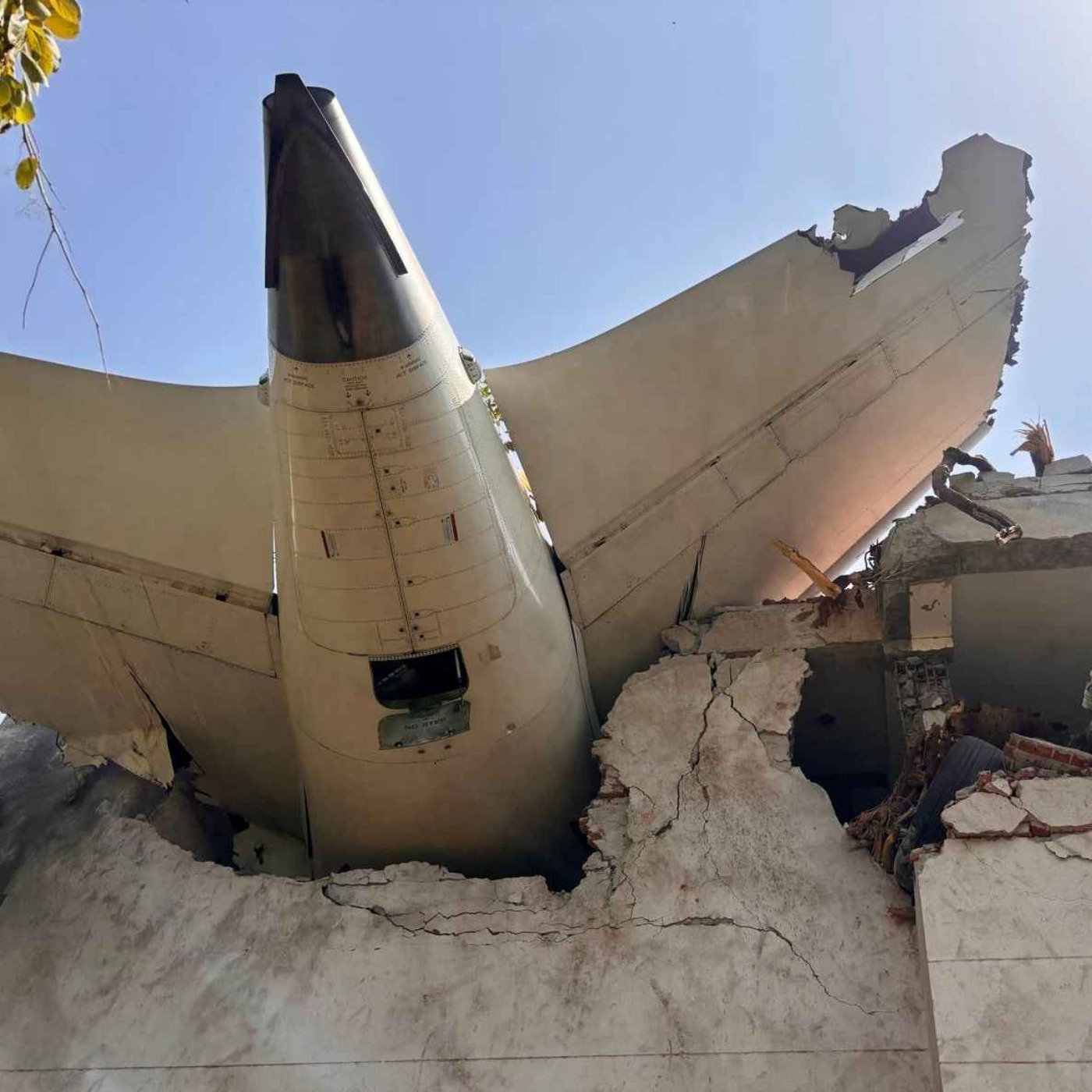
1:17Camilla: Well, let's go through what we know so far. An Air India flight bound for London Gatwick, carrying 53 British nationals, has crashed in India's western city of Ahmedabad this morning. the Boeing 787-8 Dreamliner came down shortly after take-off into a residential area leading to a massive explosion. A partially intact plane was seen sticking out of the building with thick black smoke rising over the city as people were pulled from the wreckage and taken away in ambulances. It had 240 people on board including 230 passengers and 12 crew members. Of the 217 adults and 11 children, 169 were Indian nationals, 53 were Brits, there were seven Portuguese and one Canadian, according to Air India.
2:10An Air India spokesman said in a statement on X, Flight AI-171, operating Ahmedabad to London Gatwick, was involved in an incident today, 12 June 2025. At this moment, we are ascertaining the details and will share further updates at the earliest. The Foreign Office said officials were working with Indian authorities to establish the facts around the crash and provide support to those involved. The plane fell on a hostel building used by doctors. The Prime Minister Keir Starmer has spoken and said, The scenes emerging of a London-bound plane carrying many British nationals crashing in the Indian city of Ahmedabad are devastating.
2:49I am being kept updated as the situation develops. and my thoughts are with the passengers and their families at this deeply distressing time. Conservative leader Kemi Betenoch has described the news of the crash of an Air India plane bound for Gatwick Airport as heartbreaking. In a message on X, Mrs. Betenoch said, my thoughts are with all those affected, especially the families of those on board and the emergency teams responding to what appears to be a horrifying tragedy. Indian Prime Minister Narendra Modi has described the crash as heartbreaking beyond words.
3:22Camilla: We've heard in the House of Commons from the Foreign Secretary David Lammy describing how the Foreign Office is handling the situation in India. My thoughts, and I'm sure those of the entire House, are with those who've been affected by the tragic plane crash in India this morning. We know that British nationals were on board. And, Mr Speaker, I can confirm that the FCDO is working urgently with local authorities to support British nationals and their families and has stood up a crisis team in both Delhi and in London. We're joined now by Professor Graham Braithwaite, Director of Aerospace and Aviation at Cranfield University, Professor of Safety and Accident Investigation Central.
4:10Camilla: Thank you so much for joining us today, Professor. At first glance, when you look at the footage, how would you describe what we can see? What does it seem as if the plane is doing? I think the first thing we see is obviously a human tragedy. The people who've lost their lives, their loved ones, the people who are affected by it is really where our hearts go. And as an industry, we do pride ourselves on our safety record. So when accidents like this happen, we take them incredibly seriously. I think in terms of a technical event, the investigation will follow an important search and rescue attempt.
4:48In this case, there'll be people on the ground who may have been affected by it. And although sadly, it looks like the chances of survival for anybody on the aircraft are remote. So when that investigation takes place, it will be led by an independent investigation agency, which is based in India. They will get the assistance of other countries such as the US, because that was where the aircraft was manufactured, and the UK because of a large number of nationals on board. And they will take a slow and painstaking approach to make sure that they recover all of the data. So the flight data recorders always be very useful in a situation like this, radar data and so on.
5:27And they will clearly look at the accident scene to understand what happened. Because I think it won't be a simple cause. It's usually a set of things that have gone wrong before an accident like this happens. And it is so important to get all of those pieces right so that we can make changes to prevent similar accidents happening in the future. I'm sure you'll be reluctant to speculate, I'd understand, but from what we've seen of the footage, it looked to me as if the plane was descending in such a way that it was attempting to land, its nose was sort of sticking up. Is there anything you can tell from the footage of what you can imagine the plane might have been trying to do in those last few moments?
6:03So from the information that's been shared, this aircraft is just after take-off, And when an aircraft takes off, one of the things you're trying to do is accelerate away. So the speed you take off from the runway is critical, but then you continue to accelerate. And you've got various things on the aircraft to make it fly better at a slower speed. So the flaps are the parts of the wings that help it gain enough lift to climb. And the undercarriage is partly working against you, which is one of the reasons that you'd expect the undercarriage to come up soon after an aircraft takes off. Now, seeing the undercarriage down doesn't tell you that that's necessarily the problem.
6:40It might tell you that whatever the problem was, the crew were so focused on dealing with that that they hadn't retracted the gear. It's not going to stop it flying. It's not going to cause it to descend. So something is causing that aircraft to lose altitude. The nose being held up is part of it trying to climb away. So if there was an engine failure, if there's an issue with the configuration or the weight of the aircraft, then those are all possible scenarios. and the investigators would want to work out, is it one of those things? Is it several of those things? And if so, how did that present itself?
7:12But I think looking at how close it happened to the runway, then as the aircraft took off, then I would imagine the crew are straight into dealing with an emergency. Now, that emergency may well be one of the things that they practice. So when pilots go into the simulator, one of the very common things to practice is what happens if one of your two engines fails on takeoff? and even if an engine failed, which could be mechanical, it could be a bird strike, then the other engine is still enough for it to climb. So you'd still expect it to be able to escape the airport and then make a safe landing.
7:45So it's one of those scenarios where there'll be multiple things that will have contributed.
7:49Camilla: I mean, we note that the captain in this case, Samit Sabharwal, he has 8 ,200 hours of flying experience. He's got a co-pilot, First Officer Clive Hunder, again, more than 1 ,000 hours in the air. So you're saying, Professor, that they will have practiced this kind of nightmare scenario, particularly when it comes to those crucial first five minutes after takeoff. Absolutely. So it will be the thing that you practice in initial training is what happens if an engine fails, even if somebody was learning to fly in a light aircraft. It's one of the early things you train for because takeoff is a critical stage of flight.
8:26approximately 13 % of accidents involving commercial aircraft happen in that phase, and it accounts for about 18 % of the fatalities. But bear in mind that that risk is actually incredibly low. And whilst that's little comfort to those who've been affected by this accident, actually, it shows just how much the industry puts into managing that risk, whether it's with technology or whether it's training. But certainly the threat that comes from there being a problem just as you lift off the runway is one of those risks that's managed in different ways. And training for an engine failure on takeoff is one of those examples.
9:04When a plane has taken off and there is a disaster like this and there is what they call a hull loss, what are the chances of survival for the passengers on the plane? I think tragically looking at the scene, they would be relatively low because the aircraft has climbed to some altitude and it's crashed into a built-up area. And of course, we hope and pray that I'm wrong on that. We've done a lot to make air crashes more survivable. But if you think about an airport where perhaps the most critical stage of flight is that first bit of takeoff, it's the reason that we don't have high development around the airport and so on.
9:40It's the reason we've got rescue and firefighting to come and respond so quickly. But this happened a distance away and it happened up in the built-up areas. And you will, of course, have an aircraft that is full of fuel for a very long flight to London.
9:54Camilla: You talked earlier about the investigation. How quickly does that happen, Professor? Clearly, there is a need for the emergency services to get in. And we have actually seen some footage of survivors being rushed into hospital. And of course, we pray for them. But how quickly do investigators get into the site? Is it immediate? and I would assume that they look immediately for the black box? Yeah, it will be a very rapid response. So they'll be respectful to any rescue efforts, but actually they can help within that. But they'd want to observe because you might move some of the wreckage so that you could save somebody's life.
10:29The investigator would want to understand the scene that they're looking at. And yes, one of the priorities is to recover anything like a flight data recorder so that you can get an instant readout about what was going on in the aircraft. Now, it may not give you an instant answer as to why the aircraft crashed, but as an industry, we'd want to know straight away if there was a problem that might affect other flights. So that bit will happen quite quickly. They'll be assisted by other countries. So over the next few days, you will find help will come from the United States, help will come from the United Kingdom as well.
11:00And that investigation team will follow the evidence and see where that takes them. But the final report will take months, may even take years, depending on the complexity of the investigation. There were 53 British citizens on that flight. Hopefully some have survived. If they have not, are we looking at one of the worst disasters in terms of British casualties in modern times? Yes, I think so. I think you're right. This is a significant number of fatalities, if indeed that's what eventually comes to light. It's a reminder of how safe civil aviation has managed to be. it's a very long time since we had a large fatal accident involving a commercial jet aircraft in the UK you actually have to go back to 1989 to the Kegworth crash and the Lockerbie disaster just before that so it would be a very significant accident in that regard.
11:54Camilla: I mean to be reminded of the Lockerbie crash of course 11 residents of Lockerbie were killed on the ground but on that Pan Am flight, 43 Britons were killed. If we look to the plane, Professor, the Boeing 787-8 Dreamliner, is that a plane that's never had a crash before? What's the history of aviation safety when it comes to that particular aircraft? So the 787 is the most modern design in the Boeing fleet. It's been in production since 2012 as the first aircraft to be delivered, and it has an unblemished safety record. There's been no hull losses and there's been no fatal accidents involving that aircraft.
12:34It's very well liked by its operators as a reliable aircraft. The aircraft was introduced in 2009 and more than 1 ,000 have been delivered to dozens of airlines. What do we know there about this specific plane? Do we know much yet about its age, how long it's been in the fleet? So my understanding is this aircraft is about 11 years old, which does not make it an old aircraft in international aviation terms. I believe it is powered by GE engines. And so that just tells you that there will be people involved in the investigation to help coming from the manufacturer of Boeing, but also maybe from the engine manufacturer as well.
13:14But quite quickly, you might rule out what this accident isn't. So the fact that these people are involved doesn't necessarily tell you that that was a cause. Obviously, Air India will be involved as well. But that investigation will be led by an independent safety investigation bureau in India. And their purpose is not to find blame or liability. Their purpose is to find out what we can learn in terms of aviation safety.
13:40Camilla: And what do we know about Air India, Professor, in terms of its own reliability and safety? So Air India has a very good reputation. It was one of the original signatories of what's called the International Air Transport Association Safety Leadership Charter, which was initiated just a couple of years ago by IATA for the airlines who are doing really, really good things around safety management. They submit themselves not just to audit by their own regulator, but also by an international standard. It's called IOSA, the IATA Operational Safety Audit. That gives another independent audit into the airline.
14:17And I know they put a huge amount of work into safety management. It's reflected in the aircraft types they operate. They have modern aircraft in the fleet as well. So their safety reputation is good. What can you tell us about our Medabad airport, which I'll just add is located in the Prime Minister of India's home region of Gujarat? Is this one with a very large amount of traffic going in and out of it? It's not an airport I'm familiar with, so I couldn't really tell you that. I think whether another aircraft was involved, I don't know. And assuming that's ruled out quite quickly, then the traffic volume probably wouldn't tell you very much about what might have happened here.
14:54But every one of these is a strand that an investigator would want to look at, even if it was to rule it out quickly.
14:59Camilla: There has been an exponential rise, Professor, I believe, in air travel in India. I think even Willie Walsh said very recently, he's now the head of the International Air Transport Association. And he said that the growth in Indian aviation was nothing short of phenomenal. Will investigators look at exponential growth, whether safety standards might have been compromise in the quest to produce ever more greater numbers of aircraft? So you're right about growth and growth can have implications in terms of the supply of pilots or engineers or air traffic controllers and so on. and investigators will look at the causes that were there on the day and then they will keep going they like to keep asking the question why so if we find there was a technical issue then why did that technical issue occur if the way in which the crew reacted to it was different to how you might have expected then why might that be so so they will go all that way and they will be unafraid to look at whether there are what we call deeper systemic causes you know the role the regulator plays or the role that the infrastructure plays and so on.
16:06Of course, they will look at that because their aim is not to pin blame on someone. Their aim is to find, well, where's the learning that would help the whole industry to be safer as a consequence of this? So yes, you're right. They would definitely look at all of those levels. I'd like to ask on a personal loader, I am very, very frightened of flying. I have to do it a lot. I hate doing it. And when I see this sort of thing happen, it triggers me and I think, that's it, I'm not getting on a plane again. What would you say to someone like me? First of all, I absolutely understand that that's how you might feel.
16:39And aviation isn't inherently safe. We do something that's quite unnatural. We have to work very hard to make it safe. And we do that through technology. We do that through training. We do that through an approach to risk that's very open. So different manufacturers, different operators will share all of their lessons learned, the things that go wrong, the things that go right as well. And as a consequence, the accident record shows that it is an incredibly safe thing to do. But when an accident happens, it's a very high profile event. So tragically, a large number of people have lost their lives today.
17:15A larger number of people will probably be losing their lives in single accidents, in cars or cycling and things like that. And we see that differently. So I would give you some reassurance that there's nothing I see that instantly suggests that there's an industry-wide problem here. But I understand how hard as an industry we have to continue to work to reassure people that what we're doing to manage risk is sufficient. And we can never be complacent about that. We always have to do more.
17:44Camilla: Although, I mean, it may be because of the result of the advent of the smartphone. We do seem to be seeing sort of more videos of loss of cabin pressure caused by intense turbulence. That's been a little bit of a theme of some news sites in recent months. And we do hear stories of bird strikes and the threat that that poses to aircraft. Is that just a case of such incidents being overrepresented because we're visually seeing them more? or is there something in that? I think that's part of the story, that we do see them more, they're more accessible, we see people stagger out of accidents and somehow want to film them even before they've got to safety.
18:25So there is definitely a rise in that. It's against the backdrop of an industry that is very busy, there's more flights. So although I might reassure you by saying that the accident rate continues to go down, if we're flying twice as much, then that has an effect on the overall number of accidents. I think there are certain things like the effect of extreme weather that we are seeing an increasing threat from. Again, we see that as an industry, we recognise that, and we're doing things to manage that. So again, that complacency cannot simply be that we've dealt with a stable situation. There are new hazards, there are new threats that we're constantly trying to keep up with as an industry to make sure we maintain the expectation of safety.
19:09There were serious problems, weren't there, with the Boeing 737 MAX after there were two whole losses involving that line, Air Flight 610 and Ethiopian Airlines Flight 302. That was a new plane that highlighted serious concerns about the industry itself and whether or not it was reacting to the pressures correctly. That was a very troubling story. And again, speaking personally, I've been making a point of flying on 787s precisely because of their safety record. so this is it's going to be a blow to the industry because this was such a safe plane you're right and uh its safety record still stands but we we do now have a fatal accident and again i can see why that might create some anxiety for people but i think you've got to take a balanced view on this we've got to learn from it very quickly we need to understand exactly what happened here and whether it was an aircraft issue or whether it was an operational issue Either way, we still need to and we'll want to fix that as an industry.
20:09But I think even with the accidents you referred to involving the 737 MAX, it's ultimately has had a positive effect in making sure that we are not complacent as an industry. We recognize that even with the newest products, there's risks that can come with that. We need to manage that. If there's a small upside to what happened, it was a deeply tragic pair of accidents that's happened. It was that the scrutiny that now comes to the industry is that much higher, whether it's from the regulator or whether it's from the customer. That really matters. And I think we are receiving a very high level of scrutiny.
20:44The accident that happened in Washington, although likely for a very different set of causes, because that happened right in the heart of government in the US, will have raised the industry's consciousness about just how important it is to keep focused on delivering safety.
20:59Camilla: Professor Graham Braithwaite, thank you very much indeed for joining us today on The Daily Tea. No problem.
21:09Camilla: Tim, just to say there that the professor was referring to the Kegworth air disaster, because when something like this happens, the newsroom goes into overdrive. Obviously, we've got to separate fact from fiction. There's footage coming in. We're liaising with the Home Office when it comes to the British casualties, because as a respectable news organisation, you've got to get the facts right on this when Brits are involved. And then we were just looking back, weren't we, at the history of air disasters involving Brits. Of course, Lockerbie is one of the first incidents to spring to mind because it was not the same as this.
21:43Camilla: It involved terrorism and subsequent huge investigations as to who was actually responsible. But in that case, that Pan Am flight 103, as I say, went down and 259 people were killed, including 43 Brits on board and 11 in the village of Lockerbie. We then had the Kegworth air disaster. That was in 1989 and that was when a Boeing 737-400 crashed onto the motorway embankment between the M1 and the A453 near Kegworth in Leicestershire. and of all of the 118 passengers on board, 39 were killed outright in the crash and eight died later of their injuries. So that was a total of 47 fatalities. I mean, it's just hideous, isn't it?
22:33Camilla: And we're recording this, we should say, we're recording this. More information will come to light over the course of this afternoon, this evening and tomorrow. I think aircraft disasters really hit you very hard, partly because it's a disaster and people have died and that in and of itself is a tragedy and we want to know how and to see it's fixed. But I think they also hit home because, I don't know about you, but I feel vulnerable in the air. Air travel is now a part of life. It's something you have to do for work or for leisure. To me, it seems a very unnatural thing to do. The whole idea of leaving the ground and being in the air, you put yourself in the hands of other people, you feel very vulnerable and it's really important to you to know that it's safe and as I said in the interview the 787 is actually a plane that I frequently have chosen to take I've tended partly out of a touch of superstition to avoid the 737 when it was in service and available and pick this plane instead so for those who are very nervous about it who do feel that vulnerability I think it especially hits home because the thought that something which so much time and money and energy has been poured into making it safe.
23:45The thought that it could be unsafe is really, really troubling.
23:50Camilla: And, yeah, there's always a there for the grace of God go I thought about it because we have to fly all the time for work, let alone for leisure. And the other thing, of course, is the people now waiting at Gatwick. I can't even begin to imagine that. Look, we'll be covering it all on the Telegraph website and updating you as an audience, no doubt. in the coming days and weeks as to what investigators have found out about why this plane went down this morning. We'll be back tomorrow, 5pm.
24:42Thank you.
An Air India flight bound for Gatwick Airport crashed not long after takeoff on Thursday, with more than 50 British nationals on board.
Local officials are scrambling to find survivors after shocking footage emerged of the plane hitting the ground and bursting into flames in Ahmedabad, Gujarat state.
Camilla and Tim speak with aviation safety expert Professor Graham Braithwaite about what could have gone wrong; why the minutes after takeoff are so critical; and the safety record of the Boeing aircraft involved.
We want to hear from you! Email us at [email protected] or find @dailytpodcast on X, Instagram and TikTok.
Producer: Georgia Coan
Senior Producer: John Cadigan
Planning Editor: Venetia Rainey
Executive Producer: Louisa Wells
Social Media Producer: Robbie Nichols
Video Editor: Will Walters
Studio Operator: Meghan Searle
Original music by Goss Studio
Hosted on Acast. See acast.com/privacy for more information.


