
 Ask ChatGPT


 The Daily T
22 Jul 2025 · 49m · 22 chapters
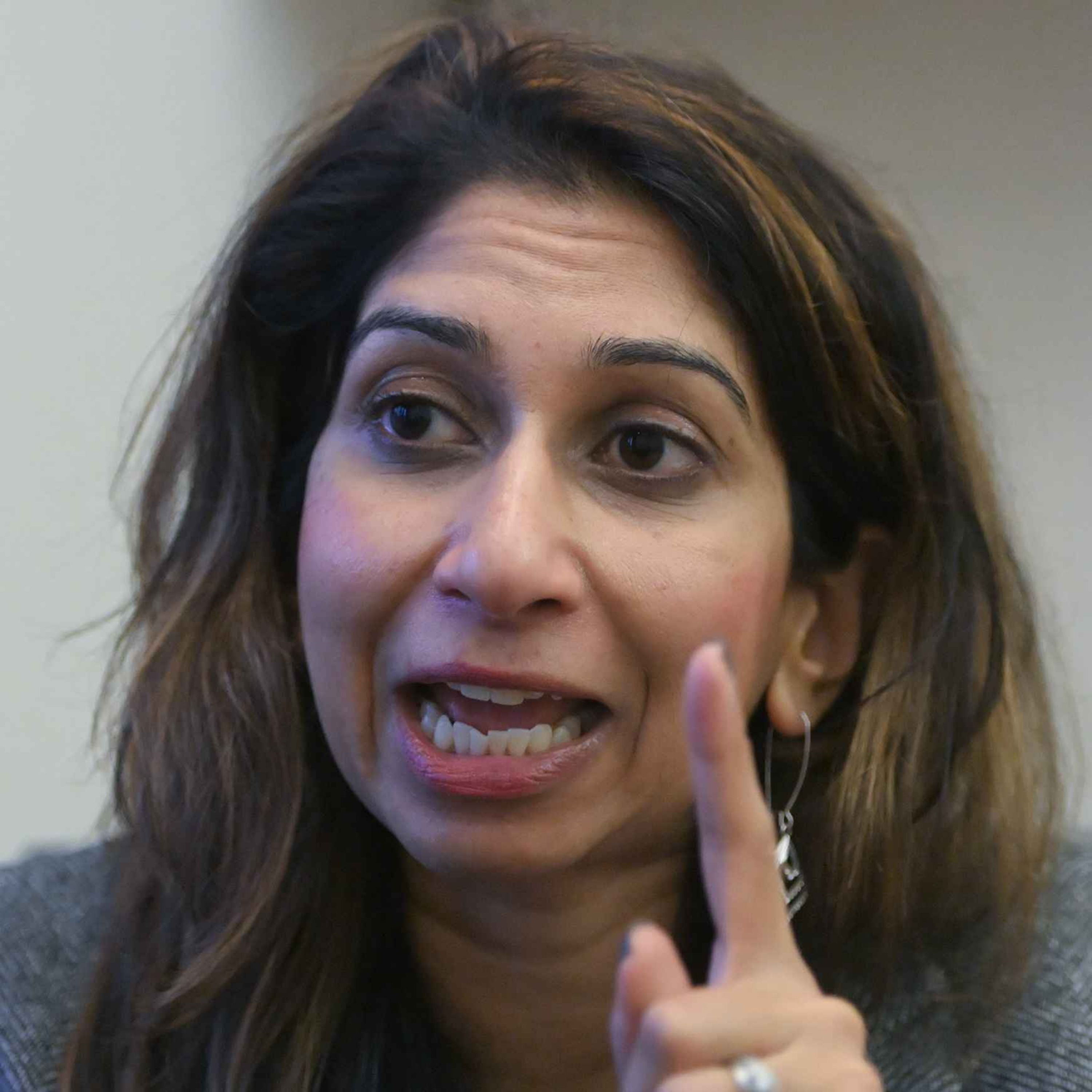
Former UK Home Secretary Suella Braverman argues the UK should withdraw from the ECHR and repeal the Human Rights Act, claiming this legal framework blocks border control, asylum enforcement, policing, and accountability. She says “stop the boats” failed because ECHR injunctions (e.g., Rwanda flights) and subsequent court decisions made deportations unlawful. She also discusses “two-tier policing,” Islamist extremism policy (Prevent), and broader concerns about immigration driving social instability.
Suella Braverman (former Home Secretary; Conservative MP; author of a 52-page ECHR/HRA “roadmap to freedom” report). Hosts: Camilla Tomini and Tim Stanley (Daily Tea).
ECHR undermines parliamentary supremacy via foreign judges; Human Rights Act “rocket boosters” expanded convention influence; reform attempts (Interlaken process) failed; leaving ECHR need not end civil liberties because UK common law and statutes already protect rights.
Rwanda deportation flights blocked by an ECHR injunction; Abu Qatada deportation blocked; Colston statue acquittal using Articles 10/11; Ziegler case; Northern Ireland veteran charged after killing an IRA terrorist; Prevent “institutional cowardice”; Meaningful Vote 3 Brexit pressure and her crying in Parliament.
Written by AI. May contain mistakes.
Discussing British identity, historical figures, and social values.
“Welcome to The Daily Tea with me, Camilla Tomini.”
Suella shares her views on the impact of the ECHR on UK immigration law.
“back in 2022 when I was Attorney General, much to the dismay of some of my colleagues at the time.”
Exploring the difficulties in deportation cases influenced by human rights.
“We've not been able to deport foreign terrorists because of their human rights.”
Examining the flaws of the Human Rights Act and its effects on UK sovereignty.
“We have carved out exceptions in the past, haven't we?”
Suella describes her experience and frustrations as Home Secretary regarding border control.
“So this saga is where a law was passed by the UK Parliament banning prisoners from having the vote.”
Explore the frustrations and realities of managing UK border control from a former Home Secretary's perspective.
“I don't think we should have this fudge of being in but breaking the rules and pretending we're not breaking the rules and then proclaiming to the world that we're a law-abiding nation.”
Discuss the political implications of promises made regarding immigration and border control, focusing on Rishi Sunak's commitments.
“Well, by the time of the last general election, he'd already failed at stopping the boats.”
Examine the tensions between the Home Secretary and police enforcement during protests and issues of anti-Semitism.
“And Mark Rowley would probably counter-argue that it wasn't helpful to have the Home Secretary at the time being so critical of his force.”
Understand the challenges faced by the Prevent strategy in addressing extremism due to fears of being labeled racist.
“I think there's some truth in that because I fear for relations, community relations in our country.”
Reflect on the Conservative Party's failures and the need for accountability in light of recent electoral losses.
“The woke agenda, the trans rights agenda, the rape gangs, all of that happened on our watch and we didn't fix them.”
Reflect on the Conservative Party's failures and the need for accountability in light of recent electoral losses.
“but always wonder how you actually get involved with them for your own brand or organization?”
Suella Braverman reflects on her loyalty to the Conservative Party amid ongoing scrutiny and speculation about her political future.
“And I ask you that because you've already spoken about how difficult it is to be a Home Secretary.”
Exploring the motivations and concerns of political loyalty and personal future within the party.
“You're always going to take the flack, whatever happens, regardless of the powerlessness that you felt.”
Discussing the implications and benefits of not being in the shadow cabinet.
“Listen, I'm very happy to serve in my role at the moment.”
Examining the relationship between ECHR membership and proposed policy changes.
“He's a very eminent lawyer and he will do a very good job on making his recommendations.”
Analyzing the flexibility and potential modifications of the Belfast Agreement in the context of ECHR.
“So the Belfast Agreement is not set in stone.”
Discussing the implications of exiting the ECHR on human rights protections.
“because I think it's a rather good one that gets to the heart of all of it.”
Exploring how common law can provide robust human rights protections independent of ECHR.
“For centuries before the ECHR was even thought about, the English legal system, the UK, has been protecting civil liberties back to the dates of Magna Carta.”
Discussing the need for a cap on legal migration and potential reforms to achieve it.
“First of all, what do you think of reform's net zero migration idea?”
Debating the impact of travel bans on countries and the need for stronger immigration controls.
“I'm just getting my phone out to look at a story that has got a lot of traction online involving a man who was helping Pakistanis get into the country on the basis of false papers.”
Discussing the repercussions for countries that do not cooperate with immigration policies.
“The government would need to be releasing prisoners, British prisoners early.”
Explore the intense pressure faced in Parliament and the personal toll it takes.
“But you're sounding like Nigel Farage now.”

Get the gist, explore an idea or ask about something said.
 Claude
On The Daily T, what are the key points of this episode?
Searching your listeningAutomatic transcript. May contain errors.
0:02The Telegraph.
0:30with fast shipping before move-in day. Get everything you need for back-to-school season. Shop Wayfair.com today. Wayfair, every style, every home. You've got social dialed in. Search is doing its thing. So why do your marketing results look the same as six months ago? That's because you're fishing in the same pond as everyone else. Podcast listeners are a different audience entirely. More engaged, harder to reach through traditional channels, and ready to act when someone they trust makes a recommendation. We're Acast. and we put them right in front of you. Browse thousands of the world's leading podcasts, book host reads or run your own ads, and track every conversion in real time.
1:10Same skills you already have, brand new results. Acast. Acast.com slash advertise.
1:22She's one of the most outspoken politicians in Britain. Former Home Secretary Suella Braverman joins us to discuss many things, including her famous falling out with Rishi Sunak and her new report on how we leave the ECHR. It is always fascinating and revealing to talk to Suella, who tells us what she thinks about reform and Nigel Farage, about crying in Parliament, about the need to reduce immigration, why the Tories should still be apologising and why Keir Starmer is a complete fool. Welcome to The Daily Tea with me, Camilla Tomini. And me, Tim Stanley.
2:08Sweller Braverman, former Home Secretary, joins us in the Daily Tea Studio. Your debut appearance here, I think, in the flesh, isn't it? Possibly. And let us please offer you a cup of tea from the Big Yellow Teapot. Do you drink tea? I do, yes. Would you like one? One cup of tea a day is all I do, so yes, please. Is this the... Oh, we're honoured to be serving you your one cup of tea. Yes, my exclusive cup of tea. Okay, why just the one? So I have one coffee in the morning to make me functional and one tea. And if I have more caffeine, I can't sleep. Oh, really? Yes. Okay, okay. This is like caffeine afternoon.
2:42Yeah, yeah, yeah. Yes, please. Say when. That's perfect. Thank you. The question we like to ask is, if you could have a cup of tea with anyone in history, who would it be? Oh, goodness. Well, Alfred the Great is of the moment, isn't he? Did you see that GB News interview? That's such a, not only a niche answer, but a niche reference that it would require us about 40 minutes to explain. This is a GB News interview. I've missed this. They stopped a young man in the street and they asked him about British values and they interrogated him and they gave him a list of historical names to see if he recognised them.
3:17And one of them was Alfred the Great. It's divided people because some people say he's just an ordinary British bloke and no one knows about Alfred the Great. I've got coffee. Thank you. Thank you. Other people are saying, you ought to know about Alfred the Great if he's truly British. But, I mean, surely most Brits, you can still be British, totally British and be completely ignorant of Alfred the Great. Totally. In fact, I would invite that chap who was interviewed and Alfred and we'd all have a cup of tea together. Because I thought that chap was, he didn't do anything wrong. He didn't say anything hostile or negative about Britain.
3:49He was a regular guy. He was put on the spot. OK, maybe not the most articulate, but didn't say anything negative or horrible about our country, which is what we often hear. I agree. And, you know, he didn't know all of his history and his facts, but that's entirely fine as well. So we've got to welcome everybody and accept everyone. Values are lived, not articulated. Yes. People don't go around in their daily lives saying, I'm going to offer you a cup of tea because we're British. Yes. They just do it because they're British. Absolutely. There we go. We shouldn't have a snobbery. No. And a purity test in that sense.
4:22Wow, that wasn't how I was thinking we would start this podcast. We're actually here to talk about British constitutional law. That's a very good way in, actually. Shall we start with the topic, the hot topic of the era, which is the ECHR and your views on it? I mean, first of all, what's wrong with our adherence to it? Well, I think I'm right in saying I was one of the first, if not the first, sitting Tory minister to call publicly for us to leave back in 2022 when I was Attorney General, much to the dismay of some of my colleagues at the time. Three years on, it seems that some of those same colleagues have changed their mind and it looks likely, I think, that the Conservative Party will shift and probably formally announce a policy of supporting withdrawal later this year.
5:10I don't know. But you've asked me what are the problems with our membership. For me, as I say in the report actually and our film, the final straw was when we had the planes on the tarmac with illegal migrants on those planes ready to be deported to Rwanda. And that was an agreement that had been struck by this sovereign government with a mandate to stop the boats. And it was all perfectly legitimate. But at the 11th hour, an unknown judge pursuant to an opaque process in the Strasbourg court intervened and issued an injunction. on those flights. And as a result, those flights never got off the ground.
5:57And it was pretty much fatal to the whole policy because following that decision by the European Court of Human Rights to block those flights to Rwanda, we then set off a series of appeals and court action culminating in a Supreme Court decision, which was handed down while I was Home Secretary actually, that ruled that the whole policy was unlawful. So that was just one little example of how our membership of the ECHR has thwarted our ability to control our borders. Forgive me for asking this, but I was under the impression that if Parliament said something was so, that is what is lawful. Is that not correct?
6:38Can Parliament not just say, actually, we've taken your advice, ECHR, but we as the sovereign body are going to vote and pass a law that says you're wrong and you can do Rwanda. Well, that is the theory of parliamentary supremacy, which is the foundation of our democracy and our constitution. However, our membership of the East HR has very largely undermined that notion of parliamentary supremacy, because as long as we've been a member of the court and the convention, it's foreign judges and interpretations of the convention that can effectively tell our parliament what to do. And that's why, you know, parliament passed three acts of parliament, three laws to stop the boats.
7:19As Home Secretary, I was unable to remove or deport a single illegal arrival to Rwanda because of the convention, the court or interpretations of the convention in our own courts. Is this just about Rwanda or are there other areas of law? I mean, so in other words, is this just you complaining because you had this one policy that got frustrated or are there other ways in which the ECHR... So many other areas. So So stopping the boats is one big example. Broader asylum policy is hamstrung by our membership of the convention. So we've not been able to, again, I list it in the paper, we weren't able to deport a foreign paedophile because of his human rights.
8:03We've not been able to deport foreign terrorists because of their human rights. Theresa May was blocked for years from deporting the Al-Qaeda terrorist Abu Qatada because of the European Convention on Human Rights. So asylum, deportation, immigration policy is one big area. Another big area is protesting and policing. So you'll remember the Colston statue case. Now, this happened when I was Attorney General, and I was able to fix it. So it's not just about passing the buck and blaming someone else. I was able to fix the problem. Situation there, BLM rioters pulled down the Colston statue in their protest.
8:40they were arrested and charged with criminal damage, rightly so. But at trial, they were acquitted. They were acquitted of criminal damage because they used the defence of human rights, Articles 10 and 11. And that served as a whole defence. That the statue was a threat to their human rights. They said that their right to assembly and freedom of expression was more important than the police's power to enforce civil order. And as Attorney General, I challenged that case on the law and was able to correct it, but only after years of legal chaos. And that's because of a seminal case called Ziegler.
9:23Ziegler is a Supreme Court case which interprets the convention in a very broad way and basically says that militant protesters have very broad human rights, even when they're obstructing the highway or committing criminal damage or breaking the law in other ways. So protesting and policing rights is one example. And another large example I talk about is veterans and the mistreatment and I would say the persecution of some of our veterans through the courts for decades after their brave service, notably in Northern Ireland. And I cite one case where we've got one soldier who was in Northern Ireland during the Troubles.
10:02He was defending the realm. He killed an IRA terrorist, a known IRA terrorist. And ever since then, he's been under investigation five times. And he's been charged with murder simply for defending our country and fighting the IRA. the rights of IRA terrorists have become more important than your rights or my rights. So if we listen to the constitutional law expert Lord Sumption he will point out that the original aims of the treaty were good and we entered into membership with the best of intentions but that actually since the introduction of the Human Rights Act legislation under Tony Blair it's the interpretation of the law by lawyers in this country I take your point about foreign judges, but this lawfare that has been waged on the back of this legislation is what is problematic.
10:59We have carved out exceptions in the past, haven't we? For instance, David Cameron on prisoner voter rights. We also know that other countries that are signatories to the convention actually ignore parts of it and do what they wish. So to what extent is this a problem with our own judiciary as well, Suella? It is. There is a problem with our own judiciary as well. And that's why my plan is not narrowly focused on mere withdrawal. I do note that we need to repeal the Human Rights Act. That's part of the plan. Because unlike other European countries, we've got this extra piece of domestic legislation in the form of the Human Rights Act, which, as Lord Sumption rightly says, was passed in 1998 under Tony Blair.
11:41It was kind of hailed as bringing rights home. And boy, did it bring rights home. It really put rocket boosters on the ECHR and it further undermined parliamentary supremacy. It has really been one of the main reasons why our border control is non-existent and we've been so emasculated in carrying out state functions in many ways. So the Human Rights Act needs to go. You've talked about attempts at reforming the ECHR and David Cameron's prisoner voting saga. Again, as my paper sets out, there's been many, many attempts to reform from within over the last two decades. It's called the interlaken process.
12:26There's been conference after conference. There's been tweak after tweak. You know, there's been lots of talk, but nothing material has resulted from any of those reform projects. prisoner voting is an interesting case study in kind of reasonable defiance, you might want to call it. So acknowledged breach. So this saga is where a law was passed by the UK Parliament banning prisoners from having the vote. And that was deemed to be in line with what the British people wanted. I think there was a mandate for it. It was challenged up to the European Court of Human rights and the European Court of Human Rights said, no, this law is illegal and it's a violation of human rights.
13:11The UK government needs to strike it down. You're in breach. Now, for decades, both the Labour and Conservative governments acknowledged that we were in breach of international law, of the European Convention. But they kind of kicked the can down the road and they paid lip service and they said to the councillor, yes, we're going to consider. And they did that for five years. Yes, we're going to review the situation. And they did that for another five years. Yes, we're going to consult. And they did that for another five years. And they just dragged their heels knowingly in breach of the convention.
13:43Now, that is a possibility. We could just breach the convention brazenly and, you know, refuse to comply. I don't think that's intellectually honest. And I think we're either in and we abide by the rules or out and we're free to do what we want. I don't think we should have this fudge of being in but breaking the rules and pretending we're not breaking the rules and then proclaiming to the world that we're a law-abiding nation. I don't think it's intellectually or legally coherent. Can I just pick you up on one thing that you just said in that as a former Home Secretary that I think people will find quite staggering?
14:21You said border control is practically non-existent. Now, is that how you felt when you were Home Secretary. Can you just take us inside the Home Office? The perception among the Telegraph audience is that border control is in total chaos, that the department itself is not fit for purpose. That was something a predecessor, John Reid, said back in the 90s. Were you, Home Secretary, tearing your hair out going, we need to stop these illegals, we need to bring down legal migration, and having civil servants push against it? What was it like? It's very frustrating because everyone expects you as Home Secretary to fix the problem and holds you responsible.
15:03Rightly, you are responsible, but you're powerless. So you're the figurehead for the blame and the failure, but your hands are tied because of the legal structures, because of the labyrinthine system that we're working in. And the net effect is that, yeah, we have an open borders system. We have open borders in this country. You only have to look at the beaches of Dover any day to see that. People are brazenly breaking into our country, largely with impunity. They know how to do it. They know that they can get away with it. They know that it's the path to a life in the UK. and if they can get the right legally aided lawyer and play the system, they're probably set up for a future in the UK unlawfully and they don't care and there's nothing we can do about it at the moment.
15:54Did you sense that there were some public officials who didn't believe in border control? Yes, to a degree, yes. But I am not one of these politicians who likes to blame the civil servants. They are unidentifiable and they are following orders. The reason we failed was not because of the civil service. The reason we failed is because of lack of political will. I grew frustrated and eventually it was an unsustainable relationship with my prime minister and cabinet colleagues because no one around the cabinet table really wanted to do what was necessary. We went through the motions of passing another law and building up the expectations.
16:36But the reality was that no one around the cabinet table wanted to do the essential difficult work, which was to leave the ECHR and radically reform our laws. So when Rishi Sunak kept on saying, stop the boats, stop the boats, stop the boats during the last general election, was he lying? During the last general election? Well, by the time of the last general election, he'd already failed at stopping the boats. He'd had just over a year to stop the boats. He'd passed a law. He passed two laws to stop the boats. He had promised to stop the boats. He'd broken the promise by the time of the general election.
17:11I don't think anyone believed him. So was he fibbing? I mean, do you think that you wanted to stop the boats, but he didn't? I don't think he wanted to do what was necessary. I mean, you'd have to ask him what was his intention when he was saying those things. But ultimately, it's all right making a promise to stop the boats, but you've got to be willing to do what's necessary. It might be difficult, but it is necessary. My plan is not necessarily easy, but it is the right thing to do if we're serious about fixing this problem. Because the former prime minister has since said, oh, I shouldn't have been that binary and I shouldn't have stated something that couldn't ever be achieved.
17:49Well, I think it's also worth remembering why Suella left office, which was specifically over the issue of two-tier policing, which now makes you look prophetic. Remind us, you were saying that the police were treating some protesters differently from others, which has become something of a theme of the Starmer government. Yes. Yes. Well, I grew frustrated again. I mean, there were many frustrations over the year and I'd bitten my tongue and been fairly kind of controlled in supporting the cabinet through, you know, the spirit of being a team player. But in the end, on the very serious issue of the post-October the 7th marches and these hate marches taking place with hundreds of thousands of people spouting anti-Semitic language and chants.
18:42Remember, they broadcasted from the river to the sea on onto Big Ben, didn't they? They were firing flares. Armistice Day. They wanted to go ahead with a march. That was the final straw for me because the police, to my mind, were not taking robust action to stop these marches or to arrest, more importantly, to arrest the wrongdoers. And they were standing by lamely. And I would have conversation with the Met Commissioner after conversation saying, why aren't you arresting people? They're breaking the law right in front of your very eyes. Why aren't you enforcing the law? And we had this debate and he said, well, I'm not going to do that because that's going to spark a riot.
19:25And I said, I would say to him, well, you guys are there to enforce the law and maintain civil order. If people are breaking the law, you should arrest them and then you should deal with any issues that flow from that. But that's how we send the message of zero tolerance, because at the moment you're sending the message that all of this criminal behavior is OK. and people are getting more and more emboldened. And I expressed my concerns about two-tier policing and the Prime Minister didn't back me up and I left Cabinet as a result. Were you fired or did you resign? No, he sacked me, yes. And Mark Rowley would probably counter-argue that it wasn't helpful to have the Home Secretary at the time being so critical of his force.
20:13I would counter that it wasn't helpful that the Met Commissioner was absolutely failing to enforce the law or actually keep our streets safe. And it's all right for him to pass the buck and hide behind elected ministers. But ultimately, the Met Commissioner, the Met Police has wholly failed on these marches. We now have a normalized anti-Semitism. We have extremism on our streets. We have people celebrating terrorism. And it's just become accepted. And that's because the police have failed time and time again to stamp it out. And ultimately, I lost confidence in the Met Commissioner. So there was no possibility of us working again together.
20:57Did you try to bring in any measures when you were Home Secretary to clamp down on Islamic extremism? For instance, I've still been trying to work out speaking to various people in your party and now out of it, including Michael Gove, whatever happened to David Cameron trying to prescribe the Muslim Brotherhood. It's a big feature of a lot of the rhetoric around extremism in the UK today. What involvement did you have with that? Did you try and clamp down? Did civil servants and others push back? And then we can perhaps get into the rape gangs as well on that. So I was very interested in Prevent.
21:36And Prevent is our counter extremism program in the Home Office. And my view is that Prevent was broken, and that it wasn't doing enough of a robust job identifying Islamist extremists in our community and dealing with them. And it was distracted by other issues. And so William Shawcross, Sir William Shawcross issued a report on how to fix prevent. He issued that while I was Home Secretary, a very comprehensive report. He talked about an institutional cowardice, which I think sums up the problem. Again, similar to rape gangs, a kind of fear of being called racist. So therefore, people who are tasked with the job of identifying extremism on the ground and taking remedial action have held back out of fears of being smeared as Islamophobic or racist.
22:34And that's a culture that has infected Prevent. And that's why it has been broken for some time. So we instituted some changes. Did I have long enough for those changes to take root and actually turn the organisation around? No. And I'm afraid we still have a system that is not fit for purpose when it comes to tackling Islamist extremism. Nigel Farage has said that he thinks Britain is on the verge of societal collapse. Do you agree with that? I think there's some truth in that because I fear for relations, community relations in our country. I sense a lot of malaise, a huge level of frustration, anger and fear amongst regular ordinary folk because of out of control immigration, because of an arrogant and dismissive elite and establishment, which keeps branding anyone who voices these fears as far right or racist, and no sign of any solution on the horizon.
23:36And I think that that is a very toxic combination because people will then feel they've got no option but to take things into their own hands and then things can rapidly spiral out of control. So I do fear for the state of civil order in this country. And do you agree with Alex Burghardt that the Tories should continue to apologise or is it time to move on from saying sorry? I think that we have a lot to apologise for. We failed. This is why on the night of the general election, I said sorry. I was re-elected in Fairmont Waterlooville. And the first thing I said was, I am sorry on behalf of this Tory government.
24:16We failed on immigration. We failed to cut legal migration, stop the boats. We failed to cut taxes. The woke agenda, the trans rights agenda, the rape gangs, all of that happened on our watch and we didn't fix them. And so, yeah, a big apology was owed then. And I think it's still owed. I mean, Rishi Sunak's team were absolutely furious that you wrote that op-ed for The Telegraph two days before everyone went to the polls saying all this. Of course, that's the reason why we lost the election. That's why we had our worst ever result in history. It's The Telegraph got lost it. Yes, it's my 700 words on page 15 of The Telegraph, you know.
25:00I know, but then I suppose the criticism was that you could have been more of a team player at that point. But did you just feel it was like rearranging the deck chairs on the Titanic? What I was very concerned about during that campaign was, I mean, one, it was a very badly run campaign, whether it was the actual announcement, whether it was the gambling issue that came out, the betting fiasco. So D-Day. Oh, my God, D-Day. D-Day. You know, so and then set against our backdrop of policy failure. I mean, there was only going to be one way that was going. Listen, I went around the country helping lots of colleagues to get elected.
25:47I delivered leaflets all around the country in places which were not my own constituency. I think that's teamwork. I stood on the manifesto set out by the party, even though I didn't agree with every single thing, that it said. I think that's teamwork. And ultimately, I think that there was a lot of, there still is to a degree, there's a bit of arrogance and complacency within the Conservative Party that we haven't done anything wrong. And I think a bit of humility and candour is not what's going to turn things around, but I think that it's necessary. Coming up, Suella tells us what she really thinks about Nigel Farage and reform, why she dislikes Starmer so much, and the time she cried over Brexit.
26:36Back to school is busy enough. The last thing you need is shopping that makes it harder. Whether you're moving into a dorm, your first apartment, or just getting organized for the semester, Wayfair makes it easy to get everything you need in one place. Furniture, bedding, storage, decor, study essentials, all at prices you'll love with fast shipping before move-in day. Get everything you need for back-to-school season. Shop Wayfair.com today. Wayfair, every style, every home. Do you keep hearing podcast ads, like this one, for example, but always wonder how you actually get involved with them for your own brand or organization?
27:13Well, it's easier than you think. We're Acast, and we give you the platform to do it all yourself. Browse thousands of popular podcasts, choose the shows that match your perfect audience, set your budget, and launch. And if you want a hand, our podcast specialists are there to help you launch with confidence. This is podcast advertising without barriers. Get started at Acast.com slash advertise.
27:47How much have you considered over the course of recent months and perhaps even years, your core conservatism? And I ask you that because you've already spoken about how difficult it is to be a Home Secretary. You're always going to take the flack, whatever happens, regardless of the powerlessness that you felt. You're also a brown woman who, a little bit like Kemi Babenock, has been accused of being a coconut and had all of these other racist slurs hurled at you. You're a mum, so you'd have concerns about just domestic and family matters in the UK. and then there has been a lot of speculation are you going to remain in the party are you going to defect to reform we know about your husband having been in reform and recently left because of Zia Youssef's criticism of you and Robert Jenrick over the Afghan data leak I mean if I were you I'd be kind of considering whether I have a future in the party and why I'm flogging my guts out for all of this shtick Oh listen I've been a member of the party I think since I was 15 years old.
28:54So a very long time. And my family's in the party. I've just been elected, re-elected as a Conservative MP. I've got a wonderful team of people who are local Conservatives in Fairham Waterlooville. And we're like a family. So it's family for me. I've been elected as a Conservative MP. I hope that continues for a long time to come. Don't you want to play a more prominent role in the shadow cabinet, which is currently being reshuffled? Oh, right. OK. Well, what does that mean? Listen, I'm very happy to serve in my role at the moment. Listen, one benefit of not being in a shadow cabinet is that I'm free to set out what policies I want.
29:39If I'd been in the shadow cabinet, I would not have been able to put out a 52-page, well-researched report on policy, and which I think is a compelling argument. It's something I really believe in and I think it's necessary for our country, for our freedom. It should be subtitled the roadmap to freedom and I feel I've been able to put that work in off my own back for the good of my party, whichever party wants to take it, for the good of my country. I wouldn't necessarily have that freedom if I was in a shadow cabinet team. How does your report tie in with the review that's being done by Lord Wolfson into the ECHR, which Kemi launched?
30:19Well, my report is available for Lord Wolfson's consideration. I very much hope that they will read it. I mean, do you have confidence in Lord Wolfson's review because he's previously spoken very highly of our membership of the ECHR? Listen, I know Lord Wolfson. He's a very eminent lawyer and he will do a very good job on making his recommendations. I have no doubt about that. Do you think it's just a case of going through the motions? Because you said earlier, you have a suspicion that you will end up in the position of saying, look, we do want to leave. It's not reform, it's actually leave. It's a bit like Brexit.
30:53You know, we can't reform our position, therefore we need to leave the ECHR. Do you think that Bade Knock is just making sure that the wets in the party know that they've thought it through very, very carefully, but ultimately, for political expediency, let alone for the issues that you've identified, it's a no brainer? I think it would be pretty bonkers if the Conservative Party didn't adopt the policy of withdrawing from the ECHR in light of the, you know, very compelling case of the problems. I set out my paper the way reform has failed, where other proposals to tweak and repeal the HRA or change the HRA, but remain in the convention.
31:36You know, all these alternatives, they've all been considered. They've all to a degree been tried. None of them have worked. And I think, you know, it is a serious policy position to adopt. I think, yeah, I think it's more likely than not that the Conservative Party, it will become official Conservative Party policy. The thing about my paper is I do deal with one of the big objections that's often... I was about to raise, which is the thing I suspect we need to cover because people will say, what about Northern Ireland? There is a view that from the Belfast Agreement onwards, it was understood in the peace process that Britain and Northern Ireland would be within the ECHR and that that was essential to understanding between the two communities.
32:15It's there in the Northern Ireland Act, etc. So is that criticism at all fair that following this policy could actually endanger the peace process in Northern Ireland? No. So I think, and I deal head on with this issue of Northern Ireland, and I've gone through the Belfast Agreement, I've gone through the history of the Belfast Agreement. You're right, The Belfast Agreement makes references to the ECHR. Nowhere, however, in the Belfast Agreement does it commit the UK to membership in perpetuity and entrench it constitutionally or give it some kind of elevated status. It is referred to. That is true.
32:53If you look at the evolution of the Belfast Agreement in the last two decades, it's been changed. It's been chopped. It's been changed. It's been adapted. It's been ripped up, actually, if you were to believe the late Lord Trimble, who said that it's fundamentally been breached by the Northern Ireland Protocol. And yet life carried on. So the Belfast Agreement is not set in stone. It has changed on many occasions through negotiation and discussion. I believe, therefore, there's a precedent that it can be changed again. And the spirit of the Belfast Agreement, i.e. peace through fairness, can be maintained.
33:30The protection of rights can be maintained. And importantly, Northern Ireland can enjoy the same human rights laws as the rest of Great Britain. The key issue here is we mustn't make the same mistakes as Northern Ireland Protocol or the Windsor Framework and leave Northern Ireland behind in any big legal change. It's often been the case. And now we have a trade border in the middle of the UK. Northern Ireland must not be left behind. And so all of the United Kingdom should be taken out of the ECHR. The HRA should be repealed for the whole of the United Kingdom and a rewritten Belfast agreement should be the basis of ongoing peace in Northern Ireland through consultation and amendment, consultation with the communities of Northern Ireland, the main political parties, negotiation with the Irish government.
34:25It can all be done with the right political will. I want to ask a question submitted by our work experience boy, James Keegan, because I think it's a rather good one that gets to the heart of all of it. Nigel Farage has said that he wants to send criminals to El Salvador. Now, if he does that, they are at the risk of poor conditions and torture. If we are outside of the ECHR, how do we guarantee that this sort of thing does not happen? And it goes to the heart of it, because people who are pro-ECHR, yeah, OK, some of them are just wet liberals who just resent us leaving the EU, but many of them also regard it as a backstop when it comes to fundamental human rights.
34:59And they're worried that if everything's just in the power of parliament, that a majority could come in and do something like say, well, we'll send people we don't like to a country that practices torture. And they're worried that because we're outside of the UCHR, because there is nowhere else to go to to protest that, they're worried that fundamental human rights would be at risk. That would be to misunderstand the origins of human rights protections. And the key thing here is that coming out of the ECHR does not need to mean, nor will it mean, a scrapping of civil liberties or a burning down of human rights.
35:36We had human rights protections to quite a sophisticated degree, I should add, in 1950 when the ECHR came into force or when we signed up to it. For centuries before the ECHR was even thought about, the English legal system, the UK, has been protecting civil liberties back to the dates of Magna Carta. The right to life, Article 2, is protected in parliamentary statute, the Offences Against the Person Act, 1861, and the common law, homicide, other laws which have evolved through our courts. The right against unlawful detention is protected in the Police and Criminal Evidence Act 1984 and the common law.
36:27So we have a very high functioning and highly evolved legal ecosystem in this country. The convention has been a document that has been imposed above our system originally, merely as a kind of aspirational declaratory document. But with the court and over the years and with the changes, it's become more and more embedded in our legal culture. You can take that away and you can actually revive our common law. You can make it much more faithful to the tradition of English jurisprudence, which is the common law, which is judge made law, which is predictable, flexible, much more honoring the spirit of and the application of parliamentary supremacy.
37:13There's a reason why the common law is emulated around the world. It's because it's incredibly pragmatic and it is very rich. It's very rich. And it's not about a top down blanket approach of rights written out in stone and imposed from high on above with judges allowed to claw onto a word and then expand it. It's about resolving disputes as they arise, building the law out of disputes in an organic way. That's what the genesis of the common law was, supplanted by parliamentary statute. And so there is ample scope for allowing the courts plus statute to provide the protections you talk about. Can I ask you a couple of questions about legal migration?
38:03First of all, what do you think of reform's net zero migration idea? I think it's a good idea, actually. I think that we need, again, we need to commit to a cap. But we need to actually be honest about what that cap is. And I think, you know, as low as possible or in the tens of thousands, it's not credible. And so I can see where reform is coming from. They're trying to give a number and show seriousness about the commitment. ultimately we need fewer people to come into this country than we are currently or have done historically and allowing for emigration yeah I mean I think it's going along the right lines.
38:49And it's workable that if a figure was produced that a home secretary could enforce it. Yes if you have a labour market assessment and if you have the right changes in place on our legal migration system like, you know, this is what I wanted to do but was blocked. You know, if you raise the salary threshold, it's a very sensitive system. It can respond very quickly to changes. Salary threshold, I don't know, was 26 ,000. If you raise that to 30 ,000, if you raise it to 32 ,500, you know, there are consequent changes in the inflow just as a result of actual quite minor changes to the salary threshold.
39:25I would say, you know, raise it to 40 ,000, actually, if you want to get the drop to be dramatic. But, you know, you can make those changes. A whole raft of operational changes can be made to actually get the numbers down. But then don't you need carve-outs for healthcare, hospitality and such? You can make that decision depending on what your labour market needs are. But I would also recall that we've got, you know, millions of people, Brits, on out-of-work welfare. And I would say far better to start recruiting from that pool of people before recruiting from abroad. I'm just getting my phone out to look at a story that has got a lot of traction online involving a man who was helping Pakistanis get into the country on the basis of false papers.
40:04And it's raised a question around actually Donald Trump's travel bans. What do you think of the idea of saying, no, actually, we're not going to take people from specific countries? The story is about migrants scamming their way into Britain using forged visa documents brought from consultants boasting openly about weak border controls. Pakistani migrants are paying up to£50 ,000 for visa applications, which the Home Office is waving through, despite the documents being littered with errors and falsehoods. And this is a telegraph investigation by our colleague Sophia Yan. Very bad, very bad. Action needs to be taken against these people.
40:43If they're a lawyer, if they've got professional qualifications, it's the professional regulator that should be investigating and kicking this person out of the profession. and if they're breaking the criminal law, the police should be involved. But you know what? I would be in favour of travel bans on particular countries. Which countries spring to mind. Difficult for me to say at the moment, but I do think if you looked at the data and you looked at where are the most illegal arrivals coming from, then I think there needs to be more robust action. And if some of these countries are not taking back their prisoners, for example, we have 10 ,000 foreign prisoners, foreign national offenders in our prisons.
41:22You know, our prisons crisis would be solved largely if we were able to remove that cohort and free up those 10 ,000 spaces. The government would need to be releasing prisoners, British prisoners early. You know, if there are countries who are unwilling to take their offenders, then we should have. We should have some kind of ban. I think there needs to be robust action. That's a problem with this country to a large degree. We don't follow through with robust consequences, whether it's our weak human rights laws or whether it's our pathetic policies towards countries who don't cooperate with us.
41:59That's why we're seen as a soft touch. But you're sounding like Nigel Farage now. Is that right? Well, you are echoing some of the rhetoric from yesterday. A lot of people sound like Nigel Farage. That is true. If you've been down to the pub in Waterlooville recently, everyone there sounds like Nigel Farage. Well, do you think he has a serious, incredible prospect of becoming the next prime minister? Listen, all of these kinds of predictions are very intriguing, but we're so far out from a general election. Anything can happen. It's, you know, the polls don't look good for the Conservative Party right now.
42:32There's no denying that. They don't look good for Labour. And yeah, reform is doing very well in the polls. But let's see what happens. We're very early. I say this because you're speaking like somebody who, from what I'm reading, from what you're saying, appears right now more inclined to vote for reform than your own party. I mean, that's how it sounds to me. You're laughing. Well, I mean, listen, I'm a straight talking politician. Sometimes it gets me into trouble. But I'm in this role because I just want to be honest with people about what I think. I like giving a straight answer. Yeah, you know, this is what I believe we need as a country.
43:08Labels are kind of irrelevant to me. I've been elected on a basis. I'm going to honour that election and, you know, do good by the thousands of people who sent me to Parliament to work for them. and to be honest, nothing's going to stop me expressing my honest views. Fair enough. Well, let's have some short straight answers to conclude with. This is scary. I mean, I know I said I'd give straight answers. No, no, no. I know you don't want to. Have you ever cried in Parliament?
43:39Yes, I have, definitely. I've had very difficult moments in Parliament, absolutely. I'll tell you where I cried. I cried on the day of Meaningful Vote 3. Meaningful Vote 3. Cast your mind back to... It's not something which makes me well up. It's the fog of the Brexit war now that we're getting. Meaningful Vote 3. Was that Theresa May? For most people, it's gone with the wind when it makes them cry. For me, it was Meaningful Vote 3. Yeah, it was. It was one of the most, I think it was one of the, yeah, it was the most difficult day in my professional life. Right. Because, as you remember, so I resigned over the terms of Theresa May's Brexit deal in the November of 2018 because I didn't have confidence in what she was doing to Northern Ireland.
44:20Basically, the deal was going to scupper Northern Ireland. And then the deal came back for votes, didn't it, at the beginning of 2019. And Meaningful Vote 1, there was a massive rebellion. Tory MPs rebelled. She put it back again for Meaningful Vote 2. The rebellion got smaller. So they were able to talk out some of the rebels into supporting the bill. And then she tried again. Didn't quite get it through. Tried again on Meaningful Vote 3. And the pressure, the pressure from the party powers and the establishment of the party was immense. And I held out and I was a Spartan. Telegraph, Telegraph was a Spartan.
44:55I think you were the only publication that held your objection out to the deal. Everyone else, even in the right wing media, had caved by that point. And I just couldn't change my mind on the deal. Nothing had changed to the terms of the deal. It was still a betrayal of the Brexit referendum. It was still going to undermine Northern Ireland's position. But we were being accused, similarly to what you just put to me earlier about the generation, accused of being traitors, accused of not being team players, accused of letting Jeremy Corbyn in. And we are being accused. And in the tea rooms of Parliament and in the Commons Chamber, my own colleagues were being very aggressive.
45:35Everyone was it was a very anxious situation. You know, was Theresa May going to win this? It was going to make or break her premiership. And the pressure was immense. I've never felt as much pressure, social pressure, social pressure from your colleagues and your contemporaries to join them. And if you didn't, you're a traitor and you're scum. And I remember crying. I cried because the pressure was so much. And I felt so torn between my party loyalty and being made to feel like, you know, as if I was committing a gross act of betrayal. and on the other hand, doing what was right for the country and honouring the referendum and Britain's freedom and our place in the future.
46:21And that was a real conflict for me internally. I did cry. And that was before the vote because I was so troubled by what to do. In the end, I took myself to my office and I just stayed by myself and I cut off from everybody else. And when the bell rang, I went with a few colleagues who were friends of mine who were also voting the same way. We all linked arms and we went through the no lobby and we voted against as Spartans, as one of the 28 Spartans who held out. Can we name names? Who was one of the most aggressive in their criticism? I'm not going to name names. I'm not going to name names.
46:59I'm not going to name names. But there were a lot of people. That story, that gives one greater sympathy for Rachel Reeves, right? I mean, looking at her crying at the dispatch box, do you sort of feel? I mean, this is going to sound very harsh, I imagine, but I don't have sympathy for Rachel Rees crying at the dispatch box. I'm really sorry. She's the Chancellor of the Exchequer, a leader of the G7 economy. It had an impact on the markets. And I don't think it's professional to cry in public, especially if you're a very senior public figure. So I will admit that I cried. I kept my tears private.
47:32but I don't hesitate in admitting that I cried. I found it very, very difficult and I know everybody has difficult days and people are human and they have lots of things going on in their lives but I do think for someone in that role with that responsibility there's a limit to what is acceptable publicly. Knowing how vicious politics is do you believe this rhetoric around Rachel Reeves and Angela Rayner being at loggerheads? I can imagine it to be true. Yeah, they're both ideologically different when it comes to the Labour Party. And Angela Rayner obviously wants to succeed Keir Starmer. She's got a large hinterland within the party.
48:15She's in a very strong position to take over if Keir Starmer falls. So, yeah, I can very much imagine her being at odds with. She wants to spend more. She doesn't believe in cutting taxes. She wants to put them up now. We've got a tourist tax coming, apparently. Yes, yes, I read about that. Exactly. And, you know, her workers' rights bill is a monstrosity, frankly. Her changes to local government are horrific. You know, I disagree with most of what Angela Rayner says. So she's very much on the further left than Rachel Reeves. And so she doesn't really want to cut the welfare bill, I imagine. She doesn't really want to cut taxes.
48:51So, yeah, I'm sure they would be at odds with each other. And can you also, to conclude, give us your characteristically pithy analysis of Keir Starmer right now, please? I mean, because I ask you that as a former chairwoman of the European Research Group. I think I might cry now. And we may cry. He may cry if he hears this. But let's just see, you know, you're a leading Brexiteer. You're crying in your own office as he is one of the key proponents in opposition of trying to reverse the referendum. He's now a year or so in. It's not going great. I mean, is there a bit of schadenfreude going on here?
49:27Are you watching him and his approval rating tank with a huge amount of glee? Maybe even toasting it with a gin and tonic at times. I don't know. No, not with glee. Not with glee at seeing how badly he's running the country. No, I feel the angst that many people feel. I feel the fear. I've lost count of the number of small businesses in Fair and Waterlooville that I talk to. hairdressers, cafes, dry cleaners, the white van man down the road who are genuinely terrified of the prospect of the next few years and they think they might go under and those are small businesses that they've sacrificed and scrimped and saved and worked so hard for over decades and they might employ a few people but it's their livelihoods and they're some of the best people in this country and they're going to be the victims of this incompetent, clueless, vapid excuse for a fool that we have running this country.
50:34Suella Braveman, thank you very much. Thank you. Get off the fence. Right, we will be back with more Forthright Opinions tomorrow at 5pm.
51:13Back to school is busy enough. The last thing you need is shopping that makes it harder. Whether you're moving into a dorm, your first apartment, or just getting organized for the semester, Wayfair makes it easy to get everything you need in one place. Furniture, bedding, storage, decor, study essentials, all at prices you'll love with fast shipping before move-in day. Get everything you need for back-to-school season. Shop Wayfair.com today. Wayfair, every style, every home. Here's a tip for you. There's a podcast out there with fans waiting to be your next customer. They tune in every week, they trust the host, and that host wants to talk about brands like yours in their own words to their audience.
51:56The problem is, you just haven't been introduced yet. We're Acast, where that introduction happens. As the world's largest podcast marketplace, we let you browse shows, see who's listening, and book host-read sponsorships or run your own ads all from one platform. Transparent pricing, real-time data, complete control. Start advertising on podcasts by visiting acast.com slash advertise.
The former home secretary, Suella Braverman, is the special guest on today’s edition of The Daily T.
The Conservative MP and ex-attorney general explains why she thinks it’s time for the UK to leave the ECHR, how it’s thwarted our ability to control our borders and undermines the sovereignty of Parliament.
Braverman also talks through the frustration she experienced at being “powerless” whilst running the Home Office amid a “lack of political will” to get a grip on illegal migration. She also takes aim at former prime minister Rishi Sunak’s “broken promises” on stopping the boats, and outlines why there could be “some truth” in Nigel Farage’s belief that Britain is on the verge of societal collapse.
The former home secretary also explains why she remains committed to the Conservatives despite there still being “arrogance and complacency” within the party, as well as why she feels no sympathy for Rachel Reeves and her belief that Keir Starmer is “incompetent” and “a fool”.
Producers: Lilian Fawcett and Georgia Coan
Senior Producer: John Cadigan
Planning Editor: Venetia Rainey
Video Editor: Will Walters
Executive Producer: Charlotte Seligman
Editor: Camilla Tominey
Studio Operator: Meghan Searle
Production assistance from James Keegan
Hosted on Acast. See acast.com/privacy for more information.


