
 Ask ChatGPT


 The Daily T
9 Apr 2026 · 36m · 14 chapters
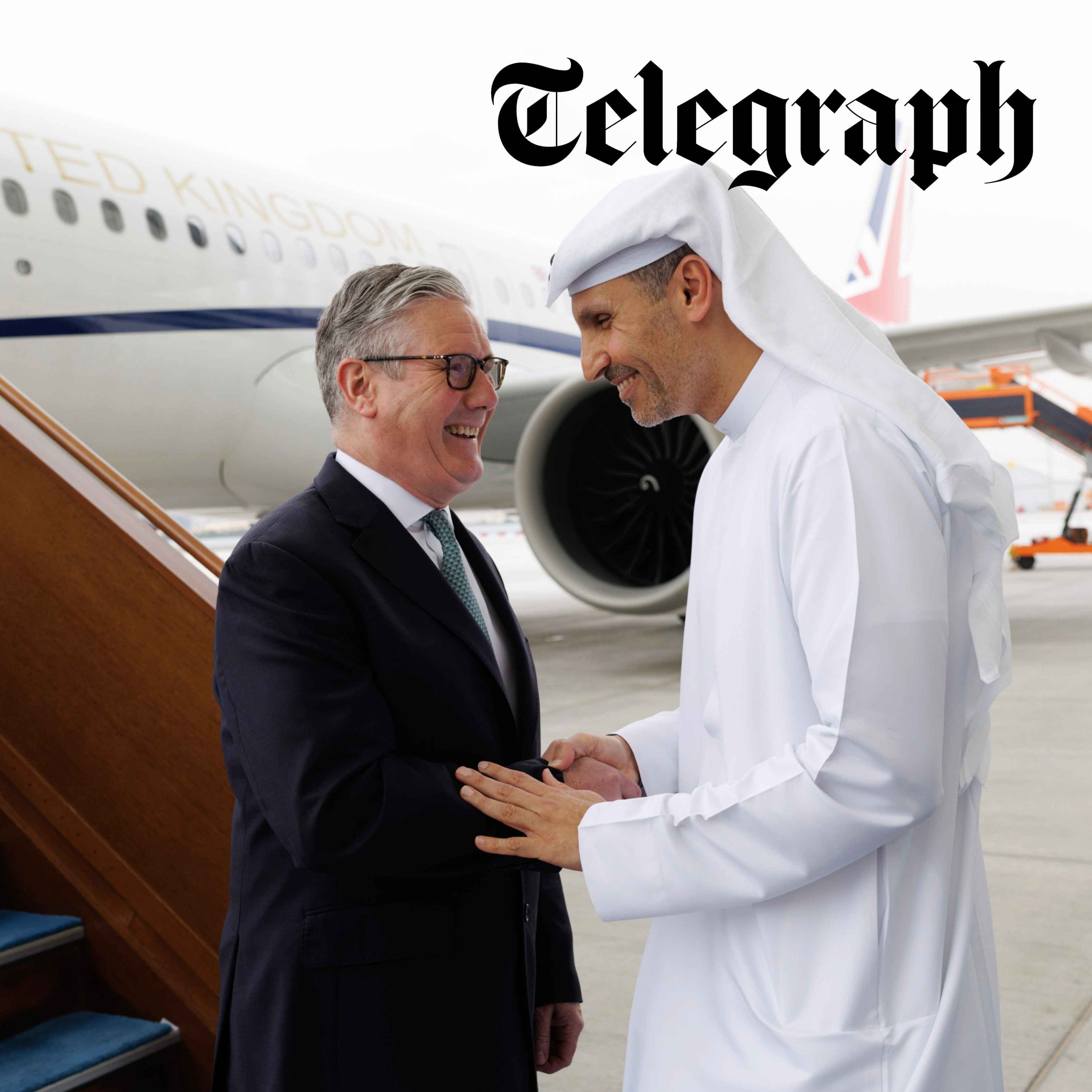
The episode argues Labour leader Keir Starmer’s “global statesman” rebrand ahead of May local elections is a PR tactic, not proof of effective leadership. It also discusses UK political division (Telegraph polling) and Britain’s foreign-policy posture during crises involving Iran, Lebanon, and Russian “shadow fleet” activity.
Tony Diver, Telegraph political editor (author of the “global statesman” analysis and the episode’s exclusive “Divided Britain” polling). The hosts are Tim Stanley and Camilla Tominey (Telegraph).
Starmer’s Middle East trip (Abu Dhabi/Saudi/UAE) is meant to offset poor domestic polling and avoid looking weak on Iran; Labour’s election broadcast used a Downing Street-style podium and focused on an Iran update. The government declassified Arctic submarine/cable operations to rebut claims of inaction. UK handling of Russian shadow-fleet tankers is portrayed as legally constrained and ineffective. Telegraph polling claims Britain is more divided than post-Brexit.
YouGov polling (Labour 16%, Greens 16%, Conservatives 19%, Reform 24%); Ashcroft poll (Tories/Reform/Greens 19%); “shadow fleet” Channel tanker escort; Arctic Akula-class submarine and GUGI deep-sea assets; Lebanon ceasefire ambiguity; 64% have little faith politicians can fix issues.
Written by AI. May contain mistakes.
Explore the implications of Starmer's attempts to position himself as a global leader amid political turmoil.
“and the Defence Secretary were on their sunbeds when Donald Trump threatened to wipe out Iran.”
Discuss Labour's election strategy in light of recent polling results.
“But what you have written a piece saying, Starmer's global statesman rebrand.”
Analyze the content and implications of Starmer's recent political broadcast.
“And I judge that it's not in Britain's national interest to get dragged into the war in Iran.”
Examine criticism aimed at Labour leaders for their vacation during global crises.
“Also, it must be pointed out that Restore Britain, run by Rupert stroke Hoopertlow, as we like to call him, because he has been slightly conspicuous by his absence from anywhere other than X, they're on 4%.”
Discuss recent UK military operations and the criticism surrounding them.
“I mean, everything is just becoming totally fractured, as we'll get on to in our new Divided Britain series.”
Understand the legal frameworks surrounding military actions and responses.
“But that happened simultaneously with a telegraph story revealing that Russian warships have been in the Channel and the British have apparently done very little about it.”
Explore how international reactions and criticisms shape UK political stances.
“Aren't we looking a bit pathetic, Tony Diver?”
Discussing the effectiveness of Starmer's foreign policy approach amidst current geopolitical issues.
“Well, Yvette Cooper did make that point this morning for the first time that I've heard.”
Exploring new polling data revealing increasing divisions within British society post-Brexit.
“It looks at division over specific political issues.”
Discussing the majority who feel politicians cannot fix issues, leading to a rise in radical parties.
“Well, if, as you say, 64%, Tony, think that politicians can't fix things, then the remaining 36 % probably adds up to the percentage in polling that intend to vote Tory or Labour.”
Exploring how past austerity measures have shaped current British sentiment and identity.
“Well, Kemi says that Britain isn't broken.”
Examining the generational traumas that have contributed to the decline of quality of life in Britain.
“Oh, are people still playing out the Brexit wars?”
Analyzing the divides in policy preferences and interests between older and younger generations.
“On that generational divide, though, Tony, the oldies still want all of the glory and all of the goodies, don't they?”
Anticipating the impact of the upcoming local elections on the political landscape in Britain.
“Well, it's still very nice weather today.”

Get the gist, explore an idea or ask about something said.
 Claude
On The Daily T, what are the key points of this episode?
Searching your listeningAutomatic transcript. May contain errors.
0:03Camilla: The Telegraph. Ahead of May's critical local elections, we're taking the daily tea on the road, visiting key battlegrounds across Britain and answering your questions with four special live events. Join me and Camilla, plus special guests, in London on April the 27th, Cardiff on April 28th Warwick on April 29th and Worthing on April 30th. You can buy tickets now at telegraph.co.uk forward slash daily tea live.
0:41Camilla: The world is in chaos and the government is on holiday. It turns out that both the Prime Minister and the Defence Secretary were on their sunbeds when Donald Trump threatened to wipe out Iran. Amid dire polling for Labour, Never Hear Care has jetted off to the Middle East in a hopeless attempt to paint himself as a global statesman. Is he fooling anyone? Plus, The Telegraph has done its own research that says the UK is now more divided than ever before. Our political editor, Tony Diver, joins us. Welcome to The Daily Tea with me, Tim Stanley. And me, Camilla Tominy.
1:23As we speak, the Prime Minister is in Abu Dhabi as part of his ongoing tour to let him be clear. And I hope the locals will. Of course, to them...
1:34Camilla: Let me be clear. To them, a tourist is a tourist. Yes. They don't care who he is and they almost certainly don't know. No. And while he's there, I hope he enjoys Warner Brothers World, which is the world's largest indoor theme park. Wow. Otherwise... Do you think he's somebody who likes roller coasters? I don't know. I would like to see the consultation on the safety of this roller coaster before I commit to a loop-the-loop. He will, of course, inform the local princes that he is the son of a toolmaker. Yes, will it make any difference to them, I wonder, as they proffer him a Rolex? But what they do not realise is that they are watching him emerge from the toolshed like a butterfly from a chrysalis.
2:13Yes, like a spanner from a toolbox. As a giant on the world stage.
2:19Camilla: Is he a giant Tony Diver? I tell you who you are. You're a giant because you've just been promoted to political editor of this great newspaper. Haven't you got your big boy pants on right now? I have. Who was once your mentor, Tony? It was still you. Who guided you through this glittering career of yours? It was all you. Who said to you, Tony, you just bide your time, my love, and you'll be political editor of this newspaper one day. I take all of the credit for all of Tony's success and none of his future failure. Right. And I'm sure there'll be none. But what you have written a piece saying, Starmer's global statesman rebrand.
2:57Camilla: Tell us everything. Well, I think what's happened is in Labour HQ, they're scratching around looking for good stuff to talk about on the doors in this year's local elections, which we're all expecting to be completely disastrous for Labour. And they're looking at what they've done recently and they're looking at the war in Iran and they think there is an angle to all of this, which is that Starmer is a man who is bringing people together, solving the war, sorting out the Strait of Hormuz, bringing down bills. And that is a good way to project him into this campaign because he's doing something that the other party leaders obviously can't do because they're not in government.
3:29So that's the big strategy.
3:30Camilla: He's not really sorting out the Straits of Hormuz, is he? No, a lot of his rhetorical emphasis is upon de-escalation, which has happened. It might be necessary again. We don't know how long the peace will hold. But also upon reminding people that he didn't want Britain to be involved, which is aimed at a domestic constituency, right? That's right. That's right. I mean, to them, they're treading a line here between engaging with the conflict and speaking to allies and deploying some meager resources to the region and totally cozying up with the US, which all the polling says is deeply unpopular and no one wants to do.
4:07People don't generally want to see the UK participate very heavily in this war. And actually, if you look at the party election broadcast, Labour's first of this local election season, which went out on Tuesday night, normally what you would get with the Labour election broadcast is lots of sort of soft focus shots of people, you know, in their local communities, probably some voters who say, I think the Prime Minister's doing a great job or whatever. There was none of that. It was a black backdrop with two union flags and a podium. It looks pretty much like the official Downing Street podium, but they're of course not allowed to use that for party political purposes, in which he just gave an update on what was going on in Iran.
4:44And that was their election broadcast. There was no vote Labour, no pledges. It was just an explanation of what he's doing. And that's the strategy is to kind of cut it back and focus on their operational record because no one else has got one.
4:56Camilla: Let's have a little listen to that party political broadcast. In uncertain times, you look to the government, you look to the Prime Minister for answers. And I judge that it's not in Britain's national interest to get dragged into the war in Iran. This is not our war. And no matter the pressure, I'm not going to change my mind on that. You don't get a second chance at decisions like this. there are huge consequences both for broad and at home and, of course, for our brave armed forces. Nigel Farage and Kevi Badenoch would have jumped into this war with both feet without thinking through the consequences.
5:39Camilla: Can I just confess something, Tim? We obviously put out our daily tea on Tuesday with Where the Hell is Starmer? And he popped up on the telly and I said to my husband, what's he doing? Is he doing a press conference? Because we had made the point, and we're going to get onto this in a minute that he'd been on his holly bobs, Tony, and indeed John Healy, the Defence Secretary, has also been on some holly bobs. And you and I were debating, is this really the time and the place to be on a sun lounger somewhere in Europe? And he popped up and then my husband said, no, don't worry, it's a party political broadcast that's been pre-recorded.
6:08Camilla: But I must admit, it didn't have those kind of Ken Loach vibes of like him going down a council estate and knocking on doors and talking about Hillsborough. Instead, it was, I'm a global leader. I am leading a coalition of the willing, Tim. Yes. On the one hand, it's a pop at the Tories because he accuses them of trying to get on board with the war at the beginning and then changing their mind. Same goes with reform. But of course, it's also heading off the Green Party, who are doing very well in the polls, by saying to left-wing and Muslim voters, look, I didn't want us to be at war again with a Muslim power.
6:42Camilla: On the polling, we're going to get onto our own very exclusive polling in just a minute, Tony. But just to say that the latest YouGov polling has Labour tied with the Greens on 16%, Conservatives haven't moved much, they're on 19%, and Reform, as ever, in the lead on 24%. That's up one point from the end of March. And, of course, Lord Ashcroft's poll put the Tories, Reform and the Greens all on 19%. That's right, at the weekend. Which he calculates would result actually in the Tories having the largest number of seats, but no one having enough seats to form a government. And Labour reduced to a hilarious run for about 32.
7:22Camilla: Also, it must be pointed out that Restore Britain, run by Rupert stroke Hoopertlow, as we like to call him, because he has been slightly conspicuous by his absence from anywhere other than X, they're on 4%. Well, he's not entirely Hoopert, is he? Because that's quite good. I know. And this is worrying for Farage, isn't it, Tony? Because haven't the reform lot done a calculation that if Restore gets anything over 3%, then they're a bit screwed? Yeah, well, I mean, what's funny now is, you know, we used to talk about reform splitting the right wing vote. You know, now we're talking about Restore splitting the reform vote.
7:58I mean, everything is just becoming totally fractured, as we'll get on to in our new Divided Britain series. But I think, I mean, if you look at the polling numbers, reform were touching 30%. There were a couple of polls that had them over 30 % a few weeks ago. Now they're back down to 24%. The general polling average is about 23%. And then you've got this kind of cluster about four points below, which is any, you know, depending on what poll you look at, it's Labour, the Tories, the Greens, all together. So, yeah, I mean, I think restore is a bit of an issue for reform, but they are still four points ahead of literally everyone else.
8:29Some of that restore vote will be people thinking it's reform.
8:33Camilla: Yes, I'm just getting confused. Because the name sounds similar. Yes, OK. Now, amid criticism of him having been on holiday over Easter, John Healy, who I must say pays more than a passing resemblance to Dobby from Harry Potter, but let's put that aside, was in his glasses looking very serious today, giving a press conference about this secret operation that we have carried out against the Russians in the Arctic. While the eyes of many were trained on the Middle East, the UK, in partnership with Norway and other allies, have responded to increased Russian activity in the Atlantic, north of the UK.
9:10This operation involved a Russian Akula-class attack submarine and a concurrent deployment of two specialist submarines from Gugi. That's Russia's main directorate for deep-sea research. And last November, I outlined how these Gugi units, including the spy ship Yantar, are vessels directed by President Putin to conduct hybrid warfare activities against the UK and our allies, specifically around critical undersea infrastructure.
9:45Camilla: But that happened simultaneously with a telegraph story revealing that Russian warships have been in the Channel and the British have apparently done very little about it. He was spotted on a budget flight to Nice. How dare he, Tony? I only say that because... How do you fly budget? Were you guys seeing him first class? Oh, absolutely not. He's a Labour politician and should basically digest paving slabs. But I think it's interesting that as Defence Secretary, you should choose to go away at a time when troops are deployed and HMS Dragon is once again in dock because it's malfunctioning and we've got Russian warships in the channel and it's all looking a bit dicey.
10:26Camilla: And by the way, I do remember very clearly, while in opposition, Lisa Nandy and others, calling for Dominic Raab's resignation when he had the temerity to go away during the summer that Kabul fell and he was Foreign Secretary. But clearly, you know, once you're in government, things change, right? And you can go on holiday because these cabinet ministers must get some relaxation, they must get some R &R, or they might go bad, Tim. Well, I agree with that. The problem is the hypocrisy. No, the problem is the hypocrisy of Labour, of saying one thing while they're out of office and another when they're in office, of course.
10:58But actually, politicians do need a break. And I'm of the view that I'd rather they spent more time abroad and less time here.
11:04Camilla: Well, indeed, never here, Keir. It seems to be good. But John Healy's been on the airwaves today reacting to this Russian operation in the Channel. It's all a bit embarrassing, this, Tony. Didn't we say that we were going to seize, stroke, we were going to do something with these Russian ships. And in fact, what we've done is look at them and give them a little wave. I mean, this is pathetic. Aren't we looking a bit pathetic, Tony Diver? There is a big problem with this Shadow Fleet story because the Americans and the French have both said, like we have, that we want to crack down on a Shadow Fleet and we'll intervene to stop them.
11:35But unlike the Americans and the French, we haven't actually intervened to stop them. And so our story this morning was a Russian warship escorting a Shadow Fleet tanker through the Channel and the Navy and the British government not doing anything about it. What John Healy was attempting to do, I think today in his press conference, and I was at that press conference, was to say, look, we understand people are annoyed with us that we haven't sent a lot of resource to the Middle East. We haven't sent a carrier. We haven't sent anything more than one Type 45 destroyer and a few mine hunters. But actually, what you didn't know is we were doing loads of other important stuff behind the scenes right up in the Arctic, you know, in the high North Sea, where Russia was using these submarines to try and tackle our undersea cables.
12:16So what it seems has happened is the government has declassified a load of stuff that we would never normally know about in order to make the argument that actually there was important stuff going on all along and it wasn't just the Royal Navy sitting around twiddling their thumbs. It's a bit desperate, isn't it?
12:28Camilla: A declassified dead cat. Is it desperate? I don't know. If I agree, I think it's interesting. Do you? It's looking so obvious that we can't even defend our own channel that John Healy, in desperation, having been criticised for being away at a critical period, then says, oh, hang on, have a look at these declassified papers about what we're doing in the Arctic. I just think it's making the point that just because we didn't intervene in Iran it doesn't mean that we're not doing lots of things around the rest of the world. Do you believe this? It's true though, isn't it? We're looking a little bit light in the trouser, aren't we?
13:00Tony? It's true that this operation happened. Okay, okay. It's fair enough that voters didn't know about it and therefore they think that the military's not doing anything.
13:10Camilla: But aren't the voters more concerned about whatever goes on in the channel because it's just by the way at the end of the M20? Yeah, I mean, undeniably that is an issue And that's probably, although we've never had a full explanation as to why it's probably some kind of international law issue, the reason why we can't seize these tankers. The government says it's now come up with a legal justification to do it using the Sanctions Act, which would basically prove that Russian mercenaries who were on these ships were committing domestic crimes. And therefore, you can send the National Crime Agency in to get them.
13:40But we've had to go through this whole kind of hoopla of legal wrangling in order to come up with a justification to do something that I think to most people would seem pretty obvious, which is if you've got a Russian shadow fleet transporting sanctioned oil around, especially when it's accompanied by a Kremlin warship, you should probably just do something about it.
13:55Camilla: Isn't it just a massive two-fingered salute by Putin? Actually, Clodagh Law, who is a regular listener and watcher of this podcast, made a really good point in an email yesterday where she said, why isn't Keir Starmer and indeed by association the Attorney General Lord Hermer jumping up and down, raising the international law breach that is the Iranians controlling international waters in the Straits of Hormuz. Well, Yvette Cooper did make that point this morning for the first time that I've heard. I've not heard the government make this argument about international law before, but she made that point this morning on the morning round.
14:26But I mean, yeah, if you want to see the entire world through an international law lens, then you should also apply it to the bad guys as well as just to us. Now, Yvette Cooper, wife of celebrated journalist Ed Balls, also was drawn to comment upon the situation in Lebanon. And there, again, the government is trying to walk a very fine line. It does say that Israel should stop, right? Because the one part of this war that doesn't seem to be covered by the peace agreement, or at least from the American and Israeli's point of view, is Israel's incursion into southern Lebanon. Yeah, that's right.
15:02And there is some debate about what exactly was in that peace agreement. I mean, J.D. Vance said yesterday that there had been a genuine misunderstanding. and it turned out that everyone had signed up to the terms of a ceasefire that no one really knew what they were. This is so weird, isn't it? I don't totally believe.
15:15Camilla: We've got about three different 10-point plans in operation. Nobody knows which one anyone signed up to. And then there's confusions about a very basic point, which is, is Lebanon included in the ceasefire or not? It's quite a major point. I mean, and the Pakistanis who were involved in brokering all of this agreement say that Lebanon was always included from the beginning. But of course, Donald Trump and Israel say that they weren't. I mean, the British government's position is not whether it was or wasn't in the agreement, because of course we weren't party to it. It's just to say that it should be.
15:43Actually, it should cover Lebanon. But in some ways, it doesn't really matter because Iran has re-closed the strait and is not allowing any tankers through. And the ceasefire is on the brink of collapse because of what Israel is doing. So whether or not there has been a technical breach of what was agreed doesn't really matter. There's a bit of realpolitik going on here, I think, which is that, you know, the war does need to substantially end in order for any ceasefire as a whole to allow them to negotiate.
16:07Camilla: But also, doesn't that just make Starmer even more ridiculous-looking being there? I mean, do you think... What's he doing there, Tim? Oh, I don't know. I don't know why Britain does this anymore. It really irritates me. I just think we should stay at home. I know I said politicians should generally be abroad, but I mean sunning themselves in the Amalfi Coast. I'm sick of Britain pretending it's got a clout and a power that it doesn't actually have. I just wish you would stop. I don't like this negative talk about the UK. I just think it's realistic. It just winds me up. Why do we have to turn up to everything and be involved?
16:38I've never understood it. It's always been something that's confounded of me.
16:41Camilla: Then we just turn into somebody irrelevant. Irrelevant to whom? What matters is the relevance of the Prime Minister to the people who elected him. What matters is what he's doing for the people of this country. but so much time and energy in Westminster is spent on what's happening in Sudan or Abu Dhabi or Burma. And I just don't understand why. We're not an imperial country anymore. The pumps. If politicians want to have relevance, then build the ships. Yes. But if you've spent the last few decades winding down the military, don't turn up with your My Little Pony lunchbox and say, can we help to broker a peace?
17:20Because you've rendered yourself irrelevant. I do agree with that.
17:24Camilla: And I find it irritating. OK, so you're saying if we turned up on the back of some kind of Churchillian war effort, then it would be fine. But if we did that... But if we're just turning up with like a little travel edition of battleships... Yes, but if we did turn up on a gunboat, let's call it what it is, we'd be making our own demands. Yeah, but can you imagine... You only turn up and say you want to act like an honest broker to help bring peace when you've got no force of your own. That's when you have to play that role. I know, but you wouldn't get Keir Starmer on a gunboat because it probably wouldn't accord with Elf in safety.
17:56Camilla: Tony, I mean, should the Prime Minister be doing what he's doing? What's he doing? Well, what he's doing is meeting Middle Eastern leaders, Britain's allies. He was in Saudi Arabia yesterday. He's in the UAE today. I mean, the purpose of this, I think, is to try and maintain Britain's seat at the table with these regional powers. I mean, our relationship with the US is clearly stretched to the point of breaking at this point. But we're trying to maintain sort of relationships with those people. And actually, there are a lot of British troops who are deployed to this region. Yesterday, he was meeting British troops at an air base in Saudi Arabia.
18:29And this has got some domestic play as well, hasn't it? Because the criticism of him in some quarters is that he hasn't done enough over the Middle East. He's not helping bring down the bills. He's not managing the domestic impact. And so I think there is an element of this which is, you know, he needs to be seen to be involved.
18:43Camilla: When will he next see Trump? I know we get the readout of the odd phone call. They seem to have been few and far between. I mean, seeing Trump next after the you're not Churchill, actually you're like Chamberlain comments with this royal visit set to go ahead later this month, Tony. But then the prime minister is not involved in that. That's just a king thing. Or is the prime minister actually going to see Trump in the flesh any time soon? Well, we don't know. I don't think he is expected to go along with the king. So in that case, you're probably assuming that there's not going to be a bilateral visit soon, which you would imagine not, given the way that they're criticising each other all the time.
19:22I guess it's the NATO summit which comes in the summer. And so we've got a pretty long way to go before we get there. And that'll be interesting because Trump, again, is threatening. Will the US still be in NATO? Yeah, I mean, the relationship between Britain and the US is going to be quite far down the list of priorities, I would say. And Rutter, of course, was in the White House yesterday meeting with Trump and came out and said what a brilliant job he thought Trump was doing. Rutter, the kind of Trump whisperer they call him, is desperately trying to hold this defensive alliance together while making the point that it is a defensive alliance, not an offensive alliance, which means you can't just go to war in Iran and expect everyone to follow you if there hasn't been a kind of formal triggering of the mechanism that brings NATO members in.
19:59So, I mean, that's a whole different kettle of fish.
20:01Camilla: And reminding him, I mean, Cooper did quite a good job of reminding the president that the last time we triggered Article 5 was in response to 9-11. And we all showed solidarity with the Americans. best not forget that Donald The only time backing up the Yanks Now you have been rather glass half empty about Britain Yes It seems that your feelings are echoed by the populace because Tony's going to carry on with us and discuss this exclusive polling that reveals a Britain divided
20:40Hello, I'm William Sitwell, and as a proud ambassador of the Telegraph Save Our Pubs campaign, I'm here to tell you about our nationwide competition. Nominate your favourite pub and tell us in 250 words what it means to you and your community. Five winning pubs will win a£5 ,000 round for punters like you to enjoy on our National Pub Day on the 16th of May. Entries close on the 11th of April, so mark your calendars and get nominating. Visit telegraph.co.uk slash pubs today.
21:15according to exclusive polling for the telegraph britain is now more divided than it was in the aftermath of brexit and tony diver who's with us uh wrote this story and perhaps explained to us some of the the top numbers three quarters of us think britain is more divided in 2026 than 2016 what are some of the roots of that division according to the polls what are people upset about and arguing over? Well, it's a pretty comprehensive poll. It looks at division over specific political issues. So we looked at crime, immigration, how people feel about tax, how they feel about institutions in Britain, the NHS, the police, the BBC, the Westminster system.
21:56And what we found was on policy questions, the public is often divided pretty much 50-50. If you look, for instance, at whether we should prioritise spending more money on welfare or spending more money on the military, you find the population is pretty much divided down the middle. If you look similarly at whether or not we should prioritise reducing inequality or cutting taxes, there's a fair amount of division there. So we polled specific issues, but we also looked at how people feel about each other and how they feel about living in Britain today. And so when you ask people, for instance, whether they recognise their country because of the scale of immigration over the last few years, you find that 51 % of people say they don't recognise their country anymore.
22:33And that is skewed towards older voters in general, as you would expect, you've got longer memories. But then if you ask people whether or not they've lost friends because of their political views, you find actually a quarter of people say that they've lost friends because of their political views. There is a general feeling of kind of not just discontentment, but a feeling of division and a feeling a lack of togetherness. And this poll covered the whole of Great Britain, England, Wales and Scotland. And when you ask Scottish people and Welsh people who they feel most affinity with. It's mostly each other.
23:03Scotland feels more affinity with Wales than it does with England. It feels more affinity with rural England than it does with urban England. And in Wales and Scotland, less than 20 % of people say that they have anything in common with people who live in London.
23:14Camilla: Yes. Nationalism is acceptable in Scotland and Wales, but not in England. Even if we are divided, of course, 52 % vote for Brexit against 48%. Even if we are divided, there's a slight advantage on some issues to the right. 51 % saying that they no longer recognise their country because of the scale of immigration. 52 % say cut tax rather than reduce inequality. So, okay, divided, but the right is doing better on some of these issues. Yeah, I think that's true. And we'll be looking in the next few weeks about how all of this translates into voting intention because, of course, we've got the local elections coming up on May the 7th and that's what this is all about.
23:53but in the first set of polling that we've looked at for today it's all about kind of social cohesion and the feeling of friendliness towards your neighbour that people feel is lacking now and even more so than it was 10 years ago but I mean it will be interesting you're right to see how this translates into who people are going to vote for. I mean just to give another example there seems to be a shift in attitudes on climate change and they're most dramatic in Scotland so So if you take support for drilling for oil and gas to boost energy security, something that the government is reluctant to do, is going to do it, but is reluctant to do it.
24:29Ned Billaban hates it. Support for drilling is at 59 % among Scots. It's lower among the English at 54 % and even lower among the Welsh at 49%. I mean, of course, a lot of Scottish industry depends upon that. And they're the people who are most going to benefit from the jobs. Still, it's interesting, isn't it, that there has been a change in general attitude towards the environment? Yeah, definitely. I mean, and this is one of the most divisive questions when you ask people it. I think it probably does make sense that people in Scotland care more about the North Sea industry because of the importance of Aberdeen.
25:00And actually, if you look at the oil and gas supply chains in Scotland, it's a lot of the central belt as well. It's a lot of the kind of more moderate Labour voting areas of Scotland are heavily reliant on that industry, even if they're not kind of up in the north actually working on the rigs. But one of the things we're interested in is looking at how people have fractured and we've just been discussing it here, but the rise of reform, the rise of the Greens, the idea that the Greens would be polling on 19 % nationally a few years ago would have been unthinkable. They would have been down on 4 % with Rupert Lowe.
25:30Now they're doing very well, especially among certain demographics. And so there's this feeling that everyone is kind of splitting up and that's based on age, it's based on identity, it's based on geography. And I don't know whether or not we'll be able to come up with any remedies to this situation, but certainly it's an attempt to kind of diagnose how Britain is feeling about itself.
25:49Camilla: But isn't the killer stat here, actually, that the one issue upon which most people are united is the total inability of our political system to cope with any of these challenges. 64 % have very little faith in our politicians to fix any of these issues. So I think what's changed is I remember discussing this with Jacob Rees-Morgan. We're talking back to like the debates between the left and right in universities. And Jacob always says, look, it was ever thus. You always had a country divided. Some people are socialists, some people are capitalists. And you had these debates and this is how it played out.
26:22Camilla: But I think what's changed is, first of all, the advent of social media, which has just made everybody much more adversarial and combative and actually generally rude. I think we've seen a decline in manners because the way people behave online, they've translated into everyday life. Point one, there was a really interesting press release that landed in my inbox this morning, making the point that social media is antisocial because it shares more posts from strangers than your own friends and relatives. And I thought that's a really good point. So that's point one. Based upon what you want to see.
26:54Yeah, exactly. Not what you need to see or what might educate you, but what you want to see.
26:58Camilla: And this is about people having their own group think spewed back to them. So they then are very narrow minded and they can't see anyone else's point of view. And that's when you get into the never kiss a Tory, if you voted for Brexit, I'm never speaking to you again, sort of completely hat stand theories of social engineering. but then I think there's also just a general sense of hopelessness. And I think that that has been exacerbated massively actually by Conservative failure because in the past you'd have people on the left saying, look, I don't agree with these people, but they can get the bins out, they can get the potholes filled, they can run the economy.
27:35Camilla: And now they're saying even they can't do it and even sensible Keir Starmer with his rule book and his process, even he's been terrible at being Prime Minister. So what hope have we? And that's when you get people, you know, doing the whole kind of roulette thing of, you know, let's put some money on the Greens. Let's put some money on Farage. There's no proof at all that either of these two very maverick figures can run the country. But we've had enough of the experts. Well, if, as you say, 64%, Tony, think that politicians can't fix things, then the remaining 36 % probably adds up to the percentage in polling that intend to vote Tory or Labour.
28:14Camilla: Yes, possibly. So the 64 % are the new majority and they're being drawn to smaller radical parties. Yeah, I think there's something in that. But when you look, when you actually look at the kind of breakdown of this, you find that there is broad consensus, even among pretty strong supporters of individual parties, that the Westminster system is broken and politicians don't know how to fix it, which is a very odd one. I mean, even among reform voters, they think no politician knows how to fix our country because it's permanently broken. In which case, why in that case, if you roll the dice and voted for Farage, you would imagine that most reform voters thought that Farage is the only politician who's able to do something about these problems because he's a maverick, because he's untested, but because he's got different ideas.
28:56Actually, it turns out they don't especially believe in politicians either. And so I think you're right, Camilla. It's a breakdown in the feeling that politics can change things for the better. And, you know, whoever wins the argument gets to have a go. But ultimately, you know, it's still possible to make things better. People don't seem to think that. I don't like this.
29:14Camilla: This is why I kind of bristle at you going, why the hell is the UK doing anything? Well, Kemi says that Britain isn't broken. And that's the side you sort of come down on, right? Well, I come down on a degree of positivity. You know, this is like a Gen X speaking to a boomer. I'm thinking of my dad here, you know, what's the point in this country anymore? Country's finished. I don't like that rhetoric because I like being British and I like Britain and I am a glass half full person. So I find these findings depressing. And like I want to go back. I'm thinking to myself, what might improve morale?
29:47Camilla: Goodness me, I hope our football team does well at the World Cup this summer because I want a 2012 moment. I want Britain to get back to a moment where we all watch Danny Boyle put together an amazing Olympic opening ceremony and feel proud about who we are and where we're going. We haven't had that sentiment for more than a decade. But that's lipstick on a pig, isn't it? It is polishing a turd tip. But I refuse to be the cliniest. I remember Britain back then, and it was a Britain where there were urban riots. It was a Britain of austerity. Everyone hated the coalition and George Osborne was booed.
30:22Camilla: Have you literally turned into Angela Raitt? It was a Britain of austerity. It was a Britain of efficiency. It was a Britain where we weren't spaffing billions of cash on welfare. We frame this as Britain is more divided than it was at Brexit. We should say there'll be some people who'll be saying it's divided because of Brexit. Right? Oh, are people still playing out the Brexit wars? I think they are. And so is the government. The government's reaching that conclusion too. I think they're playing out right versus left. At the very least, Brexit did not solve... I think they're playing out Gaza wars.
30:54Why did we have Brexit, which was supposed to regain control of our borders, and 51 % of people don't recognise their country because of mass migration? Why did we have Brexit, which was supposed to give us control over our economy, but 59 % of people say we're not drilling enough in the North Sea? In other words, Brexit, at the very least, did not solve these things.
31:11Camilla: No, I agree. And that's partly down to an almost uniquely generationally bad class of politicians. Yes. Let's be honest, at least the last four Tory PMs were a bit rubbish. Yes. Weren't they? And I think if Britain feels... And the Labour PM is rubbish. If Britain feels bad, it comes down, I think, to one simple thing, which is that the quality of life in this country has declined. And it's been happening to us since the credit crunch. We have not fully recovered. And since then, we have had national traumas. The trauma of COVID and of seeing many people die, the trauma of lockdown and seeing many people's childhoods taken away from them, the trauma of Ukraine, the trauma of Gaza, and the trauma of a sense of generational unfairness that young people can't get on.
32:01And what we have seen in daily life is things becoming gradually more and more expensive and unaffordable, while the quality of living has declined. So at the end of that, it is no surprise that people are angry. and it's no surprise that people are saying we've changed government and not only have things not got better, but we can't imagine things getting better. We don't see a plan with this particular government. So none of this survey should come as a surprise because Britain is just not very well at the moment.
32:33Camilla: Right. On that generational divide, though, Tony, the oldies still want all of the glory and all of the goodies, don't they? Well, they do. And who can blame them, to be honest? But when you look at the polling, you find there is a small majority for keeping the triple lock, which all politicians privately admit is a terrible idea and isn't sustainable, but has to be sustained because all pensioners go out and vote. However, young people are very sceptical of it. And you can just say, fine, that's just everyone voting in their own interest. Young people want to scrap the triple lock because they want more handouts and the old people want the opposite.
33:04But I think it does speak to this broader kind of division. And actually, there is a kind of concrete bit of policy there. And a lot of young people who feel like they're just not getting a lot out of the government. They're not getting any handouts. They're not getting any. They might be getting a bit of welfare, but they're not getting help onto the housing ladder in the way that they used to. The wages are down. There's this kind of feeling of unfairness. And that's being targeted not just to the government, but older people in our society. And that kind of adds to the whole division that we're talking about here.
33:32Camilla: Tony. Tony's filling me with hope because Tony is getting on in the world. Because Tony has just been promoted. He's newly married. Yes. I'm in a small minority of survey respondents. I'm having a great time. I have to have faith in the Westminster system, right? We all do. Because we work on it. Yes. Yes. Well, can we just, I just want to try and end on a positive note. Tony, give me something. Give us something. Well, it's still very nice weather today. It's all going to get worse off. Well, I tell you what, let's end on this note. Whatever happens journalistically or just for the nation, May the 7th is going to be the day to watch.
34:09Camilla: The local elections are going to be seismic and seminal and could be extremely instructive when it comes to who may come next in this failed political system to try and sort it out. Can we at least agree on that? We can agree on that. And I will add that Nigel Farage understands everything we've just discussed and recognises that if he is elected and if he isn't seen to fix things, then that really is the point of no return. That's the point at which the system collapses. And he knows that. No pressure then, Nigel. No pressure, but that's why you've got all these plans and all these policies and all these groups you're setting up.
34:44Camilla: It might require groupthink here. I think it's moving more towards, is this a right-wing coalition problem to solve or a left-wing coalition problem to solve? Absolutely, yes. So it might not be Nigel single-handed. Can I just say that now? Well, I think the Tories are underpriced. Do you? I do. It's the Grand National this weekend. What other tips have you got, Tony? The Tories are underpriced. On that, maybe you and I can go and make some dosh and cheer ourselves up. And Tony, you're going to do more polling moving forward for our Divided Britain series. Camille, we've got a whole series for you of dispatches from around the country.
35:18We've got polling data. We've got revelations about how the public feel. It's going to be running right up until the local elections on the 7th of May.
35:26Camilla: Tony Diver, congratulations on your promotion. You'll be back on The Daily Tea. Thank you for everything. We will be back with an explosive interview with Hugo Vickers, the late Queen's biographer, tomorrow, 5pm. Thank you.
Amid more dire polling for Labour and the revelation that both he and the Defence Secretary were on holiday as Donald Trump threatened to wipe Iran off the map at the weekend, Keir Starmer has now disappeared to the Middle East for meetings with Gulf state leaders.
The Telegraph’s political editor Tony Diver tells Camilla and Tim that, despite him having no say in ceasefire talks, this is a desperate, last-ditch strategy to portray Starmer as an international statesman by Number 10, with a local election wipe-out on the cards in May.
Elsewhere, Tony also talks Camilla and Tim through his exclusive research that shows the UK is more divided than ever before.
🚨 LIVE EVENT: The Daily T will be going on the road to London (April 27), Cardiff (April 28), Warwick (April 29) and Worthing (April 30) ahead of May’s critical local elections, where you'll have a chance to put your questions to Camilla and Tim.
🎟️ Tickets are limited, book yours now!: https://www.telegraph.co.uk/politics/0/live-event-the-daily-t-on-the-road/
We want to hear from you! Email us at [email protected] or find @dailytpodcast on TikTok, Instagram and X
► Sign up to our most popular newsletter, From the Editor. Look forward to receiving free-thinking comment and the day's biggest stories, every morning. telegraph.co.uk/fromtheeditor
Producers: Lilian Fawcett and Georgia Coan
Senior Producer: John Cadigan
Executive Producer: Charlotte Seligman
Video Producer: William Walters
Studio Operator: Meghan Searle
Social Media Producer: Nada Aggour
Editor: Camilla Tominey
Hosted on Acast. See acast.com/privacy for more information.


