In short
The BBC documentary examines Germany’s backlash after TV presenter Colleen Fernandes accused her ex-husband Christian Ullmann of creating fake profiles in her name, sending altered images and pornographic videos, and posing as her for phone sex—allegations she calls “digital rape.” Her case sparked mass feminist protests and a political push for laws against sexualized digital violence, including revenge porn, voyeuristic images, and (separately) sexualized deepfakes.
Guests/backgrounds
Colleen Fernandes (German celebrity; documentary maker; victim of online impersonation). Rebecca Endler (feminist movement expert). Josephine Ballon (lawyer/CEO HateAid). Theresia Krone (law student/climate activist; victim whose abuser was convicted for stalking/defamation). Ahmed Nika and Lynn (Feminist Fight Club organizers). Ronit (Only Yes Means Yes initiative). Jeanne Wasilewski (host/producer).
Key claims/examples
Thousands protested nationwide; Germany’s conviction rate is “extremely low” and current law inadequately covers deepfake-like sexual abuse. Example: Krone’s case led to conviction only for stalking/defamation; police declined prosecution for image distribution. Draft law announced by Justice Minister Stefanie Hubig would criminalize deepfake dissemination and other acts, but activists argue broader support and cultural change are missing.
Written by AI. May contain mistakes. Listen to the episode to check what was said.
Chapters
Tap a time to open that second in VOProtests Erupt in Germany
6:10 to 10:00
Witness the societal response to digital violence against women in Germany.
“As the protests erupted, Colleen Fernandes appeared on stage in her hometown Hamburg, wearing a bulletproof vest.”
The Impact of Digital Violence
10:00 to 13:50
Understand the effects of digital violence on women's lives and the legal challenges they face.
“And it starts by talking about what drives sexual abuse online.”
Mobilizing for Change: Feminist Activism
13:50 to 14:00
Learn about the grassroots organizing in response to Colleen Fernandes' case.
“In the case of the Colleen Fernandez story, what do you think made this case special?”
The Feminist Fight Club's Response
14:00 to 18:48
Explore the emergence and motivations of the Feminist Fight Club in response to Colleen Fernandez's case.
“So many women kind of were able to see themselves in her story.”
Legislative Responses to Digital Violence
19:24 to 23:09
Discuss the draft law addressing digital violence against women and its implications.
“Amid this outpouring of feminist rage and sadness came an announcement from Germany's Justice Minister Stefanie Hubig.”
Activism and Cultural Change
23:09 to 27:11
Examine the activists' views on the need for cultural change alongside legal reform.
“is that within their social circles, it's frowned upon.”
Reflections on Resilience and Hope
27:11 to 28:01
Reflect on personal experiences of activists and their ongoing struggle for change.
“Some people in the justice system could not imagine how reality is for women and how violent things feel.”
The Moment of Social Reckoning
28:01 to 28:26
Explore the implications of digital violence and its political significance.
“that this is the moment of social reckoning, even though Colleen Fernandez's case finally pushed digital violence up on the political agenda.”
Transcript
Automatic transcript. May contain errors.0:00This BBC podcast is supported by ads outside the UK.
0:33If you are currently overpaying on software to run your business, remember this number, 10 ,000. That's the number of new businesses that join Odoo per month. Join Odoo today at odoo.com. That's O-D-O-O dot com.
0:55The documentary, home of the best documentaries from the BBC World Service.
1:05Jeanny Wasielewski:I was together with him like 15 years. All my marriage feels like it was a big lie. And it feels so violent that your own husband is doing that in your name. I felt so betrayed. This is Colleen Fernandes. In Germany, she needs no introduction. She has been on television since the early 2000s, entertainment presenter, actor, children's book author, and for most of her adult life, she was one half of one of the most popular celebrity couples in the country. Her husband was Christian Ullmann, an actor and comedian even more famous than she was. But they were also political. Ullmann had made a point in interviews of his feminist values.
1:49and in 2024 Fernandes presented a documentary revealing her own experiences of being impersonated online with explicit images made to look like she was in them, being sent to men she knew. She couldn't find the person responsible but she turned it into a call for stricter laws on online abuse. Together they were a formidable team but then this high-profile fairy tale shattered and sent a shockwave through Germany.
2:27In March this year, Colleen Fernandez gave a long interview with the investigative magazine Der Spiegel, in which he said that Christian Ullman had confessed to her that he had created fake profiles, sent photos and videos through them, and posed as her for phone sex. At the time of his alleged confession, they were still married. They divorced last year. In the interview, Fernandes called what happened to her digital rape. She accused her ex-husband of using fake social media accounts under her name to pose as her, chatting with and flirting with dozens of men, leading them to believe they had online affairs with her.
3:04Der Spiegel reviewed screenshots and digital evidence she had saved and published an explosive exposé revealing that Ullmann was now under criminal investigation because of a complaint filed by Fernandes. That investigation continues. The presumption of innocence applies to Christian Ullmann. He has not been charged with or convicted of any offence in connection with these allegations and took legal action over the Der Spiegel article. When we approached his management and his lawyers, they did not provide a response to our approach. In his libel case against Der Spiegel, Ullmann had denied the creation and dissemination of AI-generated fake porn videos and the creation of original images.
3:45The Hamburg High Court issued a respective intermediate injunction against Der Spiegel. In these proceedings, Ullmann did not dispute the allegations that he created fake social media profiles in his wife's name and sent altered images and pornographic videos with women who looked like his wife to various men. His lawyers issued a press release in May which described Der Spiegel as engaging in impermissible reporting on suspicion and saying that untrue facts are being disseminated based on a one-sided account.
4:18Still, Colin Fernandes' allegations tore through the nation.
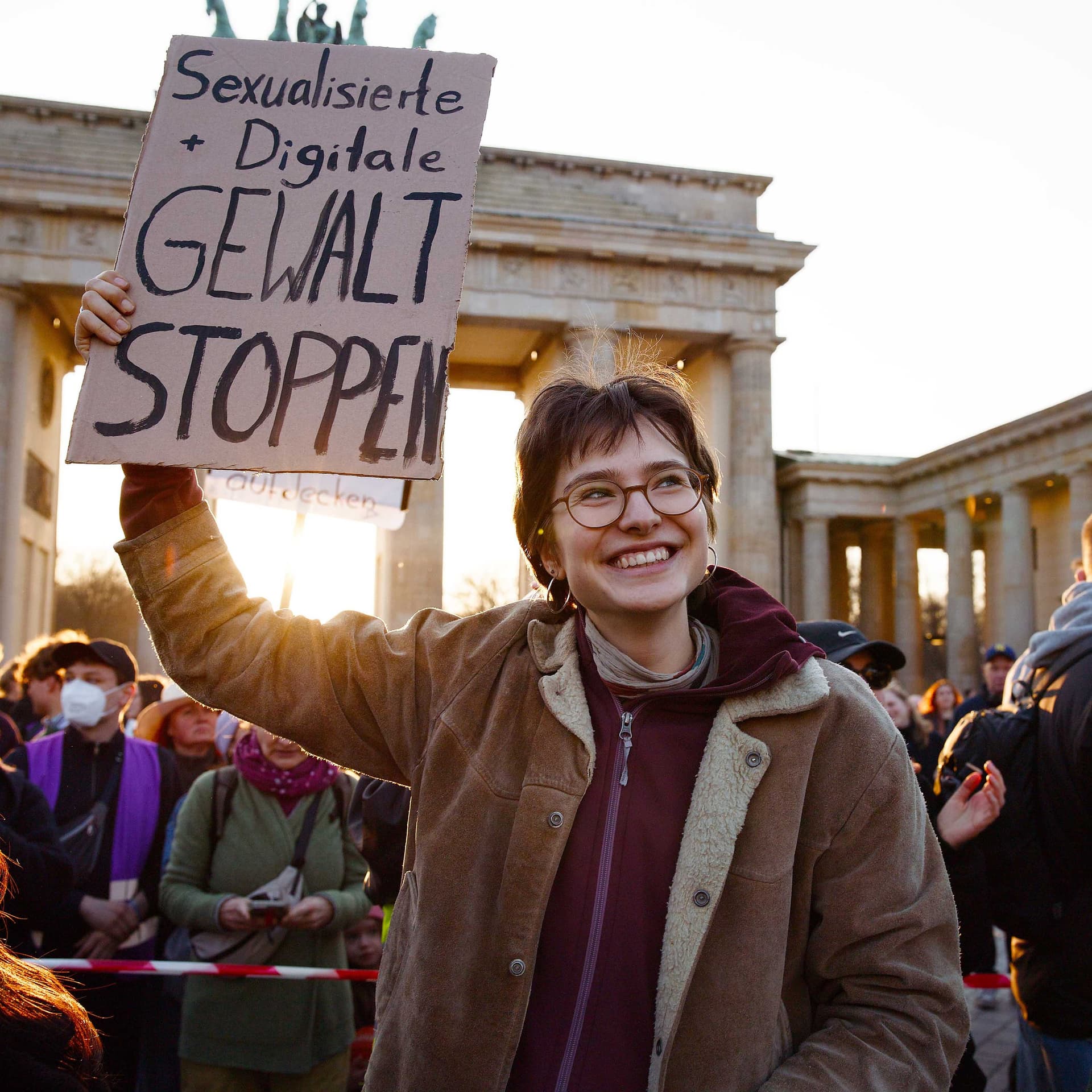
4:29In the days following the article, thousands of shocked and enraged protesters took to the streets across Germany. In solidarity, demanding change, of outdated or non-existent laws, of society's failure to prevent violence against women. Rebecca Endler, an expert on feminist movements, describes the moment she heard about the story like this. The moment I saw the headline, we all basically sent each other the same link and we're like, what? This is going to be huge. We were immediately aware that this was, for Germany, like a moment of maybe social reckoning or hoping it would be. I was not expecting demonstrations with thousands of people marching the streets.
5:19Josephine Ballon, a lawyer and CEO of the legal support organization HateAid. This was really, really unexpected. But of course, it also feels a bit surreal to me because HateAid is advocating for a better protection for more than four years now. And nobody was listening. And then at one point you wake up and the whole country is talking about nothing else. The protests felt like a feminist earthquake, fueled by a pent-up rage from women who had had enough. It was moving and unsettling to watch. But then I asked myself, where will this lead? Is this Germany's MeToo moment? And the question that actually runs through everything you're about to hear, even if this moment results in stricter laws against digital violence, will that work?
6:08I'm Jeanne Wasilewski. This is the documentary, A Women's Revolt in Germany, from the BBC World Service. As the protests erupted, Colleen Fernandes appeared on stage in her hometown Hamburg, wearing a bulletproof vest. When I sat down with her in June, she told me what was going through her head at the time.
6:29Jeanny Wasielewski:I thought there would be men who hate me for what I'm doing, but I didn't expect them to be that aggressive. It was just all too much for me emotionally, all these protests and all these death threatens I had in that period. And so many men writing and calling that they want to kill me. She chose to give her first interview to a political magazine, not a tabloid. A deliberate choice. I think it was important to make sure it's not only about me, it's not only about my case, it's about law we don't have. Because they don't know under which paragraph to put it in Germany, because we don't have anything for this.
7:23Jeanny Wasielewski:So currently you could just do this. You could create a fake profile of your husband, your wife, your mother, whoever, and just send out fake porn videos of that person and flirting to men or women or whoever in her name. And then you go to the police and they are like, well, it's not forbidden in Germany currently. You could do that. This, a very 21st century form of violence against women, almost nothing on the statute books to catch it, was an obstacle to Colleen's goal of getting her case heard in court. And I think it's also important to teach about digital violence because I hear that so often.
8:06Jeanny Wasielewski:Well, it's just digital, but there is no just digital. For example, he was sharing that rape story. So the fake Colleen was sending out rape stories where I get raped. So he is telling the man, well, I get turned on by the story. So there are a lot of men out there thinking that I am aroused by a rape story. This puts me in real life in a dangerous situation. And I have the panic attacks in real life. And I go to film sets. I'm afraid of meeting men. Well, now everyone knows. But before, that was an awful situation for me. And this is happening in my real life. So all these things you do in the World Wide Web, they don't stay in there.
8:56Jeanny Wasielewski:Because on the computers, there are real people. So nothing that happens online stays in a computer. I'm so shocked by all these stories I get from all these women out there. And it's totally devastating. And I think that's why we as a group, it's not only me, we're a huge group. we have to speak out loud. We have to tell the man to stop. When Colleen Fernandez went public with her allegations, it kick-started a movement. It's important to note that from here we're not really talking about her case specifically. That case comes with legal complications because of the ongoing investigation. Ullman is presumed innocent.
9:40It's also important to say that online sexual abuse often includes the use of deepfakes, faked images generated using AI to alter a real image. And you're going to hear about this. But deepfakes specifically are not part of Fernandes' allegations. Today, a wider howl of outrage, rooted in experiences common to many women, is being heard across the country. And it starts by talking about what drives sexual abuse online. Rebecca Endler. Domination, I think, is the key element that ties all these different cases together. The Internet and especially AI has created new means to do this. But the impulse, the need to dominate has been there for centuries.
10:29So this is nothing new. It just gets the new vessel to be even more vile and hateful. Around 90 % of those affected by sexualized digital violence are women. And the conviction rate for these offenses is extremely low. But I also spoke to someone whose online abuser was convicted, Theresia Krone. She was a 21-year-old law student and climate activist when she discovered a fake account under her name and dozens of sexualized, faked, nude images. And it was an account with my name, my face, my place of birth and where I study. And there were like dozens of sexualized fake nude images. Yeah, I felt like I couldn't move or breathe.
11:23I felt violated. I felt that maybe I was responsible for this, which is obviously not true. and then later on I just I had nightmares every night of being assaulted I had panic attacks for months I was constantly worried that someone would google my name see these pictures and would never see me like the same version of me again they would always see the violated version the a degraded woman that was portrayed online that was shown in situations of rape. And I think the reason why I assumed people would see me different is because I could not see me like I saw me before. It is really brutal. And just to hear the effects it had on your everyday life.
12:15I think I'm mostly okay now, but it used to be quite tough to date, to be a young woman to be a student and have a normal student life. That kind of experience affects how you trust people. It also affected how I look at my own body, I guess. Yeah, because I have seen myself, my faked body, being violated and humiliated and degraded. Theresia's case is one of the very few cases in Germany where a perpetrator of sexualized digital violence was actually convicted. But notice what he was convicted of. Stalking and then Verleumnung, which is defamation. Currently, under German law, distributing certain existing images without consent can, only in narrow circumstances, be prosecuted on the basis of defamation or a breach of personal privacy.
13:12But creating and sharing a sexualized deepfake, however realistic, however widely it spreads is not in itself a criminal offence. Basically, the dissemination of sexualised deep fakes is treated as a copyright violation. It's a petty crime and no one really goes after it. So we have victims who take a lot of effort into securing the evidence and everything they get is after a few months. It's a letter from the police telling them because of lack of public interest, there will be no prosecution. When it comes to deepfacts, obviously, the first thing I would change is to make it a crime because it's not yet.
13:52In the case of the Colleen Fernandez story, what do you think made this case special? Why do you think it galvanized so much action and support? So many women kind of were able to see themselves in her story. It just resonated because it's not, a unique case. It's not just one case. It's a story that so many women share. What started with one woman's story spread within days to more than a dozen cities across Germany, bringing tens of thousands of people to the streets. To understand what made these protests so effective, I met three of the people who organized it in Berlin. On a sunny day in a park, Ahmed Nika and Lynn, who are part of the Feminist Fight Club, a group of friends who already knew each other from climate activism and other causes, but who founded the Feminist Fight Club specifically in response to Colleen Fernandez's case.
14:52And Ronit, who is part of a separate initiative. Nur ja heißt ja. Only yes means yes. I'm part of the Feminist Fight Club, which just was initiated at that protest, but it's good to know that we already were a group of different people and it was just time to give us a name. I've never experienced such an emotional protest like this. A lot of us in the Femmeswahlclub are climate protesters at the core and like a lot of us are women though and Flinte people. FLINTA is a German acronym that translates as women, lesbians, intersexual, non-binary, trans and agender people. We can't skip the feminist topic because it affects us in every sense because we are women before we are everything else.
15:48I'm a member of Neuer Heist Ja, which means only yes means yes. And we've been active since April of 2025. But only yes means yes is already adopted in 14 other European countries. And we just don't understand why this is not the case in Germany. And I think our aim in the beginning was to raise awareness to this. Because consent, you would think that everyone knows that consent should be the baseline for any social or sexual interaction. But in reality, it's not. and we heard so many court cases where judges really use old school and patriarchal arguments. Just changing the law to only yes means yes doesn't solve gender violence.
16:35I think like in moments where we can really put the injustice to a face or like to a moment, it is really easy to target our rage. But I think the rage is always underlying because everybody of us knows someone who has experienced violence in a relationship. My thoughts are on the rage, which came up. As Lynn already said, it was always underlying. But I think during this case and also during the protest, you really could feel that the people, and especially the women of Flinta people, who experienced violence in the past and were not speaking up about it or were silenced, not actively silenced, but also passively silenced by the society, it all came out at once.
17:25The case of Colleen Fernandez was in a kind special because it was also a kind of digital violence which hasn't been reported or which hasn't been discussed in the public. then it was a special case where you cannot really step into a law and then just find justice. And I think this in-between of justice and feelings that you have when you are being abused physically or mentally or even digitally, like in the case of Colleen, it was the in-between rage of every woman and Flinter person. there was a room and a space and a stage for it to talk about it. There was this electricity of sadness, of rage, of standing together.
18:20Self-directed investing, trading, full-service wealth management, automated investing, financial planning, thematic investing, retirement planning. Phew. And to think, that's just a small taste of what Schwab offers. because Schwab knows that when it comes to your finances, choice matters. No matter your goals, investing style, life stage or experience, Schwab has everything you need, all in one place, so you can invest your way. Visit schwab.com to learn more. That sound could mean a lot of things. And when something's going wrong at home, the hardest part can be figuring out what the problem actually is.
19:02at thumbtack you can upload a voice message or a photo and our ai-powered search will help diagnose your project plus the pros we know have over 14 million five-star reviews so you can hire with confidence thumbtack we know homes hire the right pro today
19:23you're listening to a women's revolt in germany from the bbc world service Amid this outpouring of feminist rage and sadness came an announcement from Germany's Justice Minister Stefanie Hubig. A draft law was released soon after the wave of protests, updating the legal code with respect to digital violence against women. The draft law aims to improve criminal law protection and to define the phenomenon of digital violence more clearly under criminal law. It details new criminal offences, including banning voyeuristic images and revenge pornography. And it includes a paragraph that would make disseminating sexualized deepfakes illegal.
20:06It would also take image-based sexual violence and identity theft involving fake profiles into account. I asked the activists what they thought about the draft law. For us, it's really not about this one law, because the law itself is not a whole system. We very early on pushed the message that we want kind of like holistic approach. You need to think prevention before you actually think about a penal system. You need to give support and you need to protect people that have been affected by violence. And this law against digital violence doesn't address any of that. Also now, it's a few months since the protest and no law has changed.
20:52I think personally that it does have a big moment, but it's a continuum. There have been feminist movements and waves, and there has been Me Too, and we have had this discussion so many times, and I think that also shows part of the rage that keeps coming up because nothing changes. We asked the Justice Ministry for an interview. They declined, but replied in writing, clarifying that the bill they are now pursuing was drafted before the Fernandes allegations went public and hasn't been altered. They also said, The federal cabinet will decide on the draft bill shortly. The subsequent timeline will depend primarily on the procedures in the Bundestag.
21:33The Bundestag is the German parliament. Theresia Krone has her own, more personal connection to the current justice minister. She told me that at one point her staff was like, You got to tone it down. You cannot use Theresia as an example every time we talk about sexual violence. She used to be a public prosecutor, mostly doing sexual violence cases. So I think if there's someone understanding the reality of women going through the legal system, she understands, she knows. She's lived through that for 10 plus years. It's a good start. I'm very happy that the separation of sexualized deepfakes is supposed to be a crime.
22:13under this draft, but bikini pictures or underwear pictures would not be covered by this law. I think we are still having a chance of getting the law by the end of this year, which is quite fast. So if they can stick to this time plan, then I think we can be satisfied. But it doesn't solve the problem of gender-based and sexual violence. We need a system that goes beyond just changing one law. It was already discussed for years. What really made me angry is that the actual government or even the European Parliament is promoting themselves as being fast, as being responsive to the public voices.
22:54But this law has been discussed and has been stripped down for years. Theresia Krohne goes further. I actually think it's even more important to change the culture. The bigger reason for someone not to commit a crime is that within their social circles, it's frowned upon. Josephine Bellon sees sexualized digital violence as a threat to democracy. Because the goal of sexualized online violence, which is mostly directed at women, is to drive women out of public debates, to drive them out of public areas that they just conquered for themselves. And of course, I'm also afraid, like every other woman who is talking in public.
23:37After some talks, I just googled my name and see what happened now. Everyone at the table explains to you why you are exaggerating, why this is no damage to anyone. And there's a cost closer to home, too. But it also really affected some of us who decided to show our face in public, so on social media. We received a lot of hate online. How much can you personally take while you actually want to be loud? for this cause. But it was challenging to acknowledge that there were so many male friends who didn't understand the rage, who discussed against it, who wanted to convince you that not all men.
24:23There's also people in the law who say, actually, we do have the laws to prevent and to help victims. It's just that they are not applied. So do we really need more and harsher laws trying to fix problems that are created by patriarchy through the punitive system, through harsher sentences, but it doesn't really solve the problem at the core of it and creates more problems. It quickly becomes a question of if a perpetrator has the resources to afford being a perpetrator by then hiring really expensive lawyers or not. In my eyes, we would need right now is deeper, better understanding also by politicians and lawmakers how these AI tools work.
25:17And for helping victims and survivors, we need more money poured into really having a feminist education. And this is not the way we see the German society going right now. In what these activists are telling me, there's a tension. The Fernandes case created a moment of real unity. Lots of activists, both veteran feminists and new arrivals from the climate movement, and everyone in between, focused on channeling a media storm into addressing the same problem, violence against women. But as that moment fades, political momentum slows, and the divides among the activists themselves start to show.
26:01Between those who want harsher laws, and those who don't. Between those who want to start with the police and the courts, and those who want to take on a toxic culture. And unity really matters to achieving their shared goals. Because there's a backlash too. There's a flood of hate and abuse online to wade through for every woman who goes public in the debate. And there's concern politically that more stringent laws will curtail internet freedoms without actually preventing violence. Rebecca Endler. It's not a sprint, it's a marathon and we need to pass the baton to other people because this is what happens.
26:41People get enraged, they go on the streets, they protest something. And after a while, it's so strenuous. And patriarchy is designed in a way to break people. My hope is actually that they will develop resilience and be in it for the long run. I asked Colleen Fernandez where she finds the strength to keep going.
27:04Jeanny Wasielewski:At the moment, I don't feel resilient. Sometimes I'm just very, very weak. And I think that's also important for the people to note. Some people in the justice system could not imagine how reality is for women and how violent things feel. And sometimes they're maybe like, well, digital violence is not real violence, but it is. Society has to change on so many levels. We have to speak out loud and we have to tell the man to stop. I've cried so much at these protests. Theresia Krohne. And it wasn't an ugly cry. It was a beautiful crying. I just realized that so many of the people surrounding me right now can hold me and that gives me so much energy as well, yeah.
Read the full transcript
28:00Nobody I met would tell me they were confident that this is the moment of social reckoning, even though Colleen Fernandez's case finally pushed digital violence up on the political agenda. What they told me instead was that they would keep going. Whether Germany closes the gap between what technology can do and what the law can reach is not decided yet. It is being decided right now. A Women's Revolt in Germany was presented and produced by me, Jeannie Basilewski. It was a Whistledown production for the BBC World Service.
From the publisher
A national debate over sexualised violence online has erupted in Germany, and been seized on by Germany's feminist movement. As AI-generated deepfakes and other forms of online abuse against women become increasingly widespread, young activists are demanding stronger legal protections and putting violence against women at the centre of the political agenda. Reporter Jeanny Wasielewski meets the campaigners leading this movement, alongside survivors, politicians and legal experts, to explore whether Germany can close the gap between rapidly evolving technology and outdated legislation.