In short
The BBC documentary “A23A: Biography of an Iceberg” follows megaberg A-23A from its birth in 1986 (calving from the Filchner-Ronne ice shelf) through decades of grounding in the Weddell Sea, its 2020 release, its 2023 encounter by scientists, its 2025 grounding near South Georgia, and its final melting; it also explains how megabergs form, sound, and fertilize oceans, and what they imply for climate change and sea-level rise.
Guests (backgrounds)
Dr Catherine Walker (glaciologist, Woods Hole Oceanographic Institution); Dr Andrew Myers (science leader, Polar Oceans Program, British Antarctic Survey); Dr Joanna Milstein (affiliate researcher, Colorado School of Mines); Professor Erin Pettit (glaciologist, Oregon State University); Dr Emma Pierce (glacier geophysicist, British Antarctic Survey); Professor Geraint Tarling (ecosystems team leader, British Antarctic Survey).
Key claims
Ice behaves as both solid and fluid depending on timescale; ice shelves grow/shrink and calving can be relatively non-dramatic when much is already afloat; A-23A trapped ancient air bubbles that can “sizzle” when released; grounded megabergs fertilize oceans by melting nutrient-rich material and mixing deep layers; despite A-23A’s scale, scientists aren’t seeing more frequent megabergs, though small-scale calving/melting is increasing; Antarctica’s mass loss drives accelerating sea-level rise.
Notable examples
Halloween crack studies at Halley Base (2024); comparison to A-81 calving (2021); A-23A’s 30+ year grounding after its 1986 keel grounded; nutrient “soup” from dust/ash/minerals; South Georgia sampling circuit; A-23A disappearing from tracking about seven months after the South Georgia sighting.
Written by AI. May contain mistakes. Listen to the episode to check what was said.
Chapters
Tap a time to open that second in VOIntroduction to the Documentary
1:15 to 1:30
Overview of the documentary series on BBC World Service.
“The Documentary, home of the best documentaries from the BBC World Service.”
The Discovery of Iceberg A23A
1:30 to 3:53
Dr. Catherine Walker introduces Iceberg A23A and its characteristics.
“Just a huge block of ice, just as far as the eye could see.”
Formation of A23A
3:53 to 4:50
Exploring the ancient snow that formed Iceberg A23A.
“From the BBC World Service, this is A23A, Biography of an Iceberg Now the story of A23A begins way, way further back than the day it sheared off from the Filch-Norani ice shelf in Antarctica in 1986.”
The Flow of Ice and Glaciers
4:50 to 6:28
Understanding how ice deforms and forms glaciers.
“Although we like to think of ice as a solid, it's not.”
The Life of Ice Shelves
6:28 to 8:00
Examining how ice shelves grow and their role in iceberg formation.
“I like to say that glaciers are actually, they're pretty bad swimmers.”
The Calving Process of Icebergs
8:00 to 11:41
Describing the calving process and the birth of A23A.
“So they do have to naturally grow and shrink.”
The Journey and Significance of A23A
11:41 to 13:45
A23A's journey after calving and its climatic significance.
“But these large tabular icebergs, these very big ones, when they actually let go, so much of them is already floating that it's nothing too dramatic.”
Listening to Ice: Scientific Insights
13:45 to 14:05
Exploring how scientists listen to ice and its implications.
“and that air is escaping and it's this beautiful, poetic interconnectivity of time, really.”
Listening to Ice Melting
14:05 to 16:55
Discover how scientists use sound to understand ice and its structure.
“if you'd had the right equipment to listen to it.”
The Journey of A23A
17:58 to 21:37
Follow A23A's path from the Weddell Sea to South Georgia.
“Catherine Walker, and this is A23A, biography of an iceberg.”
Show all 15 chapters
Megabergs and Ocean Fertility
21:37 to 24:44
Learn how melting icebergs contribute to ocean nutrient cycles.
“So we did our oceanographic expeditions, which were ending in South Georgia.”
The Fate of Icebergs
24:44 to 27:03
Explore the life cycle and eventual melting of megabergs like A23A.
“or even going ahead in some instances of these icebergs as they trundle through the ocean.”
Climate Change Indicators
27:03 to 28:00
Understand the implications of iceberg melting on climate change and sea levels.
“We shared our time on Earth for 40 years, and I've been aware of it for most of my adult life.”
Antarctica's Melting Impact on Sea Levels
28:00 to 28:59
Learn about the rapid melting of Antarctica and its implications for global sea levels.
“But we do know Antarctica is losing an accelerating amount of mass with every year.”
The Human Toll of Rising Sea Levels
29:00 to 29:53
Explore the potential consequences of significant sea level rise on populations and resources.
“While they're a natural occurrence, they symbolise something that's breaking apart, losing its composure.”
Transcript
Automatic transcript. May contain errors.0:00This BBC podcast is supported by ads outside the UK.
0:30most to investors, including policy initiatives for retirement savings, taxes and trade, inflation concerns, the Federal Reserve, and how regulatory developments can affect companies, sectors, and even the entire market. Mike and his guests offer their perspective on how policy changes could affect what you do with your portfolio. Download the latest episode and follow at schwab.com slash Washington Wise or wherever you listen.
1:00your business, remember this number, 10 ,000. That's the number of new businesses that join Odoo per month. Join Odoo today at odoo.com. That's O-D-O-O dot com.
1:15The Documentary, home of the best documentaries from the BBC World Service.
1:30And there it was.
1:35Just a huge block of ice, just as far as the eye could see. A huge wall that extends from one horizon to the other.
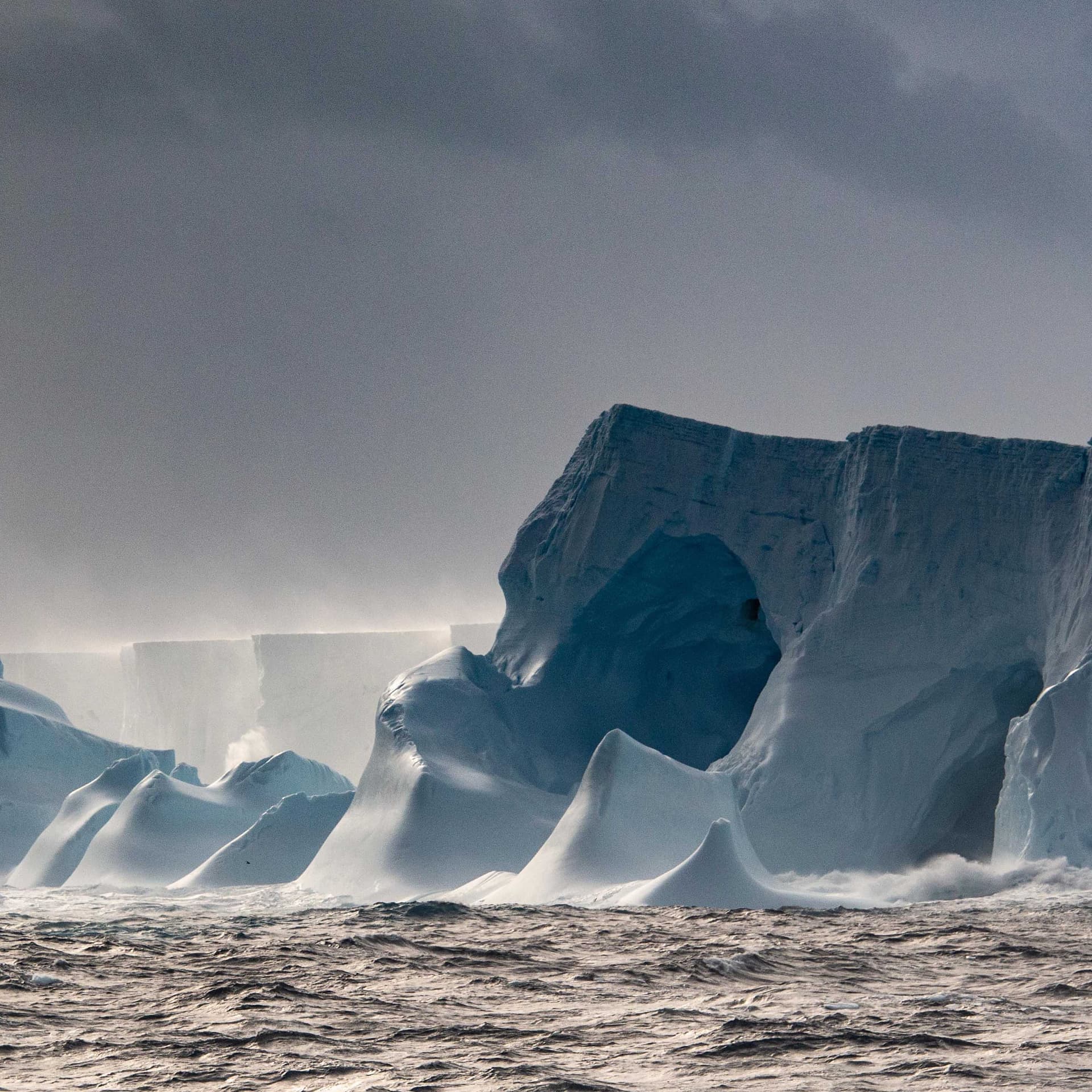
1:47It felt as if we were looking at land, because you couldn't actually imagine how big it was. It was going on for tens of kilometres in front of us. And, you know, just sparkling white. Whichever way you looked at it, Iceberg A-23A was gigantic. It was monumental. As you look down towards the base of the iceberg, you see these massive ice caves. This was a chunk of solid ice covering an area twice the size of London or Los Angeles, as deep as the Empire State Building is high, and weighing a trillion tons. Imagine that You see this really amazing scalloping so there's quite beautiful carved shapes into the ice Sharp towers coming up as well A23A broke away from the Antarctic continent in 1986 and for nearly four decades it was the world's largest iceberg a megaberg And all the cloud lifted and there we saw this huge expanse of just white cliffs and the waves crashing against it.
3:09My name is Dr. Catherine Walker, and I'm a glaciologist based at the Woods Hole Oceanographic Institution in the United States. I was born the same year that A23A separated from the Antarctic Aishi, and I've always been fascinated by this icy colossus. In my work, I've studied A23A from space using satellite images, but in this episode of the documentary, I'm going to hear from those who have seen it right up close and documented its journey, from its birth deep in the Antarctic through to its final chapter, shrinking, melting, and feeding the ocean from which it came. From the BBC World Service, this is A23A, Biography of an Iceberg
4:05Dr. Catherine Walker:Now the story of A23A begins way, way further back than the day it sheared off from the Filch-Norani ice shelf in Antarctica in 1986. The ice which would eventually become this megaberg began as snow, falling on the Antarctic continent thousands, or maybe tens of thousands of years ago.
4:28So you can think of the Antarctic as almost like a pyramid, a smooth, colossal pyramid, but it's higher in the middle, and it's higher in the middle because it's ice. There is kilometres, four kilometres of ice sitting on the Antarctic continent, and it sort of slopes downwards from the middle outwards.
4:45Dr. Catherine Walker:This is Dr Andrew Myers, science leader of the Polar Oceans Program at the British Antarctic Survey. Although we like to think of ice as a solid, it's not. It very gradually deforms, and the weight of that huge mass, basically uphill, on the Antarctic continent is sliding down. So, over centuries, layers and layers of snow come packed into ice. And as it gets heavier, that ice begins to flow, as glaciers, which are basically rivers of ice, towards the edges of the Antarctic continent where it meets the ocean. It's hard to reconcile how something can both flow slowly like a river, like a fluid, and also kind of catastrophically break and you can't put it back together.
5:33Dr. Catherine Walker:Here's glaciologist Dr. Joanna Milstein. She's an affiliate researcher at the Colorado School of Mines in the United States. And she's fascinated by that dual property of ice, that it's both a solid and a fluid at the same time. and that is really time-scale dependent. So over long periods of time, it flows a bit like a fluid and over very short periods of time, it behaves like a solid and can fracture and break.
6:07As that ice gets to the continental edge, it goes into the ocean. But because it's attached to the continent or the ice on the continent, it doesn't just break off and float away. It actually floats out into the ocean, forming these ice shelves. So they can be absolutely colossal. The Ross Ice Shelf and the Ronnie Filchner Ice Shelf are thousands and thousands of square miles. They're colossal. And they're floating. I like to say that glaciers are actually, they're pretty bad swimmers.
6:36Dr. Catherine Walker:Professor Erin Pettit is a glaciologist based at Oregon State University in the United States. They get scared if they can anthropomorphize my glacier. They kind of get scared as they enter the ocean. And if they don't have something to hold on to, like a little island or even a submarine seamount that they can just hold on to, then they tend to fall apart into a bunch of icebergs. And so many of these glaciers will flow off the continent onto the ocean, and they will continue to flow as long as they have something to hold on to. But when they lose that anchor out in the ocean, that island, then they tend to fall apart.
7:23Dr. Catherine Walker:And that's when icebergs are created. Ice shelves grow naturally and can only withstand so much stress before they have to naturally break off. Dr. Emma Pierce is a glacier geophysicist at the British Antarctic Survey. If you think about what's happening in Antarctica, snow is always falling and that snow has to go somewhere. It can't build up forever and ever and ever. So that snow densifies, turns into ice and flows out to sea. And those ice shelves can't keep growing forever because theoretically the whole of the world would be covered in ice. So they do have to naturally grow and shrink.
8:07Dr. Catherine Walker:Nobody was around to witness the origin of A23A back in 1986, but you can get a pretty good idea of what happened by looking at other massive rifts in the ice which are still growing. Halloween crack, for example, in the Brunt Ice Shelf.
8:26In the Antarctic summer of 2024, a team of scientists, including Emma Pierce,
8:32Dr. Catherine Walker:arrived at the British Antarctic Survey's Halley Base to make an in-depth study of Halloween crack.
8:45Dr. Catherine Walker:They started by flying the survey's twin otter aircraft to the crack's widest point.
8:55The crack was probably around 100 metres wide, 200 metres wide. It's so difficult to get an idea of scale with these things because there's nothing to compare it to.
9:06Dr. Catherine Walker:They followed the fracture for miles as it gradually narrowed and narrowed until they could no longer see it from the air. Then it was time to get onto the ice to take a really close look. We wanted to be at the very, very, very tip of this crack. So we landed there where we thought the tip was. and then it really came down to walking along with a ice axe roped up and prodding the ground trying to find out where this crack went and it was such a stark contrast of this giant crack that we'd been flying over that you could see for miles and miles and miles to walking along and putting your head down on the on the ice and looking horizontally trying to figure out exactly where you thought this tiny crack went.
9:57It's amazing that this giant process goes down to almost the granular size of ice. That's where it stops, at this tiny little area where you can no longer see it.
10:13Dr. Catherine Walker:The crack which eventually created a 23A took years, possibly even decades, to work its way across the ice and gradually open up a chasm. Kilometers wide, its edges crumbling into a crevasse hundreds of meters deep.
10:33Dr. Catherine Walker:By then, influenced by the pull of tides and currents, like a loose tooth, Megaberg A23A was straining to break free. I've often wondered what that moment might have been like. Maybe a terrifying rumbling, a cracking, and the ice trembling as though there's an earthquake. I think you'd be quite underwhelmed. But Emma Pierce doesn't think so. No one witnessed A23A calving back in 1986, but there were plenty of people around in 2021 when another megaberg, A81, calved off the Brunt Ice Shelf. And everyone, I think, was waiting for the announcement and they were expecting to feel something or the ice shelves suddenly change or everyone feel a big earthquake in the middle of the night.
11:30But actually, it was really only holding on by a very tiny bit at the end. The spring tides was the process that sort of finally made that iceberg let go. But these large tabular icebergs, these very big ones, when they actually let go, so much of them is already floating that it's nothing too dramatic.
11:55And that's how Megaberg A23A would have been born. Back in 1986, it calved from the Filchner-Rani ice shelf. Like an ocean liner pulling slowly and gently away from port. Exactly, yeah, all aboard the ice shelf.
12:17Dr. Catherine Walker:And so, A23A's journey had begun. In the same year, 1986, that my own life's journey had begun. While this massive island of ice, 4 ,000 kilometers square, drifted out into the Weddell Sea.
12:38Dr. Catherine Walker:But it didn't get very far. Within months, the iceberg's 350-meter-deep keel grounded on the bottom of the Weddell Sea, and it was stuck, anchored in place by its own vast bulk.
12:55Dr. Catherine Walker:And there it remained for over 30 years, waiting, biding its time until it could continue its journey.
13:08Dr. Catherine Walker:glaciers and ice hold memory in this really poetic way where the deep interior of the antarctica holding information about our past climate in that interstitial pore space between uh ice crystals preserving the actual atmosphere from thousands of years ago and so when we look at this ice, move and calve off particularly these large icebergs. There's ice in Iceberg A23 that's hundreds of thousands of years old, likely. And it'll melt into the ocean and that air is escaping and it's this beautiful, poetic interconnectivity of time, really. And it's possible to actually hear that ancient air escaping.
14:04A23A may have been grounded, but it would have been alive with sound,
14:10Dr. Catherine Walker:if you'd had the right equipment to listen to it. And Erin Pettit does have that equipment. My stepdaughter is always teasing me about this. What does my stepmom do? She listens to ice melt. And listening helps her understand the structure of the ice and how cracks propagate through it. When the snow turns into ice way up high, that process actually traps bubbles, air bubbles in the ice. And those air bubbles are amazing for many reasons because it is trapping the atmosphere at that time. But it turns out when the ice flows into the ocean, those bubbles are now pressurized because they've spent their entire life getting squeezed by this glacier and ice around it.
15:03They get to the ocean and they pop out explosively into the water.
15:11and that process of popping out generates a lot of sound. There's kajillions of these bubbles and so it sounds like a sizzling frying pan or a snap, crackle and pop of ice.
15:33Dr. Catherine Walker:Aaron Pettit has drilled 400 or 500 meters down into the Thwaites ice shelf in West Antarctica and used hydrophones, those are underwater microphones, to listen to what's happening underneath the ice shelf. And at that depth, the air bubbles are under pressure, so they're held firmly in the ice. The sizzling dies down, and another world is revealed. And it's this big cavern, and it's very... It's kind of an eerie, different sound. You can hear really, in a very eerie, echoey way, this fracturing process. And so if you listen long enough, you will hear this boom and a crack and a boom from some distance away.
16:33and then you get the sounds of seals that come through with their kind of whistles underwater that just kind of add to this this very cavernous sort of echoey feeling
16:48Dr. Catherine Walker:you're listening to the documentary from the bbc world service
16:55Self-directed investing, trading, full-service wealth management, automated investing, financial planning, thematic investing, retirement planning. Phew. And to think, that's just a small taste of what Schwab offers. Because Schwab knows that when it comes to your finances, choice matters. No matter your goals, investing style, life stage or experience, Schwab has everything you need, all in one place, so you can invest your way.
17:47under 20 seconds. Join millions saving billions on hidden fees. Be smart. Get wise. Download the Wise app today. T's and C's apply. I'm Dr.
18:01Dr. Catherine Walker:Catherine Walker, and this is A23A, biography of an iceberg.
Read the full transcript
18:10So let's go back to our megaberg, which grounded in the Weddell Sea soon after it broke away from Antarctica in 1986. And there it stayed for more than three decades. But throughout this time, very slowly, the underside of A-23A was being melted by the sea. Its huge keel, gradually eroding. In 2020, A-23A once again began to stir and shift. And one day, finally, it was free again. Free to continue its journey. Driven by currents in the Weddell Sea, the megaberg moved up north into Iceberg Alley. That's the route bergs usually take up the eastern coast of the Antarctic Peninsula. Then it entered the main southern ocean at the peninsula's tip.
19:12which is where we met it in 2023, around November. Andrew Myers was chief scientist for the British Antarctic Survey's Biopole expedition aboard their research ship, Sir David Attenborough.
19:27I was called up to the captain and he said, there's a big iceberg in the way. We're going to have to go round this. How big is this iceberg? And he showed me the satellite images and it is colossal. It was twice the size of Greater London. And it was sitting directly on our path. And it was very dramatic as we sat on the bridge, watching the fog in front of us and eventually just resolve into this massive wall.
19:58As they worked their way along the perimeter of A23A, at one point they encountered a bay in the iceberg. They decided to sail into it. and so we sat in the middle of this this huge fjord that was in the iceberg and we could see over the course of an hour or two the one wall of the iceberg moving towards us and the other one receding away as the ship stayed perfectly still and you could see the captain start sweating a bit and off we went i think you know i can't guarantee but i'm very i very much think that we were the first humans to see the ice since it had carved the first people to see it with our own eyes.
20:35And so that was a really special moment, especially when we realized it was the world's largest berg.
20:43By late 2023, when Andrew Myers and his team encountered it, A23A was not only the world's largest megaberg. Because of its 30 years stranding, a ground in the Weddell Sea, it was also now the oldest recorded iceberg still hanging around. But now it was entering a new chapter.
21:08From the tip of the Antarctic Peninsula, currents and winds carried A23A across the Southern Ocean towards South Georgia, one of the most remote islands on Earth, about 1 ,500 miles from both South America and the Antarctic. A23A reached it in early 2025 and then ran aground again for the second time in shallow waters near the island.
21:36And this was a chance for scientists from the British Antarctic Survey to pay the megaberg another visit. So we did our oceanographic expeditions, which were ending in South Georgia. Professor Geraint Tarling leads the ecosystems team at the British Antarctic Survey. He was joint leader on their Biopole 2 expedition.
22:01Dawn broke and I was up with a coffee. I'd only had two or three hours sleep the night before because I really wanted to see it at first light. And there it was, just a huge block of ice, just as far as the eye could see. It felt as if we were looking at land because you couldn't actually imagine how big it was. It was going on for tens of kilometres in front of us. And just over the top of it was just a haze of fog because it was so cold compared to the relatively warm waters of South Georgia. It was creating its own clouds and fog around it. So it was almost sort of peering at you intimately through these clouds of fog.
22:43But Geraint and his team weren't there to sightsee. What this grounded giant gave them was the chance to understand the way that megabergs can fertilize the ocean with nutrients and create new blooms of life. You remember how A23A started its life? As a glacier flowing gradually across the Antarctic continent? Well, in the centuries or maybe even millennia that it takes for ice to be laid down and flow from the center of the continent to the edge, it picks up a lot of dust on its surface. There are the particles which rain down on it from the atmosphere, volcanic ash, particles from wildfires, and even meteorites from space.
23:27Meanwhile, the bottom of the glacier is also grinding out minerals from the continent beneath it, and all of this material ends up layered into the ice in icebergs as they calve off from the ice shelf. Then, as the iceberg melts, it sheds all of this material into the ocean, effectively creating a nutrient-rich soup. So megabergs contain within them the potential to create an explosion of life around them. But the other thing that they do, these icebergs, is that they mix the water column as well. And we have these deeper water masses where there's lots of nutrients there, but they're not coming to the surface.
24:08You can almost think of the ocean like a layered cake, and these layers are quite fixed. And you need something to stir them up to bring what's deep into the surface. and that's what icebergs can potentially do particularly mega icebergs because they're so deep they can go down hundreds of meters they can get into these deeper layers and create convective currents that bring these nutrients to the surface so that's the other unique thing as well as melting out these nutrients they can stir up what's deep and the combination of those two things are what makes these such fertile environments that you can see huge booms of phytoplankton trailing behind or even going ahead in some instances of these icebergs as they trundle through the ocean.
24:49Geraint and his colleagues did a complete circuit of A23A, sampling the ocean around the iceberg to understand how it was impacting its environment and local ecosystems. But as they worked, Geraint had to keep reminding himself to take in and appreciate the awesome spectacle in front of him. I think as a scientist your instinct is just to keep going to make as many measurements as you possibly can to make the most of the opportunity. So a lot of us are saying right well let's do this, let's do that, let's make sure we get those samples. And you have to almost stop yourself to say actually you'll never see this again in the rest of your life.
25:25Please just stop and have a look because actually this is one of the most awe-inspiring natural phenomena that humans will ever see and you have to take it in. Yes, you do have to take it in. Because nothing, not even an iceberg twice the size of a city, lasts forever.
25:50A23A was entering its final chapter. Yeah, it stayed grounded at South Georgia for another couple of months. And then, you know, it's rapidly melting. so the things that they were grounded with, those keels, just melted away and released it again. And it did hang around South Georgia for another six months. This is a big iceberg, it takes a lot of melting, but this is releasing gigatons of fresh water into the South Georgia region every day, and so it was rapidly getting smaller and smaller. And on the north side of South Georgia it finally sort of cracked, and it basically broke, really large chunks started falling off it.
26:34and then by the time it got to I think about seven months after we saw it it actually was no longer registered as an iceberg that we're tracking anymore so it just gradually melted in what happens to all these icebergs it's a dramatic story when it actually is a megaberg but the fate of all of them is that they just gradually melt just like ice in a gin and tonic they just gradually disappear and then it's no longer noticeable For me, to know that A23A was gone was a poignant moment. We shared our time on Earth for 40 years, and I've been aware of it for most of my adult life.
27:17A23A had a personal meaning for me. But also, as a scientist, it's posed questions. Megabergs are a natural phenomenon. As we try to understand the effects of climate change, a key question is whether there will be more of these colossal chunks of ice breaking off from Antarctica.
27:40Dr. Catherine Walker:Over our observational record, again, 50, 60 years, we are not seeing the frequency of these megabergs increase. We're not seeing more large, large icebergs like A23A. Here's glaciologist Joanna Milstein. but we are getting more small-scale calving and melting so there's a ton of ice that just breaks off that's the size of a soccer field that we're not tracking and so kind of the implicit understanding there is we're getting more melting we're probably getting a lot more small-scale calving events it's just hard to conclusively make uh observations that show that because it's really tiny. But we do know Antarctica is losing an accelerating amount of mass with every year.
28:27Dr. Catherine Walker:It's death by a thousand cuts. This area is the most rapidly changing part of the planet. It has absolutely critical consequences for our climate, both in the atmosphere, so the heat and the carbon being taken up by the ocean and how that may rapidly change. And we know that the melt, the Antarctic is the reservoir of the majority of future sea level rise. And how that is, It's melting now, and we don't understand, we don't have the details needed to predict the sea level into the future to the level we need. Icebergs are a bellwether of climate change and sea level rise. While they're a natural occurrence, they symbolise something that's breaking apart, losing its composure.
29:10Right now, we're facing at least two metres of sea level rise across the planet because of our changing climate. That is baked in at this point. No matter what we do, that two-meter rise is going to happen, possibly within a century or so. But that's the lower limit. The upper limit for sea level rise could be considerably more. Almost 800 million people live less than two meters above sea level. if all of Antarctica collapsed, if it all disappeared, we could see tens of metres of sea level rise. And that's 800 million people we have to find homes for who don't just disappear. So it's going to impact everyone.
29:57It's going to impact how we grow food, how we grow crops, where we get our water resources from. It's going to impact all of these things. And it's something that's very important to just be able to quantify and prepare for.
30:13Dr. Catherine Walker:I'm Catherine Walker, and you've been listening to the documentary from the BBC World Service. The producer was Jeremy Grange, and it was an Overcoat Media production.
From the publisher
Forty years ago, an iceberg broke away from the Antarctic ice shelf. But this was no ordinary iceberg. A colossal chunk of ice which covered an area twice the size of London, it was as deep as the Empire State building is high and it weighed a trillion tonnes. For nearly four decades A23a was the world’s largest iceberg. Glaciologist Dr. Catherine Walker tells the story of A23a from its origins, its ice being laid down deep in the Antarctic over millennia, through to its final chapter - shrinking, melting and feeding the ocean from which it came. Catherine talks to glaciologists who study the vast cracks which propagate across the Antarctic ice shelf and to scientists who have seen A23a up close and followed its journey and its impact as it released a trillion tonnes of fresh water and nutrients into the marine environment.