In short
Heart and Soul documentary in London about Muslim speaker/author Dalia Mogahed reframing life after an eight-month cancer diagnosis, exploring grief, faith, mortality, prayer, and “how to leave this earth” through enduring charity, meaning, and relationships.
Guests (people featured)
- Dalia Mogahed: American researcher, author, public speaker; diagnosed with invasive carcinoma shortly after turning 50; has two adult sons; father died 4 years ago, best friend 3 years ago, mother died 3 months ago; experienced end of marriage; speaks at Queen Mary University and visits East London Mosque.
- Ina Sarari: Dalia’s longtime friend (met ~25 years ago during Dalia’s child’s medical treatment); lived in Emirates; barred after Arab Spring research; lives in Dubai; reunites in London after ~10 years.
- Audience members (unnamed): share impressions after Dalia’s talk.
Key claims
- “He wants good for me” is her core assumption; cancer is a “wake up call” and “blessing,” not punishment.
- Faith provides a compass, meaning for pain, and hope; life is a temporary “rest stop” and humans “belong to God and to Him we return.”
- Legacy should outlast her: beneficial knowledge/charity and authentic relationships, especially her sons’ well-being.
Notable examples
- She learned the diagnosis via lab results she copied into ChatGPT, then cried.
- She interprets a wilting flower as pruning to “let more light in.”
- She describes five daily prayers and congregation at East London Mosque; funeral (Janazah) prayer as a reminder of impermanence.
Written by AI. May contain mistakes. Listen to the episode to check what was said.
Chapters
Tap a time to open that second in VOIntroducing Dalia Mogahed
0:46 to 1:58
Introduction to Dalia Mogahed and her message to Muslim women.
“The Documentary, home of the best documentaries from the BBC World Service.”
Dalia's Life and Diagnosis
1:58 to 4:38
Dalia discusses her life, family, and her recent cancer diagnosis.
“I'm John Offord and in this episode of Heart and Soul, where we bring you stories of faith and spirituality, I'm spending the day with Dalia Mogahed in London.”
Confronting Mortality and Faith
4:38 to 7:18
Dalia reflects on how her diagnosis impacts her faith and views on death.
“And this is especially important to me because about eight months ago, shortly after I turned 50, I was diagnosed with cancer.”
Reunion with an Old Friend
7:18 to 11:46
Dalia meets her close friend after many years, highlighting their bond.
“and with all honesty i absolutely can't wait to meet him i love god so deeply i am so drenched in his grace every single day i see it in the small things and in the big things of my life.”
Experience of Community and Faith
11:46 to 14:00
Exploring the sense of belonging and the significance of prayers in Dalia's life.
“In the early afternoon, Dalia, Ina and I head to the East London Mosque.”
Faith as a Compass in Life's Challenges
14:00 to 18:00
Learn how faith provides meaning, purpose, and community connection during hardship.
“or explain all the time but when you get to be anonymous and just a person it's a huge weight off what does your faith give you personally that nothing else does a way to make sense of life's twists and turns.”
Reflections on Grief and Personal Growth
19:34 to 25:53
Understand how personal losses can lead to profound self-discovery and clarity.
“This is the documentary from the BBC World Service.”
Leaving a Meaningful Legacy
25:53 to 28:00
Explore the importance of creating a lasting impact on loved ones and community.
“What I mean by that is how do I want to leave the world a little bit different because I was here?”
Personal Legacy and Life Reflections
28:00 to 28:43
Explore Dahlia's personal reflections on legacy and making meaningful connections.
“For someone who has spent much of her life speaking to people in positions of power, Dahlia's idea of legacy is surprisingly personal.”
Transcript
Automatic transcript. May contain errors.0:00This BBC podcast is supported by ads outside the UK. Decisions made in Washington can affect your portfolio every day, but what policy changes should investors be watching? Washington Wise is an original podcast from Charles Schwab that unpacks the stories making news in Washington right now and how they may affect your finances and portfolio. Listen at schwab.com slash Washington Wise. That's schwab.com slash Washington Wise. If you are currently overpaying on software to run your business, remember this number, 10 ,000. That's the number of new businesses that join Odoo per month. Join Odoo today at odoo.com.
0:46That's O-D-O-O dot com.
0:52The Documentary, home of the best documentaries from the BBC World Service.
1:00Dalia Mogahed:I'm in a lecture theatre at one of London's universities watching an unassuming woman in a headscarf take to the stage. How do we live when we cannot guarantee that what we love will last? This is Dalia Mogahed, the American researcher, author and public speaker. She's here a long way from her home in Virginia in the USA to speak to Muslim women about finding peace in an anxious world. It's learning how to be fully human while surrendering to Allah. But as I'm going to discuss with her, she is carrying an almost unimaginable anxiety herself that she's about to reveal in public for the first time.
1:44Dalia Mogahed:This year, Dalia was diagnosed with cancer. Discover and do it. Know your Lord and call upon Him. Welcome to the documentary from the BBC World Service. I'm John Offord and in this episode of Heart and Soul, where we bring you stories of faith and spirituality, I'm spending the day with Dalia Mogahed in London. I'm hearing about this campaigner who spent her life offering support to other Muslim women, who's now turning her thoughts to what her diagnosis means for her life and her faith. Hi, nice to meet you. How you doing? Good to see you. You're alright? It's morning in London and I'm meeting Dalia Mogahed for the first time in a hotel.
2:31Dalia Mogahed:Despite the long journey and everything she's been through, there's a big smile on her face. Shall we take a seat somewhere? That's a very good thing to know.
2:44Dalia Mogahed:What does it feel like to be traveling and speaking at this particular point in your life? It's an incredible, incredible blessing. It's exhausting to travel like anyone who's ever traveled. And tours are especially exhausting because you're doing one after the other in different cities. But I see myself as having the best job in the world. I literally get paid to talk about spirituality, to brag about God, to help people find hope when things look dark. I mean, I can't imagine more meaningful work. I feel very, very blessed. I want to ask Dahlia about her diagnosis, but it's a difficult question.
3:32Dalia Mogahed:So I ask her about her life. So what is life like for you when you're not Dahlia Maggahead, the public figure? I have two adult children who live with me. So I spend a lot of time with them, two boys, two men now. And they are the most important human beings in my life. I spend a lot of time in nature. it's where I am nourished I feel like when I'm in nature when I go for long hikes I'm among a chorus of beings in praise of God and so it gives me incredible peace to be among the trees and the birds and and the rivers and I spend a lot of time I'm on projects I care about. I'm just getting to do work that excites me and feeds my soul.
4:38And this is especially important to me because about eight months ago, shortly after I turned 50, I was diagnosed with cancer.
4:50Dalia Mogahed:If you can, can you take me back to the moment you were told you had cancer? What do you remember? I was in the car and we were heading to the halal store. I think I needed cumin. And I get a phone notification. My phone buzzes. And I pick it up. It says new lab results. And I think, oh, good. I just had a biopsy after a mammogram. So many of my friends have had that happen. And it's benign and it's nothing. But it's a hassle when you're going through it and you just kind of want to put it behind you and file it away. So I was relieved, you know, the fact that the lab results were ready. You know, I'm in good shape.
5:39I work out regularly. I'm obsessive about my nutrition. My blood work's always really healthy. So I didn't worry about it. It was just something to get past and move on. And so I opened the lab result and I'm looking for where benign is. And I see invasive carcinoma. And I'm like, what? What is that?
6:16And I was so in disbelief that I put the lab result, which is like pages long. into ChatGPT. I'm like, what does this mean? And ChatGPT told me I had cancer. That that's how I had to find out.
6:41It was the before and after of my life.
6:46And I just started crying.
6:53sobbing that this was going to be what I'd be dealing with.
7:01Dalia Mogahed:It's hard to hear about Dahlia's experience of learning about her cancer, although obviously not as hard as it was for her. The cancer isn't terminal, but the diagnosis has confronted her own mortality, making her feel differently about death and her own Muslim faith. so how has that changed the way she sees things i do think about death i think about god and with all honesty i absolutely can't wait to meet him i love god so deeply i am so drenched in his grace every single day i see it in the small things and in the big things of my life. And that's
7:55why
8:02this diagnosis was both
8:10very difficult to get. But eventually I knew that it was a blessing. And I knew because I knew who gave it to me. And he wants good for me. That is my point of departure. That is my fundamental assumption. He wants good for me. And so he willed this for me and I am already seeing how it's been a protection, a wake up call, a pivot back to my true purpose. so i am very at peace with the idea of going back to god to eternal life to back home we're all just on a journey back home to god union with god where we started so this is a temporary rest stop. That's what this world is. That's what life is.
9:43Oh my God.
9:48Dalia Mogahed:This trip to London is more than just about work for Dahlia. At 11 that morning, an old friend arrives at the hotel. I miss you so much, Haripti. I miss you so much. This is Ina Sarari. They haven't seen each other for almost a decade. Dahlia met her about 25 years ago when she came to the United States for medical treatment for her child. They became incredibly close friends. I lived in the Emirates for almost two years doing research in the region. and got in trouble with the Emirati government at one point because of the research I had done on the Arab Spring. So I was no longer welcomed in the Emirates.
10:43My friend lives in Dubai, so I can't see her. I can't go visit her there. It's very hard to get a visa to the U.S., so we just couldn't see each other for years and years and years and then this opportunity came up where she had a visa to the UK and I was coming to the UK for my talks so we decided to meet here. Look at you. I came all over the way from Dubai to here to meet her after those whole years. We haven't We haven't met for 10 years and I'm so proud of her. Dalia is a soul sister. I consider myself so lucky and grateful to the creator that he gave me this chance to be part of her life.
11:38I'm sorry, I'm using the Arabic.
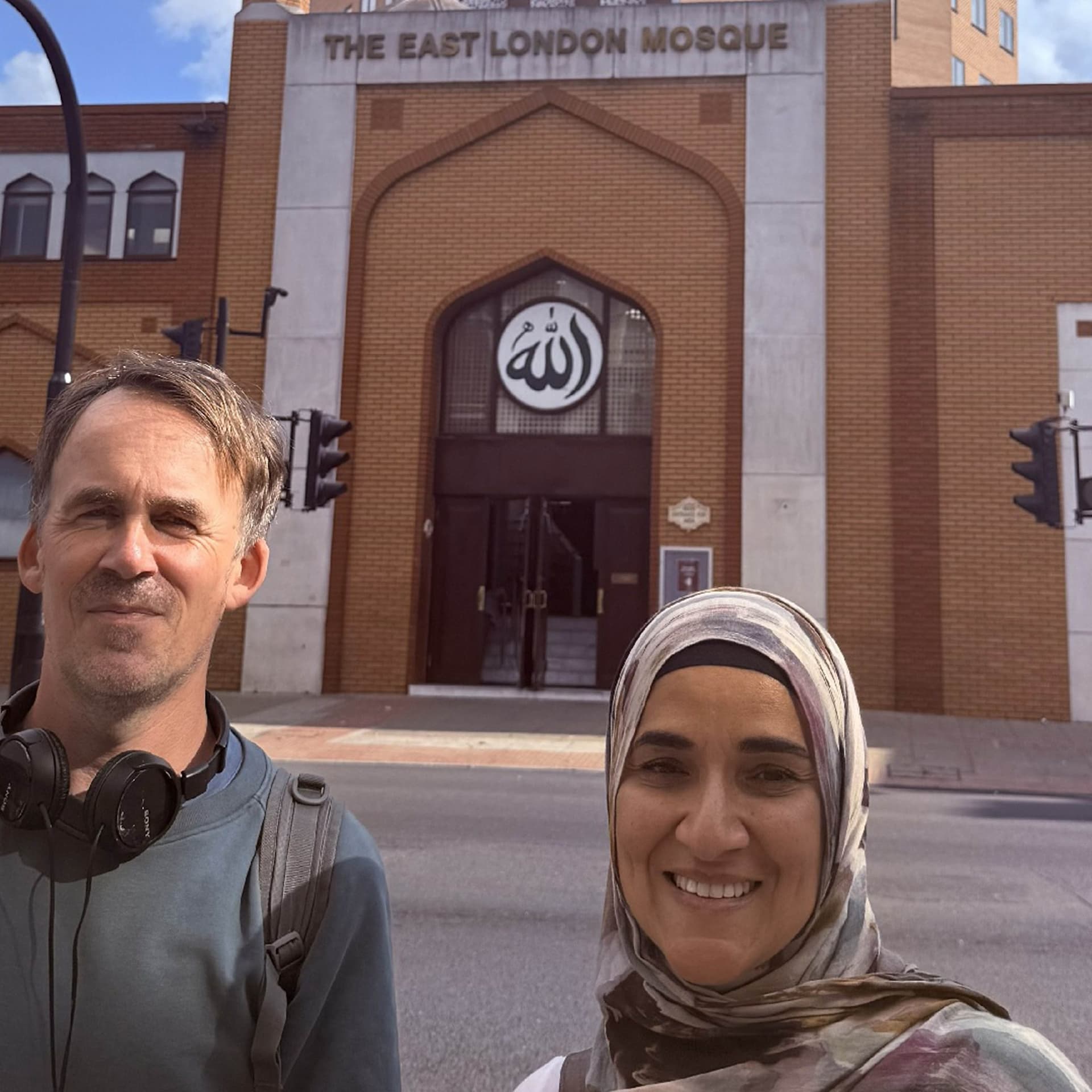
11:40Dalia Mogahed:Although Dalia is away from home, I can see how important her faith is and practicing it needs to happen wherever she is. Okay, this is us. In the early afternoon, Dalia, Ina and I head to the East London Mosque. The afternoon prayer is at 1.30pm. Yeah. I think I can see the mosque. Can you see the mosque just over there? Right in the corner? Yeah.
12:20It was really good to see the entire prayer space for the women completely full. And you can't help but feel a part of a community. I'm from America and I'm just visiting for a few days. But when you enter the prayer space, you feel like you belong wherever you go.
12:43Dalia Mogahed:So you've just been to afternoon prayer at this East London mosque. How do you feel now? I feel refreshed. I think the five daily prayers are a source of solace for me, and especially when you get to do them in congregation in the mosque. today after the afternoon prayer we also had Ejeneza prayer which is the funeral prayer and it's a it's a reminder of the reality of all of us passing away that this life is temporary and therefore very precious you've spent much of your life explaining and defending Muslim identity to other people. What does it feel like to simply be a Muslim without having to explain anything?
13:39It feels liberating and like such a weight off to get to be an individual individual human being rather than a mascot and it is exhausting to have to represent all the time or explain all the time but when you get to be anonymous and just a person it's a huge weight
14:10Dalia Mogahed:off what does your faith give you personally that nothing else does a way to make sense of life's twists and turns. It gives me a framework to put these events into that make them have meaning, that gives purpose to the pain. And I cannot imagine going through this experience, this human experience that we're all navigating without that, without that compass. I would be so lost. I would be so empty. So my faith gives me meaning and it gives me purpose. And it gives me a way to connect with other human beings. I do truly believe that we are spiritual beings having a human experience. knowing my relationship to my creator makes me more fully human.
15:21I can't imagine life without it.
15:23Dalia Mogahed:He describes your life, your body and your mind as being on loan from God. What does that mean to you? After someone passes away, what we say to them, it's a verse in the Quran, إِنَّ لِلَّهِ وَإِنَّ إِلَيْهِ رَاجِعُونَ We belong to God and to Him we return. and it's this idea we're all on loan. All of us belong to him and he calls us back to him. So my mind, my body, my soul are not my property.
16:08Dalia Mogahed:It's evening now and Dali is preparing to speak to a packed audience at Queen Mary University in London. What are you hoping to give people through these talks? Hope. Coping mechanisms. And an understanding of God that helps them make meaning of the challenges in their lives. What I was being purified from. What I was being prepared for. Maybe cancer wasn't just loss. Maybe it was damaging a boat to liberate it. After the talk, I asked some of the people in the audience what they made of Dahlia's message. I find Dahlia a person of substance and depth. and also because she uses her faith in a way that benefits not just Muslims but I feel like humanity as a whole.
17:13She's someone that I am inspired by. I feel like she's pushed past the status quo and she's gotten to a place of liberation. The biggest thing is the fact that we want to control our lives and that is difficult and this topic resonates with me because we can't control the outcome. It actually gives you a jolt in your brain that actually we're all fragile beings and this kind of health problem is like cancer could happen to any one of us at any time in our lives. It gives you a reminder that we're all fragile and we're only here for a little while, you know.
17:53Decisions made in Washington can affect your portfolio every day. But what policy changes should investors be watching? Washington Wise is an original podcast from Charles Schwab that unpacks the stories making news in Washington right now and how they may affect your finances and portfolio. Listen at schwab.com slash Washington Wise. That's schwab.com slash Washington Wise. This advertisement feature is paid and presented by GoTurkiye. Everyone takes the ferry in Istanbul. It's how the city gets from one side to the other, but stay on board a little longer and you arrive at the Prince's Islands, a cluster of nine islands southeast of Istanbul in the Sea of Marmara.
18:40Once places of exile for royals, today they're something else entirely. And on the island of Biukada, local businesswoman Mina Akhtar and her family have been enjoying the unique pace of life here for generations. Biukada is a place where time stands still. And as soon as you step onto the island, you feel at peace and you feel relaxed. Walking around, exploring different beaches, I think it's just wonderful for anyone who's interested in beautiful places. Just an hour from the hustle and bustle of the city, yet a world away, the Prince's Islands are a place where doing less somehow feels like more.
19:16Plan your next detour at goturkia.com today.
19:34Dalia Mogahed:This is the documentary from the BBC World Service. For Heart and Soul, I'm spending a day in London with Muslim speaker and author Dahlia Mogahed, who was diagnosed with cancer shortly after turning 50. She's been thinking about what the diagnosis has taught her, about faith, loss and how she wants to spend the life she has left.
20:03Dalia Mogahed:Dahlia's cancer diagnosis has come at a very difficult time when she was already experiencing profound loss. Her father died four years ago. Her best friend died three years ago. Her mother died three months ago. And she has also experienced the end of her marriage. How have those losses changed you? I'll put it this way. Grief is a power wash for self-delusion. What those losses have done is they've forced just a reckoning of what is important and what isn't. they've led to very difficult decisions around ending my marriage, for example. And my mother's passing, I want to comment on that because I think even that was a release for her because she was suffering for years with Parkinson's.
21:14Anyone who's seen advanced stages of Parkinson's will understand what I mean. And her passing was very peaceful among her family. And while I was sad to lose my mother, I was also happy for her because she was reunited with my father and she was no longer suffering.
21:45Dalia Mogahed:What Dahlia has been through would break many people. But after spending time with her, it's so clear to me that what's protected her is her faith. I love flowers. So I have all these flowers in my back porch. And there's this true story. The Dahlia, the flower I'm named after, was wilting. I mean, it wasn't doing well. and I was like how you know I wonder what's going on with my with my plant I took a picture of it put it in an app you know it tells you what's what's wrong said oh this it can recover it's not you know completely dead it's just requires pruning to get more light in and it needs more space to breathe.
22:42And I truly felt in that moment that God was responding to that thought by letting me know in my heart that I wasn't being punished. I was being pruned to let more light in, to make more space so I could grow so I could flourish
Read the full transcript
23:16he's given me meaning that people chase people pay thousands of dollars and go to yoga retreats and chase spiritual gurus because we're all so thirsty for meaning. And I got it. He gave me this meaning, this incredible surge of passion and purpose that I thought I already had and it's like nothing even compared to what I have now. So much focus, so much clarity. I was gifted that.
24:05Dalia Mogahed:As I listen to Dahlia and witness how strong her faith is, I wonder what she'd like her legacy to be. So when you talk about legacy, what are you actually thinking about? When I talk about legacy, I'm thinking about leaving something behind that outlasts me, that is beneficial to the world. maybe that's a book maybe that's a series of podcasts maybe that's a lecture that impacted someone's life and they did something differently that they wouldn't have had they not heard it leaving a difference that outlives outlasts my time on this earth in islam we call it a charity that is enduring, a running charity.
25:01I hope it's conveying knowledge and leaving behind beneficial knowledge that will help people find their own purpose and connect with God.
25:16Dalia Mogahed:What would you like to leave behind that isn't your professional work?
25:24I'd like to leave behind relationships that are meaningful and authentic to men, my sons, who are healthy and thriving and go on to be men of integrity and good husbands and fathers. That is probably my, if I were to do that, that would be my greatest achievement.
25:53Dalia Mogahed:all day dali has been talking about time what we do with it what we waste what happens when we realize it isn't guaranteed it's really thought-provoking i know when we chatted before we've met in person today you used the phrase how do i want to leave this earth I wondered what do you mean by that? What I mean by that is how do I want to leave the world a little bit different because I was here?
26:32What footprint do I want to leave? How do I want to make a difference? What impact do I want to have on the people around me, the people I love, my community, wider society, the world?
26:52That's the question that matters to me right now. And I really want to align my time, my energy, my talent toward that question and not wasting a moment.
27:11distracted
27:13Dalia Mogahed:and one final question for now at least if you could leave this earth having done one thing well what would you want that thing to be if it's only one thing it would be to leave my children happy healthy and thriving at the end of the day nothing to me is more important than that at all. It's not even close.
27:48I consider it such a privilege to have one of the most precious things you have, which is your attention.
28:03Dalia Mogahed:For someone who has spent much of her life speaking to people in positions of power, Dahlia's idea of legacy is surprisingly personal. It comes back to her children, her friends, her parents and the people she has helped through her work. Cancer has made her more conscious of the fact that none of us know how much time we have. But for Dahlia, that uncertainty isn't a reason to retreat from life. it's a reason to pay close attention to it to make the call reconnect with a friend and write the book and spend time with the people who matter
28:43Dalia Mogahed:you've been listening to the documentary from the BBC World Service the programme was presented and produced by me John Offord the series editor is Rajiv Gupta
29:28Transcription by CastingWords in one place so you can invest your way. Visit schwab.com to learn more.
From the publisher
Dalia Mogahed is one of the most prominent Muslim voices in American public life. For three decades, she has researched and defended the experiences of Muslim communities in the United States, advising leaders and challenging misconceptions about Islam, identity and belonging. But after a lifetime speaking for others, Dalia Mogahed is now exploring her own questions of faith and legacy. A cancer diagnosis on the eve of her 50th birthday prompted a period of deep reflection, bringing into focus years of personal loss, including the deaths of her father, her best friend and her mother, alongside the end of her marriage. Through these experiences, Dalia has been reflecting on how we find meaning, sustain faith and understand what truly matters. She reflects on the journey that has taken her from researcher and public intellectual to a more personal exploration of spirituality, vulnerability and purpose. She shares how faith can be tested, reshaped and deepened through moments of uncertainty.