In short
Why stars burn and whether the universe “recycles” elements to keep balance—specifically, where hydrogen comes from and whether helium can be converted back into hydrogen.
Guest backgrounds
Dr. Emmanuel Proven-Adzuri, astrophysicist and manager of the Ghana Radio Astronomy Observatory; Dr. Linus Kwekula-Bek, physicist at Kwame Nkrumah University of Science and Technology researching protoplanetary disks.
Key claims
After the Big Bang, hydrogen formed early and is not replenished; stars fuse hydrogen into helium (one-way chemical evolution, not recycling). Converting helium back to hydrogen would require far more energy than stars can provide, and fission can’t start a chain reaction for stable helium. Stars eventually die (supernova for massive stars), and heavier elements are produced during explosions.
Notable examples
Kakum National Park stargazing in Ghana; Ghana Radio Astronomy Observatory’s African Very Long Baseline Interferometry Network; supernova debris forming elements like gold, uranium.
Written by AI. May contain mistakes. Listen to the episode to check what was said.
Chapters
Tap a time to open that second in VOStargazing in Ghana
2:12 to 4:04
The journey begins in Kakum National Park to observe stars.
“And to start, we're going stargazing in Ghana.”
Market Insights and Star Questions
4:04 to 9:04
Exploring the balance of the universe through a market conversation.
“The only thing I'm scared of is failure.”
Journey Through Time and Elements
9:04 to 14:01
Understanding the origins of hydrogen and stellar formation.
“there's something pretty special which can do just that.”
Star Formation and Element Production
14:01 to 19:31
Learn about how stars form and the process of nuclear fusion creating heavier elements.
“And then they begin to collapse under their own gravity.”
The Universe's One-Way Chemical Evolution
19:31 to 20:06
Explore the concept that the universe does not recycle elements and is on a one-way street of chemical evolution.
“Wayfair's Memorial Day Sale is on at the Wayfair Store at Edens Plaza in Wilmette.”
Understanding Nuclear Fission
21:13 to 28:01
Dive into the process of nuclear fission and its implications in energy and the universe.
“Surrounded by the sound of nocturnal creatures and atop the rainforest canopy, the stars seem so much more meaningful than giant nuclear fusion machines far away in the universe.”
Splitting Atoms: The Limits of Fusion and Fission
28:01 to 29:41
Explore the challenges of splitting helium back into hydrogen and the fate of stars.
“Splitting the atom is undoubtedly one of the crowning achievements of human science and technology.”
The Life Cycle of Stars and Element Formation
29:41 to 31:49
Learn about the lifecycle of stars and how supernovae create heavy elements.
“They'll burn through their stock of hydrogen, then they'll die.”
The Universe's Recycling Concept
31:49 to 34:19
Understand the universe's process of recycling materials and the balance it maintains.
“So turns out the universe doesn't work like a giant recycling plant, fusing new elements and then splitting them apart again to keep everything in perfect balance.”
Transcript
Automatic transcript. May contain errors.0:00This BBC podcast is supported by ads outside the UK.
0:30Make your travel dollars work harder. Follow Smart Travel on your favourite podcast app. Ever wonder why we make the choices we do? And how to make smarter ones? Introducing Choiceology, an original podcast from Charles Schwab. Join Wharton Professor Katie Milkman, an award-winning behavioural scientist and author of the best-selling book, How to Change, as she shares true stories from Nobel laureates, authors, athletes and everyday people about why we do the things we do and how to make better choices to help avoid costly mistakes. Each episode covers the latest research in behavioral science and dives into themes like the power of self-control, shaping your mindset for success, navigating new beginnings, and why starting over can feel so hard.
1:20Listen to choiceology at schwab.com slash podcast or wherever you listen.
1:29Hello and welcome to the documentary from the BBC World Service. I'm Alex Lathbridge and I'm one of the presenters of CrowdScience. The concept is pretty simple. You send us your science questions and we try and answer them with the help of some of the finest minds in the world. Experts who spend their lives doing the research. From how big is a rainbow to can I really manifest the future? You can ask us pretty much anything that's bothering you. Just email crowdscience at bbc.co.uk or WhatsApp us on plus 44 8000 314 773. That's plus 44 8000 314 773. As a special treat, we're giving you the chance to hear one of our recent episodes now.
2:17And to start, we're going stargazing in Ghana.
2:23Alex Lathbridge:Welcome to Kakum National Park. My name is Kwabina Asante from Abrappu Dumasi here, who works as a tour guide in Kakum National Park Wind Forest. We're hoping to see some stars. Where are we going? We are going to the forest, but the problem is the forest canopy will cover us. to find a place where we can go up on the tree platform to be able to see the stars. Yeah, OK. Let's go. Yanko. OK. You've caught me somewhere, unexpected, hiking through a forest. I found myself in Kakum National Park in Ghana's central region. It's the end of the day. All the visitors have gone home, and dusk slowly approaches.
3:14My guide, Kovana, is leading us into the forest.
3:19Alex Lathbridge:Do you believe there are spirits? Yes. Yes. Where we are in the nature. Yes. Each and every tree has its own spirit to protect us. Without them, we cannot live. That's why we normally say, when the last tree, the last man dies. I'm here to see some stars. And that's not easy with a dense canopy overhead. so we've got a little hike ahead of us. If I'm going to have any chance of seeing the night sky we'll need to make it to a bird watching platform built around a huge tree which is slightly more difficult to find when light's fading. It's getting dark so let's hope to see something. What was that?
4:06Alex Lathbridge:So I would say that don't be scared. We're here, we are in the nature. Nothing to be scared of. Okay. The only thing I'm scared of is failure. And cobras.
4:23You're listening to CrowdScience from the BBC World Service, the programme that peers into the cosmos of your science questions to find the answers in the stars. I'm Alex Lathbridge. Today's story doesn't start in the depths of a rainforest, at the beginning of the universe, or even in the burning heart of a dying star. It starts at Makala Market, right in the middle of Ghana's capital, Accra, where hundreds of traders line the streets and shopfronts. And for the first time in my life, I'm not here just to buy designer sunglasses. I'm here to meet listener in Danusa. Everybody comes here. People land at the airport and say, I want to go to Makala because truly this is it.
5:07This is the centre of trade, commerce. I'm in Danusa Amate. I live in Accra. I am part Nigerian, part Ghanaian. I'm an engineer by schooling. To be honest, before I was born, I've been an engineer. I really like to say this, I engineered my way out of my mom. So, truly, I've lost science and engineering since I was born. So, what was your question? Because it was a really interesting one. My question was, if stars consume hydrogen and produce helium and other elements, should there not be something out there producing this hydrogen, therefore creating a cycle of balance? Okay, so this is one of those questions which seem simple at first, but the more you think about it, the trickier it gets.
5:54Danusa knows that the stars are fuelled by hydrogen, and he knows that this process produces helium too, and so he's wondering, is there something out there which does the reverse, takes all that new helium and turns it back into hydrogen, so the stars can keep burning and everything remains nicely in balance. His idea makes sense. That's certainly how it works here on Earth. From my understanding of nature, everything exists in a cycle of production and consumption. Right here on Earth, we can see that oxygen goes through a cycle of production and consumption, water, even with humans. We breathe in oxygen and turn it into carbon dioxide.
6:35while plants do the opposite. Water falls as rain, evaporates into clouds, and falls as rain again, round and around and around. Plants consume nutrients from soil, animals consume plants and then die, and put those nutrients right back where they came from, in the soil. Everything we see seems to exist in a kind of perpetual system of cycle and recycle. Ndanusa is wondering if the stars do the same. I want to believe that this law exists in the whole universe. Should there not be something out there that produces hydrogen that stars now consume? That's such an interesting idea. You're thinking about the universe here, but even here in Makala Market where you're working, this is a market that is known for buying and selling.
7:26So you're seeing that cycle there. Yes, I do. I see it every day. Imagine what would happen if there was a lot of buying by the shop owners. and there was no selling, I guess the market will probably implode. So there's balance everywhere, I guess. So you have this idea that if hydrogen is being used up by our stars, then there's got to be something else making it. What do you think the answer might be? There has to be something equally as powerful and massive as a star. Because producing hydrogen will require lots of energy, something massive enough to split the helium atom into two. So that requires a lot of pressure, a lot of pressure, a lot of energy.
8:05So that's what I have in mind for now. In the end, everything balances out. Stars need hydrogen. All I've ever heard was, hydrogen is the most common element in the universe. I've never really heard an explanation as to where this hydrogen comes from. I believe there's something out there producing hydrogen. And I would really like to find it, yeah. Alright Ndanyusa, we're on the case. if the stars in the night sky are powered by hydrogen then where does it all come from if the stars burn through hydrogen to make helium as they do is there anything out there that does the opposite turning helium back into hydrogen to keep the universe in perfect balance i mean is the universe in balance at all to answer these questions we're going to wind back the clock Peer right back to the beginning of time, look up and down the length of the periodic table, and gaze deep into space.
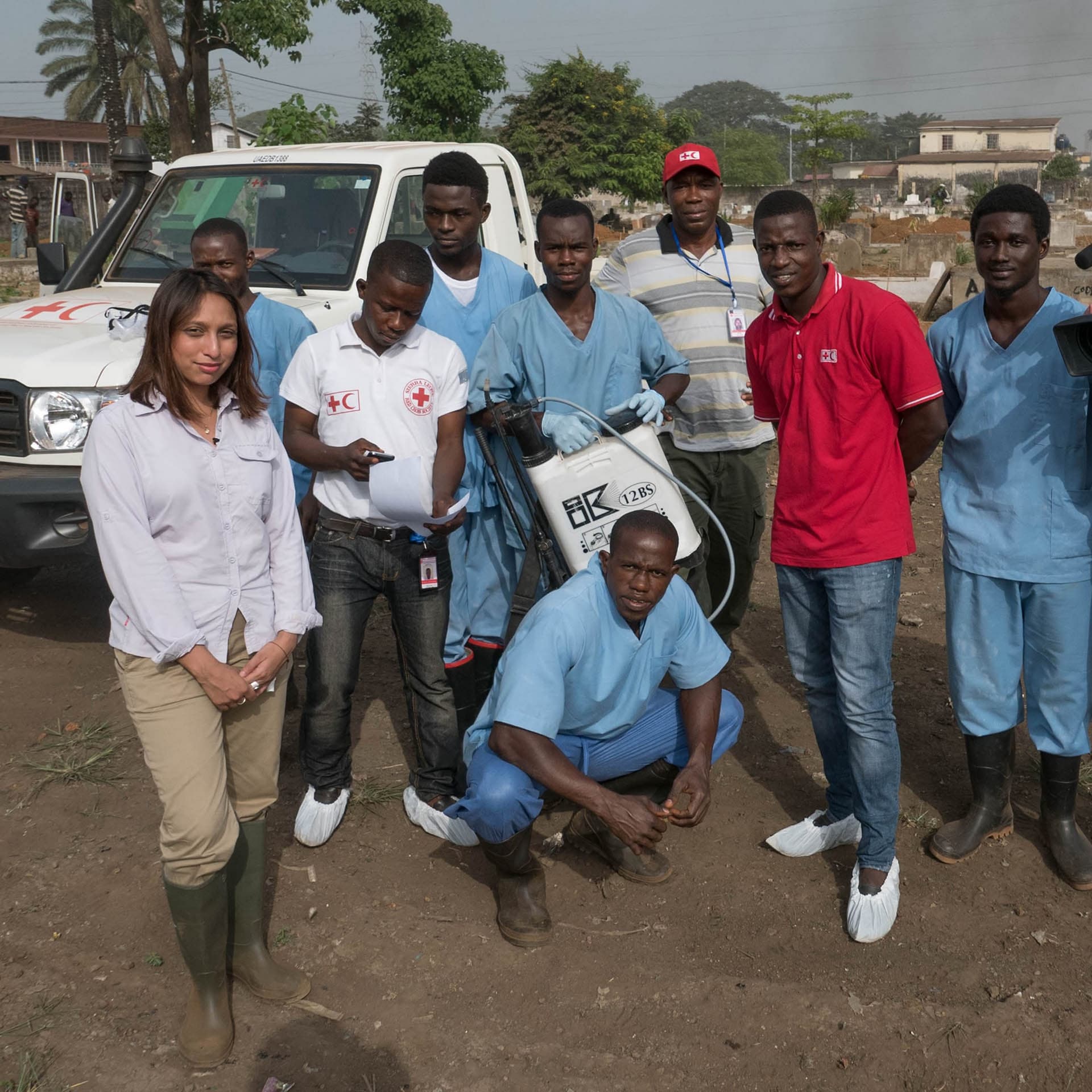
9:04Luckily, only a couple of hours' drive north from Makala Market in Accra, there's something pretty special which can do just that. If you are on the highway, you see them as very small, and then when you drive up, you see that this thing is just becoming big and big and big and big. It's the enormous, curved, 32-metre parabolic dish of the Ghana Radio Astronomy Observatory. And then when you see it moving, then you begin to ask yourself, what is it doing? So it's collecting the radio waves from space. Dr. Emmanuel Proven-Adzuri, the astrophysicist and the manager of the station here, was ready to welcome us at the gate.
9:48Akwaba, welcome to the Ghana Radio Astronomy Observatory. It's beautiful. You can hear birds in the background. And of course, there's a giant radio telescope up there and it's pointing directly upwards. So is that to be able to see the stars better? Yes, yes. So in astronomy, the bigger the dish, the better. You've got a ladder on the side of it and I kind of want to go up and see the dish. So can you show me around? Yes, of course. Let's go. The enormous dish has a fascinating backstory. It was built in the 1980s as a satellite communication dish, carrying phone calls between Ghana and the rest of the world.
10:29When fibre optics came in the early 2000s, it was abandoned and sat here unused for around a decade. A giant metal ear pointed to the sky, listening to nothing. So we are now on the elevation platform. OK. I've made it. Yeah. I'm not scared. until astronomers across Africa started collaborating on an incredible project, converting telecom dishes like this one into radio telescopes, collecting data from the depths of space together as a network. They are going to work together in sync, so if we have dishes in Ghana, in South Africa, in Mauritius, Kenya, Namibia, Zambia, Botswana, In the future, we expect that all these dishes will observe the same astrophysical source at the same time.
11:22And then you correlate the data together in one big computer. And then you produce your image, some very super cool stuff of the universe. It's called the AVN, or to use its government name, the African Very Long Baseline Interferometry Network. And this one in Ghana was the first.
11:45so we're now inside what are we looking at so we are looking at the feed horn so the feed horn is the waves from space getting onto the big reflector that's the dish so this feed horn directs the waves into the receiver wow so that gap there i see that's where the radio waves come through this one is here it's a mirror and this is the last mirror that directs the re from its center straight through this place and into the receiver back down in proven's office we got stuck into some serious astrophysics the question that we had from our listener starts with the stars burning hydrogen so if we managed to wind the clock all the way back where did most of the hydrogen in the universe actually come from.
12:37So all the hydrogen in the universe started just after the Big Bang. And the conditions and the ingredients were there. It was very hot, very dense. And then the first element, that's hydrogen, was produced, followed by some helium and then some lithium. He's very much underselling this story, so allow me. Around 13.8 billion years ago, there was nothing. This was a rather boring and silent period in history, but then again, the concepts of sound, history and boredom didn't yet exist. This all changed in a fraction of a second with the Big Bang, our universe birthed from a single super-dense point in space-time.
13:23Within a cosmological heartbeat, there was something, and there was a lot of it. These weren't elements by any means, rather a hot dense plasma soup filled with fundamental subatomic particles, your electrons, protons and neutrons. Over time, which very much existed at this point, those particles began to fuse together into the very simplest atoms. Just one proton and one electron gave us hydrogen, the lightest element in the universe. following that helium with two protons and two electrons our periodic table remained relatively empty with just two elements and then three with some small amounts of lithium soon forming as the universe expanded over millions of years this soup cooled enough to bear something special the first stars were formed through gravity and then the collision of these hydrogen atoms They're pulling each other together and then they start to spin, getting more dense, getting more momentum, pulling in more materials.
14:31And then they begin to collapse under their own gravity. Then you now begin to start the nuclear fission that begin to bend the hydrogen. A star is basically a giant nuclear reactor, squashing atoms together under enormous pressure until they fuse together. For most of a star's life, it fuses hydrogen to helium. That's what our sun is doing right now. But it doesn't stop there. Bigger, older stars, which are even denser, fuse that helium into heavier elements. From helium, you have more heavier atoms coming out. Carbon, oxygen, and then later ion. That's the process of this nuclear fusion. So from the Big Bang, we had hydrogen within minutes, and then these heavier elements took millions of years.
15:23Why? It's a rather long and steady process happening in the stars. One lighter element will lead to the next heavier element, and then you begin to have the more heavier elements. It's an interstellar domino effect. Fusion works down the periodic table. Carbon to neon to oxygen to silicon, all the way down to iron, which is the heaviest element that can be forged in the heart of a star. We're around a quarter of the way down the periodic table now. And so far, it's a lot of production and consumption, but none of the recycling that Listan Danusa was expecting. So the stars are like the factories where all these elements are coming from.
16:07Sometimes I liken it to the way who all is refined. Yeah, you see crude oil as very black, dirty stuff. But when you pass it to the refinery, then you begin to have several products coming out, your petrol, even your fertilizer materials all coming out of it. So it's a really nice factory where all these things are being produced. All right. And sort of bring it back to listener Danusa's question. Are there any processes in today's universe that can go backwards, that can convert helium into hydrogen? The short answer is no, because you need enormous amounts of energy to convert the helium back into hydrogen.
16:51And the amount of energy should be much, much higher than what is going on in the stars. There's no amount of system that will give you much more energy to now convert this helium into hydrogen. Is there new hydrogen being produced anywhere in the universe? No, no. All the hydrogen that is there now is what was created just after the Big Bang. So new hydrogen is not being created. So the time will come the universe will actually run out of the hydrogen that is formed at the beginning of the Big Bang. But that is still a very long way, trillions of years. So does that mean if we can't take helium back to hydrogen, then the universe isn't a system that recycles these elements?
17:34The universe is more like a chemical evolution and you can picture it like a one-way street. It's not going back the other direction. But you also need to remember that though our Earth is a closed system where things are being recycled, in the timeline of the universe the sun's energy is going to run out and the sun may explode the earth is also going to be turned into something okay so us humans is just a fraction of a moment so we're just a fraction of a moment our f is just a fraction of the whole even if you compare the earth to the solar system very small fraction then compare the solar system to the whole universe in the time scale of the universe our earth though you see it as a very nice recycling plant it's also going to end up into something yeah so when we're looking up at the stars we see a universe that feels uh feels eternal in perfect balance but if we're really slowly burning through all the hydrogen in the universe it sounds like we're not actually in balance at all.
18:42It sounds like the universe is very slowly burning out. Yes, that's it. The stars are slowly, steadily burning this hydrogen. That's balance in a way. Okay, so according to astrophysics, there's nothing in the known universe that acts the way Ndanyusa was hoping. A sort of anti-star, unfusing helium back into hydrogen to give the stars enough fuel to keep burning forever. And so this means that, yes, all the stars in the universe, including the one at the centre of our solar system, are burning through all of their fuel. One day, they will run out, cool, and die. There's no recycling like we see here on Earth.
19:30But is that the end of the story? That's what we'll find out next. Hey, Chicagoland. Wayfair's Memorial Day Sale is on at the Wayfair Store at Edens Plaza in Wilmette. From May 11th through 26th, you can score huge deals on everything home in person. Like up to 70 % off area rugs, up to 50 % off outdoor furniture, and up to 50 % off mattresses. Plus, you can take home the small stuff that day and get the big stuff shipped fast and free right to your door. Shop Wayfair's Memorial Day Sale, May 11th through 26th at the Wayfair Store at Edens Plaza in Wilmette. Wayfair, every style, every home. Ripbox has the best of British TV, period.
20:12Let's get started. The best mystery, period. I like a good detective story. The best romance, period. This is a book that will open the hearts of Miss Mary Bennett. The best drama, period. Welcome to the grown-up world. Stream the best British period dramas, including The Lady, inspired by a true story of murder and scandal. And from the world of Jane Austen, The Other Bennett Sister, only on BritBox. Start your free trial at BritBox.com. Today's episode is sponsored by NerdWallet's Smart Money Podcast. Personal finance can feel like a pop quiz you didn't study for. This podcast is your study guide.
20:48On NerdWallet's Smart Money Podcast, you'll hear from trusted journalists who explain the why behind major financial decisions. You'll get research-backed insights and clear pros and cons, whether you're planning a big purchase or just want to grow your wealth. Make your next financial move with confidence. Follow NerdWallet's Smart Money podcast on your favourite podcast app.
21:12You're listening to CrowdScience from the BBC World Service, where the burning stars of your curiosity light up the night sky of ignorance. I'm Alex Lathbridge and I'm trying to find an answer to a question from Indanusa from Ghana who's curious about the energy that powers the stars and what happens when that energy runs out so far we've learned a lot about fusion so could there be a way to reverse the fusion process make new hydrogen and keep the universe ticking along forever a flying squirrel
21:46Alex Lathbridge:just saw a flying squirrel back in Kakum National Park we've reached our destination before the torch drained my phone battery built around a colossal tree a huge 40 meter wooden tower rises up above the rainforest canopy the darkness has truly taken over in the distance a hyrax is calling and the stars are beginning to show themselves in their tens and hundreds.
22:23We're getting a great view. Surrounded by the sound of nocturnal creatures and atop the rainforest canopy, the stars seem so much more meaningful than giant nuclear fusion machines far away in the universe. Kwabana and Chris, another guide here, tell me that I'm not alone.
22:43Alex Lathbridge:So as we are looking like this, if a star moves, it will fly like going to fall somewhere. They will tell you somebody is going to die. That's what they were telling us. The stars in the skies are representing humans. So if you see any of the stars moving, it means you are going to lose somebody or a human life is going to get lost. It's like people don't want to, listen to their grandfather, their grandmas anymore. But formerly because there were no lights in some communities, no electricity. So when the moonlight comes up, they call all the children together and sit down and be telling them stories.
23:28When you were a child, did you grow up sitting down hearing stories on the moonlight?
23:33Alex Lathbridge:Yes, I was. It was my grandfather, my grandmother was doing that work. I can remember some of the stars, they were even giving names. There's a particular one star. It shines, but it guides the moon as the moon is moving. Wow. Now people are not concerned about the stars. Those stories are going away from us. It was even good for eyesight. If you don't have a good eyesight, you don't see that star moon. That's your test, your test. Our forefathers told us that if you count the stars, you are going to die. That one, I think it is true, because you can't count them. How can you count all these stars?
24:16Alex Lathbridge:Very difficult. One, two, three, four. You get confused. So they told us, if you try counting the stars, you are going to die. So you will not try at all.
24:29Alex Lathbridge:If you ask me there's seven, I'll say no. If there's hell, I'll say no. Heaven is where we are standing now. That's my belief.
24:45When most people gaze up at the twinkling stars, they might make a wish. But listener Danusa worries about their fuel consumption. He's an engineer through and through. He wants to know what keeps the stars burning and whether the elements that make up our universe get replenished or recycled so that they'll never burn out. So far, it looks like the answer is no. Stars use up their fuel, mostly hydrogen, by fusing it to make heavier elements. And all the astrophysicists agree, nuclear fusion can only go in one direction. But is there an alternative? In terms of fission, you want to break the element apart.
Read the full transcript
25:31We've come 250 kilometres north to the city of Kumasi and to the Kwame Nkrumah University of Science and Technology, the premier science university in Ghana, a school that I did not get into. After producer Emily and I got lost on the campus and somehow ended up in an undergraduate geophysics lecture, we were able to find a man who knows a lot about how the universe is arranged. I'm Dr. Linus Kwekula-Bek. I am a physicist at the Department of Physics. My research area is into protoplanetary disks. Protoplanetary disks, basically, when stars form, they have their dust which is around them, they would coagulate and then form into planets.
26:11And basically, I want to understand how they form into planets. More on protoplanetary disks later. I'm here so that he can explain a technology which does just what Ndanyusa was wondering about. It breaks atoms down from larger to smaller. You've probably heard of it. It drives the generators in nuclear power plants and shook the world with the bombs dropped on Hiroshima and Nagasaki. It split the atom, fuelled the Cold War and changed history forever. It's called nuclear fission. Not fusion. Fission. Fission. Fission? Fission. Yeah. It's difficult. So what is fission? Yeah, so fission. That's the F-I-1.
26:56So nuclear fission is when the particles in the nucleus, the protons and then the neutrons, which are together, would break apart. Why would humans actually want to do this process of nuclear fission here on Earth? For energy processes. Most of the nuclear reactors we have on Earth are basically tuned towards nuclear energy. Ghana, for example, is interested in nuclear energy so that they'll provide enough energy for us. What elements are usually involved there? So you tend to do that for heavier elements, materials like uranium, which are able to be broken apart into smaller elements. And that is what you have in the control system here.
27:36And so why is fusion then so common in the universe, while fission is comparatively rare? So fission requires a concentrated amount of material. And in space, you do not have that. in terms of uranium in the universe we do not have that much of it there so even if you notice even on earth we need to do some kind of uranium enrichment to be able to create the processes for fishing. Splitting the atom is undoubtedly one of the crowning achievements of human science and technology. Out there in the depths of space it rarely happens but let's get hypothetical. Could this process be used to split helium back into hydrogen?
28:19Could this be the thing that Ndanyusa was searching for? Can we go from helium back to hydrogen? In stars it's going to be impossible to do that because for fission it's a chain reaction so once you do not have that chain reaction then that means you cannot have fission so it's quite difficult for you to have that process yeah. Right okay it's like pushing a snowball down a hill you do the initial push and then it sort of takes care of the rest the process keeps going and going and going right okay so from cartoons i've watched snowballing and i think that's it right yeah yeah i've watched cartoons never seen snow before alex this is gone the chain reaction is an essential part of the fission process the elements we use in nuclear reactors are both large and unstable making them relatively easy to break apart and once you split one atom, the leftover neutron floating around helps to split another, and another, and another.
29:18But helium is both one of the smallest and one of the most stable atoms in the entire universe. It would require a huge amount of energy to split a single atom into hydrogen, and it wouldn't start a chain reaction either. One atom is all that you'd get. Sorry Ndanyusa, looks like the fate of the stars is sealed. They'll burn through their stock of hydrogen, then they'll die. But before they do, they have one more trick up their sleeves, because when stars go out, they do so with quite a bang. Let's say we get to a point for very large stars, they get to the point where they would form ion. Fusing ion does not produce energy, and so what would happen is that gravity would now be more than the force of the hot gases which are exerting and then after that the star would then explode.
30:12Explode in a supernova. Then we now get other options, either a black hole or you get a neutron star depending on the size of the star or you get a red dwarf. When a dying star explodes as a supernova, temperatures become unimaginably high and all bets are off in these extraordinary conditions the heavier elements can be fused this is where we get gold silver lead and the uranium that we need for fission reactions back here on earth they're all the explosive debris left over from the death of a star the star goes and explodes and so it's from that that we ended up with things like iron gold and uranium the elements that we see here in the earth today yeah yeah so you find them in the universe in dust materials which then forms these kind of protoplanets then the planets will form then you have some of these materials in them that's where your work comes in you look at seeing how that dust the protoplanetary dust can eventually create planets yeah so you would have the dust which was going around the star would now begin to calculate they begin to combine into smaller forms how long does that take for that dust to become a planet so that it takes millions of years so i think that's really interesting going back to listener danusa's question you know can we go backwards you know is the universe always in this sort of recycled balance and the answer is no but if it were yes the stars wouldn't explode and we wouldn't have the dust that would eventually become our planet earth no so that means that if we tend to go backwards then that means that we don't have those materials which would be useful for other processes then we wouldn't have earth we wouldn't have the animals that became us humans through evolution which gave us listener and then you said he wouldn't be able to ask this question yeah that's basically that yeah that's it that's it yeah fantastic so just as the universe was born it would get to a point where it would die and there are some theorists who believe that before the big bang there was another universe and then as that universe exploded we now got our universe so definitely there would be that point where our universe will also die out and another process would begin.
32:42So maybe our listener isn't truly wrong it's just the concept of recycling you know he's thinking oh it's going to all happen in the same universe maybe once this universe ends next universe that's still technically recycling. Yeah I'd agree with that. So turns out the universe doesn't work like a giant recycling plant, fusing new elements and then splitting them apart again to keep everything in perfect balance. It's more like a cosmic factory, taking the raw materials from the Big Bang and making increasingly heavy and complex elements, right the way down the periodic table. But that doesn't mean that it's not in balance.
33:25It's in perfect balance, each star a precise little cog in the great celestial machine. It makes planets, moons and asteroids. It makes comets with icy tails, magnetic fields twisting in the dark, black holes and pulsars ticking like interstellar lighthouses. It makes everything, including the mysterious dark matter that we still can't quite see. Eventually, sometime billions of years in the future, the factory will run out of raw materials. The production lines will stop, doors will close, and our universe will die. But maybe, just maybe, everything that's ever been will somehow reform into a brand new universe.
34:13Everything that's ever been will be, again, only different. Now that's a recycling scheme I can get behind. Thanks for a brilliant question, Danusa. Take it away with the credits. That's all from this episode of CrowdScience from the BBC World Service This week's question was from me Ndanusa Amate from Accra in Ghana The show was presented by Alex Slithbridge and the producer was Emily Knight If you have a question on any science subject and you want the team to investigate why not email crowdscience at bbc.co.uk Goodbye
34:58Thank you, Ndanyusa. And I'm just going to add that you can also WhatsApp CrowdScience on plus 44 8000 314 773. That's plus 44 800 314 773. Now, CrowdScience isn't normally here in the documentary podcast feed. So if you'd like to hear episodes about the colour of animals, the taste of salt, and even whether you can unlock a car using your own head, search for CrowdScience wherever you get your BBC podcasts.
35:51changes to brand new tires, there's no grander opportunity to feel more confident in your ride. Visit Midas, now at 1812 Sycamore Road and get a synthetic blend oil change with tire rotation for just$29.99.
From the publisher
Listener Ndanusa in Ghana, is gazing up at the stars, and wondering what keeps our universe in balance? Ndanusa knows a thing or two about the stars, and he knows that they use up hydrogen as they burn, and release helium. And he’s wondering, is there something out there which does the opposite? Something that uses up helium, and produces hydrogen, to keep the universe in perfect, chemical equilibrium? Presenter Alex Lathbridge goes on a journey to answer his questions and delves into the blackness of deep space, the ancient origins of our universe, and the complex physics of the stars. He pops into the Ghana Radio Astronomy Observatory, just outside Accra, where astrophysicist Dr Proven Adzri helps him peer into the earliest few seconds of our universe, and find out what set the stars burning. And at Kwame Nkrumah University of Science and Technology, Dr Linus Labik talks him through what’s going on at the atomic level. And in the deep blackness of the night, up above the tree canopy of Kakum National Park, he takes a peek at the stars for himself. Local guides Chris and Kwabena explain how much meaning there is behind the stars in the night sky.