In short
Australia’s “frenemy” relationship with China—economic interdependence alongside rising military rivalry—set against Belt and Road fallout, US-backed defense integration, and public/elite perceptions.
Guests (backgrounds)
- Charles Lyons-Jones, research fellow at the Lowy Institute (Sydney think tank); analyzes Australian public opinion via Lowy polling.
- US Marine Captain Kevin Hicks; US Indo-Pacific crisis-response framing; trains with Australian forces.
- Australian Brigadier Ben McLennan; commands a brigade preparing for “world war” scale contingencies.
- Dr Marina Yue Zhang, University of Technology Sydney associate professor; studies China-Australia dynamics and power politics.
- Ron Barker, Townsville local entrepreneur/businessman; long-time Chinese supplier/customer.
- Michael Koo, schoolteacher; Chinese-Australian, Townsville Chinese Club member; discusses community politics.
- Adam Armstrong, Queensland cattle producer; trades beef with China and other markets.
Key claims + examples
- Trust is low: 31% trust US, 28% trust China (Lowy poll).
- Australia cancelled Victoria’s Belt and Road deal in 2021; now expands bases and buys nuclear submarines with US backing.
- Joint exercises in Townsville (e.g., Southern Jackaroo) rehearse high-end war; US Marines increased from ~200 (2012) to ~2,500.
- China-Australia clashes include allegations of political/PLA covert activity and Chinese Navy live-fire drills near Australian waters (Tasman Sea).
- Trade is “fraught”: China imposed 55% beef tariffs (June) after a reduced 2026 quota despite the free trade agreement.
Written by AI. May contain mistakes. Listen to the episode to check what was said.
Chapters
Tap a time to open that second in VOAustralia's Defense Exercises and Relations with China
0:55 to 2:54
Exploration of military exercises in Australia and its relationship with China.
“That's the sound of a live fire exercise taking place near Townsville in Queensland, Australia.”
The Evolution of Australia-China Relations
2:54 to 5:24
Discussion on the historical context and recent developments in Australia-China relations.
“I'm the BBC's Australia correspondent Katie Watson.”
Public Perception of Global Alliances
5:24 to 7:40
Analysis of Australians' trust in the US and China based on poll results.
“As part of his role as a research fellow at the Lowy Institute, a Sydney-based think tank.”
Military Partnerships and Strategic Alliances
7:40 to 9:10
Insights into the military partnership between Australia and the US and its implications.
“There are a number of European countries which are larger investors in Australia than China.”
The Geopolitical Landscape and Future Threats
9:10 to 14:00
Discussion on the role of Australia in the Pacific region amidst rising concerns about China.
“When it comes to the amount of Marines within the Indo-Pacific, we can't get into all those details, but we do stand prepared to respond to any crisis out here.”
Geopolitical Dynamics in the Region
14:00 to 14:15
Explore the military and economic alignment of Australia and its implications.
“those foreign troops operate, the differences, the commonalities, because the idea is that if the region allies can work together, they're much stronger in the event of any future threat.”
Dr. Marina Yue Zhang on China-Australia Relations
14:15 to 18:12
Dr. Zhang discusses the complexities of Australia's relationship with China and the US.
“Dr Marina Yue Zhang is an associate professor at the University of Technology, Sydney.”
Dr. Marina Yue Zhang on China-Australia Relations
18:15 to 18:46
Dr. Zhang discusses the complexities of Australia's relationship with China and the US.
“Fed up with losing out to hidden fees when you send money abroad with your everyday bank?”
Ron Barker: Businessman and His Views
18:46 to 20:45
Ron Barker shares his experiences and evolving views on Australia-China relations.
“This battery is, they call it a blight battery.”
Cultural Connections at Townsville Chinese Club
20:45 to 22:36
Meet Michael Koo and explore the historical ties between Australia and China.
“Should it pay more attention to building that relationship outside of trade with China?”
Show all 13 chapters
Adam Armstrong on the Cattle Industry
22:36 to 24:28
Adam Armstrong discusses the essential relationship between Australia and China in the cattle market.
“because that was that kind of the political upheaval at that time that, oh, you know, China's going to take over, et cetera, et cetera.”
Navigating Relationships with China and the US
24:28 to 28:00
Industry perspectives on balancing trade and geopolitics in the context of global markets.
“The Chinese market is a very, very interesting one.”
Exploring Power Transitions and War
28:00 to 28:16
The discussion centers on the implications of power transitions and the potential for conflict.
“So if we are at the time of power transition, can we avoid war?”
Transcript
Automatic transcript. May contain errors.0:00This BBC podcast is supported by ads outside the UK.
0:35If you are currently overpaying on software to run your business, remember this number, 10 ,000. That's the number of new businesses that join Odoo per month. Join Odoo today at odoo.com. That's O-D-O-O dot com.
0:54The documentary, home of the best documentaries from the BBC World Service.
1:11That's the sound of a live fire exercise taking place near Townsville in Queensland, Australia. The operation is part of a wider training programme involving the Australian, American and Japanese armed forces, which, according to US Pacific Command, is set to strengthen defence cooperation across the Indo-Pacific region. It's a good example of how Australia's bond with one superpower, the US, ensures security. Meanwhile, its connection with another seems to do anything but. In recent years, China and Australia have clashed. We will cooperate with China where we can, disagree where we must and engage in the national interest.
1:53Over the years, concerns have grown over China's influence and military activity in and around Australia, from allegations that politicians accepted financial support linked to Chinese interests, to claims of covert operations by the People's Liberation Army, and more recently, live fire exercises by the Chinese Navy close to Australian waters. Chinese warships in Australia's EEZ, is that a serious thing? When there are live firing exercises taking place in areas where there's... 11 years after signing a free trade deal with China that was set to usher in a new era of mutual harmony and trust, there's clearly much more volatility and wariness between the two nations than there was before.
2:36If China wanted us, they would have taken us five years ago. They are a superpower now. Why can't we just show our aggression and show our weapons, show our muscles? It does seem that China would like to have more control over us as a nation than it does. This is Stories from the new Silk Road, the frenemy. I'm the BBC's Australia correspondent Katie Watson. There's constant discussion here in Australia about the role of China. And together with producer Pete Shevlin. There's a new type of warfare out there. Do you train like that as well? We're exploring Australia's complicated relationship with China, the destination for around a third of all its exports.
3:20More than a decade ago, a beautiful friendship with China began to blossom. Australia opened up its economy and encouraged business and trade, with Mandarin being taught in public schools and President Xi Jinping invited to address Parliament. In 1972, China and Australia entered into diplomatic ties, which opened a new chapter of friendship and cooperation in the relations between our two countries. But then, that upward trajectory took a downward spiral. In 2021, Australia became the first nation to perform a U-turn on China's Belt and Road Initiative, its massive global infrastructure plan when they cancelled the state of Victoria's agreement with the Chinese government.
4:07The determination that we have formed is that they are not consistent with Australia's approach to foreign policy and under the legislation will be terminated. Today with US backing, Australia is expanding its military bases and buying nuclear submarines, deepening its military integration with the United States and strengthening its role in the Indo-Pacific. But does this make Australia safer or does it risk drawing the country deeper into future conflicts? Former Defence Secretary Peter Dutton speaking in 2022. We know that our nation is facing the most complex and potentially catastrophic regional security environment since the Second World War.
4:48The threat now posed by the Chinese government aggression is very real. And Mr Speaker, it's growing.
4:59So how did a multi-billion dollar friendship morph into military rivalry? And with US international relations experiencing a shift with Donald Trump in the White House, is Australia left out on a limb? Should Australia's attention shift to China once again? Is China a friend, an enemy? Or as former Prime Minister Malcolm Turnbull famously put it, are they really the frenemy? As part of his role as a research fellow at the Lowy Institute, a Sydney-based think tank. Hey, how are you doing? I'm Charlie. Hi, Katie. Nice to meet you. Pleasure to meet you, Katie. Charles Lyons-Jones examines what Australians think about other countries in the world.
5:38How do you see that evolving relationship between Australia and China? I might go back to the results of the Lowy Institute poll as they're quite striking. When Australians look at the United States and China, they're not sure who to trust. Only 31 % of Australians trust the United States to act responsibly in the world, and a mere 28 % of Australians trust China to do the same. Those are striking findings when you consider the level of trust that the Australian government has with the United States. When I was an Australian diplomat, one of the first ports of call I would make when sharing cables or coordinating on any common policy challenges was the United States government.
6:22While Australia has a strong trading relationship with China, we are unequivocally an ally of the United States.
6:34In 2018, the Australian state of Victoria signed up to the Belt and Road Initiative, China's ambitious global infrastructure and development strategy, which in Victoria's case would have seen trade, infrastructure and financial cooperation, although the details were pretty thin at the time they signed the deal. But then in April 2021, the Australian federal government used new veto powers to pull Victoria out of that deal, cancelling all agreements signed with China because it said it was inconsistent with Australia's foreign policy. Back to our conversation with Charles at the Lowy Institute.
7:10Australians on the whole are more supportive of our trading relationship with China than they are to Chinese investment. Trade is, by its nature, defined by a relationship between buyer and seller. Investment requires a great deal more confidence. The United States remains a larger investor in Australia than China does. There are a number of European countries which are larger investors in Australia than China. And that is because our jurisdictions are much more similar and there is a greater level of trust between our governments. Australians support the trading relationship with China. They're a little less open to investment from China.
8:08The growing bond between Australia and the United States can perhaps be felt most notably through their expanding military partnership. Back in 2012, just 200 US Marines were deployed to Australia as part of the Marine Rotational Force Darwin, or MIRF-D. Today, that figure has arisen to around 2 ,500. To see Australia's military build-up up close, we travelled north to Townsville in tropical Queensland. It's a strategic outpost facing the Pacific. Just beyond the city, the silence of the bush was shattered by artillery fire. American and Australian troops training side by side, firing live rounds as part of a major joint exercise known as Southern Jackaroo.
8:54It's a glimpse of how closely the two militaries are now preparing for an uncertain future. So what does this increasing military presence tell us about the relationship between both countries? US Marine Captain Kevin Hicks. We do like to call ourselves America's 911 response force. When it comes to the amount of Marines within the Indo-Pacific, we can't get into all those details, but we do stand prepared to respond to any crisis out here. So China is obviously the biggest trading partner for Australia. It's probably the most important partner economically, but Australia has always looked to the US for security.
9:32We focus in our lane, which is the military lane, And we're on our 15th rotation of MRFD, Marine Rotational First Darwin. And this is one of the many exercises that we have going on in Australia. We also have in the Northern Territory, we just finished up Predator's Walk. We have another one out here in Townsville next month called Predator's Run. So we're constantly coming out here on behalf and the invitation of the Australian government. and whenever MRF-D does come out here, we just focus on how do we improve our interoperability alongside our ADF partners. A small part of that is the communication.
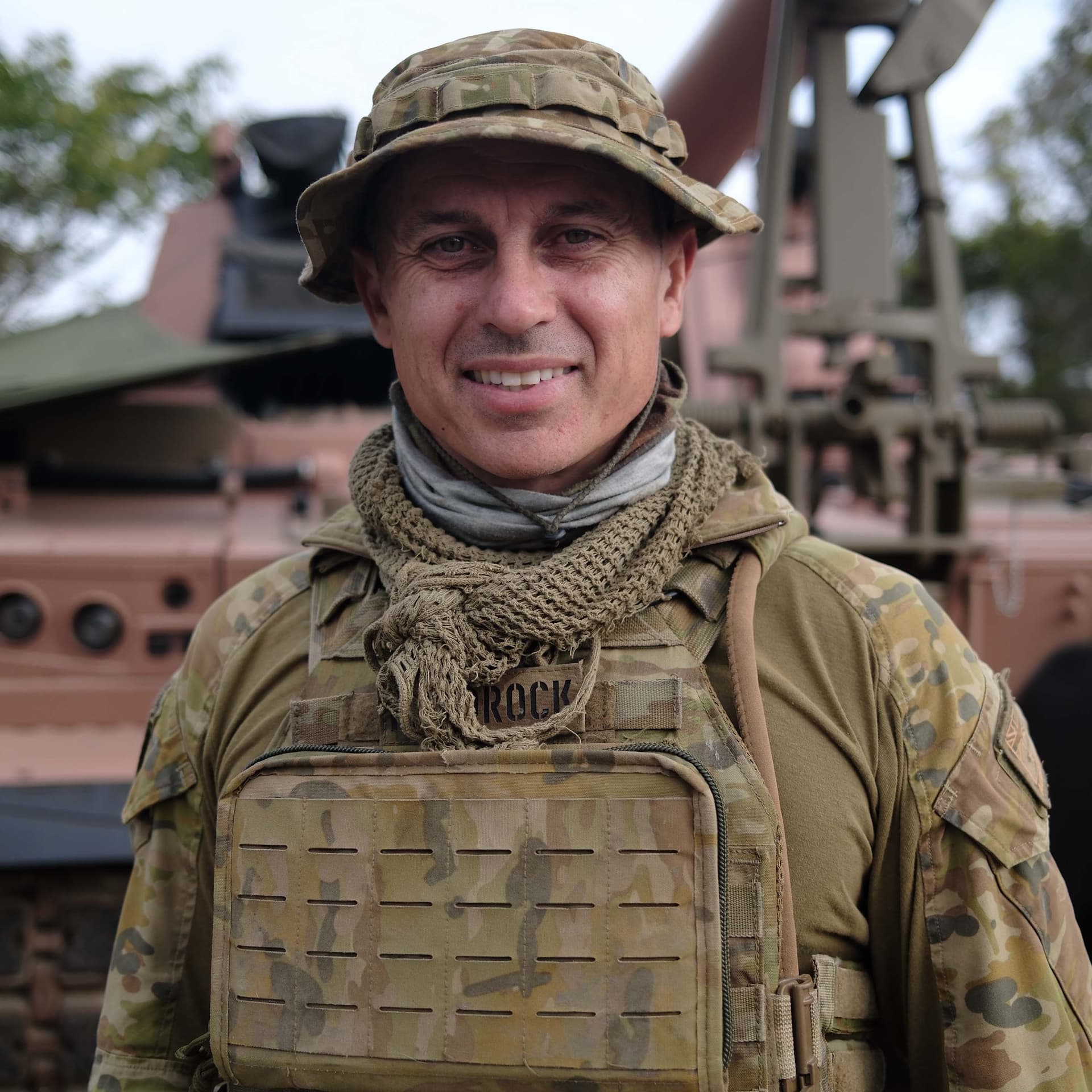
10:15We have to constantly retrain that as new Marines and sailors are coming through to make sure it never gets lost in translation. While standing next to a self-propelled artillery system, which to me looks just like a tank, we spoke to Australian Brigadier Ben McLennan. so you're not currently fighting war what war are you preparing for we're rehearsing for a war and the worst type of war you know a world war ii like war a world war one type war a total war of course we prepare for all sorts of other potential contingencies that our nation might require of us but ultimately a nation like australia maintains its military to fight wars or to be prepared to fight them.
10:57Thankfully and hopefully, we will never have to fight one. But in the meantime, we need to be prepared to do so. But the fact that this is, as you said, the first ever, it's a big piece of kit, a dangerous piece of kit, is there a sense that that threat is more urgent than ever? I think we live in a volatile world and perhaps a world that is more volatile than it has been since the end of World War II. So recapitalising an army and training an army to be prepared to fight a war that is potentially more likely than it has been previously, I think that's very important for a nation like Australia to have.
11:37There's constant discussion here in Australia about the role of China, so it's a really important trading partner. There's a huge influence, but there's also the military threat that's hovering, concerns when China does something that makes Australia nervous. How do you see that, obviously as a military man, the relationship that Australia now enjoys with China? As a military person, my role is to command this brigade while I'm in this appointment to be ready to do what our nation requires of us, irrespective of the context or the actors involved. and we are recapitalising our army with platformers like you have behind you, the most sophisticated artillery system in the world, but also coming into this brigade, the most sophisticated armoured breaching vehicles, tanks, the Apaches that have just come in to the airport.
12:29It's important for me to make sure that we are very, very focused on achieving our mission of preparing in every respect for war. Ideally, to avoid it, but if it is required, to be able to fight and win it.
12:48As you can hear, the war scenario is well underway. You can hear snipers, there's artillery. There's a huge valley in front of me, absolutely stunning, and it's now just filled with grey smoke. You can see tanks, there are tanks down there. At the bottom of the valley you can see flashes of light just before they launched the artillery. Now the whole valley, you can hear the echoes across this massive space here in remote North Queensland.
13:26So nobody here will identify a wall that they're particularly focused on, but it's pretty easy to guess who a potential enemy may be. Australia is in the Pacific region. The growing influence of China has put Australia in the middle of this geopolitical contest. For decades, the US has offered security to Australia and this concern about a future military threat from China has brought that cooperation together. Over the next few days, we'll have Australian troops, US troops, Japanese troops all working together in this exact war scenario, trying to understand how each of those foreign troops operate, the differences, the commonalities, because the idea is that if the region allies can work together, they're much stronger in the event of any future threat.
14:32Dr Marina Yue Zhang is an associate professor at the University of Technology, Sydney. We met her on campus to get her perspective on the increasingly complex relationship between China and Australia and on the forces shaping it. This balance of kind of military alignment with the US and economic alignment with China, do you think that's going to continue? And do you think there will be this kind of debate about which side where the allegiances lie? I think that's ongoing balance Australia has to work on. It's getting harder and harder to maintain, but Australia has to do it. And we know in a democratic country, you have to look after the majority's interests.
15:18The US is really doing something dramatic, which it has been doing for sometime. And more and more people in Australia, I think globally, they have realised this. Is this the big brother we can all trust? This last year, so 2025, it started, there was a tense moment with Chinese naval fleet conducting those live fire drills in the Tasman Sea. And then you also had this kind of debate about Australia's security. Do you think there will ever be a time that Australia can trust Beijing's military, given the size of it? Nobody can say for certain for anything at this type of geopolitical situation.
16:09And Beijing, again, I guess, even as an authoritarian regime, policymakers, they have to look after their people. They have to take into consideration public reactions. I mean, last year actually was quite a typical example because I read Chinese. Obviously, I'm getting on Chinese online, social media. And some of them is sort of public vent. You put a lot of your anger, especially when China is dealing with sanctions, accusations globally. it's quite often the public has this kind of mentality that why can't we just show our aggression and show our weapons, show our muscles and is that really the political or military intention?
17:07I don't think so. Last year when the Chinese big ship coming to our sea, our waters It was very much like, you know, we just show you we have this. Whether we will use it is a different matter. But we show our muscles. I would say that's almost like, you know, the bottom-up public demand for China being, you know, we have to show our muscles. You're listening to stories from the New Silk Road, the frenemy from the documentary on the BBC World Service.
18:10www.smart.com way. Visit schwab.com to learn more. Support comes from Wise, the smart way to manage the currencies you need around the globe. Fed up with losing out to hidden fees when you send money abroad with your everyday bank? Choose the smart way. Wise. You can count on the exchange rate you'd usually find on Google. No unwelcome surprises. Plus, ditch that where's my money feeling. Most transfers arrive in under 20 seconds. Join millions, saving billions on hidden fees. Be smart. Get wise. Download the Wise app today. T's and C's apply.
18:49This battery is, they call it a blight battery. Ron Barker proudly shows us his Chinese-made pickup truck, or ute, as they're called here. Two screens, yes. Ron is a local businessman and entrepreneur from Townsville who's been working with Chinese companies for decades. How do you see the relationship with China and Australia? How has it evolved in that time? Well, I've spent a lot of time in China because of the business in the Middle East and also my company here in Townsville. We used to buy a lot of product from China, from the old company. I will tell you something. Probably 15 years ago, I retired the first time.
19:30I bought a batch of golf carts from America to sell them at a golf estate I was living at and then I bought this bridal wedding car like a convertible from China the welding on the axle snapped in no time I'd had it for about a week I've got to tell you right now that in that 15 years the production coming from China is just like Japan was 25 years ago superb because of these cars. Everything is well finished. Everything's well made. But there is that unease politically, militarily. We're in Townsville where there's bases, there's US troops who come through to do training exercises. How do you see that dynamic?
20:13My take is that we'd probably be better off if China come and took us over. We are the most unstable bloody country for all this stuff that's going on with this woke society we have? That doesn't happen in China. Nothing like that happens in China. You know exactly what's happening tomorrow in China. Today you haven't got a clue. Australia can't do without China. Every industry in Australia is too embedded. I just wish we would revisit our manufacturing industry and go back 30 or 40 years like it was. Does that leave Australia vulnerable? Should it pay more attention to building that relationship outside of trade with China?
20:55No, I don't think so. Look, Australia is such a small country. If China wanted us, they would have taken us five years ago. They could just walk in and do it. They are a superpower now, and the stuff that they build is incredible. Turn left into the car park, then slide left to stay on Boundary Street. We're arriving at Townsville Chinese Club, and we're in a suburb of Townsville, and we're just about to meet Michael, who's part of the club, and he says he's going to introduce us to a few people who play Mahjong, which is a tile game of strategy, very common among the Chinese community. Can you play?
21:42I can't play, but I can stack. When we examine the rise of modern China and its impact on nations like Australia, it's sometimes easy to forget that there was the old China. And in many countries, including Australia, the connection with old China goes back a long time. In Townsville, Queensland, the first Chinese settlement can be traced to the 1860s, driven by a well-known gold rush of the era, and more recently when Hong Kong was handed back to China in 1997. I went to meet schoolteacher Michael Koo at the Townsville Chinese Club. I'm a Chinese-Australian. I was born in Hong Kong. And then I came when I was around about seven years old.
22:21Then I just followed my parents coming up here to Australia. My father was an East Timor Hacker. And my mum's Hong Kong as well. So it was during that time, during 1994, I arrived in Australia. because that was that kind of the political upheaval at that time that, oh, you know, China's going to take over, et cetera, et cetera. And everyone was very, very scared. And mum just tells me, you know, yeah, the Chinese communism is not good, et cetera, et cetera, so we need to move to a better country like Australia. And during that time, a lot of our relatives moved to America, Canada and elsewhere as well.
22:59That brought us here to Australia and then met, you know, dad's family, family and relatives and yeah then I started to become Australian. And culturally kind of or politically I mean what kind of discussions happen in that in the club? We try to avoid a lot of political agendas because we know that they come to Australia to avoid that kind of political tension as well as that kind of you know that sensitivity as well because they knew that you In China, it's just pretty much, excuse my French, I mean, it's brainwashing. It's brainwashing because communism is very similar to that. Without talking more political aspects there, it's that they want to come in here to just be with the community and start fresh.
23:57The Australian cattle industry generates billions of dollars for the economy every year. My name's Adam Armstrong. I'm a producer from Queensland, Australia. In such a thriving global market, it's necessary to build relationships with both American and Chinese businesses. In fact, China currently has an insatiable demand for beef as the world's biggest importer. As a cattle producer who obviously has had a lot to do with trade with China, how do you see that relationship? Look, at times it's often fraught. The Chinese market is a very, very interesting one. It's an essential market for Australia, not only for cattle, but for all sorts of primary products that we produce.
24:40I think fraught is a safe word to use. It's very, very good at times, but it can be very punishing at other times. So like now, right now you've got tariffs being slapped on beef. China slapped 55 % tariffs on beef back in June after setting a lower than usual quota for 2026 to protect its own domestic market. That's despite a free trade agreement between the two countries. And that came in with very little warning and was very surprising. So do you feel like China is your boss? I think they would like to be. But we as an industry have a lot of other very important markets. So Australia plays this kind of dance between the US is a big security partner.
25:21China is clearly the trading partner. but you obviously have relationships with the two as well. Is that a fraught triangle? The relationship with the US from a beef industry perspective is very, very long standing. China has not been on the scene very long at all. Ten years ago, China as a market for Australian beef was almost non-existent. We're very grateful for China entering the market and being very active to the point it would be the top four destinations for Australian beef at the moment. Three, four years ago, it was the top destination. It came as a bit of a surprise, no, the rapid growth of China.
26:00Would you have imagined when you started your career how important China is now to your grip? Absolutely not, Katie. I remember walking across the land border from Macau into Zhuhai City in about 92, 93, and this was before China opened up. And literally, as you know, as someone who grew up in Hong Kong, the Han Chinese are the Eastern Chinese people, but when you walked across that land border, you stepped back 50 years, it was unbelievable. Whereas you go back to China now, they've caught up 50 years in 10. It's amazing. You talk about this fraught relationship, but is this something that you admire in their business sense?
26:44Oh, look, they're some of the toughest, and I say that with affection, if you like, counterparts you'll ever do business with. They know what they want. And, you know, I actually quite respect that. They are not the enemy. They have their own interests and they will pursue their own interests above all else. We just need to make sure that we do the same and we don't let them get too powerful that we can't actually stand up for ourselves. There has to be balance simple as that. With Australia caught between two superpowers, every exchange between their leaders carries weight. And in Beijing in 2026, when Xi Jinping met Donald Trump, the Chinese president invoked the idea of the Thucydides trap, the theory that conflict can become almost inevitable when a rising power challenges an established one.
Read the full transcript
27:31Final word to Marina Zhang from the University of Technology, Sydney. For Xi to say that, actually, I think that's a bit interesting. If not the transition of great powers, it's at least power struggles of great powers. And China is judging its position. So it's a power transition. Historically, the Harvard scholar, Allison, he tracked 40-some power transitions historically, and most ended up in war. So if we are at the time of power transition, can we avoid war?
28:15I'm Katie Watson, and the producer is Pete Shevlin. Stories from the new Silk Road, The Frenemy, is a Pod 60 production for the BBC World Service.
From the publisher
Katy Watson highlights Australia’s complex, turbulent and evolving relationship with their number one trading partner - China. Having signed a free trade agreement eleven years ago, in recent years there has been a marked shift in relations, with Canberra balancing its security dependence on Washington with its economic reliance on Beijing. From businesses, diplomats and military personnel, Katy Watson asks if China is Australia’s enemy or friend? Or as some critics suggest, are they a ‘frenemy’?